4
Applause and Advice


As theatre performers, you are putting all your effort (backstage and on stage) to make sure that the audience is happy. But as you perform, you also have certain expectations from the audience. Don’t you? Some basic behaviour and understanding of the hard work you have put, along with some applause and support after the show.
As you have been told in the previous grades that watching performances makes you a better performer, it is now important for you to understand the responsibility and duty of being a good member of the audience — for any performing art.
Being a good audience for the performing arts When you sit among the audience, you are just as important as the actors on stage! Your duty is to —
- Watch and listen respectfully, giving full attention to the performance.
- It is important not to talk, fidget or use phones.
- Small distractions from you can disturb the actors and the other audience.
- Applauding at the right time, reacting kindly and appreciating the effort of the performers.
- Being a good audience for the arts
- Review writing
The above list has very simple requirements on what is to be done (applaud, appreciate, congratulate, offer help), and what is not to be done (disrespect the performers and distract anyone with your actions). This very spirit is reflected in the 27th chapter of the Nāṭyaśhāstra, that talks about the success of a performance. The third stanza speaks about how the appreciation must be communicated to the performers —
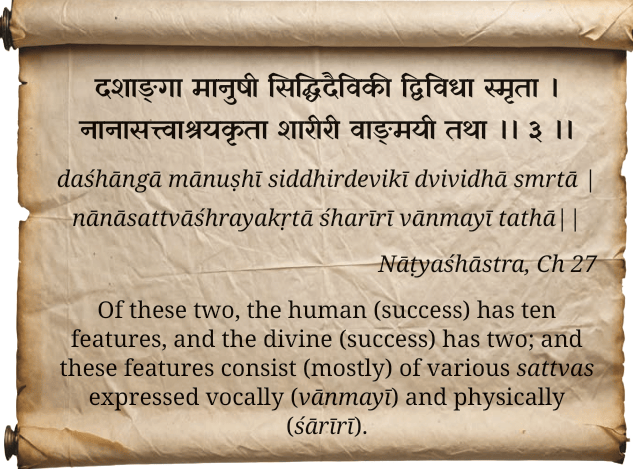
It mentions that the expression of success can be in two ways —
- Vocally — through words — speech, exclamations and writing.
- Physical body — through actions — clapping, standing up after the show for respect and giving gifts.
In this chapter, we shall look at how you can use the first option — write about the performance and be a good audience to the arts. The process of writing a performance for the others to read, and understand the elements and spirit of the show is called a ‘review’. As the word itself, it should be so well-written that the reader should feel like it is being viewed again. You review the show! Let us look at the technical definition of a review, which is not limited to performances alone. Reviews are done for books, products, paintings, projects and even sports along with movies, music, drama and dance concerts.

Reviewing is the process of thoughtfully observing, reflecting and giving feedback on a performance, product or experience. It involves looking closely at what worked well, what could be improved and how effectively the goal was achieved. Good reviewing is not just about finding faults. It is about appreciating strengths, noticing details, and offering suggestions. It sharpens critical thinking and helps everyone to improve.
Reviewing in theatre is a special skill where you not only watch a play but also pay attention to how well the actors perform, how the story is told, use of voice, movement, costumes, lighting and even sets. It is not about criticising. It is about celebrating what made the performance powerful and suggesting how it could connect more deeply with the audience. Theatre reviewing trains you to be a careful observer, a sensitive listener and a respectful communicator.
There are three types of reviews —
-
Self-review —
When the creators themselves examine the art and check for ways to improve before presenting it to the audience. -
Peer review —
Contemporaries in the field provide suggestions, either before or after the show. -
Critical review —
It is obtained from everyone after the show, which includes a detailed analysis of all the aspects of the performance, including the scope for improvement, strengths and weaknesses.
Let us start reviewing!
Being a reviewer does not mean you can just go and sit in the audience. It is your responsibility to prepare for it!
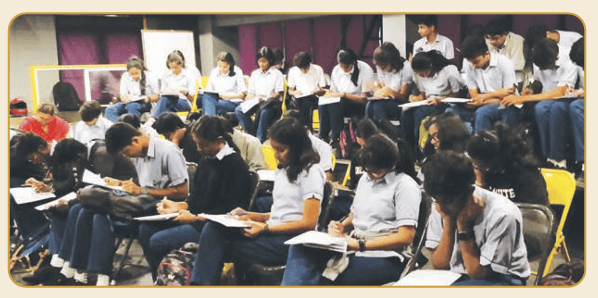 As theatre students, you not only do theatre but
also watch plays. You learn more by watching. Any
language of any genre. Watch a play whenever
possible. Request your teachers to plan field trips
from school to watch plays together. You can also
watch plays with your family and friends, as a fun
activity. Make sure you write a review for every
performance you watch. The steps given in this
chapter will help you.
As theatre students, you not only do theatre but
also watch plays. You learn more by watching. Any
language of any genre. Watch a play whenever
possible. Request your teachers to plan field trips
from school to watch plays together. You can also
watch plays with your family and friends, as a fun
activity. Make sure you write a review for every
performance you watch. The steps given in this
chapter will help you.
- Research the Play
- Find out the name of the play, playwright and the basic plot (without spoiling it!).
- Understand the time period or setting, if it is famous or historical.
- Know the Genre
- Is it a comedy, tragedy, musical, historical drama, or a modern play? This helps you watch with the right mindset.
- Find out about the Theatre Team that is
Performing
- Find out about the group performing — are they professionals, students or a community group? It helps in understanding their point of view.
- Keep a Journal
- Carry a small notebook to quickly jot down thoughts during or right after the show.
- Your Mindset
- Go with an open mind — be ready to enjoy and observe.
- A reviewer must be honest but also fair and respectful. Holding a bias towards the team or an actor will not make the review honest.
- Revise What You Intend to Observe
- Acting — Was it believable and emotional?
- Set design — Did the stage support the story?
- Costumes — Did they match the time and character?
- Lights and Sound — Did they add to the mood?
- Story — Was it clear, engaging or confusing?
- Flow — Is there a smooth flow from one scene to another? Are the entries and exits smooth within a scene?
- Errors that were visibly evident — How were they handled?
- Have No Expectations
- Every production is different. Donʼt expect it to be exactly like a movie or a previous version you may have seen
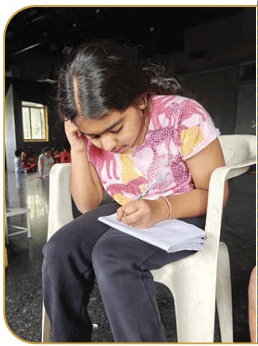
Writing a review
You have watched the performance, made key points in your notepad and have a lot more points in your mind, waiting to be expressed. But there are some points to keep in mind before you do.

- Donʼt be mean or personal —Critique the performance, not the person. Never insult an actor, director or team.
- No spoilers — If the story depends on a surprise, donʼt ruin it for others.
- Avoid using single phrases like ‘it was not bad’ — Explain why you thought it was good or needed improvement. Justify your opinions.
- Have a balance of positives and negatives — Even if you didn’t enjoy the play, find and mention something positive too. The main purpose is to help the team or individuals improve and do better.
- Neither too long nor too short — Find the balance — detailed but easy to read. Around 300 words is good for beginners.
Now, how do you write it?
With all these points in mind, you can start writing. Though you can make it creative in your presentation, such that it reflects your unique style, following a structure will help put things in order and also making it easy for the readers.
CIRCLE TIME
- What did you learn about being a performer after understanding the review process?
- Is it easy to review your own work or the work of others? Which is more important?
- Are you able to accept reviews from others
as fairly as you give your reviews to others?
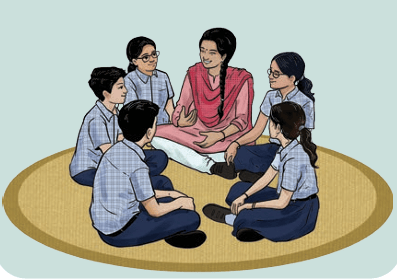
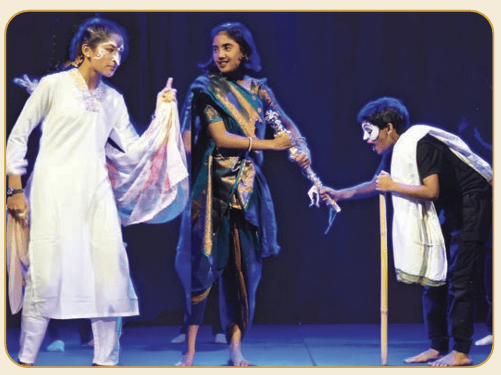
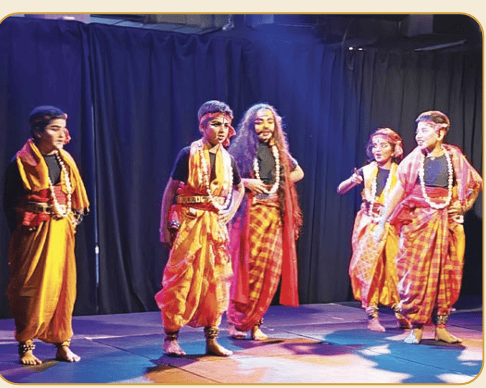
Look at the pictures and write a small review based on your understanding.
- What is the genre of the play?
- What is the scene being enacted? Observe each actor and their action. You can guess and write creatively a few possible dialogues.
- Your opinion on the lighting, costumes, make-up and props?
------------------------------------------------------------------------
------------------------------------------------------------------------
------------------------------------------------------------------------
------------------------------------------------------------------------
------------------------------------------------------------------------
ASSESSMENT
CHAPTER 4: APPLAUSE AND ADVICE
Competencies
- C-3.2 Refines ideas and techniques from the stage of planning to the final presentation in drama for external audiences, and reviews the entire process
- C-4.2 Describes the life and work of a few theatre artists and performers in their region, and across India
| CG. | C. | Learning Outcomes | Teacher | Self |
|---|---|---|---|---|
| 3 | 3.2 | Able to understand the stages of a production in the process of reviewing | ||
| 3 | 3.2 | Works towards refining one’s review, based on the steps suggested | ||
| 4 | 4.2 | Reads professional reviews to understand the role of a critic | ||
| 4 | 4.2 | Describes life and works of theatre critics in English and local languages | ||
| Overall participation in class |
Teacher’s Comments and Student’s Observations
----------------------------------------------------------------------------------------
----------------------------------------------------------------------------------------