NOTE TO THE TEACHERS
The students must have noticed that music is an integral part of our lives, alive in almost every activity we undertake. They surely feel that musical traditions which have prevailed in our country deeply enrich their lives. They realise how people naturally turn to songs to express themselves during important moments. Hence, it’s time to let them explore further.
When they listen to a composition or learn a song, let them delve into its various aspects: theme, author, beauty of the words or lyrical beauty, different tunes, and rhythmic patterns that form a song. Point them towards the diverse voices of singers. There is so much more to discover. With your motivation they will uncover the vibrant, enchanting world of swara, laya and shabd, that surrounds and captivates us all.
Along with the lessons, the assessments should be scientific, rational and systematic. So, follow the guidelines for Formative Assessments given at the end of each chapter, which should be conducted in a relaxed and engaged manner, and mainly through observation in the classroom. The suggestions for Summative Assessments are provided at the end of the music section. The competencies required for this stage are given below. The main aim of assessments is to see whether students are able to reach the competencies laid out or whether more support is needed. Give students qualitative feedback at regular intervals to help them develop further.
| CG1 Develops openness to explore and express themselves through various art forms. |
C-1.1 Expresses confidently their personal and everyday life experiences through a variety of musical activities. C-1.2 Demonstrates flexibility in the process of collaboratively developing music practices. |
| CG2 Applies their imagination and creativity to explore alternative ideas through the arts |
C-2.1 Creates, and performs songs and musical compositions that challenge stereotypes observed in their surroundings (such as, gender roles). C-2.2 Connects elements of music (lyrics, raagas, rhythms, volume, tempo and patterns) with personal experiences, emotions and imaginations. |
| CG3 Understands and applies artistic elements, processes and techniques. |
C-3.1 Demonstrates stage etiquette and, care for musical instruments, and makes informed choices while using resources and techniques in music. C-3.2 Refines ideas and methods of musical expression from the stage of planning to the final performance and reviews the entire process. |
| CG4 Acquaints themselves with a range of aesthetic sensibilities in regional arts and cultural practices. |
C-4.1 Demonstrates familiarity with various local and regional forms of music. C-4.2 Describes the life and works of a few local musicians and performers in their region, and across India. |
5
Discovering the Elements of Music


INTRODUCTION
Welcome back, students! When we listen to a piece of music or sing a song, we observe that it is made of constituent elements.
Some of the main elements of music are — melody (raga), rhythm (tala) and lyrics (sahitya). In this chapter, we will discover further aspects of rhythm, melody and lyrics, and observe how they come together when we sing a song.
Vocal Exercises
Here are some exercises to help develop your voice in different ways.
Mandra Saptak Practice
SS Ṇ S
S Ṇ Ḍ Ṇ S
S Ṇ Ḍ P Ḍ Ṇ S
S Ṇ Ḍ P Ṃ P Ḍ Ṇ S
Do you notice a pattern here?
Can you create a similar pattern to extend your range in the higher register (tara saptak)?
These vocal exercises help you develop flexibility in your voice. Sing them slowly and increase the tempo of practice as you get comfortable.
Sargam in Teentala
| S R S G | R G M G | S G R G | S R G M |
| R G R M | G M P M | R M G M | R G M P |
| G M G P | M P D P | G P M P | G M P D |
| M P M D | P D N D | M D P D | M P D N |
| P D P N | D N S N | P N D N | P D N Ṡ |
| x | 2 | 0 | 3 |
| Ṡ N Ṡ D | N D P D | Ṡ D N D | Ṡ N D P |
| N D N P | D P M P | N P D P | N D P M |
| D P D M | P M G M | D M P M | D P M G |
| P M P G | M G R G | P G M G | P M G R |
| M G M R | G R S R | M R G R | M G R S |
| x | 2 | 0 | 3 |
- First sing the lines together as a group.
- Then divide into two groups, with each group singing one part (simultaneously).
Try singing this in two groups at the same time:
Warmup in thirds
| Group 1 | SRG DNṠ | RGM PDN | GMP MPD | MPD GMP | PDN RGM | DNṠ SRG |
| Group 2 | GMP SRG | MPD NSR | PDN DNS | DNS PDN | NSR MPD | SRG GMP |
Harmony
Different notes can be sung at the same time to
produce a pleasant effect. This is called harmony.
Singing in harmony is a wonderful example of collaboration. Playing a duet or a jugalbandi is another example. Can you think of how you can carry forward these principles of harmonious collaboration to other areas of your life?
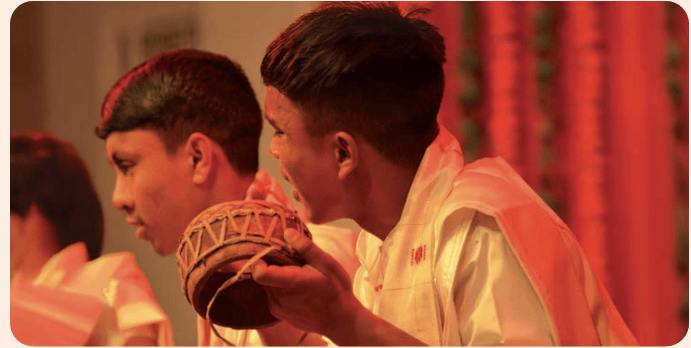
There are many verses in Sanskrit composed by various poets and philosophers. These verses are set in a particular metre or pattern. This is referred to as chhandas in Sanskrit. Thus, while Sanskrit verses are chanted as a devotional offering, they can also give us an understanding of rhythm.
Shloka and Chhand (Metre)
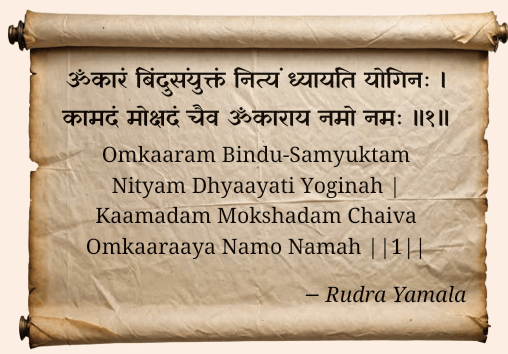
Here is a shloka which you can recite in ʻAnushtup Chhandʼ.
Meaning
(Salutations to him) Who resides in the spiritual heart centre as omkara, on whom the yogis constantly meditate.
Who grants all desires and also liberation to his devotees. Salutations to that Shiva, who is represented by syllable ‘Om’.
When you recite these verses a few times, you may observe that the syllables naturally follow a pattern of 4 which is also anushtup chhand.
You can even clap your hands while reciting, to understand the underlying rhythm pattern.
TALA, KONNAKKOL AND SWARAS
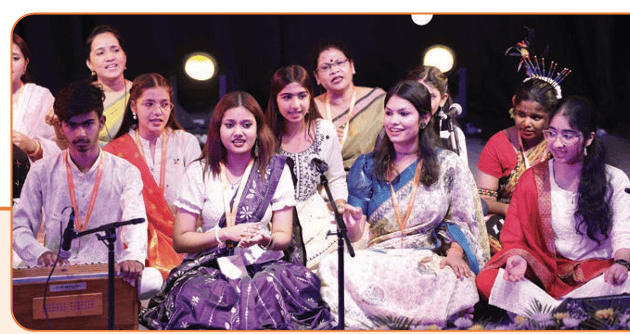
As you may remember, konnakkol is the rhythm language of Carnatic music. We have looked at some simple konnakkol patterns in the previous years, now let us learn to sing or recite a konnakkol phrase in adi tala.
1st speed: 1 count per beat
2nd speed: 2 counts per beat
3rd speed: 4 counts per beat
8 akshara phrase: ThaKaDhiMi ThaKaJhaNu (4 + 4 = 8 akshara)
| Beat 1 | Beat 2 | Beat 3 | Beat 4 | Beat 5 | Beat 6 | Beat 7 | Beat 8 | |
| Clap | Little finger | Ring finger | Middle finger | Clap | Wave | Clap | Wave | |
| 1st Speed | Tha | Ka | Dhi | Mi | Tha | Ka | Jha | Nu |
| 2nd Speed | ThaKa | DhiMi | ThaKa | JhaNu | ThaKa | DhiMi | ThaKa | JhaNu |
| 3rd Speed | ThaKaDhiMi | ThaKaJhaNu | ThaKaDhiMi | ThaKaJhaNu | ThaKaDhiMi | ThaKaJhaNu | ThaKaDhiMi | ThaKaJhaNu |
Observe the proportionate change in total number of syllables each time the speed changes. Can you relate this to a mathematical concept? Discuss.
Now, let us repeat the same exercise, but instead of using konnakkol patterns, we will use swaras.
| Beat 1 | Beat 2 | Beat 3 | Beat 4 | Beat 5 | Beat 6 | Beat 7 | Beat 8 | |
| Clap | Little Finger | Ring Finger | Middle Finger | Clap | Wave | Clap | Wave | |
| 1st Speed | S | R | G | M | P | D | N | S |
| 2nd Speed | SR | GM | PD | NS | SN | DP | MG | RS |
| 3rd Speed | S R G M | P D N Ṡ | Ṡ N D P | M G R S | S R G M | P D N Ṡ | Ṡ N D P | M G R S |
Similarly, can you make your own patterns in adi tala using swaras?
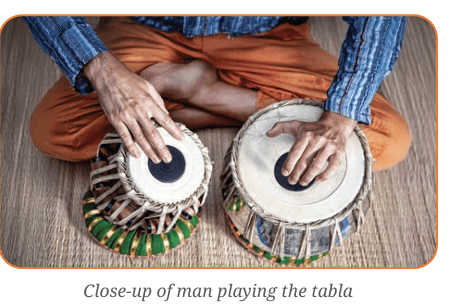
TABLA PATTERNS IN HINDUSTANI MUSIC
Many stalwarts have created beautiful patterns in Talas including Paran, Chakradhaar, Uthaan, Fard, and Palta.
First, let us recollect the bols of Ektaal, and then recite the Paran given on the next page.
| Matras | 1 2 | 3 4 | 5 6 | 7 8 | 9 10 | 11 12 |
| Bol/Syllable | Dhin Dhin | Dhage Tirakita | Tu Naa | Kat Taa | Dhage Tirakita | Dhin Naa |
| Paran bols | Jayatijayati Jaya | Maatu Saraswati | Chamcham Chandra | Mukut Sohat Ati | Karbandhe Sur | Vinay Karatley |
| Mridang Dhaage | Dhagedigan Dhaa | Veena paani | Dhaare Veena | Paani Dhare | Veenapaani Dhaare | |
| Signs | x | 0 | 2 | 0 | 3 | 4 |
When reciting bols, follow these patterns:
- Ek gun — 1 bol per beat
- Dugun — 2 bols per beat
- Tigun — 3 bols per beat
- Chaugun — 4 bols per beat
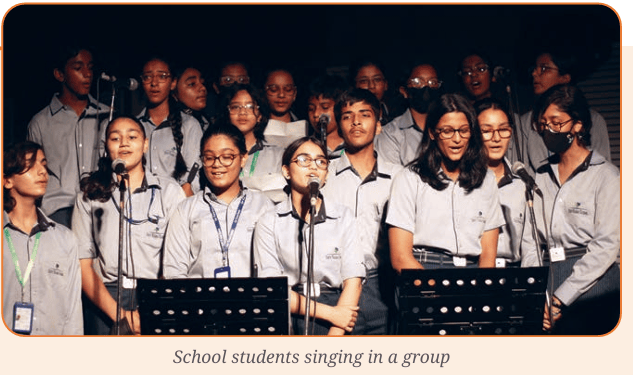
- Learn any song.
- Form groups of 15 – 20 students.
- Assign roles to each team member.
Some possible roles —
- Conductor: the one who ensures the whole performance is synchronised
- Lead singer
- Chorus singers
- Instrument players
- Providing support by clapping or body percussion
- Now, work together to ensure that each team member has a clearly defined role and is aware of it.
- Rehearse the song multiple times.
- Present it before the class.
- You can also repeat the activity by shuffling the roles.
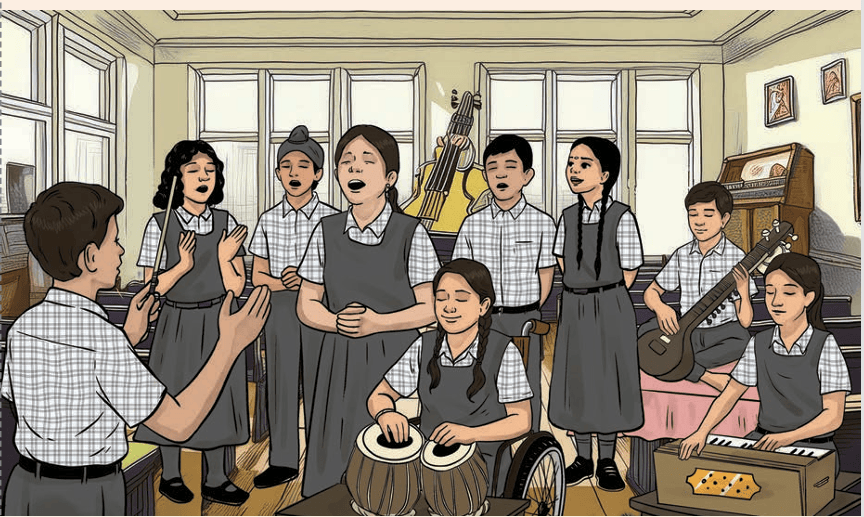
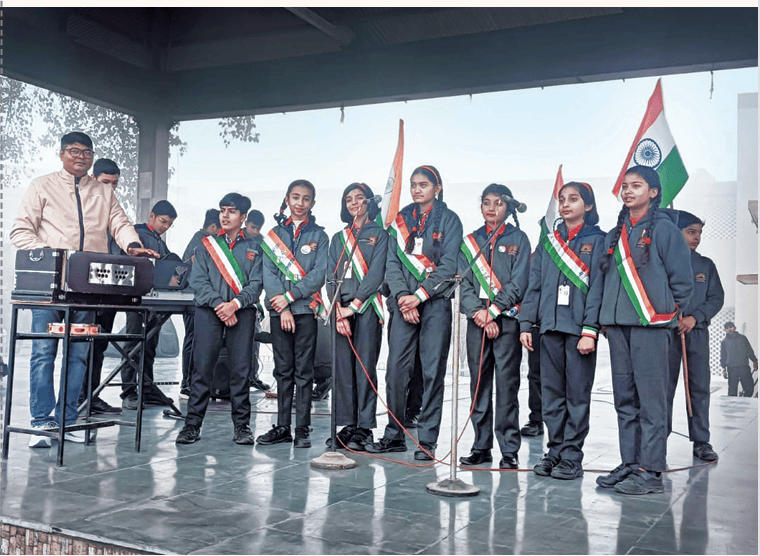
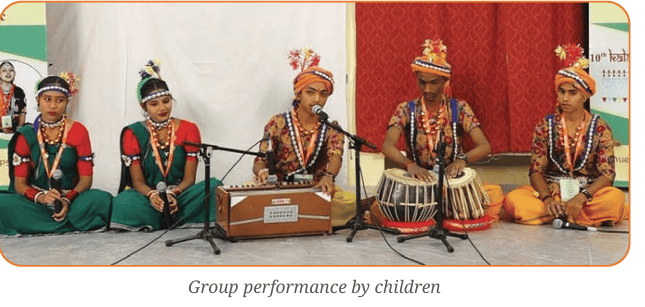
A music ensemble or band is like a team with many different roles. Some members will be lead singers, others will be in the chorus. Some will play particular instruments. However, it is important to realise that each member of the team is important for a successful performance.
PATRIOTIC SONG
Jayati Jayati Bharata Mata
Bharatam, Jayati Jaya Jaya Mama Bharatam, Mama Bharatam Jayati Jaya Jaya, Jayati Jaya Jaya, Jayati Jaya Mama Bharatam, Mama Bharatam Ho teri jaya, jaya teri jaya, Teri Jaya mama bharatam (3)
Devbhoome namoh namah, Vedbhoomeh namoh namah, tyaagbhoomey namoh namah Matribhoomey namoh namah, Gungaan teraa namoh namah, karoon gaan teraa namo namah shatta baar teraa namo namah, samman teraa namo namah, namo namah (3) Jayati jaya jaya, Jayati jaya jaya ...
Terey ang ang bharey rang rang, naari shakti kay sung sung sanskriti, udyog, shiksha, kridaa, arogya, samriddhi kaa ley beeda Urjaa, krishi ko ley karkey sung, harit kraanti bhar daaley rung vikaas path par datey hooe, unnat unnat jeeney kaa dhang Hongey anathak sab prayas, naa rukengey baaromaas swarnim bharat meri maa, hum phir tumhey banayengey Vishwa guru kaa taaj terey maathey pey sajayengay, sajayengay Jayati jaya jaya, Jayati jaya jaya ... jaya, jaya jaya jaya jaya jaya, Jayati jaya ... Jayati jaya jaya Mama Bharatam ...
Credit: Sangeet Natak Akademi
ASSESSMENT
CHAPTER 5: Discovering the Elements of Music
| CG. | C. | Learning Outcomes | Teacher | Self |
|---|---|---|---|---|
| 1 | 1.1 | Understands the concepts of rhythm and metre, and is able to recite konnakkol, shlokas and bols | ||
| 1 | 1.2 | Can sing a patriotic or folk song individually or in a group | ||
| 1 | 1.2 | Is able to sing note patterns in harmony. |
Teacher’s Comments and Student’s Observations
----------------------------------------------------------------------------------------
----------------------------------------------------------------------------------------
----------------------------------------------------------------------------------------
----------------------------------------------------------------------------------------