7
Indian Classical Music


CARNATIC MUSIC
There are seven main talas in Carnatic music. They are:
- Dhruva
- Mattya
- Rupaka
- Jhampa
- Triputa
- Ata
- Eka
The three main parts or angas that make up a tala are:
- Laghu (clap and finger counts): notated I
- Drutam (clap and wave): notated as O
- Anudrutam (beat): notated as U
Note:
There can be different numbers of beats in a laghu, which is known as jathi. Also, not all talas have all angas.
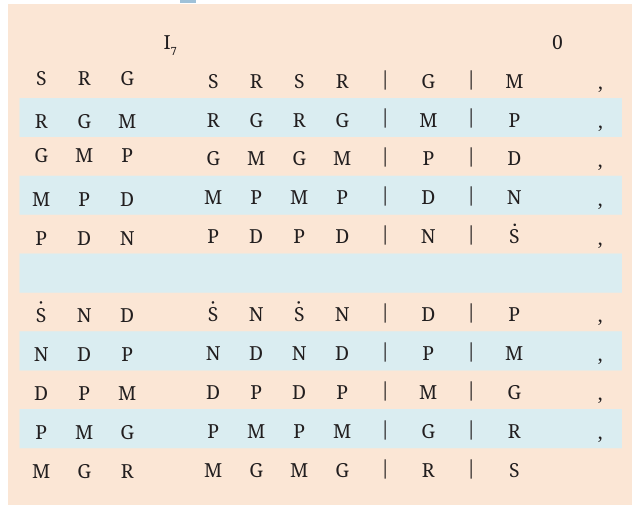
An important set of vocal exercises to build vocal strength and understand talas is the sapta-tala alankaras, three of which were introduced in Grade 7. In Grade 8, we will learn to sing and keep tala for the remaining four —
Mishra Jathi Jhampa Talam Alankaram
I7 U 0 = 7 + 1 + 2 = 10 Beats
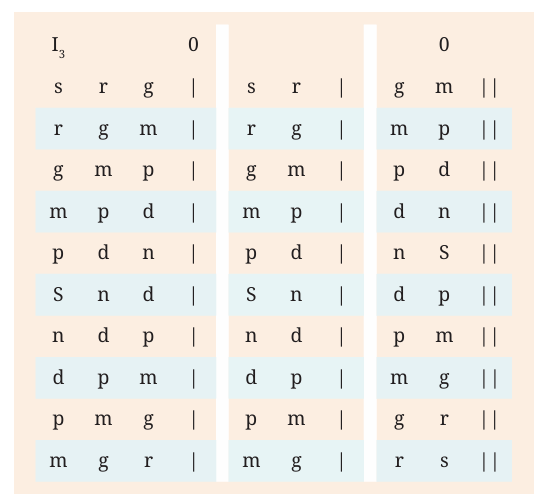
Thrisra Jathi Triputa Talam Alankaram
I3 0 0 = 3 + 2 + 2 = 7 Beats
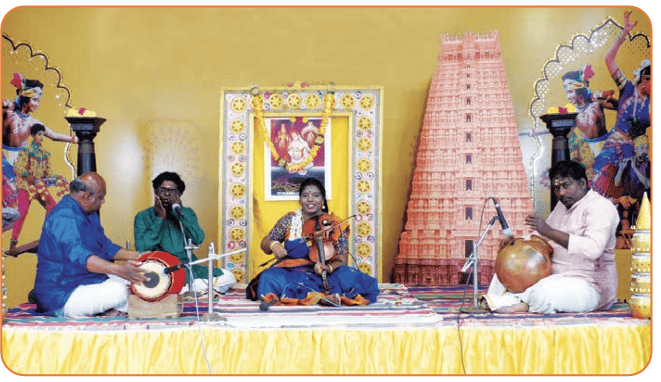 An ensemble of (L-R) — mridangam, morsing, violin and ghatam
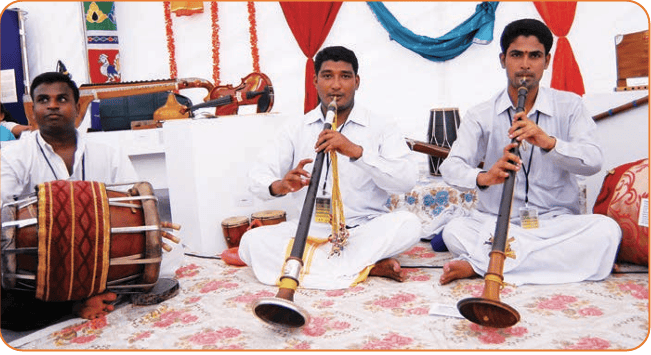 Artists playing the nadaswaram — a double reed wind instrument
from South India
Artists playing the nadaswaram — a double reed wind instrument
from South India
Khanda Jathi Ata Talam Alankram
I5 I5 0 0 = 5 + 5 + 2 + 2 = 14 Beats
Chatushra Jathi Eka Talam
Alankaram: I4 = 4 Beats I4
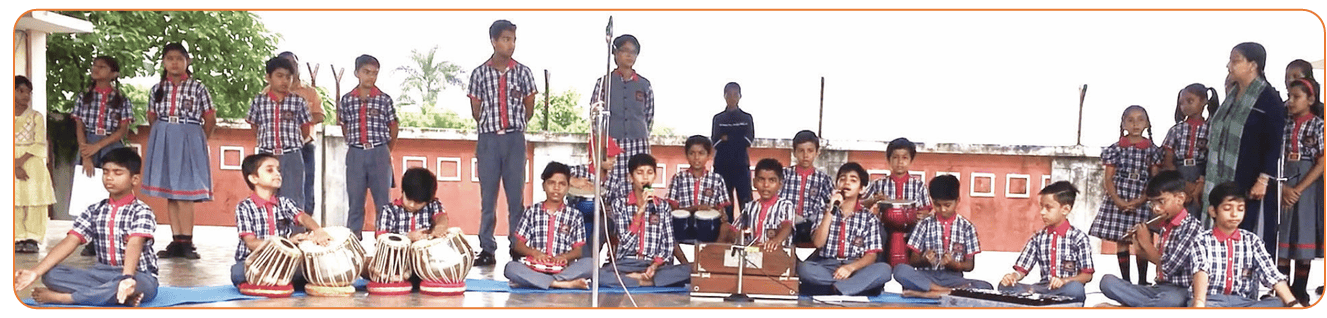 Students singing and playing instruments
SRI GANANATHAM BHAJARE
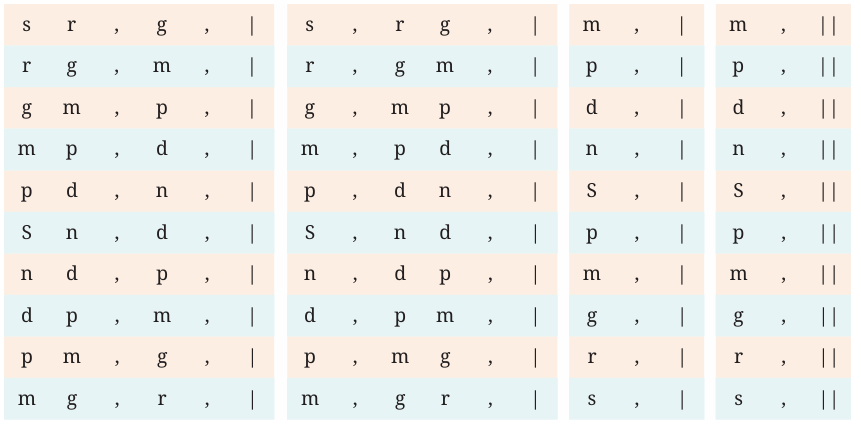
Before singing this song, sing the arohana and the avarohana. Try keeping the tala as you sing the composition. Rupaka tala is a rhythm cycle of 6 beats.:

Sri Gananathan Bhajare
| Ragam: Ishamanohari | Arohanam: S R2 G3 M1 P D2 N2 Ṥ |
| Talam: Rupaka | Avarohanam: Ṥ N2 D2 P M1 G3 M1 R2 S |
| TComposer: Muthuswami Dikshitar |
Pallavi




MaDhyama kalam




Anupallavi




Charanam




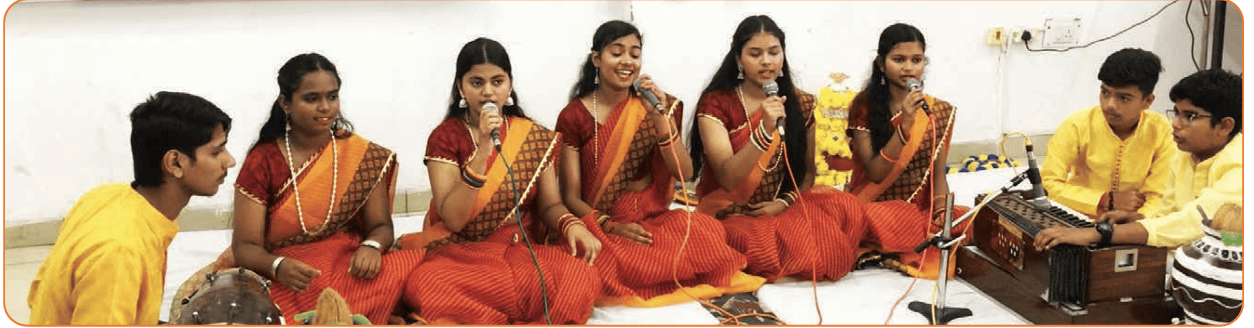 Students singing a group song
RAAG ASAVARI
This raga is originated from asavari thaat. In this raga, the notes — gandhar, dhaivat and nishad — are komal, and the remaining notes are shudh. Its vaadi note is ‘dhaivat’ and the samvaadi note is ‘gandhar’. The ‘gandhar’ and ‘nishad’ are missing notes in aroh (ascending order), due to which the jathi of this raga is audav-sampoorna. The singing time of this raga is the second quarter of the day. A raga similar to this is jaunpuri.
| Raag — | Asavari |
| Thaat — | Bhairavi |
| Aroh — | S, R, M P, D, Ṡ |
| Avroh — | Ṡ N D, P, M G, R, S |
| Pakad — | R, M, P, N D P |
| Varjit swar — | G, N, in aroha |
| Jathi-audav — | Sampoorn |
| Komal swar — | G, D, N, |
| Vadi swar — | Dhaivat |
| Samvadi swar — | Gandhar |
| Singing time— | 11.00 a.m. to 1.00 p.m |
Raag Asavari Lakshan Geet Teentala
Sthayi
Kanha mohe aasavari raga sunaye gani ko aarohan me chupaye
| S | R | M | R | M | P | D | P | D | G | R | S | R | N | D | P |
Antara
Dhaivat vadi g samvadi madhym sur grah nyas supanchmavrohan sang purn dikhavat
| S | R | M | R | M | P | D | P | D | G | R | S | R | N | D | P |
Accompaniment
Play a musical instrument you know to accompany one of the compositions you have learnt in this chapter.
Tempo changes
Sing any of the pieces from this chapter at a lower tempo, and then at a higher tempo. Explore how a change in tempo changes the mood.
HINDUSTANI MUSIC
Raga Asavari— Teentaal Lakshan Geet
 Matra
Bol Symbol
Matra
Bol Symbol
Sthayi
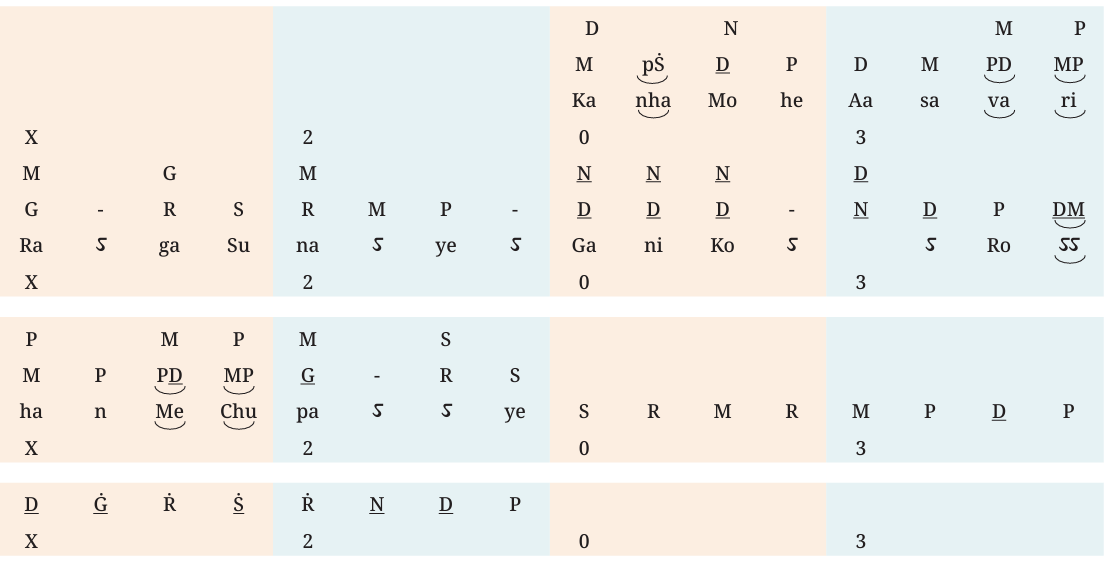
Antara
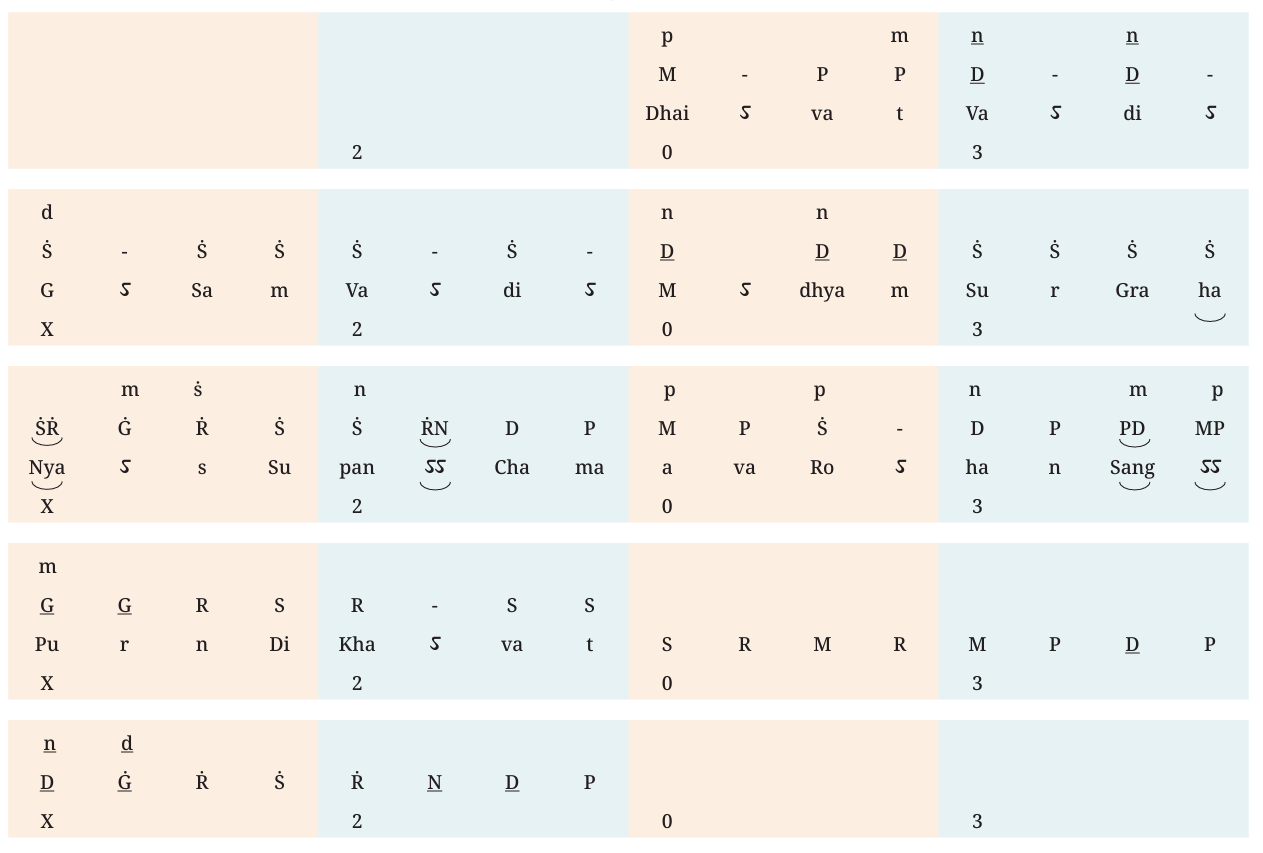
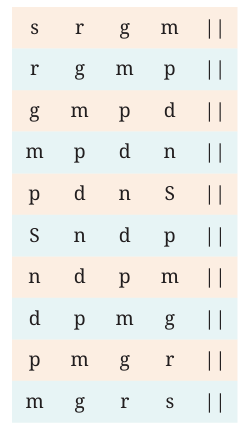
Raga Asavari, Jhaptal— Sargam Geet

Sthayi

Antara

Note to the Teacher:
Have you listened to the programme Sangita Sarita? Listen to it and you will get multiple ideas of how music is connected with different aspects of life. Try listening to music related to the above ragas through concert, your acquaintances, or any other internet resource. As you hear ragas performed by different artists, you will be able to understand the depth in each ragas.

BHAKTI SANGEET AND SUFI QAWWALI
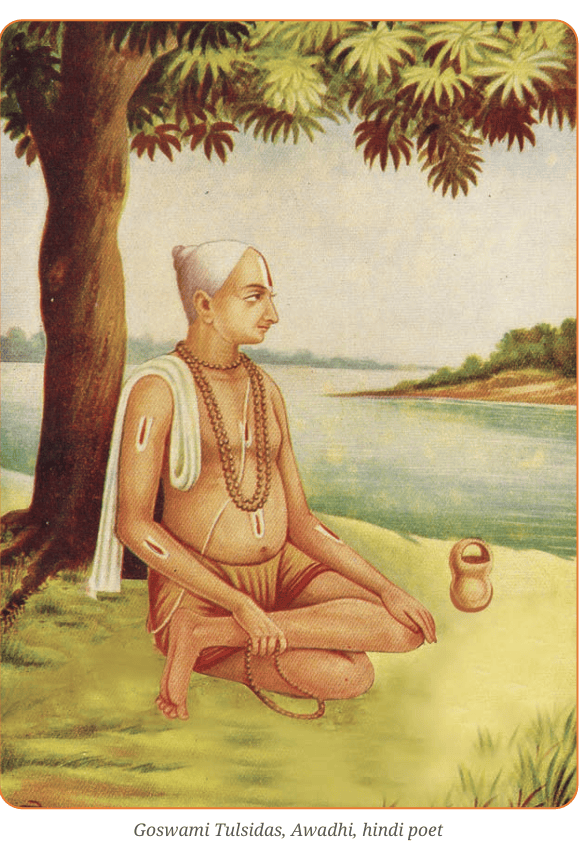
Devotional music in India has its roots in the Bhakti movement, a significant religious, social and literary movement that swept across India beginning from the 6th century CE, and reaching its peak during the 15th – 17th century CE. It led to a spiritual revival emphasising devotion, and significantly influenced Indian music, leading to the creation of new musical forms like kirtanas and bhajans. Some prominent bhakti poets include Mirabai and Tulsidas in northern India, and Haridasa saints like Purandara Dasa and Kanakadasa in the southern India.
Similarly, Sufism is a mystical dimension of Islam that emerged around the medieval period in India. Sufi saints like Khwaja Moinuddin Chishti and Baba Farid focused on inner devotion and spiritual experience as a means of connecting with god. The Sufi Qawwali genre of music arose from this philosophy and continues to be widely practised and performed, especially in Punjab and the western regions of India.
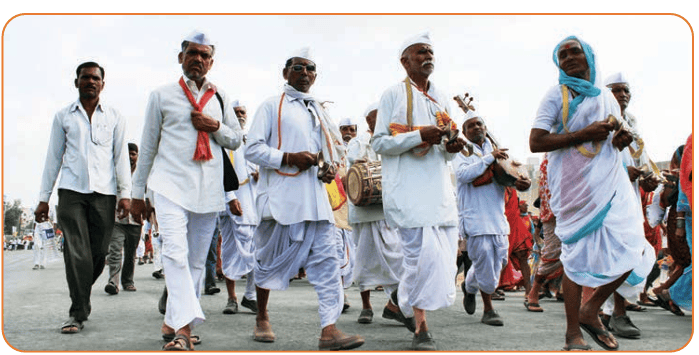 Warkari (pilgrims) singing bhajans
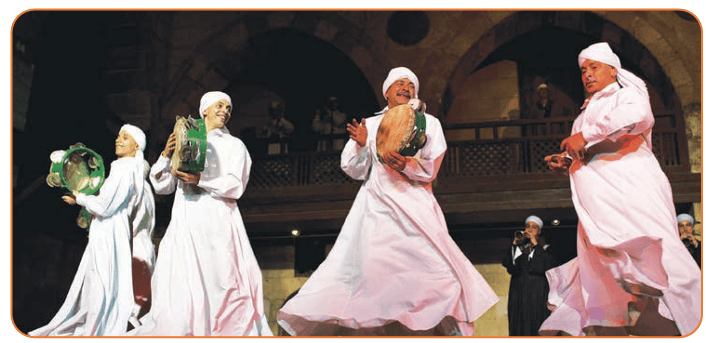 Sufi whirling dervish performance
Here is a bhajan by Tulsidas.
Thumak Chalat Ram Chandra
Thumak Chalat Ram Chandra Baajat Paijaniya
Kilak Kilak Uthat Dhave Girat Bhumi Latpataye,
Dhaya Maat God Let Dashrath Ki Raniya
Tulasidas Ati Aanand Dekh Ke Mukharvind,
Raghuvar Chhabi Ke Samaan Raghubar Chhavi Baniya
The following is a Sufi Qawwali that is sung in both traditional and contemporary music.
Duma Dum Mast Kalandar
Ho laal meri pat rayhio bala jhoole laalan, Sindhri da
sehwan da sakhi shabaaz kalandar
Duma dum mast kalandar,
Ali dum dum de andar,
Ali da pehla number
Duma dum mast kalandar
Ho laal meri Ho laal meri …
Char chirag tere baran hamesha, Panjva main baaran aayi bhala jhoole laalan, Sindhri da …
ASSESSMENT
CHAPTER 7: Indian Classical Music
| CG. | C. | Learning Outcomes | Teacher | Self |
|---|---|---|---|---|
| 1 | 1.1 | Ability to sing basic songs in Carnatic and Hindustani music. | ||
| 1 | 1.1 | Ability to keep tala while singing or listening to a composition | ||
| 4 | 4.1 | Respects others’ works in the preparation process and helps if required |