9
My World of Music


How do you relate to music in your life? Today, music is found in a variety of contexts and situations — from reinterpretations of traditional songs, to the latest advertisement or anthem, music is everywhere. Let us explore some of these diverse contexts of music. Shall we start with singing some popular songs?
TRADITIONAL MUSIC IN POPULAR CULTURE
There are many examples of traditional music, both folk and devotional, that have found their way into popular culture and have been adapted into films or pop music. This helps the music reach a new audience of people who can also enjoy it.
Two examples of songs that are traditional in nature and have become very popular are given on next page.
Nimbooda Nimbooda
Nimbooda nimbooda is a traditional Rajasthani folk song, performed by the Langa and Manganiar musicians. Such songs have been used in films and have gained immense popularity.
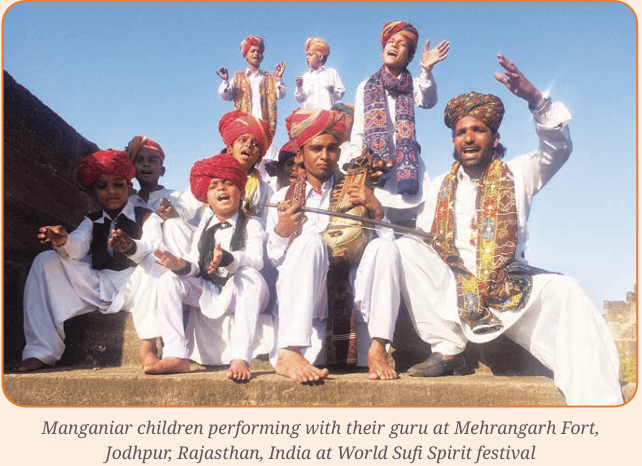
Listen to the traditional and the bollywood version of the song. What do you like about both versions, and how are they different?
Now, learn to sing the song!
song from Rajasthan
Nimbooda Nimbooda Nimbooda
Arre Kaacha Kaacha Chhota Chhota
Nimbooda Layi Do
Arre Layido Layido Laydo,
Arre Layido Layido Laydo —
Nimboo Layido
Ja Khet Se Hariyala Nimbooda — Layido
Aa Nimboo Layi Layi Layi — Layido
Ah Ha Deewanon Ki Boori
Nazar Se Bachna Ho To Sunlo
Arre Khatto Khatto Nimboo
Tez Churi Se Sar Pe Kaato
Phir Chhota Chhota Nimbooda
Kya Jaadu Karega Dekho
Ki Boori Nazar Vo Khatti Hoyegi
Phir Char Raste Pe Vo Utar Giregi
To Layido Layido Laydo,
To Layido Layido Laydo
song from Kashmir
Rind posh maal gindney draayi lo lo
shoobi shaabash chaaney pout tchhayi lo lo
Raaz haeniziyaani naaz kya aenzini gardan
ya illaehi chashme badh nish rachhtan
Gaschhi kya kam chaani baargahi lo lo
shoobi shaabash —
Rind posh —
Zaeli vankan baeli yeli laagi shumaar
pache lagnaes gaenzraan lachi ty hazaar
teymi shaayi no maklan paayi lo lo
shoobi shaabash —
kalmoyas tal chhi aeshqae bombaeri
Paelinaafaeyi wolmut mushk adfar
heynzi paeraan tchonzae ty taayi lo lo
shoobi shaabaash —
Ronni goudkuy yaamat bozum saaz
saaz bozney aamut shah e yandraab
Poshmal chham posh kuli daayi lo lo
shoobi shabash —
Rind posh maal
APPLICATIONS OF MUSIC
Music has an important place in advertisements, sporting events and more.
Have you heard songs written about products in advertisements? These are known as jingles, and are meant to be catchy for people to remember brands and products.
Name some popular jingles that you remember.
----------------------------------------------------------------------------------------
Major sporting events like Khelo India and the Olympics also have their signature tunes, and theme songs. These tunes and songs help create a feeling of community among the people attending the events. List out some sporting events which have theme songs and tunes that you may remember. You can pick an issue or a campaign of national importance.
----------------------------------------------------------------------------------------
In movies, in addition to the background score and songs, sometimes you will hear a particular theme being played whenever a specific character appears. This is put in movies to highlight the actions or presence of the particular protagonist.
- Choose a product. It could be something you use everyday.
- What are some features of the product that make it attractive for others to buy it?
- Using these features, write a few lines which will be the lyrics for your jingle.
- Set your words to a tune or rhythm, and feel free to add sound effects
- Share your 15–30 second jingle with the class.
- As an additional activity, you can draw an advertisement poster for your product, using the tag line from your jingle.
MUSIC AND CLIMATE CHANGE
Today, climate change and global warming are threatening to cause irreversible damage to humans, and the planet. We must all take steps at individual and collective level in our own way to preserve the environment from further damage. One way to spread more awareness about the importance of the natural world with plants, animals and birds, is through music.
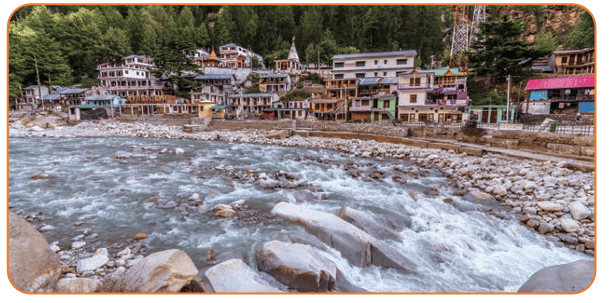
The Clean Ganga movement is a project undertaken by the Government of India to restore and revitalise the Ganga river. A theme song of this movement, ‘Namami Gange’ is available online. You can find it and listen.
- Divide your class into groups of 5–6 students each.
- Choose a nationally important issue or campaign, such as swach bharat, clean ganga, beti bachao beti padhao, etc.
- Now, you can write an anthem for the chosen
movement. Here are some ideas on how you
could go about it.
- First, write down some of the key points you would like to express through the song.
- Find a chorus or hook line that encapsulates the message of the song.
- Write two verses that explore the theme.
- You can first think of a tune and then, write lyrics to the tune, or write the lyrics first and then, set it to tune.
- Work on refining the song.
- Share it with your friends in class and if possible, present it during the school assembly.
We have explored several facets of music and how they are created. Some of you may enjoy music. If this is so, have you wondered how you could continue to work with music as a career? You may be surprised to know that besides being a singer or an instrument player, there are many different careers in music. Some of them are discussed below.
CAREERS IN MUSIC OR OPTIONS TO MAKE MUSIC A PART OF YOUR LIFE
1. Sound engineer
A sound engineer, also known as an audio engineer, is responsible for recording, mixing and reproducing sound for live performances, and recordings. They use audio equipment like microphones, speakers and mixing consoles to ensure good quality of the sound.

2. Music producer
A music producer helps artists record their songs, album or project. Music producers bring an artist’s vision to life. It is the music producer’s job to ensure that the finished product is good, and to see that the artist’s plan for the album or song is carried out successfully.
3. Event manager
An event curator or manager puts together one or more aspects of a live concert, including contacting and selecting artists to perform, promoting the event, earning revenue through ticket sales and sponsorships, and ensuring all the requirements for the concert, such as venue, sound, lights, etc., are in place.
4. Music therapist
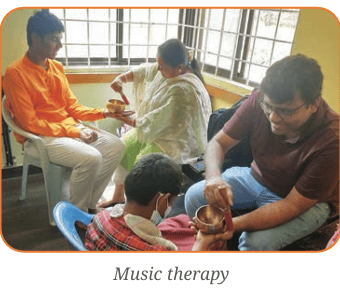
Music therapists are professionals who use music as a tool to relieve pain, manage stress, support mental health and rehabilitation for their patients or clients. Depending on the treatment needs, a music therapist may be required to create music, or select and play appropriate songs or ragas, as well as engage their clients in active listening and responding to music. Music therapy is a growing area, with many research experiments being conducted. It lies at the intersection of music, science and medicine.
5. Music educator
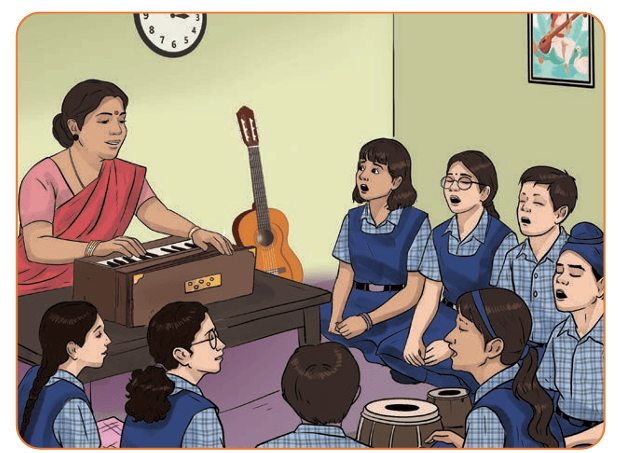
Music educators teach music to students at different places, such as schools, universities, music conservatories or online. Some may teach music to groups of students or a choir at a school, while others may teach select students individually. Sometimes music educators use songs to teach concepts of maths and science. To be a music educator or teacher, you must have good knowledge and training in music, and also enjoy interacting with people.
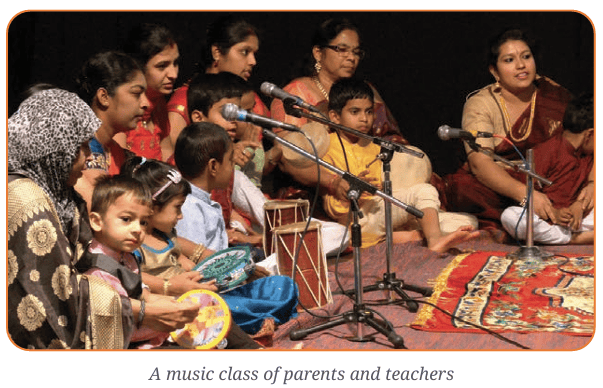
Speak to them and understand what their typical day looks like. If possible, ask them if you could join them for a half day, when they are working and understand what their work is like.
Share what you learnt with your friends and teacher in class.
Would you like a career in music? Reflect and share it with your friends.
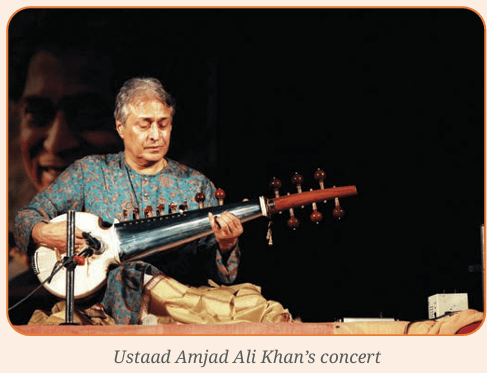
Consider the stages to organise and plan an event, and refer to your Grade 7 music textbook if needed.
Identify the musician or organiser you would like to volunteer and approach them with the permission of your school.
While designing a promotional plan, think of how you can collect information — how can you spread word about the event in a way that would be interesting to people of your age? Consider online, and offline promotion, hyperlocal communication or even a contest to create interest. Submit your promotion plan to your teacher and the musician or organiser you are volunteering with for approval.
Ask if you can help and learn about the other aspects of the performance, whether it is ticketing, stage design, light, sound or other activities.
Document the process and performance, and share your report with the class.
ASSESSMENT
CHAPTER 9: My World of Music
| CG. | C | Learning Outcomes | Teacher | Self |
| 2 | 2.1 | Appreciates the interconnection betweem music genres. | ||
| 2 | 2.2 | Understands the applications of music and is able to create a jingle. | ||
| 3 | 3.2 | Expresses insights on the work of a music professional. | ||
| 4 | 4.2 | Is aware of various career opportunities in music, and is able to make a presentation on the same. |
Teacher’s Comments and Student’s Observations
SUMMATIVE ASSESSMENT
| Music | Examples of Summative Assessment | Criteria for Summative Assessment |
| Individual |
|
|
| Group |
|
|