
UNIT 2
Physical and Motor Fitness
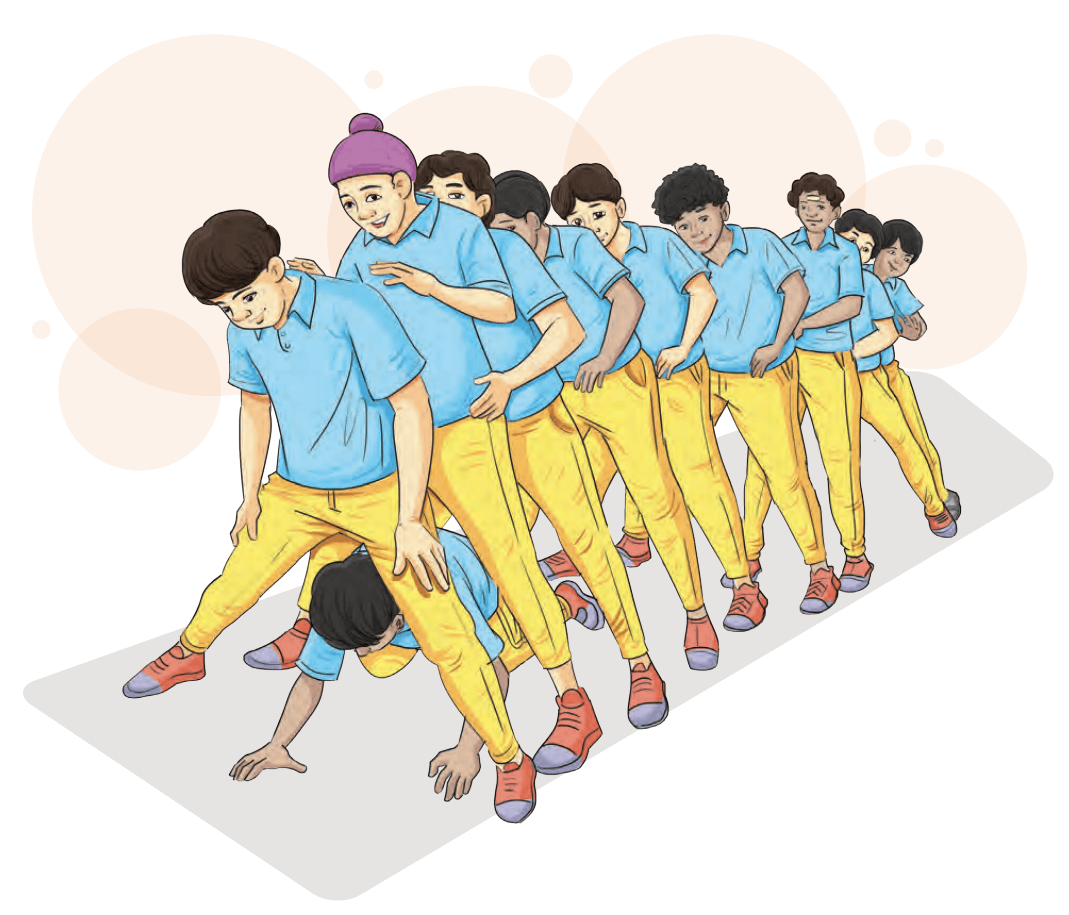
Crawl to the Front is a dynamic relay race in which students take turns crawling on all fours, under their teammates legs to reach the front of the line, where they stand and inform the next teammate to do the same. The game continues until the entire team crosses the finish line.

How to play?
- Make a team of ten students each.
- Set up a starting and finishing line.
- Each team forms a line, with all students standing at one arm distance and feet wide enough for someone to crawl through.
- All team members stand at the starting line, feet apart and facing forward.
- On the whistle, the last student in the line crouches down and crawls through their teammate’s legs to the front of the line.
- Once the student reaches the front, they stand up and shout "Next!" for the next person to start crawling.
- The team continues the sequence until all the students have successfully crossed the finish line. The team that finishes first wins the race.
Circle time — Time management
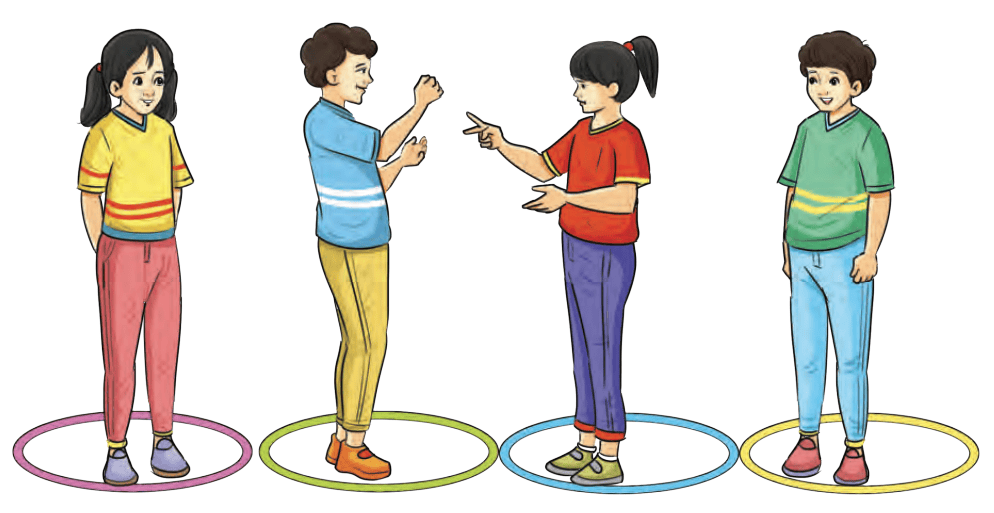
Discuss different ways of crawling and standing to minimise the time taken for the task.Rock-Paper-Championship Run is a dynamic and engaging physical activity that combines the classic game of RockPaper-Scissors with running, teamwork, and competitiveness. It promotes physical activity, decision-making, and quick reactions.

How to play?
- Place hula hoops or markers in a straight line or a zig-zag pattern across the floor.
- The number of hoops is determined by the available area and the number of students, but the route should have an equal number of hoops on both sides.
- Add a different coloured hula hoop or marker to the second-to-last hoop on each end.
- Divide the class into two teams. Each team should line up on opposing sides of the hoop route.
- The first member from each team enters the first hula hoop from their respective sides. These two students will compete in a game of ‘rock, paper, scissors’.
- The winner advances to the next hula hoop in the line, while the loser returns to the rear of their team’s lineup.
- The next student in the losing team’s line enters the first hoop and prepares to challenge the opposing team’s advanced student.
- Every time a student wins, they move forward through the hula hoops.
- If they lose a round of rock-paper-scissors, they return to their team and the next teammate gets their turn.
- The goal for each team is to reach the second-to-last hula hoop on the opposing team’s side.
- When a student gets to the hoop, they score a point for their team.
- When a point is scored, both teams return to their starting positions and a fresh round begins.
Circle time — Perception
Identify and discuss different factors within the game which will affect the outcome.Modified Triathlon Activity is a short skills competition that emphasises agility, balance, and coordination. Students will compete in three different stages—dribbling a football, balancing an object on their head, and crawling on the ground with the object. The goal is to finish all stages as quickly as possible while maintaining precision in each task.

How to play?
- Mark a starting and ending line.
- Set up a 10-metre-long zig-zag course using cones or markers.
- Students will dribble a football along the zig-zag course, weaving between cones.
- After dribbling, grab any object such as a cardboard, a used rough copy or a school bag and keep it on your head.
- Balance the object as you go back towards the starting line.
- If the object falls off, you must stop and put it on your head again before continuing.
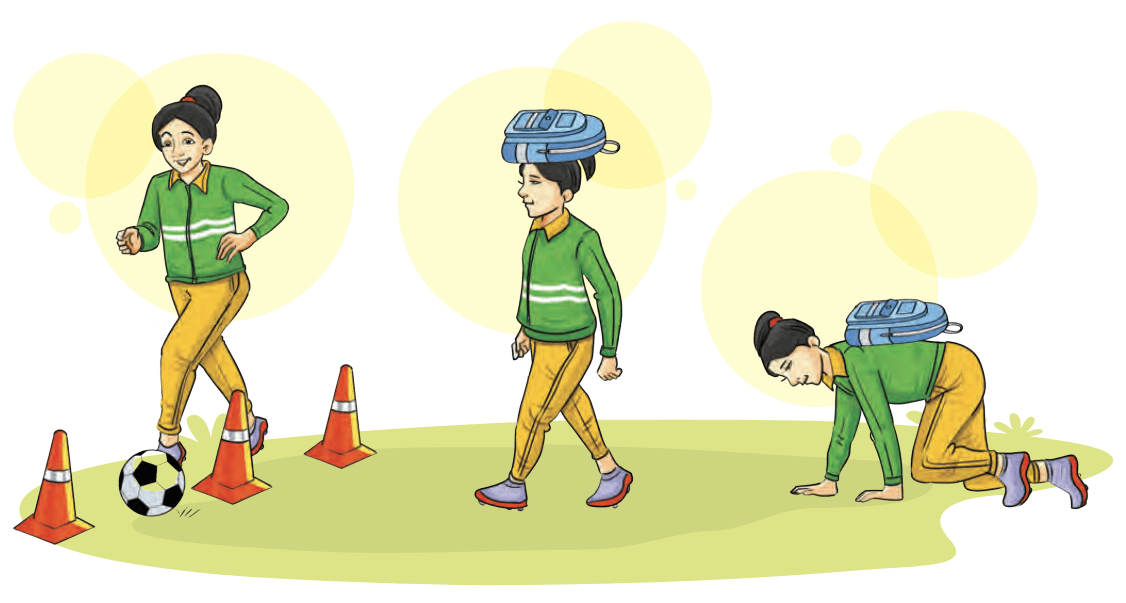
- Balance the object on your back and continue to crawl, travelling across the ground towards the finish line.
- Next, drop the object there, pick up the football and run back towards the starting line, passing it to a teammate.
- The game continues until all the students get their turn.
- The team that finishes first wins.
Circle time — Introspection
- Identify the best performance out of three and share one activity that you need to improve.
- Discuss your happy feelings while giving your best effort in attempting to finish all stages as quickly as possible with complete precision for each task.
Pass, Sit, and Score is a fun and engaging team game that combines passing, quick decision-making. The goal is for teams to work together to pass a ball down the field and score points, with a sitting element to add strategy and teamwork.

How to play?
- Divide the students into teams of six students each.
- Make two little goal areas at each end of the field (cones or mini goals can be used).
- Students make a straight line.
- One student (the passer) stands in front of the line, facing the group, holding a ball.
- A goal or a target is positioned behind the passer.
- The passer throws the ball to the first student in line.
- The first student catches the ball, returns it to the passer, and immediately sits down.
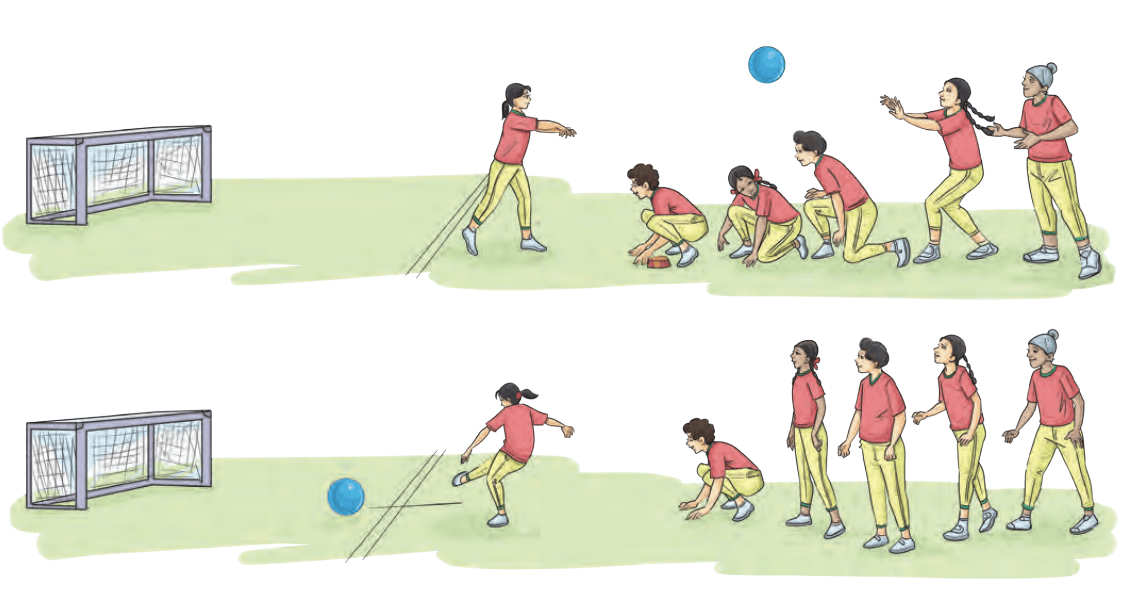
- The passer continues by passing the ball to the second student and so on.
- After returning the ball, the student sits in their spot.
- When the last student catches and returns the ball, the passer turns around to kick the ball towards the goalpost.
- The game continues until everyone gets the chance of being the ‘passer’.
- The team to score the most goal wins.

Note for the teacher
The teacher will help students in identifying the muscles.Circle time — Muscle involvement
Feel and identify the major muscles responsible for movements performed in the activity.Crab Crawl Ball Relay is an activity that develops the core muscles. It encourages participants to work together efficiently, leading to an enjoyable and interesting relay challenge.

How to play?
- Students are divided into teams of ten students each.
- Each team forms a line, with all students in the crab position (hands and feet on the ground, belly facing upwards).
- To begin the game, the student at the end of each line holds the ball.
- All students must remain in the crab position throughout the game, making a straight line behind one another.
- After the command to start is given, the last student in the line rolls the ball underneath them, towards the next teammate.
- Each student in the line must roll the ball underneath their body to the next person in line without leaving the crab position.
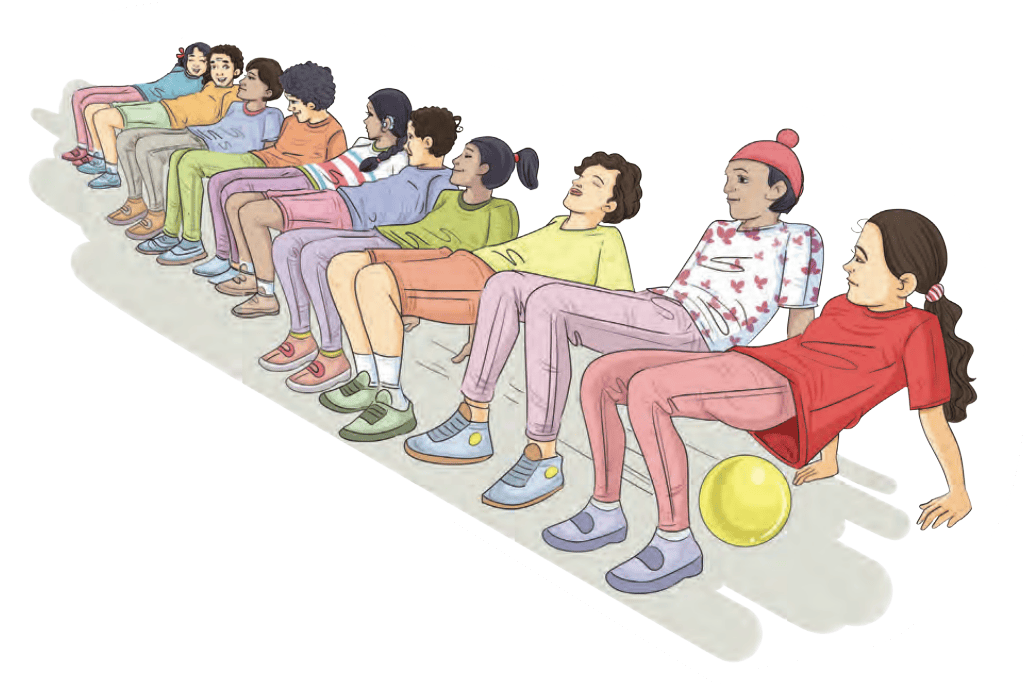
- When the ball reaches the first student in line, they take the ball, get up, run to the back of the line, and quickly return to the crab position.
- The student who just went to the back of the line will get back in the crab position, roll the ball beneath the line again, and the sequence will continue.
- The relay continues until the first student to start the game returns to their starting place at the beginning of the line.
Note for the teacher
The teacher will discuss the concept of core muscles (abdominal muscles like, rectus abdominalis, external oblique, internal oblique, quadratus lumboram, multifidus).Circle time — Effect of gravity
- Discuss the role of gravity in maintaining the crab position.
- Identify the muscle involved in maintaining the crab position against gravity.
This game focuses on coordination, object manipulation, and anticipation skills through a traditional target game, which is called the Hitting Running Target Game, and is adapted to modern gameplay. Students play it by throwing tennis balls at a moving target while ensuring safety measures are followed.

How to play?
- Use 6–10 markers to define a rectangular playing area.
- A student, designated as a roller, stands at one end and rolls a target ball (a large ball) between two parallel lines, and a desired number of students will stand perpendicular to the roller, 5–10 metres away.
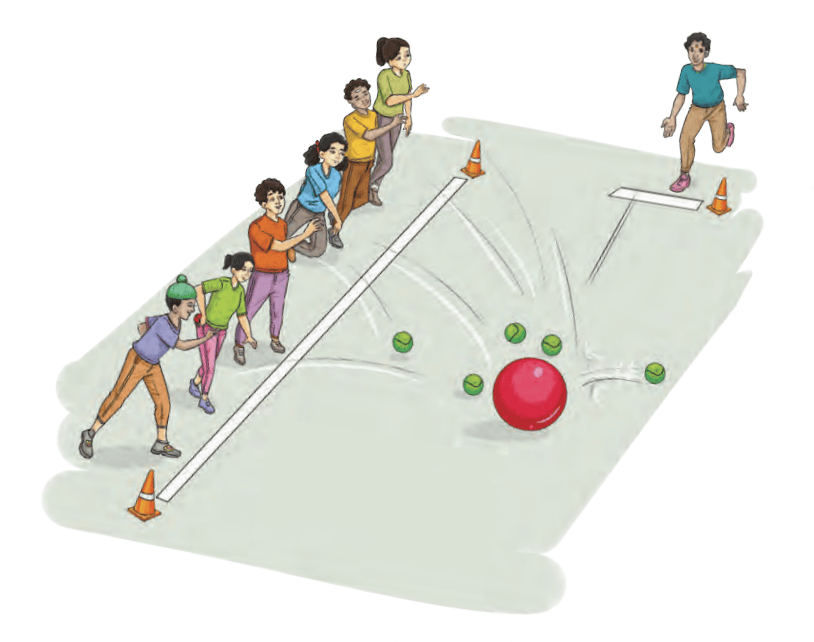
- The roller calls out “gool-gool” (or “going-going”) to signal the roll.
- Students aim to hit the moving target using smaller tennis balls, throwing them when the ball passes in front of them between two parallel lines.
- A fielder at the other end retrieves the target ball and returns it to the roller after all thrown balls are collected.
- Students must wait for the "OK" signal before retrieving their thrown balls.
Variations
- Use a ball that makes noise for students with limited vision.
- Allow rolling or underhand throwing for students with limited grip strength.
Note for the teacher
- Always provide a signal before students retrieve balls to ensure safety.
- Encourage modesty and good sportsmanship among students.
Circle time — Inclusiveness and personal goals
- Share how adaptations made the game inclusive for all students.
- Reflect on personal achievements and encourage setting goals for future sessions.
Kick Volleyball is an engaging game that combines elements of traditional volleyball with the added challenge of using feet instead of hands. This activity helps develop coordination, teamwork, and agility.

How to play?
- Divide students into two teams of 5–6 students.
- Set up a volleyball net or a similar divider at a height of 2–3 feet.
- Instead of using hands, students kick the ball to send it over the net.
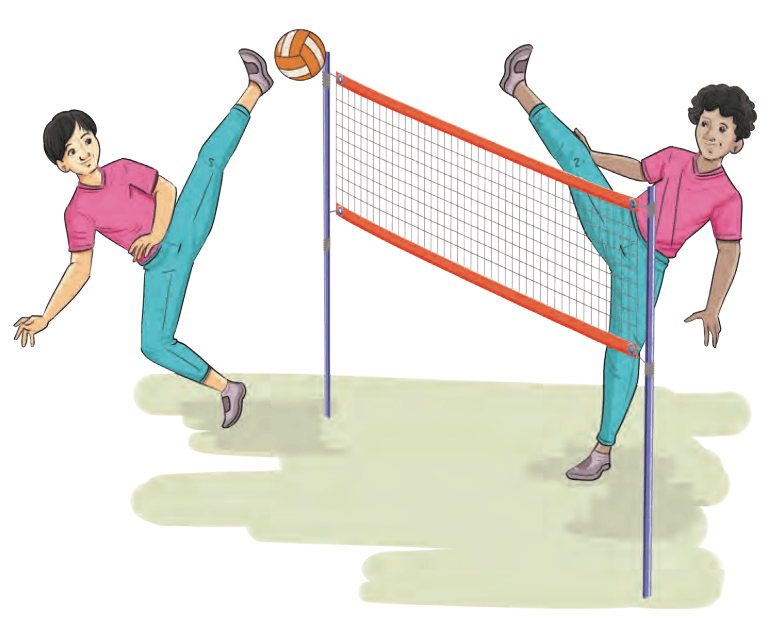
- Each team can allow up to three touches before sending the ball over the net.
- Play for 10–15 minutes, alternating teams every 5 minutes for fairness.
Variations
- Number of students may vary.
- Different net height may be used and focus must be on keeping the ball in the air.
- Time-based Scoring: Teams try to score as many points as possible in a fixed time.
Note for the teacher
- Encourage teamwork and communication among students.
- Emphasise safety and ensure that students maintain control over their kicks.
- Provide guidance on proper kicking techniques to avoid injuries.
Circle time — Techniques, strategies and challenges
- Discuss the different techniques and strategies adopted by different students and what worked well.
- Identify and discuss the challenges during the game and how did you overcame them.
Ropeless Tug of War is a fun and engaging team-based activity where participants compete to pull their team across a designated line without using a rope. The game encourages teamwork, strategy, and physical strength in a safe and playful environment.

How to play?
- Divide the students into two teams having similar height and weight and equal in number.
- Mark a centre line. The teams will stand in front of each other at a distance of approximately one foot from the centre line.
- Students of each team will hold the waist of a student who is standing in front.
- The first student of both the teams will hold each other’s elbows.
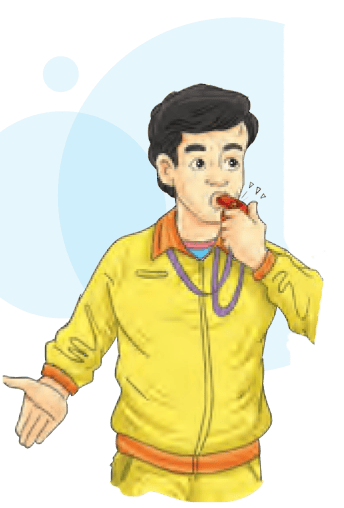
- On the whistle, students will pull against each other using their body weight and strength. The aim is to pull the opposing student past the centre line.
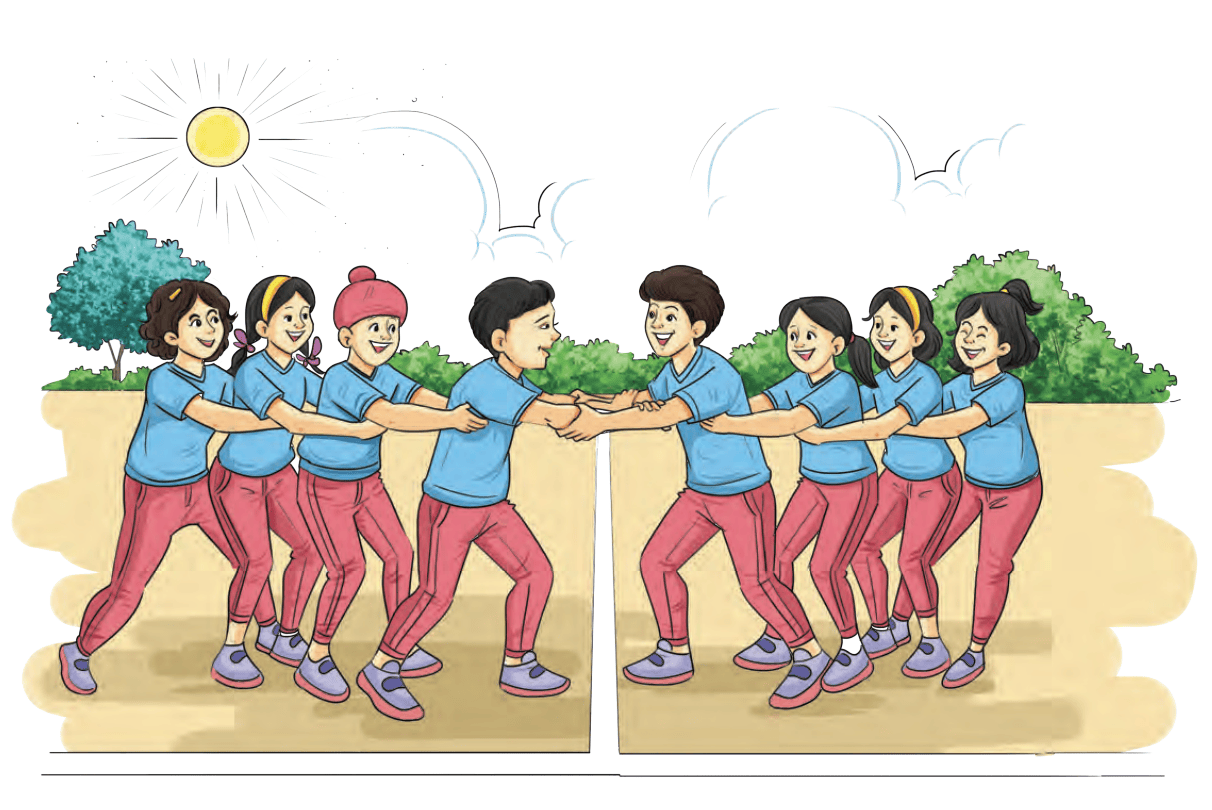
- Both teams must always stay connected as a chain. Breaking the chain will result in losing the game.
- The game continues until one team wins by pulling the other past their centre line.
Variations
- Circle tug of war: Play in a circular arena, and the team that pulls the other out of the circle wins.
- Timed challenge: See which team can hold their ground the longest.
- Mixed strength teams: Mix players of different strengths and sizes to encourage inclusivity.
Note for the teacher
- Emphasise safety by ensuring students are evenly matched in size and strength.
- Encourage students to use their legs and body weight rather than straining their arms.
- Monitor for fair play and ensure the game stays fun and inclusive.
- Ensure there are no jerk movements while pulling the opposing team.
Circle time — Cooperation
Discuss and identify your efforts in the team's success. Also, identify players not giving their hundred per cent effort in the game. How does it affect the team's success?- Do you feel any difference between when you push the wall and when you hold your water bottle for a minute in a horizontal position?
- Social loafing is when people put in less effort when working in a group than when working alone.
- Social facilitation describes how people perform better when others are present.
Swāsthya Dauḍ is an interactive game that helps students understand the effects of unhealthy food and lack of exercise on metabolism.

How to play?
- To begin, a large circle is made using cones and divided into two areas: the ‘playing zone’ and the ‘exercise zone’, with a cone placed in the exercise zone labeled ‘exercise.’
- Two students are chosen as denners: Denner 1 represents unhealthy food, and Denner 2 represents the will to avoid exercise.
- All other students start in the playing zone and run around, symbolising high metabolism. Denner 1 tries to tag players inside this zone.
- However, when students move to exercise zone then Denner 2 will try to tag them. If Denner 2 tags a student for the first time, the student must return to the playing zone but can only jog, representing moderate metabolism.
- If the same student is tagged by Denner 1 again and then tagged by Denner 2 a second time, they must return to the playing zone and only walk, showing low metabolism.
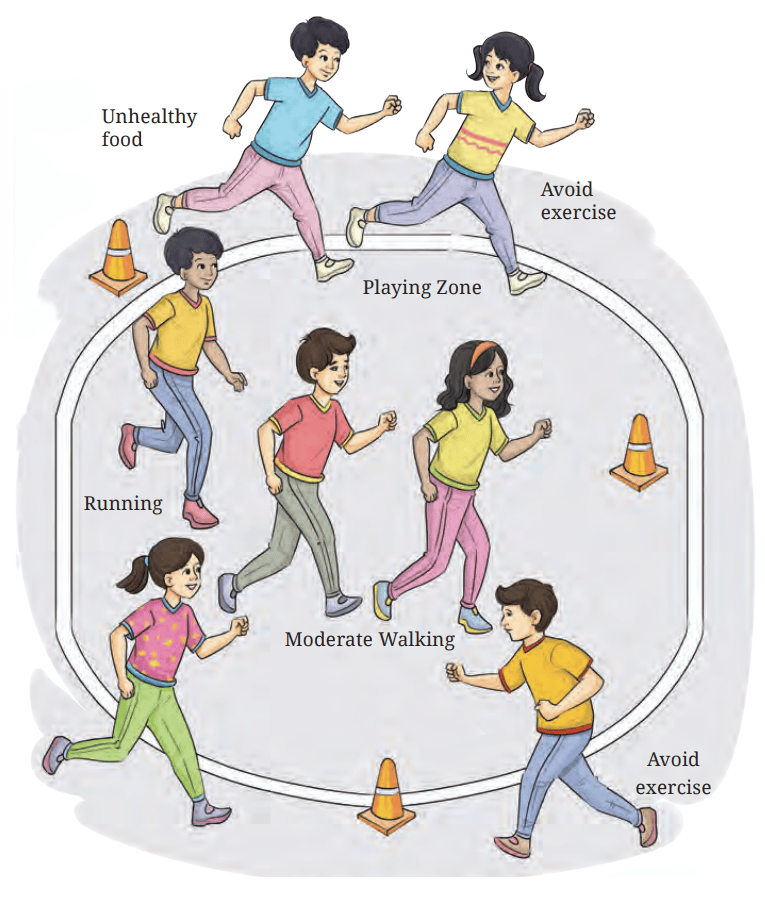
- On successfully touching the Exercise cone without being tagged by Denner 2, a student regains the ability to run, symbolising improved metabolism.
- Both denners are changed every ten minutes so everyone gets a chance to play.
- This fun and educational activity shows how lifestyle choices can impact energy levels and health.
Circle time — Body Mass Index and goal setup
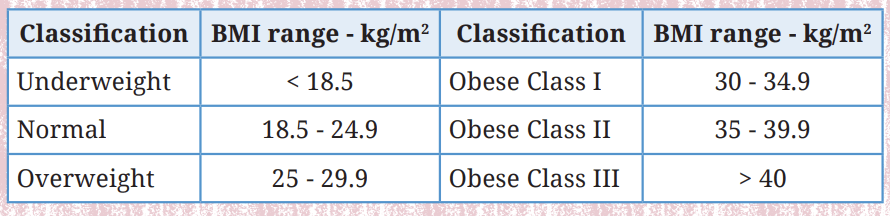
Calculate your Body Mass Index using the formula: BMI = weight (kg)/[height (m)]2 and compare it with the table given below and plan your next one month accordingly for leading a healthy lifestyle
Assessment
Instructions:
- Perform each fitness test and record your baseline result.
- Set a goal for improvement.
- Retest and compare your progress!
- Teachers should ensure they set up the testing environment.
- The procedure for conducting each test is mentioned in the Annexure.
Agility
Test: T - TEST
- Baseline time: ................ seconds
- Goal (Improve by 1–2 sec): ................ seconds
Cardiovascular Endurance
Test: 600-m Run/Walk
- Baseline time: ................ minutes
- Goal (Improve by 10–20 sec): ................ minutes
Test: 3-Minute Step Test
- Baseline HR: ................ bpm
- Goal (lower HR over time): ................ bpm
Strength & Muscular Endurance
Push-ups (Max in 1 min)
- Baseline: ................ reps
- Goal (increase by 3–5 reps): ................ reps
Squats (Max in 1 min)
- Baseline: ................ reps
- Goal (increase by 5–10 reps): ................ reps
Plank Hold (time)
- Baseline: ................ seconds
- Goal (hold 10–15 sec longer): ................ seconds
Flexibility
Sit-and-Reach Test (measure reach in inches past toes)
- Baseline: ................ inches
- Goal (improve by 1–2 inches): ................ inches
Speed
50-Meter Sprint
- Baseline time: ................ seconds
- Goal (improve by 0.2 – 0.5 sec): ................ seconds
Balance
Stork Balance
- Baseline time: ................ seconds
- Goal: ................
Reflection & Progress
- Which area improved the most? ..................
- What was the biggest challenge? .................
- How can I improve further? .................