
UNIT 1WIT AND WISDOM
THE WIT THAT WON HEARTS
Let us do these activities before we read.
I. Select qualities of a person who uses wit from the box given below.
stubborn courageous observant charming creative
punctual confident energetic
Now, discuss reasons for your choice of qualities.
II. Work in pairs and answer the riddles that are given below. Share the answers with your classmates and teacher.
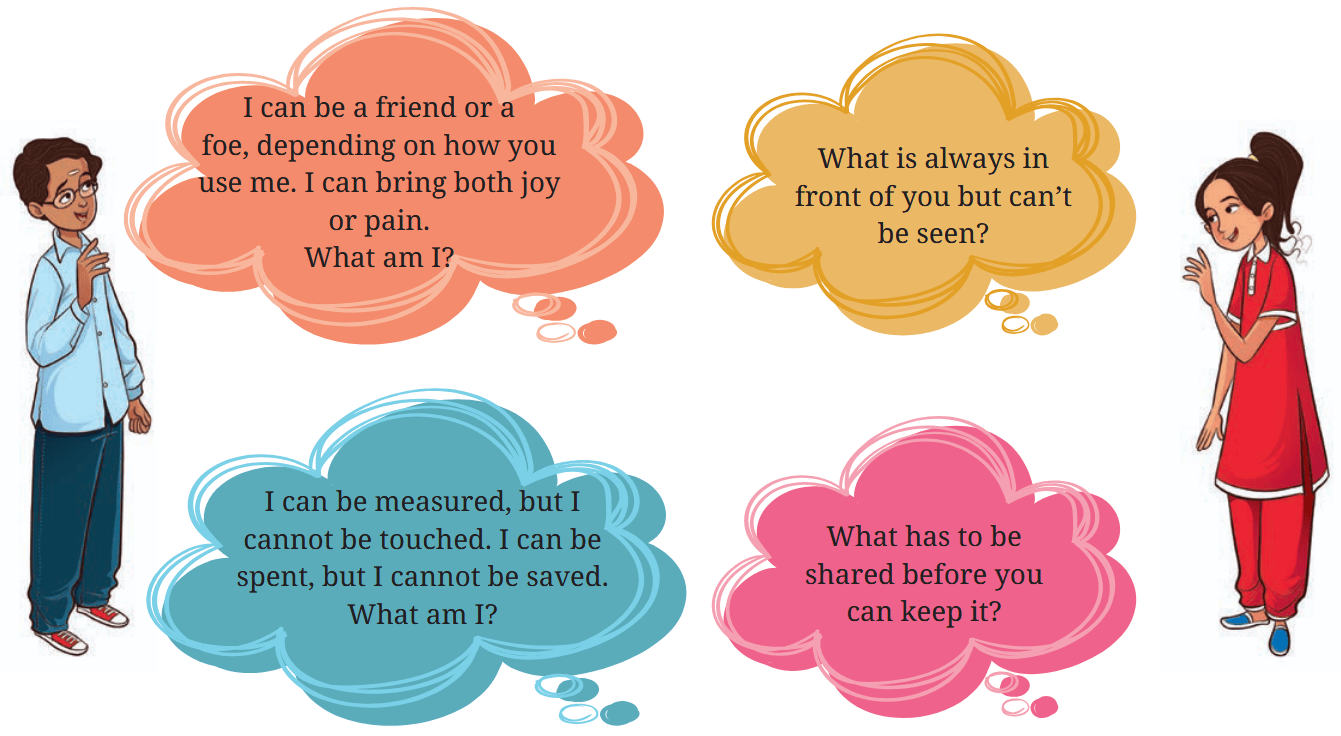
- I can be a friend or a foe, depending on how you use me. I can bring both joy or pain. What am I?
- What is always in front of you but can't be seen?
- I can be measured, but I cannot be touched. I can be spent, but I cannot be saved. What am I?
- What has to be shared before you can keep it?
Note: You will find the answers of these riddles on page 16.
Discuss in pairs.
- Why are qualities like humour and wit important in a person?
- Why do you think kings and queens preferred to have witty people among their courtiers?
- If you were asked to solve a disagreement between two people, what approach would you take?
- Have you ever been in a situation where a small misunderstanding led to a big problem? How was it resolved?
Let us read
illustrious: respected and famous
patron: supporter
eminent: famous
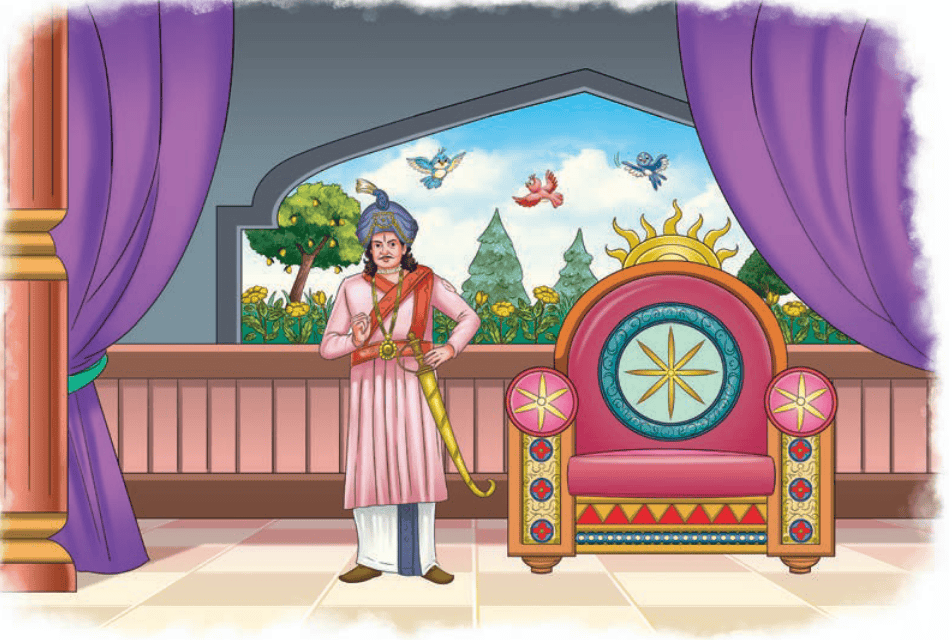
The Vijayanagara Empire was renowned for its glory, wealth, and cultural achievements. Among its many illustrious
rulers, King Krishnadeva Raya (ruled 1509-29 CE) stood out as a wise and powerful monarch. His reign is often referred to as the Golden Era of the Vijayanagara Empire, a time when art, literature, and architecture flourished. A great patron
 of learning, Krishnadeva Raya was not only an eminent warrior but also a gifted poet. His works, such as the epic Amuktamalyada
and the Sanskrit drama Jambavati Parinayam, are acclaimed even today.
of learning, Krishnadeva Raya was not only an eminent warrior but also a gifted poet. His works, such as the epic Amuktamalyada
and the Sanskrit drama Jambavati Parinayam, are acclaimed even today.
insurmountable: undefeatable
trivial: unimportant
forlorn: lonely
distraught: upset
vague: unclear
Krishnadeva Raya's court was home to eight celebrated poets, collectively known as the Ashtadiggajas. These poets, including Allasani Peddana and Tenali Ramakrishna, enriched the literary tradition with their masterpieces. Tenali Ramakrishna, in particular, was known for his quick wit and humour, earning him a special place in the king's court as both a poet and a witty advisor. His clever solutions to seemingly insurmountable problems made him a beloved figure in the empire's history.
Even the wisest rulers face moments of disharmony, and at one such time, the king had a quarrel with his queen, Thirumalambal, over a seemingly trivial matter. For weeks, he did not utter a single word to her, and in his frustration, stopped visiting her altogether. His absence cast a shadow over the palace, and the once cheerful corridors seemed quiet and forlorn.
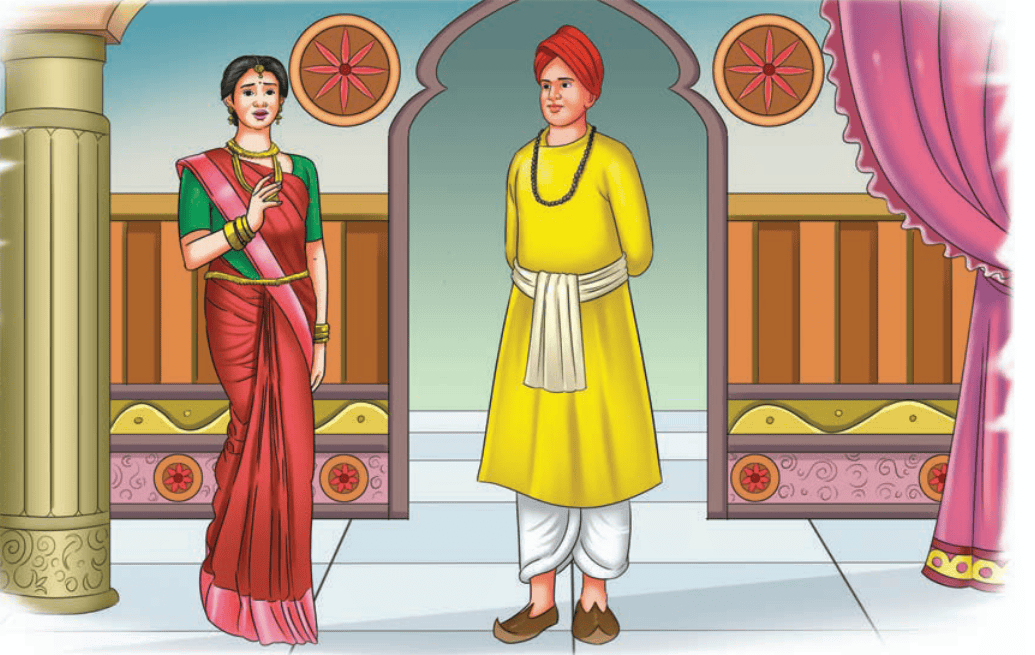
Thirumalambal, distraught and upset, tried her best to resolve the issue but failed. With no other alternative, she decided to seek the help of Tenali Rama, the court's brilliant and witty poet. Rama listened patiently as the queen recounted the incident in detail.
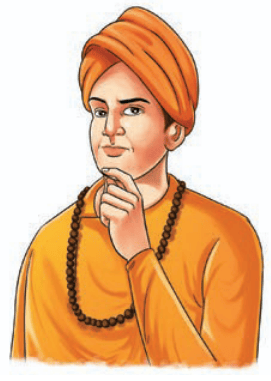 "The king wrote a poem," she began, her voice trembling. "It was filled with vague expressions-sun, moon, stars, beautiful sky-but it made no sense. When he tried reciting it to his ministers, they all avoided him, making excuses. It was late evening when he came to me, seeking an audience. He began reciting it to me, but I was so exhausted after a tiring day that I yawned- not once, but several times. The king thought I was disrespecting his poem and stormed off. Since then, he has not spoken to me. If I had known this would happen I would have chosen another day. Help me, please, Rama. Only you can help the king understand."
strategy: plan
profusely: in large amounts
bustling: busy
intricately: in a detailed manner
exquisite: fine and attractive
ornate: decorative
gnawed: (here) bothered
Rama nodded thoughtfully. "If you like, I will try my best to resolve this matter, Your Highness. But this needs a well-planned approach, and I may need time to find the right strategy." The queen, who had placed her last hope in Rama, agreed and thanked him profusely.
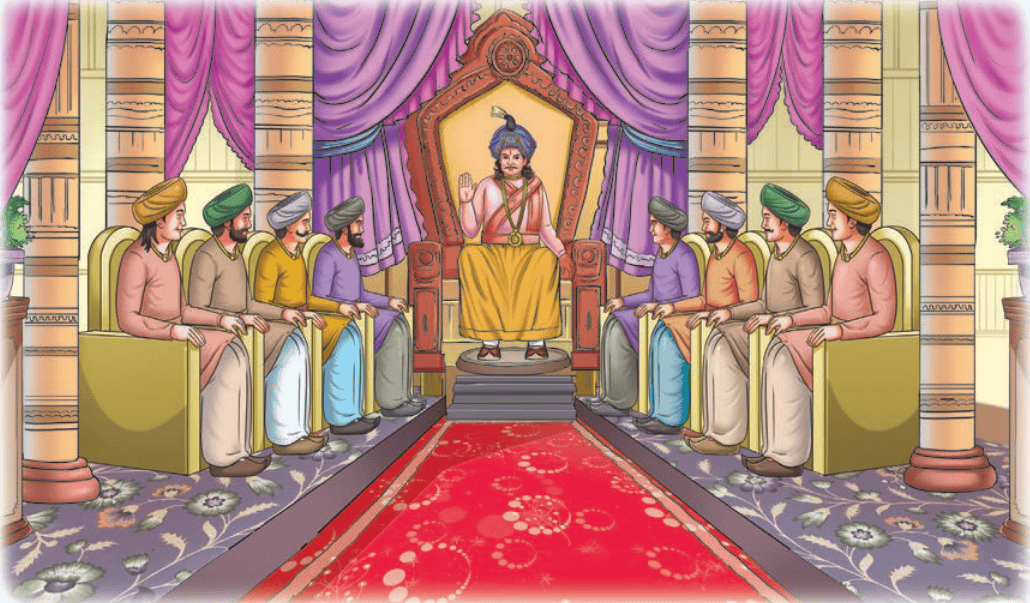
The next morning, the royal court was bustling with activity. Ministers, scholars, and courtiers filled the courtroom, its intricately carved pillars towering towards the high ceiling. Rays of sunlight streamed through the open windows, illuminating the floor adorned with exquisite rugs. Despite the lively chatter, a tension hung in the air. The king sat on his ornate throne, his expression stern, his sharp eyes scanning the room. It was evident that the unresolved quarrel still gnawed at him.
The court discussion was centred on improving paddy cultivation in the empire. One by one, the ministers rose to present their ideas. Some suggested expanding irrigation networks, while others advocated for better manure. Amid these suggestions, Tenali Rama stood quietly at the edge of the court, observing everyone with an amused smile.
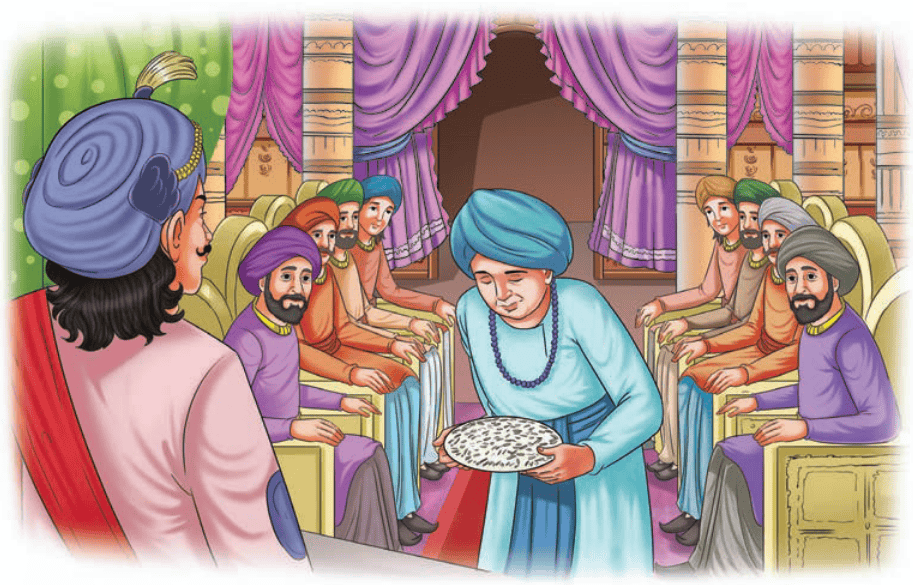
Finally, the king called upon Rama. The chatter in the court died down as all eyes turned to him. Rama approached the throne, carrying a plateful of paddy seeds. Bowing low, he began, "Your Majesty, I bring you a revolutionary type of paddy seeds. If these are sown, the yield will be three times greater than the current results."
yield: (here) harvest
sarcasm: mockery
snickers: suppressed laughter
absurd: illogical
unfazed: not worried
The king frowned, unimpressed. "That sounds absurd," he muttered. "Such cultivation would need special soil, manure, and pest and insect repellents. If, by chance, something were to go wrong, our farmers would suffer."
Rama smiled, unfazed. "That may be true, Your Majesty, but the real issue lies not with the seeds themselves but with the person who sows them."
furrowed: wrinkled
sceptical: doubtful
keenly: intensely
gesture: a movement of a hand or the head, to express an idea or a meaning
A hush fell over the court as Rama's words hung in the air. The king's eyebrows furrowed. "What is wrong with the person who sows the seeds? Speak clearly, Rama!" he roared.
Rama glanced around the court, his sharp gaze meeting the sceptical eyes of the courtiers. "If one were to sow seeds without proper care, no one would reap a good harvest," he said, pausing for effect. "And what if the person had a habit of yawning while sowing? Wouldn't the seeds scatter unevenly?"
The court erupted into laughter, the earlier sarcasm replaced by genuine amusement. Even the king, caught off guard, sighed and instinctively yawned. Rama watched him keenly, then continued, "Your Majesty, is there anyone in this world who does not yawn? It is as natural as breathing."
The king's expression shifted as realisation dawned. His mind raced back to the quarrel with the queen. He remembered scolding her harshly for yawning while he recited his poem. He realised how unfair he had been. "If I had known that yawning was not a sign of disrespect, I wouldn't have taken her gesture so personally," he thought, regret filling his heart.
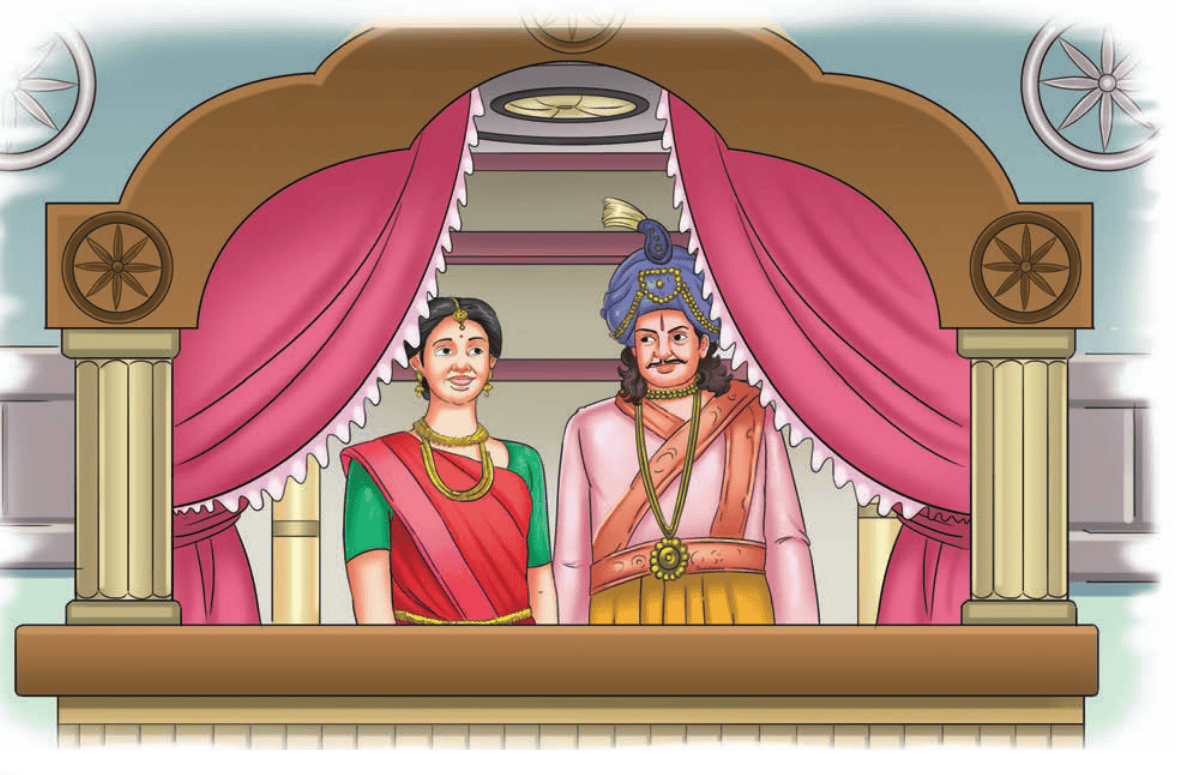
That evening, the king approached the queen with a softened expression. "Thirumalambal," he began, his voice gentle, "I have been foolish. I see now that I overreacted. I let my pride blind me. I'm so sorry."
The queen, who had longed for this moment, smiled and replied, "If you like, we can leave this quarrel behind us. I would very much like to listen to your poem."
brimmed: overflowed
Let us discuss
I. Rectify the following false statements from the text.
- The queen insulted the king by speaking against the quality of his poem.
- Tenali Rama immediately went to the king and convinced him to talk to the queen.
- The courtiers admired the king's poem and praised his literary talent.
- The ministers in the court were eager to hear Tenali Rama's idea about paddy cultivation.
- The king never realised his mistake and continued to stay angry with the queen.
Let us think and reflect
I. Read the extracts and answer the questions that follow.
- "... The king thought I was disrespecting his poem and stormed off. Since then, he has not spoken to me. If I had known this would happen I would have chosen another day. Help me, please, Rama. Only you can help the king understand."
Rama nodded thoughtfully. "If you like, I will try my best to resolve this matter, Your Highness. But this needs a well-planned approach and I may need time to find the right strategy." - A. She is angry at the king for overreacting.
- B. She regrets the unintended misunderstanding.
- C. She believes the poem was not worth listening to.
- D. She is worried that the king might punish her.
- That evening, the king approached the queen with a softened expression. "Thirumalambal", he began, his voice gentle, "I have been foolish. I see now that I overreacted. I let my pride blind me. I'm so sorry."
- The queen, who had longed for this moment, smiled and replied, "If you like, we can leave this quarrel behind us. I would very much like to listen to your poem."
- (i) Complete the following with a suitable explanation.
- When the king said, "I let my pride blind me", he means that
- (ii) Why does the queen say, "If you like, we can leave this quarrel behind us"?
- (iii) Fill in the blank by choosing the correct option from those given in the brackets.
- The king acknowledges that his pride clouded his judgement, which shows (intelligence and courage/maturity and self-awareness)
- (iv) State any one characteristic that the queen's response to the king's apology shows about her.
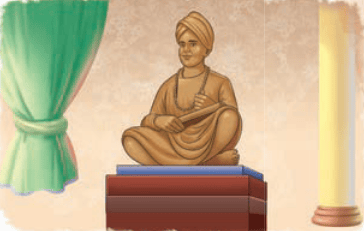
(i) Why does the queen believe that only Tenali Rama can help the king understand?
(ii) What does the queen's statement, "If I had known this would happen, I would have chosen another day", suggest about her feelings?

(iv) Fill in the blank by choosing the correct option from those given in the brackets.
The king's reaction shows that he is sensitive and ........... (has a lot of faith/takes great pride) in his poetry.
II. Answer the following questions.
- Why was the Vijayanagara Empire considered to be in its 'Golden Era' during Krishnadeva Raya's reign?
- How did Tenali Ramakrishna gain a special place in the king's court?
- How did the quarrel between the king and the queen affect the palace?
- What strategy did Tenali Rama use to make the king realise his mistake?
- What was the reaction of the courtiers when Tenali Rama introduced his 'special' paddy seeds?
- How does the story conclude, and what lesson can be learnt from it?
Let us learn
I. Fill in the blanks and complete the paragraph by choosing suitable expressions from the box given below.
mind raced back stormed off rippled through
My mother is quite witty, and her sense of humour always lightens stressful moments. Once, at a family dinner, an argument began over a minor issue, and 1.___, making everyone feel uncomfortable. Just as things were getting serious, she made a clever remark and laughter 2.___ the gathering, making everyone relaxed. The person who started the argument 3.___ Everyone disapproved of the action and a 4.___ My 5.___ to how my mother had saved other situations like this. Without her, such moments would have 6.___ over the gatherings. I hope that I grow up to be as witty as my mother.
II. The writer uses words like 'roared', 'murmur' in the text to indicate the sound produced. Fill in the blanks with suitable sound words from the box given below. You may refer to a dictionary.
snickers thud groan rattle
roared whispered
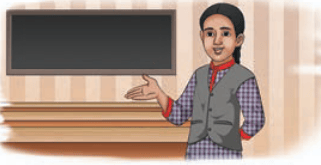
- As the teacher began the riddle challenge, a _________ of excitement spread through the classroom.
- Anaya _______ in relief-she loved riddles more than solving Mathematics problems.
- Think carefully, the teacher began to _____ as she wrote a riddle on the board.
- When the question was revealed, a few students _____ realising it wasn't as easy as they had expected.
- Some exchanged ______ wondering if anyone at all would be able to solve it.
- Just then, Anaya tapped her book on the desk with a small _____ deep in thought.
- 'Ah, I see it now!' she said stretching with a ____ as if it had taken her great effort.
- A small breeze made the windows _____ adding to the suspense of the moment.
- 'So, what's the answer?' the students _____their voices filled with playful enthusiasm.
- Leaning forward with a smile, Anaya _____ 'Sometimes, the trickiest questions have the simplest answers.'
III. As you have learnt, a compound word is formed when two or more words are combined to create a new word with a distinct meaning. These are of three types: closed compounds (sunlight, courtroom), hyphenated compounds (well-planned), and open compounds (paddy seeds).
- Create new compound words by matching words in Column 1 with those in Column 2.
- Fill in the blanks with the words created in the previous question.
| Column 1 | Column 2 |
| (i) quick | A. hall |
| (ii) soft | B. tempered |
| (iii) common | C. spoken |
| (iv) house | D. blue |
| (v) book | E. store |
| (vi) ill | F. sense |
| (vii) sky | G. witted |
| (viii) dance | H. hold |
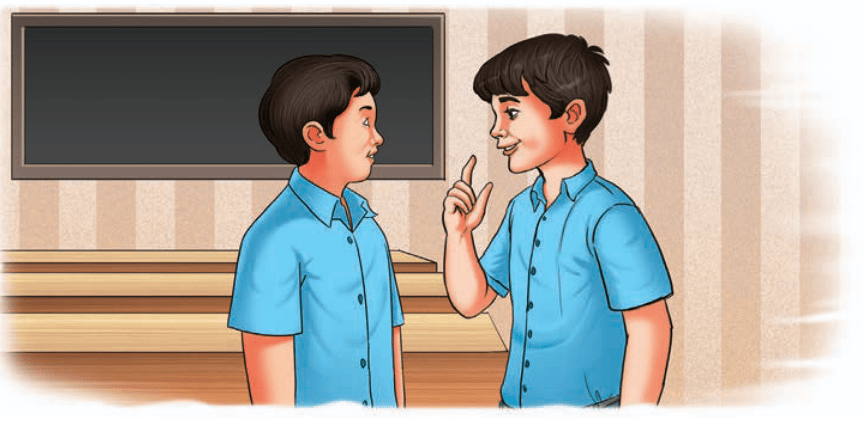
Ravi was (i) ____, always speaking calmly even in arguments. He grew up in a lively (ii)____, where he learned to handle different personalities. His friend Arun, however, was (iii) ____ and often lost his patience. Despite this, Arun admired Ravi's (iv) ____ thinking. One evening, as they passed a (v) ____, they saw some performers rushing out. Ravi noticed that one of them dropped a (vi) ____ book on the ground. "Is this yours?" he asked. "Oh thank you, young man!" the performer smiled. "It's a recent purchase from the (vii) ____ round the corner." True to his nature Arun promptly said to Ravi, "It's (viii) ____ that it's not from a bakery but bookshop!" Ravi smiled and they walked on.
IV. Read the sentences from the text and their explanation given in the table below.
| Sentences from the Text | Tenses | Explanation |
| 1. If you like, I will try my best to resolve this matter. | Simple Present + Present Modal | The condition in the 'if clause may or may not be fulfilled. The present tense refers only to a possible future action. |
| 2. If, by chance something were to go wrong, our farmers would suffer. | Simple Past + Past Modal | The condition in the 'if clause expresses a hypothetical or imaginary situation. |
| 3. If I had known this would happen, I would have chosen another day. | Past Perfect + would have + Past Participle | The condition in the 'if clause describes what the speaker would have done (differently) if the past situation had been different and it is impossible to rectify it in the present. |
In sentence 1 'if you like' is the subordinate clause (if clause) and 'I will try my best to resolve this matter' is the main clause.
Identify the subordinate and main clauses in sentences 2 and 3.
Now, match the subordinate clauses (if clauses) in Column 1 with the appropriate main clauses in Column 2 to make complete sentences.
| Column 1 | Column 2 |
| (i) If I had a magic wand, | A. We will go to the theatre. |
| (ii) If it rains tomorrow, | B. I would sneak into the secret room. |
| (iii) If you had listened carefully, | C. I would give myself wings. |
| (iv) If you finish your homework, | D. The boys would have woken up on time. |
| (v) If I were invisible, | E. We will stay indoors and play board games. |
| (vi)If the alarm had rung, | F. You would have solved the puzzle. |
V. Complete the following sentences appropriately with either the main clause or the subordinate clause (if clause).
- Your teacher will be unhappy if __________.
- They would have caught the train if __________.
- __________ if you continue to stay up late every night.
- If she knew the answer, __________.
- __________ if she had studied harder.
- If I had a million rupees,__________.
VI. Complete the following sentences. One example has been done for you.
- If I were a tree, I would play with the wind and talk to the birds.
- If I were the Head Teacher of my school, __________.
- If I were a bird, __________.
- If I were a magician, __________.
- If I had studied harder, __________.
Let us Listen
I. You will listen to a woman narrating a story. As you listen, fill in the blanks in the following sentences by selecting the correct options. (Transcript for teacher on page 46)
- The rope tying the bundle of sticks was
- (i) loose
- (ii) thick
- (iii) short
- The scholar is finally referred to as
- (i) irritable
- (ii) mischievous
- (iii) arrogant
II. You will once again listen to the story. As you listen, number the events of the story in the correct order of occurrence.
- The great scholar was ashamed because he did not know what to say.
- Rama accepted the challenge thrown by the visitor.
- Rama had a bundle tied in silk when he came to the palace.
- The king laughed at the explanation given by Rama.
- The visitor wanted to show his superiority over others in the palace.
- Rama showed the work to be a bundle of sticks tied together by a rope.
- The king wanted to know more about the work mentioned by Rama.
- The court scholars were afraid of the king's anger.
Let us Speak
I. While asking questions, it is important to use the appropriate tone to convey the correct meaning.
- 'Yes' or 'No' questions have a rising tone at the end. Are you coming home?
- '-Wh' questions have a falling tone at the end. When will you come home?
This rise and fall in tone is called intonation.
Now, work in pairs and mark the intonation in the questions given below. Take turns to practise by saying them aloud with the correct intonation.
- (i) Is this your cat?
- (ii) What is the name of your cat?
- (iii) Will you be going to your village?
- (iv) Why are you going to your village?
- (v) Is this where you live?
- (vi) Where do you live?
- (vii) Can I meet your parents?
- (viii) How are your parents?
- (ix) Do you have any plans for tomorrow?
- (x) What are you going to do tomorrow?
II. 'What', 'Why', 'When', 'How', 'Where', and 'Who' are the words used to ask questions. These words are called question words. Let us use these words and make some questions
While making questions, remember the correct word order.
- Who is the cleverest character in the story? (Correct)
- Who the cleverest character is in the story? (Incorrect)
- Work in pairs and take turns to ask and answer questions about a trip that you are planning. Remember to use the correct intonation while asking these questions.
- The destination (Where...)
- Purpose (Why...)
- Mode of transport (How...)
- Duration (When...)
- Travel companions (Who...)
- Activities (What...)
Here are some prompts for you.
Now, work in pairs and take turns to ask and answer the questions about witty characters in folktales or stories you have read. Use the correct intonation while asking questions.
For example: Your favourite character in the folktale (Who...?) Who is your favourite character in the folktale?
- The name of the witty character (Who...?)
- The reason for her/his wit being important in the story (Why...?)
- The most famous trick or clever idea she/he used (What...?)
- The time period or setting of the folktale/story (When...?)
- The way she/he used her/his intelligence to solve a problem (How...?)
- The location where the story takes place (Where...?)
Let us Write
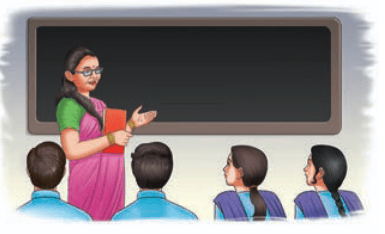
A narrative essay is written on a personal experience or an imagined experience.
I. Read the narrative essay given below.
A Lesson in Responsibility
One bright Monday morning, I woke up to the sounds of birds chirping loudly. For once, I wasn't late for school. My uniform was neatly laid out, and my homework was already packed in my bag. I felt proud of myself for being so organised. But little did I know, the day would still teach me an important lesson.
During the morning assembly, our teacher, Mrs. Rao, announced a surprise Science quiz. My heart skipped a beat. I had studied the chapter a week ago, but I had forgotten to revise it over the weekend. As I sat at my desk with the question paper in front of me, I froze. The questions looked familiar, yet I couldn't recall the answers clearly. I tried my best to focus, but it wasn't enough. Later, when the results were announced, I scored much lower than I expected. Disappointed, I spoke to Mrs. Rao after the class. She smiled and said, "It's not about how much you know but how consistently you prepare. Small efforts add up every day."
Her words stayed with me. From that day on, I made it a habit to revise my lessons regularly, even if there wasn't an immediate test. Responsibility isn't just about being on time or finishing tasks-it's about being ready for what's unexpected.
Now, work in pairs and check (✔) if the following features are present in the narrative essay.
- Introduction
- The essay begins with a clear and engaging opening.
- The introduction sets the context for the narrative.
- The central idea or purpose is clear.
- Body of the essay
- Events are narrated in a logical sequence.
- Descriptive details are used.
- Characters and settings are clearly described.
- The narrator's emotions or thoughts are shared.
- The essay includes a challenge or a problem or a turning point.
- Conclusion
- The essay ends with an outcome.
- A lesson or a message is clearly stated.
- Writing Style
- The tone is personal and engaging.
- First person narration is used (for example, 'I,' 'my').
- Language
- The essay uses simple and clear language.
- Grammar, punctuation, and spellings are correctly used.
Note: A narrative essay focuses on sharing a personal experience to convey a specific lesson, a reflection, or an idea. It has an introduction, a body, and a conclusion.
Now, write a narrative essay based on any one of the situations given below.
- The Day I Learnt the Value of Teamwork
- A Small Act of Kindness that Made a Difference
Let us explore
I Limericks are poems in five lines that have a twist in the last line. Read and enjoy the following limericks and create one on your own. Raju flew his kite in the sky so wide, It soared with grace, full of pride. But a crow came along, Singing its song, And now it's the crow on a joyride!
II Go to the library and read a story of your choice. Share its theme and the interesting parts of the story with your classmates and teacher.
III You must have read stories of wit, humour, and wisdom in your own language or English. Make a list of these stories that you have read on a chart paper. Each student should read at least one new story from the list.
A CONCRETE EXAMPLE
Let us do these activities before we read.
I Read the names of items you usually find in a garden and write their names against each picture given below.
garden hose, sapling, hedge, flower beds, flower pot, pebbles, rockery, fence, vine, wheelbarrow
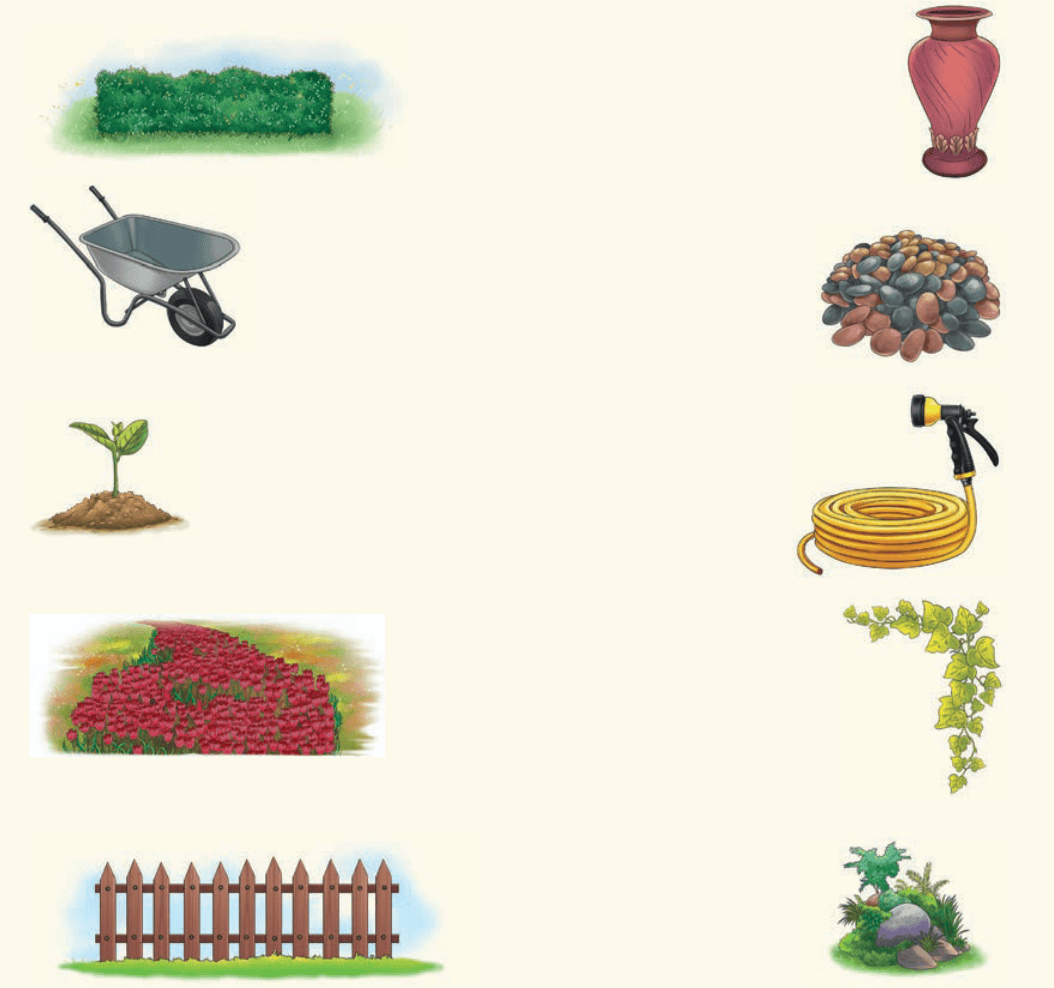
II Work in groups of four. What kind of garden would you like to have? Mention the features that you can include and the reasons for your choice. Share your answers with your classmates and teacher.
III Read the title of the poem. What comes to your mind when you read the word 'concrete'? Does it have more than one meaning? Share your answers with your classmates and teacher.
Let us Read
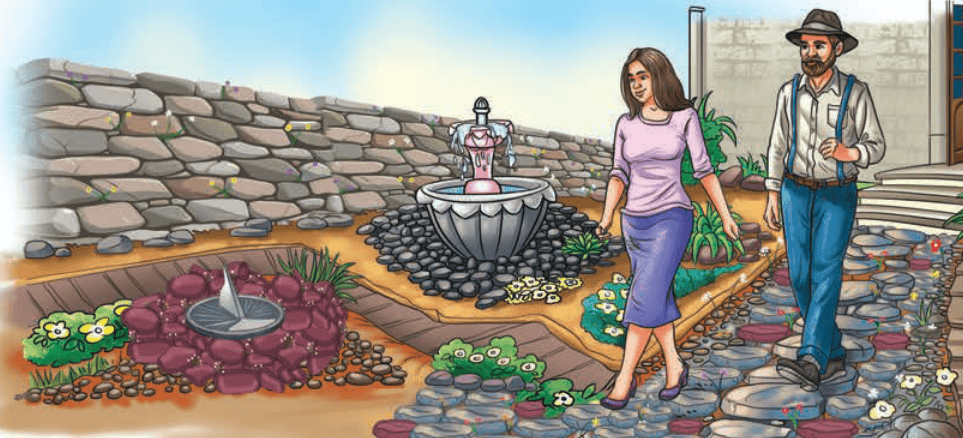
My next-door neighbour, Mrs. Jones, has got a garden full of stones: A crazy path, a lily pond, a rockery and, just beyond A sundial with a strange device, which Mrs. Jones thinks rather nice.
My next-door neighbour, Mrs. Jones, puts little plants between the stones They are so delicate and small, they don't mean anything at all. I can't think how she gets them in, unless she plants them with a pin.
My next-door neighbour, Mrs. Jones, once asked me round to see her stones. We stood and talked about a flower for quite a quarter of an hour. "Where is this lovely thing?" I cried. "You're standing on it," she replied.
Let us discuss
I Complete the following summary with exact words from the poem. One example has been done for you. Share your answers with your classmates and teacher.
The poem describes Mrs. Jones, the speaker's next-door neighbour, who has a unique garden filled with 1. _____. Her garden includes a peculiar 2. _____, a pond, and a rockery, along with an unusual 3. _____ that she finds charming. Mrs. Jones plants tiny, 4. _____ plants between the stones, which the speaker thinks must be so small that they are planted with a 5. _____. One day, Mrs. Jones invites the speaker to see her garden, and they discuss a 6. _____ that Mrs. Jones treasures. When the speaker asks where the 7. _____ flower is, Mrs. Jones says that the speaker has been 8. _____ on it all along.
II Select the correct option to fill in the blanks for the following sentences.
- The tone of the poem is
- (i) mocking
- (ii) humorous
- (iii) mournful
- (iv) amusing
- (v) light-hearted
- A. (i), (ii), and (iii)
- B. (i), (ii), and (v)
- C. (ii), (iii), and (iv)
- D. (ii), (iv), and (v)
- The speaker in the poem is
- (i) Mrs. Jones
- (ii) the poet
- (iii) a gardener
- (iv) a child
- The rhyme scheme of the poem is
- (i) AABBCC
- (ii) ABABCC
- (iii) AABCAC
- (iv) ABBACC
III Complete the following sentences by choosing the correct answer given in the brackets.
- The poet uses the word 'stones' in all stanzas in order to emphasise her _____.(obsession with a stony garden/pride in gardening skills)
- The poet uses imagery to describe the features of the garden that help readers _____. (understand Mrs. Jones' love for plants/visualise the garden's peculiar nature)
IV Pick examples of alliteration from the poem.
V A refrain is a repeated line or phrase that appears in each stanza. Identify the refrain from the poem.
VI Irony is a literary device that emphasises the difference between what is expected and what actually happens. It often involves a situation where the outcome is the opposite of what is expected, creating a surprising or a humorous effect. For example, Mrs. Jones' excitement about her garden contrasts with the speaker's disappointment on how ordinary it is. Identify the line(s) from the poem that display(s) situational irony.
VII Complete the following sentences appropriately.
- The word 'concrete' can refer to readers _____in Mrs. Jones' garden.'concrete' example of Mrs. Jones'
- The title also has a symbolic meaning, as the poem provides a clear or 'concrete' example of Mrs. Jones' _____ gardening habits.
VIII The title 'A Concrete Example' carries both literal and symbolic (metaphorical) meaning. Such word play is called a pun. A pun is a figure of speech that uses words with multiple meanings or words that sound alike but have different meanings, creating a humorous effect.
- I tried arguing with my pencil but it kept making sharp points. (suggests the idea of an actual sharp pencil point and strong argument points)
- My pencil and I had a disagreement but we finally got to the point. (refers to solving an argument and the pencil's tip)
Let us think and reflect

I Read the given extract and answer the questions that follow.
- My next-door neighbour, Mrs. Jones, has got a garden full of stones: A crazy path, a lily pond, a rockery and, just beyond A sundial with a strange device, which Mrs. Jones thinks rather nice.
- (i) What can be inferred about Mrs. Jones's taste in gardening from the description of her garden being 'full of stones'?
- (ii) Identify whether the following statement is true or false.
The garden serves as a means to reveal more about Mrs. Jones herself. - (iii) What does the poet mean by 'crazy path'?
- (iv) What does the sundial with a 'strange device' suggest about Mrs. Jones' personality?
A. She has a fascination with unusual items.
B. She prefers traditional garden decorations.
C. She is uninterested in her garden's appearance.
D. She likes modern and expensive items.
II Answer the following questions.
- How does Mrs. Jones feel about her garden? Support your answer with evidence from the poem.
- Why do you think the speaker describes the plants as being so small that they could be planted with a pin?
- What do we get to know about Mrs. Jones-based on her gardening style and her interaction with the speaker?
- The poem portrays Mrs. Jones in a positive light. Support this statement.
- What does the poem tell us about the way people think differently about the world around them?
Let us learn
I Select the appropriate word from the brackets that correctly replaces the underlined word in the sentences from the text.
- A sundial with a strange device, (unusual, peculiar, new, rare, external)
- ... which Mrs. Jones thinks rather nice. (pleasant, superior, agreeable, gentle, charming)
- They are so delicate... (delicious, fragile, dainty, graceful, weak)
- "Where is this lovely thing?" I cried. (exclaimed, wept, shouted, announced, whispered)
II The 'sundial' is referred to as a 'device' in the poem. Work in pairs to infer the meaning of 'device'. Share your thoughts with your classmates and teacher.
Now, match the type of instruments in Column 1 with their definitions in Column 2. Column 3 shows one example of each type of instrument. Add more examples in Column 3.
| Column 1 | Column 2 | Column 3 |
| 1.implement | (i) something that is electrical and is used to do work in the house | spade, knife |
| 2.tool | (ii) something small that is mechanical or electronic | hammer |
| 3.equipment | (iii) something that works on being moved by hand | cricket bat, helmet, batting gloves, etc. |
| 4.appliance | (iv) a set of necessary items for a particular purpose | mixer grinder |
| 5.gadget | (v) something used by hand to make or repair | mobile phone, laptop |
III Complete the table by making new words in Column 1 using the hints given in Column 2. Replace the first letter of the given word to create new words. One example has been done for you.
-
nice
Column 1 Column 2 (i) dice cut into small pieces (ii) grain that we cook (iii) plural of mouse (iv) bad habit -
soil
Column 1 Column 2 (i) heat something (ii) work very hard (iii) length of wire in a circle (iv) sheets to wrap food items
Let us Listen

I. You will listen to a presentation about the wonderful Rock Garden of Chandigarh. As you listen, answer the following questions using one to three exact words from the presentation. (Transcript for teacher on page 47)
- Where was Nek Chand's Rock Garden featured?
- What kind of sculptures does the Rock Garden have?
- How is the Rock Garden divided?
- Name any one thing that has been transformed into a piece of art in the Rock Garden.
- Approximately, how many statues border the Rock Garden?
Let us Speak
I. The speaker of the poem might have felt sorry for stepping on Mrs. Jones' flower. When we make a mistake, we must express regret and apologise for our actions.
- When we apologise to a friend or a family member, we use informal language. Take turns to apologise for the following situations and respond to the apology.
- (i) You have eaten your brother's share of sweets.
- (ii) You have broken your sister's flower craft.
- (iii) You accidentally spilled ink on your mother's important documents.
- (iv) You forgot to bring your friend's notebook to the school after borrowing it.
You may use the following phrases given below.
| Phrases for Apology | Phrases to Respond to Apology |
| ●I'm sorry about... | ●That's alright. |
| ●I'm really sorry... | ●It's no big deal. |
| ●Please forgive me for... | ●No problem. |
| ●Sorry, I didn't mean to... | ●These things happen. |
2. When we apologise to someone in authority like a Principal or a teacher in a formal setting, we use formal language. Work in pairs and take turns to apologise for the following situations and respond to the apology.
(i) You did not bring an assignment that was due for submission.
(ii) You were late to school for the past three days and had to meet the Principal.
(iii) You did not submit your project work and were asked to explain.
You may use the phrases given below.
| Phrases for Apology | Phrases to Respond to Apology |
| ●I'm extremely sorry for... I promise it won't happen again. |
●I accept your apology. Please ensure you... |
| ●I owe you an apology for... I'll do my best not to repeat it. |
●I appreciate you saying this, but... |
| ●I really regret... I assure you that this will never happen again. |
●I'm glad you realised your mistake... |
Let us write
You are a member of the Nature Club of your school. Draft a notice informing the students of Grades 6-8 about the inauguration of the Herb Garden.
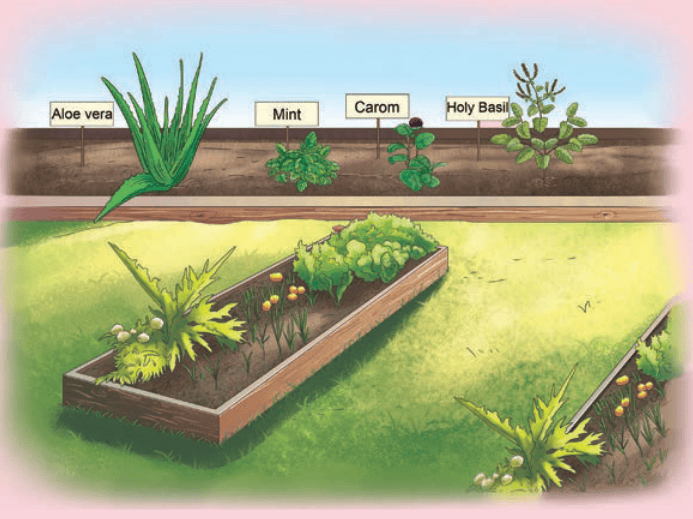
Points to remember:
- Mention the purpose of writing, date, time, venue, and any other relevant information-whom to contact, when, and where.
- Use formal language in the third person form.
- Write the notice in a box.
NAME OF THE ORGANISATION
NOTICE
Date
Title
(Body of the notice)
Name
Signature
Class
Let us explore
I Amrit Udyan is a garden spread over an expanse of 15 acres around Rashtrapati Bhavan in New Delhi. It has multiple attractions that include a specially curated garden for children called Bal Vatika, a treehouse, nature's classroom, etc. It also has the Bonsai, Herbal-I, Herbal-II, Tactile Garden, Arogya Vanam, and Circular Gardens with a diverse variety of flora and fauna.
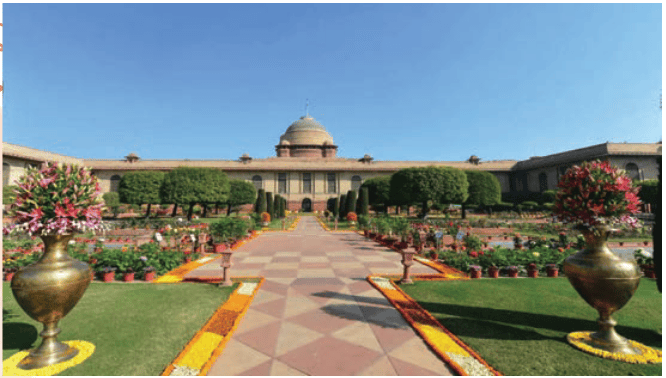
Now, find out about popular gardens in your region and share with your classmates and teacher.
II A herbarium is a collection of plant samples preserved for long-term study, usually in the form of dried and pressed plants mounted on paper.

Now, collect some fallen flowers and leaves from your neighbourhood. Place them in folds of a newspaper carefully and put a pile of books on them. After one week, take them out and use them to make a card, wall hanging or any other artwork. A sample has been given for your reference.
III Read and enjoy the poem.
A Sea of Foliage
A sea of foliage girds our garden round,
But not a sea of dull unvaried green,
Sharp contrasts of all colours here are seen;
The light-green graceful tamarinds abound
Amid the mango clumps of green profound,
And palms arise, like pillars gray, between;
And o’er the quiet pools the seemuls lean,
Red—red, and startling like a trumpet’s sound.
But nothing can be lovelier than the ranges
Of bamboos to the eastward, when the moon
Looks through their gaps, and the white lotus changes
Into a cup of silver. One might swoon
Drunken with beauty then, or gaze and gaze
On a primeval Eden, in amaze.
WISDOM PAVES THE WAY
Let us do these activities before we read.
I Why do we seek advice of the elderly in our family? Share your thoughts with your classmates and teacher.
II Knowledge is about learning facts and information, while wisdom is about using that knowledge with good judgement. Work in pairs. Read the following situations and classify each one as either ‘knowledge’ or ‘wisdom’. One example has been done for you.
- Riya’s understanding of plant care helped her grow a healthy vegetable garden in her backyard.
- Mr. Kumar values time with family over chasing wealth.
- Karuna’s expertise in computer programming helped her develop a successful app.
- Rohan understood the value of time management and created a timetable to complete his assignments systematically.
- Ramesh chose to forgive his friend for a misunderstanding.
- Ms. Vaijayanthi delivered a lecture on Indian Classical music at the cultural festival.
| Knowledge | Wisdom |
| 1. |
III Observe the picture carefully. What do you think might have happened? Share your answers with your classmates and teacher.
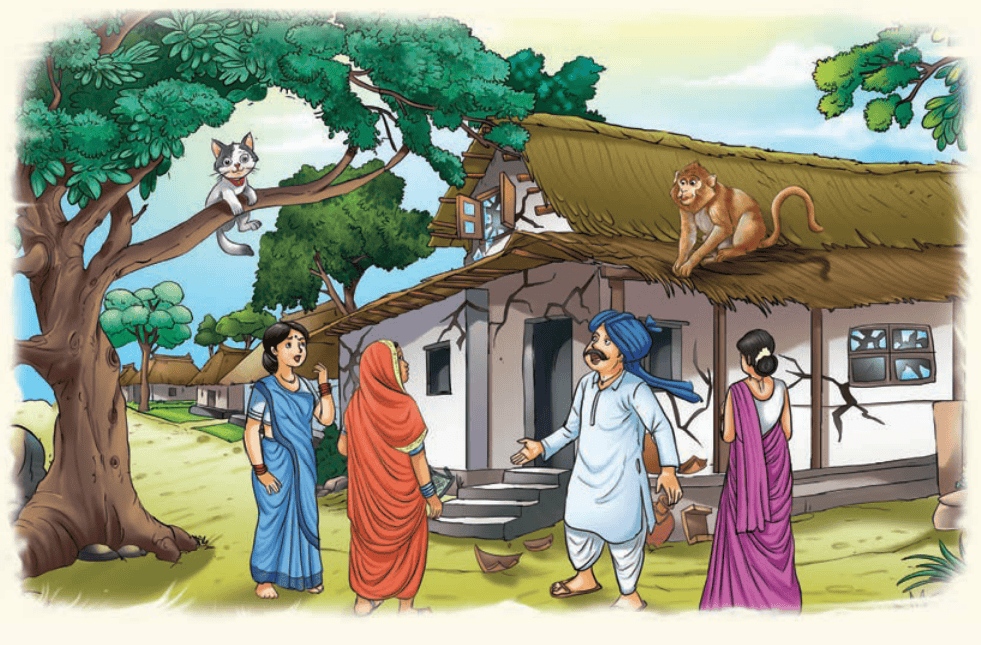
Let us Read
Characters
The King of Ujjain : a young King
Four Young Men The Merchant : Ram Datt, Shiv Datt, Har Datt, and Dev Datt
adorned: beautified
tapestries: heavy decorative fabrics woven with pictures or patterns
resolute: determined
bustling: busy
Two Sentries
Setting : A road leading to Ujjain, visible in the distance. Later, the King’s court, adorned with rich tapestries, tall pillars, and regal decor. The time is midday.
Scene I: The Road to Ujjain
(Four young men—Ram Datt, Shiv Datt, Har Datt, and Dev Datt—are walking along a dusty road leading to Ujjain. They appear travel-worn but resolute, their eyes fixed on the city that looms ahead. The sun is high, and the distant noise of the bustling city faintly reaches them.)
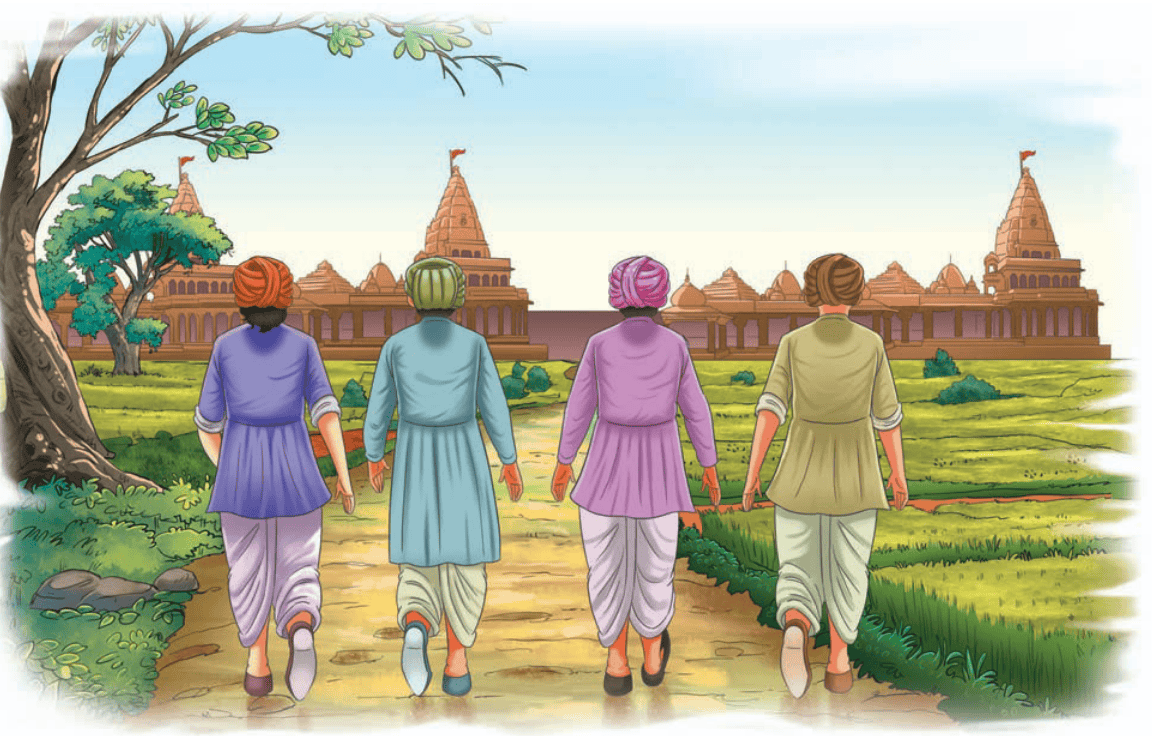
Ram Datt : (Wiping his brow) We have journeyed far from home, yet the prospect of finding work still eludes us.
Har Datt : How long has it been since we left our village?
Shiv Datt : I believe it has been over a week— perhaps even longer.
Ram Datt : Ten days, to be precise. Every day feels longer than the last.
Dev Datt : Ten days are but a short span in the grand scheme of things. We may still have many more roads to wander before we find employment befitting all four of us.
Ram Datt : If only we could secure an audience with the King of Ujjain. I am confident he would recognise our talents and appoint us to his service.
Shiv Datt : I share your belief.
Dev Datt : Indeed, we ought to be united in this hope. That is why we press on towards Ujjain.
deliberate: to think carefully
Har Datt : (Pausing thoughtfully) Gaining an audience with the King is no simple task. We need to devise a strategy.
Dev Datt : Let us reach the city gates first. We can deliberate
once we are closer.
(As they walk, Ram Datt notices something on the
ground.)
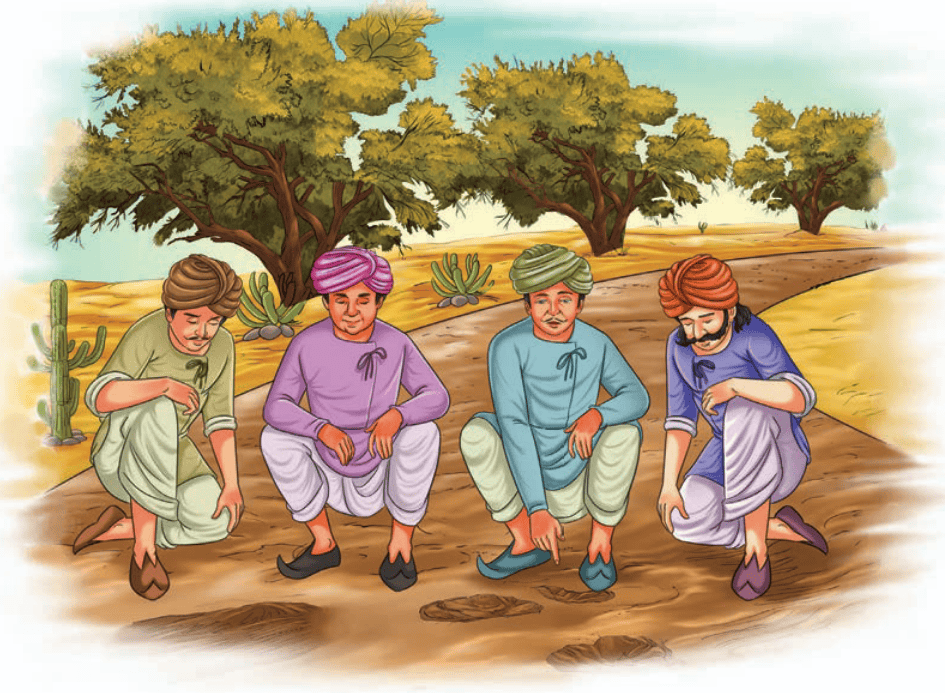
Shiv Datt : Look there, friends. A camel has passed this way.The tracks are fresh.
scrutinise: to look carefully at
in haste: in a hurry
pursued: (here) chased
countenance: facial expression
distressed: worried
Ram Datt : (Studying the tracks) Yes, let us observe them as we continue. They may tell us more than meets the eye.(The four men continue walking, occasionally stopping to examine the camel’s tracks. They scrutinise every detail, exchanging glances but saying little.)
Ram Datt : I have discovered something peculiar about this camel.
Shiv Datt : So have I.
Har Datt : I, too, have noticed a strange detail.
Dev Datt : (Smiling) It seems each of us has learnt something unique, yet I believe my discovery is unlike any of yours.
Har Datt : Let us rest beneath a large tree and share our findings. But wait—someone approaches in haste!
Shiv Datt : (Peering ahead) It appears to be a merchant, running as if pursued by trouble.
Ram Datt : A merchant indeed, and judging by his countenance, he has lost something of great value—perhaps his camel. (The Merchant, panting and distressed, reaches the group. He pauses to catch his breath, then addresses them anxiously.)
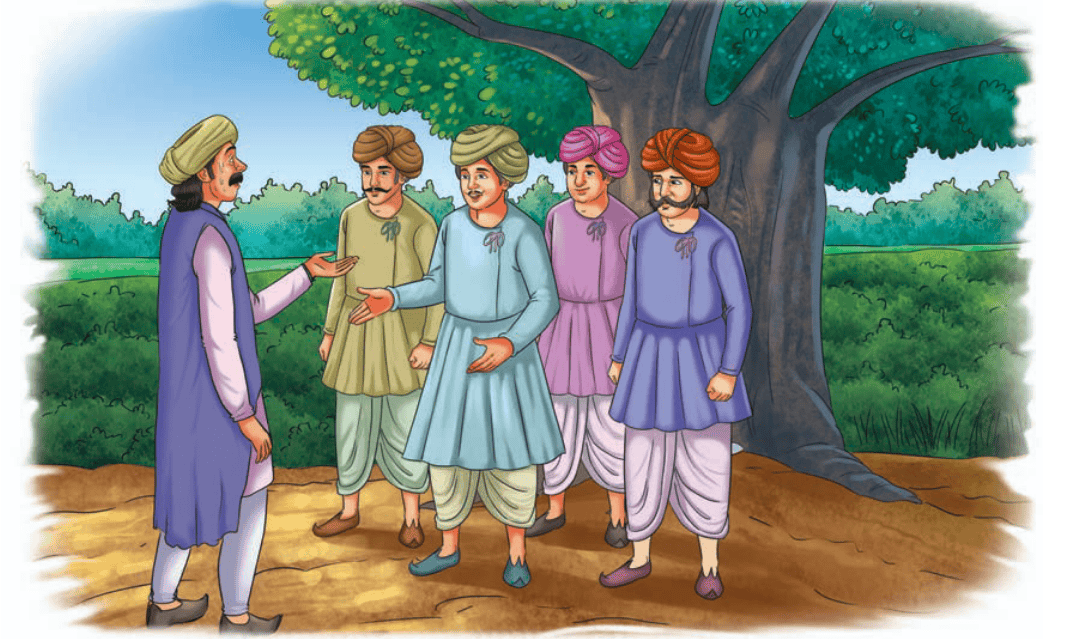
Merchant : (Breathlessly) Good day, kind sirs
All Four : Good day, brother.
Merchant : I seek your help. My camel has gone astray. Have you, by chance, seen it?
Ram Datt : Is your camel lame in one leg, by any chance?
Merchant : (Surprised) Yes, yes, it is!
Shiv Datt : Is it blind in the right eye?
Merchant : Precisely! It is blind in one eye—the right one, as you say.
Har Datt : And does it have a short tail?
Merchant : (Astonished) You describe it perfectly! Yes, it has a short tail.
Dev Datt : Tell me, sir, has it not been suffering from a pain in the stomach?
Merchant : (Taken aback) How could you possibly know that? The poor creature has been unwell for two weeks now. Surely you are a healer! I will gladly pay your fee if you can cure it. But tell me, where is my camel?
Ram Datt : We regret to inform you that we do not know where it is.
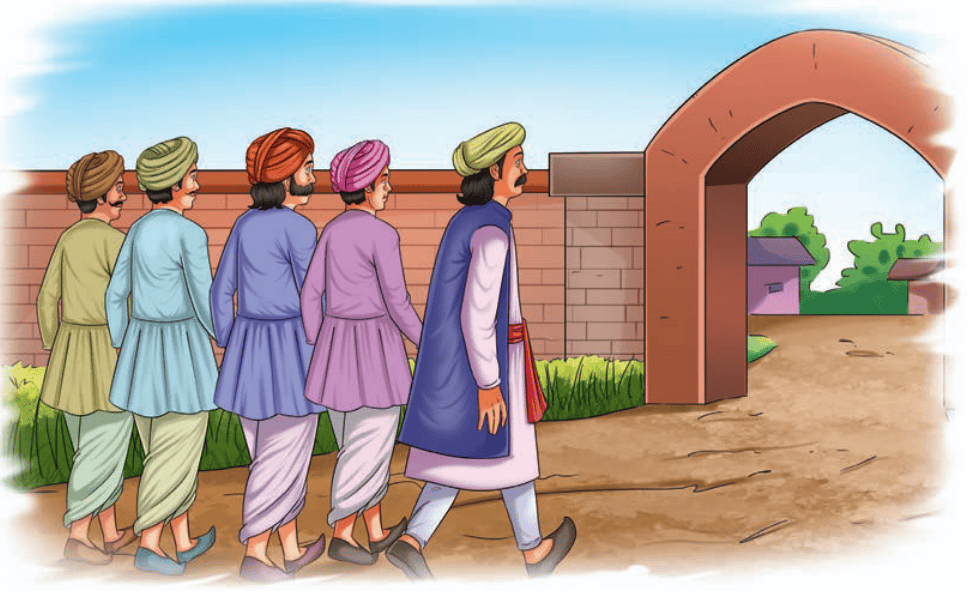
Shiv Datt : We have not seen your camel, not even once.
indignant: angry
yonder: over there
Merchant : (Indignant) How can that be? You speak of my camel as if it stood before you, yet you dare to claim not to have seen it! You are deceivers! You must have stolen it and sold it off. I will take this matter to the King himself.
Dev Datt : You are free to do as you wish, sir. If the King desires our presence, we shall be waiting under that banyan tree yonder.
Merchant : I do not trust your words. I will not leave you here to slip away. You shall come with me to face the King!
All Four : Very well. We shall go to the King.
(They follow the Merchant towards the city gates. As
they arrive at the palace, the Merchant speaks urgently
to a Sentry. The Sentry leads the Merchant inside.)
Let us discuss
I . Complete the following sentences with suitable reasons. One example has been done for you. Share your answers with your classmates and teacher.
- Shiv Datt said, “I believe it has been over a week, perhaps even longer,” because it had been a long time since they left the village.
- Dev Datt said, “Indeed, we ought to be united in this hope. That is why we press on towards Ujjain,” because ______________________.
- Har Datt said, “Look there, friends. A camel has passed this way. The tracks are fresh,” because ______________________.
- Shiv Datt said, “It appears to be a merchant, running as if pursued by trouble,” because ______________________.
- The merchant said, “How could you possibly know that? The poor creature has been unwell for two weeks now. Surely you are a healer!” because ______________________.
- Dev Datt said, “You are free to do as you wish, sir. If the King desires our presence, we shall be waiting under that banyan tree yonder,” because ______________________.
Scene II: The King’s Court
canopy: (here) a cover fixed over a seat for decoration
grievance: complaint
accusations: claims that someone has done something wrong
(The King of Ujjain sits upon his throne, surrounded by courtiers. The grand hall is adorned with rich draperies, tall columns, and a golden canopy. The King, regal in his bearing, watches intently as the Merchant and the Sentry bow before him.)
King : (Commanding) What is the matter that brings you to my court?
Sentry : Your Highness, this merchant has come with a grievance against four travellers. He accuses them of stealing his camel.
King : Bring forth the accused.
(The Sentry bows and exits, returning shortly with the four young men. They bow respectfully before the King, maintaining calm despite the accusations against them.)
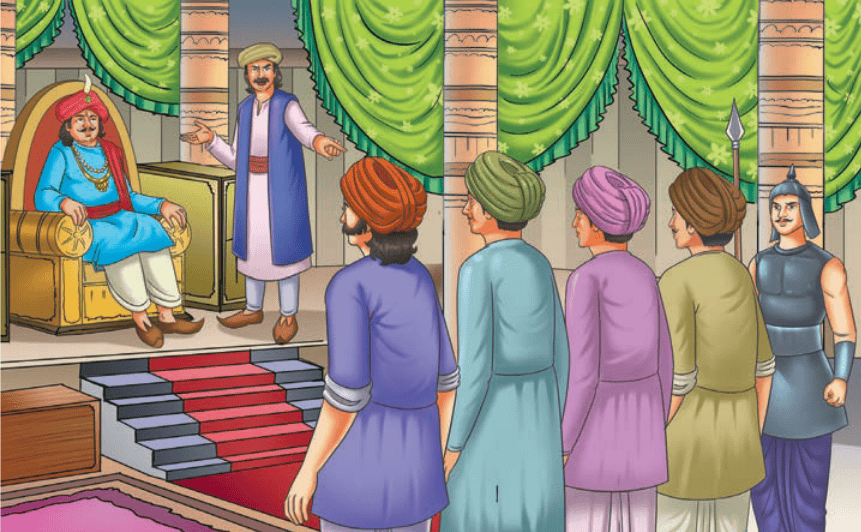
King : (To the Merchant) Speak your accusation clearly. I shall not tolerate any confusion in my court.
Merchant : Your Majesty, these men know every detail of my missing camel, yet they insist they have never seen it. They are undoubtedly the thieves. How else could they know so much about it?
King : (Turning to Ram Datt) You, speak. What do you know of this camel?
Ram Datt : Your Highness, I discovered that the camel is lame in one of its legs.
discern: to see or notice something
foliage: green leaves and plants
King : And how did you deduce this?
Ram Datt : From its tracks on the road,I observed that only three feet left distinct impressions. The fourth was faint, indicating a limp. The pattern of the tracks told the tale of a creature struggling to bear its weight evenly
King : (Nodding thoughtfully) Impressive observation. You have sharp eyes, indeed. (To Shiv Datt) And what of you? What did you discern about this camel?
Shiv Datt : I observed that the camel was blind in its right eye, Your Majesty.
King : How did you arrive at this conclusion?
Shiv Datt : It had nibbled only on the foliage to the left of the road, leaving the right side untouched. The leaves on the right hung undisturbed, as if unseen. From this, I deduced it could not see with its right eye.
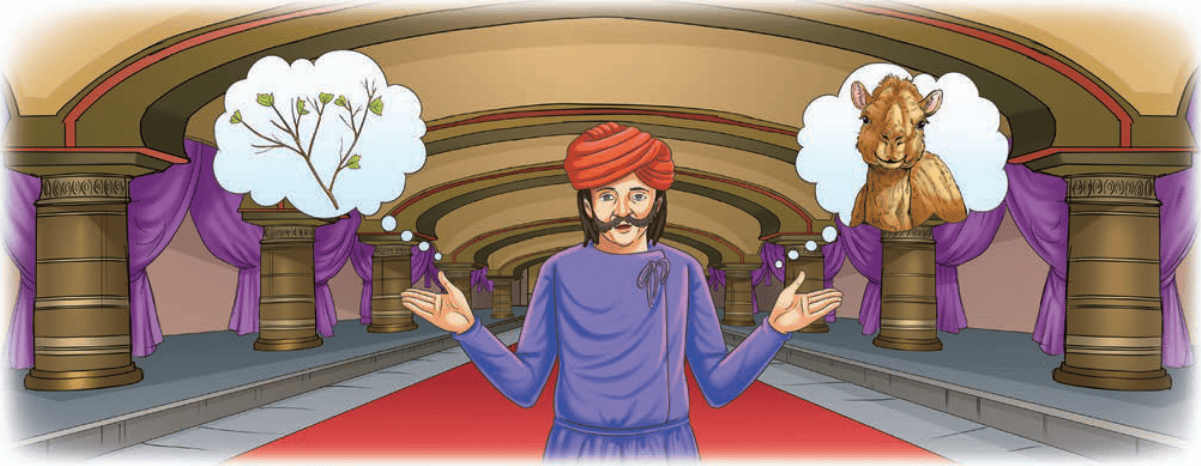
King : (Smiling) Well-reasoned indeed. Such detail is not easily noticed by a casual traveller. (To Har Datt) And your finding?
Har Datt : I discovered that the camel’s tail is short, Your Highness
King : Explain how you came to such a conclusion.
insight: a clear/deep understanding
sound: healthy
intimately: in a detailed way
flawless: perfect
chastened: felt sorry
counsel: advice
beacon: guiding light
Har Datt : I noticed small droplets of blood along the track, likely from mosquito bites. A camel with a long tail would have fended off these pests with ease. These small specks told me of an animal lacking such defence, hence the short tail.
King : (Impressed) You reasoned with great insight, showing both observation and deduction. (Turning to Dev Datt) And you, what did you observe that set you apart from your companions?
Dev Datt : I noticed, Your Majesty, that the prints of the camel’s forefeet were deep and clear, while those of the sound hind foot were faint. This indicated that the camel was drawing up its hind legs, likely due to discomfort. It moved cautiously, burdened by a pain in its belly, trying to spare itself further suffering with every step.
King : (Marvelling) Extraordinary! You have not seen the camel, yet you know it intimately. Your reasoning is flawless and speaks of wisdom that goes beyond mere sight. (Turning to the Merchant) Your accusations are baseless and misguided. These are men of wisdom, not thieves. Go, and continue your search for your camel, and be mindful of whom you accuse in the future.
(The Merchant, chastened and embarrassed, bows deeply and exits, his face red with shame.)
King : (To the four men) You have demonstrated remarkable intelligence and the ability to see beyond the obvious. Suchminds are rare and highly valued in my court. I extend to you the honour of becoming my advisers. Your counsel shall guide my decisions, and your wisdom shall be a beacon for my kingdom. What do you say to my offer?
Ram Datt : (Stepping forward) Your Highness, it is an honour we had not dared to dream of.
Shiv Datt : We are humbled and deeply grateful for your trust in our abilities.
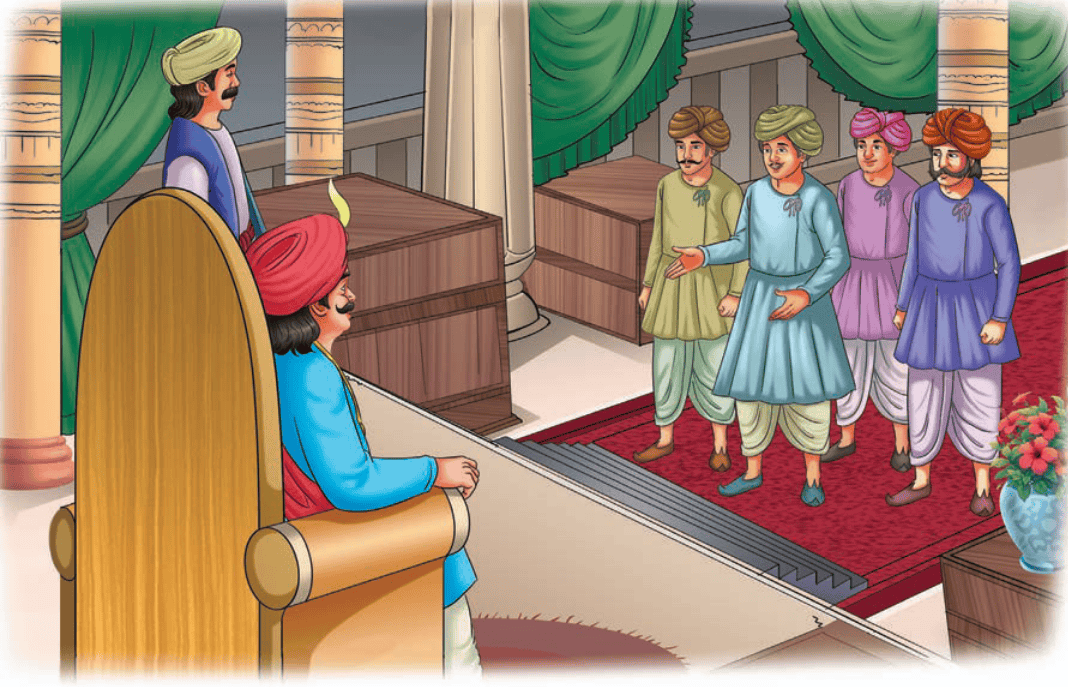
Har Datt : To serve a wise and just ruler like yourself is a privilege we accept with all our hearts.
Dev Datt : We shall dedicate ourselves to your service, offering our insights and counsel in all matters you see fit.
King : (Rising from his throne) Then let it be known across the kingdom that four new advisers stand by my side. May your wisdom shine upon Ujjain and guide us to prosperity.
(The court erupts in applause as the King steps down to greet his new advisers. The four men stand proud and humbled, their journey fulfilled in a manner they had never anticipated.)
CURTAIN
Let us discuss
I. Arrange the following events in order of their occurrence from Scene II of the play. One example has been done for you. Share your answers with your classmates and teacher.
- The King makes the four young men his advisers, impressed by their skills. (8)
- Ram Datt explains how he infers from the tracks that the camel is lame.
- The King asks the merchant to clearly state his accusation.
- The King praises the young men for their observations and dismisses the merchant’s accusation.
- Shiv Datt reveals that the camel is blind in its right eye as it had only chewed on the leaves on the left side of the road.
- Dev Datt explains his observation about the camel’s pain and careful movement.
- Har Datt clarifies how he knew that the camel has a short tail.
- The merchant accuses the four men of knowing a lot about his missing camel.
Let us think and reflect
I. Read the given extracts and answer the questions that follow.
1. Dev Datt : Ten days are but a short span in the grand scheme of things. We may still have many more roads to wander before we find employment befitting all four of us.
Ram Datt : If only we could secure an audience with the King of Ujjain. I am confident he would recognise our talents and appoint us to his service.
Shiv Datt : I share your belief.
Dev Datt : Indeed, we ought to be united in this hope. That is why we press on towards Ujjain
Har Datt : (Pausing thoughtfully) Gaining an audience with the King is no simple task. We need to devise a strategy.
(i) Identify the false statement from the two given below and
rectify it.
A. Dev Datt believes that finding employment is an easy task.
B. Ram Datt is confident that the King would recognise
their talents.
(ii) What does Ram Datt’s confidence in gaining the King’s
recognition tell us about him?
(iii) Complete the sentence given below with the correct option from
those given.
In the line, ‘That’s why we press on towards Ujjain’, the phrase
‘press on’ refers to __________.
A. walking with heavy steps
B. moving forward with determination
C. slowing down frequently for rest
D. stopping briefly to s
(iv) Har Datt says, “We need to devise a strategy.” What can be inferred about Har Datt’s character from his statement?
A. He is doubtful of their abilities and wants to give up.
B. He is eager to rush into the palace without preparation.
C. He is cautious and thoughtful, preferring to plan ahead.
D. He relies on others to make decisions for the group.

2. King : (To the four men) You have demonstrated remarkable intelligence and the ability to see beyond the obvious. Such minds are rare and highly valued in my court. I extend to you the honour of becoming my advisers. Your counsel shall guide my decisions, and your wisdom shall be a beacon for my kingdom. What do you say to my offer?
Ram Datt: (Stepping forward) Your Highness, it is an honour we had not dared to dream of.
(i) Select the option that is true for both Assertion (A) and Reason (R).
(A): The Merchant left the court feeling humbled and ashamed.
(R): The King commanded that the four wise men join his court.
A. Both (A) and (R) are true, and (R) is the correct explanation
of (A).
B. Both (A) and (R) are true, but (R) is not the correct
explanation of (A).
C. (A) is true, but (R) is false.
D. (A) is false, but (R) is true.
(ii) Complete the following sentence by choosing the correct option.
The line, ‘See beyond the obvious’ means that the men had the
ability to ______.
A. challenge common beliefs with reasoning
B. interpret information in traditional ways
C. notice details that others might overlook
D. predict what is going to happen in the future
(iii) Complete the following sentence with a suitable reason. Ram Datt described the King’s offer as ‘an honour we had not dared to dream of’ because ___________.
(iv) How does the King’s offer to the four men reflect his values as a ruler?
II. Answer the following questions.
- What does the dusty road leading to Ujjain tell us about the challenges of the young men’s journey?
- Why did the merchant become suspicious of the four men? What does this tell us about him?
- How do the four young men’s observations about the camel serve as a turning point in the play?
- Why did the King believe the four young men and not the merchant?
- How does the capability of the four young men make them suitable to become advisors?
- Why does the merchant feel ashamed for accusing the four young men of stealing his camel? Explain in your own words.
Let us learn
I. Complete the sentences by filling in the noun form of the textual words given in the brackets.
- Some word games need a lot of thought and _________________.(deduce)
- We need to make close _________________of animals in order to understand their behaviour. (observe)
- A detailed _________________ of the documents shows a lot of errors.(scrutinise)
- You should not make any false _________________against anyone.(accuse)
- She was given an award in _________________of her contribution to literature. (recognise)
II. Match the expressions in Column 1 with their meanings in Column 2.
| Column 1 | Column 2 |
| 1. with all our hearts | (i) surprised |
| 2. to be precise | (ii) starts cheering together |
| 3. gain an audience with | (iii) hidden information that is not obvious |
| 4. catch his breath | (iv) exact and accurate |
| 5. erupts in applause | (v) meeting or hearing someone |
| 6. grand scheme of things | (vi) complete sincerity |
| 7. taken aback | (vii) to pause or rest for some time |
| 8. more than meets the eye | (viii) overall plan of life in a larger context |
Now, make sentences using any five of the expressions from Column 1.
III. Match the different meanings of ‘face’ and ‘bear’ with the correct usage in the sentences given in the table below. (n. stands for the word noun and v. stands for the word verb.)
| Words | Meanings | Sentences |
| face | 1. (n.) the front part of a person’s head from the forehead to the chin | (i) Ravi turned to face his father, when he was called. |
| 2. (v.) to be positioned with the face or front towards | (ii) The face of the clock was painted red and blue. | |
| 3. (v.) to deal with a difficult task or situation | (iii) She has a round, smiling face. | |
| 4. (n.) the front or surface of a thing | (iv) We should be ready to face life’s challenges. | |
| bear | 1. (v.) tolerate | (i) The trees that I planted in my garden took a long time to bear fruit. |
| 2. (v.) accept | (ii) I spotted a bear on a wildlife safari. | |
| 3. (n.) a large heavy mammal | (iii) Riya agreed to bear the responsibilities with confidence | |
| 4. (v.) produce; give birth to | (iv) I can’t bear the sound of vehicles honking. | |
IV. Match the highlighted words in the sentences in Column 1 with the functions they express in Column 2.
| Column 1 | Column 2 |
| 1. I will gladly pay your fee if you can cure it. | (i) expression of disbelief |
| 2. You must have stolen it and sold it off. | (ii) imagined (hypothetical) possibility |
| 3. You shall come with me to face the King! | (iii) moral obligation or advice |
| 4. How could you possibly know that? | (iv) challenge |
| 5. I am confident he would recognise our talents and appoint us to his service. | (v) logical conclusion |
| 6. A camel with a long tail would have fended off these pests with ease. | (vi) wish or hope |
| 7. They may tell us more than meets the eye. | (vii) necessity |
| 8. May your wisdom shine upon Ujjain and guide us to prosperity. | (viii) prediction |
| 9. Indeed, we ought to be united in this hope. | (ix) willingness |
| 10. We need to devise a strategy | (x) command |
| 11. You speak of my camel as if it stood before you, yet you dare to claim not to have seen it! | (xi) possibility |
V Complete the following story with modal verbs in the box given below by using the clues from the functions given within brackets.
might could need to
An old man, known for his wisdom, lived in a small village. One day, a young boy asked him, “How 1. _______ (ability) I become wise like you?” The old man smiled and said, “Wisdom 2._______ (necessity) be earned through patience. You 3. _______ (suggestion) listen, more than you speak.” The boy thought for a while and replied, “It 4. _______ (weak possibility) take years, but I’ll try.” The old man nodded. “You 5._______ (obligation) learn from your mistakes too. Wisdom 6. _______ (possibility) come slowly, but it always arrives for those who seek it.” The boy knew he 7. _______ (ability) become wise if he followed the old man’s advice.
VI. Rewrite the following sentences using appropriate modal verbs. You may take clues from the highlighted words. One example has been done for you
- It is advisable for you to think before you speak.
You should think before you speak. - It is unnecessary to worry about things beyond your control.
- It is not possible for a person to gain experience without taking risks.
- It is essential to treat others with kindness, even when they disagree with you.
- It is not allowed to interrupt when someone else is speaking.
Let us listen
I. You will listen to four people sharing their thoughts on why they enjoy witty characters in stories. As you listen, match statements 1–6 given below to the speakers (i)–(iv). There are two statements you do not need. (Transcript for teacher on page 48)
| Statements | Speaker No |
| 1. Witty characters prove that cleverness is as powerful as strength. | |
| 2. Witty characters show us ways to make learning enjoyable. | |
| 3. Witty characters in a story keep the reader involved. | |
| 4. Witty characters teach me that tricky situations can be managed calmly | |
| 5. Witty characters add excitement to a story by their extraordinary deeds | |
| 6. Witty characters can deactivate tense situations with their cleverness. |
Let us Speak
I. The way in which a word is stressed in a sentence can change its meaning. Read the following examples.
| 1. Look there, friends | (look, not go or do some other action) |
| 2. Look there, friends. | (look there, not here or somewhere else) |
| 3. Look there, friends. | (is addressing the friends and not anybody else around) |
Now, work in pairs. Take turns to say the following sentences aloud by stressing on the highlighted words. Share the meanings of the sentences with each other and teacher.
- I take my dog for a walk in the evening.
- I take my dog for a walk in the evening.
- I take my dog for a walk in the evening.
- I take my dog for a walk in the evening.
- I take my dog for a walk in the evening.
II. Statements and exclamatory sentences usually end with a falling tone. Listen to the teacher read these sentences aloud and repeat it with the correct intonation.
Very well. We shall go to the king.
Yes, yes, it is!
Now, practise by saying the following sentences with the correct intonation.
- Good day, kind sirs.
- We regret to inform you that we do not know where it is.
- You describe it perfectly!
- You shall come with me to face the King!
Let us Write
I. You have observed that the kutcha road leading to your colony is in a very bad condition due to heavy rains. The potholes are dangerous for people and can lead to accidents. They also serve as a breeding ground for mosquitoes as there is stagnant water all around.
Write a letter of complaint to the Commissioner,Municipal Corporation or the Sarpanch, Gram Panchayat to look into the matter and take necessary action.
Follow the format of a formal letter and draft the letter with the help of cues given below.
| Body of the Letter | Useful Phrases |
| Paragraph 1: state the purpose of writing and the issue |
|
| Paragraph 2: give details and consequences of the problem |
|
| Paragraph 3: give suggestions and request for swift action |
|
Let us explore
I. Staging a play requires creativity, organisation, and teamwork.
Steps involved in staging a
- Choose a play that suits your requirement of theme, duration,number of actors, and available resources.
- Choose a director, a stage manager, a light and sound incharge,a props manager, a costume designer, and a makeup artist.
- Hold auditions and decide the roles.
- Read the script and plan stage movements, and positions for each scene.
- Make a schedule for rehearsal.
- Work on the set design (backdrop) and make or collect the required props.
- Design or gather appropriate costumes.
- Plan makeup and hairstyles to suit the play’s time period.
- Check light and sound arrangements.
- Hold a dress rehearsal including sound and light effects.
- Promote the event through posters and pamphlets.
- Organise the backstage with labelled props, costumes, and actors’ entrances or exits.
- Present the play to the audience.
Now, present the enactment of the play ‘Wisdom Paves the Way’ with the help of the steps you have just read. Ensure you use the correct intonation and sentence stress.
II. Stories related to wit and wisdom have always fascinated the readers. Go to the library and read the stories associated with the following.
Vikramaditya and Betal Tenali Rama
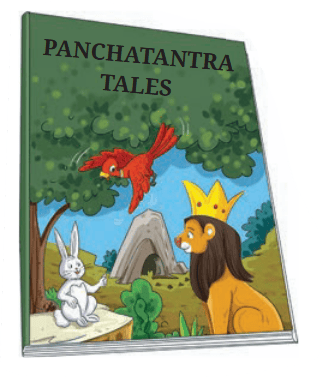
Gopal the Jester Panchatantra Tales
“Let knowledge be the beacon that dispels the darkness of ignorance”.
Savitribai Phule
“The highest education is that which does not merely give us informationbutthatmakesour life inharmonywithall existence”.
Rabindranath Tagore
TRANSCRIPTS
THE WIT THAT WON HEARTS
Let us Listen(refer to page 12)
I. You will listen to a woman narrating a story. As you listen, fill in the blanks for the following sentences given below by selecting the correct options.
Hello everybody! Today I’ll be narrating a story about a quick-witted courtier in the kingdom of Vijayanagara.
A renowned scholar, proud of his abilities, once visited the kingdom of Vijayanagara. You see, he wanted to challenge the scholars in the court of King Krishnadeva Raya. The court scholars did not want to accept the challenge as they were worried of being defeated by the visitor. Besides this, they were also afraid that the king would be angry if they refused to face the scholar.
They knew that only the quick-witted Tenali Rama would be able to manage the situation. So, naturally, they asked him for a solution. As expected, Rama told them that he would accept the challenge.
The next day, Rama arrived at the palace. Rama and the challenger sat facing each other. There was a bundle wrapped in silk kept near Rama. He placed his hand on the bundle and said to the visitor, “Let us start by discussing the merits of tila-kashta-mahisha-bandhana”. The visitor was taken aback. He had read thousands of works. But he had never heard of this work. He had no idea what to say. The scholar had to accept his defeat. Ashamed, he quietly left the palace.
Now, the king was curious to know about the great work Rama had mentioned. Rama smiled and removed the silk cloth. There was a huge bundle of sticks tied with a thick rope! The king was puzzled and asked for an explanation.
Rama told him, “O king! til is sesame; kashta is stick, tilakashta means sticks of sesame plants”. Then, displaying the rope Rama said, “This is the rope used to tie a buffalo—mahisha means buffalo, bandhana means the rope used for tying—so, this is tila-kashta-mahisha-bandhana.”
The king burst out laughing. The poor visitor had become scared hearing such a difficult name. In this way, Rama had taught the arrogant scholar a lesson.
II. You will once again listen to the woman narrating the story. As you listen, number the events of the story in the correct order of occurrence.
A CONCRETE EXAMPLE
Let us Listen(refer to page 23)
I. You will listen to a presentation about the wonderful Rock Garden of Chandigarh. As you listen, answer the questions in one to three exact words.
Hello everyone! The Rock Garden is a spacious open-air exhibition. It is a proof of human creativity with waste materials. This garden was created by Nek Chand, in 1957. This is the reason the garden is also known as Nek Chand’s Rock Garden. The garden was featured on an Indian postage stamp in 1983 and Nek Chand was awarded the Padma Shri a year later.
The Rock Garden is spread across a massive 40-acre wonderland. Do you know why I say this? Well, it is because it has several colourful sculptures and mosaic of art pieces.
What is unique about the Rock Garden is that it is divided into three distinct phases. Each area reveals a unique collection of installations including terracotta pots, light fixtures, and even broken toilet pots, that have been transformed into extraordinary masterpieces.
You will be surprised to know that the borders of the Rock Garden are lined with around 5,000 statues. The Rock Garden is truly a place that celebrates the best from waste. I sincerely recommend that you visit this extraordinary national treasure.
WISDOM PAVES THE WAY
Let us Listen(refer to page 42)
I. You will listen to four people sharing their thoughts on why they enjoy witty characters in stories. As you listen, match statements 1–6 given below to the speakers (i)–(iv). There are two statements you do not need.
Speaker (i) : I love witty characters because they make serious situations funny! Even when things seem tense, they alwayshave acleverresponse. Suchcharacters never panic, think fast, and solve problems in the smartest way. I wish I could think that quickly!
Speaker (ii) : Witty characters are the best because they make stories exciting. I especially like how they turn ordinary moments into something memorable. It makes me feel like intelligence and humour are just as powerful as strength.
Speaker (iii) : I enjoy witty characters because they always have an answer for everything! They use humour instead of fighting, and that’s really wonderful. Even in folktales, they prove that smart thinking can win over force. It makes me laugh but also teaches me to stay calm in tricky situations.
Speaker (iv) : Witty characters add charm to a story. Their intelligence keeps the reader engaged, and their humour makes learning fun. Whether it’s a folktale or a modern one, a clever character always stands out. I often feel that wit and wisdom go hand-in-hand!