
UNIT 5SCIENCE AND CURIOSITY
FEATHERED FRIEND
Let us do these activities before we read.
I. Work in pairs and discuss the questions given below. Share your answers with your classmates and teacher.
- Who can a ‘feathered’ friend be?
- Which ‘feathered’ friend do you like? Why?
- If you have a choice between a ‘feathered’ and a ‘furry’ friend, who would you choose? Why?
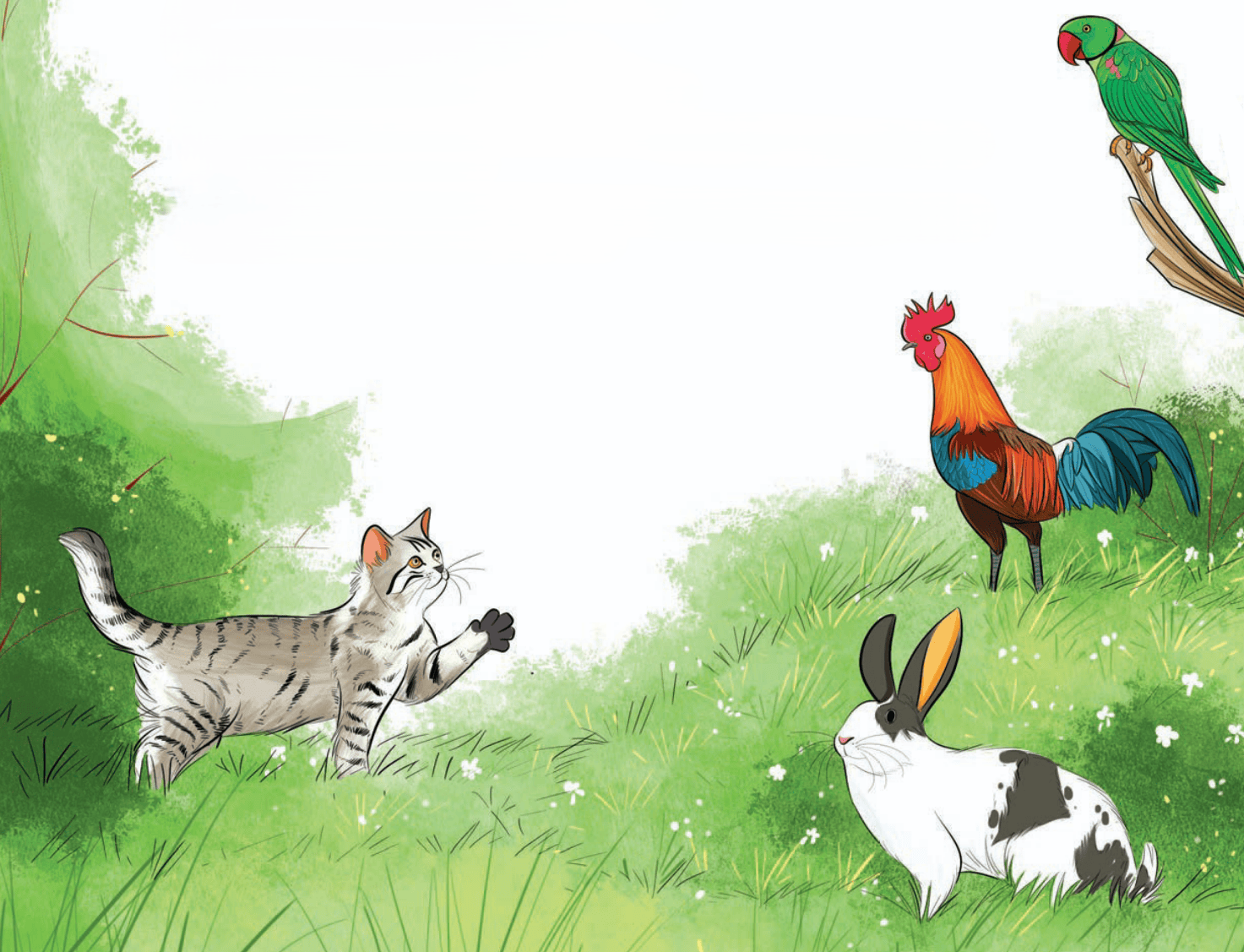
- Do you think a ‘feathered’ or a ‘furry’ friend can accompany astronauts to space? If yes, why? If no, why not?
II. Complete the words given below by inserting vowels. Refer to their meanings given alongside. Share your answers with your classmates and teacher.
- official rule that controls how something is done: R _ G _ L _ T _ _ N
- to not allow something: F _ R B _ D
- join or blend to form a single entity: F _ S _
- suddenly: _ B R _ P T L Y
- admit one’s mistake: C _ N F _ S S
- a person who advises what to eat to keep healthy: D_ _ T _ T _ _ N
Let us read
I
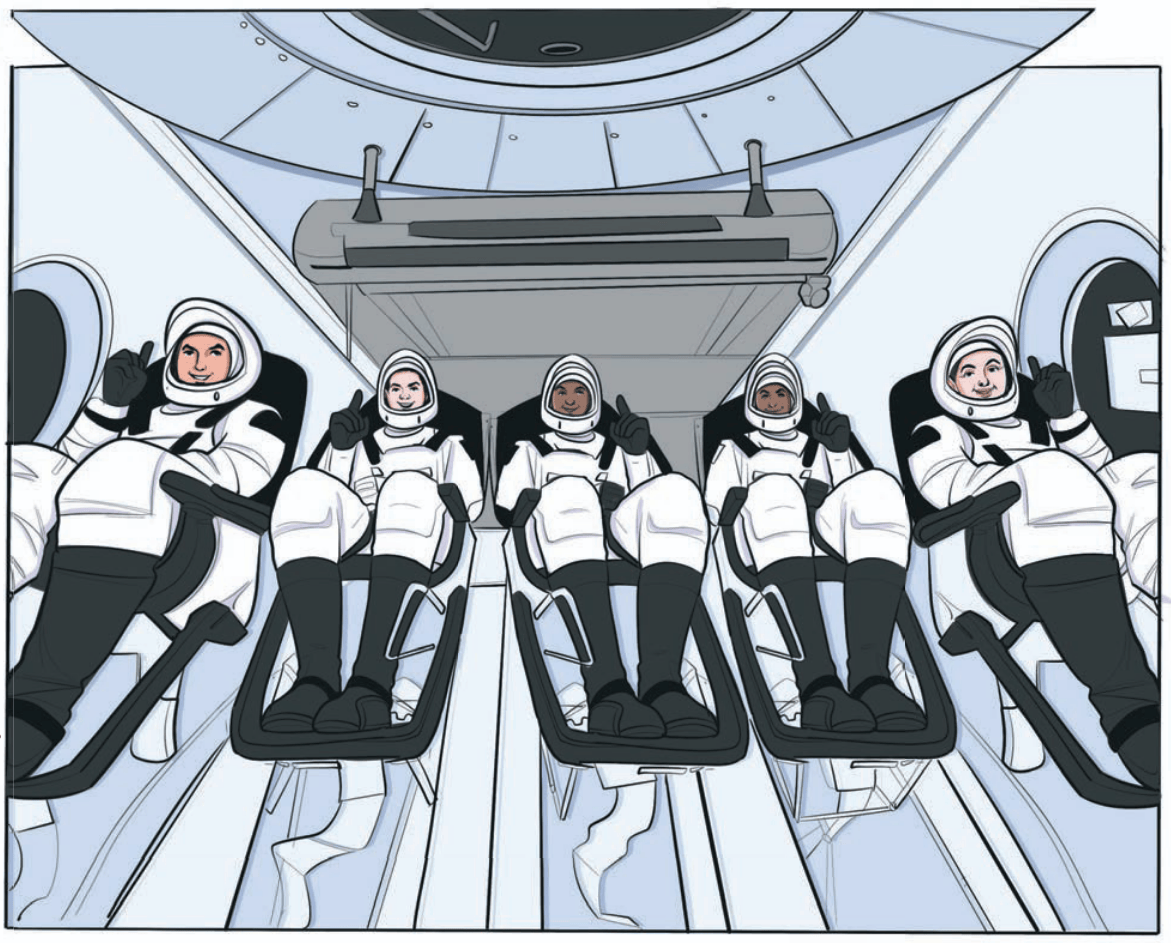
To the best of my knowledge, there’s never been a regulation that forbids one to keep pets in a space station. No one ever thought it was necessary—and even had such a rule existed, I am quite certain that Sven Olsen would have ignored it.
Actually he was a wiry little fellow, like most of the early spacers, and managed to qualify easily for the 150-pound bonus that kept so many of us on a reducing diet. Had he been built otherwise, his chances of getting a job in space would have been very slim.
Sven was one of our best construction men, and excelled at the tricky and specialised work of collecting assorted girders as they floated around in free fall, making them do the slow-motion, three-dimensional ballet that would get them into their right positions, and fusing the pieces together when they were precisely dovetailed into the intended pattern: it was a skilled and difficult job, for a space suit is not the most convenient of garbs in which to work. However, Sven’s team had one great advantage over the construction groups you see putting up skyscrapers down on Earth. They could step back and admire their handiwork without being abruptly parted from it by gravity.
Don’t ask me why Sven wanted a pet, or why he chose the one he did. I’m not a psychologist, but I must admit that his selection was very sensible. Claribel weighed practically nothing, her food requirements were tiny—and she was not worried, as most animals would have been, by the absence of gravity.
girders: long, thick piece of steel or concrete that supports a large structure
precisely: exactly
dovetailed: fitted together
garbs: clothing of a special kind
handiwork: creation
abruptly: unexpectedly/ suddenly
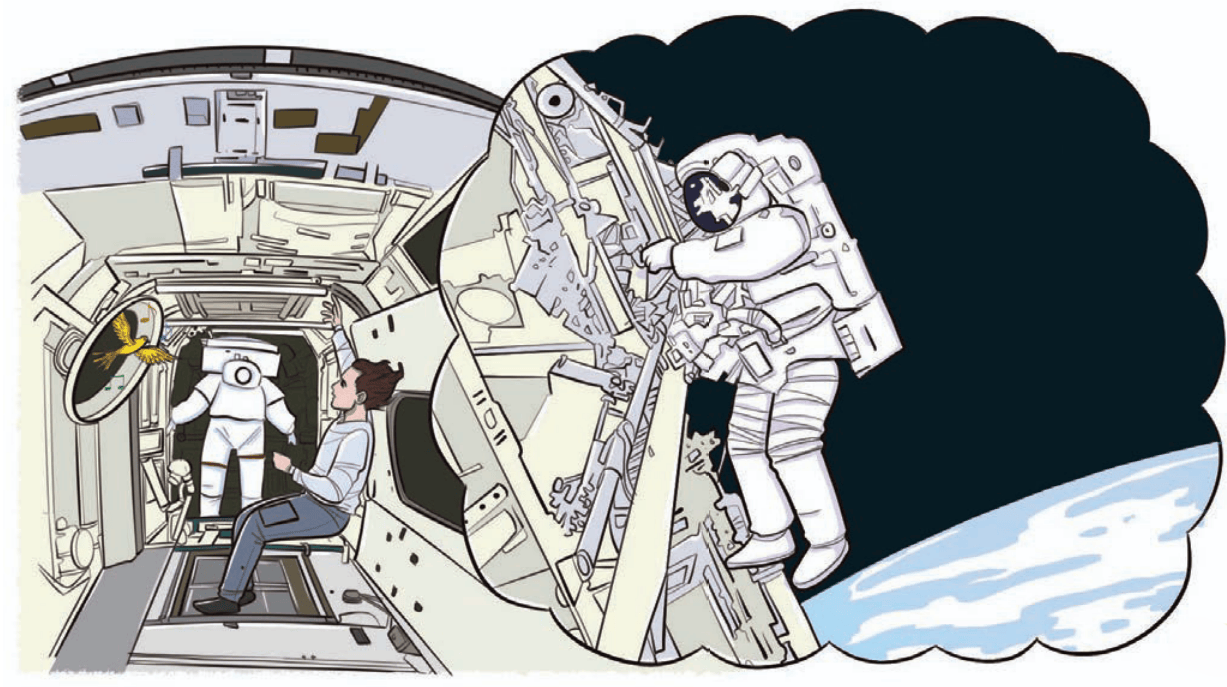
I first became aware that Claribel was aboard when I was sitting in the little cubbyhole laughingly called my office, checking through my lists of technical stores to decide what items we’d be running out of next. When I heard the musical whistle beside my ear, I assumed that it had come over the station intercom, and waited for an announcement to follow. It didn’t; instead, there was a long and involved pattern of melody that made me look up with such a start that I forgot all about the angle beam just behind my head. When the stars had ceased to explode before my eyes, I had my first view of Claribel.
She was a small yellow canary, hanging in the air as motionless as a hummingbird—and with much less effort, for her wings were quietly folded along her sides. We stared at each other for a minute; then, before I had quite recovered my wits, she did a curious kind of backward loop I’m sure no earthbound canary had ever managed, and departed with a few leisurely flicks. It was quite obvious that she’d already learned how to operate in the absence of gravity, and did not believe in doing unnecessary work.
Sven didn’t confess to her ownership for several days, and by that time it no longer mattered, because Claribel was a general pet. He had smuggled her up on the last ferry from Earth, when he came back from leave—partly, he claimed, out of sheer scientific curiosity. He wanted to see just how a bird would operate when it had no weight but could still use its wings.
Claribel thrived and grew fat. On the whole, we had little trouble concealing our guest when VIPs from Earth came visiting. A space station has more hiding places than you can count; the only problem was that Claribel got rather noisy when she was upset, and we sometimes had to think fast to explain the curious peeps and whistles that came from ventilating shafts and storage bulkheads
There were a couple of narrow escapes—but then who would dream of looking for a canary in a space station?
ceased: stopped
canary: a popular bird which people love to keep as pets; found in open areas with small trees and shrubs
wits: ability to think quickly
flicks: sudden, quick movements
concealing: hiding
ventilating shafts: passageways or ducts that allow fresh air in a closed space
bulkheads: dividing walls or barriers between separate compartments in an aircraft
Let us discuss
Answer the following questions briefly.
- Why did the narrator think Sven had sneaked a bird aboard? What was Sven’s scientific reason?
- How did Claribel adjust to the new surroundings?
- What made the narrator mistake the musical whistle for a sound from the intercom?
- Do you think the presence of the canary would lead the spacers into trouble? If yes, why? If no, why not?
II
We were now on twelve-hour watches, which was not as bad as it sounds, since you need little sleep in space. Though of course there is no ‘day’ and ‘night’ when you are floating in permanent sunlight, it was still convenient to stick to the terms. Certainly when I woke that ‘morning’ it felt like 6:00 a.m. on Earth. I had a nagging headache, and vague memories of fitful, disturbed dreams. It took me ages to undo my bunk straps, and I was still only half awake when I joined the remainder of the duty crew in the mess. Breakfast was unusually quiet, and there was one seat vacant.
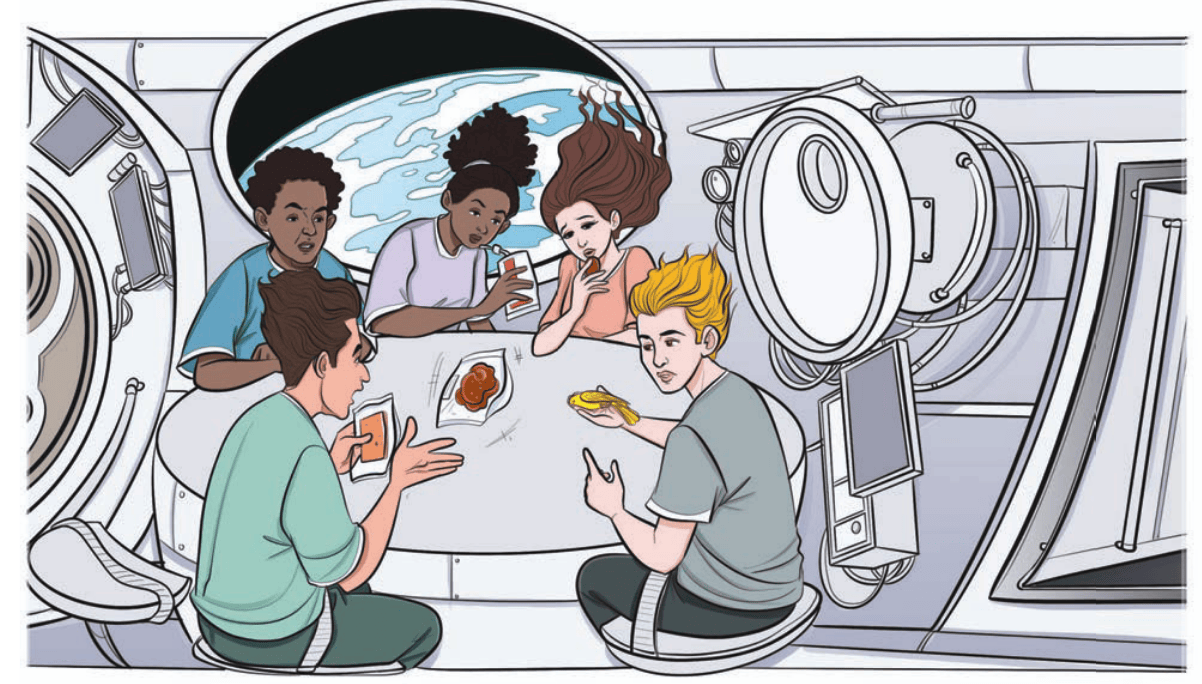
“Where’s Sven?” I asked, not very much caring.
“He’s looking for Claribel,” someone answered. “Says he can’t find her anywhere. She usually wakes him up.”
Before I could retort that she usually woke me up, too, Sven came in through the doorway, and we could see at once that something was wrong. He slowly opened his hand, and there lay a tiny bundle of yellow feathers, with two clenched claws sticking pathetically up into the air.
“I don’t know,” said Sven mournfully. “I just found her like this.”
“Let’s have a look at her,” said Jock Duncan, our cook-doctor-dietitian. We all waited in hushed silence while he held Claribel against his ear in an attempt to detect any heartbeat.
Presently he shook his head. “I can’t hear anything, but that doesn’t prove she’s dead. I’ve never listened to a canary’s heart,” he added rather apologetically.
“Give her a shot of oxygen,” suggested somebody, pointing to the green-banded emergency cylinder in its recess beside the door. Everyone agreed that this was an excellent idea, and Claribel was tucked snugly into a face mask that was large enough to serve as a complete oxygen tent for her.
To our delighted surprise, she revived at once. Beaming broadly, Sven removed the mask, and she hopped onto his finger. She gave her series of “Come to the cookhouse, boys” trills—then promptly keeled over again.
“I don’t get it,” lamented Sven. “What’s wrong with her? She’s never done this before.”
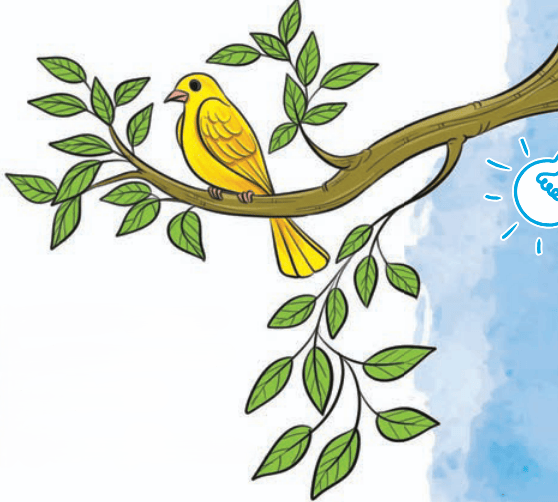
For the last few minutes, something had been tugging at my memory. My mind seemed to be very sluggish that morning, as if I was still unable to cast off the burden of sleep. I felt that I could do with some of that oxygen—but before I could reach the mask, understanding exploded in my brain. I whirled on the duty engineer and said urgently: “Jim!” There’s something wrong with the air! That’s why Claribel’s passed out. I’ve just remembered that miners used to carry canaries down to warn them of gas.”
clenched: pressed together tightly
hushed: quiet
snugly: cosily
keeled: collapsed/ fainted
tugging at: causing to remember something
sluggish: inactive
“Nonsense!” said Jim. “The alarms would have gone off. We’ve got duplicate circuits, operating independently.”
“Er—the second alarm circuit isn’t connected up yet,” his assistant reminded him. That shook Jim; he left without a word, while we stood arguing and passing the oxygen bottle around like a pipe of peace.
He came back ten minutes later with a sheepish expression. It was one of those accidents that couldn’t possibly happen; we’d had one of our rare eclipses by Earth’s shadow that night; part of the air purifier had frozen up, and the single alarm in the circuit had failed to go off. Half a million dollars’ worth of chemical and electronic engineering had let us down completely. Without Claribel, we should soon have been slightly dead.
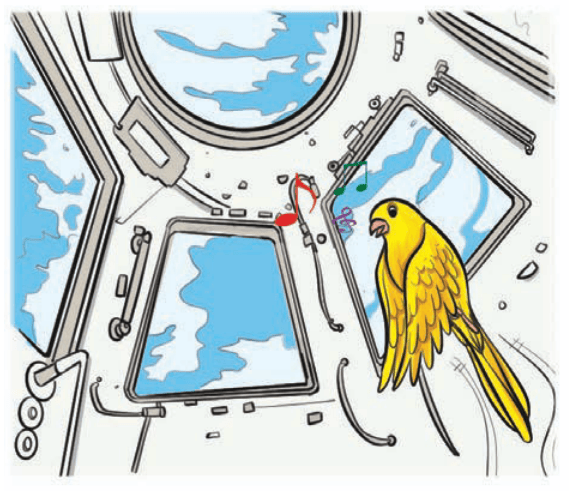
So now, if you visit any space station, don’t be surprised if you hear an inexplicable snatch of birdsong. There’s no need to be alarmed; on the contrary, in fact. It will mean that you’re being doubly safeguarded, at practically no extra expense.
safeguarded: protected
ARTHUR C. CLARKE
Let us discuss
Identify whether the following statements from parts I and II are true or false. Share your answers with your classmates and teacher.
- The alarm at the space station failed to work properly because they were not connected.
- Claribel was brought to the space station for an official experiment on animal behaviour in space.
- The canary’s suffering helped the crew discover a problem with the air purifier.
- The air purifier froze because there was a rare eclipse.
- Claribel could fly gracefully in the space station, performing loops in the air.
- 6 The space station crew was uninterested in Claribel and hardly noticed her presence after she was discovered.
- Claribel had fainted and had to be revived with oxygen supply.
Let us think and reflect
I. Read the given extracts and answer the questions that follow
1. Sven was one of our best construction men, and excelled at the tricky and specialised work of collecting assorted girders as they floated around in free fall, making them do the slow-motion, three-dimensional ballet that would get them into their right positions, and fusing the pieces together when they were precisely dovetailed into the intended pattern: it was a skilled and difficult job, for a space suit is not the most convenient of garbs in which to work.

(i) What can be inferred about Sven’s abilities from his job description?
- A. He is good at following instructions but lacks creativity.
- B. He possesses a strong understanding of working in space.
- C. He struggles with the complexities of construction in space.
- D. He prefers working on simpler tasks rather than complex jobs.
(ii) How can we conclude that Sven was working in zero gravity?
(iii) Select the option that is correct for both (Assertion) A and (Reason) R.
(A): Sven’s job required him to make girders perform a ‘three-dimensional ballet’ in space.
(R): Working in zero gravity allows objects to float, making precise positioning more challenging
- A. Both (A) and (R) are true, and (R) is the correct explanation of (A).
- B. Both (A) and (R) are true, but (R) is not the correct explanation of (A).
- C. (A) is true, but (R) is false.
- D. (A) is false, but (R) is true.
(iv) Replace the underlined word with a word similar in meaning from the extract.
During the festival, people wore colourful outfits that represented their culture.
2. “Jim!” There’s something wrong with the air! That’s
why Claribel’s passed out. I’ve just remembered that
miners used to carry canaries down to warn them
of gas.”
“Nonsense!” said Jim. “The alarms would have
gone off. We’ve got duplicate circuits, operating
independently.”
“Er—the second alarm circuit isn’t connected up yet,” his assistant
reminded him. That shook Jim; he left without a word, while we stood
arguing and passing the oxygen bottle around like a pipe of peace.
(i) Fill in the blank by selecting the correct option from those given in the brackets.
The narrator references canaries and miners in order to __________.(highlight the historical use of canaries as warning systems/explain the reason that caused Claribel to faint suddenly)
(ii) Complete the following sentence with a suitable reason. Jim initially dismisses the warning about the air because __________.
(iii) What does the phrase ‘shook Jim’ mean in the context of the
information in the extract?
Jim was _________.
(iv) Replace the underlined phrase with a word from the extract that has a similar meaning.
- A. physically pushed by someone
- B. startled by unexpected information
- C. cold and needed to warm up
- D. trying to shake off sleepiness
(iv) What does the crew’s action of passing the oxygen bottle around ‘like a pipe of peace’ suggest about their response to the situation?
II. Answer the following questions.
- What was the purpose of the alarm? What had caused its failure?
- How does the crew’s reaction to Claribel change over the course of the story?
- What does the last part of the story tell us about the significance of unusual ways of problem solving?
- Justify the appropriateness of the title of the story.
- ‘Without Claribel, we should soon have been slightly dead.’ What does this line suggest about uncertainty of life in space?
- Explain how has the writer presented science fiction with a touch of humour.
- How would Sven reflect on his experience of almost losing Claribel and for saving the lives of the entire crew?
Let us learn
I. Choose the appropriate adjectives from the box given below to match with the words 1–8 that follow.
nagging
vague
delighted
narrow
sluggish
hushed
inexplicable
sheepish
- ________________ path
- ________________ worry
- ________________ plan
- ________________ look
- ________________ reason
- ________________ traffic
- ________________ voices
- ____________ expression
Now, underline the sentences that use these adjectives in the text.
II. The word ‘intercom’ is used in the text. It is called a merged word as it is made by combining the parts of two words—‘internal’ and ‘communication’. Merged words are made by combining two words.
Combine the words in Column 1 with the words in Column 2 to make merged words. Write the merged word and its meaning.
One example has been done for you.
| Column 1 | Column 2 | Merged word | Meaning |
| breakfast | lunch | (i) brunch | meal eaten between breakfast and lunch hours |
| motor | hotel | (ii) | |
| smoke | fog | (iii) | |
| situation | comedy | (iv) | |
| video | log | (v) | |
| spoon | fork | (vi) | |
| web | seminar | (vii) |
III. Read the following sentence from the text and fill in the blank.
It will mean that you’re being doubly safeguarded.
In the given sentence, ‘will’ denotes __________ (past/present/future) time.
There are several ways to use verbs to talk about the future in English. The following table lists some of the usages of future time references.
| S.No. | Tense | Usage | Examples |
| 1. | ‘will’ [Note: also common in offers, promises, and orders expressing willingness, certainty or obligations] | When we provide information about future events or discuss possible future occurrences. | • I think the Kailash House will win. |
| 2. | Simple Present Tense | When we talk about the future only in situations that are a part of a regular schedule or planned action. | • My school reopens on 03 January. |
| 3. | Present Progressive Tense | When we use for future actions and events mostly for personal arrangements and fixed plans. | • My exams are
getting over this
weekend. • I am visiting my grandparents during the vacation. |
| 4. | ‘Going to’ | Present Progressive Tense of ‘go’— This is common in informal style, especially in speech or conversation. | • We’re going to get a new motorbike soon. |
| 5. | Future Perfect (will have + Past Participle) | When we say that something will be finished or completed by a certain time in future. | • The teacher says, she will have completed the portions by next month. |
| 6. | Future Progressive (will + be + -ing) | When we say that something will be in progress at a particular moment in the future. | • This time tomorrow I will be relaxing at home. |
| 7. | Future in the Past | Sometimes, when we talk about the past, we need to mention something that was still in the future at that time— something that had not happened yet. | • I had no time
to shop as I
was leaving for
Chennai in an
hour. (instead of
‘am leaving’) • Last time I saw you, you were going to start a new business. (instead of ‘are going to’) • In 2024, I arrived in a town where I would spend the rest of my life. (instead of ‘will spend’) |
IV. Fill in the blanks with the correct form (Simple Present, Present Progressive, ‘will’, or ‘going to’) to indicate future time.
- Our flight __________ (leave) at 10.00 a.m. tomorrow.
- They __________ (finish) the project by the end of this week.
- The weather forecast says it __________ (rain) later today.
- We __________ (move) into our new house next month.
- I __________ (start) my new hobby class next Monday.
- She __________ (go) to the mall this afternoon.
- The team __________ (have) a meeting at 3.00 p.m. tomorrow.
- I __________ (help) you with your homework after dinner.
V. Fill in the blanks with the suitable forms of verbs given in brackets to express future time reference.
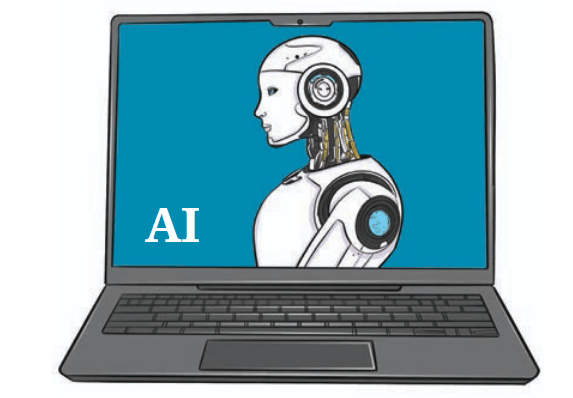
By 2040, artificial intelligence 1. ________ (revolutionise) medical treatments. Researchers 2.________ (develop) AI-powered diagnostic tools that 3. ________ (transform) healthcare by the end of this decade. Next week, the International Science Congress 4. _______ (open) to showcase advancements in AI and robotics. In the coming years, robots 5. _______ (assist) surgeons in performing complex operations. Years ago, experts had predicted that AI would reshape our world, and now, as we approach the future, this 6. _______ (be) our new reality.
Let us Listen
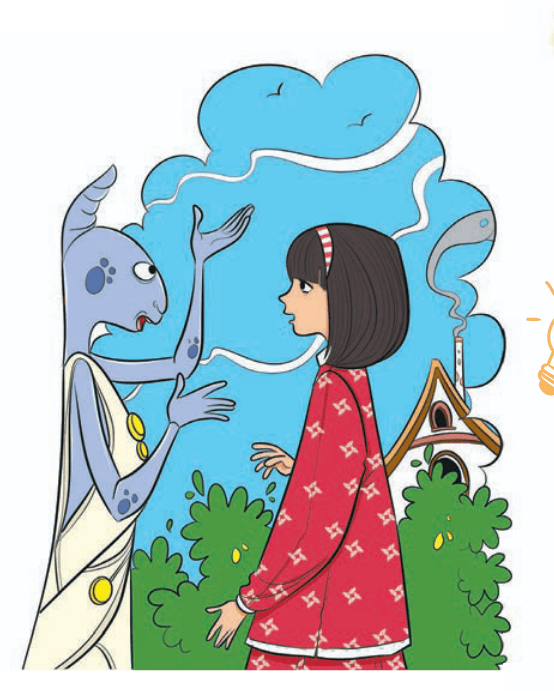
I You will listen to a conversation between Monika and Toby. Toby is a Martian and is stranded on Earth. He has become Monika’s friend. As you listen, put a tick mark () against the correct statements and a cross against the wrong ones. (Transcript for teacher on page 249)
- Toby misses his school.
- Monika accepts Toby as her friend.
- Monika asks Toby about one of his facial features.
- Toby tells Monika that she had a bananafor breakfast.
- Toby shares that he can see much clearer with a closed eye.
II Listen to the conversation again and fill in the blanks with the exact words you hear.
- Toby: I miss my _________________ and home.
- Toby: Well, we _________________ don’t need to eat anything. We get our
- _________________ from the Sun.
- Monika: Oh! Don’t you ever feel like having ice-creams and _________________!
- Monika: Okay, tell me one thing. How are you able to see only with_________________ eye?
- Toby: I can see beyond mountains and _________________, woods and even ____________.
Let us Speak
I. Read the following words from the text aloud and circle the letters that are not pronounced (silent letters).
ballet (ba-lay)
[ba pronounced as in bat]
whistle (wi-sl)
alarm (uh-laam)
psychologist (sai-ko-luh-juhst)
receipt
debris
pneumonia
almond
foreign
island
wreck
aisle
campaign
fasten
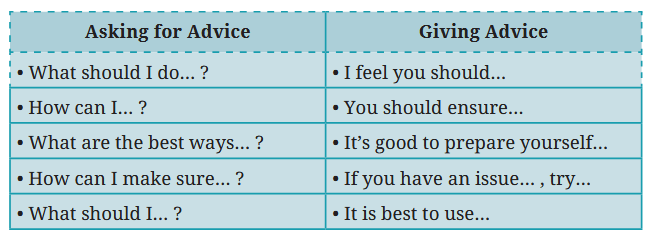
II. Work in pairs. Use the given situations to ask for and give suggestions.
- You need to make a model of the solar system for the Science Exhibition but don’t know what materials to use. Ask your friend for suggestions.
- You need to prepare for the inter-class quiz on the topic Chandrayaan-3. Ask your friend for advice on how to prepare.
You may use the prompts given below.
Let us Write
I. Complete the social media web given below with the uses of the internet.

Now, write an article titled ‘The Importance of Internet’ with the help of the social media web.
Points to remember:
Heading/Title
Name of the writer
Paragraph 1: Give a general introduction to the topic.
Paragraph 2: Explain the uses of the internet and why it is important. Give examples to support your view.
Paragraph 3: End with a comment and leave the reader with a thoughtful idea or quote.
Let us explore
‘A canary in the coal mine’ is a popular phrase to describe early signs of potential danger.
I. Coal miners in places like Arunachal Pradesh used canary birds to detect the presence of carbon monoxide. Such gases are a potential risk to the life of the miners. These little birds are particularly sensitive to carbon monoxide and can prevent mining accidents.
II Astronauts living in space stations have to do things differently. Read how they manage the routine tasks in the absence of gravity. You may find out more information about it from the internet.
- Write: Astronauts use a special Space Pen which has a cartridge with ink combined with resin. The ink remains solid until friction with the ball at the point of the pen liquefies it. It works in all positions, in extreme heat and cold, and in atmospheres ranging from pure oxygen to vacuum.
- Exercise: Astronauts use resistance exercise equipment. Weight training is done by applying a load using vacuum cylinders. Running on the treadmill is made possible with the bodies held down using rubber straps.
- Eat: Astronauts eat preserved foods which is dried, canned, vacuum-packed, and frozen. These can be prepared by adding cold or hot water, and some can be heated in an oven. They also eat ready-to-eat items, such as nuts, breads, and fruits.
- Sleep: Astronauts can sleep on a floor, wall, or ceiling as there’s no distinction between up and down but they may gradually float away while sleeping. Therefore, they need to restrain their bodies in small sleeping compartments or sleeping bags.
III. Did you know that animals can save humans from natural calamities? Animals can sense natural calamities. Read the following examples and decide if this is true.
- In 2004, before a tsunami could hit the coastline of Indonesia, some animals made efforts to flee—elephants ran for higher ground, flamingos abandoned low-lying nesting areas, and dogs refused to go outdoors.
- Minutes before the Naples quake of 1805, oxen, sheep, dogs, and geese started making alarm calls in unison.
- Migratory birds crossing the Pacific are able to dodge storms and other hazards.
- In the Gulf of Mexico, sharks sense the drop in barometric pressure that precedes hurricanes and tend to swim to deeper waters as a result. Dolphins have also been observed swimming away from storm-prone areas.
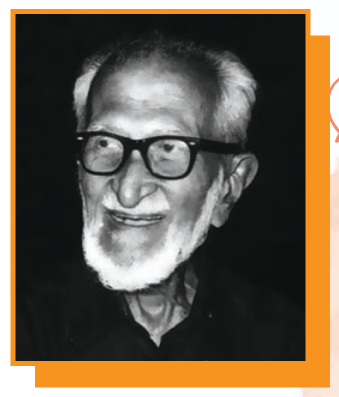
IV. Salim Ali, the ‘Birdman of India’, was an Indian ornithologist (a person who studies birds). He was the first Indian to conduct systematic bird surveys across India and wrote several books on birds. He was awarded the Padma Bhushan in 1958 and the Padma Vibhushan in 1976
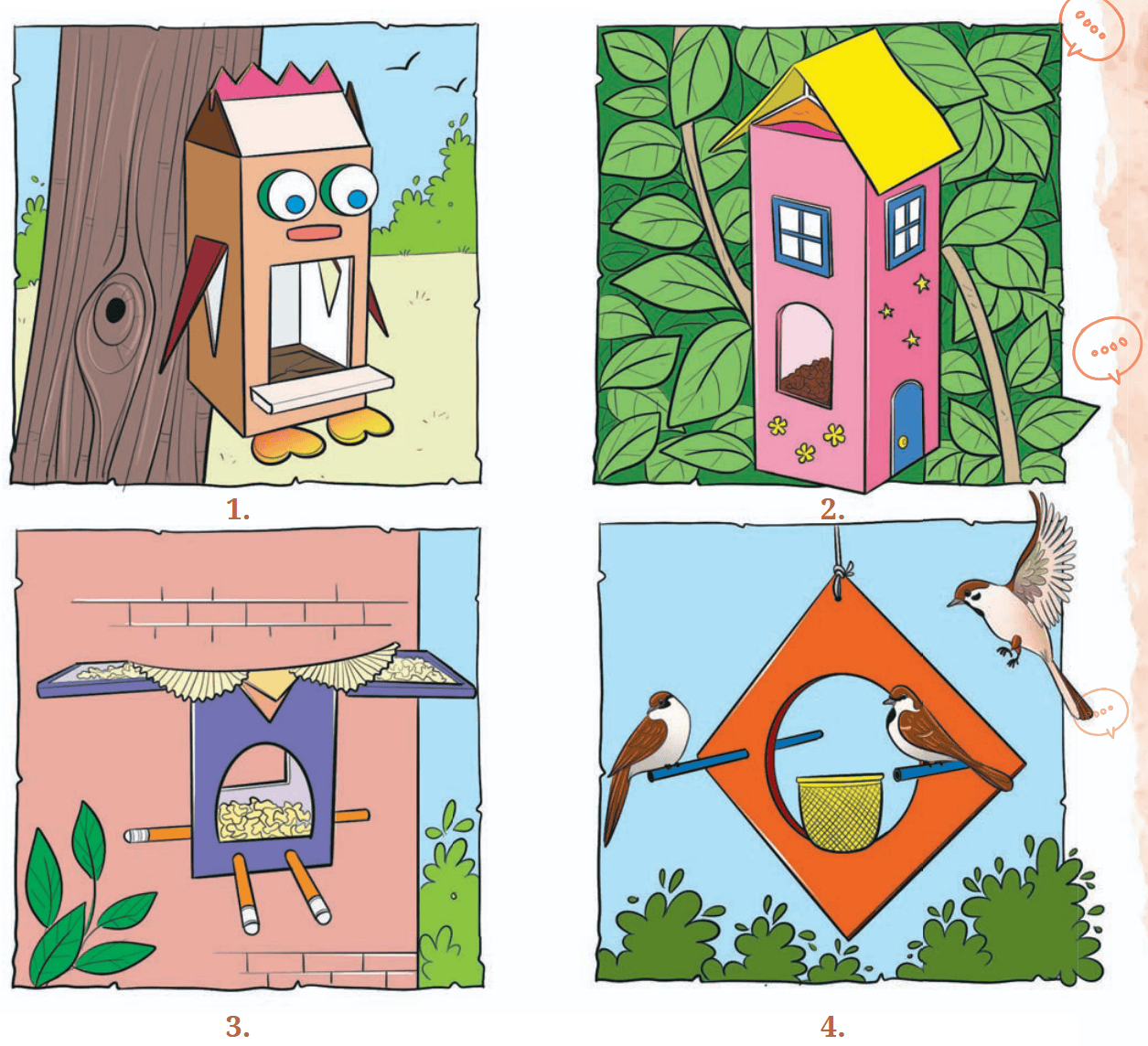
V. We need to conserve our ‘feathered’ friends. Work in groups of four.
Look at the pictures and make a bird feeder with cardboard, chart paper, etc.
MAGNIFYING GLASS
Let us do these activities before we read.
I. Work in pairs. Answer the questions that follow the pictures given below. Share your answers with your classmates and teacher.
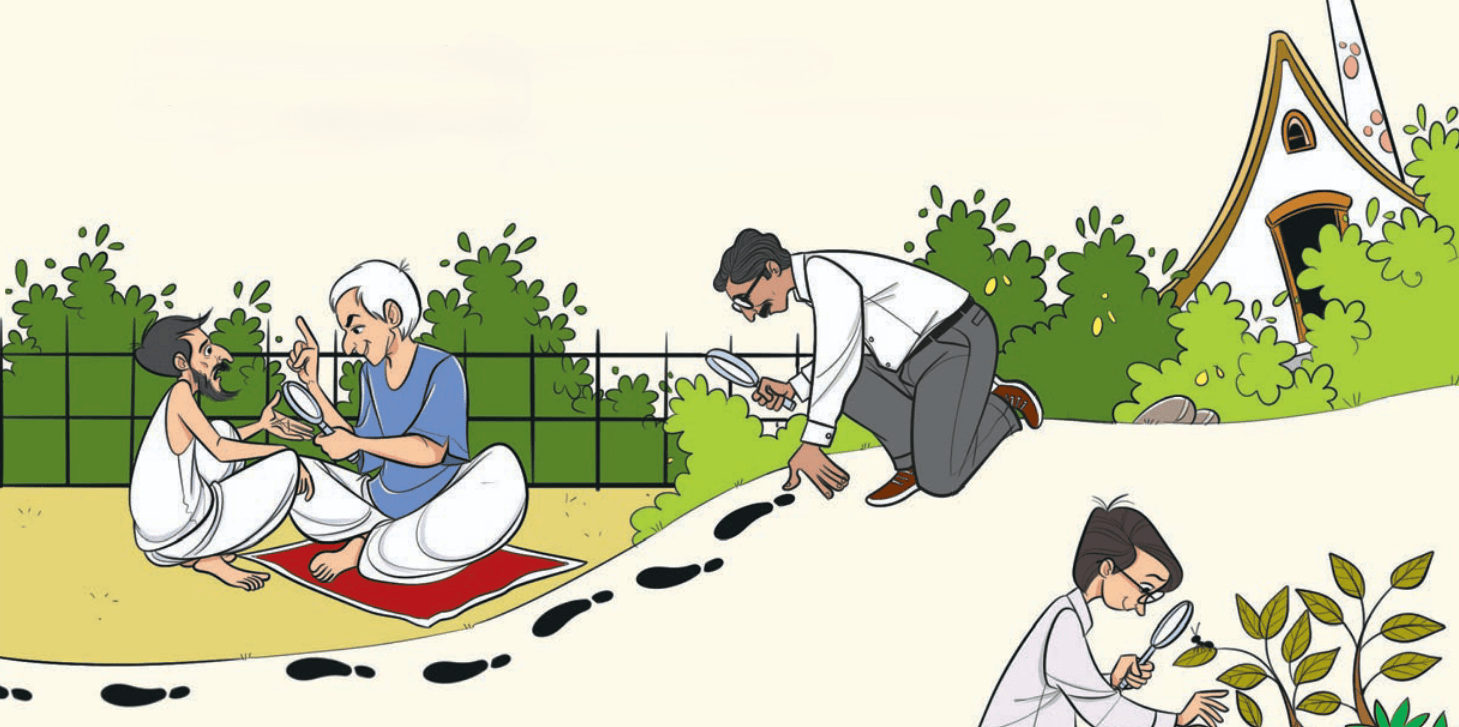

- What is common in all these pictures?
- Select the pictures you are familiar with.
- Why do you think the people in the pictures need to use a magnifying glass?
- What other instruments magnify objects?
II. If you have a magnifying glass, what would you like to use it for and why? Share your answers with your classmates and teacher.
Let us read
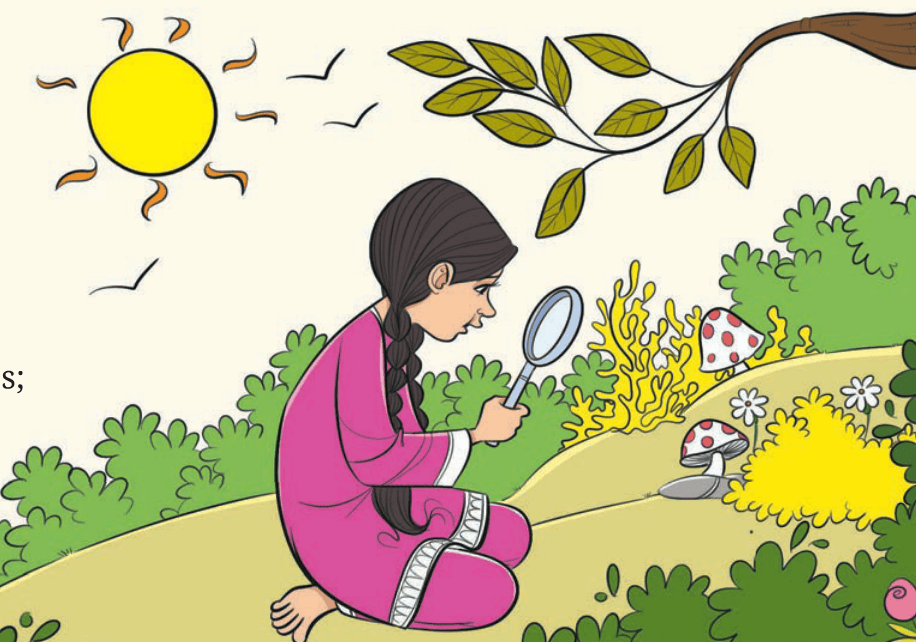
With this round glass
I can make Magic talk—
A myriad shells show
In a scrap of chalk;
Of but an inch of moss
A forest—flowers and trees;
A drop of water
Like hive of bees.
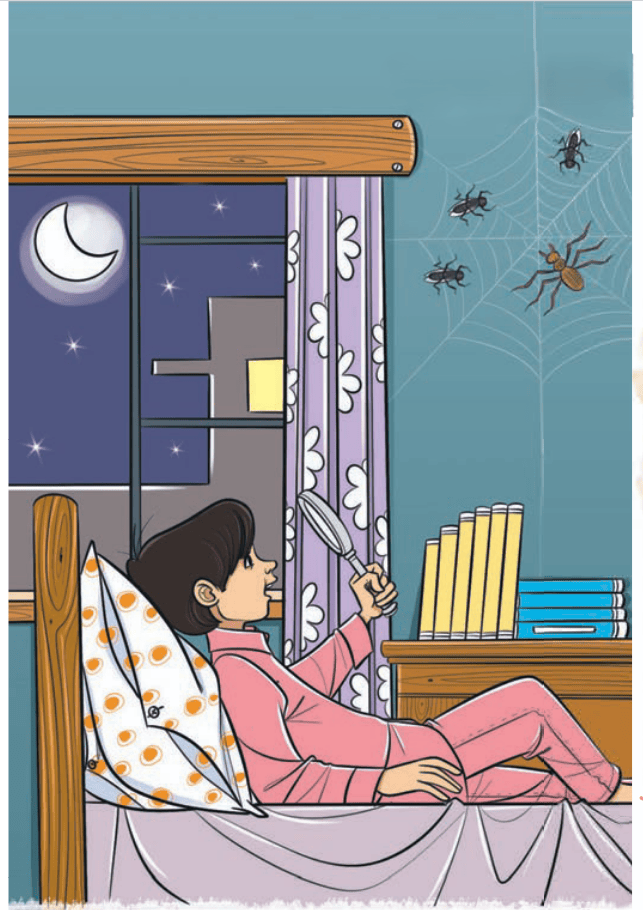
I lie in wait and watch
How the deft spider jets
The woven web-silk
From his spinnerets;
The tigerish claws he has!
And oh! the silly flies
The stumble into his net—
With all those eyes!
Not even the tiniest thing
But this my glass
Will make more marvellous
And itself surpass.
Yes, and with lenses like it,
Eyeing the moon,
‘Twould seem you’d walk there
In an afternoon!
WALTER DE LA MARE
Let us discuss
I. Complete the summary of the poem given below with suitable words from the poem
The poem describes the magic of seeing the world through a 1. __________. It reveals how tiny things like 2. __________ and 3. __________ can appear vast and complex. Even a 4. __________ of water can seem like a hive of 5. __________. The poet is impressed at how the spider spins its 6. __________ from its 7. __________. The poem ends with the idea that, through lenses, the 8. __________ could seem within reach.
II. Fill in the blanks by choosing the correct answer from the brackets.
- The main idea of the poem is the transformative power of __________ (wonders in nature/close observation) through the magnifying glass.
- The tone of the poem is __________ . (wonder and curiosity/peaceful and emotional)
- The poem has __________ stanzas with __________ lines in each stanza. Hence, it is a quatrain. (four; six/six; four)
- The rhyme scheme of the poem is __________. (ABCD; ABCB)
III. Pick examples from the poem for the following poetic devices.
- Simile
- Alliteration
- Repetition
IV.The poem is rich in visual imagery, painting vivid pictures of small, everyday things magnified into something grand.
- In the line, ‘A myriad shells show in a scrap of chalk’, the magnifying glass reveals ______________________.
- In the line, ‘A forest—flowers and trees’ the poet uses the imagery of nature to emphasise ______________________.
V. Complete the following sentence with a suitable reason.
1. The poet uses exclamation marks in lines, ‘The tigerish claws he has!’, ‘With all those eyes!’ and ‘In an afternoon!’ because it ______________________
2. In the phrase, ‘Magic talk’ the poet uses personification to describe the magnifying glass because it ______________________.
3. Each stanza follows a repetitive pattern of introducing a small or ordinary object and then describing the extraordinary details revealed through magnification.
This is because it supports the theme of __________ as the speaker reveals ____________.
4. In the final stanza the poet shifts from small, everyday objects being magnified to a celestial body like moon because __________.
VI. Complete the analogy:
The old woman: vulnerable and neglected :: The young boy:_______________________.
Let us think and reflect
I. Read the given extracts and answer the questions that follow.
1. With this round glass
I can make Magic talk—
A myriad shells show
In a scrap of chalk;
Of but an inch of moss
A forest—flowers and trees;
(i) Identify whether the following statement is true or false.
The poet uses his magical powers to make the round glass powerful.
(ii) Select the line from the extract that expresses the presence of intricate patterns in ordinary objects.
(iii) What does the comparison of ‘an inch of moss’ to a ‘forest’ suggest about the speaker’s view of the world through the magnifying glass?
(iv) How does the poet feel about the ability of the magnifying glass to reveal hidden wonders?
- A. Satisfied
- B. Fascinated
- C. Grateful
- D. Determined
II. Answer the following questions.
- What is the significance of the spider in the poem?
- How might the speaker’s view of the natural world change if there was no use of a magnifying glass?
- Why does the poem end with the idea of the moon being within reach?
- What is the speaker’s attitude towards nature and the act of observation?
- Which is your favourite part of the poem? Why?
Let us learn
I. Fill in the blanks in the sentences with the words given in the box below.
With his 1. ____________ description, the author has written the story beautifully 2. ____________with fascinating details. When you read the story, you will surely enjoy the 3. ____________storytelling technique that attracts all kinds of readers. What makes the story interesting is the superb way of describing the 4. ____________emotions and feelings of the characters. The reader will 5. ____________upon the unexpected twists and turns that 6. ____________ all our understanding and make us wonder at the narrative power of the author.
II. The collective noun ‘a hive of bees’, is used in the poem. Match the phrases in Column 1 with suitable words in Column 2 to make collective nouns.
| Column 1 | Column 2 |
| 1. a swarm of | (i) ships |
| 2. a constellation of | (ii) soldiers |
| 3. a grove of | (iii) dancers |
| 4. a troupe of | (iv) locusts |
| 5. a battalion of | (v) trees |
| 6. a fleet of | (vi) stars |
III. IThe poet uses the expression ‘eyeing the moon’ in the poem. Match the idiomatic expressions with ‘eye’ given in Column 1 with their meanings in Column 2. You may refer to a dictionary.
| Column 1 | Column 2 |
| 1. apple of one’s eye | (i) watch something or someone closely |
| 2. in the blink of an eye | (ii) act as if you do not see or notice |
| 3. keep an eye on something or somebody | (iii) something that happens very quickly |
| 4. turn a blind eye | (iv) an overall look at something |
| 5. see eye to eye | (v) a person who is very precious or important |
| 6. bird’s-eye view | (vi) agree with each other |
IV. The poet uses the adjective form ‘tigerish’ in the poem by adding the suffix -‘ish’ to the noun ‘tiger’. In the same way, we can make adjectives by adding the suffix -‘ish’ to some nouns.
Choose the nouns to which you can add the suffix -‘ish’ to make adjectives.
Let us Listen
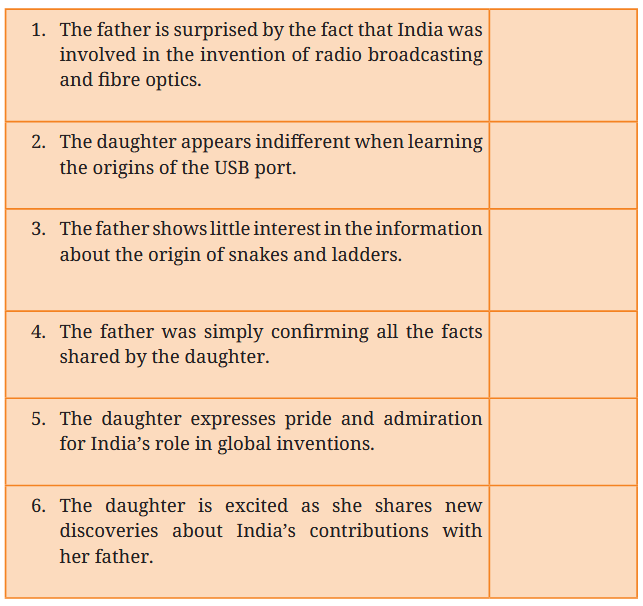
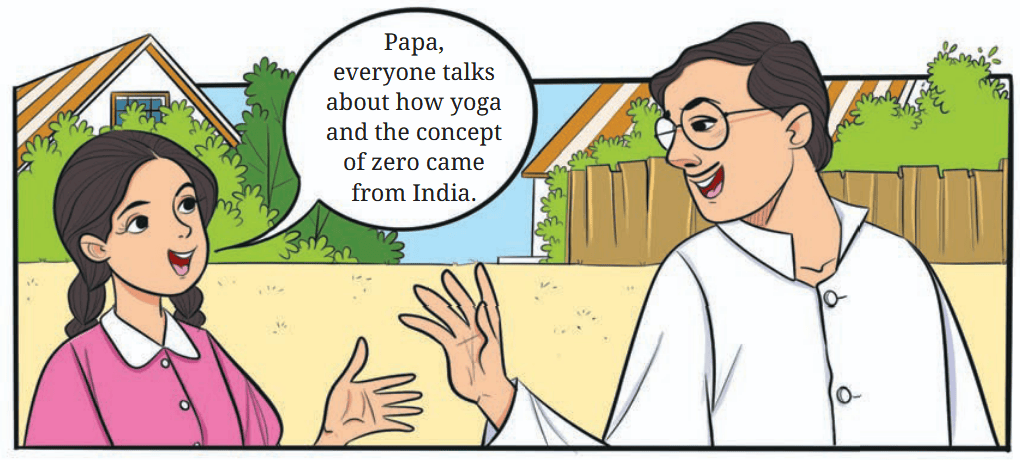
I. You will listen to a conversation between a father and daughter about lesser-known Indian inventions. As you listen, mark the four true statements from (1)–(6) given below. (Transcript for teacher on page 250)
Let us Speak
I. When pronouncing /v/ and /f/, the lower lip lightly touches the edge of the upper teeth. Air flows through the small gap, creating a soft friction sound.
Note the difference between /v/ and /f/. When we pronounce words with /v/ sound, there is a vibration, whereas /f/ sound has no vibration. Both the sounds can occur in the beginning, middle, or at the end of words.
Read these words aloud with the help of your teacher.
| beginning sound /f/: forest | flowers | from |
| middle sound /f/: | deft | afternoon |
| end sound /f/: | of | itself |
| beginning sound /v/: vase | valour | victory |
| middle sound /v/: | woven | even |
| end sound /v/: | hive |
II If you could travel to space, which planet would you like to visit? Why? What preparations would you like to make? Speak about any five things that you would like to take along.
III If you could invent something, what would you like to invent and how? Give reasons for the choice of your invention. Speak about your wonder invention.
Let us Write
I In a conversation, we communicate through dialogues. While writing a conversation, we need to ensure that the dialogues are engaging and serve a purpose.
Points to remember:
- Mention where, when, and with whom the conversation is taking place.
- Identify the word choice and tone—formal or informal.
- Include key information, points of agreement and disagreement, etc.
- Use words in brackets to express emotions or actions, such as (joyfully) (sits down).
- You may use filler words like Uff, Er… , Ugh, etc
Deepa and Asma, members of the Science Club have a conversation to take a decision about making a model for an upcoming Science Fair. Create this conversation between Deepa and Asma
You may begin the conversation like this.
Deepa: Hi Asma! Our Science teacher mentioned that you have a wonderful idea for the Science Fair project.
Asma: (hesitatingly) Yes, I do. But I’m not sure if it is good enough.
Deepa: (encouragingly) Don’t worry…
Let us explore
I Children with low vision may benefit from different types of visual aids, such as magnifying spectacles, stand magnifiers, hand-held magnifiers, and telescopes. Magnifying spectacles are used for reading, threading a needle or doing other close-up tasks. Stand magnifiers rest above the object and are hands-free and help to keep the magnifying lens at a proper distance. Hand-held magnifiers with and without built-in lights, are usually smaller and lighter to move over printed material. They can be moved more easily. Telescopes are used to see objects or signs far away. Some telescopes can even be attached to eyeglasses.
II. Did you know that telescopes also use lenses?
1. The largest telescope in India for studying celestial objects is located in the district of Nainital, Uttarakhand. Commissioned in 2016, it is maintained and operated by ARIES (Āryabhaṭa Research Institute of Observational Sciences)
2. The Indian Astronomical Observatory (IAO) is a high-altitude astronomy station located in Hanle, Ladakh, India. It is situated at an elevation of 4,500 meters (14,764 ft), and supports optical, infrared, and gamma-ray telescopes.
3. The largest, most powerful, and most complex telescope ever launched into space is the James Webb Space Telescope. NASA launched it on, 25 December 2021. It orbits the Sun at a distance of 1.5 million kilometres from Earth. To learn more, visit the link below.
https://science.nasa.gov/mission/webb/
4. The Mauna Kea Observatory, astronomical observatory in Hawaii, US, that has become one of the most important in the world because of its outstanding observational conditions. The Mauna Kea Observatory is operated by the University of Hawaii and lies at an elevation of 4,205 metres (13,796 feet) atop the peak of Mauna Kea, a dormant volcano on north-central Hawaii island. The summit hosts a world- renowned collection of astronomical research facilities and large telescope observatories, including the Keck Observatory and Subaru Telescope, for optical, infrared, and submillimeter astrono
The observatories are set up here because of Mauna Kea’s high elevation, dry environment, and stable airflow that make it a prime location for astronomical observation. The focus is scientific research across the electromagnetic spectrum.
Public Access: The Onizuka Center for International Astronomy provides visitor information and exhibits about the mountain and its observatories, and offers guided tours of the summit.
Find out more about them from the internet and discuss with your science teacher and classmates.

III. Read about ancient Indian scholars.
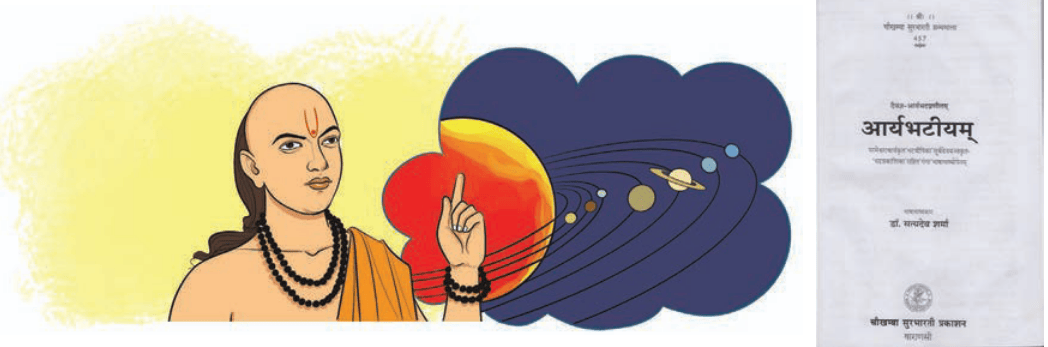
1. One of the eminent astronomers of the ancient India was Āryabhaṭa. His work Āryabhaṭiyam, laid the groundwork for various astronomers to develop in subsequent centuries and continues to be an important work even today. Āryabhaṭa proposed a heliocentric model of the solar system centuries before Copernicus. He also gave a scientific explanation of lunar and solar eclipses.
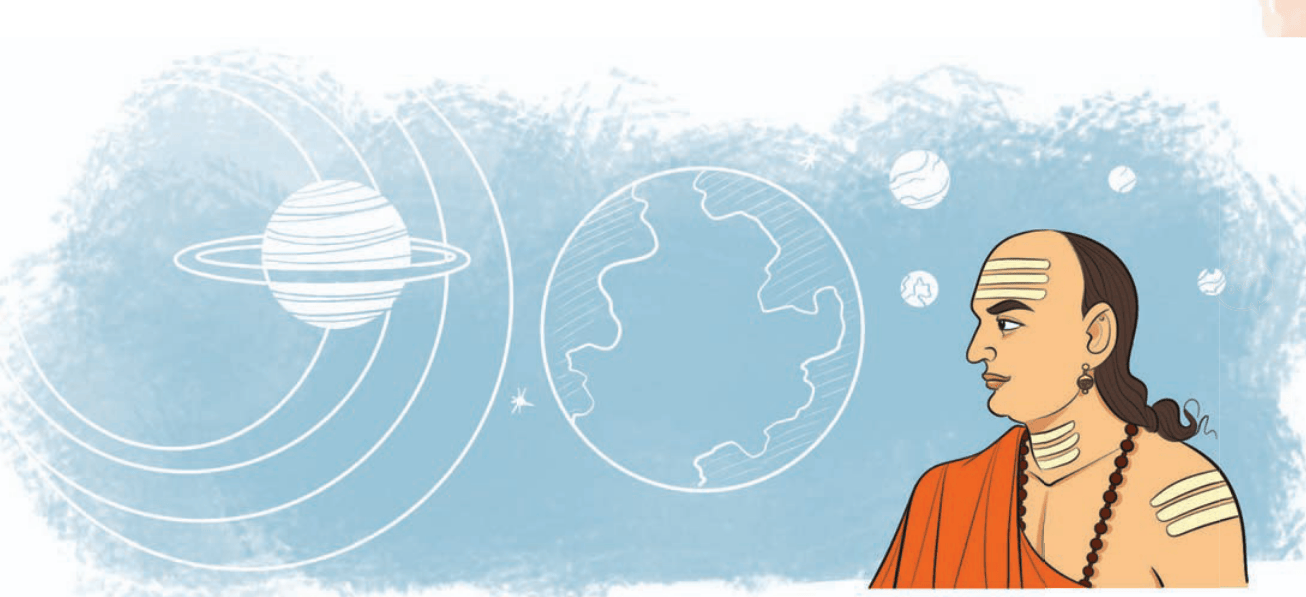
2. Varāmihira, the sixth-century CE astronomer, philosopher, and mathematician wrote the astronomical treatise Pañchasiddhāntika (Fine Treatises), a compendium of Greek, Egyptian, Roman, and Indian astronomy.
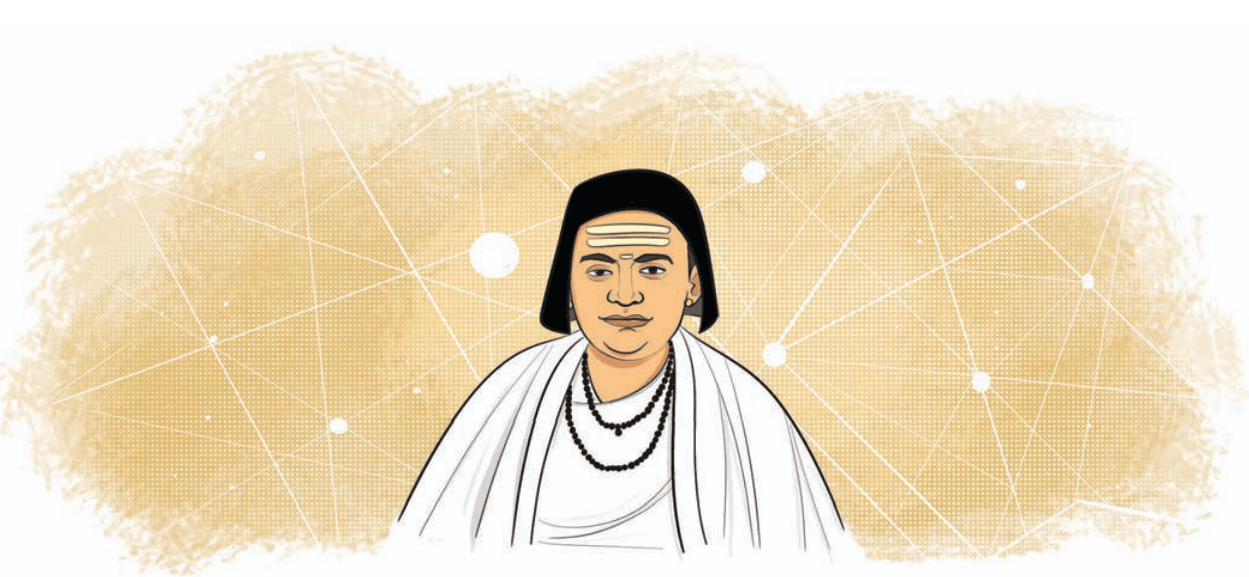
3. The tenth-century CE mathematician-astronomer Bhāskarachārya II contributed significantly to the advancement of astronomical concepts. His works Siddhāntaśiromaṇi and Karaṇakutūhala, include compiled data on planetary positions, conjunctions, and eclipses.
https://indianculture.gov.in/timeless-trends/unveiling-cosmos-journey-through-history-astronomy-india
IV Jantar Mantar in New Delhi is an astronomical observatory. It has large-scale astronomical instruments designed for precise calculations and measurements of celestial movements. It was built in 1724 by Maharaja Sawai Jai Singh II. The observatory is a UNESCO World Heritage Site. Five such observatories were built by Jai Singh II, the other four are located in Ujjain, Mathura, Varanasi, and Jaipur.
BIBHA CHOWDHURI
THE BEAM OF LIGHT THAT LIT THE PATH FOR WOMEN IN INDIAN SCIENCE
Let us do these activities before we read.
I. Work in pairs. What qualities do you associate with a scientist? Share your answers with your classmates and teacher. Complete the word web given below.
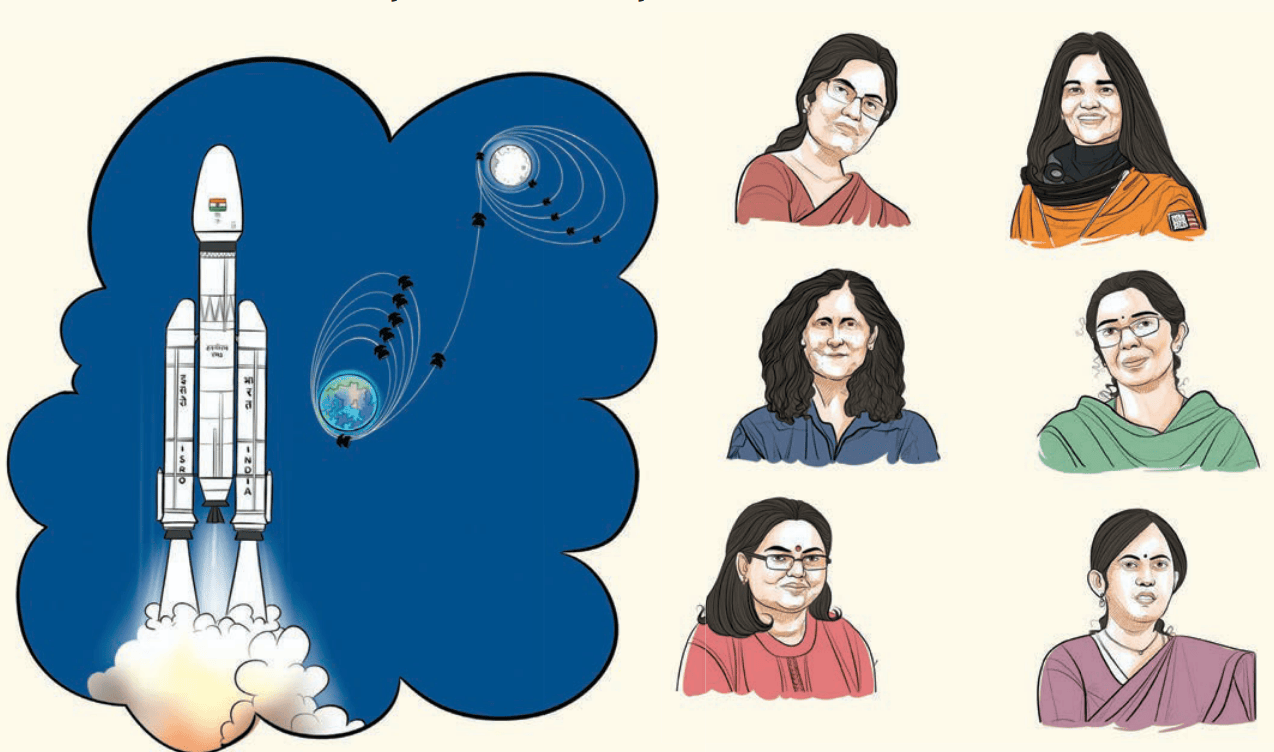
II. Some pictures of women scientists are given below. What do you know about their work? Share your answers with your classmates and teacher.
Let us read
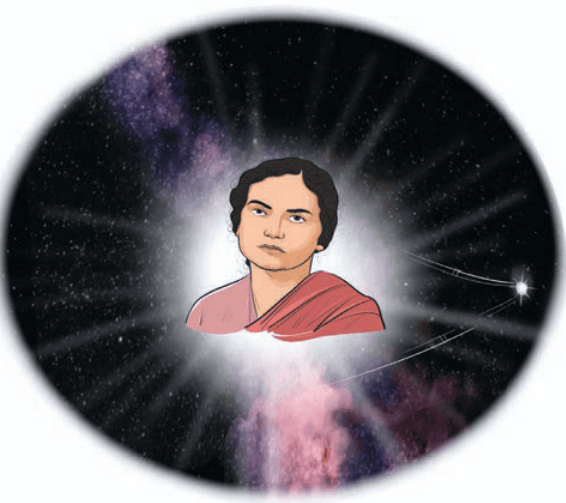
In a world where women’s potential in science, technology, engineering, and mathematics (STEM) is being recognised beyond doubt, India has seen its share of trailblazers who paved the way. Today, the women behind ISRO’s Mars Orbiter Mission and Chandrayaan-3 are celebrated for their brilliance and achievements. However, the foundation was laid by early pioneers like Bibha Chowdhuri—India’s first woman physicist—who carved a path in the male-dominated field of physics.
At a time when Indian women struggled to seek knowledge and equitable access to education, Bibha Chowdhuri emerged as a rare beam of light—a woman who defied the odds and lit a path for others to follow. Born in 1913 in Kolkata, in an India that still followed the traditional path. Bibha’s story was anything but ordinary. She was a scientist who rose not only against the societal expectations of women but also amidst the towering giants of science—men whose names the world would come to celebrate, while hers was whispered only in the halls of those who recognised her brilliance.
Bibha’s persistence eventually earned her a place at the Bose Institute. She had already begun to chip away at the walls of exclusion, becoming the first Indian woman to excel in high-energy particle physics.
trailblazers: people who are the first to do something that other people do later
equitable: treating everyone fairly and in the same way
defied the odds: achieved something despite difficulties
towering: very high or great
persistence: ability to keep doing something difficult
Breaking Boundaries
In 1945, Bibha’s academic journey took her to the University of Manchester. Under the guidance of the celebrated Nobel Laureate, Patrick M.S. Blackett, she delved deeper into the field of cosmic rays. Her Ph.D. thesis on cosmic rays earned local recognition, with newspapers introducing her as ‘India’s New Woman Scientist—She has an eye for Cosmic Rays’. This title reflected the awe she inspired in a world still sceptical of her capabilities.
In an era marked by towering scientific discoveries, Bibha was often on the cusp of greatness but remained in the shadows of her male counterparts. Her most notable contribution was the discovery of pi-mesons, a subatomic particle. Her nomination for a Nobel Prize in 1950 by Erwin Schrödinger, though unsuccessful, reflected her remarkable talent. Her life, full of challenges and struggles, was marked by an uphill battle to be heard and seen in the field of science. Chowdhuri never received any awards during her lifetime, but continued her work tirelessly.
In 1949, upon her return to India, she became the first woman faculty member at the Tata Institute of Fundamental Research (TIFR), personally selected by Homi J. Bhabha. Chowdhuri’s contributions spanned across research institutes like the Physical Research Laboratory in Ahmedabad and the Saha Institute of Nuclear Physics in Kolkata. This is where she continued her work on cosmic rays and subatomic particles. Through decades of crucial research, from Kolar Gold Mines to the Physical Research Laboratory under the mentorship of Vikram Sarabhai, Bibha’s work went on quietly, as she remained in the periphery of Indian scientific acclaim. She passed away in 1991, her story untold, her name largely forgotten.
sceptical: doubtful
notable: remarkable
periphery: boundary
acclaim: praise
The Legacy of Bibha Chowdhuri and Today’s Women in Indian Science
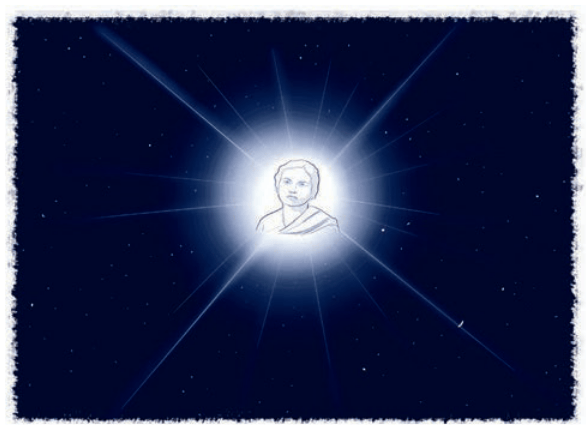
The stars are not meant to remain hidden forever. In 2019, the International Astronomical Union (IAU) honoured her legacy by renaming a star in the constellation Leo—HD 86081—as ‘Bibha,’ meaning ‘beam of light.’ Fittingly, she is now a ‘star in heaven,’ a symbol of the light she brought to Indian science. A fitting tribute to a woman whose life was a radiant example of tenacity, brilliance, and quiet determination. In 2020, the Government of India declared a chair professorship in her name.
Fast forward to the present day, and the advancements made by women in Indian science reflect Chowdhuri’s pioneering spirit and the progress she helped ignite. Women in ISRO, for instance, are no longer participants but leaders in missions that make global headlines.
One such luminary is Dr. Ritu Karidhal Srivastava, popularly referred to as the ‘Rocket Woman of India.’ Her pivotal role in ISRO’s Mars Orbiter Mission and subsequent leadership in Chandrayaan-2 and Chandrayaan-3 reflect the leaps women have made in STEM in India. Over 50 women contributed to Chandrayaan-3, and their success is built upon the shoulders of pioneers like Bibha Chowdhuri. Their roles in developing autonomous systems for spacecraft and managing mission-critical operations highlight the capabilities of women in pushing India’s space programme forward.
ignite: arouse
autonomous: independent
From Shadows to the Stars
The journey from Bibha Chowdhuri’s era to today’s women scientists has been long and arduous, but it is also inspiring. The struggles Chowdhuri faced are a stark reminder of how far we’ve come—and how much further we have to go. But with every cosmic achievement—be it landing on the moon or reaching Mars—these women prove that the journey is well worth it.
Bibha Chowdhuri’s legacy lives on. Her story continues to inspire young women to pursue their passions, break barriers, and leave their mark on the world. Whether exploring cosmic rays or sending rockets to Mars, India’s women scientists are writing the next chapter in a story that Bibha Chowdhuri helped begin.
As the stars of Indian science shine brighter, Bibha Chowdhuri, the beacon-‘beam of light,’ will always guide the way.
arduous: difficult, needing a lot of effort and energy
stark: clear
beacon: a good example that gives people hope and encouragement
Let us discuss
I. Arrange the following events from Bibha Chowdhuri’s life in the correct order of occurrence. Share your answers with your classmates and teacher
- The International Astronomical Union (IAU) honoured her legacy by renaming a star in the constellation Leo—HD 86081—as ‘Bibha’.
- She became the first woman faculty member at the Tata Institute of Fundamental Research (TIFR).
- Bibha Chowdhuri was born in pre-independent India.
- The Government of India declared a chair professorship in Bibha’s name.
- She joined the University of Manchester under the guidance of the celebrated Nobel Laureate, Patrick M.S. Blackett.
- She was nominated for a Nobel Prize by Erwin Schrödinger.
Let us think and reflect
I. Read the given extracts and answer the questions that follow.
1. In 1945, Bibha’s academic journey took her to the University of Manchester. Under the guidance of the celebrated Nobel Laureate, Patrick M.S. Blackett, she delved deeper into the field of cosmic rays. Her Ph.D. thesis on cosmic rays earned local recognition, with newspapers introducing her as ‘India’s New Woman Scientist—She has an eye for Cosmic Rays’.
(i) Why is the mention of Patrick M.S. Blackett, a Nobel Laureate,
significant in this extract?
(ii) What can be inferred about the public perception of women
scientists in the 1940s from the title given to her by the press ‘India’s
New Woman Scientist’?
- A. Women scientists were widely accepted and celebrated at that time.
- B. The world was still doubtful about the capabilities of women scientists.
- C. Women scientists were as common and renowned as men in the 1940s.
- D. Women were not allowed to study sciences or pursue scientific careers.
(iii) In the phrase ‘celebrated Nobel Laureate,’ the word ‘celebrated’ refers to all of the following EXCEPT someone who is
- A. famous and highly respected
- B. frequently seen in public
- C. renowned for their achievements
- D. well-regarded in their field
(iv) Complete the following sentence suitably.
The phrase ‘She has an eye for Cosmic Rays’ suggests that __________.
2. The journey from Bibha Chowdhuri’s era to today’s women scientists
has been long and arduous, but it is also inspiring. The struggles
Chowdhuri faced are a stark reminder of how far we’ve come—and
how much further we have to go. But with every cosmic achievement—
be it landing on the moon or reaching Mars—these women prove that
the journey is well worth it.
Bibha Chowdhuri’s legacy lives on. Her story continues to inspire
young women to pursue their passions, break barriers, and leave
their mark on the world. As the stars of Indian science shine brighter,
Bibha Chowdhuri, the beacon–‘beam of light,’ will always guide the way..
(i) What can be inferred about the challenges faced by women scientists today, as compared to Bibha Chowdhuri’s era?
- A. Women scientists no longer face any barriers.
- B. The challenges remain, but progress has been made.
- C. The struggles have become more difficult over time.
- D. The struggles are the same as they were for Chowdhuri.
(ii) The phrase ‘Bibha Chowdhuri’s legacy lives on’ suggests that __________.
(iii) Why is Bibha Chowdhuri referred to as a ‘beacon’ and a ‘beam of light’ in the extract?
(iv) State whether the following sentence is a fact or an opinion.
Bibha Chowdhuri was the beacon, the ‘beam of light’ whose story continues to inspire young women.
II. Answer the following questions.
- Why is Bibha Chowdhuri considered a pioneer in the field of science?
- What does Bibha Chowdhuri’s nomination by Erwin Schrödinger tell us about her abilities?
- Bibha Chowdhuri never worked for awards or recognition. Support this statement with evidence from the text.
- How does the renaming of a star as ‘Bibha’ serve as both a literal and symbolic recognition of her contributions to science?
- How do the roles of women in ISRO today reflect broader changes in societal attitudes towards women in STEM in India?
- What is the writer’s purpose of highlighting the contributions of Bibha Chowdhuri and other modern women scientists?
- What is the writer’s purpose of highlighting the contributions of Bibha Chowdhuri and other modern women scientists?
Let us learn
I. Complete the crossword puzzle by filling in the antonyms from the clues given below in the table. You may refer to the text.
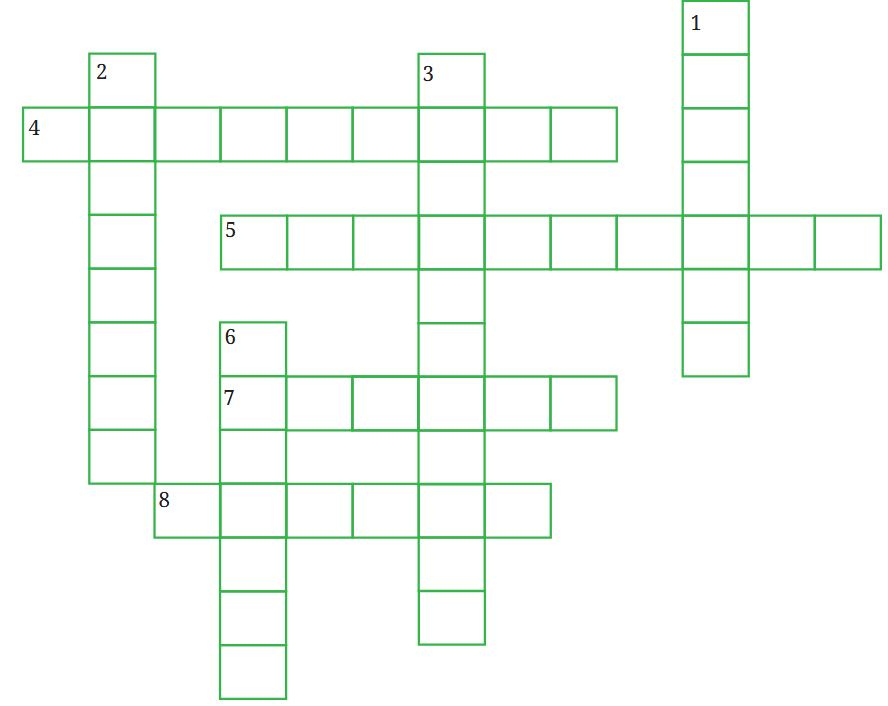
| Across | Down |
| 4. core | 1. effortless |
| 5. dependent | 2. weakness |
| 7. extinguish | 3. neglect |
| 8. terrestrial | 6. trivial |
II Substitute the underlined phrase in the sentences with the suitable words from the box given below.
- They are considered to be the first people to start the online markets.
- A scientist who studies matter, energy, light, etc.
- Most of my friends are my classmates and are my age.
- We first welcomed all the famous and important people in folk song for the award ceremony.
- My brother finally succeeded in his business because of his continuous
- efforts and determination.
- We should remove all the things that block our way in achieving success.
III. The words ‘professorship’, ‘mentorship’, and ‘leadership’ are used in the text. These words are made by adding the suffix ‘-ship’ to the words ‘professor’, ‘mentor’ and ‘leader’. Similarly, we can make words by adding -ment and -hood to certain words.
Now, make words by adding suitable suffixes -ship, -ment, and -hood to the words given below. One example has been done for you.
achieve + ment = achievement
- member + _______________ = _________________
- govern + _______________ = _________________
- partner + _______________ = _________________
- child + _______________ = _________________
- citizen + _______________ = _________________
- entertain + _______________ = _________________
- brother + _______________ = _________________
- agree + _______________ = _________________
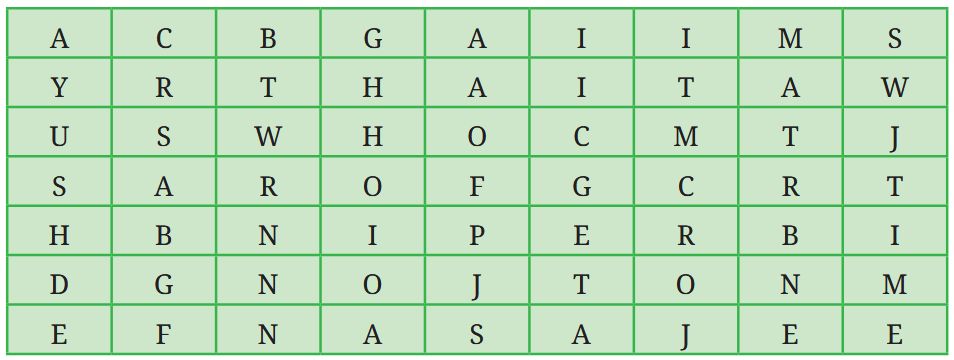
IV The abbreviations—ISRO and STEM—used in the text are called acronyms because they are read or pronounced as full words.
The grid given below has acronyms for the following. Circle the acronyms in the grid.
- National Aeronautics and Space Administration
- All India Institute of Medical Sciences
- Ayurveda, Yoga and Naturopathy, Unani, Siddha, and Homoeopathy
- National Institute of Pharmaceutical Education and Research
- World Health Organization
Clipping
The short form of laboratory is lab. In making this short form, the front part of the word is retained and the end part is removed or clipped.
Clipping is a method of making words from larger words in English. There are three clipping methods.
1. Back clipping: a word is made by removing the end part of a word and retaining the front part (exam—examination, ad—advertisement, gas—gasoline, memo—memorandum, gym—gymnasium, photo—photograph, etc.).
2. Front clipping: a word is made by removing the front part of a word and retaining the end part (phone—telephone, net—internet, bike—motorbike, net—internet, etc.).
3. Middle clipping: a word is made by removing the front and the end parts of the word and retaining the middle part (flu—influenza, fridge—refrigerator, etc.).
V. Read the following sentence from the text and the table that follows.
…, the foundation was laid by early pioneers like Bibha Chowdhuri…
| Subject | Verb | Object |
| The foundation | was laid | early pioneers like Bibha Chowdhuri… |
Here the verb is expressed in passive form.
Verbs can be expressed in either active voice or passive voice.
When the subject performs the action, the sentence is said to be in active voice. On the other hand, when the subject receives the action, the sentence is in passive voice.
Generally, sentences written in active voice are considered effective. However, passive voice is used when the
- action is more important than the doer,
A cure for the disease was discovered.
(The focus is on the discovery, not on who discovered it.) - doer of the action (agent) is obvious,
The national anthem is sung at the beginning of the event.
(It is clear that people sing it, so mentioning the doer is unnecessary.) - doer of the action is unknown.
The car was stolen last night.
(The identity of the thief is unknown.)
Now, complete the following news report with the passive form of verbs given in the box below. (Remember that the verb must agree with the subject.)
Last year, significant advancements in medical science 1. __________ in leading medical journals when a new vaccine for malaria 2. __________. The vaccine 3. __________ through several clinical trials and results 4. _________ in those journals. During the trials, blood samples 5. __________ regularly from participants to monitor their immune response. The amount of antibodies produced 6. __________ carefully to assess the effectiveness of the vaccine.
VI. Read the following report of an experiment. Rewrite the report using passive verbs wherever necessary.
I conducted an experiment to investigate the effects of light on plant growth. I placed various plants under different light conditions and measured their growth over several weeks. I recorded data daily to track the height of each plant. At the end of the experiment, I analysed the results and found that plants exposed to natural light grew significantly taller than those under artificial light. I concluded that sunlight plays a crucial role in plant development. I presented my findings to the class, highlighting the importance of light in enhancing photosynthesis and overall plant health.
You may begin like this.
An experiment was conducted…
VII. Read the instructions given in the box on landing of Chandrayaan. Complete the passage by choosing the correct answer from the options given.
- Launch the spacecraft towards the Moon from Earth.
- Position the spacecraft to enter the Moon’s orbit.
- Adjust the spacecraft’s path for landing.
- Slow down the spacecraft as it nears the Moon’s surface.
- Release the rover to explore the surface and collect valuable data.
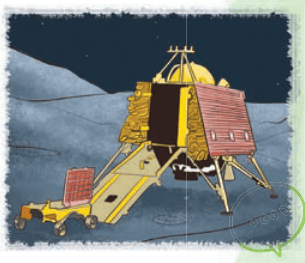
Chandrayaan’s landing mission involves several key steps. First, the spacecraft 1.________ towards the Moon from the Earth. Then, it 2. ________ to enter the Moon’s orbit. After reaching the Moon’s orbit, the spacecraft’s path 3. ________ for landing. Next, the spacecraft 4. ________ as it nears the Moon’s surface. Finally, the rover 5.________ to explore the surface and collect valuable data.
(i)
- launched
- were launched
- was launched
- is launched
(ii)
- position
- was positioned
- is positioned
- has positioned
(iii)
- adjusted
- was adjusted
- is adjusted
- were adjusted
(iv)
- slowed down
- was slowed down
- is slowed down
- were slowed down
(v)
- is released
- has released
- were released
- was released
Let us Listen
I. ou will listen to a podcast about Artificial Intelligence. As you listen, answer the following questions by selecting the correct options. (Transcript for teacher on page 251).
1. What is one of the key benefits of AI in the healthcare sector?
- Helps doctors communicate faster with patients.
- Provides personalised treatments and faster diagnoses.
- Focuses on cosmetic surgeries to improve appearance
2. How did AI play a crucial role during the global pandemic?
- AI robots monitored patient behaviour in hospitals.
- AI assisted in speeding up the discovery of new medicines.
- AI developed different types of vaccines by itself.
3. What example was given regarding AI’s role in renewable energy?
- AI is optimising the placement of wind turbines and solar panels in cities.
- AI is promoting alternative energy from wind turbines and solar panels.
- AI is improving the performance of wind turbines and solar panels.
4. What does AI offer to teachers in the field of education?
- Helps teachers assign grades more quickly.
- Allows teachers to communicate better with students.
- Helps teachers analyse student performance.
5. What is one of the user-friendly features that AI is enhancing for people with disabilities?
- Helps them find better jobs in the mainstream.
- Improves speech recognition and voice command technologies.
- Trains individuals to interact with robots.
Let us Speak
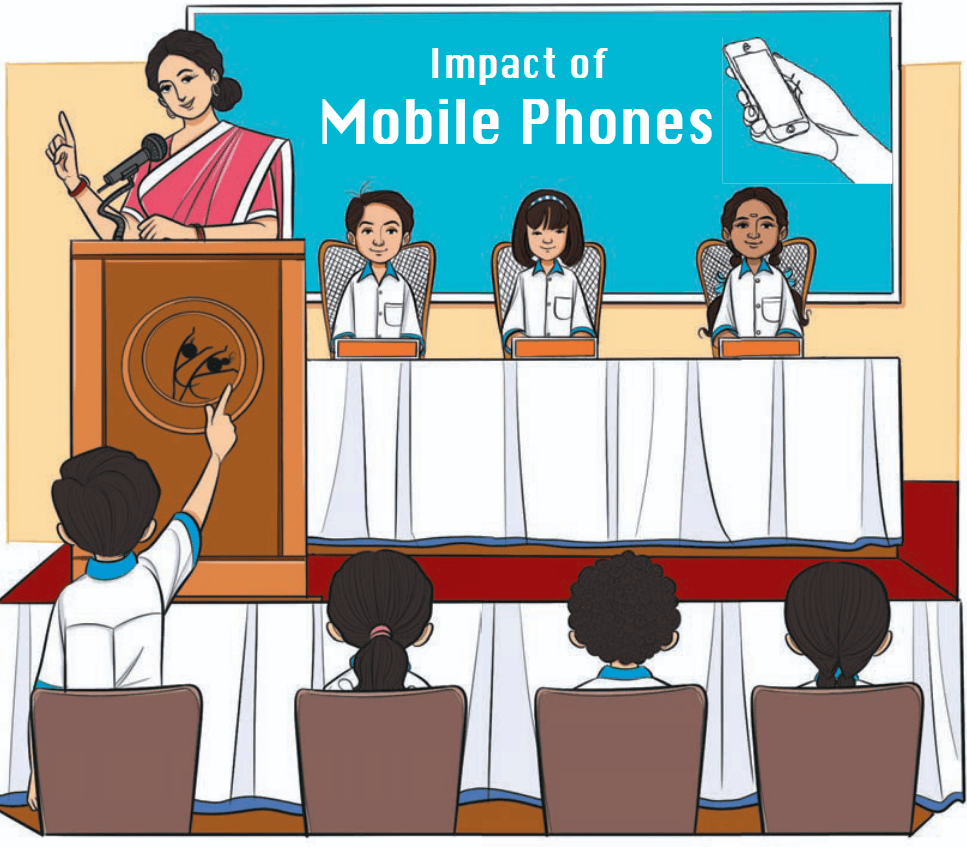
I. Form a group of five. Conduct a panel discussion on the topic, ‘Evaluating the Impact of Mobile Phones—Beneficial or Harmful’. Each student will take on one of the following roles.
- Moderator (initiates and directs the flow of the discussion inviting the speakers to share their views on the subject; at the end sums up the points of discussion and thanks the members of the group)
- Principal (opposed to—focus on discipline in school)
- Teacher (in favour of—partially in favour, educational use with limitations)
- Parent (opposed to—concerned about health and social effects on children)
- Student (in favour of—highlighting the benefits like connectivity and learning)
You may use the cues given below and add your own ideas when speaking.
As a Principal, I strongly believe mobile phones are largely disruptive because…
From an educator’s perspective, I think mobile phones can be valuable but…
As a parent, I’m concerned that mobile phones pose certain risks to children’s health and social development…
As a student, I feel mobile phones are essential because…
Let us write
I. Your school recently hosted the Zonal Science Exhibition, in which teams of students from 25 schools participated enthusiastically. As the student editor, write a report on the exhibition to be published in your school magazine. Use the cues given below with your own ideas to compose this report.
- Who was the organiser and who hosted the exhibition?
- When (date and time) and where was it held?
- Why was it held?
- Who participated?
- Who was the Chief Guest?
- What were the competitions held? For example: Science Quiz, Science Models, etc.
- What were the topics of models exhibited? Give details.
- Which team got the trophy for best exhibit?
- What were the observations of the Chief Guest and other visitors?
Points to remember:
- Write the report in past tense, passive voice, and third person.
- Follow proper format with a headline, reporter’s name, and three paragraphs.
Let us explore
I. n the recent times, Augmented Reality and Virtual Reality are changing the way students learn. Let us know more about them.
- Augmented reality (AR) enhances a person’s environment by adding digital elements to what can be seen in real time, usually through a smartphone camera.
- Virtual reality (VR) offers a fully immersive experience, replacing the real world with a simulated one.
- Through AR and VR, the students can see and interact with things that they could not interact with in real life. This enables younger students to understand difficult ideas easily.
- To keep up with the times, NCERT has developed the e-Pathshala AR (Augmented Reality) App under the aegis of MHRD, Government of India.
- This App aims to enable students to go beyond textbooks and four walls of the classrooms and learn concepts by directly experimenting rather than only through reading and memorisation.
- This revolutionary effort will change most students from passive listeners to active learners.
- This effort is in line with the Prime Minister’s Digital India vision to
- empower varied sectors using technology and addressing the triple
- need of skill, scale, and speed.
Gear up for the new age education!
https://ciet.ncert.gov.in/ar-vrII. The Government of India has come out with a new set of National Awards in the field of Science, Technology, and Innovation known as ‘Rashtriya Vigyan Puraskar’.
The objective of the Rashtriya Vigyan Puraskar (RVP) is to recognise the notable and inspiring contribution made by the scientists, technologists, and innovators individually or in teams in various fields of science, technology, and technology-led innovation.
- Vigyan Ratna (VR) award will recognise lifetime achievements and contributions made in any field of science and technology.
- Vigyan Shri (VS) award will recognise distinguished contributions in any field of science and technology.
- Vigyan Yuva-Shanti Swarup Bhatnagar (VY-SSB) award will recognise and encourage young scientists up to the age of 45 years, who have made an exceptional contribution in any field of science and technology.
- Vigyan Team (VT) award to be given to a team comprising three or more scientists/researchers/
innovators, who have made an exceptional contribution working in a team in any field of science and technology.
PressReleaseIframePage.aspx?PRID=1959262
III. A glimpse of women pioneers from different fields.
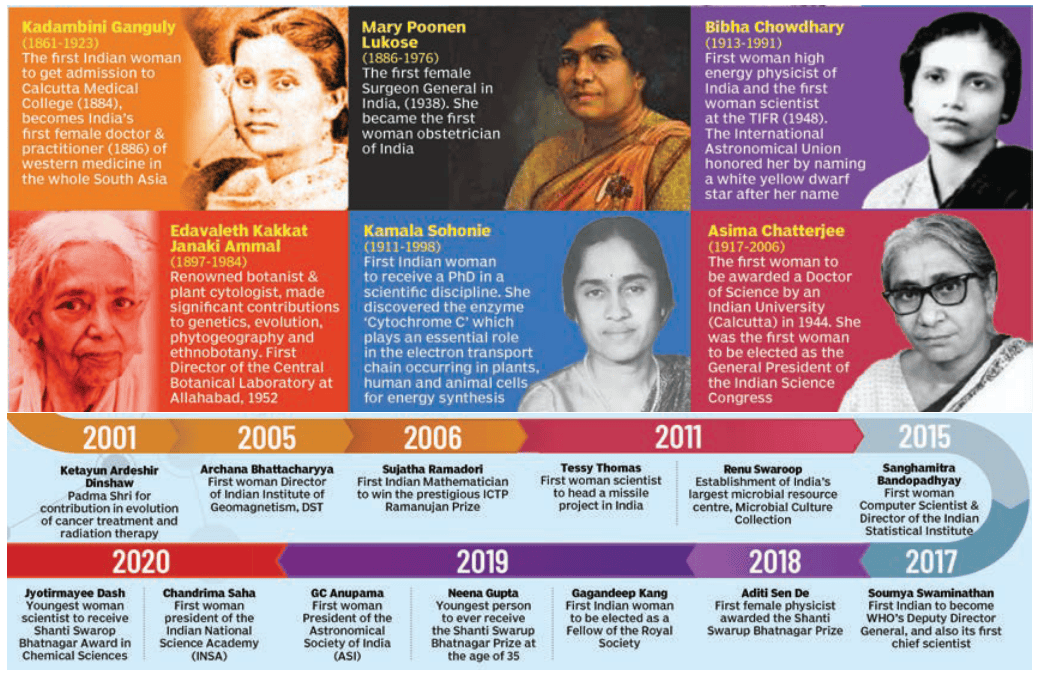
TRANSCRIPTS
FEATHERED FRIEND
Let us listen(refer to page 217)
I You will listen to a conversation between Monika and Toby. Toby is a Martian and is stranded on Earth. He has become Monika’s friend. As you listen, put a tick mark against the correct statements and a cross against the wrong ones.
Monika : Hi, Toby! Do you miss your planet?
Toby : Very much, Monika! I miss my people and home.
Monika : Oh! I wish I could do something about it! But I am happy to have you as my friend.
Toby : Thank you, Monika!
Monika : Er... could you tell me something more about yourself?
Toby : Why not! What do you want to know about me, Monika?
Monika : What do you eat for breakfast?
Toby : Well, we Martians don’t need to eat anything. We get our energy from the Sun.
Monika : Oh! Don’t you ever feel like having ice creams and chocolates? I can’t think of life without them!
Toby : No, Monika! We are made of different stuff.
Monika : Okay, tell me one thing. How are you able to see with only one eye? I see only one big eye in the centre of your face.
Toby : My friend, we Martians need only one eye to see clearly. In fact, I can see even with my eye closed. I can see beyond mountains and clouds, wood and even metals. I can see that you are carrying a toy in your pocket. It’s a blue aeroplane. Isn’t it? And yes! That apple you just had for breakfast is going round-and-round in your stomach right now!
Monika : (gasps in disbelief) Oh my goodness!
II Listen to the conversation again and fill in the blanks with the exact words you hear.
MAGNIFYING GLASS
Let us listen(refer to page 227)
I You will listen to a conversation between a father and daughter about lesser-known Indian inventions. As you listen, mark the four true statements from 1–6 given below.
Daughter : Papa, everyone talks about how yoga and the concept of zero came from India, but I recently found out there are so many more inventions that people don’t really know about!
Father : Oh really? Like what?
Daughter : Well, did you know that radio broadcasting has roots in India? We usually credit Marconi, but Jagadish Chandra Bose, a Bengali scientist, actually conducted an experiment using microwaves before Marconi.
Father : Wow, I didn’t know that! That’s incredible. I can recollect something about fibre optics.
Daughter : Yes! You’re absolutely right Papa. Can you imagine life without fibre optics? No fast internet, no clear communication… And guess what? It was pioneered by Narinder Kapany, an Indian physicist from Punjab. He’s called the ‘father of fibre optics.’
Father : That’s something I use every day, but I just had an idea that the origins were in India. What about fun things? Any of those that you’ve found out about?
Daughter : Yes indeed! You’ll love this one—Snakes and Ladders! It was actually invented as a game to teach children values, with ladders representing virtues and snakes representing evil. It wasn’t just a board game like we think today. It had a spiritual meaning in ancient times.
Father : So even that simple game had such deep roots. Let me tell you about one that I just remembered.
Daughter : Of course! I’d love to know.
Father : Well, the USB port, something we rely on all the time to connect devices, was invented by Ajay Bhatt. He’s an Indian-born engineer who helped revolutionise the way we use technology.
Daughter : That’s amazing. USB is such a basic part of life now. It’s hard to imagine a time without it.
Father : That’s incredible. And all this from India. I definitely learned a lot from this conversation.
Adapted from—https://www.bbc.co.uk/
programmes/articles/5rnsYs1
QcP-B7CsyjzvTcmjf/7-surprising-things-india-has-given-the-world
BIBHA CHOWDHURI
THE BEAM OF LIGHT THAT LIT THE PATH FOR WOMEN IN INDIAN SCIENCE
Let us listen(refer to page 244)
I You will listen to a podcast about Artificial Intelligence. As you listen, answer the following questions by selecting the correct options.
Hello and welcome to Tech Talks, the podcast where we explore how technology is shaping our world! I’m Faizy, your host, and today we’re diving into the fascinating topic of artificial intelligence, or AI, and how it’s benefiting humankind.
AI is often seen as futuristic, but it’s already making everyday tasks easier and more efficient. Let’s look at some of the incredible ways AI is improving our lives in four of the many segments.
Let’s begin with Segment 1: Healthcare Transformation
AI systems can analyse medical data much faster and more accurately than humans, leading to quicker diagnoses and personalised treatments.
AI-powered robots are also assisting in surgeries, making them more precise and less invasive. And during the global pandemic, AI played a crucial role in speeding up the discovery of new medicines.
Let’s now talk about Segment 2: Environmental Sustainability
AI is helping us fight climate change. It helps in predicting natural disasters, and managing resources like water and agriculture more efficiently.
In renewable energy, AI is improving the performance of wind turbines and solar panels, pushing us toward a greener future.
Next, we have Segment 3: Enhancing Education
In education, AI is offering personalised learning experiences to students.
Teachers also benefit from AI, which helps analyse student performance and manage administrative tasks, giving them more time to focus on teaching.
Segment 4: Accessibility and Inclusion is the final segment of the podcast today.
You see, AI is also improving accessibility for people with disabilities. Technologies like speech recognition, text-to-speech, and voice commands make communication easier and faster.
Now you know how AI is improving life for humankind. AI is a powerful force for good but we need to use it responsibly.
Thanks for tuning in to Tech Talks. Join us next time for another deep dive into the world of technology. Until then, stay curious, and keep exploring!