
UNIT 1
Evolution of Physical Education and Well-being
The first unit of this book explores the concept of physical education as a holistic approach to nurture the body, mind, and spirit. It emphasises the importance of physical activities, games, yoga, and sports in promoting physical fitness, emotional balance, mental calmness, and social values like respect, fairness, and cooperation.
The unit highlights the National Curriculum Framework for School Education (NCF-SE 2023), which integrates traditional Indian practices with modern sports to foster overall wellness and personal growth. The unit explores the meaning, definitions, aims, and objectives of physical education. It goes beyond physical activity, highlighting learning through the body to develop teamwork, discipline, and self-control. Scholars like Sri Aurobindo and organisations, like UNESCO, have highlighted the role of physical education in achieving holistic development. The aims include building character, instilling virtues such as, honesty and patience, and preparing students to be socially responsible and emotionally balanced individuals. This unit also focuses on physical literacy which is defined as the ability, confidence, and motivation to engage in physical activities throughout life. It includes developing locomotor, non-locomotor, and manipulative skills, which are essential for fitness, holistic health and overall development. The unit encourages students to reflect on their experiences with physical education and its impact on their growth. It also promotes the integration of fitness and well-being into daily life while informing students about various career pathways in physical education.
Chapter 1
Physical Education and Well-being
The word ‘education’ creates an initial perception of books, classrooms, and exams. However, real education is not only about the mind, it is about the body as well. If the body is weak or unhealthy, the mind cannot focus, and if the mind is unwell, even a strong body feels tired.
In the Preparatory and Middle stages of school, you were introduced to various indigenous games, traditional sports, āsanas, prāṇāyāma, and other yogic practices. These activities not only built physical strength and stamina but also provided mental peace, discipline, and balance.
That is why physical education is an important part of our lives. It teaches us how to take care of our health, move and play, stay active, and balance studies with fitness. The National Curriculum Framework for School Education (NCF-SE 2023) names the subject as Physical Education and Well-being, since it not only helps us become physically fit and active but also promotes happiness, confidence, emotional balance, and mental calmness. It nurtures important values, such as, respect for others, fairness, honesty, and co-operation.
Before we explore the meaning, aims, and importance of Physical Education, let us ask ourselves — how does Physical Education shape our bodies and improve the quality of our lives? How are movement, discipline, and fitness closely linked to living a better life?
Meaning and Definitions of Physical Education
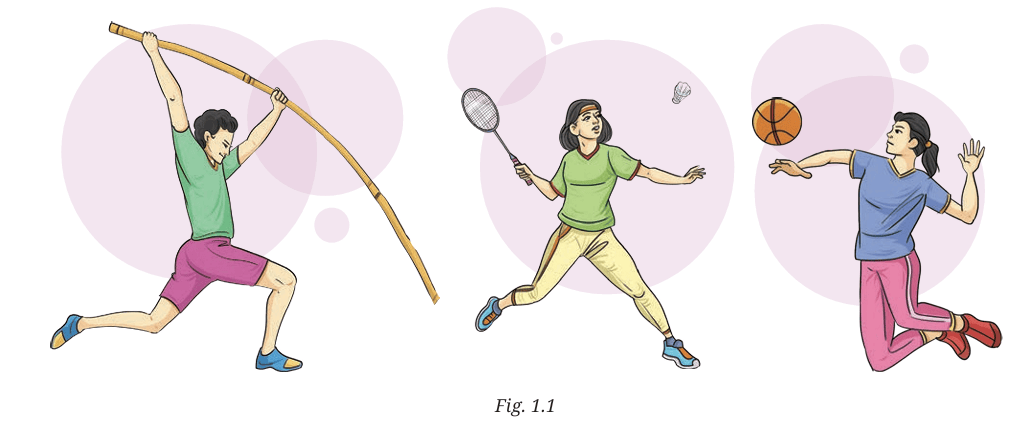
Physical Education is not just restricted to a sports period or an exercise class in school. It is not limited to drills, games, or physical activity alone, but is rather a process of learning through the body. It trains the body and the mind together. Every sprint develops speed and each repeated sprint improves endurance; every yoga posture builds balance and self-control; and every game teaches teamwork, strategy, confidence, and discipline — lessons that are useful in everyday life.
“The perfection of the body, as great a perfection as we can bring about by the means at our disposal, must be the ultimate aim of physical culture. Perfection is the true aim of all culture, the spiritual and psychic, the mental, the vital and it must be the aim of our physical culture also.” – Sri Aurobindo
“Physical education is the process of education through physical activities. It is the development of the total personality of the child to its fullness and perfection in body, mind, and spirit.” — Central Advisory Board of Physical Education and Recreation (1959, India)
“Physical education is education through physical activities for the development of the total overall personality of the child and its fulfilment and perfection in body, mind, and spirit.” — J.P. Thomas (1963 Indian educationist)
“A fundamental right for all, physical education is an essential element of lifelong learning that contributes to holistic development, health, and quality of life.” — UNESCO (1978) International Charter of Physical Education and Sport, Paris
“Physical education is an integral part of the total education process. Its aim is the development of physically, mentally, emotionally, and socially fit citizens through the medium of physical activities.” — Charles A. Bucher (Bucher, C. A. 1979)
“Physical Education consists of movements, drills, exercises, yoga, games, sports, and other activities that promote mind-body wellness. Physical Education should provide a wide range of age appropriate and level-appropriate physical activities that develop knowledge of the body, and of games and sports, together with a disposition towards perseverance, teamwork, and sportsmanship.” – NCF-SE 2023
LET US THINK
In your previous classes, you learnt to develop friendships, mental tenacity, emotional resilience, learning to handle losses and looking beyond the victories through play. How have these been helping you in your everyday life?
AIMS of Physical Education
Imagine your school team is preparing for an inter-house sports event. Students of different backgrounds, abilities, and personalities are grouped together and asked to plan their practice sessions. Some of your teammates are fast runners, while some struggle with stamina. During practice, disagreements might arise. At times, a team loses a match, and at other times, they win.
Physical Education is not limited to your physical training alone. It develops character and inculcates virtues such as honesty, patience, and fairness. When students play together, they learn to respect rules, accept victory with humility, and face defeat with courage. These qualities slowly become a part of their personalities and prepare them to live life with strength and dignity. While playing in teams and sharing responsibilities, they learn co-operation, equality, and respect for diversity.
The National Curriculum Framework – School Education (NCF-SE) 2023 also highlights that physical education should nurture mind-body wellness, resilience, empathy, co-operation, and fair play. In this way, the aim of physical education is not limited to physical fitness, but extends to enabling students to become socially responsible, emotionally balanced, and ready to contribute to the nation.
Objectives of Physical Education
The objectives of physical education encompass the various ways in which it supports the growth of students and prepares them for the future.
LET US EXPLORE
Write your experiences on how physical education and sports activities helped you in developing the given objectives in your own words.
Physical development
..................
..................
..................
Mental development
..................
..................
..................
Emotional development
..................
..................
..................
Social development
..................
..................
..................
Character formation
..................
..................
..................
READ AND REFLECT
Richa is a Grade 9 student, who spends most of her free time on mobile games and rarely engages in outdoor activities. Recently, her teachers noticed that she often feels tired, struggles to concentrate in class, and gets stressed before exams. During the annual sports day, her friends encouraged her to join a team game. At first, she hesitated, but slowly she started enjoying it. Over time, as she participated more in sports, she became more energetic, her focus in studies improved, and she learned how to co-operate with teammates. Her teachers also observed that she became calmer and more confident, even when she made mistakes.
• Which two objectives of physical education helped Richa improve her concentration and confidence?
• How did participation in team games help Richa in her social development?
• If Richa continues to play regularly and maintains healthy habits, which long-term benefit of physical education will she achieve?
Physical Literacy
How did you learn movements like throwing a ball, running, or balancing on one leg? Did you learn everything at once? What helped you to finally do them correctly?
As you have learnt in your previous grades, it is physical literacy that enables us to execute various physical activities with ease in our daily life. Just as reading and writing develop language literacy, learning to move confidently while performing physical activities develops physical literacy. It means having the ability, confidence, and motivation to participate in different physical activities throughout life.
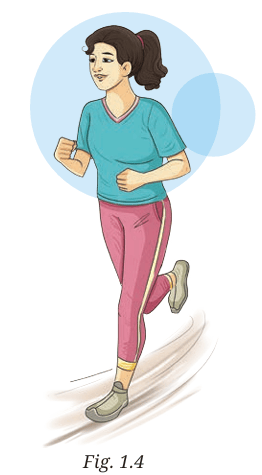
Physical Literacy includes:
• Physical ability such as running, throwing, balancing, and jumping
• Confidence in one’s own movement and skills
• Motivation and interest to stay active and
• Understanding why physical activity is important for our health and well-being
Benefits of Physical Literacy
After school, you might find yourself sitting for long hours — scrolling through your phone, watching videos, or playing games with little or no movement. Gradually, over time, the body feels stiff, muscles grow weaker, and the mind becomes tired or stressed. When you choose to step outside, play a sport, practise a skill, or simply move more, you feel a difference in your body and energy levels.
Developing physical literacy helps students build fitness, confidence, and healthy habits throughout their life. Several benefits of physical literacy are listed below:
• Improves overall health and physical fitness
• Builds confidence and self-esteem
• Helps prevent lifestyle diseases
• Develops teamwork, leadership, and decision-making skills
• Reduces anxiety and improves focus in studies
Movement skills are the building blocks of all physical activities. These fall under the umbrella of physical literacy and can be categorised into the following:
Locomotor Skills
You have learnt skills like walking, jumping, leaping, hopping, and skipping in the Preparatory and Middle stages. These skills develop strength, speed, agility, and endurance which are known as locomotor skills. Activities like Kabaddi and Kho-Kho depend heavily on these skills for chasing, dodging, and changing direction quickly.
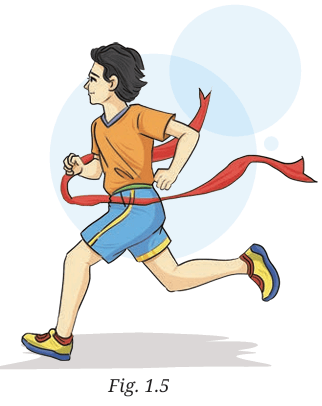
Non-locomotor Skills
Non-locomotor skills are movements performed without mobilising the body from one place to another. These include bending, stretching, twisting, turning, balancing, and swaying. They develop stability, flexibility, and body control. Yoga predominantly uses non-locomotor skills. In postures like Tāḍāsana or Vṛikṣhāsana, learners must stay balanced and focused without moving from their positions.
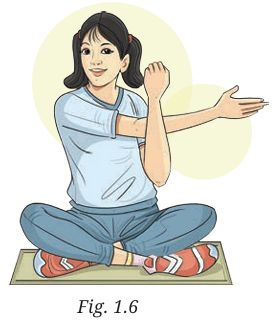
Manipulative Skills
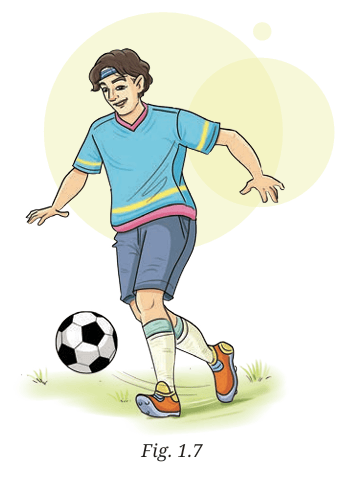
Manipulative skills involve controlling objects with hands or feet. These include squeezing, throwing, catching, kicking, striking, rolling, and dribbling. They build hand-eye coordination, timing, focus, and judgement. Games like Gillī-Daṇḍā, cricket, football, and volleyball depend on manipulative skills. They help link brain coordination with physical action.
Movement skills are at the heart of physical literacy games like Āṭyā-Pāṭyā, Anding Oka, Turai Kar, Nāḷugu Rāḷḷu Āṭa, Ghorpaḍīchhe Śhepūta, etc., helping students develop speed, agility and coordination, while yoga asanas improve balance, stability, and body awareness. These activities reflect India’s cultural heritage and support holistic development.
Explore your school’s library, search for Khel Yoga and Khel Yatra books of previous grades, and list down locomotor, non-locomotor and manipulative activities mentioned in them. Try to perform any two activities.
Exercises
1. At the Middle and Preparatory stages, you have played traditional games. Discuss how these games helped you to attain the objectives of physical education.
2. From the given options, circle the word which you think is appropriate for physical literacy, and discuss with your peers.
3. A student is skilled in football but avoids trying any new sport. According to you, which component of physical literacy might they need to develop? Discuss with your peer, parents and teachers.
Chapter 2
History and Culture of Physical Education in India
On a clear morning, in an ancient gurukula, a group of young students wake up before sunrise. After prayers, they begin their day with archery practise, aiming arrows at wooden targets set under the trees. Some students wrestle in the mud courtyard, while others engage in farm work or practise yoga postures. Only after this physical training, do they gather around their teacher for lessons in the Vedas, grammar, and philosophy.
From the gurukulas of the Vedic age to universities of ancient India, physical education had been practised regularly. This chapter takes you on a journey through tradition, showing how physical education was practised, celebrated, and gradually woven into daily life. We will also replicate these practices according to the contemporary scenario.
The concept of education in India has always been holistic. It was never limited to reading and writing. Students were trained to develop the body and the mind together. Hence, physical training exercises, games, martial arts, and yoga were an important part of ancient life. Evidences for these are also found in the Vedas, epics, Ayurveda, and even various archaeological findings.
Evolution of Physical Education in Indian Culture
Vedic Period - Ṛigveda describes chariot races and wrestling.
Yajurveda - Highlights archery and Dhanurveda.
Atharvaveda Contains mantras about bows and arrows.
Epics Rāmāyaṇa and Mahābhārata depict martial training.
1st–2nd century CE Charaka-saṁhitā highlights exercise benefits.
3rd–6th century CE Suśhruta-saṁhitā emphasises moderate exercise.
4th century BCE Arthaśhāstra describes military training.
12th century CE Mānasollāsa mentions Mallakhamb.
13th century CE Malla-purāṇa describes wrestling exercises.
1854 Wood’s Despatch focuses on literary subjects.
19th century Indian Education Commission 1882, also called the Hunter Commission, recommends that schools encourage native games, gymnastics, drills, and other exercises
1914 The foundation of the Hanuman Vyayam Prasarak Mandal (HVPM) in Amravati, Maharashtra. The Vaidya brothers started it as an akhara but soon developed it into an institution that trained instructors in traditional Indian physical activities.
DID YOU KNOW?
Ancient Indian texts like the Charaka-saṁhitā (c. 1st–2nd century CE) explain that exercise (vyāyāma) which is a foundational text of ayurveda highlights the need for balance between activity and rest, reflecting an early scientific understanding of fatigue and recovery.
Suśhruta-saṁhitā (c. 3rd–6th century CE) emphasises the importance of moderate exercise for good health and clearly instructs that it should be done only up to half of one’s capacity.
From Independent India to Present
1948 - Tara Chand Committee — National Cadet Corps (NCC) was founded to build discipline and fitness among youth.
1950 - Central Advisory Board on Physical Education was created.
1957 - Lakshmibai College of Physical Education, Gwalior — a pioneer institute of Physical Education, was founded.
1961 - National Institute of Sports (NIS) — a pioneer institute of coaching and development of coaches, was founded.
1964 - Kothari commission – It was decided that PE should be treated as an essential part of general education, linked to health, social, moral, and spiritual development, not just athletics.
1986 - National policy on education — directed that schools should spend about 8–10 per cent of teaching time on physical and health education.
2005 - National Curriculum Framework (NCF) — emphasised that sports and yoga should be seen as a part of learning. Every school day should include time for physical activity.
2020 - National Education Policy (NEP) — gave special importance to fitness, yoga, and sports as part of core curriculum. It called for equal focus on academics, arts, vocational, and physical education.
2022 - National Curriculum Framework for Foundational Stage (NCF-FS) 2022 — emphasises Physical Education (PE) as vital for holistic child development.
2023 - National Curriculum Framework for School Education (NCF-SE) 2023 — Health and Physical Education should be treated as a curricular area at the Secondary Stage (till Grade 10). It integrates traditional Indian games alongside modern sports, and link daily physical activity to life skills, values, and well-being.
Long before marked playgrounds and stadiums existed, physical activity was part of everyday life. In early Indian societies, physical activities referred to daily movements, such as walking, running, swimming, lifting, farming, hunting, bathing, and martial training. Games were not separate leisure activities but were connected with health, discipline, social interaction, and preparation for life. For example, children learned to run while helping elders, balance while walking on uneven paths, and work together.
Cleanliness, strength, discipline, and co-operation were essential for survival and community living. Over time, these daily movements developed into organised training, martial skills, wrestling traditions, and, later, structured games. Physical fitness was valued as a means of maintaining health, fulfilling duties, and strengthening community life. Let us explore how physical activities and games evolved in early Indian society from prehistoric times to the colonial period.
Activity
Fig. 2.2 shows the Rock Shelters of Bhimbetka, and encircle the words that depict the scene in the box given below.
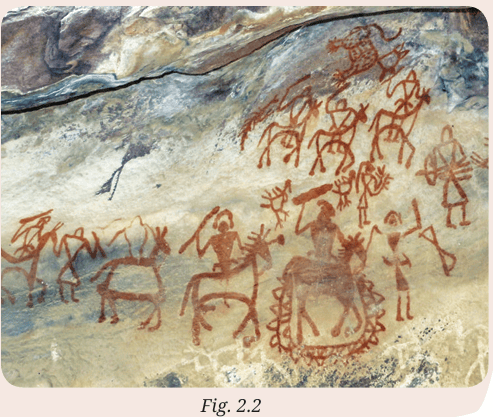
Hunting, Gathering, Climbing, Running and Group movement, Equestrian, Javelin, Activity Aqua sport, Cycling, Mace, Archery
The rock paintings of pre-historic times show that early humans engaged in various activities that built physical strength, endurance, coordination, and cooperation. These activities required strength, endurance, and teamwork. The UNESCO World Heritage Report on the Rock Shelters of Bhimbetka records paintings depicting hunting History and Culture of Physical Education in India scenes, use of weapons, and collective activities indicating that physical movement was central to daily life and social organisation.
People of the Sindhu-Sarasvatī civilisation led active daily lives. Physical activity was mainly linked to agriculture, construction, craftwork, walking through planned cities, and managing water systems. Structures such as the Great Bath of Mohenjo-Daro and water reservoirs at Dholavira show the importance of cleanliness, movement, and community effort. Physical activity was a part of daily work and community living.
Ṛigveda
The Ṛigveda entails warriors, chariots, weapons, and physical strength indicating that courage, endurance, and combat ability were highly valued in early society.
Sāmaveda
The Sāmaveda focuses on the chanting of hymns. Proper chanting requires disciplined posture, rhythm, and controlled breathing, showing coordination between the body and the voice. This reflects the importance of physical control and discipline in ritual practice.
Yajurveda
The Yajurveda describes rituals that involved precise movements, balance and bodily steadiness. Such practices required control over the body and careful coordination, highlighting the role of physical discipline in religious life.
Atharvaveda
The Atharvaveda places strong emphasis on health, bodily strength (bala), healing, and protection from disease. It reflects an early awareness of physical well-being and the need to maintain stability for a healthy life.
Upaniṣhads
The Upanishads (800-200 BCE)ave a spiritual meaning to physical strength. The Kaṭhopaniṣhad says, ‘Nāyamātmā balahīnena labhyo na cha pramādāt tapaso vāpyaliṅgāt|’ which means “This self cannot be attained by the weak.” It depicts the body as a chariot, the mind as the reins, the intellect as the driver, and the senses as horses. This shows that control of the body and senses was essential for higher wisdom.
BEFORE WE MOVE ON
Vasiṣhṭha’s Dhanurveda-saṁhitā, belonging to the medieval period describes systematic training in archery, including posture, balance, controlled movement, and discipline. It also emphasises moderation in physical effort and ethical conduct, showing that martial training is focused on strength, control, and responsibility, rather than competition or sport.
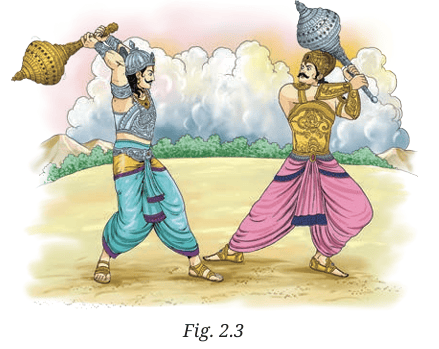
During the Epic period, physical training became more organised and purposeful, especially as part of education and preparation for life. The great Indian epics, the Rāmāyaṇa and the Mahābhārata, describe how students were trained in archery, the use of weapons, physical strength and discipline under the guidance of teachers (Guru) in gurukulas. The Mahābhārata provides detailed descriptions of systematic training where students practised archery, mace fighting, and other forms of warfare including horse and chariot riding. These epics show that physical activity during the Epic period was closely linked with education, physical training, discipline, courage, and moral values.
During the early classical period, ideas about physical activity became more systematic, especially in relation to health, discipline, and state responsibilities. Texts from this period show that physical strength and bodily control were considered important for both personal well-being and effective administration. The Arthaśhāstra by Kauṭilya describes physical discipline, regular routine, and fitness particularly for rulers, soldiers and officials. The text also highlights cleanliness, order, and regulation of daily activities in cities, showing that physical preparedness and public health were matters of state concern.
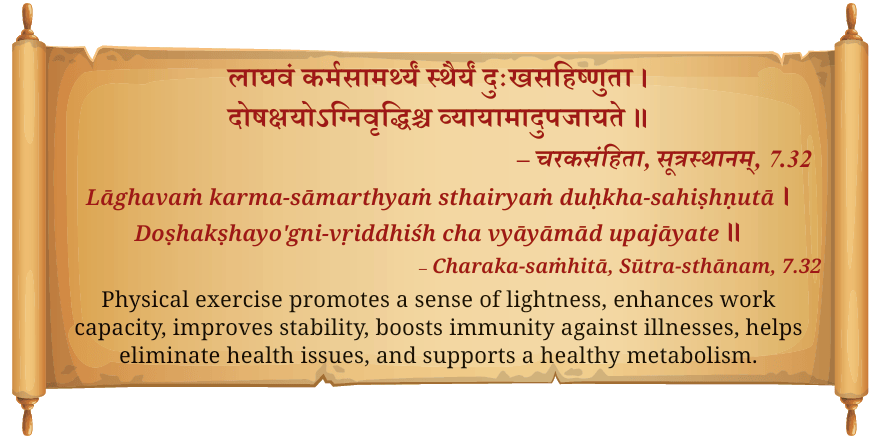
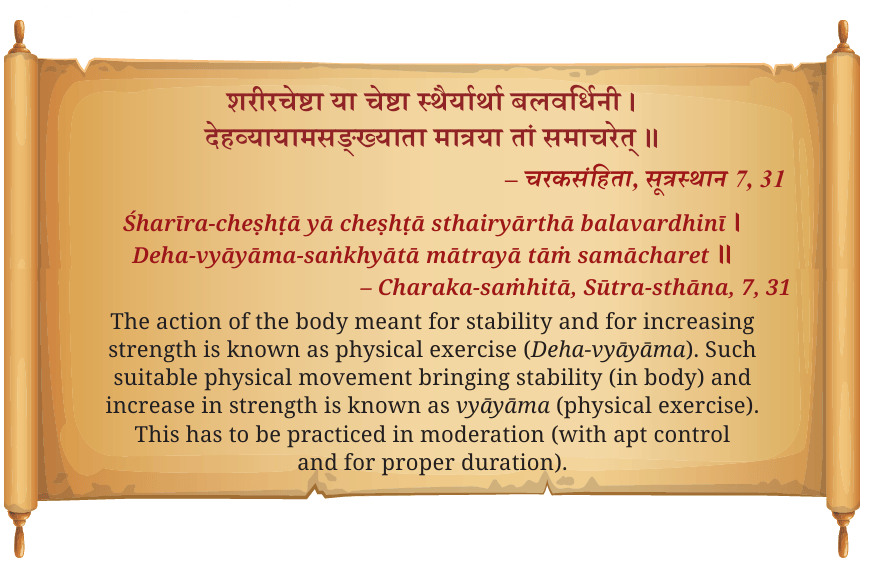
According to ancient Indian knowledge, exercise is any physical activity of the body that is beneficial, improves stability, and increases strength. Such activity is called vyāyāma. However, this exercise should always be done in moderation, not excessively. According to Āchārya Charaka, regular physical exercise makes the body light, strong, stable, and hardworking. It also improves pain tolerance, helps in balancing doṣhas and strengthens digestion and metabolism. All these benefits are achieved through proper exercise.
DID YOU KNOW?
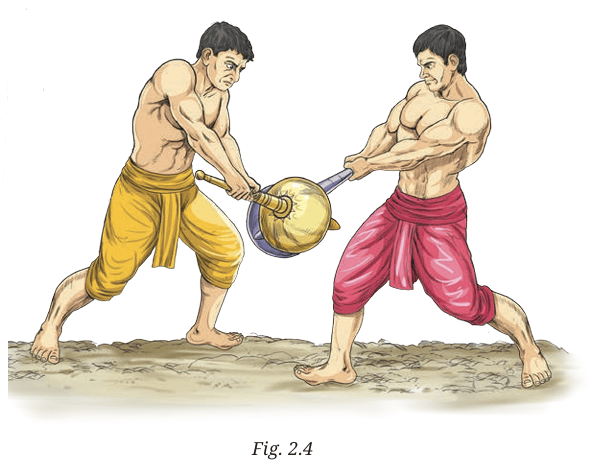
In South India, kalaripayaṭṭu emerged as a systematic martial art practised in spaces for kalari that focused on flexibility, balance, strength, agility, and weapon training.
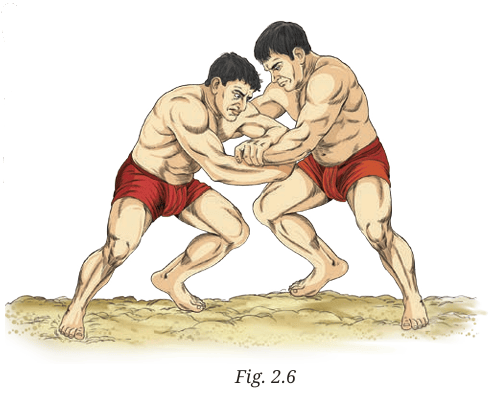
Wrestling (malla-yuddha) was practised in akhāḍās in northern, central, and western regions of India, while various stick and sword practices developed in eastern and central India. Although these traditions have ancient roots, most written records describing their methods belong to the medieval period.
Medieval Physical Culture
The Malla-purāṇa (13th century CE) describes 16 types of wrestling exercises for strength and stamina. Wrestlers were expected to practice daily, combining drills with yoga postures. Wrestling was both a sport and a way to build character. The Mānasollāsa (12th century CE), written by King Someśhvara III, is the first text to mention Mallakhamb as a unique Indian sport where athletes perform acrobatic poses on a wooden pole. This exercise improved strength, balance, and flexibility, and its royal patronage shows how highly it was valued.
In medieval times, wrestling (malla-yuddha) became a community sport. Towns had akhāḍās (wrestling schools) where young people trained in daṇḍs (push-ups), baiṭhaks (squats), and weight lifting. Wrestling matches were held at fairs and festivals, attracting large crowds and strengthening community bonds.
Late Medieval Period
During the late medieval period, physical activities were closely connected with military preparation and administration. The Āʾīn-i-Akbarī records that wrestling, archery, horse riding, and hunting were encouraged during the reign of Akbar. Contemporary Marathi chronicles describing the life of Chhatrapati Shivaji Maharaj, and Rajputana history describing the life of western Indian warriors show that physical endurance, agility, weapon training, and movement across difficult terrain were essential for warfare and defence. These activities focused on physical strength, mental resilience and readiness, unlike organised games.
Global Origins of Physical Education
While India followed its own traditions, in Europe the modern subject of Physical Education began to take shape in the 18th and 19th centuries. The term itself first appeared in English in 1748, in a translation of a French book, where it spoke about ‘the physical education of children’. This shows that by the mid-1700s, Europeans had begun to think of training the body as an important part of education.
By the late 1700s, educational reformers were treating physical training as a part of general schooling. In Germany, Johann Christoph Friedrich GutsMuths, often called the “grandfather of Gymnastics”, published Gymnastics for Youth in 1793. He designed exercises and games for children as part of their overall development. Another German, Friedrich Ludwig Jahn, wrote Die deutsche Turnkunst in 1816, promoting Turnen or organised gymnastics to build discipline, strength, and national pride. In Sweden, Per Henrik Ling developed a system of gymnastics that combined medical, military, and educational training.
These ideas also spread to America. In 1825, Charles Beck, a German who had moved to the United States, introduced gymnastics at the Round Hill School in Massachusetts and set up the first school gymnasium in the country. A few years later, in 1828, he translated Jahn’s book into English as ‘Treatise on Gymnasticks’. In the introduction, Beck even used the term physical education, helping to popularise the idea that training the body should be a part of school learning. In the middle of the 19th century, many schools in Europe and America had gymnastics, games, and drills as part of their daily timetable.
DID YOU KNOW?
The Swedish system of gymnastics developed by Per Henrik Ling later influenced DID YOU KNOW? military drills and even modern physiotherapy exercises!
Colonial India
When the British introduced modern schooling in India, their main focus was on literary subjects. The famous Wood’s Despatch of 1854 laid the foundation for schools and universities but did not include physical education.
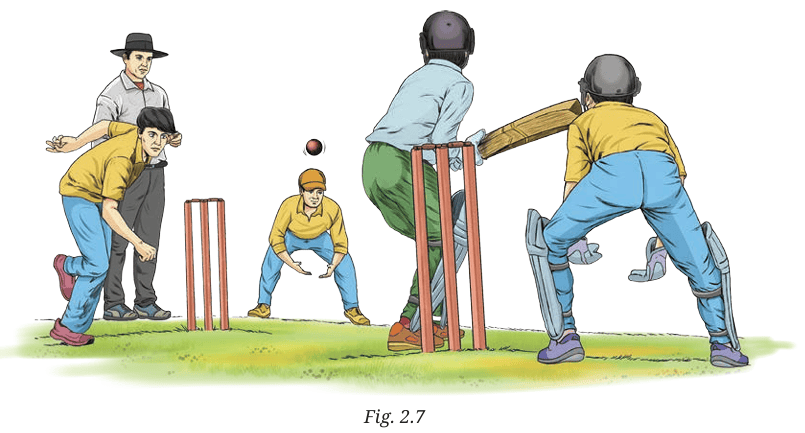
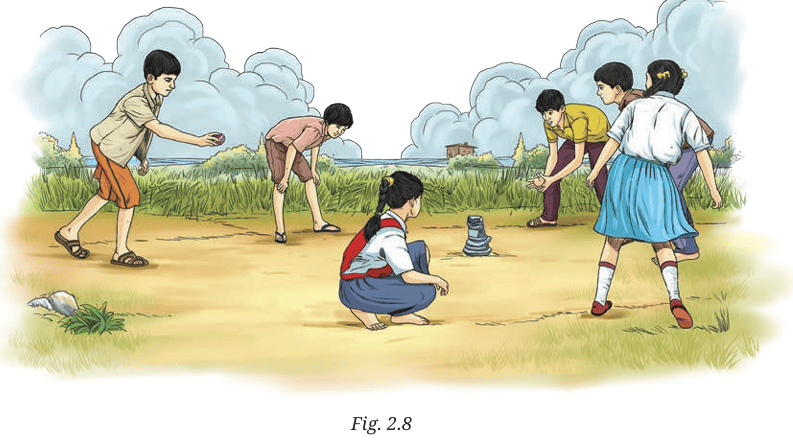
British sports like cricket, hockey, and football entered Indian schools and clubs, often promoted by the princely states and their rulers. Indian rulers like the Maharaja of Patiala and Maharaja of Vijyanagar patronised cricket and hockey, while wrestling and traditional games continued outside the school system.
In 1914, a major step was the foundation of the Hanuman Vyayam Prasarak Mandal (HVPM) in Amravati, Maharashtra. In 1920, Harry Crowe Buck, an American educator, started the YMCA College of Physical Education in Madras, which became the first professional institute for Physical Education in India. During the 1930s, more colleges opened in Hyderabad, Lucknow, and Bombay.
DID YOU KNOW?
What did the city of Pune in Maharashtra give to the world? The history of badminton in India dates back to the 1860s, when British Army officers stationed in Pune adapted a local game called Poona or “Poonah” by adding a net and formalising the rules.
The Sargent Report of 1944 made physical education compulsory in all schools, and the All India Physical Education Conference in Amravati in 1946 brought educators from across the country together on one platform. These steps laid down the groundwork for India to step forward and make Physical Education an integral part of every student's education.
Exercises
1. From the given options select words which according to you are promoted by the Charaka-saṁhitā? Discuss with your peers.
2. On a map of India, encircle any state or region and name the games played there. Do they have different names across the country? Discuss how geographic terrain impacts the type of sport played in a particular region.
3. Write a list of shlokas from various epics and Saṃhitā which mention physical activities or physical culture.
Chapter 3
Careers in Physical Education
It was Sports Day at School. The physical education teacher was giving warm-up instructions, the coach was guiding the relay team, the doctor was ready with first aid, the announcer was calling out the events, and the camera person was capturing the action.
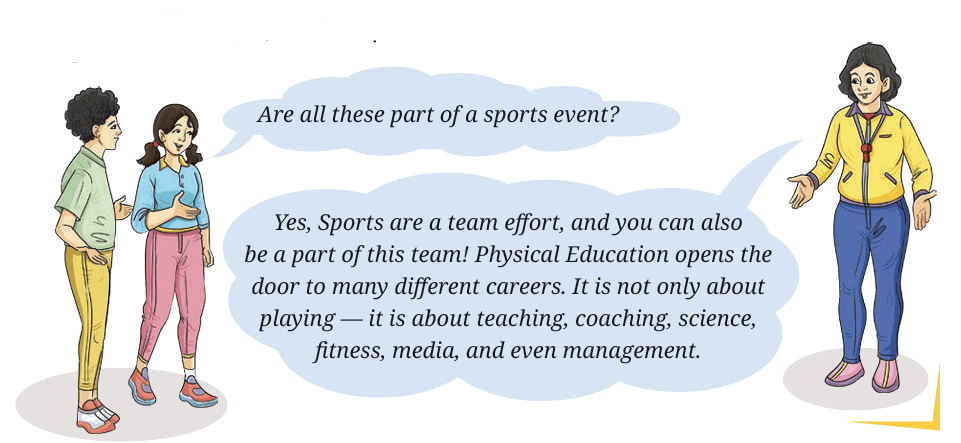
Let us now learn about the possible career paths that can be chosen, after studying Physical Education.
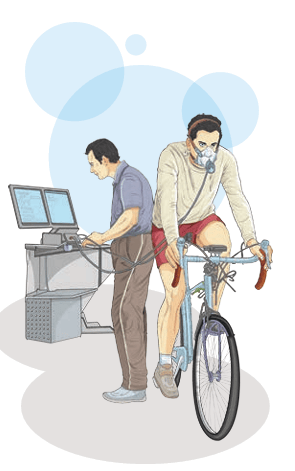
Area/Category: Therapeutic Modality
|
Role |
Description |
Qualification |
|
Physiotherapist |
Helps with injury treatment and recovery |
BPT + specialisation |
|
Sports Nutritionist |
Plans diet for performance and recovery |
B.Sc./M.Sc. Nutrition |
|
Sports Psychologist |
Improves mental strength and focus |
Degree in Sports Psychology |
|
Sports Biomechanist |
Analyses movement and technique |
Degree in Biomechanics |
|
Exercise/Sports Physiologist |
Studies body response to training |
Degree in Exercise Physiology |
Area/Category: Teaching and Coaching
|
Role |
Description |
Qualification |
|
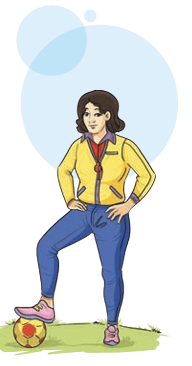
School PE Teacher |
Guides students in fitness, games, yoga, and healthy habits |
NCTE-approved PE programme |
|
College/ University PE Teacher |
Teaches sports science subjects and trains future professionals |
NCTE-approved qualification |
|
Sports Coach |
Trains athletes and teams |
B.P.Ed/M.P.Ed as well as coaching certificates |
Area/Category: Fitness and Wellness Industry
|
Role |
Description |
Qualification |
|
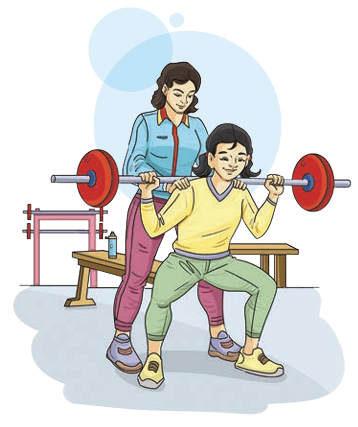
Fitness Trainer |
Guides gym workouts and design fitness plans |
Certificate/ Diploma |
|
Yoga Practices |
Teaches yoga and meditation |
Diploma/ Certificate in Yoga |
|
Aerobics/ Zumba/Pilates Instructor |
Leads group fitness classes |
Short-term certification |
Area/Category: Emerging Careers
|
Role |
Description |
Qualification |
|
Esports Coach/ Fitness Expert |
Trains gamers’ fitness and reflexes |
Gaming + fitness knowledge |
|
Adventure Sports Guide |
Leads trekking, rafting, climbing |
Training from adventure institutes |
|
Sports Technologist |
Develops wearables and tech in training |
Technology + Sports Science |
|
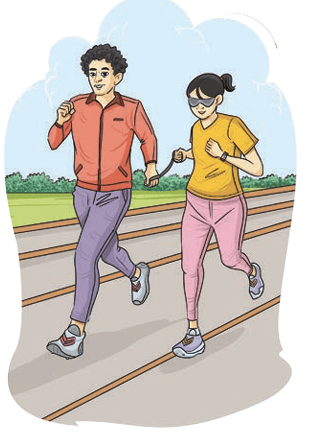
Para-Sports Trainer |
Trains differently abled athletes |
PE + adaptive sports certification |
Area/Category: Sports Management and Media
|
Role |
Description |
Qualification |
|
Sports Event Manager |
Organises tournaments and events |
Degree/Diploma in Sports Management |
|
Sports Administrator |
Manages sports bodies and policies |
Degree/Diploma in Sports Management |
|
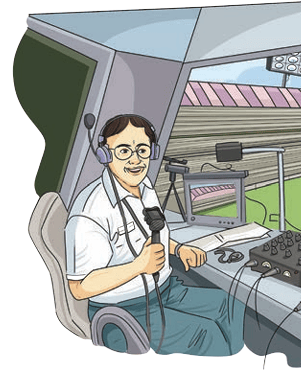
Sports Journalist/ Commentator |
Reports and comments on sports |
Journalism/Media Management degree or diploma |
|
Sports Data Analyst |
Analyses performance data |
Statistics/CS/Sports Science |
|
Sports Engineer |
Develops sports equipment and technology |
Engineering + specialisation |
TRIVIA
Before the FIFA World Cup, the Swedish national football team built a support staff that worked for 21 months to prepare players. This backend team included:
• Performance Analysts
• Medical Practitioner and Physiotherapists
• Fitness and Strength Coaches
• Mental Performance Specialists
• Logistics and Travel Coordinators
The staff’s job was not only to train players but also to monitor recovery, plan travel, and prepare strategies using match analysis. This ensured that athletes were supported in every way—physically, mentally, and logistically. This example shows how international teams depend on a wide network of professionals, proving that careers in Physical Education and Sports Sciences are global.
Choose a suitable role in your school team for yourself based on your interest and capacity.
Exercises
1. Name any four professions who not only help people earn a living but also contribute to a healthy and balanced society. Write what you think of their roles.
2. Discuss with your peers and teachers the different career options students can choose based on the subjects they study.
3. You have learned about different careers in sports. Which sports professional do you admire the most? Why do you like them and how do they inspire you?
Chapter 4
Fitness and its Components
On the first day of fitness week at school, the Physical Education teacher asked the students to start with a short run. Ravi completed the lap quickly. Aisha ran at a steady pace without stopping. Anurag could not run very fast, but he balanced extremely well during a yoga pose. Observing all the students, the teacher smiled and said, “All of you are fit in different ways. It is not the same for every person.”
Being fit is not only about speed or strength. It is about balance, flexibility, endurance and confidence.
Types of Fitness and their Components
Fitness is the ability of the body to work efficiently, stay healthy and perform daily activities without getting tired. A f it student can run, jump, lift, play and concentrate better in school. Fitness is not only about strength or long-distance running. It includes different types of abilities that help the body move smoothly and stay active. There are two main types of fitness, namely, Health-related Fitness and Skill-related Fitness. Both are important for students because they support overall growth, sports performance and well-being.
Health-Related Fitness Components
Health-related fitness components help maintain good health, prevent diseases, and support everyday activities. They are important for all students, whether they play sports or not.
Cardiovascular Endurance
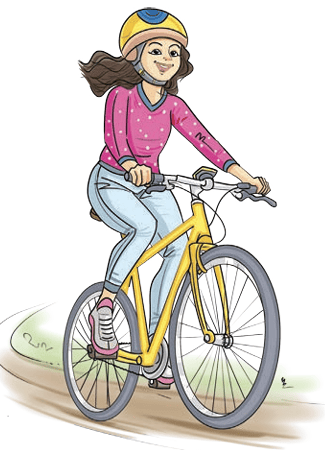
It is the ability of the heart and lungs to supply oxygen to the body during physical activity. A student with good endurance can run, cycle or swim for a long time without getting tired. It includes jogging for 10 minutes during warm-up, skipping rope, or running a long-distance race.
Muscular Strength
It is the ability of a muscle to overcome resistance which could be in the form of body weight, air, water or any other objects. It is required for lifting, pushing, holding or carrying objects like books, doing push-ups, and holding a yoga posture.
Muscular Endurance
It is the ability of muscles to work for a long period without getting tired. It can be built by performing repeated sit-ups, holding Vṛikṣhāsana for 20 seconds or cycling without stopping.
Flexibility
It is the ability of joints to move through a full range of motion. Flexible students can bend, stretch or turn without difficulty. Flexibility can be improved by performing forward bending in Yoga, stretching hamstrings, or movements in dance.
Body Composition
It is the proportion of fat, muscle, and bone in the body. A healthy body composition supports better movement and prevents lifestyle diseases. Balanced diet and regular physical activity help maintain a healthy body composition.
Skill-Related Fitness Components
These components help students perform better in games and sports. They support speed, coordination, and quick movement. However, skill-related fitness is not only for sports. It is an important part of daily life, physical literacy, and overall development. While players use these skills in sports, every person uses them in day-to-day activities. They help us stay active, independent, and confident.
DID YOU KNOW?
There are two types of isometric strength
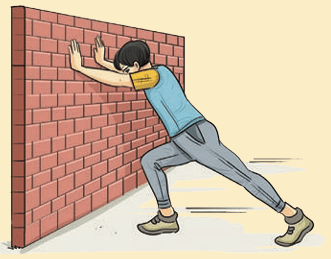
(a) Overcoming isometric: Pushing Isometrics Muscle Action (PIMA) also known as overcoming isometrics is when you apply force against an immovable object (for example, pushing a wall).
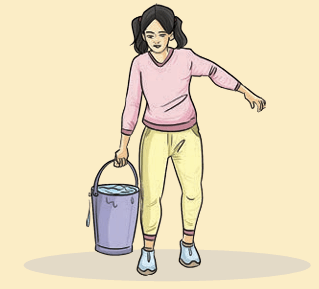
(b) Yielding isometric: Holding Isometric Muscle Action (HIMA) also referred to as yielding isometrics is when you resist an external load and prevent movement (for example, holding a weight in a fixed position).
1 SPEED -Speed is the ability to move from one point to another quickly. For example a short sprint in athletics or relay, or daily activities like catching a bus, etc.
2 AGILITY -Agility is the ability to change direction quickly while maintaining balance. For example, dodging in Kho-Kho or moving from side to side in badminton. It is also helpful while moving through a crowded market, avoiding obstacles or changing direction while walking.
3 BALANCE -Balance helps maintain body position irrespective of whether the body is still or moving. For example, holding Vṛikṣhāsana or balancing Gillī-Daṇḍā before striking. In daily life, balance is used while standing in a moving bus, walking on uneven roads, or climbing stairs safely.
4 COORDINATION -Coordination is the ability to use different body parts smoothly together. Hand–eye coordination is used while catching a ball and foot–eye coordination is used while kicking a football. Coordination is also used while performing daily chores like writing, cutting vegetables, using a computer, driving or operating tools.
5 POWER -Power is a combination of strength and speed. It helps the body perform explosive movements. Jumping high in volleyball, throwing a javelin, or performing a powerful leap in athletics are expressions of physical power. It is also needed for lifting school bags quickly, helping with household tasks or getting up from the floor smoothly.
6 REACTION TIME -Reaction time is how quickly a person responds to a signal. It includes starting to run when the whistle blows, and catching the ball quickly in cricket. In day-to-day life, it is important for stopping quickly while riding a bicycle, avoiding a falling object, or responding to a sudden movement.
Importance of Skill-Related Fitness
Skill-related fitness helps learning in the following ways:
• Improved hand control in day-to-day tasks.
• Improved catching, throwing, jumping and coordination.
• Increased confidence in team games and rhythmic activities.
• Improved posture and stability in Yoga practices.
• Stronger foundation for sports participation in later classes.
Activity
Divide the students into groups and ask them to select any one profession. Discuss the importance of fitness in their chosen profession.
Exercises
1. From the word given below, underline the ones related to health-related fitness and encircle the ones related to skill-related fitness.
Body Composition, flexibility, cardiovascular endurance, balance, muscular strength, muscular endurance, speed, agility,power,coordination and reaction time
2. Combine strength, flexibility, and endurance exercises into a simple 15-minute routine. Write one benefit of each type of exercise.
3. Calculate your Body Mass Index (BMI) and identify which category you fall into based on the World Health Organisation guidelines.
Check Your Progress
Answer in brief
1. A student has adequate knowledge of fitness but lacks motivation to attend PE classes. Which domain of physical literacy needs improvement? Suggest one strategy to help increase motivation.
2. Explain how physical literacy is connected to overall wellness (physical, mental, emotional, and social health).
3. Write about any two indigenous sports of India and explain how each is played.
4. Name any four sports played worldwide today that originated or were played in India from ancient times.
5. Construct a simple weekly fitness plan including exercises, rest, and healthy food to improve physical and mental well-being.
6. Design a school day routine that combines exercise, healthy meals, and study breaks. Explain how this routine helps you stay energetic and focused.
Answer the following in detail
1. How can participating in team sports improve both the physical and social aspects of physical literacy?
2. Create a flowchart from the prehistoric till ancient period with changes in the philosophy of physical education.
3. Do you think skill-related fitness is useful only for athletes? Justify your answer.
4. Compare two favourite sports that you play and explain which components of fitness are most important for each.
5. Design a one-week fitness plan for yourself or your family that includes both health-related and skill-related components under the guidance of a physical education teacher. Explain your choices.
6. Justify the importance of the subjects that you have studied till now, and explain how these subjects serve as pathways that guide students toward different career opportunities in the field of physical education or sports.