
UNIT 3
Olympism
This unit explores the philosophy and values of the Olympic Movement, inculcating the role of sports in promoting peace, unity, and personal excellence. Olympism is presented as a philosophy of life that combines sport, culture, and education to foster harmony and cooperation among individuals and nations. The unit highlights the core Olympic values of excellence, friendship, and respect, along with educational values like joy of effort, fair play, and balance between body, mind, and willpower. This unit traces the history of the Olympic Games, from their ancient origins in Greece to the modern revival by Pierre de Coubertin in 1896. It discusses the evolution of the Games, including the inclusion of women, the introduction of the Winter Olympics, Paralympics, and Youth Olympics, and their role in promoting equality and inclusion. Students are encouraged to reflect on the values of the Olympic Movement and how they can be applied in their own lives to foster personal growth and social harmony. Symbols like the Olympic flag, rings, motto, and anthem are explored, highlighting their significance in uniting athletes and nations. The unit emphasises the importance of participation over winning, as expressed in the Olympic Creed, and encourages students to embrace the spirit of fair play, mutual respect, and global friendship. Through engaging activities, students learn how sports can transcend boundaries and contribute to a more peaceful and inclusive world.
Chapter 9
Olympic Values
Imagine you are standing in a packed stadium. Thousands of people are cheering, the Olympic flame is burning brightly, and athletes from different countries are marching together in a colourful parade. They speak different languages, belong to different cultures, and compete in different sports. Yet, in that moment, they are all united under one flag— the Olympic flag.
A memorable example is the 1936 Olympics, when Jesse Owens, an African-American sprinter, won four gold medals despite facing racial discrimination both at home and abroad. His friendship with German athlete Luz Long, who supported him during the long jump, became a symbol of mutual respect, friendship, and fairness. This story reminds us that the Olympics are about more than winning medals, they embody values that bring people together.
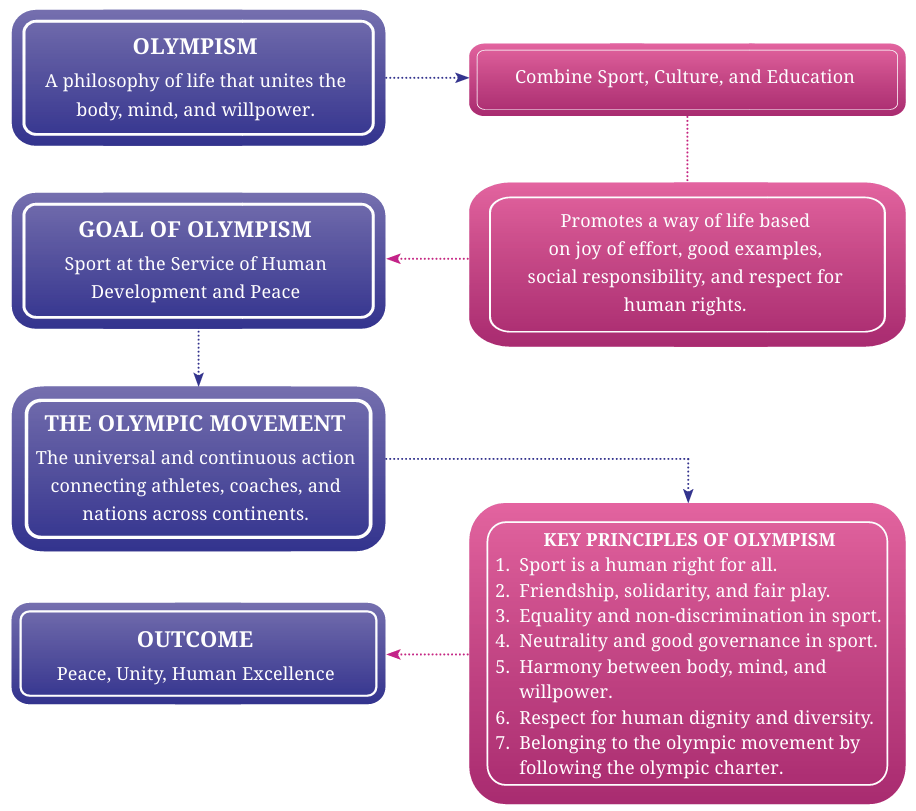
The word ‘Olympism’ may sound big, but its meaning is simple and inspiring. Olympism is a philosophy of life. It teaches us to balance our body, mind, and willpower. It is not only about sports but also about how we live every day. Olympism brings together sport, culture, and education to make the world more peaceful and united.
Philosophy And Goal of Olympism
Olympism views sport as an enabler of a balanced development of body, mind, and character. It promotes physical, mental, social, and emotional growth while upholding the dignity of every individual and ensuring equal participation without discrimination. More than winning medals, Olympism teaches values such as joy of effort, fair play,respect, friendship, and solidarity. By combining sport with culture and education, it encourages cooperation, harmony, and responsible citizenship.
Activity
Try to recall instances when two rival countries united during sports competitions. Have sports ever helped you bond with new friends?
TRIVIA
• The Olympic flag, with its five rings, was first introduced in 1914 by Pierre de Coubertin. These rings symbolise the five continents and the coming together of athletes from around the world.

• The Olympic motto today is “Faster, Higher, Stronger — Together” (Citius, Altius, Fortius — Communiter)
• The word ‘Olympism’ first appeared in the 1908 edition of the olympic charter, defined by Pierre de Coubertin as “a life philosophy that balances the qualities of body, will, and mind.”
• The Olympic Charter is revised regularly to reflect global values. The latest edition (2025) includes a strong focus on sustainability and equality.
Sport as a Force for Peace and Unity
The Olympic Movement spans across continents and includes athletes, coaches, technical officials and communities who believe in friendship, solidarity, and fair play. A powerful moment occurred when athletes from North and South Korea marched stogether under one flag in the 2018 Winter Olympic. This act sent a strong message of peace and understanding, showing how sport can rise above political boundaries.
LET US FIND OUT
Why do you think the place where participating athletes of the Olympics, Commonwealth Games, Asian Games, National Games, etc., stay is called the Games Village?
LET US REFLECT
• How does the idea of Olympism go beyond sport? than winning?
• Can you recall a situation in which effort was more important to you
LET US DISCUSS
Pierre de Coubertin, founder of the modern Olympics, believed that sport is the fourth branch of education, along with science, art, and morality. What does this mean? How does sport educate us differently from classroom subjects?
Core Olympic Values
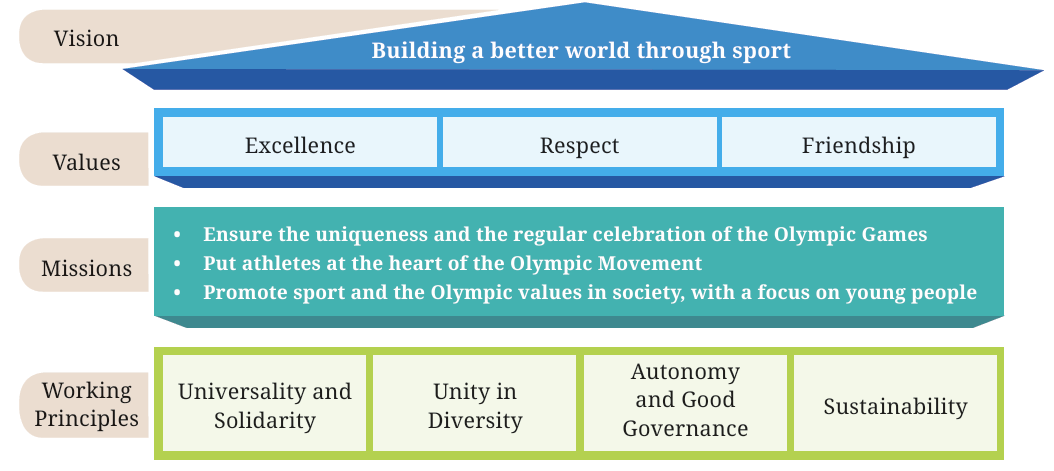
Excellence
Excellence means giving your best effort and continuously improving, not just winning. It inspires us to set goals and persist through challenges.
Neeraj Chopra, India’s first Olympic gold medalist in athletics (Tokyo 2020), exemplifies this value. Despite injuries, his disciplined training and self-belief led to his historic achievement. Similarly, Michael Phelps’ 23 Olympic gold medals demonstrate that excellence requires sustained hard work and resilience.
Excellence applies beyond sports. A student shows excellence by completing work with full effort and honesty, always seeking to learn and improve.
Olympism is a philosophy of life, which places sport at the service of humankind.
Friendship
True friendship is founded on trust, respect, and kindness. In school or the community, it involves including others, helping those in need, and celebrating successes together. Many Olympians have spoken about the friendships they forged with fellow athletes worldwide. For example, the story of lifelong friends Jesse Owens and Luz Long that we read in the introduction. Their relationship serves as a lasting lesson in humanity.
Respect
Respect means valuing yourself, others, and the rules, whether in sports or daily life. Many Indian athletes, like Sachin Tendulkar, touch the ground before entering the field as an act of gratitude and humility. In competition, respect is shown when athletes accept a referee’s decision, shake hands with opponents, or acknowledge their competitors’ efforts. Beyond sports, respect means listening to others, accepting diversity, following rules, and caring for our environment and resources.
LET US SHARE
Your favourite sportstar’s act of excellence, friendship, and respect.Olympic Educational Values
In addition to the three main values of excellence, friendship, and respect, the Olympic Movement also promotes a set of educational values that help learners grow as complete individuals. These values connect sports with education and life.
Joy of Effort
The joy of effort means finding happiness in giving your best, whether you win or lose. It encourages us to enjoy the process of learning and playing, not just the result. Each time we work hard and improve ourselves, we experience true joy.
Fair Play
Fair play means playing honestly, following the rules, and showing respect to teammates, opponents, and officials. It teaches honesty, justice, and equality in both sport and life.
DID YOU KNOW?
• According to the Olympic Charter, sport is a human right. Every individual should have access to participate in any physical activity without discrimination.
• The Olympic flame is first lit in Olympia, Greece, and then carried to the host city through a torch relay.
Balance of Body, Mind, and Willpower
A balance of body, mind, and willpower teaches the importance of overall well-being. A healthy balance of physical fitness, mental strength, and emotional stability helps us perform at our best. It connects directly with India’s traditional concepts of holistic health in Yoga and Pañchakośha (body — mind — spirit harmony). Abhinav Bindra, India’s first individual Olympic gold medallist in shooting, practiced meditation and mental training as seriously as his shooting practice. His calm focus became the key to his success at the 2008 Beijing Olympics.
LET US RECALL
Think of a moment when you experienced one of these values — joy of effort, fair play, pursuit of excellence, or balance. What activity were you doing? What did you learn about yourself?
Activity
Olympic Values Tree
• Draw a large tree on a classroom board or chart.
• Label the trunk ‘Olympism’.
• On the branches, write values like Excellence, Friendship, Respect, Joy of Effort, and Fair Play.
• Each student will add a leaf to the branches with their personal experiences of these values.
Exercises
1. What do the five rings on the Olympic flag symbolise?
2. What is the current Olympic motto?
3. How can the three core values of the Olympic Movement be achieved by participating in different games and sports?
Chapter 10
The Ancient Olympic Games
Imagine a bright summer morning in ancient Greece, nearly 2,800 years ago. Thousands of people from different city-states are walking towards a small valley called Olympia. Merchants, poets, and priests gather near the great temple of Zeus, while athletes prepare for their races on the dusty track. Among them is a young runner from Sparta. He has trained for months under the sun, running barefoot, eating simple food, and following strict discipline. When the trumpet blows, the crowd falls silent. The runner kneels at the starting line, offers a prayer to Zeus, and races forward with all his strength. The cheers rise as he crosses the finish line, not for fame or gold, but for honour and glory.
This was the beginning of the Olympic spirit, a celebration of effort, respect, and unity. From these humble beginnings in ancient Olympia, the idea of the Olympic Games spread across history and continues to inspire athletes and nations today.
Origin And Purpose
In 2004, Indian shooter Rajyavardhan Singh Rathore was honoured with an olive wreath after winning silver at the Athens Olympics. This ancient tradition, where victors received olive crowns instead of gold medals, connected the modern Games back to their origins in ancient Olympia.
The Olympic Games began in ancient Greece nearly 2,800 years ago. According to historical and archaeological evidence, the first recorded Games took place in 776 BCE at a place called Olympia, in the western part of Greece. Olympia was not a large city but a sacred valley surrounded by hills and olive trees.
The main purpose of the Games was to honour Zeus, the chief God of the Greeks, through physical excellence and fair competition. Ancient writers like Pausanias and Herodotus described how the Games were both a religious festival and a celebration of human strength and skill. The Greeks believed that the body and mind should work together in harmony. Winning an event was seen as a gift to the gods and a way to achieve arête, meaning excellence of character. The Games encouraged peace, respect, and moral discipline. They brought together people from different regions, united by a shared belief in effort, fairness, and honour. These early ideals of the ancient Olympics became the foundation for the modern Olympic Movement that began many centuries later.
Organisation and Events
The ancient Olympic Games were carefully organised and followed sacred traditions. The people of Elis, a small region near Olympia, were responsible for preparing and managing the Games. They acted as judges and were called the Hellanodikai, meaning ‘Judges of the Greeks’. They trained for ten months before the festival to ensure that all events were fair and that every athlete followed the rules. Only free-born Greek men were allowed to compete. Athletes came from different city-states, such as Athens, Sparta, and Corinth. Before the Games began, every athlete had to take an oath in front of the statue of Zeus, promising to play fairly and respect the rules. This oath showed that honesty and discipline were as important as strength and skill.
TRIVIA
Athletes at the ancient Olympic Game trained for ten months before competing and had to prove their Greek citizenship and moral character.
The Games were held every four years and lasted for five days.
The first recorded event was the stadion race, a short sprint of about 192 metres. Over time, more events were added. These included:
• Running races of different distances, such as the diaulos (two laps) and dolichos (long-distance race)
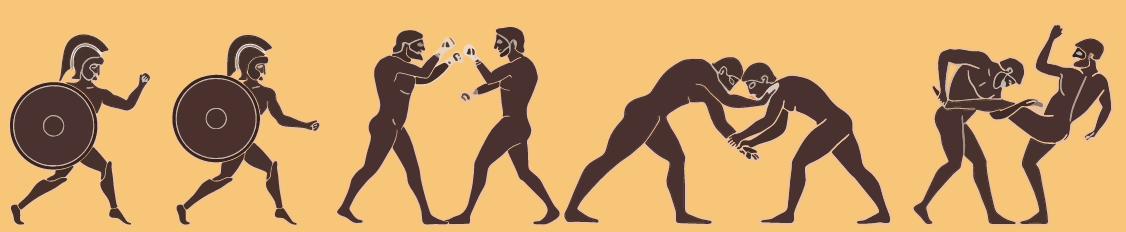
• Wrestling and boxing, which tested strength and technique
• Pankration, a tough event combining wrestling and boxing
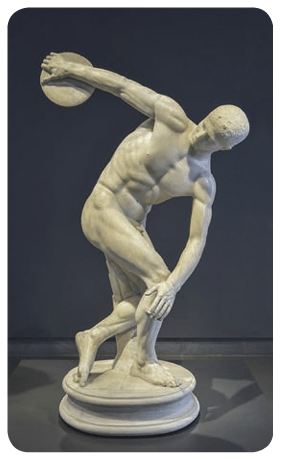
• Pentathlon, which included five events — running, long jump, discus throw, javelin throw, and wrestling
• Chariot racing, which was a highlight of the Games and took place in the hippodrome
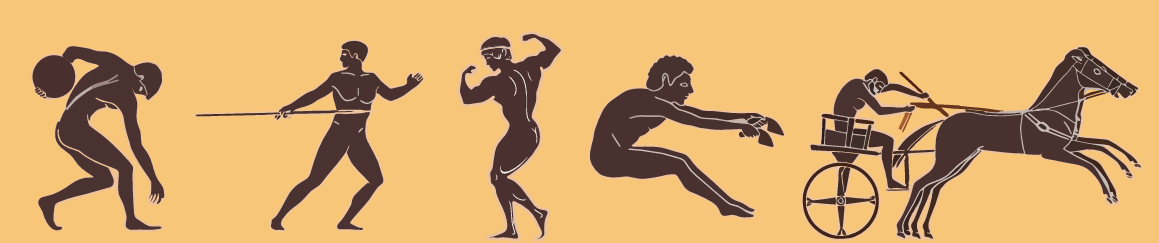
All athletes competed without clothing, as the Greeks believed that the human body was a symbol of beauty, balance, and discipline. Training took place in the gymnasia and palaestrae of each city-state, where athletes followed strict diets and routines. The audience at Olympia included citizens, poets, artists, and philosophers. Spectators cheered for athletes from their own cities, and yet, everyone celebrated a shared spirit of effort and honour. The Olympic Games became not only a competition of skill but also a festival of art, religion, and culture.
LET US REFLECT
Write a paragraph comparing the values emphasised in the ancient and modern Olympic Games. What similarities and differences do you notice?
Rewards and Olympic Ideals
Winning an event at the ancient Olympic Games was considered one of the greatest honours in Greek society. The prize itself was simple, but the respect it carried was enormous. Victors were crowned with a wreath made of wild olive leaves, taken from a sacred tree near the temple of Zeus. This wreath, called the kotinos, symbolised purity, hard work, and peace. Unlike today, the winners did not receive money, medals, or gifts at Olympia. The real reward was honour and fame. When champions returned to their cities, they were welcomed with great celebrations. Poets wrote songs about them, sculptors made their statues, and sometimes the city even granted them free meals for life. These rewards showed that victory was a service to one’s community, not just personal success.
The idea behind the Olympic victory was deeply moral and spiritual. Competing in the Games was not just about physical strength but also about courage, fairness, and self-control. Losing with dignity was also respected, because it showed humility and discipline. The poet Pindar praised Olympic winners in his famous victory odes, describing how their effort and virtue reflected divine blessings. He wrote that true glory comes to those who combine skill with moral strength. This belief became one of the roots of the Olympic ideals — respect, excellence, and friendship — that continue even today. The ancient Greeks saw the Olympic Games as a path to harmony between body, mind, and spirit. This balance is still central to the modern Olympic Movement, which encourages athletes to play with joy, fairness, and honour rather than focusing only on victory.
Social and Cultural Impact
The Olympic Games were more than sports competitions. They were a festival of peace, culture, and learning that united the people of ancient Greece. Although Greek city-states often fought wars, they stopped all conflicts during the Olympic Truce so that athletes and visitors could travel safely to Olympia. This showed how sport could bring peace and friendship among people. The Games also became a meeting place for art, music, and knowledge. Poets and artists created songs, statues, and paintings to honour the athletes. The philosopher Pindar wrote poems praising the courage and fairness of Olympic winners. At the same time, teachers and thinkers discussed health, discipline, and good character, showing that body and mind should grow together.
DID YOU KNOW?
Victors sometimes dedicated their olive wreaths to Zeus instead of keeping them, showing gratitude and humility.
The festival also honoured Zeus, the chief deity in ancient Greek mythology. His great temple at Olympia had a huge statue made by the sculptor Phidias, which became one of the Seven Wonders of the Ancient World. Women did not take part in the main Games, but they had a separate event called the Heraean Games, held in honour of the Goddess Hera. These races for young women showed that physical activity was valued for all. The Olympic Games helped the Greeks feel proud of their shared identity and taught the world that sport can promote peace, creativity, and respect for all.
Decline and Legacy
The ancient Olympic Games continued for more than a thousand years. Over time, they lost their original spirit of simplicity and honour. As the Roman Empire gained control over Greece, the Games became more luxurious and sometimes unfair. Money and politics started to influence competitions that were once held for moral and religious reasons. In 393 CE, the Roman Emperor Theodosius I banned all pagan festivals, including the Olympic Games, as Christianity became the main religion of the empire. The temples at Olympia were closed, and the site was later damaged by earthquakes and floods. For many centuries, Olympia lay buried under sand and forgotten.
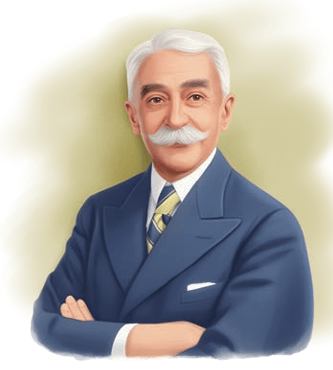
In the 18th and 19th centuries, archaeologists rediscovered the ancient site. The remains of the stadium, temples, and statues helped historians understand how the Games were organised. These discoveries, along with the writings of Pausanias and Herodotus, inspired people in modern Europe to bring back the spirit of the Olympics. The French educator Pierre de Coubertin studied the ideals of ancient Olympia and believed that sport could unite people and promote peace. His vision led to the revival of the Modern Olympic Games in 1896 in Athens, Greece. Thus, the ancient Olympics, though lost for centuries, became the foundation for the modern movement that continues to inspire the world today.
Activity
Write a letter to your parents as if you just witnessed the first Olympic opening ceremony. Describe what you saw, heard, and felt.
LET US REFLECT
Write a letter to your parents as if you just witnessed the first Olympic opening ceremony. Describe what you saw, heard, and felt.
Exercises
1. Name any four events held in the Ancient Olympic Games.
2. What was the kotinos? What did it symbolise? What does the Greek word arête mean?
3. Why were athletes required to take an oath before competing?
Chapter 11
The Modern Olympic Games
In the late nineteenth century, a young French educator named Pierre de Coubertin dreamed of using sport to bring nations together. He believed that playing games could teach young people courage, discipline, and respect for others. While visiting ancient Olympia in Greece, Coubertin was deeply moved by its history and ideals. Standing among the ruins of the old stadium, he imagined the revival of the Olympic Games as a symbol of peace and friendship among nations. His dream soon began to take shape. In 1894, at a meeting held in Paris, Coubertin and delegates from twelve countries decided to establish the International Olympic Committee (IOC). They agreed to organise the first Modern Olympic Games in Athens, Greece, the birthplace of the ancient Games.
Two years later, in April 1896, the dream became reality. Athletes from 13 countries gathered in Athens to compete in 43 events. The Greek athlete Spyridon Louis, a humble water carrier, became a national hero by winning the marathon. The Games were filled with excitement and hope, and they marked the rebirth of the Olympic spirit after nearly 1,500 years. From that moment, the Modern Olympic Games became a celebration of human effort and unity, carrying forward the ideals of Excellence, Friendship, and Respect from ancient Greece to the entire world.
Growth and Development
After the success of the first modern Olympics in 1896, the Games began to grow and attract more countries and athletes from around the world. The idea of peaceful competition inspired nations to join together through sport. Over time, new events, better facilities, and improved organisation made the Olympics the world’s largest sporting festival. The International Olympic Committee (IOC), founded by Pierre de Coubertin, became the main body to plan and guide the Games. Every four years, a new city was chosen as the host. The Second Games were held in Paris in 1900, followed by St. Louis in 1904, and gradually more nations began to participate. At first, only men were allowed to compete. However, women soon gained recognition, through their first participation in the 1900 Paris Olympics, in sports such as tennis and golf. This change reflected the growing idea of equality and inclusion in the Olympic Movement. The Olympic Games continued to evolve even during difficult times. Although they were stopped during the World Wars, they resumed with even greater enthusiasm. The Games became a platform for unity, fair play, and international friendship.
TRIVIA
• The first modern Olympics in 1896 had no official national teams. Athletes entered as individuals.
• Only one female athlete took part in the 1896 Games unofficially, as women’s events were not yet allowed.
India's Journey in the Olympic Movement
India’s Olympic journey began in 1900, when Norman Pritchard, representing India, won two silver medals in athletics at the Paris Games. Later, India formed its own National Olympic Committee in 1927 and participated as a team in the 1928 Amsterdam Olympics. That year, Indian men’s hockey team, led by Dhyan Chand, won the gold medal. It was the beginning of India’s golden era in hockey, when the country went on to win eight Olympic gold medals between 1928 and 1980. Over the years, India expanded its presence in many sports. Many athletes reflected the true Olympic values of excellence, perseverance, and respect.
LET US EXPLORE
Create a list of Indian athletes who have won medals in the Olympics in the following order — events, year, position, score, and the sport in which Indian contingent participated as a team.
Global and Development and New Addition
• The modern Olympics also grew to include new ideas and categories.
• The Winter Olympics began in 1924, featuring sports like skiing and ice hockey.
• The Paralympic Games were started in 1960, and gave athletes with disabilities a global platform to compete with courage and skill.
• The Youth Olympic Games, first held in 2010, encourage young athletes to learn Olympic values and friendship through sport.
Today, the Olympic Games bring together over 200 countries and thousands of athletes, carrying forward Pierre de Coubertin’s dream of using sport to build peace and understanding among nations.
DID YOU KNOW?
• The marathon distance (42.195 km) was fixed at the 1908 London DID YOU KNOW? Olympics so that the race would finish in front of the royal box..
• The first Olympic torch relay was introduced at Berlin in 1936, linking the modern Games to ancient Olympia..
• The youngest-ever Olympic champion was 10-year-old Dimitrios Loundras (Greece, 1896, gymnastics).
LET US REFLECT
• How did the modern Olympics bring the world together after many wars?
• Why do you think women’s inclusion in the Games was a turning point?
The Identity of the Olympic Movement
The Olympic Creed
The Olympic Creed is a short message that expresses the true meaning of the Games. It reminds athletes and everyone watching that participating with effort and courage is more important than winning. The Creed was first spoken by Bishop Ethelbert Talbot during the 1908 London Olympics and later adopted by Pierre de Coubertin, the founder of the modern Games. It reflects the spirit of fair play and personal excellence that Olympism stands for. The Olympic Creed says:
“The most important thing in the Olympic Games is not to win but to take part, just as the most important thing in life is not the triumph but the struggle. The essential thing is not to have conquered but to have fought well.”
This message teaches us that victory lies in honest effort and courage, not just medals or records.
The Olympic Symbol (Five Rings)
The Olympic symbol is made up of five interlaced rings— blue, yellow, black, green, and red— on a white background. These rings represent the union of the five continents and the meeting of athletes from all over the world at the Olympic Games. The symbol was designed by Pierre de Coubertin in 1913. He chose these colours since every national flag in the world contains at least one of them, showing the idea of universality and inclusion. The Olympic rings first appeared on a flag in 1914 and were officially introduced at the 1920 Antwerp Games. Since then, they have become the most recognised emblem of global peace and sportsmanship.
TRIVIA
• The five rings were first displayed in 1914 but appeared in the Games only in 1920 due to World War I.
• The Olympic flag is stored at Lausanne, Switzerland, when not used in the ceremonies.
The Olympic Flag
The Olympic Flag is one of the most important symbols of the Olympic Games. It carries the five interlaced rings on a white background, representing peace, purity, and unity among nations. The flag was designed by Pierre de Coubertin in 1913 and officially presented in 1914 at the Olympic Congress in Paris. However, it was first used during the 1920 Antwerp Olympic Games in Belgium. The white background stands for peace, while the five coloured rings show the coming together of athletes from the five continents in a spirit of friendship and fair play. At every Olympic Games, the flag plays a central role at the Opening and Closing Ceremonies. It is raised when the Games begin and lowered at the end. The Olympic Charter states that the flag must always remain clean, untorn, and treated with respect.
The Olympic Motto
The Olympic Motto expresses the spirit of constant effort, improvement, and unity among athletes and nations. The original motto, “Citius, Altius, Fortius”, is a Latin phrase that means “Faster, Higher, Stronger.” It was first proposed by Father Henri Didon, a French teacher, and later adopted by Pierre de Coubertin when he founded the modern Olympic Games. In 2021, the motto was officially updated by the International Olympic Committee to include a new word: ‘Together’. The complete motto now reads “Citius, Altius, Fortius — Communiter”, which means “Faster, Higher, Stronger— Together.” This change reflects the modern Olympic belief that success in sport and in life comes through teamwork, solidarity, and shared effort.
The Olympic Oath
The Olympic Oath is a promise made by the athletes, coaches, and judges during the Opening Ceremony of every Olympic Games. The first Olympic Oath was introduced at the 1920 Antwerp Games. It was written by Pierre de Coubertin and spoken by Belgian fencer Victor Boin on behalf of all athletes. Since then, the wording of the oath has been updated several times to reflect fairness, equality, and inclusion. During the ceremony, one athlete, one coach, and one judge from the host country hold a corner of the Olympic flag and take the oath. This tradition symbolises unity and shared responsibility among all participants. The current Olympic Oath (as per IOC 2025) says:
“In the name of all competitors, I promise that we shall take part in these Olympic Games, respecting and abiding by the rules and in the spirit of fair play, inclusion and equality, together we stand in solidarity and commit ourselves to sport without doping, without cheating, without any form of discrimination.”
DID YOU KNOW?
• The Olympic Oath was expanded in 2000 to include coaches and judges, not only athletes. Olympics so that the race would finish in front of the royal box..
• The Olympic Anthem was sung in Japanese and Greek at the Tokyo 2020 Opening Ceremony to honour tradition and the host nation.
• The Olympic emblem of each Games must receive formal approval by the IOC to protect its symbolic integrity.
The Olympic Emblems
Every Olympic Games has its own official emblem, which acts as the visual identity of that edition of the Games. It usually combines the Olympic rings with symbols, colours, or designs that represent the host country’s culture, values, and vision. The emblem appears on flags, banners, uniforms, tickets, and souvenirs. It helps create a sense of unity and pride for both the athletes and the host nation. The design of each emblem must follow strict rules set by the International Olympic Committee (IOC) to ensure respect for the Olympic symbols. The first official Olympic emblem appeared at the 1924 Paris Games. Since then, every host city has designed a new emblem that reflects its own identity. The Tokyo 2020 emblem used circular shapes to represent harmony and diversity. The Beijing 2008 emblem was inspired by a traditional Chinese seal, and symbolised movement and passion. The Paris 2024 emblem combines the Olympic flame with the face of Marianne, a national symbol of France, representing equality and spirit.
The Olympic Anthem
The Olympic Anthem is a song that expresses the spirit of peace, friendship, and unity of the Olympic Games. It is played during the Opening and Closing Ceremonies whenever the Olympic flag is raised or lowered. The anthem was composed by Spyros Samaras, a Greek musician, with lyrics written by Kostas Palamas, a famous Greek poet. It was first performed at the first Modern Olympic Games in 1896 in Athens, Greece. For many years, different Olympic host cities used their own songs. In 1958, the IOC officially adopted the composition by Samaras and Palamas as the official Olympic Anthem. Since then, it has been performed in every Olympic Games in various languages and musical styles.
LET'S EXPLORE
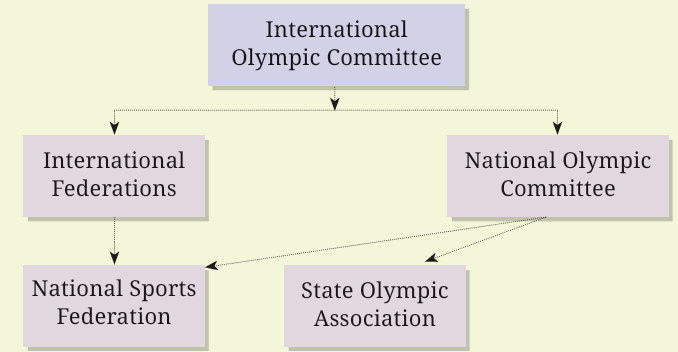
Explore the protocols, liabilities, election procedures of each units and their constituents shown in the above organogram, and create a similar organogram of the International Paralympic Committee.
LET US REFLECT
• Which Olympic symbol do you connect with the most and why?
• How do symbols and flags help unite people across countries?
Exercises
1. What is the Olympic Creed?
2. What do the five Olympic rings symbolise?
3. What is the meaning of the Olympic motto “Citius, Altius, Fortius–Communiter”?
Check Your Progress
Answer in brief
1. If you were an athlete in ancient Greece, how would you prepare for the Games?
2. Compare the rewards given to ancient Olympic winners and modern Olympic winners.
3. How can the idea of arête be applied in school life today?
4. How does the structure of the IOC and National Olympic Committees ensure smooth organisation of the Games?
5. If you were designing an Olympic emblem for your country, what elements would you include and why?
Answer the following in detail
1. Compare the Ancient Olympic Games with today’s Olympic Games. Highlight at least three similarities and three differences.
2. How has the Olympic Movement evolved to promote equality and inclusion (for example, Paralympics, Youth Olympics)?
3. Why is participation considered more important than winning according to the Olympic Creed?
4. How do Olympic symbols (flag, motto, oath, anthem) strengthen the identity of the Games and promote other characteristics of humanity?