
UNIT 6
Yoga for Holistic Health and Personal Excellence
Yoga is a continuous journey of awareness and self-development. By the end of Grade 8, we explored the values of Yama and Niyama, learned to move our body gently through Sūkṣhma-vyāyāma, understood the importance of practising Sūrya-namaskāra regularly, and became familiar with Āsanas that keep the body steady and comfortable. We also developed breath awareness through prāṇāyāma, learned to guide our senses wisely with Pratyāhāra, and discovered how to focus the mind through Dhāraṇā and Dhyāna. With this strong and balanced foundation, we are now ready to deepen our yogic journey and understand these practices with greater clarity. In Grade 9, we will build on everything we have learned so far, deepening our understanding and practice.
The uniqueness of Unit 6 lies in its simple and practical approach to the three main themes, Samagra Svāsthya (Yoga for Holistic Health), Yogamaya Jīvana (Lifestyle for Holistic Health) and Yoga for Personal Excellence.
Samagra Svāsthya introduces the definition of health, meaning of holistic health, the states of ease and disease, as well as the various dimensions of health.
Yogamaya Jīvana highlights different lifestyle factors such as āhāra (food), nidrā (sleep), brahmacharya (moderation), good company, behaviour, circadian rhythm, and habit formation. It offers simple tools to help students manage the challenges of adolescence. The chapter also shows how yoga improves focus, emotional balance, confidence, and menstrual health.
Yoga for Personal Excellence guides students to choose the path of Śhreyas (long-term excellence) over Preyas (temporary pleasure). Through the inspiring stories of contemporary role models, students learn that true success is achieved by connecting hard work to a ‘higher goal’ beyond oneself. Finally, it provides a practical Yoga toolkit, including breathwork and self-reflection, to help students transform their scattered energy into a focused force for personal and national growth.
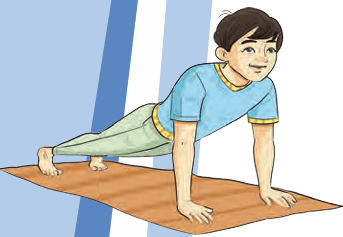
Chapter 21
Samagra Svasthya (Yoga for Holistic Health)
Swami Sivananda Baba
Swami Sivananda Baba was a real-life superhero of health and happiness. Born in 1897, he lived an extraordinary 128 years, thanks to his simple lifestyle, daily yoga practice, and peaceful mind. In 2022, he was honoured with ‘Padma Shri’ award for inspiring millions with his healthy habits. His life teaches us that true strength comes from simplicity, discipline, and kindness.
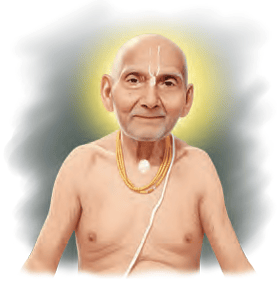
Let us follow Sivananda Baba’s example and aim to live a healthy, long, and purposeful life. The Vedas offer us the blessing “Jīvema śharadaḥ śhatam” (Śhukla-Yajur-Veda 36.24), which translates to “May we live for a hundred years”. The Upaniṣhads also encourage us to remain active, engaged, and dedicated so that we not only live a long life but one filled with happiness. A life worth living is one that is driven by purpose, filled with joy, and brings happiness, and fulfillment to those around us.
To truly achieve this vision of a long, purposeful, and joyful life, we must first understand how to live a healthy life ‘Śharīram ādyam khalu dharma-sādhanam’ (Our body is the first and primary means to achieve all great things in life). It is important to understand what health really means, and how it shapes our journey toward well-being.
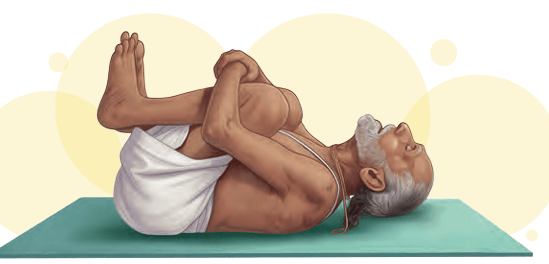
Definition of Health
Many people equate being healthy as simply a state of ‘not being sick’. However, consider a student who never falls ill but consistently feels lonely and stressed. Are they really healthy? The answer is ‘no’. According to the World Health Organisation (WHO), health is defined as, “a state of complete physical, mental, and social well-being and not merely the absence of disease or infirmity”. In other words, health is a condition where there is proper balance and harmony among all the dimensions, not just the absence of diseases.
Being healthy is having the energy to play and study, a calm mind to think clearly, and the happiness of being connected with others. Therefore, health is more than just ‘not being sick’, it is about living a balanced life where the body, mind, and social bonds all work together in harmony.
Health can be interpreted in the dimensions given below.
|
Dimensions |
What it covers |
|
Physical |
Eating nutritious food, getting regulated sleep, regular exercise, good hygiene and self-care, proper functioning of all body systems, good strength, stamina and flexibility. |
|
Mental (includes Emotional and Intellectual) |
Staying calm, confident and resilient, being able to cope with life’s stresses and challenges, showing empathy and understanding others, being able to regulate emotions like joy, fear, anger and sadness and being free from attachment and aversion. |
|
Social |
Building good relationships with family and friends, working together cooperating, sharing, caring and communicating, being responsible in the community, and living with a positive attitude, truthfulness, nonviolence, selflessness, and contentment. |
The modern definition of health, as described by organisations like WHO, offers a valuable baseline. However, the Bhāratīya system established thousands of years ago takes us a significant step deeper into the concept of holistic well-being, the Svāsthya (Health). It offers a holistic vision that goes beyond the purely materialistic views of health.
Bharatiya Concept of Svasthya (Holistic Health)
The holistic vision is defined in the ancient Āyurvedic text, the Suśhruta-saṁhitā as follows:
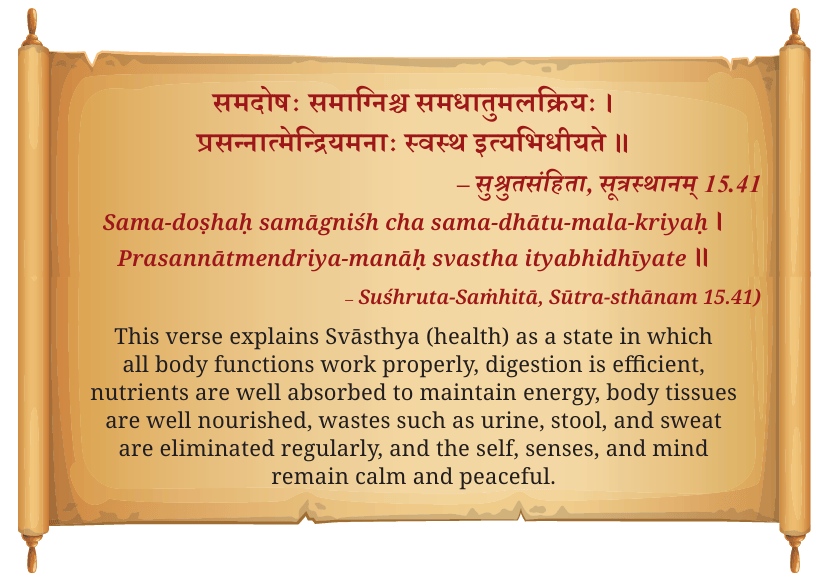
Āyurveda, therefore, views health as a harmonious integration of not only physical, mental and social but also the spiritual dimension. Yogic practices help in bringing the synergy and harmonies development of all aspects of human existence.
Ease and ‘Dis-Ease’
Let us understand the state of Svāsthya from the yogic point of view. The term Svāstha (health) signifies being rooted in one’s own natural state of balance, a state of ease and harmony. ‘Sva’ means self and ‘stha’ means being established. It is the natural state of the body to remain in balance. Though the body constantly strives to maintain an equilibrium, our lifestyle, habits, and stressful experiences can disturb this state, leading to Vyādhi (disease).
Ease vs. Dis-Ease
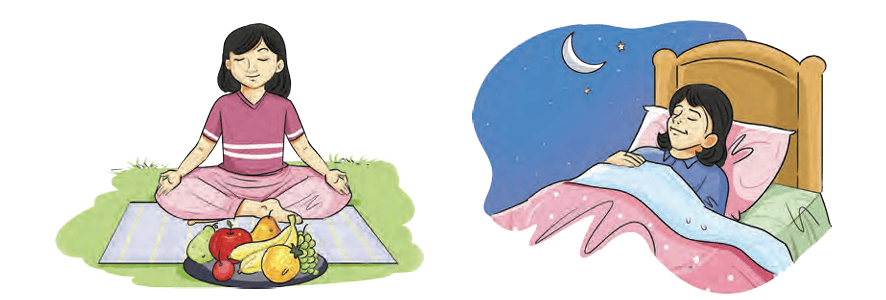
Ease: Natural State of Balance
• Consistent Daily Activities
• Calm Emotions
• Healthy and Strong
• Good Sleep and Appetite
• Focused Mind
• Compassionate and Friendly
Dis-Ease: Disturbance and Lack of Ease
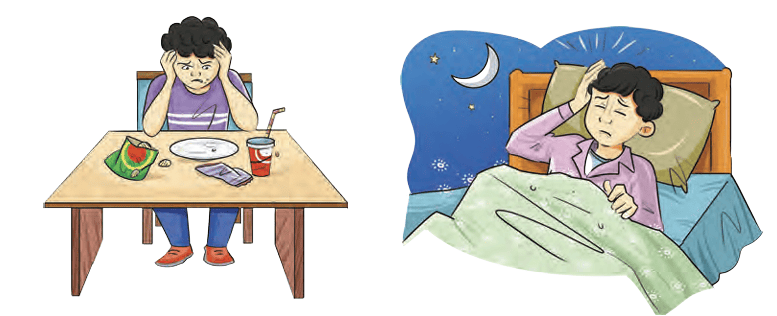
• Tiredness and Illness
• Poor Sleep and Appetite
• Weak Immune System
• Emotional Instability
• Lack of Focus
• Faded Confidence and Low Optimism
Activity
Your Ease Meter
Objective: To identify your current state of being and determine actions for returning to the state of Ease.
Instructions: Rate your current state (right now, as you read this) for each level, on a scale of 1 to 5.
• High Dis-ease (Disturbed, blocked, zero comfort, imbalanced) – 1
• Noticeable discomfort; low balance and energy – 2
• Average state; manageable but not fully comfortable – 3
• Comfortable and calm; good balance and energy – 4
• High Ease (Balanced, relaxed, active and energetic) – 5
|
Description |
Your Score (1–5) |
|
1. How does your body feel? (Do you feel any aches in your body, low energy levels, trouble in posture, or any tension?) |
|
|
2. How is your Energy Level? (Are you enthusiastic or drained/sluggish?) |
|
|
3. How is your mental focus? (Are your thoughts clear or confused/worried?) |
|
|
4. How stable are you? (Are you calm or easily irritated/moody?) |
|
Keep track of your score for 15 days. Circle the lowest scores and try to find the possible reasons behind both low and high scores.
Reflection Questions for the Activity:
|
1. When do you feel that you are in a state of Dis-ease? |
• I am usually tired after gaming late at night. • I get upset when I compare myself to others. |
|
2. When do you feel at ease? |
• After I attend a yoga class. • When I am laughing with my friends • When I finish my homework early. |
|
3. What can you do to stay at ease? |
• Play a sport • Eat healthy food • Stretch every hour • Sleep before 11 PM • Talk to a friend when stressed • Reduce screen time |
Dimensions of Holistic Health
From the previous discussion, we understand that health is not just limited to the physical body. It is multidimensional in nature. It is also clear that health is not merely the absence of disease but the experience of complete well-being. Holistic health is an inclusive approach that views the human being as a whole, emphasising the interconnectedness and balance of physical, vital, mental, intellectual, social, and spiritual dimensions.
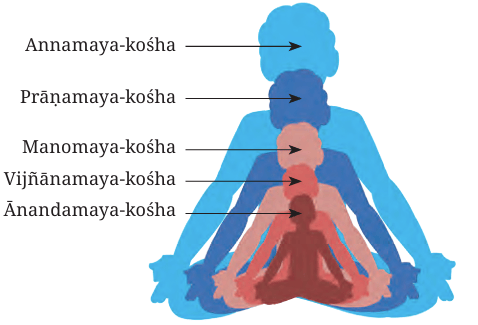
In Indian philosophy, as explained in the Taittirīya-Upaniṣhad, different dimensions of our existence are described through the Pañchakośha — the five sheaths that offer a holistic view of well-being. Health is seen as the harmonious existence integration of the Annamaya (physical), Prāṇamaya (life energy), Manomaya (mental), Vijñānamaya (intellectual), and Ānandamaya (blissful) sheaths.
The correlation of the health and status of the kośha can be understood from the following table:
|
Kośha |
Definition |
Balanced state |
Imbalanced state |
|
Annamaya-kośha (Physical sheath) |
Anna means ‘food’ and maya means ‘composed of’. Annamaya-kośha is the physical body made from the food that we eat. It includes bones, muscles, organs, and tissues, and serves as the vehicle for all the other layers. |
Healthy, energetic, strong, and active body. |
Frequent illness, lifestyle diseases (diabetes, hypertension), tiredness, obesity, etc. |
|
Prāṇamaya-kośha (Life energy sheath) |
Prāṇamaya-kośha is the sheath of prāṇa (life force/energy) that flows through the body. There are five prāṇas, classified according to their functions and broadly related to the major systems of the body. Prāṇa governs respiration, Apāna governs excretion, Samāna governs digestion, Udāna governs circulation, and Vyāna governs the nervous system. |
Steady breath, good stamina, and energetic body. |
Low energy, shallow or irregular breathing, fatigue, anxiety, mood swings, poor circulation or digestion, chronic pain, lack of clarity, and poor concentration. |
|
Manomaya-kośha (Mind sheath) |
Manomaya-kośha is the sheath of thoughts and emotions. It connects our outer experiences with our inner self, shaping how we feel, think, and react. It governs emotions like desire, greediness, attachment, ego, jealousy, sadness, anger, and fear, and influences our habits and decisions. |
Positive emotions, good relationships, and an ability to handle stress |
Overthinking, worry, mood swings, irritability, anxiety, lack of focus, negative thoughts, fear, and disturbed sleep. |
|
Vijñānamaya-kośha (Intellectual sheath) |
Vijñānamaya-kośha is the sheath of wisdom and intellect. It helps us process experiences, make decisions, distinguish right from wrong, and develop self-awareness. It acts as a bridge between the mind and inner bliss |
Good decision-making, ethical values, and clarity of thought |
Poor decision-making, confusion, resistance to new ideas, and inability to reflect on one’s thoughts and actions |
|
Ānandamaya-kośha (Bliss sheath) |
Ānandamaya-kośha is the subtlest layer of our being, a state of inner peace, harmony, bliss |
Inner peace, contentment, and joy without external cause |
Restlessness, emptiness, addictions, and a lack of satisfaction even after achievements |
DID YOU KNOW?
Among these five kośha, the physical body, Annamaya kośha is Sthūla-śharīra, which means that it can be seen through the eyes and is tangible. Whereas Prāṇamaya kośha, Manomaya-kośha, Vijñānamaya-kośha are Sūkṣhma-śharīra (subtle layers) and Ānandamaya kośha is Kāraṇa-śharira, the causal body.
Activity
Draw five concentric circles, labelling each kośha and write one habit that strengthens each sheath.
Exploring the Pañchakośha
|
Day |
Kośha Focused |
Theme |
Activities |
|
1 |
Annamaya-kośha |
Caring for the Body |
Begin with 15 minutes of yoga practice, including āsanas and Sūrya-namaskāra. Observe and record how your body feels before and after the practice. Emphasis is also placed on adopting a sāttvika diet, along with adequate rest and sleep. |
|
2 |
Prāṇamaya-kośha |
Breath and Vitality |
Practice 5 minutes of deep breathing or prāṇāyāma (such as Nāḍī-śhodhana or Bhastrikā) adopting specific hasta-mudrās. Note any changes in alertness and energy levels. |
|
3 |
Manomaya-kośha |
Emotions and Thoughts |
Guided Journaling: Write about a strong emotion that you experienced during the day and reflect on how it influenced your focus and behaviour. This will be followed by a group discussion. Practices such as Trāṭaka and mantra chanting are performed. |
|
4 |
Vijñānamaya-kośha |
Intellect and Values |
Case Study Discussion: An ethical situation (for example, choosing between studying and helping a friend) is given to you. Discuss possible responses and identify the most appropriate choice. |
|
5 |
Ānandamaya-kośha |
Inner Joy and Peace |
Engage in 5 minutes of silent sitting, followed by a gratitude practice, where you write down one thing you are thankful for. Spending time in nature is encouraged to nurture inner peace and joy. |
Note for the teacher
For more details, refer to Grade 7 Khel Yatra NCERT Book.
Check Your Progress
Answer the following
1. Am I healthy in all dimensions?
Tick what you are following on a daily basis:
(a) Physical Dimension
Do I eat healthy food regularly?
Do I get enough sleep (7–8 hours)?
How often do I play, exercise, or do yoga āsana, prāṇāyāma, dhyāna?
Do I feel energetic throughout the day, or tired quickly?
(b) Mind and Emotions
Do I learn with focus and what do you mean by learning with positive thinking?
Am I able to manage emotions like anger, sadness, and stress without getting too disturbed?
Do I treat everyone with compassion and friendliness?
(c) Intellect and Social
Do I make thoughtful decisions?
Do I listen and cooperate with friends/family?
Do I respect differences in opinions?
(d) Spiritual
Does contentment make me feel peaceful and happy inside?
Do I practice silence, meditation, or prayer?
2. When do I feel connected to something bigger than myself?
3. Which kośha do you take care of the most in daily life? Which one needs more attention?
4. What small steps can I start today to move towards “holistic health”?
Health is having all these — a disease-free body; a quiver-free breath; a stress-free mind; an inhibition-free intellect; an obsession-free memory; an ego that includes all, and a soul that is free from sorrow.
Gurudev Sri Sri Ravi Shankar
Chapter 22
Yogamaya Jivana (Lifestyle for Holistic Health)
Achieving holistic well-being is not an overnight process, but it develops gradually through simple, consistent daily habits. Caring for the body and mind is a lifelong journey — a steady, continuous practice that helps us stay healthy and balanced.
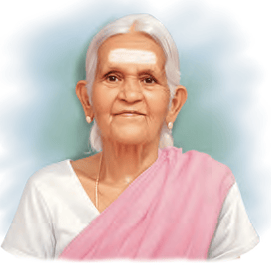
The life of V. Nanammal popularly known as Amma, a ‘Padma Shri’ award-winning yoga practitioner from Tamil Nadu, exemplifies this concept beautifully. From a very young age, she practiced yoga diligently and due to this regular and sincere routine, she remained strong, flexible, and mentally calm even in her nineties. Her lifestyle shows us that when simple habits, such as practicing yoga (āsana, prāṇāyāma, and dhyāna), eating moderately, and following a disciplined daily routine are practised consistently, they support the body, mind, and emotions throughout life. Amma’s example reminds us that true well-being is cultivated through small actions repeated every day.
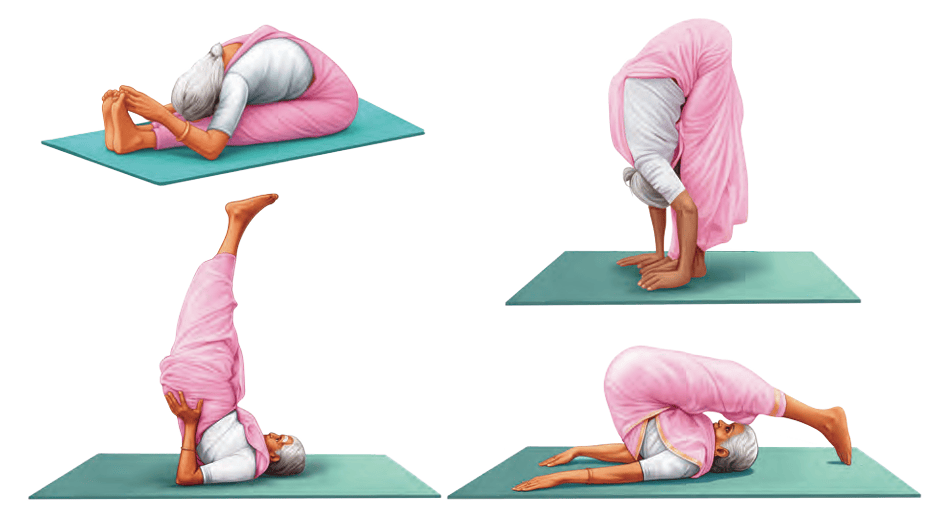
In the previous chapter, we learned that health includes not just the body but also our thoughts, emotions, and overall balance. The next step is to understand how our daily choices shape our well-being. A healthy lifestyle becomes a strong foundation for this balance, especially during adolescence, when the body and mind are changing rapidly.
Adolescence (10–19 years) is a dynamic and important stage of life — a time of fast growth, changing emotions, and new responsibilities. It is also full of curiosity and creativity, as we begin to discover who we are becoming. The habits we build during this stage shape the adults we will grow into. Yoga can be a strong and steady support during this time, helping maintain physical strength, emotional balance, and mental clarity.
In today’s world, we often think of lifestyle in terms of convenience, fast food, lots of screen time, and quick shortcuts. But living a meaningful lifestyle is really about small habits that help us stay healthy and balanced. In this chapter, we will look at a few simple factors that shape our well-being, such as:
• Āhāra — what and how we eat
• Nidrā — the quality of our sleep
• Brahmacharya — how wisely we use our time and channelise our
energy
• Satsaṅga (Good Company)— having friends who inculcate Sadguna (good habits) ultimately leading to character building.
• Sadvyavahāra (Positive Behaviour) — our actions and responses in
daily life
• Jaivika-ghaṭī (Circadian Rhythm) — the body’s natural day–night cycle
• Saṁskāra-nirmāṇa (Habit Formation) — the routines we follow
every day
Understanding these factors helps us build a lifestyle that supports good health in body, mind, and emotions.
Ahara (FOOD)
Food is not just something we eat to satisfy our hunger or for taste, it becomes part of our body and influences how we think, feel, and act. As you have learnt in science, every cell in our body is formed from the food we consume. In yogic tradition, food is therefore considered an important factor in shaping both physical health and mental clarity. The Bhagavad-Gītā (Chapter 17) classifies food into three broad types — Sāttvika, Rājasika, and Tāmasika.
Sāttvika food includes fresh fruits, vegetables, grains, nuts, milk, and ghee. These are light, nourishing, and best when eaten fresh. They help keep the mind calm, improve concentration, and support overall health and balance. Sāttvika food purifies the body and mind, and supports longevity. This category primarily includes foods that are freshly prepared, juicy, and natural.

Rājasika food includes items that are spicy, sour, very hot, salty, or stimulating, such as strong spices, fried snacks, tea, coffee, and fast food. When eaten in moderation, these can provide energy and strength, which may be beneficial for growing children and adolescents. However, excessive intake can lead to restlessness, impatience, irritation, or reduced focus. Rājasika food stimulates both the body and the mind.

Tāmasika food includes stale, reheated, heavily processed, or leftover foods, along with the items that have been stored for a long time. Such foods tend to make the body feel heavy and the mind dull, reducing alertness, enthusiasm, and clarity.

For students, a balanced diet mainly includes sāttvika foods, with rājasika food in moderation for activity and growth, while avoiding excessive tāmasika foods. Making mindful food choices helps maintain energy, focus, and a healthy lifestyle.
As the famous proverb states, ‘Yathā annaṁ tathā manaḥ’ which means ‘As is the food, so is the mind’. This highlights the close connection between what we eat and how we think and feel.
Mitahara : Moderate Eating
Yoga reminds us that how we eat matters just as much as what we eat. Eating in moderation is a vital discipline in yoga. Mitāhāra emphasises pleasant, nourishing food taken with reverence, leaving one-fourth of the stomach empty to maintain lightness and balance. When food is received as prasāda, accompanied by chanting and a mental offering to the Divine, it becomes a source of purification rather than indulgence. As the Haṭha-Yoga-Pradīpikā (1.58) states, “Mitāhāra, moderate eating, is conducive to yoga. It consists of pleasant and nourishing food, leaving one-fourth of the stomach empty, eaten as an offering to Śhiva.”
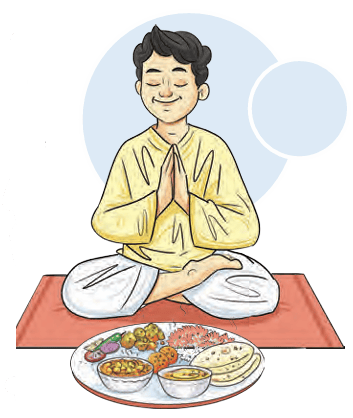
Awareness is the gateway to transforming our relationship with food. Eating slowly and without distractions, allows us to truly taste and enjoy each bite, while also noticing the moment we feel comfortably full. In contrast, packaged and processed foods are deliberately designed to trigger cravings, often disturbing our energy, mood, sleep, and focus. By cultivating mindful eating, observing hunger signals, eating with calm attention, and noticing how food affects our body and mind we protect ourselves from unhealthy addictions and naturally move towards choices that nourish us.
A weekend trip to your local market to discover seasonal and local foods
On a weekend, visit a local market with your family to explore the food native to your region. Observe the fresh seasonal fruits, vegetables, grains, and traditional snacks available there. Find out which fruits and vegetables are in season and note how they help the body stay healthy during the current weather (for example, cooling foods in summer or warming foods in winter).
If possible, talk to a farmer or vendor to learn when these foods are harvested and how they are grown. Also, ask them if they use any regional or traditional recipes using seasonal ingredients, to prepare the food.
After your visit, complete the following task:
• List 3–4 seasonal fruits or vegetables you found and write one health benefit for each of them.
Activity
Choosing Foods That Support Your Body Systems
Our body works best when we eat foods that support each of its systems. This chart is a simple way to understand what kinds of food help different parts of the body stay healthy. You can also fill in examples of local and seasonal foods that are easily found in your region. Eating fresh, home cooked meals made from seasonal and local ingredients help the body stay active, energetic, and clear-headed throughout the day.
|
Body Functions |
Food that help us stay healthy |
Local/Seasonal options |
|
Healthy digestion |
Warm, freshly cooked meals; such as soups, rice, dal, mildly spiced food, etc. |
|
|
Healthy breathing and optimal function |
Fresh fruits, steamed vegetables, tulsi, ginger, warm water, etc. |
|
|
Body’s resistance to illness |
Amla, turmeric milk, leafy greens, and seasonal vegetables |
|
|
Healthy blood circulation |
Whole grains, sprouts, lentils, and fibre-rich foods |
|
|
Muscle growth and strength |
Dal, paneer, lentils, peanuts, and millets |
|
|
Strong bones and flexible joints |
Ragi, sesame seeds, leafy greens, and sunlight exposure |
|
|
Memory and learning ability |
Nuts, seeds, ghee, warm milk, Almonds, walnuts, fruits, and whole grain porridge |
|
|
Sustained energy and stamina |
Banana, jaggery, buttermilk, and traditional snacks (poha/upmā) |
|
|
Healthy Skin and Hair growth |
Coconut, ghee, vegetables, and adequate water |
|
Activity
Healthy Plate Check
|
Body Functions |
What to Do |
Your Response |
|
1. What to Do Before Eating |
Ask yourself: Am I truly hungry? |
|
|
2. During . Eating |
• Take small bites |
How did you feel? |
|
3. After Eating |
Feel your body and mood |
Did you feel light/ heavy? |
|
4. Reflect |
Did you stop eating when you felt comfortable enough? |
|
|
5. Healthy Choice |
Write one small change you will try this week. |
|
News You Can Use - Eat Like a Yogi
“Sāttvika eating makes one a yogī, but overeating can make a person a rogī (unwell).” This idea connects beautifully with the saying: “Eat your water and drink your food.” It simply means chewing your food so well that it becomes almost liquid, and sipping water slowly instead of gulping it down. Proper chewing helps digestion begin in the mouth, reduces strain on the stomach, and allows the body to absorb nutrients better. These small habits—eating calmly, chewing thoroughly, and drinking water gently—help keep the body light, the mind relaxed, and overall health in balance.
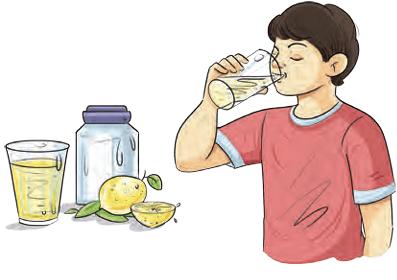
• Thirst is the body’s natural signal for indicating that it needs water, so pay attention to it. Drink when you feel thirsty and avoid drinking large amounts of water when your body doesn’t ask for it.
• Lukewarm water in the morning can support digestion and cleanse the system.
• Very cold water, when taken too often, may weaken digestion.
• Hydration does not come from water alone—fruits, vegetables, soups, coconut water, and herbal drinks also keep your body hydrated.
• Be mindful while drinking—notice how your body feels before and after drinking water.
• Sit and drink water slowly, gently sipping it instead of gulping it down.
• Staying well-hydrated can improve concentration in class, stamina during sports, and overall mood.
• Avoid storing or drinking water from plastic bottles.

DID YOU KNOW?
A Japanese scientist, Masaru Emoto, conducted experiments with water as it froze and observed that words and emotions appeared to influence Love the formation of water crystals. He reported that water exposed to positive words formed more pleasant crystal patterns, while water exposed to negative words formed distorted ones. This suggests that emotions may Thank you I hate you influence not only our mind and behaviour but also how our body responds to the food we eat and the water we drink, reminding us to eat and drink with a calm and positive attitude.

Nidra (Sleep)
Sleep is like the body’s natural recharge mechanism, just as a phone needs charging to work well. During sleep, the body repairs tissues, restores energy, balances hormones, clears toxins, and strengthens immunity. The mind also benefits, as sleep improves memory, focus, mood, and emotional balance.
According to the Patañjali’s Yoga-sūtra, deep sleep is a state in which the mind experiences the awareness of ‘nothing’, giving it complete rest. Modern science also emphasises that teenagers need quality sleep for healthy functioning, yet many miss this due to late-night screen use and irregular routines. Good sleep keeps us fresh, active, and positive, making it one of the simplest and most powerful ways to care for both the body and mind.
Just as the food we eat influences our mind and the sleep we get helps us recharge, the way we use our energy during the day also shapes our overall well-being. This is where brahmacharya becomes meaningful. While āhāra nourishes the body and nidrā refreshes the mind, brahmacharya teaches us to use ourtime and energy wisely so we can stay focused, balanced, and healthy in our everyday life.
Activity
Sleep and energy check
1. For the next two weeks, try this simple night routine.
Yogic Practices: Practice 5 minutes of deep breathing and prāṇāyāma before sleep.
Avoid using screens (mobile / TV) for at least 1 hour before bed.
Avoid heavy meals at night and eat in moderation.
2. Each morning, reflect and write down the following: The quality of your sleep (deep / disturbed / dreams) Your energy level (fresh / tired / alert)
3. At the end of the week, think of the day when you slept less than usual.
• Did you find it harder to focus in class the next day?
• How was your mood throughout the next day?
• Did you notice any cravings for junk food or sugary snacks?
Write a few lines about what you experienced and whether the night time routine made any difference to your sleep and energy. Share and discuss your answers with your classmates. Does the amount of sleep we get affect our focus, feelings, and food cravings?
Brahmacharya
Brahmacharya is one of the Yamas in yoga and refers to the wise use of your time and energy. Adolescence is traditionally known as Brahmacharyāśhrama, a stage of life meant for learning, building discipline, and developing good values. Practising brahmacharya will help you manage your senses, reduce unnecessary distractions, and stay focused on what truly matters in life.
In everyday life, this simply means noticing where your time and energy are utilised. Sometimes we may spend too much time on social media, gaming, eating junk food, etc. These habits drain our energy. A small step toward brahmacharya is to observe our routines honestly and bring moderation into one area at a time. Even small changes can make a big difference.
Brahmacharya is not about strict rules, it is about balance. It teaches us to direct our energy towards things that help us learn, grow, and become the best version of ourselves. It is the control over the temptations of your mind that can deviate us from your aim. It is the preservation and direction of our energy and time towards righteousness.
Our social and emotional well-being connects naturally with brahmacharya. When we use our time and energy wisely, it becomes easier to handle emotions, avoid distractions, and build positive relationships with the people around us.
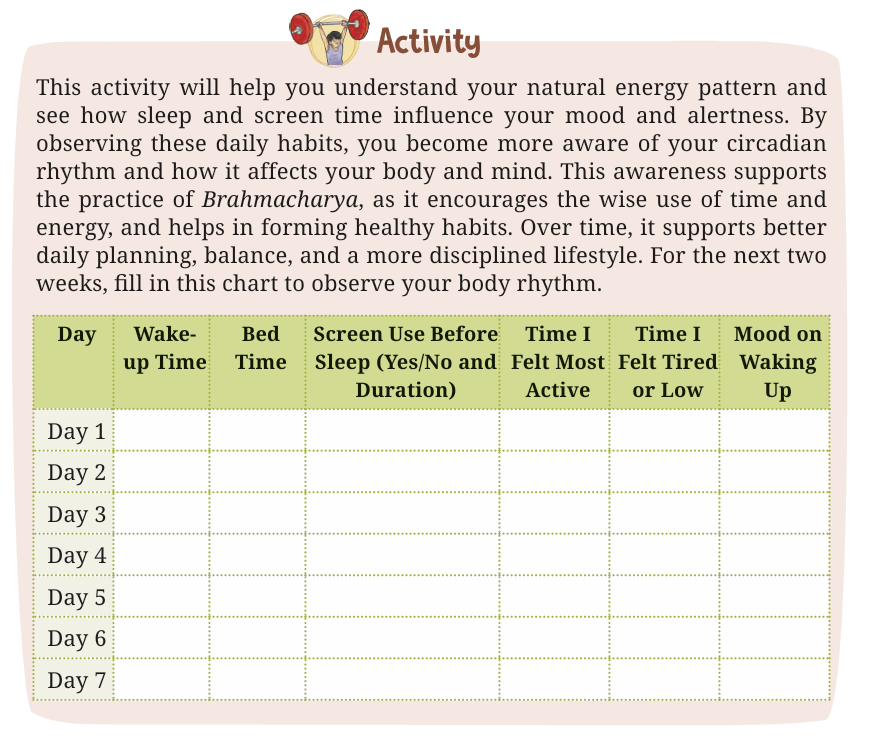
Weekly Energy Awareness Check (7-Day Reflection Chart)
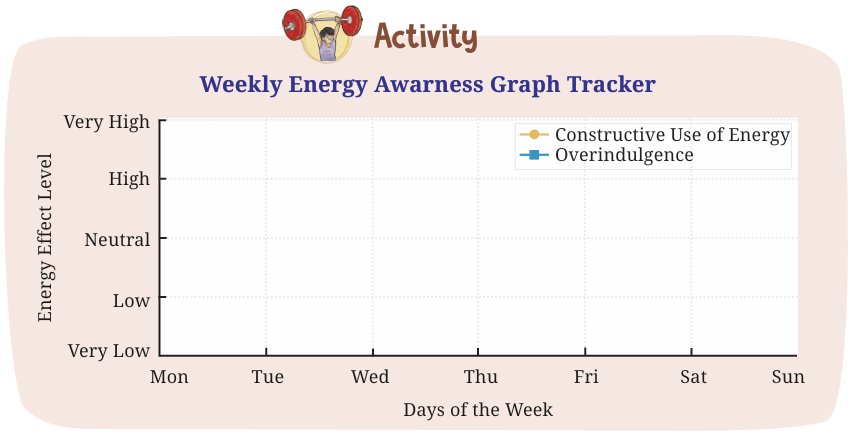
Student Checklist – My energy level today is:
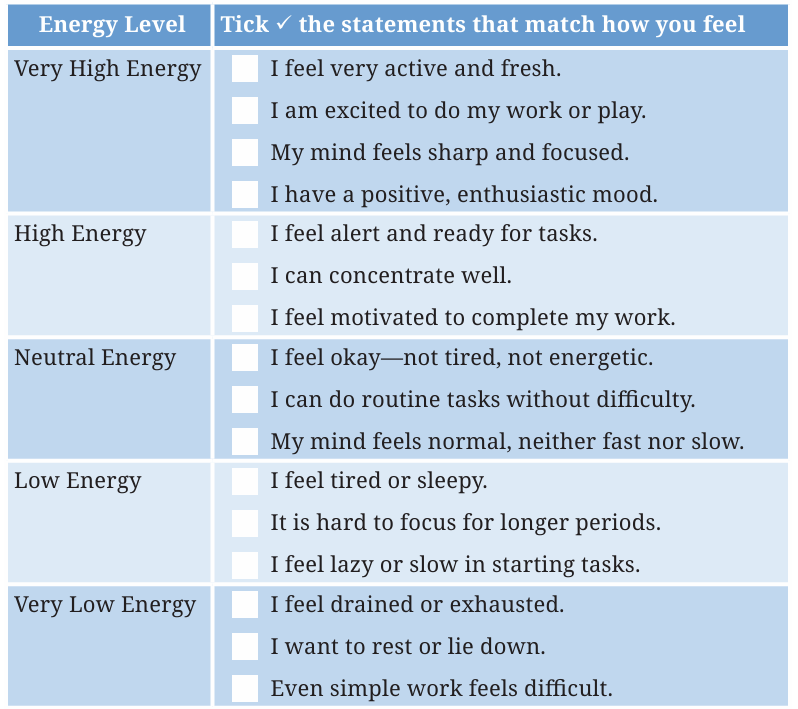
Use the checklist to note your energy levels each day for one week. As you observe, think not only about how much energy you have, but also how you use it. Continue this activity for the next two weeks and notice whether your energy is being directed towards meaningful goals like studies, sports, or creative work, or is it getting scattered in distractions such as indulging in excessive screen time or junk food. This activity helps you understand brahmacharya as the wise use of energy.
LET US REFLECT
After completing the previous chart, answer the following questions.
1. Which activities gave you the most positive energy this week?
2. Which habits made you feel tired, low, or restless?
3. What is one healthy change that you practised that you want to continue next week as well?
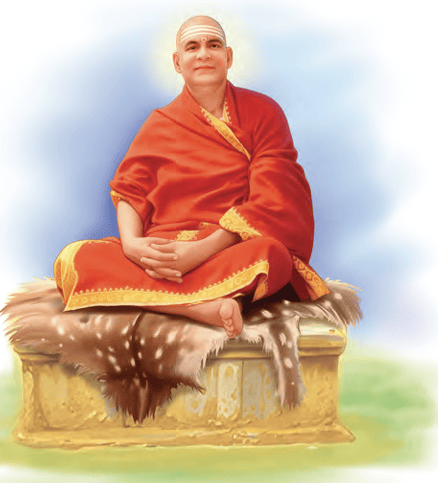
Swami Shivananda and the Practice of Brahmacharya
Swami Shivananda, a respected spiritual teacher from Tamil Nadu, began his life as a doctor. Even when he had access to comfort and luxury, he chose to live simply. Later, he moved to Rishikesh to dedicate his life to yoga, meditation, and service. Swami Shivananda practised moderation in his diet by eating simple, freshly prepared meals and only as much as the body needed. He believed that overeating made the mind dull and restless. He also followed moderation in thought—training his mind through prayer and meditation to stay calm and positive. His moderation in actions was evident in his balanced daily routine of study, yoga practice, writing, service, and rest. Because of this disciplined lifestyle, Swami Shivananda remained mentally sharp and energetic. He went on to write more than 200 books on yoga and spiritual living and inspired people across the world. He emphasised that brahmacharya is not only for monks, and students too can practise it by avoiding distractions and using their time wisely. His life shows us that small habits of balance and self-discipline help us stay focused, use our energy well, and achieve meaningful goals.
LET US REFLECT
What is one distraction you could avoid to better concentrate on your goals?
DID YOU KNOW?
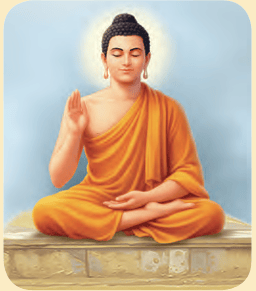
Even though Yoga and Buddhism come from different Indian traditions, both guide us towards a balanced and meaningful life. They emphasise right conduct (सम्यक् शील) and right concentration (सम्यक् समाधि) as essential practices to develop the right understanding or wisdom (सम्यक् प्रज्ा). Together, these values help shape our thoughts, actions, and behaviour, leading us towards self-discipline, inner clarity, and a more harmonious life.
Satsanga (Good Company)
The people we spend time with play an important role in shaping our thoughts, habits, and the way we use our energy. This good company is referred to as Satsaṅga, or good company. Being around positive, disciplined, and supportive people makes it easier to practise brahmacharya. Great yogis like Swami Sivananda and Swami Vivekananda, through their lives, set an example that good company helps us stay focused, channel our energy towards meaningful work, and grow steadily without feeling pressurised. Their experiences remind us that choosing the right company is a quiet but powerful step towards personal growth and balance.
A Short Story from Swami Vivekananda’s Life
As a young student, Narendranath (later known as Swami Vivekananda) was curious, energetic, and deeply interested in learning. Instead of spending his time in unhealthy distractions, he chose the company of scholars, monks, and seekers of knowledge. He dedicated long hours to discussions, reading, and reflection, which helped sharpen his thinking and disciplinehis mind.

Later, when he met Sri Ramakrishna, Vivekananda spent time in his company regularly. This Satsaṅga deeply influenced his thoughts, behaviour, and way of life. Under this guidance, he learned self-control, focus, and compassion. This strong foundation later helped him speak confidently at the World Parliament of Religions and inspire millions. Swami Vivekananda’s life shows that choosing the right company helps us channel our energy wisely, practise brahmacharya naturally, and move steadily toward
meaningful goals.
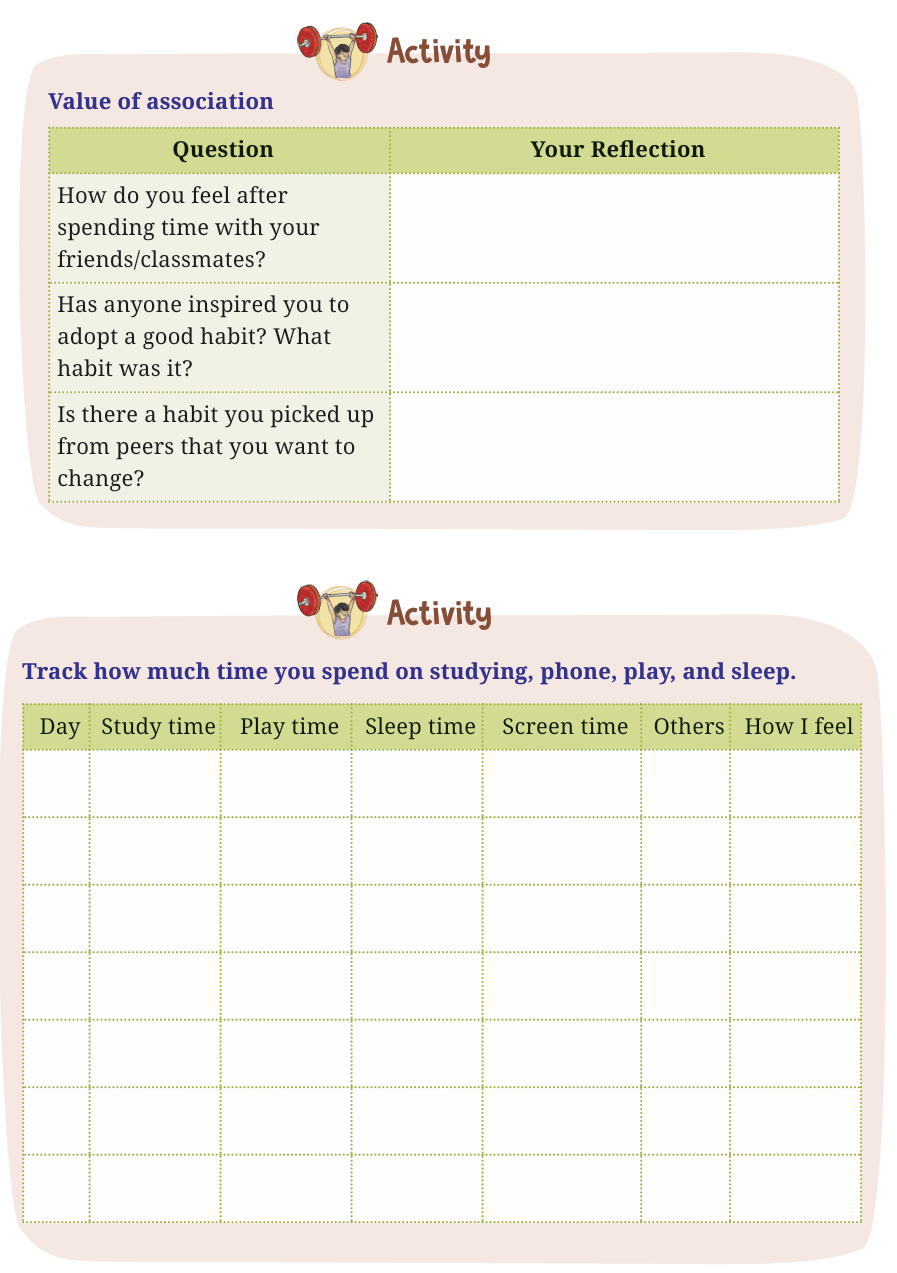
Challenges of Adolescence and Yoga
Yoga is more than just physical exercise, it acts like a compass that helps us find balance in the body, clarity in the mind, and harmony in our emotions. By following simple habits such as staying active, practising yoga through āsanas, prāṇāyāma, and dhyāna, eating wisely, thinking positively, and building healthy relationships with family, friends, and society, we can support our overall well-being. During adolescence, these practices transform confusion into confidence and struggle into strength, leading us towards a healthier, happier, and more meaningful future.
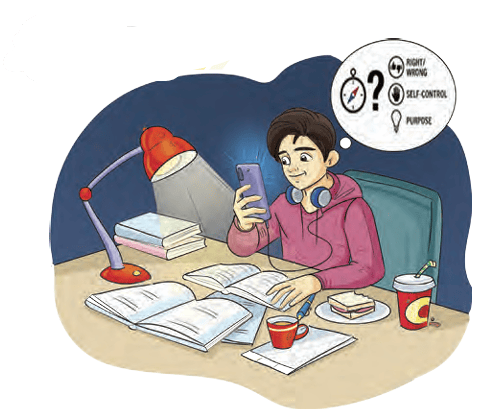
Here is a tool to understand the specific challenges that are faced by adolescents.
Challenges during adolescence and how yoga practices help
|
Type of Challenge |
Common Issues Faced by Students |
Helpful Yogic Practices |
How These Practices Help |
|
Physical and Health Challenges |
Weak posture, stiffness, tiredness, poor digestion and hormonal changes |
Āsanas (Tāḍāsana, Vṛikṣāsana, Paśhchimottānāsana), Sūkṣhma Vyāyāma, Āhāra (balanced diet), Nidrā (proper sleep) |
Yoga practices help improve strength, flexibility, posture, digestion, and overall physical health |
|
Emotional and Mental Challenges |
Stress, anxiety, mood swings, exam pressure, and lack of focus |
Prāṇāyāma (Anuloma-Viloma, Bhrāmarī), Dhyāna, Śhavāsana, Yoga-nidrā |
It helps to calm the mind, reduce anxiety, improve concentration, and balance emotions |
|
Social and Behavioural Challenges |
Peer pressure, anger, impatience, and communication issues |
Vihāra (balanced routine), group yoga practice, Sevā (helping others), mindful behaviour |
It also helps to build patience, empathy, cooperation, and healthy relationships |
|
Moral and Value-Based Challenges |
Confusion about right and wrong, lack of discipline, and impulsive actions |
Yama (Ahiṁsā, Satya), Niyama (Śhaucha, Santoṣha), self-reflection |
It helps develop self-control, honesty, responsibility, and inner discipline |
|
Overall Life Balance |
Feeling overwhelmed, low confidence, and lack of direction |
Regular yoga practice (15–20 minutes daily) |
Yoga helps in building confidence, emotional stability, clarity, and a balanced lifestyle |
Activity
Expression scale for managing adolescent challenges
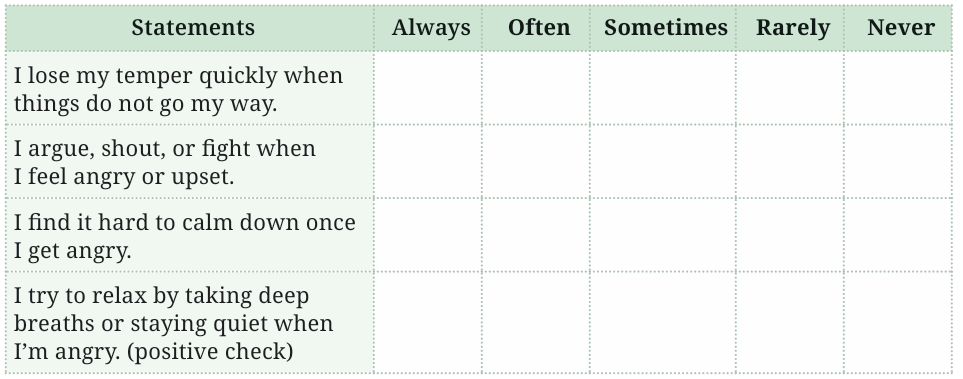
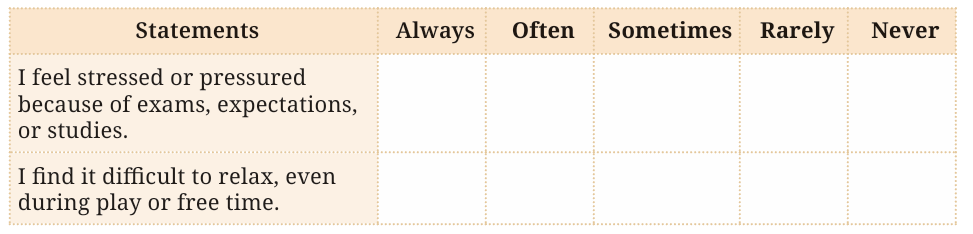
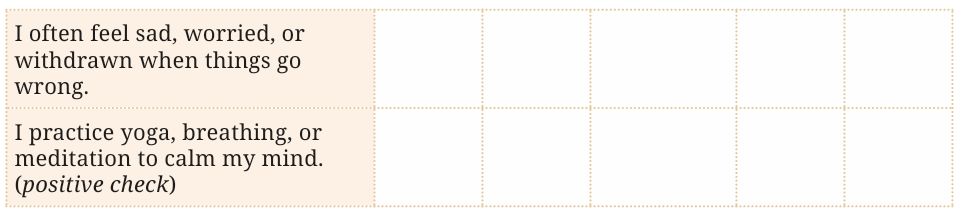
Read each statement carefully. Be honest with yourself and tick the option that best matches how you usually feel or act. The following table will help you understand your emotions and habits so you can manage them.
Anger Management
Emotional Balance and Stress
Peer Pressure and Substance Use
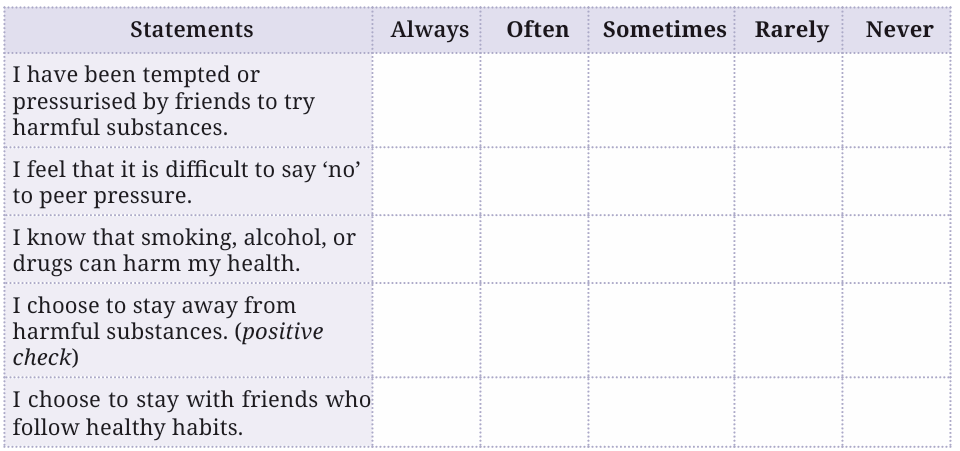
LET US REFLECT
1. What situations cause you to feel the most anger or stress?
2. What helps you calm down — talking, breathing, physical activity or something else?
3. Who can you talk to when you feel overwhelmed?
Activity
1. Discuss in your class, the common problems faced during adolescence and their possible solutions.
2. Maintain a diary to note down your emotions, stress levels, and how yoga helped regulate them.
3. Enact situations showing peer pressure, stress, or family conflict and present healthy ways to resolve them.
Menstrual Health and Yoga
Menstruation is a natural process. Sometimes, due to stress or lifestyle imbalance — that leads to hormonal imbalance — girls may experience painful periods (dysmenorrhoea) or irregular cycles. Yoga provides a safe and effective way to balance hormones and ease menstrual discomfort.
Yoga Routine for Hormonal Balance and Well-being
|
Practices |
What to Practise |
How It Helps |
|
Loosening Practices |
Neck movement (Grīvā-sañchālana) and shoulder rotation (Skandha-chakra), hip loosening, toe and ankle rotations, gentle bending and twisting, Pavana-muktāsana-kriyā, Titalī-āsana, and Chakkī-chālanāsana. |
Loosening practices prepares the body, improve circulation, reduce stiffness, and ease discomfort. |
|
Āsana |
Beginners group: Vajrāsana, Supta-vajrāsana, Uṣhṭrāsana, Mārjarī-āsana, Śhaśhāṅkāsana, Baddha-koṇāsana,, and Bālāsana. Intermediate group: Tāḍāsana, Kaṭi-chakrāsana,, Sūrya-namaskāra, Setu-bandhāsana,, Ardha-śhalabhāsana, Vakrāsana, Jānu-śhīrṣhāsana, Supta-baddha-koṇāsana, Utkaṭāsana, and Naukāsana. Advanced group: Bhujaṅgāsana, Śhalabhāsana, Dhanurāsana, Paśhchimottānāsana, Ardha-matsyendrāsana, Sarvāṅgāsana, and Halāsana. |
Āsana helps to tone the reproductive system, improve blood flow, balance hormones, reduce cramps, and support overall health. |
|
Ṣaṭkarma |
Jala-netī |
Jala-netī helps maintain hormonal balance by reducing stress, improving nasal breathing, and supporting better functioning of the nervous and endocrine systems. |
|
Prāṇāyāma |
Nāḍī-śhodhana, Bhrāmarī, Śhītalī/Śhīatkārī, Ujjāyī, and Bhastrikā. |
Prāṇāyāma calms the nervous system, reduces stress, and supports hormonal balance. |
|
Relaxation |
Śhavāsana with breath-awareness, and Yoga-nidrā. |
Relaxation helps in relieving stress, stabilising mood, and improves emotional balance. |
|
Dhyāna (Meditation) |
Om chanting with Chin-mudrā, Antar mauna and *Ajapā japa. |
Dhyāna improves mental calmness, focus, and emotional stability. |
|
Balanced Diet |
Fresh, home-cooked, seasonal food with proper nutrients. |
*The steps for the practice are given at the end of the chapter
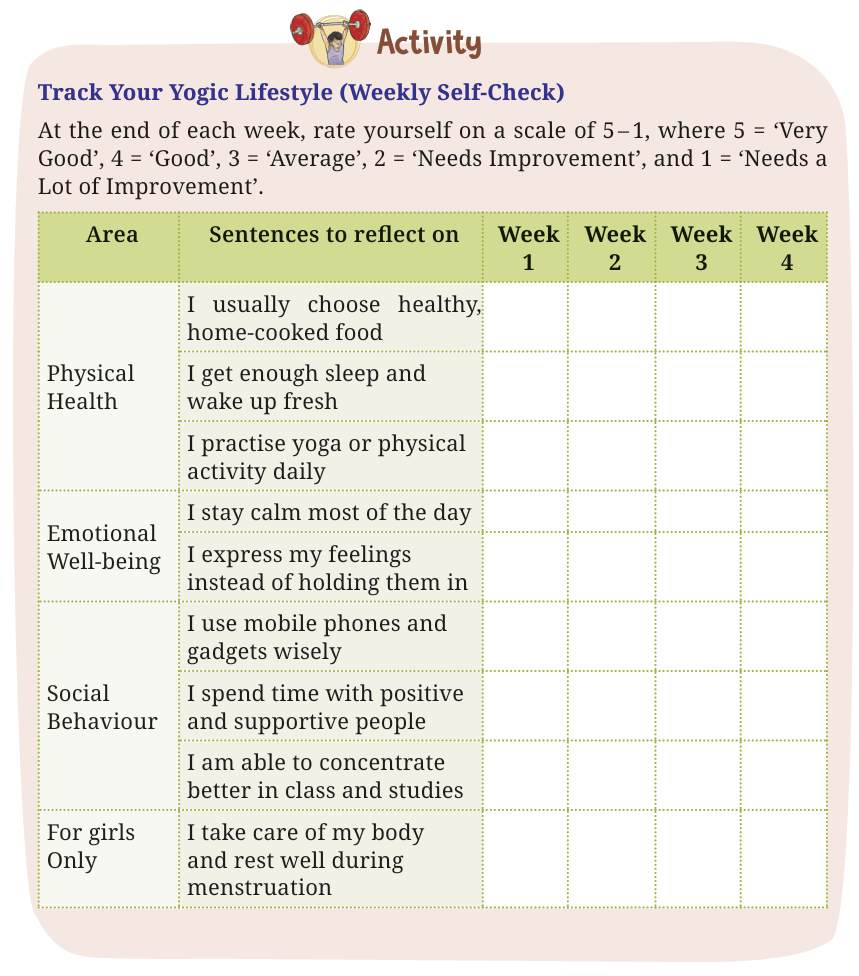
Circadian Rhythm and Habit Formation
Our body has its own internal 24-hour clock that guides when we sleep, wake up, feel hungry, stay active, and even how our mind works. This natural cycle is called the circadian rhythm. Everyone’s rhythm is slightly different and changes with age, but its purpose is the same — to keep the body working smoothly.
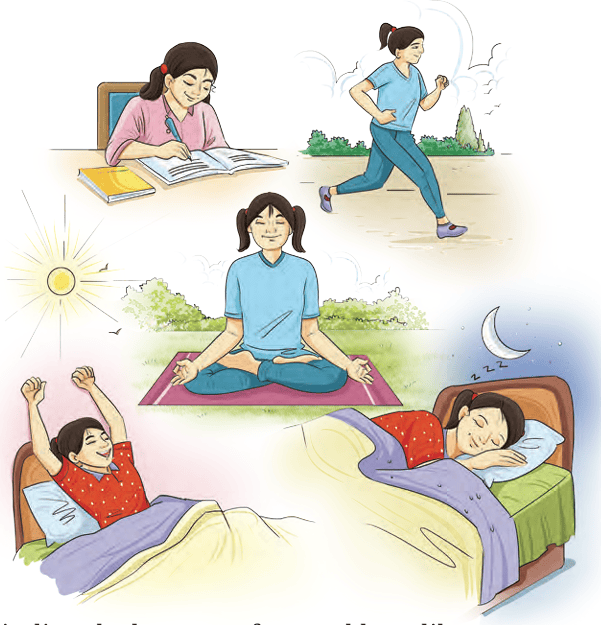
The circadian rhythm influences many functions, such as sleep, body temperature, immunity, hormones, digestion, memory, and how we react to stress. When this rhythm is disturbed, we may face problems like poor sleep, tiredness, mood swings, digestion issues, or difficulty in focusing.
Building habits becomes easier when we follow this natural rhythm. Some simple ways to align with it include:
• Sleeping and waking up at the same time every day
• Studying or working when the mind feels most alert
• Exercising during high-energy periods
• Eating meals at regular times
When we live in tune with our circadian rhythm, our body and mind function at their best. Ayurveda also teaches us that aligning our daily routine with nature’s cycle — sunrise, sunset, and seasonal changes — supports digestion, immunity, and overall balance.
In conclusion, yoga is a holistic practice that address wellness in a comprehensive way. It comprises cleansing methods, physical postures, breathing techniques, and meditation practices ensuring well-being in all dimensions. It is a preventive, transformative tool making you happy, healthy and wise. Make sure that you take small actions daily for your overall improvement and then yoga will become a part of your lifestyle.
Open Discussion Themes
• Adolescence
• Hormonal changes
Notes for the teacher
• Encourage students to practise an everyday yoga routine with awareness, without forcing their bodies.
Remind them that consistency matters more than perfection. Consistent, even brief practice enhances strength, flexibility, and emotional balance.
• Motivate students to choose traditional, local, and seasonal foods. Encourage children to avoid processed,packaged and unhealthy food. If possible, suggest visiting local markets where they can interact with farmers and learn more about where their food comes from.
• Help students understand that lifestyle changes do not have to be big. Even small, steady improvements can make a meaningful difference. Encourage them to stay patient and not feel discouraged if progress seems slow.
• Support girls by helping them understand how yoga can be helpful during menstruation, especially gentle stretches, breathing practices, and relaxation techniques.
• Menstrual health awareness
• Role of food, sleep, exercise, yoga, and positive thinking in hormonal balance.
• Changes noticed after 4 weeks of Yoga practice.
Check Your Progress
Section A
Answer in one sentence
1. What is Mitāhāra?
2. Name the three types of foods described in the Bhagavad-Gītā.
3. What is the body’s natural 24-hour cycle called?
4. What does brahmacharya mean in daily life?
5. Write one benefit of regular sleep.
Section B
Answer in 2–3 sentences
1. How does sleep affect your mood and concentration?
2. Why is it important to choose sāttvika food more often?
3. What changes can you make to reduce distractions in your daily routine?
4. How does practising yoga help during adolescence?
5. Why is good company important for a healthy lifestyle?
Section C
Answer in 3–4 sentences
1. Look at your weekly habits. Identify one overindulgence (for example, screen time, junk food, gossip) and explain how you can bring moderation to it.
2. Explain how the circadian rhythm can guide healthy habits in sleep, study, and eating.
Note for the teacher
The step-by-step procedures for Ajapā japa and Antar mauna are explained below.
Ajapa Japa
Japa is the continuous repetition of a mantra which comes from the mouth and Ajapa comes from the breath and the heart. Japa is the preliminary practice of mantra repetition and ajapa is the perfection of this practice. It relaxes the body and mind.
Stage 1 (Preparation): Sit in a comfortable meditatative Āsana with your back upright and head straight. Place your hands on your knees in the jñāna or chin-mudrā. Become aware of your body and the meditation posture. Feel the position of your body from the top of the head to the toes. Feel your posture becoming steady and still. Develop total awareness of your body and maintain this stillness.
Stage 2 (Breath Awareness): Switch the awareness from your body to your breath. Practice slow and deep breathing. Breathe in, counting to five, and then breathe out, counting to five again. Concentrate on the breath in your throat and feel it moving through your throat. Gradually feel the stillness of your mind and body as a whole. Notice your breath moving from your navel to your throat. Focus your attention on your navel. Inhale slowly in a straight line from your navel up to your throat. Then exhale slowly in a straight line from your throat down to your navel. Count to five while breathing in and while breathing out. Continue until your breath moves along this fixed path without conscious effort. Watch your breath carefully, without missing a single breath.
Stage 3 (Frontal Passage Visualisation): Visualise the psychic passage between your navel and your throat as a long, thin, and transparent tube. It is hollow inside and open at both ends, like a flute. Move your awareness up and down along the outside surface. Now, visualise the tube from within. Move your attention across the passage up and down, and to the centre.
Stage 4 (Breath Rotation Inside the Psychic Passage): Feel your breath moving inside the frontal passage, between your navel and your throat. While inhaling, the breath ascends from your navel to your throat. While exhaling, it descends from your throat to your navel. Feel as your awareness moves up and down the centre of the psychic passage, along with your breath.
Stage 5 (Rotation of Prāṇa): Gradually become aware of the prāṇa (vital energy) moving together with your breath and consciousness. Prāṇa moves in form of energy with the breath. This flow of prāṇa or energy between the navel and the throat creates the psychic passage. Visualise the thin sparkling stream of energy flowing inside from inside your navel to your throat as you breathe in and from your throat to your navel as you breathe out. With practice you will spontaneously feel a powerful current of energy flowing up and down the psychic passage.
Stage 6 (Rotation of So’ham): Leave the awareness of the prāṇa. Carefully listen to the subtle sound of your breath moving up and down the passage. The inherent sound of your breath is Soham. As you breathe in here the sound made is ‘so-o-o-o-o’. As you breathe out, hear the sound ‘ham-m-m-m-m-m’. Feel the vibration of the mantra moving with the breath.
Stage 7 (Ending the Practice): Get ready to end the practice. Withdraw your awareness from your frontal passage and the mantra. Change over to normal breathing. Become aware of your body and the meditation posture. Feel your body from head to toe. Breathe in deeply and chant ‘Om’ three times.
Antar Mauna
Antar mauna, translates to inner silence. It cultivates awareness, mental clarity, and mastery over the mind. It follows the principle of Sākṣhī-bhāva (the attitude of witnessing). It is a profound method of inner observation and transformation. By fostering conscious awareness of mental processes, it leads to inner silence that is natural, stable, and transformative, supporting holistic well-being and spiritual growth. It guides the practitioner away from external distractions towards their inner consciousness. Learning this practice correctly leads to mental stability, depth of meditation, and self-realisation.
Step 1 (Preparation)
Sit in a comfortable meditation posture. Keep your back upright and head straight. Close your eyes and become aware of the whole body. Keep observing different sounds in the surroundings, nearby and far away, without analysing any particular sound. Shift your awareness to your natural, spontaneous breathing. Maintain full awareness of your breath for a while.
Step 2 (Awareness of Thoughts)
Now observe the thoughts that arise in your mind. Do not stop or change them. Focus your full attention on your thought process. Become aware of every thought, like clouds passing in the sky.
Step 3 (Creation and Dissolution of Thoughts)
Select any one thought and maintain this thought for some time. Hold it for a few moments and then leave it. Then, create another thought and leave it. Hold each one for a few minutes and dismiss it. Take your awareness to Chidākaśha
(space in front of the closed eyes), and be a witness to any thoughts or visions that arise. Do this for some time.
Step 4 (Experience of Thoughtlessness)
Now focus on the space between thoughts. Do not put any effort. Simply experience the silence. This state comes spontaneously, not by force. Continue doing this for some time.
Step 5 (Conclusion)
Gradually bring your awareness back to your breath. Become aware of your body. Rub your palms together and place them over your eyes. Open your eyes.
Chapter 23
Yoga for Personal Excellence
In the previous chapters, we learned how yoga helps us build a strong, balanced body and mind. Now, let’s see how yoga can help you do your best in life, whether in your studies, sports, arts, as a leader, or by simply becoming your best self. This chapter will help you learn how to handle challenges wisely and excel in everything you do.
Personal excellence is a continuous, conscious choice to develop one’s capabilities, character, and skills to achieve the highest potential in all aspects of life. It is not a final destination or about achieving perfection, but rather a journey of ongoing self-improvement, growth, and commitment to one’s potential.
Yoga , The Art of Making Wise Choice
Imagine a scenario. It is 10:00 PM, and you have a mathematics exam tomorrow. You know you should study (goal). But your phone rings, your friends are online playing a game, and a new viral video has just come out on social media (distraction). You are confused. One path feels good now, but might hurt you later. The other path feels difficult now, but brings success later.
You might think this is a modern problem caused by smartphones, but thousands of years ago, teenagers faced similar dilemmas. Although the objects of distraction varied, the human mind remained the same. The ancient Yogis identified that at every moment, life offers you two ‘boarding passes’ to your future:
1. Preyas (The Pleasant): This is the path of immediate pleasure. It is easy, comfortable, and instantly satisfies your senses. For example, eating junk food, procrastinating, doom-scrolling, etc. Preyas looks like a friend today but acts like an enemy tomorrow.

2. Śhreyas (The Good): This is the path of long-term well-being. It often requires effort (sādhanā) and discipline initially, but it leads to strength, excellence, and lasting happiness. For example, exercising daily, communicating honestly, studying sincerely, etc. Śhreyas may look like a strict teacher today but is your best friend in the long run.

Achieving Excellence Through Yoga
We often think of excellence as saying “yes” to hard work. But actually, excellence starts with the power of saying “no” to distractions.
Let’s travel back thousands of years to meet a teenager named Nachiketāḥ, the boy who said “no” to the easy path.
Nachiketāḥ was a young boy, perhaps your age, who found himself face-to-face with Yama (the Lord of Death). Yama was so impressed by the boy’s courage and discipline that he offered him three boons (wishes). For the final wish, Nachiketāḥ asked for the ultimate knowledge, “What is the secret of life and death? What is the highest truth?” Yama hesitated. He knew this knowledge required immense focus and maturity. So, he tried to distract the boy. He tested him.
“Do not ask me for that,” Yama said. “Instead, take these gifts:
• I will make you the king of the world.
• I will give you piles of gold and wealth.
• I will give you fast chariots (like modern sports cars) and music.
• I will give you a long life to enjoy all of this.
But do not ask me for the ultimate knowledge!”
Imagine that! He was offered everything a teenager could dream of—fame, money, gadgets, etc.
The Choice of Excellence
Nachiketāḥ looked at all those distractions and smiled. He said,
“These things are temporary and won’t stay with me forever. These will vanish soon! I would like to have that which stays with me forever, that which is eternal.”
Yama was stunned. He had never met anyone—adult or child—who could resist these temptations. He felt Nachiketāḥ was a true Yogi and taught him the secrets of excellence in life and immortality.
Excellence is not an accident, it is a habit formed by your choices. When you consistently choose Śhreyas, you build the four pillars of a successful life, i.e., abhaya, satya, kartavya and ānanda.
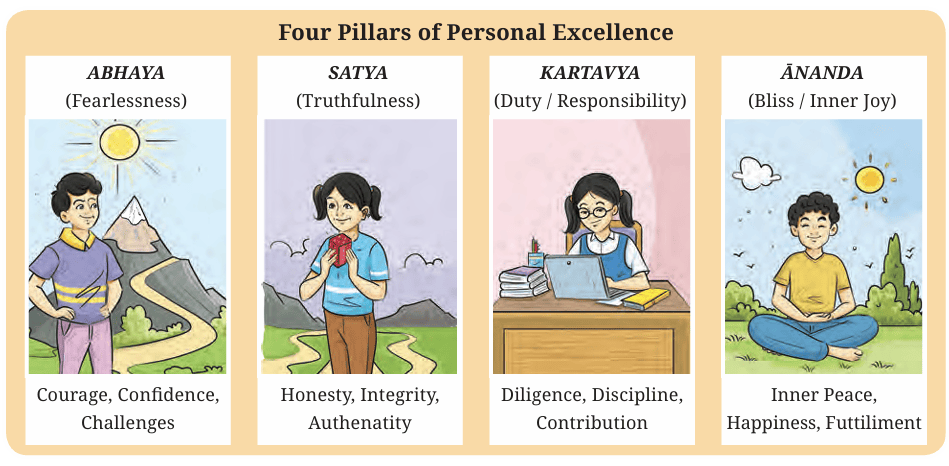
Just as Nachiketāḥ stood up to Yama, you build courage (abhaya) every time you say “no” to peer pressure. It is the strength to choose the hard right over the easy wrong. Truth (satya) requires integrity. Just as you must be honest about your limits in a yoga pose to avoid injury, choosing Śhreyas teaches you to be honest with yourself and others.
Success comes from doing what needs to be done i.e. doing one’s duty (Kartavya), not just what you feel like doing. It is the discipline to prioritise responsibilities (like study and service) over temporary distractions.
While Preyas offers fleeting excitement, Śhreyas leads to bliss (ānanda, or lasting inner joy). You realise that true happiness does not come from external objects but from the peace of a disciplined and focused mind.
Now, imagine if you had chosen Śhreyas. How would the result have been different?
LET US REFLECT
• Think about a time recently when you chose Preyas (immediate pleasure) over Śhreyas (long-term good).
• The Situation: (for example, I watched a movie instead of preparing for an annual day performance.)
• The Immediate Feeling: (for example, I felt relaxed and calm.)
• The Result: (for example, I felt stressed the next morning and my presentation was average.)
Choosing Śhreyas (the good) over Preyas (the pleasurable) requires focus on your higher life goals and a calm mind. Yoga provides the mental stability and discipline to anchor this focus, helping you make the right, long-term beneficial decision even when facing a critical situation.
Activity
How do we practise Śhreyas? Every time you step on your yoga mat, sit at your study desk or start your performance in sports or arts, you are practicing this choice of Śhreyas and Preyas. When you hold a plank pose even when your muscles shake, you are choosing strength (Śhreyas) over the comfort of collapsing (Preyas).
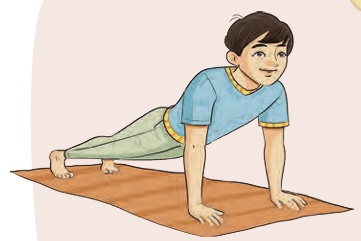
When you choose to focus on your creative project instead of watching TV, you are choosing growth (Śhreyas) over stagnation (Preyas).
Yoga teaches us that we are not just biological machines, but we have a vast potential to excel in the material life and grow to into divinity. But to unlock that potential, we must stop being slaves to our impulses, rein in our senses and decide with a calm and focused mind.
Preparing the Body and Mind for Śhreyas through Yoga Practice
One of the main obstacles that pulls us repeatedly towards Preyas instead of Śhreyas is laziness and a lack of routine. When the body is not active and there are too many thoughts in the mind, it becomes difficult to make wise choices, even when we know what is right.
Yoga teaches us that self-mastery begins with the body. By gently training the body through regular āsana practice, and calming the mind through prāṇāyāma, we develop alertness, discipline, and inner motivation. This daily effort (sādhana) gradually reduces laziness, increases energy levels, and strengthens willpower. As regularity grows, choosing Śhreyas becomes natural rather than forced.
If you are at a point where you are having to choose between instant gratification and long-term happiness, take a step back. Sit in any meditative posture — Sukhāsana, Vajrāsana or Padmāsana — and practice slow, deep breaths, bringing all your focus to your abdominal breathing till the mind settles down. You will then be in a clear, calm state of mind to make a wise decision.
Activity
Practice this simple 10-minute yoga routine, spending one minute on each practice:
1. Tāḍāsana
2. Vīrabhadrāsana
3. Vṛikṣhāsana
4. Paśhchimottānāsana
5. Śhaśhāṅkāsana
6. Nāḍī-śuddhi Prāṇāyāma
7. Bhrāmarī Prāṇāyāma
8. Sectional breathing
9. Trāṭaka-kriyā
10. Śhavāsana
Practice these regularly and reflect on the changes you observe:
Do you notice any changes in your thought pattern?
Do you feel more focused, and has this helped you make better decisions?
Are your distractions reduced or become easier to manage?
Focusing on Higher Goals
Think of an Indian Olympian who is one of India’s youngest shooting champions. She has often spoken about the mental discipline required to excel at the highest level of sport. In the high-pressure environment of Olympic-level competition, maintaining composure is as crucial as technical skill. For her, the Bhagavad-Gītā has become an essential tool for maintaining mental calmness and resilience. When asked about the last few moments of the 10m air pistol final, she said, “Honestly, I read a lot of Gītā, so what was going through my mind is ‘just do what you are meant to do, do what you are supposed to do’ and leave whatever. Destiny you can’t control.” So, in the Bhagavad-Gītā, Kṛiṣhṇa says to Arjuna: “You focus on the Karma, and not on the outcome. That was running in my head.”
Her daily routine involves 6–7 hours of shooting practice and an hour of yoga practice. She even solves puzzles during breaks to keep her mind sharp and clear.
Can you name who she is?
Here's a secret about overcoming distractions that many students miss!
Distractions are more tempting when your goal is small and your mind is not focused or calm.
Higher Goals vs Smaller Goals
“Nālpe sukham asti, bhūmaiva sukham.” (Chhāndogya-Upaniṣhad)
Meaning: “There is no joy in the small/limited. True joy is only in the infinite/vast.”
Do you know about the teacher who refused to be miserable?
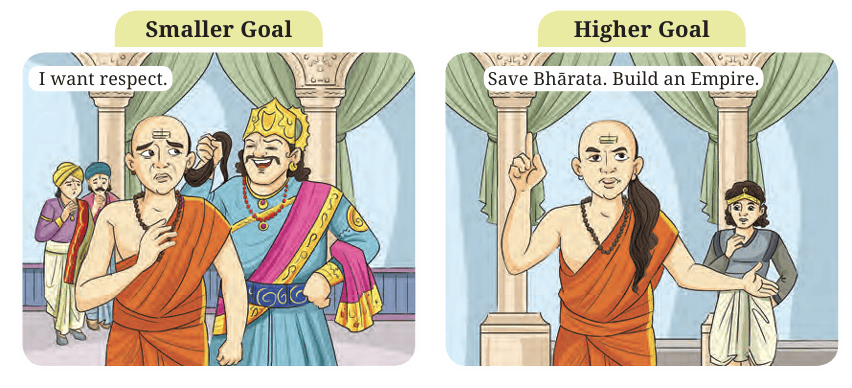
In ancient India, the great teacher Chāṇakya went to the court of King Dhanānanda to warn him about a Greek invasion.
Instead of listening, the arrogant King insulted Chāṇakya. He mocked his appearance, pulled him by his hair, and threw him out of the palace.
Now imagine this moment, a respected teacher has been humiliated in front of hundreds of people.
The Small Goal Reaction: If Chāṇakya’s goal was just “I want respect” or “I want a job in the palace,” this moment would have destroyed him. He would have gone home, cried, and lived in misery forever. He would have been broken by shame.
The Big Goal Response: But Chāṇakya had a higher goal. His vision was to save Bharat from Greek invasion and our people from slavery.
Because his goal was big, the personal insult didn’t break him. It fueled him. He untied his hair and vowed, “I will not tie my hair until I replace this corrupt King with a leader who can protect the nation.”
He didn’t go home to cry. He went to the streets, found a boy named Chandragupta, trained him, and built the Mauryan Empire. Chāṇakya showed us that when your eyes are fixed on a mountain peak, you do not care if you trip on a stone.
Shifting focus from a smaller goal to a higher goal creates a psychological shield that we can apply to our own modern lives. When you are in a fragile state because of a small goal— like wanting to be popular in school — the results are often devastating. One rude comment from a friend makes you sad for a week because you have nothing else to look forward to. Conversely, when you enter an unbreakable state driven by a big goal, such as wanting to become a scientist to solve climate change, the result changes entirely. If someone makes fun of your glasses or your grades, it does not matter; you are too busy building the future, and the insult simply bounces of you.
The same logic applies to our daily habits and how we sustain our motivation over time.
A narrow or smaller goal might be to be fit to look good, which makes it very easy to quit when things get tough. However, a higher goal means you want to be fit so you have the strength to help others and serve your country, a mindset that makes it almost impossible to quit.

Let your goal be so big that challenges make you shine brighter!
When you link your hard work to something bigger than yourself, like your family, your community, or your country, you find extra energy within yourself.
Yoga is not only about self-improvement, it is about preparing yourself for higher/bigger goals in life. You train your body and mind not just to develop yourself and stand out but to be helpful to others. Thinking beyond self helps you avoid internal distractions.
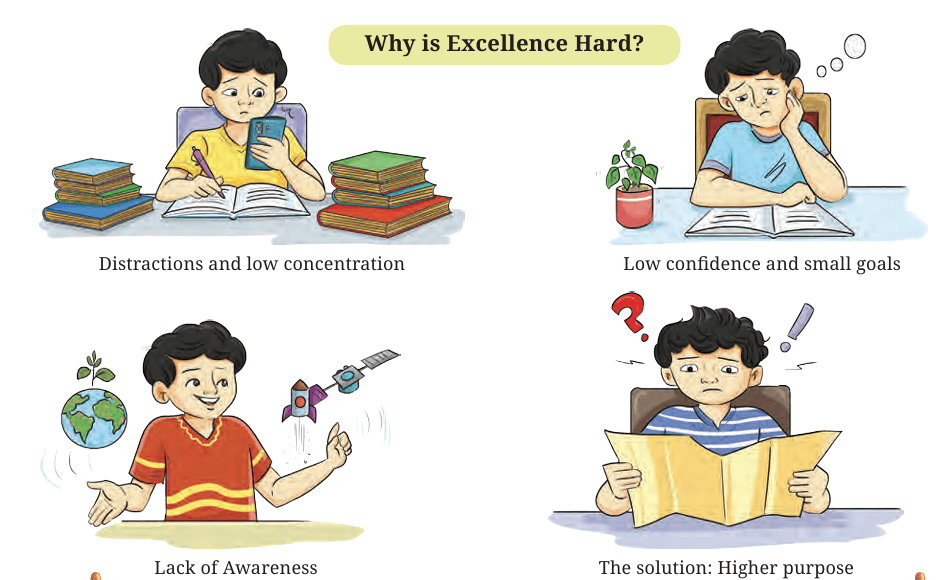
Why is Excellence Hard?
You might be thinking, “I know I should study. I know I should practise. Why is it so hard to actually do it?” You know that studying helps you learn, and junk food is not great for your health. Yet, we often struggle to do the ‘right’ things.
What stops you from always doing good and excelling in what you do?
A few reasons could be:
• Lack of awareness and concentration
• Low Confidence
• Small goals and perspective (Thinking only about “Me, Me, Me”, or being selfish)
• Distractions (Social media, gaming, or peer pressure)
Why is Excellence Hard?
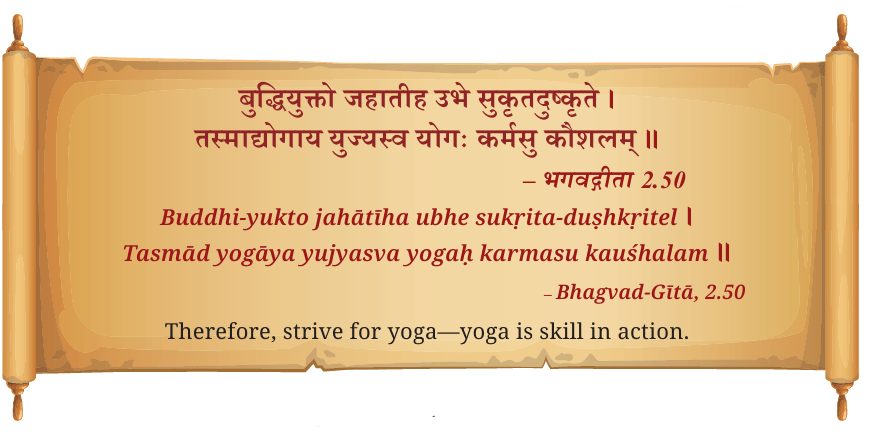
This means doing every action—whether you are studying, playing, or helping a friend—with full dedication. Your actions affect the world around you.
How do we learn to achieve this ‘skill in action’? We need to look at the lives of people who lived for others.
• Dr APJ Abdul Kalam didn’t just want to be a great scientist; he wanted to make India strong and self-reliant. Dr. Kalam was the architect of India’s missile programme and the 11th President of India. But he didn’t work for fame, money, or power. He owned very little—just his books, his vīṇā, and a few clothes. His entire life was a yajña (sacrifice) for the nation. Dr. Kalam believed that his ‘Higher Goal’ was to ignite the minds of the youth. Even after being President, he didn’t retire to a life of luxury. He travelled constantly to meet students in schools and colleges. He personally to thousands of emails from children. He mastered the art of “Karma-Yoga,” executing complex scientific missions with clinical precision while remaining completely detached from the rewards. When the first SLV-3 launch failed in 1979, he courageously took the blame as the mission director. Yet when the mission succeeded a year later, he stepped aside to let his team take the limelight. This rare ability to absorb failure and distribute credit transformed a group of individuals into a world-class scientific force. He passed away doing exactly what he loved most, teaching students. Until his last breath, he was serving others.His excellence was a gift to his country.
Excelling is not just about winning a prize. You are also setting an example for your younger siblings, classmates, and your community. You show them what can be achieved. Excellence is a mindset, not a physical condition.
You might be thinking, “These role models are superheroes. I am just a normal teenager. How can I be like them?”
The secret is this — excellence is not a gift, but a process. Just as coal turns into a diamond under pressure, a human mind turns into a genius through sādhanā — Yoga-sādhanā. These role models consciously or unconsciously applied yogic principles to enhance their minds. Here is how Yogic practices can help you excel:
1. Turning a Lightbulb into a Laser (Ekāgratā)
Normal Mind: Your energy is like a lightbulb, scattered in all directions (thinking about food, friends, games, movies, homework, etc).
Yogic Mind: Yoga practices like Trāṭaka (gazing) and Prāṇāyāma (breathwork) gather all your scattered energy into a single beam.
The Result: You become like a laser, with a focused mind, and you can then solve even the hardest math problem or master a sport.
2. Stopping the Energy Leaks (Prāṇa)
Normal Mind: We leak energy every day through anger, jealousy, overthinking, and scrolling. Mornings are refreshing, but by evening, we are exhausted.
Yogic Mind: Yoga stops these leaks. It teaches you to stay calm (Samatvam), not react disruptively to situations in life, but act positively.
The Result: You are energetic throughout the day to pursue your dreams.
3. From Fragile to Strong (Tapas)
Normal Mind: When things get hard, we break and quit.
Yogic Mind: Yoga postures pose a challenge to the body. Holding a pose even when your legs shake teaches your brain to be comfortable with discomfort.
“If I have to go to school again I will learn only two things: Concentration of mind and detachment, so that I can focus and learn any subject at will.”– Swami Vivekananda
The Result: When life hits you, you do not break, but bounce back stronger
Let us open the Excellence Toolkit to see the practical steps you can take, starting today.
Your Toolkit: 5 Steps to Excellence
Step 1: Hard Work and Commitment (Tapas)
It is easy to work hard on things you enjoy. It is much harder when the work feels boring but is still important.
The Trap: “Why should I study this boring chapter?”
The Higher Goal Solution: You are not just studying a chapter. You are building a discipline of knowledge, that you will need to solve real problems in the future. For example, a surgeon cannot say, “This surgery is boring. I’ll quit.”
The Yogic Solution: In yoga, this is called Tapas, which means hard work, self-discipline and the inner strength to transform. You build up energy in your body to clear away what holds you back. By practising tapas, you prepare yourself to overcome challenges in daily life and help your family or country when needed.
Action Plan
Embrace Boredom: Stick to a task for 15 minutes even if it feels boring, knowing that it is building your mental muscles.
Finish What You Start: Do not leave a task half-done.
Need to mention about tapas in daily life: eg: daily exercise, yogic practices, etc.
Tapas becomes your fuel for growth when you make it a part of your daily life.
It could be your consistent practice of yoga on a daily basis, being aware of your breath, sticking to healthy eating, waking up in the morning for a run, speaking kindly, or setting boundaries with technology.
Start small, gradually build up your discipline like holding your pose for one extra breath or holding a challenging pose to build strength .
Step 2: Positivity, Emotional Intelligence, and Resilience
Sometimes, your emotions can feel like a rollercoaster. But if you always react to your feelings, it becomes difficult to focus on your bigger goals.
The Trap: Getting lost in ‘what others say or think about you’ and letting others control your mood.
The Higher Goal Solution: When you have an important task, like organising a school event or helping a charity, small insults do not bother you. You are too focused on your bigger purpose to worry about little things.
The Yogic Solution: Prāṇāyāma helps you be aware of your emotions and pause before reacting. It keeps you from saying things in anger and helps your group stay peaceful so everyone can do well together.
Action Plan
The 3-Breath Rule: Before reacting to anger, take 3 deep breaths.
Empathy: Ask, “How can I support my friend right now?” instead of judging them.
Daily Practices that Support Emotional Control
• Nāḍī-śhodhana Prāṇāyāma: 9 rounds
• Bhrāmarī Prāṇāyāma: 5 times
• Slow, Deep Breathing: 20 times
• Short Periods of Dhyāna: 5 minutes
Step 3: Leadership and Responsibility (Sevā)
Leadership is not about being the boss. It is about sevā, which means service.
The Trap: “I won’t volunteer because it’s too much work” or “What if others laugh at me?”
The Yogic Solution: Karma-Yoga is about selfless action. It teaches you to work for the satisfaction of self and not reward. Do things because you feel they are right, like taking care of your surroundings. If the classroom is messy, a leader cleans it, not for praise, but because it is the right thing to do. When you focus on helping others, you stop worrying about what people think. People follow a person who is genuine, works selflessly and cares for others. They are true leaders.
Action Plan
Take Initiative: Do not wait to be asked. If you see clutter, pick it up.
Help others shine: Teach a concept you know to a friend who is struggling with it.
Step Out: Volunteer for community service or school responsibilities.
Step 4: Self-Confidence (The Prāṇa Connection)
As a student, it is easy to lose confidence because of social media or comparing yourself to others.
The Trap: “I am not good enough because I do not look like that influencer.”
The Higher Goal Solution: Confidence is not about how you look but about how useful you are. When you know you are helping your family, friends or community, you feel engaged and important. You stop worrying about your appearance and focus on what you can do for others.
The Yogic Solution: Yoga builds Prāṇa, or energy. When you stand tall in a yoga pose, you are not just stretching, you are also learning to stand strong against peer pressure.
Action Plan
Practice Āsanas: Vīrabhadrāsana (Warrior Pose): This helps you build the strength and courage of a warrior who stands up for what is right.
Vṛikṣhāsana (Tree Pose): This pose helps you find balance, even when life feels chaotic. Padmāsana (Lotus Pose): Use this pose to sit quietly and meditate, thinking about your goals.
Sevā: When you feel low, go help someone. Doing a good deed is the fastest way to boost confidence.
Step 5: Self-Awareness and Continuous Growth (Svādhyāya)
The Trap: “I know enough, I do not need to learn more.”
The Higher Goal Solution: The world faces big problems like climate change, pollution, and poverty. To solve these complex issues, innovation, research and knowledge of numerous subjects is necessary. To be happy and uplift the needy, continuous learning and action is required. You can help the planet with your small actions.
The Yogic Solution: Svādhyāya means self-study. Think about your actions. Are you becoming someone who helps the world, or just someone who takes from it?
Action Plan
Seek Feedback: Ask, “How can I improve to be a better team player?”
Daily Reflection: “Did I help someone today? Did I waste my potential today?”
Practical Implementation: Start Now
Everything depends on your mental and physical health. You cannot help others if you are not strong or if you are unwell.
Daily Micro-Practices
3 minutes of Sectional breathing to energise.
5 minutes of neck rolls and spinal twists.
5 minutes of Nāḍī-śhodhana Prāṇāyāma/Bhrāmarī Prāṇāyāma for focus.
A brief overview of the integration of yogic practices for
Personal Excellence
|
Aspects of excellence |
Yogic practices |
Inner Quality Developed |
|
Strong, energetic and healthy body |
Āsanas, Kriyās and, Prāṇāyāma |
Vitality, stamina |
|
Discipline and self control |
Regular practice, lifestyle discipline |
Tapas – inner strength to transform |
|
Focus/concentration |
Dhāraṇā, Dhyāna |
Ekāgratā, clarity in thoughts. |
|
Values/character |
Yama-Niyama |
Integrity, compassion, responsibility |
|
Overall life balance |
Feeling overwhelmed, low confidence, lack of direction |
Regular yoga practice (15–20 minutes daily) |
|
Emotional balance and leadership Managing stress, anger, anxiety |
Dhyāna, Relaxation, Karma-Yoga (selfless service) |
Calmness, empathy, confidence, resilience |
|
Higher goals |
Svādhyāya, reflection Purpose from deeper yogic insights and inquiry |
Meaningful living, wisdom |
Activity
The Excellence Tracker
Excellence is not an act, but a habit. Copy this table into your journal and use it to track your journey towards becoming a role model.
Part 1: Weekly Checklist
Check the box only if you have honestly achieved
the specific goal that day
|
The Excellence Habit |
The Specific goal |
Mon. |
Tue. |
Wed. |
Thurs. |
Fri. |
Sat. |
Sun. |
|
Focus (Dhāraṇā) |
I defeated a distraction (phone/TV) to finish some important work. |
|||||||
|
Discipline (Tapas) |
I completed a task I found boring or difficult without complaining. |
|||||||
|
Service (Sevā) |
I did something selfless for my family, friends, or neighborhood (Higher Goal). |
|||||||
|
Emotional Strength |
I took a “Prāṇa Pause” (3 deep breaths) instead of reacting in anger/fear. |
|||||||
|
Body (Śharīra) |
I practiced 10 minutes of Yoga or conscious breathing to charge my energy. |
|||||||
|
Growth (Svādhyāya) |
I admitted a mistake or asked for feedback to improve myself. |
Part 2: The Sunday Reflection
At the end of the week, answer these three questions to practice self-awareness:
The Win: What was one moment this week where I felt truly proud of my behaviour?
The Challenge: Which distraction was the hardest to fight this week? How will I handle it better next week?
The Higher Goal: How did my actions this week help someone else or contribute to my home or school environment?
Conclusion: The Ant and the Vulture
Excellence is not a quick race, but a long journey. You might feel small right now. But if you keep moving forward with a clear purpose to improve yourself and help others, you will go farther than you think.
To support this journey towards personal excellence, a unique yoga module has been designed, requiring a few minutes of daily practice. When sincerely and consistently followed, these qualities not only reflect on the yoga mat but also lead to observable improvements in physical vitality, mental clarity, confidence, discipline, and the ability to make calm, wise choices in challenging situations.
Yoga Module for daily practice
|
Opening Prayer |
ॐ सह नाववतु । सह नौ भुनक्तु । सह वीर्यं करवावहै । तेजस्विनावधीतमस्तु मा विद्विषावहै ॥ ॐ शान्तिः शान्तिः शान्तिः ॥ Oṁ saha nāvavatu । Saha nau bhunaktu । Saha vīryaṁ karavāvahai । Tejasvināv adhītam astu mā vidviṣhāvahai ॥ Oṁ śhāntiḥ śhāntiḥ śhāntiḥ ॥ |
|
Closing Prayer |
ॐ सर्वे भवन्तु सुखिनः सर्वे सन्तु निरामयाः । सर्वे भद्राणि पश्यन्तु मा कश्चिद् दुःखभाग् भवेत् ॥ ॐ शान्तिः शान्तिः शान्तिः ॥ Oṁ Sarve bhavantu sukhinaḥ sarve santu nirāmayāḥ । Sarve bhadrāṇi paśhyantu mā kaśhchid duḥkha-bhāg bhavet ॥ Oṁ śhāntiḥ śhāntiḥ śhāntiḥ ॥ |
|
Category |
Monday |
Tuesday |
Wednesday |
Thursday |
Friday |
Saturday |
Sunday |
|
Breathing |
Hands Stretch breathing: |
Ankle Stretch Breathing, Rabbit breathing, Dog breathing |
Śhaśhāṅka breathing, Ananta-śhayana Breathing, |
Forward-backward bending, side bending, bending and twisting |
Forward-backward bending, side bending, bending and twisting |
Tiger breathing |
Eye exercise — Up and down, Left and right, Diagonal movements, rotation |
|
Loosening practices |
Bhujabandha-śhakti-vikāsaka Rotation with the palms on the shoulder. Free rotation of the shoulders. |
Kaphoṇi-śhakti-vikāsaka, Wrist rotation |
Aṅgulī-śhakti-vikāsaka, Stretching and compressing of the fingers, Stretching and compressing of the toes, Jānu-śhakti–vikāsaka |
Full butterfly, hip rotation |
Pavana-muktāsana-kriyā, Gatyātmaka-meru-vakrāsana |
Sarvāṅga-puṣhṭi, Chakkī-chālanāsana, Bhū-namanāsana. |
Camel walk, Toe walk, crab walk, Heel walk, Frog jump |
|
Sūrya-namaskāra |
3 round, 12 steps each |
3 rounds |
3 rounds |
3 rounds |
3 rounds |
3 rounds |
3 rounds |
|
Āsana |
Ardhakaṭi-chakrāsana, Vajrāsana |
Pāda-hastāsana, Ardha-chakrāsana |
Trikoṇāsana, Padmāsana |
Parivṛitta-trikoṇāsana, Vakrāsana |
Bhujaṅgāsana, Śhalabhāsana |
Śhaśhāṅkāsana, Uṣhṭrāsana |
Sārvāṅgāsana, Matsyāsana |
|
Relaxation |
Śhavāsana |
Śhavāsana |
Śhavāsana |
Śhavāsana |
Śhavāsana |
Śhavāsana |
Yoga-nidrā |
|
Prāṇāyāma |
Nāḍī-śhodhana Prāṇāyāma |
Sectional Breathing |
Anuloma-Viloma Prāṇāyāma |
Bhastrikā Prāṇāyāma, Nāḍī-śhodhana Prāṇāyāma |
Śhītalī Prāṇāyāma, Śhītakārī Prāṇāyāma |
Bhrāhmarī Prāṇāyāma, Nāḍī-śhodhana Prāṇāyāma |
Ujjāyī Prāṇāyāma |
|
Dhyāna |
Oṁ-Dhyāna |
Pañchakośha-Dhyāna |
Jatru-trāṭaka |
Antar mauna |
Nādānusandhāna |
Bindu-trāṭaka |
AJapā japa |
Check Your Progress
Section A
Answer in one sentence
1. What is the difference between Śhreyas and Preyas regarding the type of happiness they offer?
2. Which quality (Abhaya) do you build when you stand up to peer pressure like Nachiketāḥ stood up to Death?
3. According to the text, “Success comes from doing what needs to be done”; what is the Sanskrit term for this “duty”?
4. How does practising Satya (Truth) prevent injury during a yoga pose?
5. Name the two athletes mentioned in the text as examples of focusing on “higher goals”.
Section B
Answer in 2–3 sentences
1. Explain the statement, “Excellence is not an accident; it is a habit formed by your choices.”
2. Why does the text suggest that “higher goals” lead to peace, while “smaller goals” can lead to misery?
3. ‘Physical limitations cannot stop excellence.’ Do you agree? Explain with the help of an example.
4. Why is ānanda (bliss) considered different from the “fleeting excitement” offered by Preyas?
5. How does the pillar of Kartavya help a student handle the distraction of video games vs. the responsibility of studying?
Section C
Answer in 3–4 sentences
1. Identify a recent situation where you had to choose between “the hard right” (Śhreyas) and “the easy wrong” (Preyas). How did your choice affect your inner peace or stress levels?
2. Through yogic practices, how can one overcome a personal challenge like fear of failure or physical weakness?
Note for the teacher
The following are the details of practices covered in Grades 3 to 8 textbooks, which may be referred to while conducting practical sessions.
|
Grade |
Śhakti-vikāsaka (Strengthening Practices) |
Sūkṣhma Vyāyāma (gentle and subtle movements for the joints) |
|
4 |
Aṅgulī, Maṇibandha, Kaphoṇi, Bhuja-bandha-śhakti-vikāsaka |
|
|
5 |
Jaṅghā-śhakti-vikāsaka |
Pādāṅgulī-namana, Gulpha-namana, Gulpha-chakra, Ardha-titalī-āsana, Śhroṇī-chakra, Gatyātmaka-meru-vakrāsana, Chakkī-chālanāsana, Bhū-namanāsana, Pāda-sañcalanāsana |
|
6 |
Sūkṣhma Vyāyāma |
Neck Movements— Up and down movement, Left and Right Movements |
|
7 |
Aṅgulī-śhakti-vikāsaka, Maṇibandha- śhakti-vikāsaka maṇibandha-chakra, kehuni-śakti-vikāsaka, |
Skandha-chakra, Grīvā-sañchālana |
|
8 |
Pavana-muktāsana series |
Pādāṅgulī-namana Gulpha-namana Gulpha-chakra Jānu-namana Ardha-titālī Pūrṇa-titālī |
|
Grade |
Śhītalīkaraṇa-vyāyāma |
Breathing Practices |
|
3 |
Heel walk, Frog jump |
|
|
4 |
Camel walk, Toe walk |
Hands stretch, Deep breathing |
|
5 |
Loosening the Toes, Loosening the Ankle joints, Loosening of Hip joint, Hip rotation |
Straw breathing |
|
6 |
Ekapāda-pavanamuktāsana-kriyā (single leg), Dvipāda-pavanamuktāsana-kriyā (both legs) |
Rabbit breathing, Dog breathing |
|
7 |
Forward and backward bending, Side bending, Bending and twisting, Twisting |
Marjāryāsana, Vyāghrāsana |
|
8 |
Hṛidaya-gati, Ūrdhva-gati, Sarvāṅga-puṣhṭi |
|
Grade |
Prāṇāyāma |
Kriyā |
|
3 |
Breathawarness |
Eye exercises |
|
4 |
Bhrāmarī, Anuloma-Viloma |
Karṇa-randhra-dhauti, |
|
5 |
Ujjāyī Prāṇāyāma, Śhitakārī Prāṇāyāma, Śhītalī Prāṇāyāma |
Bindu-trāṭaka |
|
6 |
Sectional breathing, Nāḍī-śhuddhi, Bhrāmarī |
Introduction to Jatru-trāṭaka |
|
7 |
Bhastrikā |
Jatru-trāṭaka |
|
8 |
Sūrya-bhedana Prāṇāyāma, Chandra-bhedana Prāṇāyāma |
Introduction to Kapālabhāti, Preparatory practices for Jyotiḥ-trāṭaka |
|
Grade |
Āsana |
|
3 |
Vṛikṣhāsana, Sukhāsana,Vajrāsana, Bhujaṅgāsana, Pavana-muktāsana |
|
4 |
Ardha-chakrāsana, Pāda-hastāsana, Trikoṇāsana, Śhaśhāṅkāsana, Uṣhṭrāsana, Vakrāsana, Setu-bandhāsana, Uttāna-pādāsana, Śhalabhāsana, Dhanurāsana, Śhavāsana |
|
5 |
Hastottānāsana, Utkaṭāsana, Vīra-bhadrāsana, Parivṛitta-trikoṇāsana, Parvatāsana, Jānu-śhīrṣhāsana, Gomukhāsana, Ardha-matsyendrāsana,, Sarpāsana, Tiryag-bhujaṅgāsana, Matsyāsana, Siṁha-garjanāsana |
|
6 |
Ardha-kaṭi-chakrāsana, Padmāsana, Bhujaṅgāsana, Śhalabhāsanā, Uttana-padāsanā |
|
7 |
Utkaṭāsana, Vṛikṣhāsana, Gomukhāsana, Sarala-dhanurāsana, Sarvāṅgāsana, Matsyāsana |
|
8 |
Garuḍāsana, Vīra-bhadrāsana, Paśhchimottānāsana, Supta-vajrāsana, Uṣhṭrāsana, Pavana-muktāsana, Parivṛitta-jānu-śhīrṣhāsana, Utthita-padmāsana |
|
Grade |
Mudrā |
Dhyāna |
|
3 |
Chin-mudrā, |
Om chanting |
|
4 |
Namaskāra-mudrā, Chin-mudrā, Nāsikā-mudrā |
Om chanting |
|
5 |
Prāṇa-mudrā, Apāna-mudrā, |
Om chanting |
|
6 |
Chin-mudrā, Chinmaya-mudrā, Ādi-mudrā, Brahma-mudrā, Nāsikā-mudrā |
Nādanusandhāna |
|
7 |
Ṣhaṇmukhī-mudrā, Jñāna-mudrā, |
Pañchakośha |
|
8 |
Tāḍāgī-mudrā |
Simple meditation |
An implementation plan helps in systematically planning timelines and sessions. An overview of the implementation of Unit 6 is given here, which can be thoughtfully adapted as required. This plan also enables continuous tracking of students’ progress and helps in assessing whether the intended objectives and learning outcomes are being effectively achieved.
|
Month 1 |
||||
|
3rd period |
6th period |
9th period |
12th period |
|
|
Yoga for Daily Life |
Samagra Svāsthya — Story of Swami Sivananda Baba, Definition of Health, Bhāratīya concept of Svasthya (Holistic Health), Ease and Dis-ease, Dimensions of Holistic Health |
The correlation of health and the status of the kośha, Exploring the Pañchakośha |
Yogamaya Jīvana - Introduction, The life of Amma, Āhāra (food) - Sāttvika, Rājasika, Tāmasika, Mitāhāra |
Āhāra (food) - Activity 1, 2 and 3 discussion, Nidrā (sleep) - Reflection Activity discussion |
|
Yoga Sādhana (25 mins) |
Hands Stretch Breathing, Shoulder, hip, wrist, ankle, neck - rotations, ______ |
Full Butterfly, Rabbit and Dog breathing, ______ |
Śaśāṅka Breathing, Ananthaśayana Breathing, Stretching and compressing of the fingers and toes, Jānu Śakti Vikāsaka, ______ |
Forward-backward bending, side bending, bending and twisting, ______ |
|
Sūrya Namaskāra ______ Ardhakaṭi Cakrāsana, Vajrāsana, ______ Śavāsana, _______ Kapālabhāti, Jatru-trāṭaka |
Sūrya Namaskāra _______ Pādahastā sana, Ardhacakrāsana, _______ Śavāsana, ______ Sectional Breathing, ______ Pañchakośha Dhyāna |
Sūrya Namaskāra (1 round), _______ Vīrabhadrāsana, Paścimottānāsana ______ Śavāsana, ______ Nāḍī-śhodhana Prāṇāyāma, Ujjāyī Prāṇāyāma _______ Ajapā japa |
Sūrya Namaskāra ______ Parivṛta Trikoṇāsana, Vakrāsana, ______ Śavāsana, ______ Bhastrikā Prāṇāyāma, Nāḍī-śhodhana Prāṇāyāma, ______ Nādānusandhāna |
|
|
Month 2 |
||||
|
15th period |
18th period |
21st period |
24th period |
|
|
Yoga for Daily Life |
Brahmacharya - Activity 1, 2 and 3 discussion, |
Satsaṅga - Activity 1 and 2 discussion |
Revision of |
Revision of chapter 2 |
|
Yoga Sādhana (25 mins) |
Tiger breathing, Sarvāṅga-puṣṭi, Cakki Cālanāsana, Bhū Namanāsana. ______ Sūrya Namaskāra (1 round), ______ Śaśāṅkāsana, Uṣṭrāsana, ______ Śavāsana ______ Bhrahmari Prāṇāyāma, Nāḍī-śhodhana Prāṇāyāma, ______ Oṁ Dhyāna |
Camel walk, Toe walk, crab walk, Heel walk, Frog jump ______ Sūrya Namaskāra (1 round), ______ Sārvāṅgāsana, Matsyāsana, ______ Śavāsana ______ Nāḍī-śhodhana Prāṇāyāma ______ Oṁ Dhyāna |
Ardha Titali Āsana, Pūrṇa Titali Āsana, Śroṇi Cakra, Pāda Sañcalanāsana v Sūrya Namaskāra (1 round), ______ Vṛkṣāsana, Paścimottānāsana, Vīrabhadrāsana- 1 ______ Śavāsana v Ujjāyī, Śītālī Prāṇāyāma ______ Antarmauna |
Gatyātmaka Meru Vakrāsana, Cakki Cālanāsana, Bhū Namanāsana Vakṣasthala-śakti-vikāsaka, Kaṭi-śakti-vikāsaka, Sarvāṅga-puṣṭi _______ Sūrya Namaskāra (1 round), _______ Vīrabhadrāsana- 2, Naṭarājāsana, Uttānāsana _______ Yoga Nidrā |
|
Month 3 |
||||
|
27th period |
30th period |
33rd period |
36th period |
|
|
Yoga for Daily Life |
Mid-Term Assessment |
Adolescence challenges and yoga, Anger management, Emotional balance and stress, Peer pressure and substance use |
Menstrual Health and Yoga |
Circadian Rhythm and Habit Formation - Activity discussion |
|
Yoga Sādhana (25 mins) |
Neck movements Ardha Titali Āsana, Pūrṇa Titali Āsana, Śroṇi Cakra, Pāda Sañcalanāsana __________________ Sūrya Namaskāra (1 round), __________________ Paścimottānāsana, Uṣṭrāsana __________________ Śavāsana, __________________ Bhastrikā Ujjāyī Prāṇāyāma __________________ Nādanusandhāna |
Sūrya Namaskāra (1 round) __________________ Vajrāsana, Supta Vajrāsana, Uṣṭrāsana, Tāḍāsana, Kaṭi Cakrāsana, Setu Bandhāsana, Ardha Śalabhāsana, Vakrāsana, Jānu Śīrṣāsana, Supta Baddha Koṇāsana, Utkatāsana, Naukāsana. __________________ Nāḍī-śhodhana Prāṇāyāma, __________________ Ajapa japa |
Hands in and out breathing, Bhū Namanāsana, Pada Sañcalana __________________ Sūrya Namaskāra __________________ Vṛkṣāsana, Trikoṇāsana, Vīrabhadrāsana __________________ Śavāsana, __________________ Nāḍī-śhodhana Prāṇāyāma, __________________ Bindu Trāṭaka |
|
|
Month 4 |
||||
|
39th period |
42nd period |
45th period |
48th period |
|
|
Yoga for Daily Life |
Revision - |
Yoga for Personal Excellence - Preyas, Śhreyas, The Choice of Excellence - Story of Nachiketa, Focusing on Higher Goals |
Focusing on Higher Goals, Higher goals vs Smaller goals |
Why is Excellence Hard? Yogic practices that help you excel - Ekāgratā, Prāṇa, Tapas |
|
Yoga Sādhana (25 mins) |
Śaśāṅka Breathing, Ananthaśayana Breathing, Stretching and compressing of the fingers and toes, Jānu Śakti Vikāsaka, __________________ Sūrya Namaskāra __________________ Vīrabhadrāsana Paśchimottānāsana __________________ Śavāsana, __________________ Nāḍī-śhodhana Prāṇāyāma, Bhrāmarī, __________________ Nādanusandhāna |
Pādāṅguli Naman, Gulpha Naman, Jānu Naman, Jānu Chakra, Pūrṇa Titali __________________ Sūrya Namaskāra __________________ Supta Vajrāsana, Uṣṭrāsana, Pavana Muktāsana, Parivṛtta Jānu Śīrṣāsana, Utthita Padmāsana __________________ Śavāsana, __________________ Ujjāyī __________________ Oṁ Dhyāna |
Aṅgulī Śakti Vikāsaka, Maṇi Bandha Śakti Vikāsaka, Kehuni Śakti Vikāsaka, Skandha Chakra, Greevasanchālana __________________ Sūrya Namaskāra (1 round), __________________ Utkaṭāsana, Vṛkṣāsana (R), Gomukhasana, Sarala Dhanurasana, Sarvāṅgāsana, Matsyāsana __________________ Śavāsana, __________________ Sūrya Bhedana, Candra Bhedana Prāṇāyāma __________________ Bindu Trāṭaka |
Forward-backward bending, side bending, bending and twisting Pavanamuktāsana Kriya, Gatyātmaka Meru Vakrāsana Sūrya Namaskāra (1 round), __________________ Sarala Dhanurāsana , Sarvāṅgāsana, Matsyāsana __________________ Śavāsana, __________________ Sectional breathing __________________ Antarmauna |
|
Month 5 |
|||||
|
51st period |
54th period |
57th period |
60th period |
||
|
Yoga for Daily Life |
Steps to Excellence - Tapas, Positivity, Emotional Intelligence, and Resilience |
Steps to Excellence - Sevā, The Prāṇa Connection, Svādhyāya, Activity discussion |
Activity discussion - Excellence Tracker, Sunday reflection |
Revision - chapter 3 |
Final Exam |
|
Yoga Sādhana (25 mins) |
Śaśāṅka Breathing, Ananthaśayana Breathing, Stretching and compressing of the fingers and toes, Jānu Śakti Vikāsaka, _____ Sūrya Namaskāra _____ Vīrabhadrāsana, Paśchimottānāsana _____ Śavāsana, _____ Nāḍī-śhodhana Prāṇāyāma, Bhrāmarī, _____ Pañchakośha Dhyāna |
Pādāṅguli Naman, Gulpha Naman, Jānu Naman, Jānu Chakra, Pūrṇa Titali _____ Sūrya Namaskāra _____ Supta Vajrāsana, Uṣṭrāsana, Pavana Muktāsana, Parivṛtta Jānu Śīrṣāsana, Utthita Padmāsana _____ Śavāsana, _____ Nāḍī-śhodhana Prāṇāyāma, _____ Antarmauna |
Aṅgulī Śakti Vikāsaka, Maṇi Bandha Śakti Vikāsaka, Kehuni Śakti Vikāsaka, Skandha Chakra, Greevasanchālana _____ Sūrya Namaskāra (1 round), ______ Utkaṭāsana, Vṛkṣāsana (R), Gomukhasana, Sarala Dhanurasana, Sarvāṅgāsana, Matsyāsana _____ Śavāsana, _____ Sūrya Bhedana, Candra Bhedana Prāṇāyāma _____ Ajapa japa |
Revision - chapter 3 |
|
|
Total number of classes |
21 classes |
|
Implementation Time per class |
40 minutes |