HISTORY
OF ARTS
Note to the Teacher
This chapter traces the major artistic developments across the Visual and Performing arts in a chronological timeline. This will help students develop a perspective in art history. The chapter is broadly divided into four time periods to give an idea about the techniques and styles that characterise the Arts of each time period.
Artefacts, textual records, historical monuments, etc., would introduce students to the cultural rootedness of our country. Glimpses of artistic developments from other parts of the world have also been given. The chapter additionally emphasises the importance of oral histories and living traditions that continue to be practised today.
The suggested discussions, explorations, and hands-on activities provided through the chapter would help students understand the relevance of diverse cultural histories, and find inspiration for their own creative work. Since it is difficult to do justice to the diversity of art forms across India and the world in a single chapter, it is important that students explore histories of various art forms beyond the examples given in this textbook.
| Learning Outcomes That Can Be Assessed | ||
|---|---|---|
| Curricular Goals | Competencies | Learning Outcomes |
| 1 | C-1.2 | Interact with peers, teachers, family members, and artists in their community to know more about the Arts practices |
| 1 | C-1.2 | Create artwork inspired by the ideas and processes from art history |
| 3 | C-3.2 | Identify and discuss the evolution of materials, processes, and techniques used in various art forms |
| 4 | C-4.1 | Trace the historical development of Visual Arts, Theatre, Music, and Dance with examples |
| 4 | C-4.1 | Identify the continuing ideas, practices, and art traditions mentioned in ancient Indian texts and treatises |
| 4 | C-4.1 | Discuss and correlate the geographic, social, and cultural linkages across art forms that share a common time period |
| 4 | C-4.2 | Explain why they find an artwork or performance relevant to their interests, experience, and present social context |
Introduction to the
History of Arts
Our Cultural Heritage

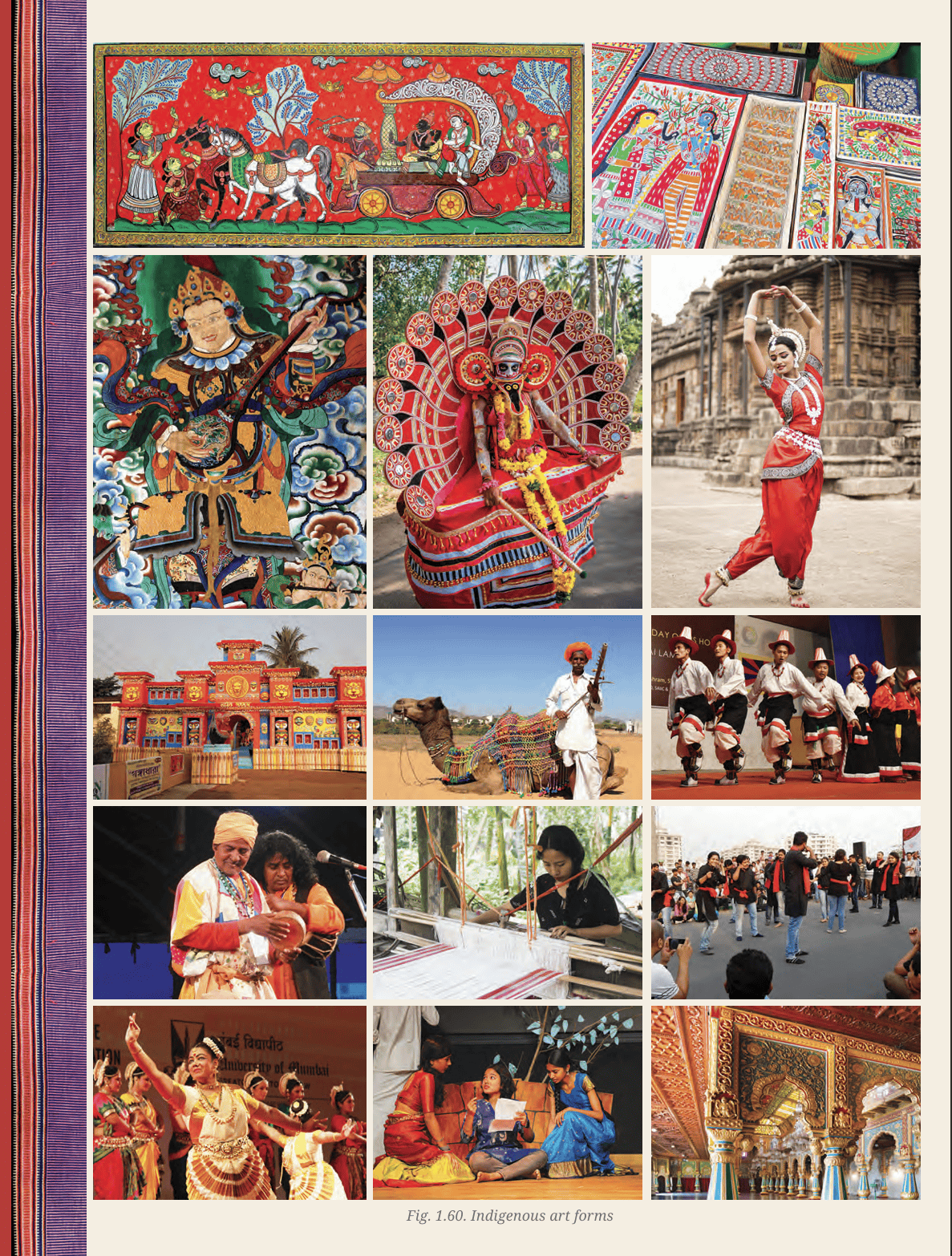
India that is Bharat has a heritage of about 5,000 years that can be seen, heard, and experienced through a rich range of artefacts, monuments, artworks, manuscripts, musical instruments, clothing, jewellery, masks, props, and diverse performance traditions. Ancient Indian scriptures speak of 64 kalās—arts and skills meant to ensure the holistic development of an individual’s character and personality. These not only included painting, music, crafts, drama, dance, and literature, but also sciences such as herbal medicine, carpentry, metallurgy, cuisine, etc. They even covered aspects of everyday life, such as decorating living spaces, grooming, conversation, and the art of waking someone with music. Thus, many activities in life were connected to aesthetic expressions.
While studying this chapter, keep the following points in mind:
- The history of performing arts is constructed from evidence such as ancient texts and inscriptions, as well as art and artefacts that...
- depict performers, musical instruments, and other objects associated with performance traditions. In addition to learning about the history of Visual Arts, many paintings, sculptures, and artefacts in this chapter also provide insights into the performing traditions.
- It is important to read the captions of every picture carefully to learn more about the subject, materials, dimensions, and time-period of the given artworks. These details will help you trace the historical development of various art forms and discover their interconnectedness.
Tangible and intangible cultural heritage
Civilisations across the world have developed their own cultural practices and traditions. The United Nations Educational, Scientific and Cultural Organization (UNESCO) defines culture as the distinct spiritual, material, intellectual, and emotional features characterising a society. According to UNESCO, all over the world today, cultural heritage is considered to be of two kinds:
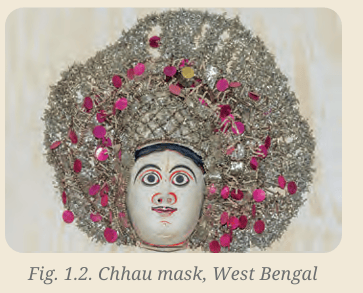
Fig. 1.2. Chhau mask, West Bengal
1. Tangible cultural heritage includes physical and material expressions of culture, which can be in the form of artefacts, monuments, artworks, manuscripts, musical instruments, clothing, jewellery, masks, props, tools, and other physical objects.
2. Intangible cultural heritage includes traditions and living expressions inherited from our ancestors and passed down to future generations. These include oral traditions, performing arts, social practices, rituals, festive events, knowledge, and practices related to nature and the universe, as well as the skills required to create traditional crafts.
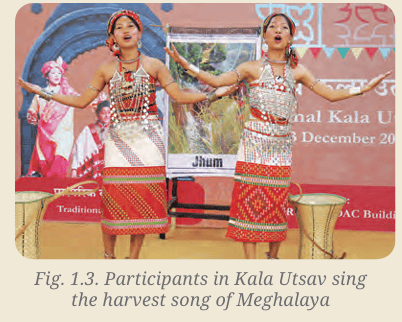
Fig. 1.3. Participants in Kala Utsav sing the harvest song of Meghalaya
INTRODUCTION TO THE HISTORY OF ARTS
Let us explore
Which artistic practices and traditions around you can be categorised as either tangible or intangible cultural heritage?
Purpose of the Arts
The Arts are a foundational part of our cultural heritage and have consistently provided new ways for people to express their ideas, thoughts, and feelings. The practice of creating and living with the Arts has enriched societies and inspired them to pass their creative knowledge from one generation to the next. In this way, the Arts link the present with the past and nurture hope and vision for the future.
Discussion circle
How do various art forms enrich our lives?
Why should we study the history of the Arts
The knowledge of history instils awareness of and pride in our rich cultural heritage. The Arts ignite our curiosity about the time, place, techniques, and environment of the people who created them. They also help us interpret and appreciate creative ideas from different perspectives. Most importantly, they inspire us to carry forward the traditions of creative expression in the present.
Why timeline matters
This chapter holds special importance because it brings together four major art forms— Theatre, Music, Dance, and Visual Arts—in an integrated timeline, allowing you to see how creativity and culture have evolved as one interconnected story. Instead of learning each discipline in isolation, it lets you discover how different art traditions influenced one another, how ideas travelled across regions, and how global events shaped artistic expressions everywhere. When you study Indian and global artistic developments across art forms through the ages, you will be able to understand the uniqueness of your culture and what it shares with other cultures too. You will also discover that the timeline has many overlaps of the periods mentioned in the table.
Glimpses of the Arts of India and the world: A timeline
| India | World |
|---|---|
| 50,000 BCE – 4000 BCE | |
| Paintings in rock shelters of Bhimbetka, Madhya Pradesh; Lakhudiyar, Uttarakhand as well as other locations across India | Surviving artefacts include cave paintings in Indonesia, France, and Spain, as well as bone-flute fragments and small figurines |
| 4000 BCE – 500 BCE | |
| Artefacts from the Sindhu-Sarasvatī civilisation include painted pottery, jewellery, seals, bronze figurines, and a few stone sculptures. Evidence of architecture suggests the existence of well-planned towns. | Artefacts from civilisations in Mesopotamia, Egypt, and China such as pottery, jewellery, seals, sculptures in bronze and stone, musical instruments, and manuscripts |
| 500 BCE – 600 CE | |
| Pillars like the lion capital of Sarnath were erected, and several stūpas, chaityas, and vihāras were constructed across the country. Sarnath, Mathura, and Gandhara became important centres of sculpture. Mural traditions developed at Ajanta and Sittannavasal. The Nātyaśāstra, Chitra-sūtra of the Viṣṇu-dharmottara Purāṇa and Silappadigāram were written. | Art and culture continue to grow in Egypt, China, and other parts of the world like Greece and Rome. Major developments took place in painting, sculpture, architecture, theatre, music, and dance. |
| 600 CE – 1200 CE | |
| Both rock-cut and structural temples were built and decorated with detailed carvings and sculptures. Chola bronzes, murals, and manuscript paintings are well-known examples from this period. Sanskrit and Tamil drama flourished alongside Bhakti poetry, which strongly influenced music and dance traditions. More texts on music, dance, and theatre were written. | Indian art and culture spread to Southeast Asia. Temple architecture, sculpture, music, and dance in these regions show strong influences of Buddhist and Hindu ideas. |
Śhruti, Smṛiti, and Timeless Traditions
Humans likely developed oral traditions much before the invention of writing. Parents and elders pass on languages, arts, and cultural experiences to their children through everyday activities—lullabies, conversations, and storytelling. All these are oral traditions that each of us has inherited. Oral traditions were also followed in the guru–śhiṣhya-paramparā (teacher–student tradition), through which the Vedas were transmitted. This method is linked to the idea of śhruti—'that which is heard'—emphasising learning through careful listening.
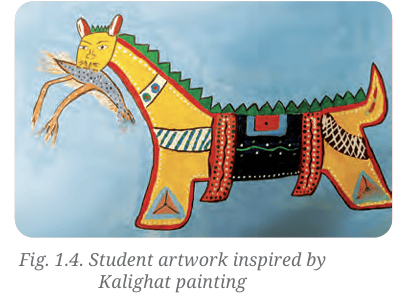
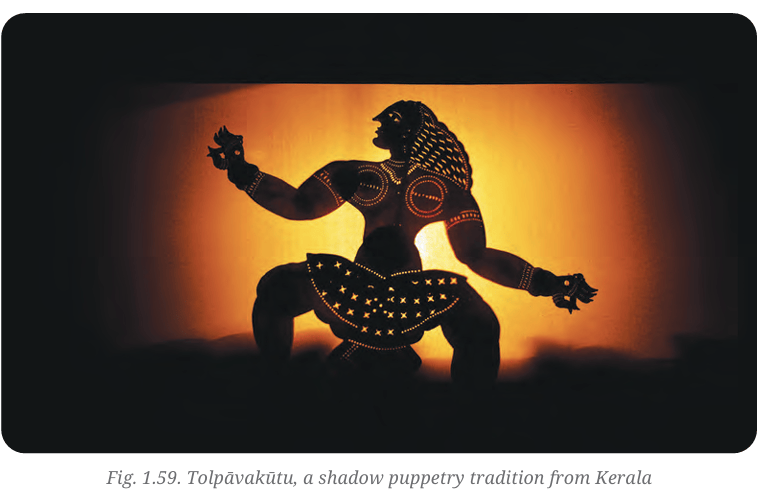
The Rāmāyaṇa, Mahābhārata, Purāṇas and Dharmaśhāstras are written texts that are associated with smṛiti as they were passed on from one generation to the next through narration that was based on memory (smṛiti). They reflect the long and continuous narrative traditions that continue to thrive in many forms, including visual and performing arts. Across India, people retell episodes from the Rāmāyaṇa, Mahābhārata, Purāṇas, Jātakas, and local legends through their own regional styles and artistic flavours. You may know some of these traditions that are practised even today, such as Rāmalīlā, Bhavāi, Kāvaḍ Kathā, Terukūtu, Bayalāṭa, Paṭachitra, and Aṅkīyā Nāṭ.
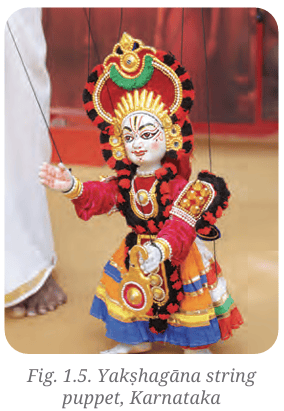
Early forms of performing arts can be traced to Vedic practices like the Yajña rituals that combined movement, dialogue, and music. The Ṛigveda mentions Uśhas, the light at dawn, arriving like a bejewelled dancer. Traditions of Indian music are traced to the Sāmaveda, in which mantras and verses were recited as ritual chants—initially in one note, then three notes (udātta, anudātta, and svarita) leading to development of seven notes (saptasvara). The Vedas also mention a variety of drums like the dundubhi (Ṛigveda 1.28.5), which were used both in times of war and peace.
In the Rāmāyaṇa, Lava and Kuśha, the sons of Rāma and Sīta, recount the life story of their parents through the arts of drama, music, dance, and poetic narration. Pāṇini’s Aṣhṭadhyāyī mentions the Kuśhīlava tradition, describing professional singers and performers as a recognised occupation. The Mahābhārata mentions the Kathaka community of performers, who kept the exiled Pāṇḍavas in high spirits and a positive mindset through stories that were brought to life through songs, dances, and narration. Early literature also refers to the sūtradhāra, the
narrator who guides a performance. The Sūta-paramparā was an ancient storytelling tradition in which sūtas, or storytellers used dialogues, voice modulation, and gestures to perform narratives from the epics.
Our epics and Purāṇas feature a variety of arts and artists. Ugraśhravā Sauti appears as the narrator of the Mahābhārata, Śhiva is worshipped as Naṭarāja, the ‘lord of dance’, and as Nṛittapriya, the ‘one who loves dance’. Rāvaṇa is described as a skilled musician who played the veena, while Kṛishṇa is known as Muralīdhara—the enchanting flute player. Celestial beings such as apsarās, gandharvas, and kinnaras are portrayed as masters of music and dance. The Mahābhārata also tells us that Arjuna, during his exile, took on the guise of Bṛihannalā and served as a dance teacher to Princess Uttarā in the kingdom of Virāṭa.
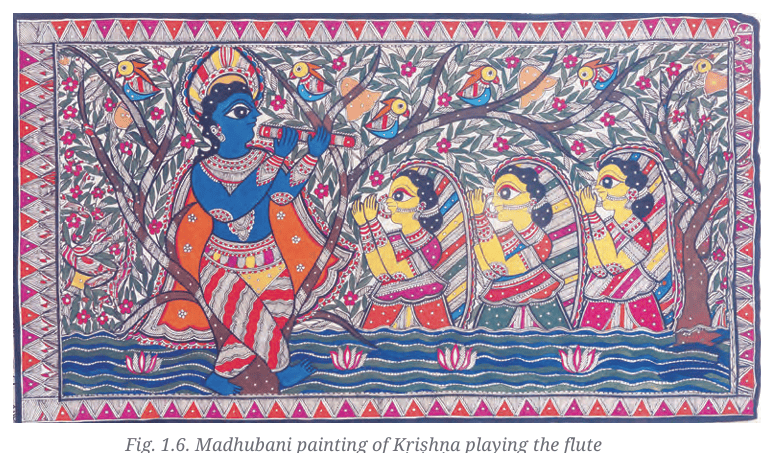
These wonderful traditions and literary sources continue to inspire the Arts till today. The history of Arts helps us appreciate people and their Arts practices. It shows us how traditions have evolved and stayed relevant with time, both in terms of themes as well as materials, tools, and forms employed.
50,000 BCE – 4000 BCE
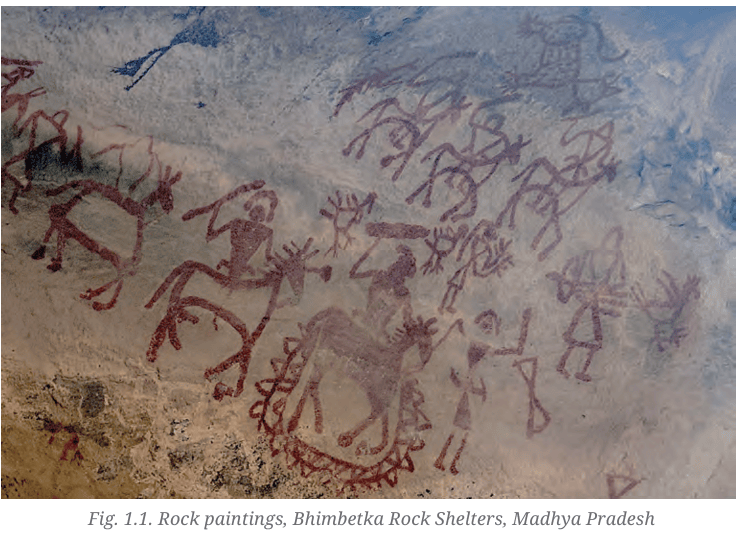
The period before the invention of writing systems is known through archaeological evidence rather than written documents. Early humans left behind remarkable cave paintings, figurines, stone tools, and other artefacts that provide valuable insights into their lives. Cave paintings from this period have been discovered in many parts of the world. In India, they are found in Bhimbetka in Madhya Pradesh, Lakhudiyar in Uttarakhand, and several other caves located in Andhra Pradesh,
Karnataka, Uttar Pradesh, Jharkhand, and Bihar.
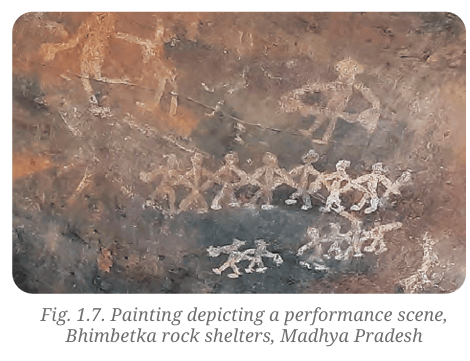
Bhimbetka is one of the oldest groups of rock shelters in India. They have cave paintings depicting animals, hunting scenes, processions, and other scenes from everyday life. The paintings were created at different periods, showing how art evolved. The cave paintings at Bhimbetka were made using earth pigments mixed with water and a binder. Red, white, yellow, and green colours are used in these paintings.
A painting depicting people dancing with interlinked arms is shown in Fig. 1.7. Next to them stands a person holding an object that looks like a musical instrument. Some more human figures and an animal are also visible.
Lakhudiyar Caves indicating 1,00,000 lakh caves situated in Barechhina near Almora, Uttarakhand also belong to the Stone Age in the prehistoric era. Sketches of animal motifs, human figures, etc., have been found.
Related developments in global art
Cave paintings have been found in other parts of the world like Altamira in Spain, Chauvet and Lascaux in France, and Sulawesi in Indonesia. Neanderthal flutes made of bone fragments have been found in different parts of the world.
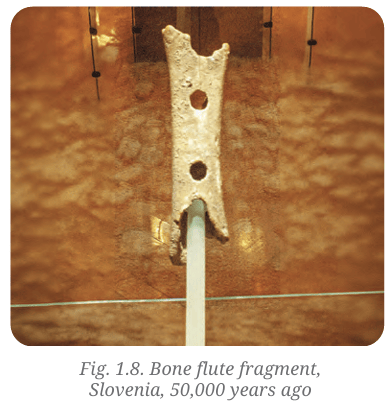
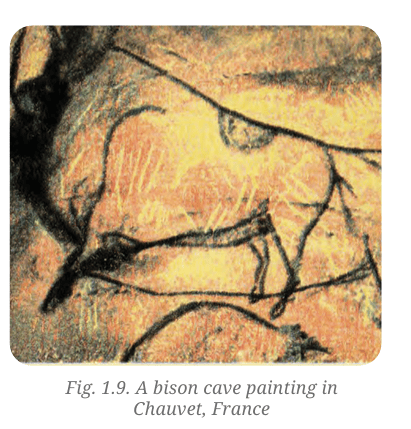
Paintings from this period across the world depict animals using lines and a minimal use of colour. Most of the animals in the cave paintings can be identified by their physical features.
Create a line drawing of an animal
- Make a line drawing of any animal from observation or memory.
- Pay attention to the proportions and details of other features.
- Is your animal identifiable?
- Analyse the artistic qualities in your drawing.
- The facilitator — a teacher, special teacher, or other learners can help children with special needs to draw or sketch.
4000 BCE – 500 BCE
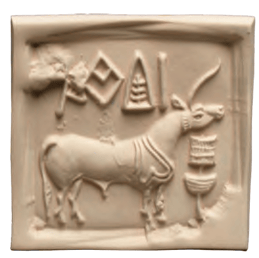
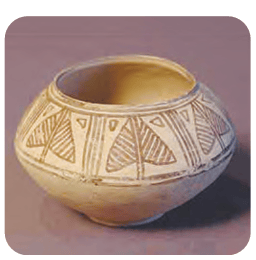
As early civilisations flourished along riverbeds across the world, people developed writing systems to record various aspects of their lives and cultures. The earliest script of the Indian subcontinent is found in pictographic inscriptions on seals from the Sindhu-Sarasvatī civilisation. Other artefacts from this time period show a high level of creativity and technical expertise in art practices.
The bronze figurine from Mohenjo-Daro (Fig. 1.12) was made using the lost-wax technique prevalent in West Bengal, Jharkhand, and Chattisgarh.
This sculpture depicts a posture with one knee bent, one hand on the waist and a slightly lifted chin.
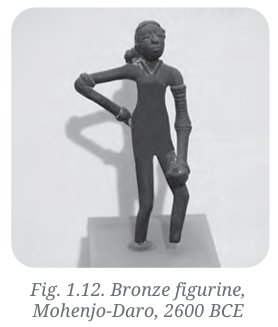
What do you think is portrayed by the pose in the figure above?
Activity 1.2
Visualise, pose, and draw
- The feet of the bronze figurine are not visible.
- Take turns to mimic the pose while imagining various positions of her feet.
- Quickly sketch the pose and various feet positions.
Related developments in global art
Artefacts from civilisations in Mesopotamia, Egypt, and China show us that the arts were an integral part of ancient cultures. They created a variety of artefacts and built fascinating monuments that can be seen even today. Many of their artefacts are housed in museums across the world. Find out more by visiting museum websites and reading books.
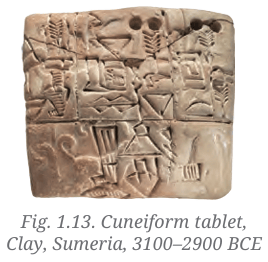
Cuneiform was one of the first systems of writing that developed in Mesopotamia and Persia. This cuneiform tablet with seal impressions is believed to be an administrative account of barley distribution.
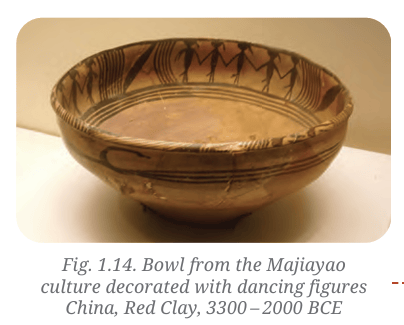
Thousands of everyday objects like this bowl have been found in archaeological sites of ancient civilisations across the world.
Discussion circle
Compare pottery from the Sindhu-Sarasvatī civilisation with pottery from other ancient civilisations and discuss your observations.
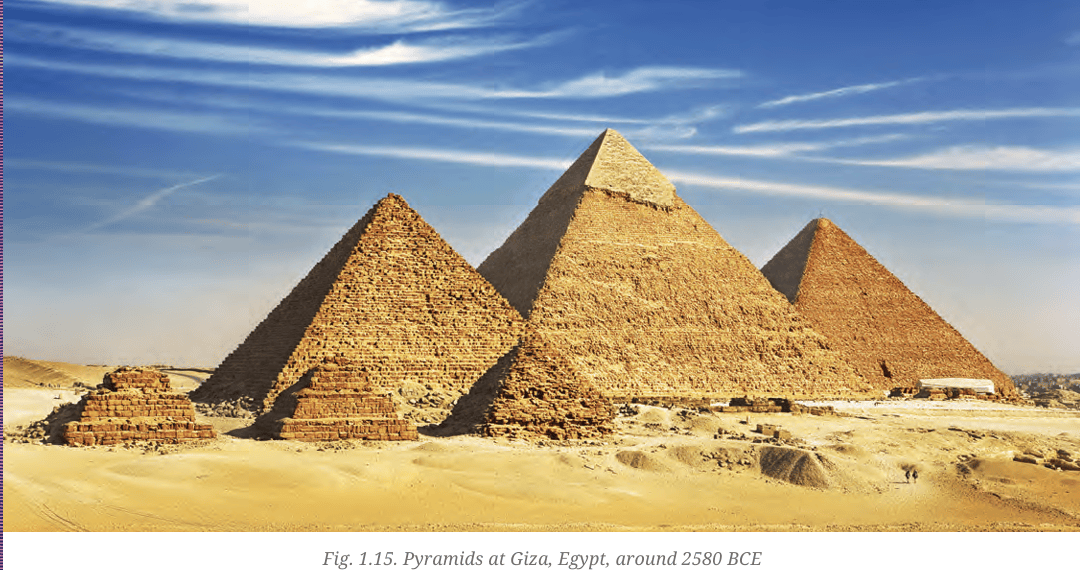
The pyramids (Fig. 1.15) are monumental stone structures that were built as tombs for the Egyptian pharaohs.
A few musical instruments from ancient Egypt and Mesopotamia have survived till today.
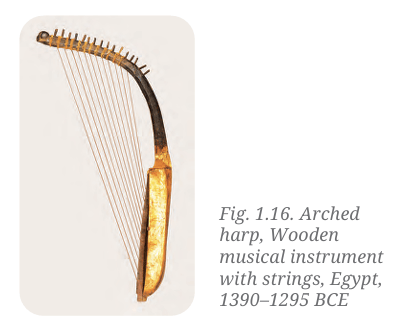
Which category of instruments do you think the harp belongs to? What role might this instrument have played in Egyptian culture?
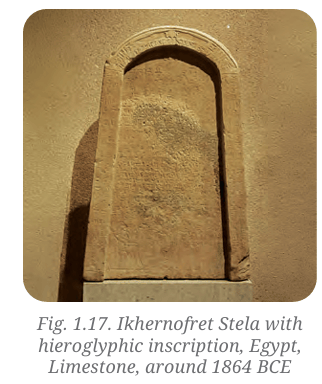
Ikhernofret was the treasurer of the Middle Kingdom in Egypt, who led ritual enactments performed annually at a place known as Abydos during a festival dedicated to the god Osiris. Fig. 1.17 shows a stone inscription that mentions specific roles, sequence of actions, symbolic costumes/props, designated spaces, and participation of the audience in ritual processions. It is considered one of the earliest examples of performance, and is known as ‘Passion Play of Abydos’.
500 BCE – 600 CE
You are probably familiar with the historical developments of this time period, which you studied in Grade 7. Let us focus on the artistic developments across various art forms through some common themes.
Important texts and treatises on the Arts
As artists from diverse regions practised various art forms, each specialised their knowledge and skills in unique ways. From around 500 BCE, texts on the arts were composed, exploring artistic ideas and techniques in depth and detail. Among them are three important treatises:
- Nāṭyaśhāstra by Bharata Muni
- Viṣhṇu-dharmottara Purāṇa, containing the Chitra-sūtra
- Silappadigāram by Iḷaṅgo Aḍigaḷ
Why is the Nāṭyaśhāstra important?
- It is one of the earliest known treatises on Indian arts.
- It contains structured information on techniques of drama, dance, music, and the visual arts.
- The most important contribution in this text is the rasa theory, which mentions eight bhāvas as the basis for the eight rasas.
Discussion circle
- Why do you think ancient scholars composed treatises that codified the arts?
- On what basis do you think they devised theories, and do you think they remained constant over time?

Note to the teacher: Keep a few videos of two different traditions of dance, music, or theatre performances ready to play in class.
Activity 1.3
Watch performances and make notes in your journal
Watch short videos of two different performances of Indian dance, music, or theatre.

As you watch the performance, note down the following—
- Postures, formations, steps, rhythms, movements, gestures, sounds, costumes, props, etc.;
- Emotions and rasas; and
- Aspects that you found special in the performances.
Cave architecture and stūpa
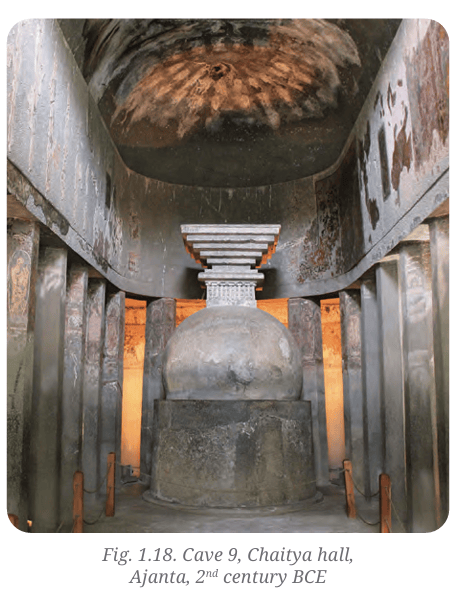
As Buddhism and Jainism rose in popularity, several stūpa (monuments that were built over the Buddha’s relics), chaityas (prayer halls) and vihāras (monasteries) were built from the third century BCE onwards. The well-known sites are located in Barabar, Bharhut, Vidisha, Vaishali, Udayagiri, Khandagiri, Sarnath, Kushinagar, Amravati, Ajanta, and Ellora.
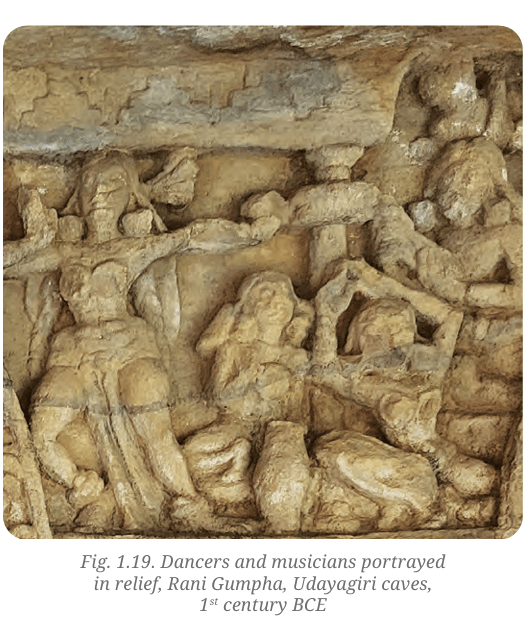
Kauṭilya’s Arthaśhāstra recognises naṭa, nartakī, gāyaka/vādaka as professional performers who contribute towards the state’s economy.
Let us recall
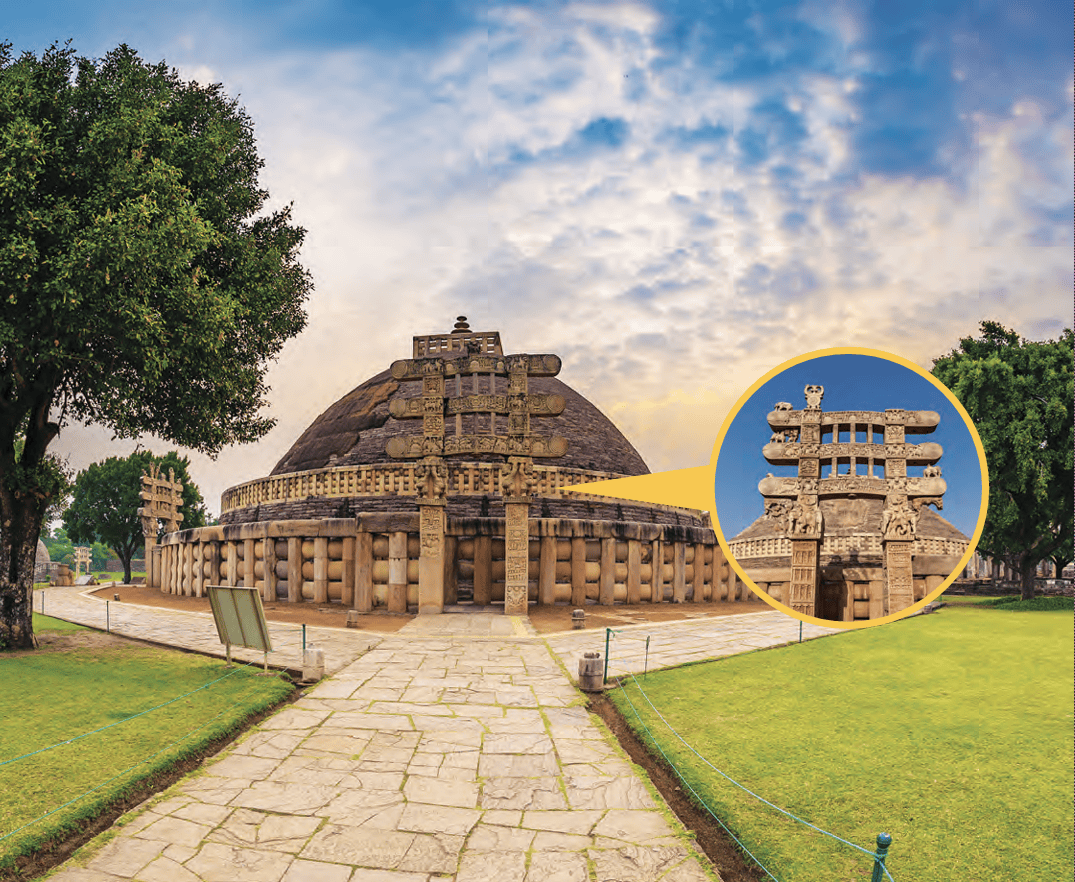
You have read about the stūpa at Sanchi in Chapter 5 of the Grade 7 Social Science textbook Exploring Society: India and Beyond.
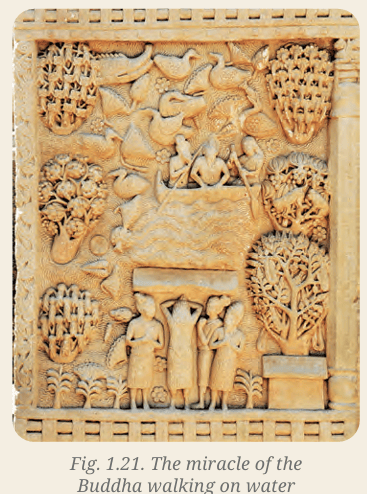
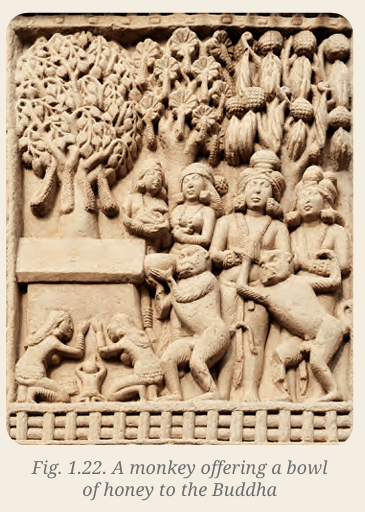
Intricately carved reliefs on the four gateways of the stūpa depict episodes from the life of the Buddha as well as various Jātakas like the Vessantara Jātaka, Mahākapi Jātaka, Syāma Jātaka. Reading these stories will help you understand the reliefs better.
Find the Buddha in the relief panels
During the early phase of Buddhism, the Buddha was not represented in human form but through symbols like the platform under a Bodhi tree, stūpa, elephant, lotus, and many more. Find the symbols in these reliefs.
Imagine the music
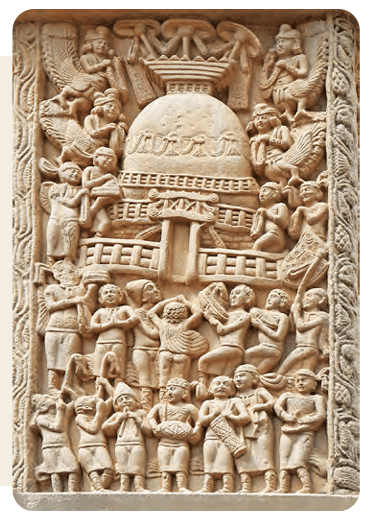
This relief panel depicts musicians playing a variety of instruments.
- What do you think is the occasion?
- Identify the instruments or their categories.
- What kind of music might they have played?
Important centres for sculpture
Let us recall
In Chapter 15 of the Grade 7 Art Education textbook, Kriti, you learnt how objects can have symbolic meanings. Symbols are objects or images that have a deeper meaning than what they visually represent. For example, the wheel represents the Chakra of Dharma.
Sarnath, Mathura, and Gandhara developed as important centres for Buddhist, Hindu, and Jain sculptures, with distinct traditions and styles.
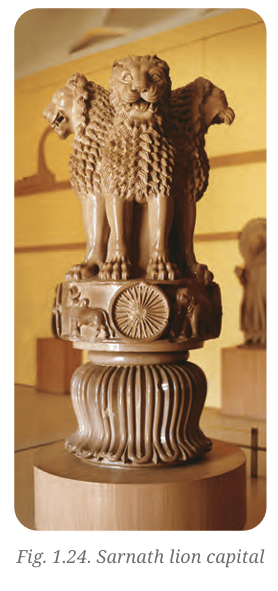
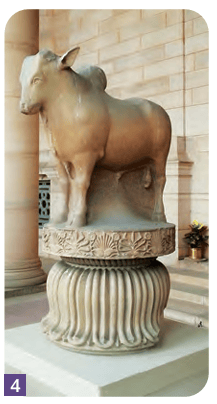
Sarnath was an important centre for Buddhism and art production. The early phase of Buddhism used many symbols to represent its ideas and beliefs. This can be seen in the lion capital, which is our national emblem. It was originally a part of the Stupa complex at Sarnath. One of the most striking features of the lion capital is its lustre, which was achieved using a technique now known as mirror polish. It is achieved by finely grinding the surface of the stone till it becomes smooth and reflective.
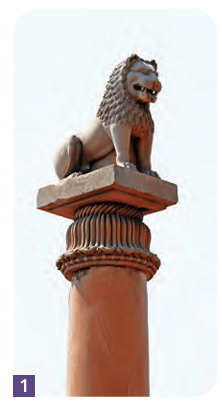
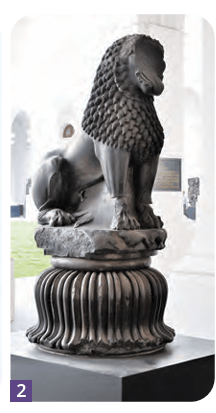
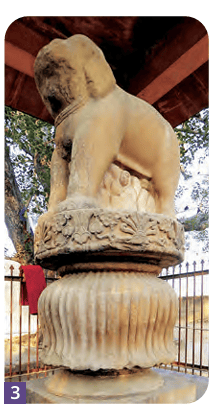
The Mauryan emperor Aśhoka erected many pillars inscribed with his edicts that reiterated the Buddhist way of life and the path of Dhamma. Most of these pillars feature animals that have symbolic meanings. You will read more about symbolism in the section titled Theatre.
Discussion circle
Observe the captions in the pictures and discuss these points:
- What are the various animals you see, and what are their symbolic meanings?
- What qualities of these animals do you associate with staying on the path of Dhamma?
- What other details do you appreciate in the capitals?
 1
1
 2
2
 3
3
 4
4
Discuss artworks of the Kushāṇa empire that you studied about in Chapter 6 of your Grade 7 Social Science textbook Exploring Society: India and Beyond.
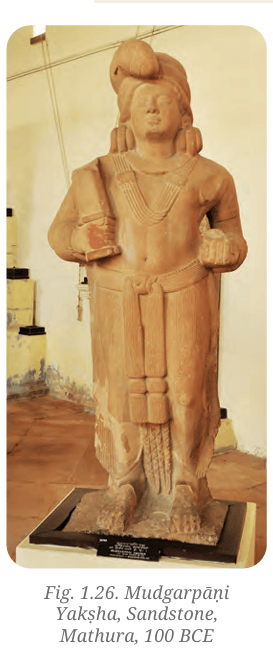
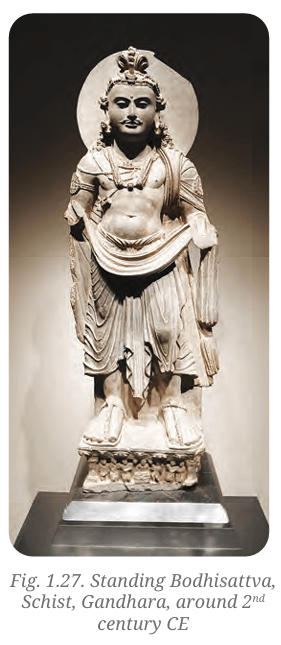
Along with Sarnath, Gandhara and Mathura in north India also emerged as important centres of art production. This period marks a shift in the representation of the Buddha from symbolic forms to a human form. The images of the Buddha in the Mathura tradition were modelled on the lines of earlier Yakṣha sculptures. The sculptural tradition at Mathura influenced traditions across northern India. Refer to the table for the distinguishing features of sculptures from these three places.
Representation of Buddha in different places
| Place/Region | Material | Style/Characteristics |
|---|---|---|
| Sarnath | Chunar sandstone | Idealised body proportions, clinging drapery, serene and spiritual expressions |
| Mathura | Red spotted sandstone | Body is rounded with expressive eyes and faces |
| Gandhara | Grey schist | Realistic anatomy, resemblance to Greek/Roman sculptures (wavy hair, facial features, flowing robes, postures) |
| Sarnath | Chunar sandstone | Idealised body proportions, clinging drapery, serene and spiritual expressions |
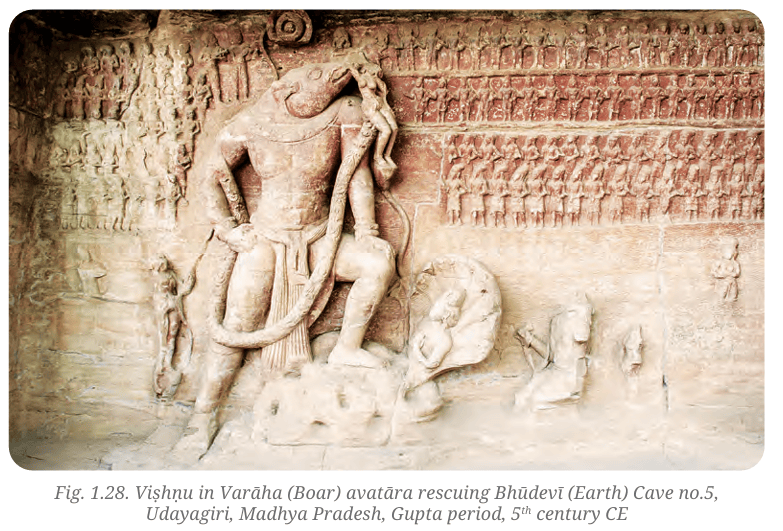
So far you have learnt to read symbolic meanings through various depictions in Buddhist sculptures. Similarly, Hindu deities are usually identified by specific images and symbols. For example, Śhiva is easily identified by the trishula and the damaru, and Sarasvatī is identified by the veena and a swan. The use of symbolic images to identify characters or themes is termed iconography.
Similarly, Viṣhṇu and other deities have their own iconography. The sculpture given below is one of the Daśhāvatāras of Viṣhṇu. Compare it to the sculptures you have been introduced to in this chapter, and discuss how it is different.
Observe and respond to the artwork
- Discuss the story of the Varāha-avatāra in Fig. 1.28, and identify the main characters depicted in the sculpture.
- How is strength and power depicted in this artwork?
- Which among the navarasa would you relate with this artwork?
- Does the image of Varāha resemble any dance pose?
- Mimic the postures of Viṣṇu in Varāha-avatāra, Śheṣhanāga (king of all snakes) at his foot, and Bhūdevī being rescued.
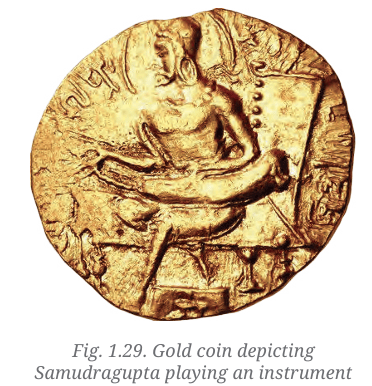
The Gupta period is known for a wide range of coins, particularly gold coins. The coin in Fig. 1.29 shows Samudragupta playing a seven-stringed bow-shaped veena called Parivādinī. A similar instrument is referred to as Yāzh in Saṅgam literature.
Painting
Examples of early painting traditions are found in Ajanta caves in Maharashtra and Sittannavasal caves in Tamil Nadu. Paintings that are made directly on the wall surface are also known as murals.
In the murals at Ajanta, earth pigments and natural colours were used after priming the surface with a plaster base. The use of blue pigment, obtained from lapis lazuli, indicates contact with Persian or Central Asian visitors. Artists skillfully portrayed spatial depth and three-dimensionality by using perspective and shading techniques. You will be learning more about these techniques in the Visual Arts section.
Figure 1.30 depicts a scene from the Mahājanaka Jātaka showing a dancer with musicians playing flute, cymbals, and drums. The portrayal of people in graceful postures, with clearly delineated outlines and shaded tones and a variety of facial expressions can be connected with conventions of painting mentioned in the Chitra-sūtra of the Viṣṇu-dharmottara Purāṇa.
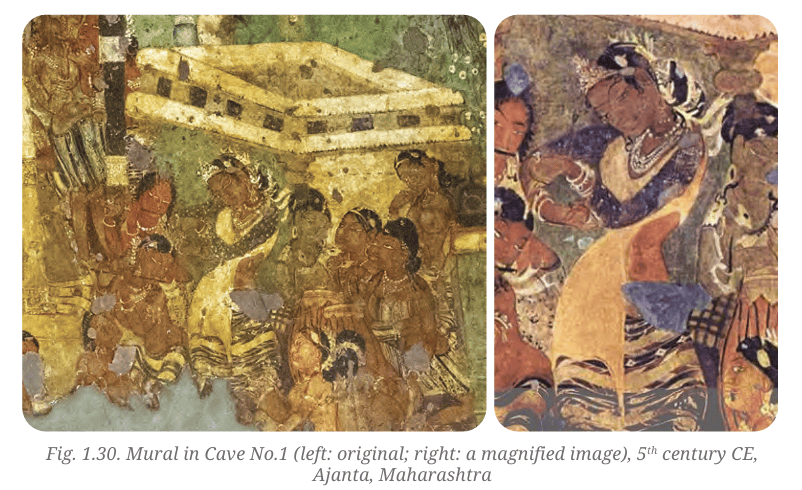
Fig. 1.30. Mural in Cave No.1 (left: original; right: a magnified image), 5th century CE, Ajanta, Maharashtra
Discussion circle
- What ensures the longevity of an artwork?
- The murals at Ajanta have survived more than 1,500 years for us to see them today. How long do you think murals made today can last?
- Reflect on the factors that damage artwork. What can ensure their longevity?
Influence of Sanskrit literature on the Arts
Music, dance, and drama were deeply influenced by literature of the time. The Pañchatantra that you have grown up learning from was also written during this period by Viṣhṇu Śharmā. Sanskrit playwrights gained widespread recognition and their works continue to influence themes across art forms till today. Sanskrit texts and plays featured characters who were portrayed as excellent performers well-versed in the arts. Here are a few examples:
- Āmrapālī in the Buddhist text Therīgāthā
- Mālavikā in Mālavikāgnimitram, a play by Kālidāsa
- Urvaśhī in Vikramorvaśhīyam, a play by Kālidāsa
- Vasantasenā in Mṛichchhakaṭikam, a play by Śhūdraka
Aśhvaghoṣha is considered to be the first Sanskrit dramatist, who lived between the first and second century CE. His work Buddhacharitara describes the life of the Buddha in the form of a mahākāvya (epic poem).
Rhythmic recitation challenge
Bhāravi’s Kirātārjunīyam is a mahākāvya that exudes vīra rasa. The following verse from this epic poem has only one consonant. Read it aloud multiple times till you are fluent and can feel its rhythm. The verse talks about the ideal qualities and ethics of bravery—realising one’s own strength and refraining from persecuting those who are weaker.
न नोननुन्नो नुन्नोनो नाना नानानना ननु ।
Na nonanunno nunnono nānā nānānanā nanu |
नुन्नोऽनुन्नो ननुन्नेनो नानेना नुन्ननुन्ननुत् ॥
Nunno’nunno na nunneno nānenā nunnanunnanut ||
— Kirātārjunīyam, 15.14
Related developments in global art
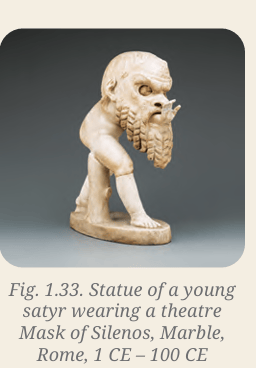
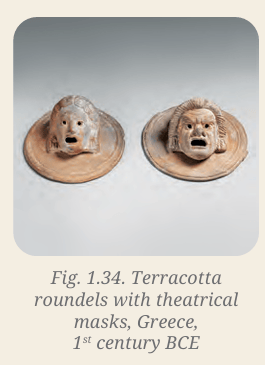
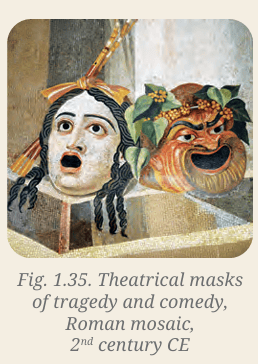
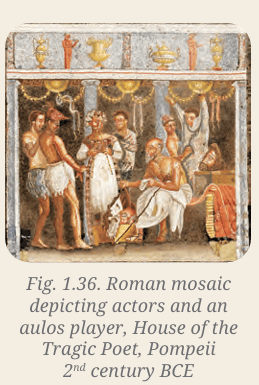
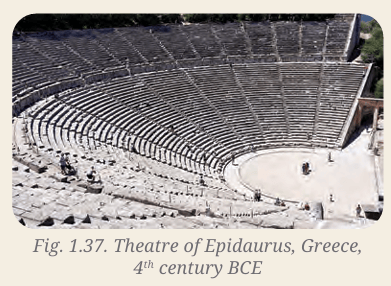
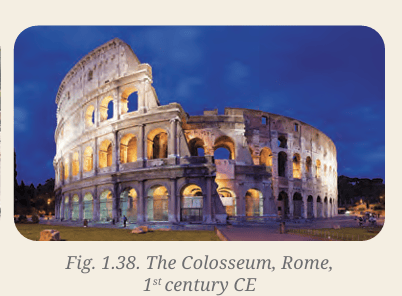
Ancient Greek and Roman cultures made huge contributions to the arts, exploring everything from visual artwork to live performances. Their creativity shaped the foundations of theatre, architecture, and entertainment that still influence us today.
Note to the teacher: Use online museum resources and books to show students more examples of Greek and Roman art. Help them connect historic events involving the Greeks, which they learnt in Chapter 7 of the Grade 7 Social Science textbook Exploring Society: India and Beyond
Important details about Greek and Roman art are stated below.
- Greek theatre traces back to Dionysian festivals, where masks were used to show the themes of comedy and tragedy.
- Many theatre words we use today originate from Greek words like theatron (theatre) and skene (screen).
- Roman art is characterised by portraiture and a life-like quality in sculptures.
- Roman architecture such as the Colosseum and other amphitheatres hosted huge events like the Circus Maximus and gladiator games.
The following selection of artworks from ancient Greece and Rome reflects a deep engagement that these cultures had with the performing arts.
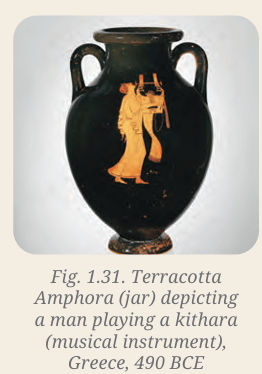
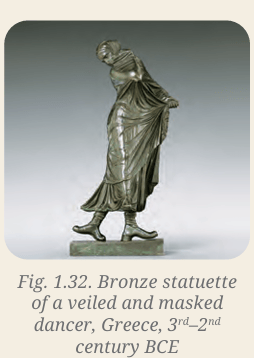
600 CE – 1200 CE
Among the artistic developments from this period, you will learn about the influence of Bhakti traditions, important treatises on the arts, as well as examples of temple architecture, sculpture, and painting from different parts of India.
Influence of Bhakti traditions and other treatises
Bhakti or devotion has always been a part of India’s culture. Around the seventh century CE, the Tamil poetry of Āḷvārs and Nāyanmārs/Nāyanārs propagated Bhakti as a path of devotion and spirituality that was accessible to all people regardless of social status. Over the next 1000 years, Bhakti poetry gained popularity and spread as a social movement across the country. It continues to be an important source for music, dance, and other performing arts in present times.
Under the Bhakti paramparā, dancers were closely connected to temples, with some of them having an exclusive space for performances. Dance became a part of temple rituals and gave rise to the tradition of temple dancers. Chola period records indicate that dancers were categorised as temple dancers, ritual dancers, court dancers and dancers for the general audience.
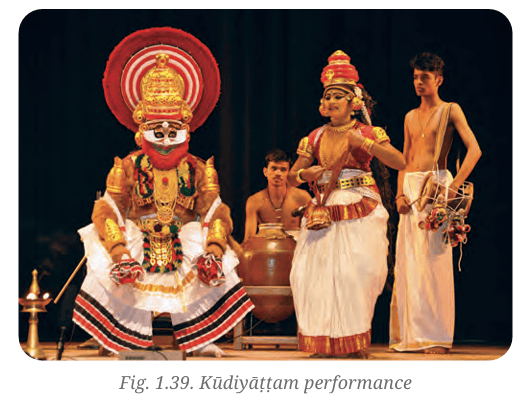
The ninth century CE Chera ruler Kulaśhekhara Varman, also known as Kulaśhekhara Āḷvār, is credited with reconstructing Kūḍiyāṭṭam, a performing art tradition that combined Sanskrit theatre and dance (kūtu). This art form continues to be practised in Kerala till today.
Important treatises
From the seventh century CE onwards, many texts were written, which became popular among artists and became the basis for major evolution that took place in the later periods.
- Saṅgīta-makaranda by Nārada (seventh–eighth century CE)
- Bṛihaddeśhī by Mataṅga Muni (eighth–ninth century CE) are two important treatises on music.
The Saṅgīta-makaranda is an ancient work on Indian Classical Music. It is a rare collection of definitions, descriptions, and comments on all the essential musical theories prevalent at the time. There were references of other ancient reputed authors like Bharata Muni, Matanga Muni, etc. The main features are the treatment of rāga and their classification. Nārada Muni structured popular music belonging to different communities living in varied geographical locations as rāgas. These scales in classical music, or groups of notes, became popular because they were named after the region, such as Gurjar, Khamboj, Malava, etc.
The Bṛihaddeśhī highlights the distinction between mārga (classical, pan-Indian tradition) and deśhī (regional, folk-influenced music). It also associates specific colours with each of the seven notes/svaras.
- S- Colour of a lotus petal
- R- Colour of a parrot
- G- Golden colour
- M- White like a jasmine bloom
- P- Black (Kṛiṣhṇa)
- D- Yellow
- N- Multi-coloured
Activity 1.8
Visualise music
What do you visualise when you listen to a piece of music? Listen to a recording of instrumental music and create an artwork based on what you visualise. Some actions can be done by the students to help peers which will showcase the emotion in music.
Abhinavabhāratī by Abhinavagupta (950–1020 CE) was a commentary on the Nāṭyaśhāstra, which continued the study of rasa theory.
Nāṭakalakṣhaṇaratnakośha by Sāgaranandi (ninth century CE) explains the characteristics and the implementation of the rules of Sanskrit drama, like dramatic structure and character types.
Daśharūpaka by Dhanañjaya (tenth century CE) classified the types of drama scripts into 10 categories based on structure, theme, and characters.
Abhinaya-darpaṇam by Nandikeśhvara (eleventh century CE) is the first text solely dedicated to both dance and drama techniques. As it is an important manual on expressive techniques (abhinaya), codifying hand gestures and body positions, it continues to be followed by dance professionals even today.
Mindful movement
Do you think dance can be a mindful practice?
Try a few dance movements according to Śhloka no. 36 of Abhinaya-darpaṇam given below, and note down your reflections.
यतो हस्तस्ततो दृष्टियतो दृष्टस्ततो मनः ।
यतो मनस्ततो भावो यतो भावस्ततो रसः ॥
Yato hastas tato dṛiṣhṭir yato dṛiṣhṭish tato manaḥ |
Yato manas tato bhāvo yato bhāvas tato rasaḥ ||
Meaning: Wherever the hand moves, the eyes follow; Wherever the eyes go, the mind follows; Where the mind is directed, there bhāva is created; Where there is bhāva, rasa unfolds.
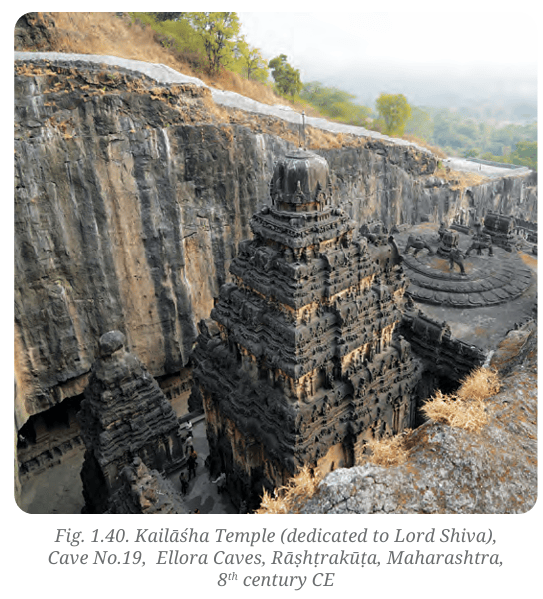
Rock-cut architecture and sculpture
The Kailāśha Temple, Ellora Caves in Maharashtra, a UNESCO World Heritage Site, is the largest monolithic free-standing architectural structure in the world. It is carved from monolithic (single) basalt rock, starting from the top and progressing downwards.
Historians have estimated that the temple took 18 years to build, and around 4,00,000 tonnes of rock were cut out during its construction, without a single piece of rock attached separately.
Let us explore
The Kailāśha Temple’s construction can be compared to an excavation process, where the builders carefully removed rock bit by bit from the top. They had to visualise the entire temple inside the monolith before starting the construction, and could not afford to make mistakes while cutting out rock.
What kind of planning would they have done?
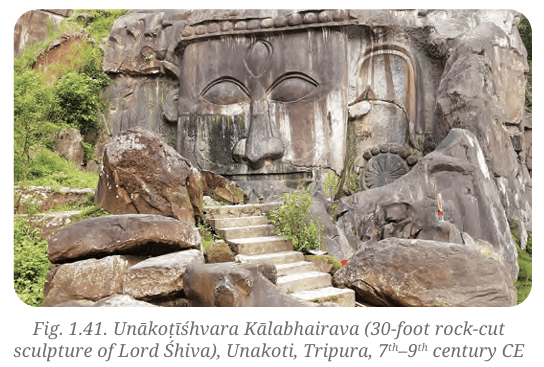
This is one among many monumental rock-cut relief sculptures spread across a forest area. ‘Unakoṭi’ means one less than one crore, which is believed to be the number of carvings found in this region.
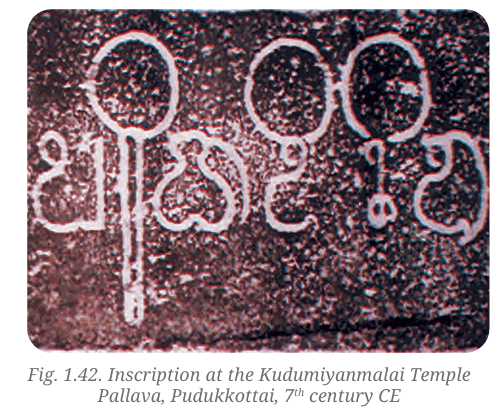
The Kudumiyanmalai inscription is a significant musical inscription on a cave temple’s rock face that provides insight into ancient Indian music and classical rāgas. It contains musical notes and treatise details in Sanskrit and Tamil.
Let us explore
Palm leaves were commonly used for written texts and documents. Why do you think these musical notations and detailed treatise were inscribed on rock?
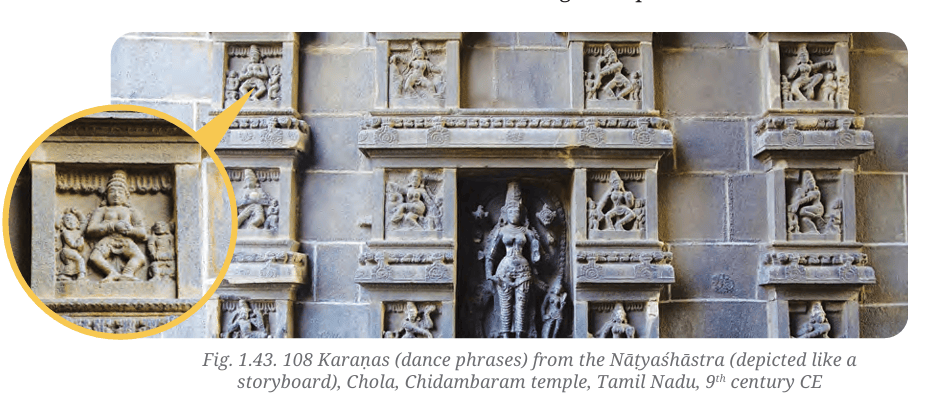
Performing traditions in temple sculptures
A wide variety of subjects and themes are seen in temple sculptures across India. We can see entire story panels that depict scenes from the Purāṇas and other epics, to the elaborate carvings of people engaged in various art forms. Look at the following examples.
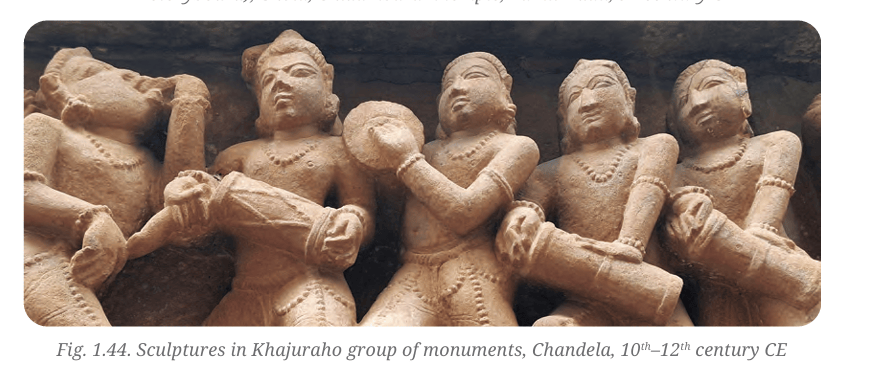
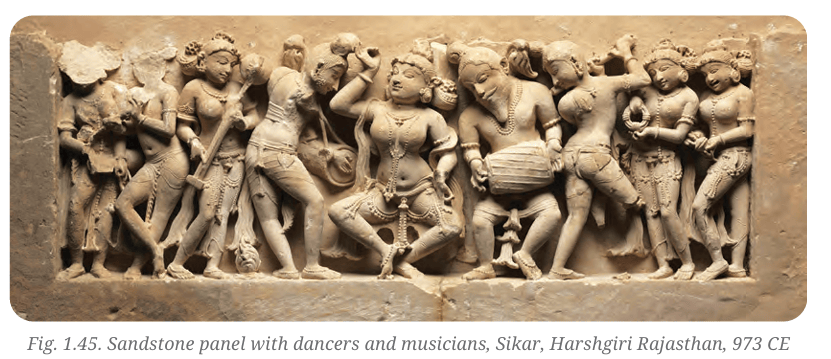
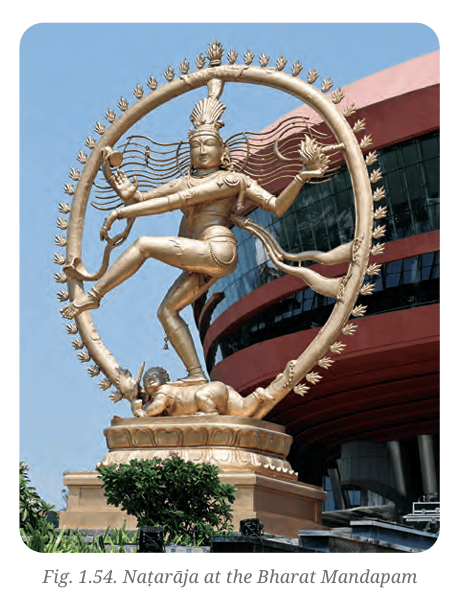
The Cholas mastered the technique of bronze sculpture. While the Naṭarāja, or Śhiva as the Lord of Dance, had previously been represented in stone sculptures, the Chola bronze version set within a ring of fire became iconic for symbolising cosmic rhythm and movement.
Iconography of the Naṭarāja:
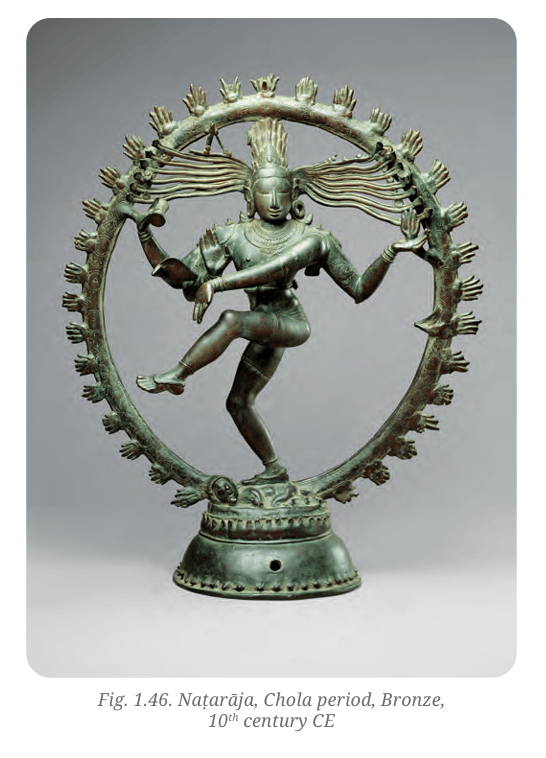
- Ring of fire: The cyclical nature of the universe
- Five cosmic activities: Creation, preservation, destruction, illusion, and salvation
- Four hands:
- Back left: Fire, denoting destruction in the cycle of nature
- Front left: Gajahasta-mudrā (elephant trunk hand) signifying refuge and emancipation for the soul
- Back right with ḍamaru: birth of sound and source of the alphabet of language
- Front right: Abhaya hasta for protection. You have already learnt some hasta-mudrās in previous grades
- Flying hair: River Ganga and a snake within it
- Left foot: Detachment leading to upliftment of the soul for the attainment of mokṣha
- Right foot: Apasmāra Puruṣha (dwarf), crushing ignorance
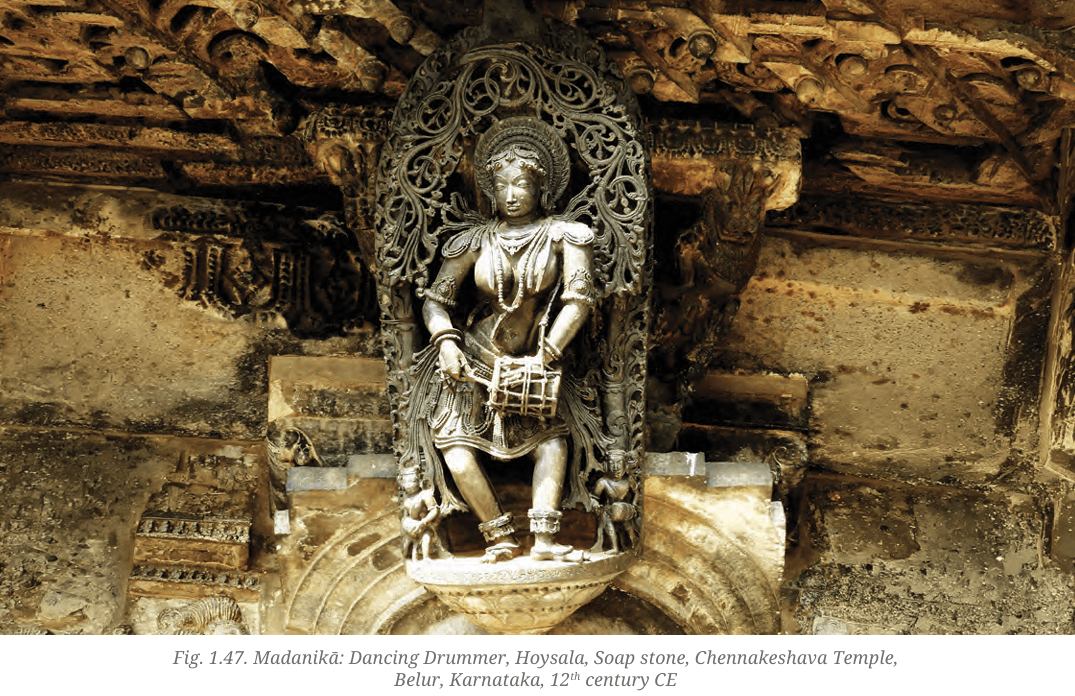
Under the Hoysala rulers, sculptures are characterised by short, rounded human forms with decorative and intricate carvings.
Manuscript painting
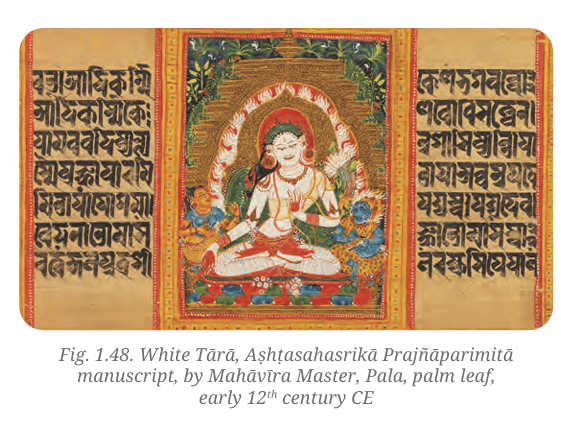
The Gilgit manuscript from Kashmir is the earliest surviving manuscript written on birch bark, dating back from the fifth to sixth century CE. It is a sacred Buddhist text that is written in the Śhāradā script.
Let us explore
- Which aspects of the White Tārā in Fig. 1.48 remind you of the Chola bronze Naṭarāja?
- What do you think white symbolises in this image?
Related developments in global art
Indian art and culture began travelling to Southeast Asia as early as the first century BCE, via maritime trade routes, military incursions of Cholas, as well as travelling Buddhist and Hindu monks. The Rāmāyaṇa and Mahābhārata became major influences on the art, architecture, dance and theatre traditions in Southeast Asian countries like Indonesia, Thailand, Vietnam, and Cambodia.
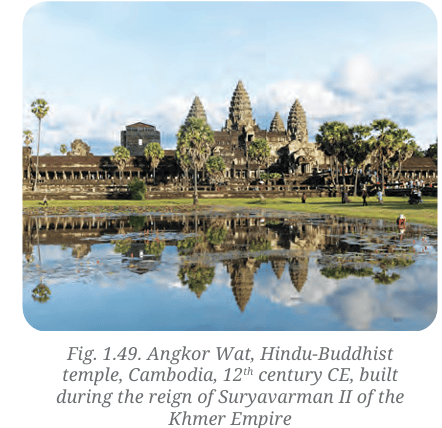
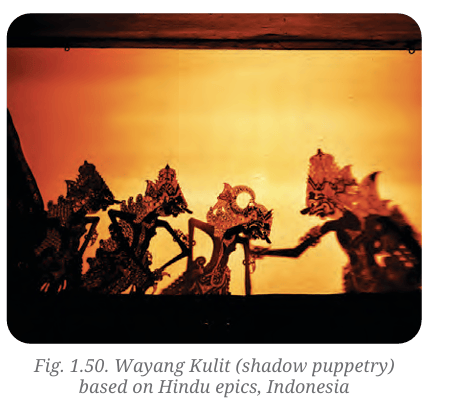
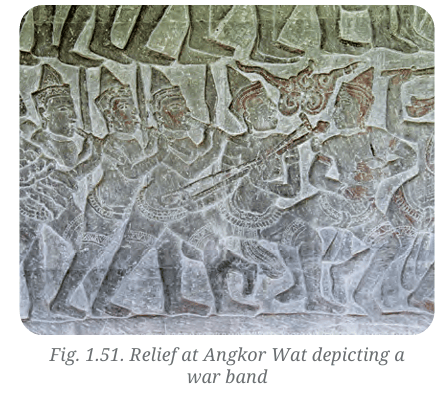
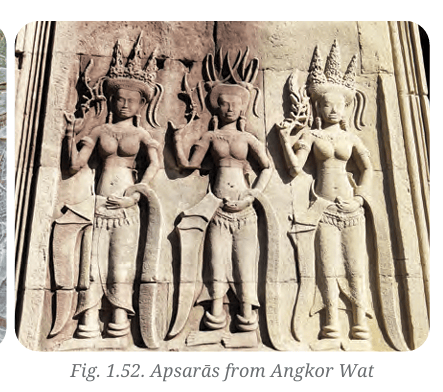
From the eleventh and twelfth centuries CE onwards, several miniature painting traditions began to develop in different parts of the country. These paintings were made on palm leaves and later on paper. You will learn more about these traditions in Chapter 4.
- Do you think materials such as birch bark and palm leaf would have posed challenges to artists?
- Why is paper a more preferred material for writing and painting than birch bark or palm leaf?
- Do you think the change in material would have also influenced the way of painting?
Temple architecture
The Sun Temple at Konark, Odisha (thirteenth century CE), built by King Narasimhadeva I of the Eastern Ganga dynasty, is a UNESCO World Heritage Site. This temple is designed in the shape of a colossal chariot for the Sun God, Surya, with twelve pairs of wheels and seven horses.
The entire temple is covered with intricate carvings of deities, animals, floral patterns, and people in various postures. One of the most famous features of this temple is its exquisitely carved wheels (Fig. 1.49). These wheels are not just decorative but also serve as sundials, which can be used to tell the time of day with great accuracy.
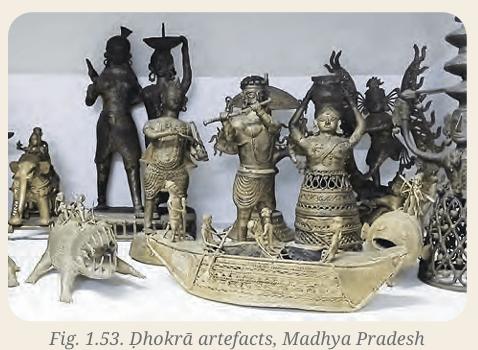
Of the sculptures you have studied in this chapter, which are made from the lost wax process?
The tallest Naṭarāja sculpture in the world now stands at the Bharat Mandapam in erstwhile Pragati Maidan, New Delhi. Take your teacher’s help to find out more about it and note down the following details:
- Artist
- Lineage/tradition
- Material
- Dimensions
- Year of installation
Activity 1.10
Find out about living traditions
You have explored metal crafts through the ages. Now, make groups in your class and choose a living tradition from the choices given below. Gather information about the art forms your group has chosen. Present it in class and discuss the traditions.
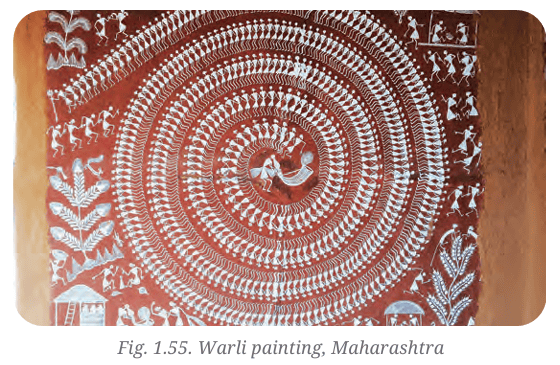
Painting traditions
- What are the painting traditions in your region/state?
- What materials and mediums do they use? How have they changed over time?
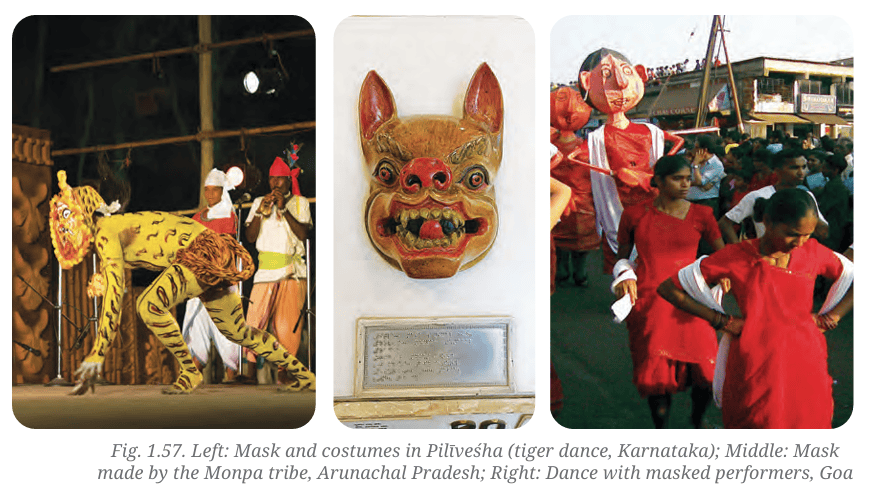
Masks
- Find out about Indian performing traditions that use masks.
- What are the masks made of?
- How are they used in performances?
Songs
- Which traditional songs are performed in your region/culture to mark important life events, such as birth of a child, wedding? Think of some harvest songs, grinding mill songs, songs of fisherfolk, travel songs, festival songs, or songs on the everyday life, etc.
- Would you categorise these songs as tangible or intangible heritage?
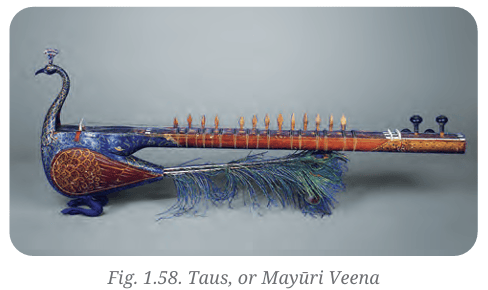
Musical instruments
- Find artworks/texts from this chapter that are connected to music.
- Which traditional musical instruments are used in your region, and what materials are they made of?
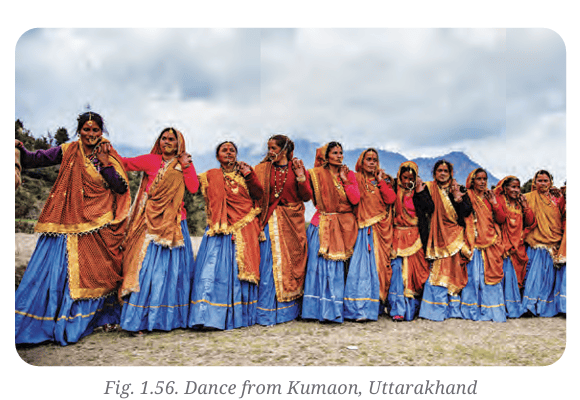
Kathā/ storytelling traditions
- Gather and share folk stories from different parts of India.
- How are stories told in your region through drama, music, dance, and visual arts?
Do you know?
Several Indian films have adapted characters and stories from Sanskrit plays you have learnt about in this chapter. The next time you watch a film, find out about the sources and inspiration behind the storyline and characters.
In this chapter, you have studied some key developments in the arts from early history till the twelfth century CE. You will continue to learn more in Grade 10.
EXERCISES
Q1. Categorise the given list into tangible and intangible cultural heritage:
- Sculptures
- Vedic chanting
- Knowledge of weaving textiles
- Pottery
- Jewellery
- Traditional wedding songs
- Kāvaḍ Kathā
- Madhubani painting
Q2. Why are ancient texts and treatises on Indian arts still relevant today?
Q3. Why do you think the murals in the Ajanta caves have survived close to 1,500 years?
Q4. Write three rules you would follow when you are at a historical monument, performance, or art gallery, in order to respect the art and ensure its protection from damage.
Q5. Choose any art form you are familiar with. What kind of developments do you see in techniques over time? Use these prompts to guide your responses to the following:
- Function or role of artworks/ performance traditions at different points of time
- Exploration of literary sources, materials, mediums, and techniques
- How are arts processes practised today informed by the past?
Q6. Write a note on any work of Indian art that you like, which was made before 1200 CE. You can also choose an artwork that hasn’t been provided in the textbook. Describe using any five prompts given below:
- Material, time period, location/region
- Subject/theme
- Iconography or symbolism (if any)
- Visual characteristics (style/expression)
- What interests you in the artwork, and how do you connect it to the present times?
-
- Which emotions or navarasa do you experience when you see the artwork, and how do you relate to it?
Projects
Q7. Individual Project
Select any one tradition of Indian art practised today. This may include music, dance, theatre, visual arts, etc. Write a note on them by describing the following:
- Art forms that they involve (Music, dance, drama, visual arts, etc.)
- Occasion/ purpose of the performance
- Subject/theme of the performance
- Literary sources (oral tradition or written texts)
- Instruments, props, and other resources that are used
- Number of artists/ performers who are involved (add names, if possible)
- Which aspects of the performance tradition have continued from one generation to the next, and what changes has it undergone?
- What interests you in the performance, and how do you relate to it?
- What emotions do you feel when you see the artwork?
Q8. Group Project
Explore a local tradition
Every part of India lives and engages with diverse traditions and rich cultural heritage. Choose a State or Union Territory in India that is not the one you live in, and that is preferably not chosen by another group in your class. Using the prompts below, find out about visual or performing arts living traditions.
- Name of the Tradition
- State/Union Territory
- Neighbourhood/Group associated with the art form/s
- Description of the art tradition—materials, instruments, costumes, techniques, etc.
- Function or role of the art traditions
- When is it performed or practised?
- Has it always been performed in the same way?
- What changes has it undergone during the last 20–25 years?
- What histories, stories, oral traditions, or texts are associated with this practice?
- Present your explorations in class.