Symbols and Metaphors on Stage
While we often think that only actors speak and communicate with the audience, it is interesting to note that everything put up on stage, including lights, props, set designs, etc., communicates many aspects. From a small prop kept on a table to the music playing in the background, or even the red scarf worn by an actor — each of these communicates something different to the audience! With this in mind, it becomes the responsibility of everyone in the team to carefully consider every element before including it in a stage performance.
Beyond words
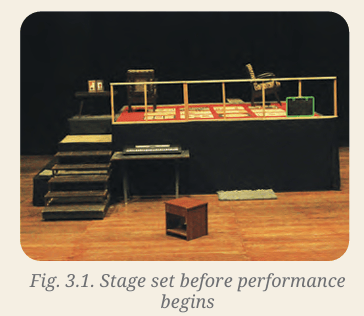
Observe Fig. 3.1. It is a picture of a stage set before the performance begins. As a member of the audience, look at what you notice and what you understand from it. Answer the questions given below based on what you observe. Remember that these questions do not have ‘one correct answer’. Each of you can give a different answer based on your perception and understanding. Let your creativity flow!
Questions
- What do you think is implied by the two levels created on stage?
- What is the first object that caught your attention? What do you think it represents?

What are the other forms of communicating to the audience? Why are they necessary?
 Symbolism and Metaphors in Theatre
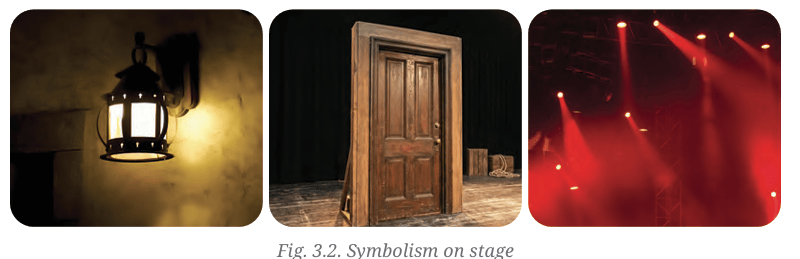
Symbolism in theatre is when an object, action, colour, sound, or movement represents something deeper than its literal meaning. For example:
- A single lamp on stage might symbolise hope.
- A closed door might symbolise fear or opportunity.
- A red light could symbolise passion or energy.
Metaphors in theatre are devices used by playwrights to draw comparisons between two seemingly dissimilar things or ideas.
For example:
- A character walking in circles might be a metaphor for confusion or being trapped.
- A torn costume might be a metaphor for a broken identity.
Metaphors help the story speak in images, not just words.
Why are they necessary
Symbolism and metaphors help theatre move beyond simple dialogue to become emotionally powerful and visually expressive. They allow:
- Deeper meaning: Instead of directly stating ideas, symbols let the audience discover meaning on their own. It makes the experience richer and more memorable.
- Emotional connection: It can express what words cannot — fear, love, loss. This connects with the audience's imagination.
- Creativity on stage: Theatre often has limited sets or props. Symbolism allows a single object or movement to represent many ideas, making storytelling more flexible and artistic, like the lamp or the closed door mentioned above.
- Cultural expression: In Indian theatre, especially in traditions like Kathakali and Yakshagana, gestures, colours, and costumes are symbolic.
- Visual impact: Symbolic images stay with viewers long after the play ends—like a candle blowing out at the final moment, or a character handing over a flower to show forgiveness.
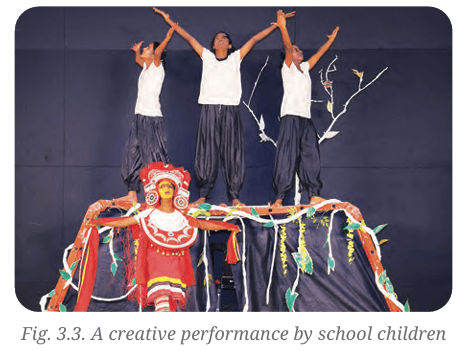
So, symbolism and metaphors turn theatre into a language of images, feelings, and ideas, making performances meaningful and unforgettable.
Let us now examine the different elements used in theatre to see how symbols and metaphors are represented in each of them.
Symbolism Using Colour
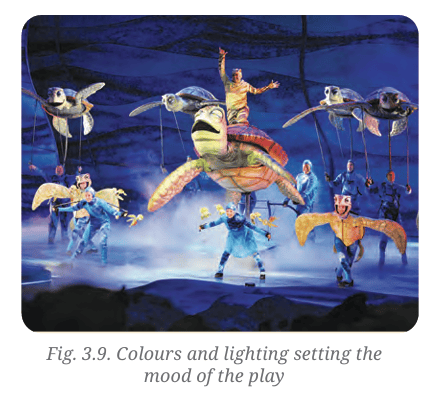
If you notice all the points we have discussed so far, one aspect common to them is colour. It is one of the most prominent things noticed by the human eye. Not only is it noticed, it also has the maximum impact on the human mind. So whether it is lights, costumes, set, or make-up, utmost attention needs to be paid to the appropriate choice of colours.
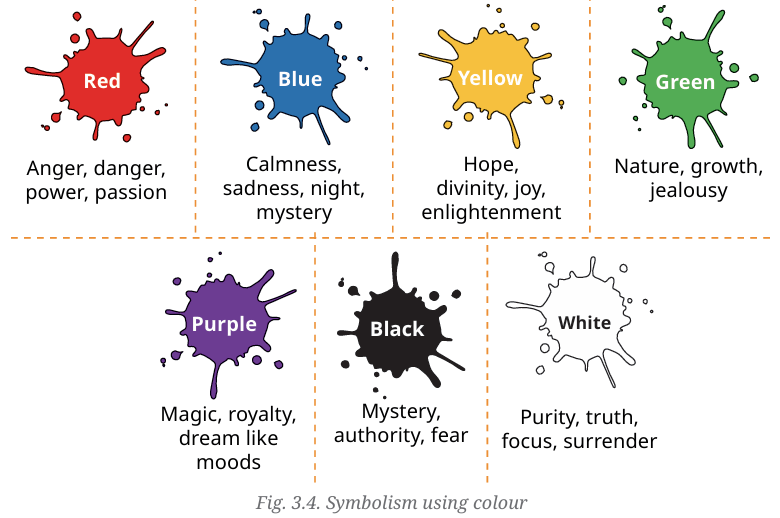
Fig. 3.4. Symbolism using colour
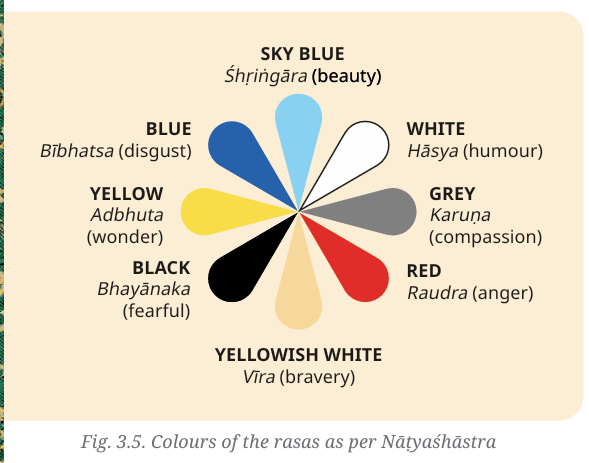
Fig. 3.5. Colours of the rasas as per Nātyaśhāstra
Though these are commonly used interpretations, there could be numerous other meanings based on:
- geographical location;
- time period;
- local culture and traditions; and
- situation and context.
The Nātyaśhāstra mentions colours associated with each of the rasas. These were meant to evoke specific emotions.
 Scene work
Here are two situations that need to be represented on stage. Read and understand the context with complete clarity. We will work on each part of the scene throughout the chapter. Any additional details not mentioned below can be added by you, based on your imagination. All the designs and ideas can be put in your journal.
| Scene 1 | Scene 2 |
|---|---|
|
Two kings are seated facing each other. They are about to sign a peace treaty after a battle. One is a regional ruler, and the other is an emperor of a powerful empire. They are accompanied by their chief advisors and army commanders. The emperor’s queen and daughter are also present. The regional ruler is not very happy with the terms of the proposed treaty. |
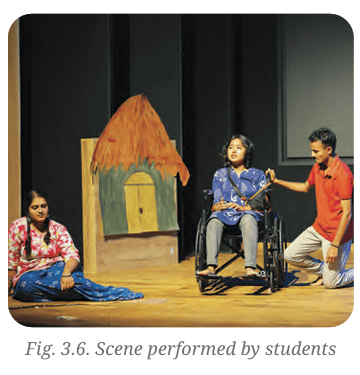
Waiting room at a hospital. Five people are waiting for their turn. Each one with a different backstory:
|
Symbolism Using Music
Music is a very powerful tool that can transform how one experiences and interprets a scene. For example, when a character enters the stage, if the sound of a snake hissing plays in the background, the audience will associate that character to be dangerous ... like a snake. However, if there is a soothing flute playing in the background when they enter, the character will be accepted as calm and endearing.
Musical symbolism doesn’t have to be restricted to just the person. The instruments used in the theme music determine the mood and the underlying meaning of the play.
Though some of these arise from the culture and practices associated with the region, there are a lot of sounds that are more universal, based on the human psychology. The Nātyaśhāstra suggests the swaras that evoke certain rasas in this stanza:
हास्यशृङ्गारयो: कार्यौ स्वरौ मध्यमपञ्चमौ । षड्जर्षभौ च कर्तव्यौ वीररौद्राद्भुतेष्वथ ॥ ९९ ॥
गान्धारश्च निषादश्च कर्तव्यौ करुणे रसे । धैवतश्चैव कर्तव्यो बीभत्से सभयानके ॥ १०० ॥
Hāsyaśhṛṅgārayoḥ kāryau svarau madhyamapañchamau |
Ṣhaḍjarishabhau cha kartavyau
vīraraudrādb
huteṣhvatha||99||
Gāndhāraśhcha niṣhādaśhcha kartavyau karuṇe rase |
Dhaivataśhchaiva kartavyo bībhatse samhayānake || 100 ||
Nātyaśhāstra, Ch. 17 (Kāvyamālā edn.)
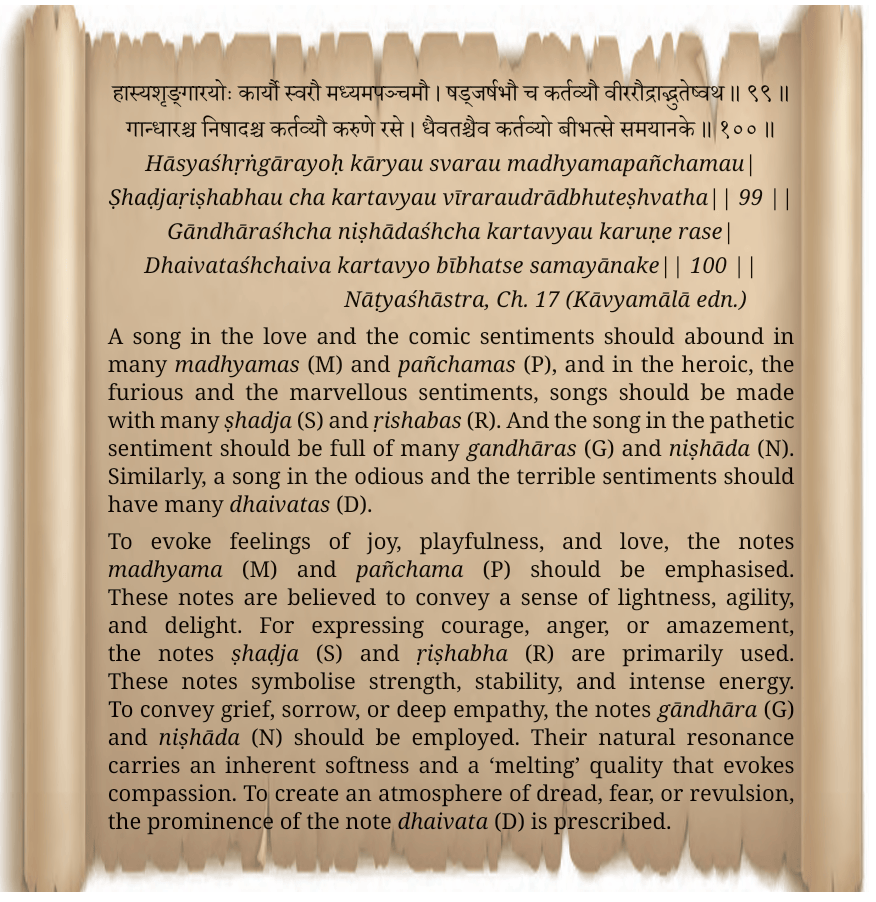
A song in the love and the comic sentiments should abound in many madhyamas (M) and pañchamas (P), and in the heroic, the furious and the marvellous sentiments, songs should be made with many ṣhaḍja (S) and ṛishabhas (R). And the song in the pathetic sentiment should be full of many gandhāras (G) and niṣhāda (N). Similarly, a song in the odious and the terrible sentiments should have many dhaivatas (D).
To evoke feelings of joy, playfulness, and love, the notes madhyama (M) and pañchama (P) should be emphasised. These notes are believed to convey a sense of lightness, agility, and delight. For expressing courage, anger, or amazement, the notes ṣhaḍja (S) and ṛishabha (R) are primarily used. These notes symbolise strength, stability, and intense energy. To convey grief, sorrow, or deep empathy, the notes gāndhāra (G) and niṣhāda (N) should be employed. Their natural resonance carries an inherent softness and a ‘melting’ quality that evokes compassion. To create an atmosphere of dread, fear, or revulsion, the prominence of the note dhaivata (D) is prescribed.
| Musical notes (Svara) | Rasa evoked |
|---|---|
| M, P | Hāsya, Śhṛingāra |
| S, R | Vīra, Raudra, Bhayānaka, Adbhuta |
| G, N | Karuṇa |
| D | Bībhatsa |
This use of svaras for evoking a rasa may not be exactly the same as mentioned in the Nātyaśhāstra. Today, it may vary in the way music is composed and the scene is perceived. Let us try our own creative way of evoking the required rasa.
Scene work
List out your preferences for both scenes, based on the questions given below:
- What is the mood of the scene?
- How would the rhythm pattern be to represent that mood?
- Fast and energetic
- Slow and pathos
- Gentle and soothing
- Any other
- Which instruments would you use, considering the time and place?
- Would you need vocals/lyrics, or is instrumental music better?
Based on your notes, you can start exploring suitable music. You can also try creating your own composition!
Symbolism Using Costumes
The type of costume can suggest everything about the world in which the story is set, the time period, country, social settings, and so on.
- Style and texture: Heavy, rich fabrics may suggest royalty; simple cotton indicates humility or innocence. Flowing costumes can show softness or dream-like qualities while sharp, structured lines suggest rigidity.
- Transformation through costume: A change in costume (or even an added layer) often symbolises a character’s internal change or a shift in the story.
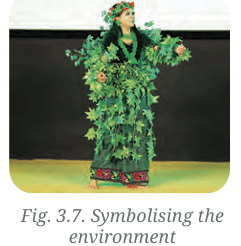
Example: A character is going in and out of his house multiple times. The first time the character is wearing loose cotton clothes, the second time a raincoat, and the third time the character is wearing woollen clothes with gloves. This symbolises a change in the weather and passage of time.
Symbolism Using Make-up
- Age and experience: While wrinkles or grey shading can show wisdom or burden, smooth, bright make-up may represent youth or innocence.
- Cultural or traditional symbols: Certain markings or motifs represent identity, heritage, or spiritual qualities.
- Abstract Make-up: Make-up can express themes like chaos, harmony, duality (for example, half of the face painted differently).
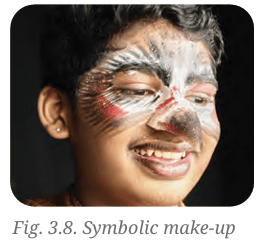
Example: A character narrating the journey of her life entering and exiting from time to time. Every time she re-enters the stage, her hair are whiter and ageing lines are deeper. Hair and the lines are symbolic of the passage of time.

Note to the teacher: Please ensure that all make-up sessions are conducted with proper safety and hygiene measures. Students should use skin-safe, non-allergenic products. Care must be taken while using brushes and other equipment near sensitive areas like the eyes.
Symbolism in Sets and Props
Props can be a very powerful tool of symbolism. They add details to the characters directly.
Sets
- Scale and space: A huge empty stage may symbolise loneliness or powerlessness. A cluttered set can show confusion, chaos, or mental overwhelm.
- Levels: Higher platforms symbolise authority, aspiration, or dominance. Lower levels show vulnerability or submission (Refer to Fig. 3.1 in the beginning of the chapter).
Props
- Symbolic objects: A broken mirror may symbolise inner conflict. A key might represent freedom, secrets, or opportunity.
- Repeated props: If an object appears multiple times, it becomes a motif carrying deeper meaning.
- Metaphorical use: Props can stand in for emotions — an empty chair representing loss, a rope representing connection or constraint.
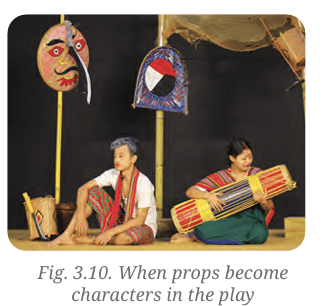
Example: A character walks into a store, barehanded and comes out wearing a luxurious looking watch. Now, the watch has become a symbol of power and status. Similarly a broom, basket, spear, colour of costumes, furniture can all symbolise different situations or moods.
- Which are the general props kept on stage to establish the place and situation?
- What are the specific props given to each character—to represent their characteristics (sword, shield, medical report folder, etc)?
- Would you place certain characters at different levels to represent their character in the scene?
- How would you creatively represent the ‘corrupt doctor’ or the ‘pain of the regional ruler’?
Symbolism Using Light
Lights not only provide visibility, but are also instrumental in telling the audience what to see, where to see, and what it means. Lights can communicate emotion, theme, mood, and hidden meaning as well. There are various factors that contribute to creating these effects.
Intensity (brightness)
How bright or dim the light is affects the mood.
- Bright light: Clarity, revelation, happiness
- Dim light: Fear, secrecy, confusion, suspense
- Sudden blackouts: Shock, transitions, dramatic endings
Direction and angles
‘Where’ the light comes from changes the symbolic meaning.
- Footlight: Fear, supernatural effects
- Backlight: Mystery, silhouette, inner struggle
- Front light: Honesty, clear emotions, openness
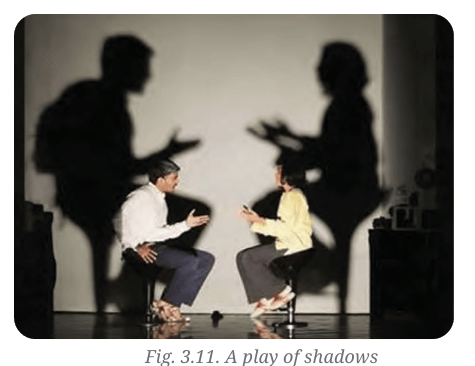
Shadows
It is one of the strongest symbols in theatre.
- Long shadows: Fear, loneliness, internal conflict
- Soft shadows: Memory, nostalgia
- No shadows: Honesty, clarity, safety
Scene work
- Based on the mood of the scene you defined under ‘symbolism using colour’ and ‘symbolism using music’, how would the light represent the mood of the scene?
- Bright and well-lit
- Colourful
- Dull with more shadows
- A combination of these
- What colours would you choose, based on the time of the day, indoor-outdoor, emotion?
- Would you use any specific effect like footlights or shadows, to represent certain characteristics?
Example: The powerful emperor could have a bigger shadow behind him to represent the unspoken supremacy over the regional ruler.
What do you think it means?
In the scene given below, think of multiple possibilities of what meaning it could convey to the audience. Write your answers in your journal, but remember, there is no right or wrong answer. The activity is based entirely on your creative interpretation.
Scene: Two characters are engaged in a dance/combat in the centre of the stage with low lights, and an ancestral photo, which is framed, is highlighted with a spotlight.
Designing abstract concepts
When you design abstract concepts for the stage, you are learning to turn ideas into living characters. You will explore how to give form to emotions and forces like stress, hope, pollution, time, or technology. Through costume, make-up, props, movement, and use of space, you can transform invisible ideas into powerful stage presence. Design costume, props, and make-up for this character:
- an AI-based robot that is concerned about the environment and intends to tell people to reduce the use of plastic;
- a book that can talk, wants to tell people about the actual problems of youth and their overdependence on gadgets.
- If a single colour could describe your mood today, which colour would it be and why?
- Imagine a doorway on stage. What could it symbolise besides entering and exiting?
- Which symbol or metaphor from this chapter are you most excited to try in your own performance?
- If you had to choose one object from your school bag to use as a symbol on stage, what would it represent?
- Is a symbol always obvious to everyone? Can two people interpret the same symbol differently? Share an example.
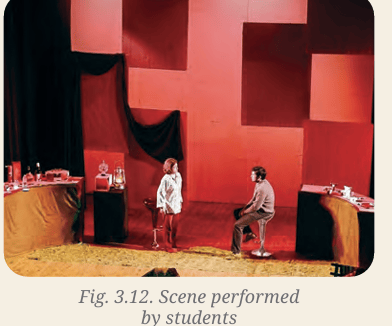
Q1. Look at this picture of a scene on the stage. List out what each thing represents and write the overall meaning of what is being conveyed on stage.
Q2. If you had to show a person growing in wisdom and intelligence over a period of 10 years, how would you show it? You are free to include costumes, lights, props, and music. No speech or dialogue can be used. Describe the visuals on stage. Doodles or drawings can also be used.
Q3. Assign one friend who you think represents each colour and explain why.
| Colour | Name of friend |
|---|---|
Q4. Why are symbolism and metaphors used on stage?