
Skip to content

5

From Vision to Performance:

Direction and Acting

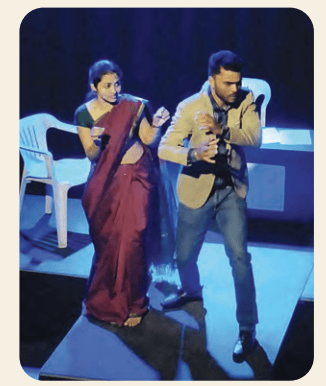
Actor in Vira Rasa pose

QR Code for Chapter 5 0914CH05

Visualise this scenario in your mind

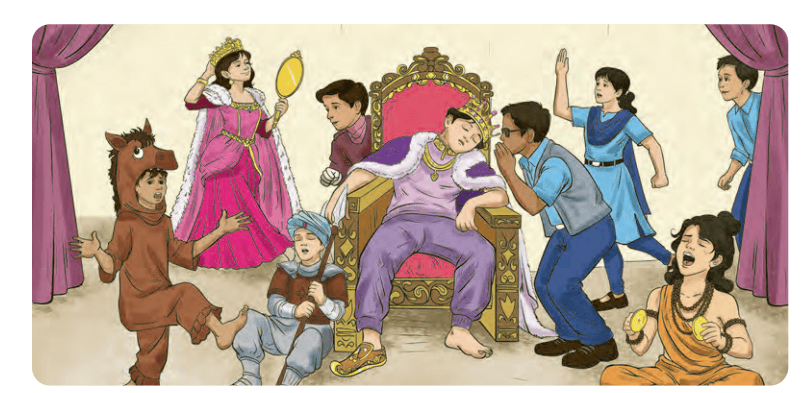
The rehearsal for the school play ‘The King Who Lost His Shoes’ is going on, but things are already going hilariously wrong. Everyone is doing something on their own.

The director walks in, understands the situation, takes a deep breath, and says, “Alright, pause!” She first corrects the body language of the king, so he sits and stands tall like royalty...

Slowly, the scene begins to look like a real story, not a group of people playing ‘pretend’ in different worlds. Everyone laughs, but they also understand something important—without direction, a play is just noise and confusion. But with guidance, it becomes an experience, called ‘theatre’.

Every play you watch is the result of many ideas, decisions, and careful planning. At the centre is the director—like the guiding vision, shaping how the story looks and feels...

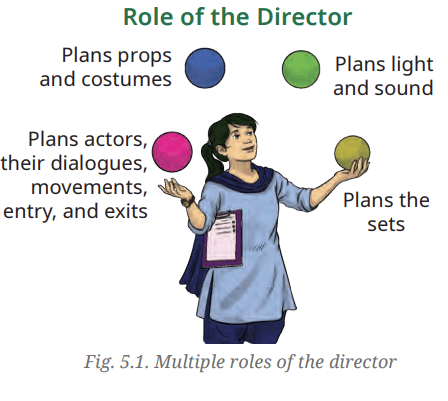
Role of the Director

Screenshot 2026-05-15 105917

Fig. 5.1. Multiple roles of the director

A group of students rehearsing a play with a king on a throne.
Fig. 5.2. Is this similar to what you visualised?

The Process — From Micro to Macro


The director of the play usually begins work weeks before the rehearsals start with the team and ends much after the show concludes. The primary requirement for the director is to read and understand the minute details of the script.
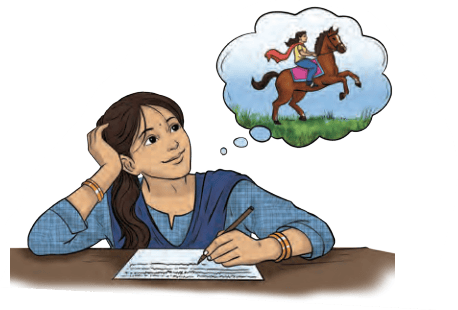
A director writing and imagining a knight on a horse.
Fig. 5.3. Visualisation and imagination

Unless the director has worked on the script and tried various possibilities to finally arrive at what will happen on stage, rehearsals cannot begin. If the director is unsure of what happens in each scene, how will that be communicated to the actors? While the minutest detail must be thought of, the director must also have the ‘big picture’ or the ‘larger vision’ of the entire play to plan the impact it will have on the audience.

Let us look at the various aspects a director must work on.
Script work

This is almost like detective work. The director reads the script several times to identify the main themes, emotions, and the message they want to communicate through the play. They make notes on different scenes, the place where it is happening, which characters are present, how relationships change, and the mood of each moment. The director also imagines the visual world of the play, including the use of space, lighting, sound, costume styles, and the overall tone. This phase also allows the director to make changes to the script, including editing or rewriting parts of the play. This early script work becomes the foundation for all the choices made during rehearsals.

Visualisation and scene building

Visualisation and scene building

Scene building involves creating the environment and visualising how each scene unfolds on stage. Sometimes, simple sketches of stage layouts are made as visual notes for each scene. These sketches show:

  • where the characters are (a street, a school, a forest, a palace);

Speaking, Moving, and Blocking

Diagram showing actor positions and movement arrows on stage
Fig. 5.4. Scene building
  • how and why actors move around in the scene;
  • what objects or props are used and why; and
  • which emotions fill the space and how it is achieved (music, light, sound effects).

Blocking

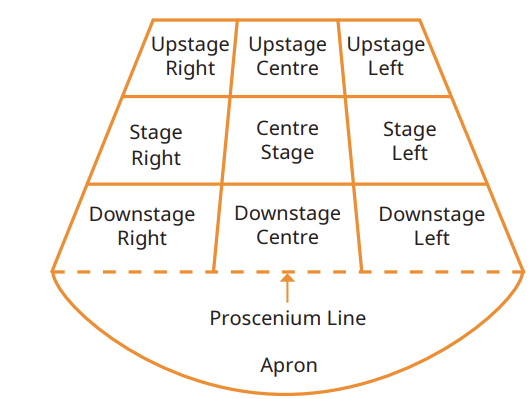
It refers to the process of deciding the positions of the sets, properties, actors, and their entries and exits. The terminology for identifying parts of the stage is called ‘stage division’ and is used universally across the world.

Stage division plays a crucial role in several aspects of theatre direction:

  • Communication: Stage division provides a universal, unambiguous vocabulary for everyone involved in a production, from the director to the cast and crew. This avoids miscommunication.
Stage map showing Upstage, Centre Stage, and Downstage divisions
Fig. 5.5. Stage divisions
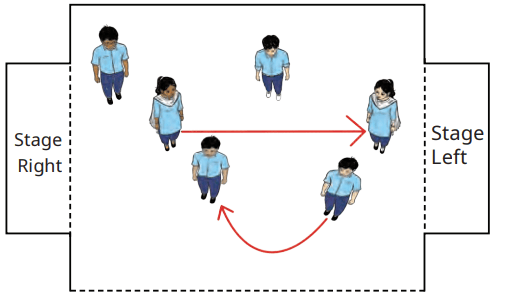
  • Blocking (movement): Directors use stage divisions to plan actors’ movement, ensuring clarity and dramatic effect. For example, moving downstage (closer to the audience) is often considered a ‘stronger’ or more attention-grabbing move than moving upstage.
  • Focus and emphasis: The position on stage can convey meaning and relationships. For example, centre and downstage centre are the most prominent areas, often...
Direction and Acting

used for major speeches or solos, while upstage left might be used for a discreet entrance.

  • Technical crew and set design: Lighting designers, sound engineers, and set crews use stage divisions to place equipment and set pieces. The divisions help the creative team determine how set elements can fit within the performance space.
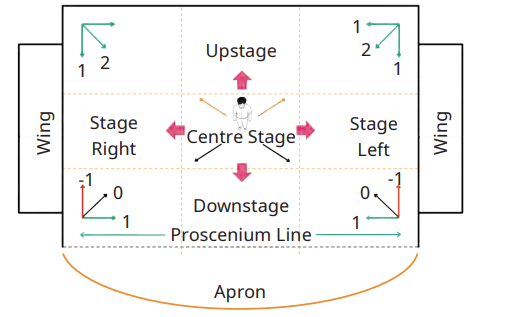
Planning movement on stage diagramScreenshot 2026-05-15 135113
Fig. 5.6. Planning movement on stage

Stage balance and compostion

This refers to how the actors, props, and actions are arranged so the stage doesn’t look ‘empty’ on one side or ‘crowded’ on the other and gives the best visual impact. This is called Balance Visual Weight. The following have to be kept in mind:

  • Clear focus: Direct the audience towards where to look first. Highlight the places or person where the story’s action takes place.
  • Strong diagonals: Diagonal lines (from upstage-left to downstage-right) add depth and interest.
  • Levels and grouping: Different heights and group shapes (triangles, circles) create attractive stage pictures.

Movement on stage

It is never random—it expresses purpose, emotion, and story.

  • Motivated movement: Walk only if your character has a reason. Every move should connect to dialogue or emotion.
  • Avoid upstaging: Don’t block another actor from being seen by the audience.
  • Use the whole stage: Whether upstage, downstage, left, or right, each part should feel alive.

Consolidating all departments

As the actors rehearse, the director focuses on aligning the scenes with appropriate music, sound, costumes, and lighting. Each team, familiar with the script, sits with the director to understand and provide a design of their department of work. When all teams are aligned with the script and directorial vision, it helps create a continuous flow of scenes.

Polishing and Styles of Direction

Polishing, run-throughs, and stage rehearsals

The team then continuously rehearses the entire run of the play, including all technical aspects. The run-throughs are not just for the actors but also for the technical crew. The director now works on the finer details, ensuring the team can put up their best performance.

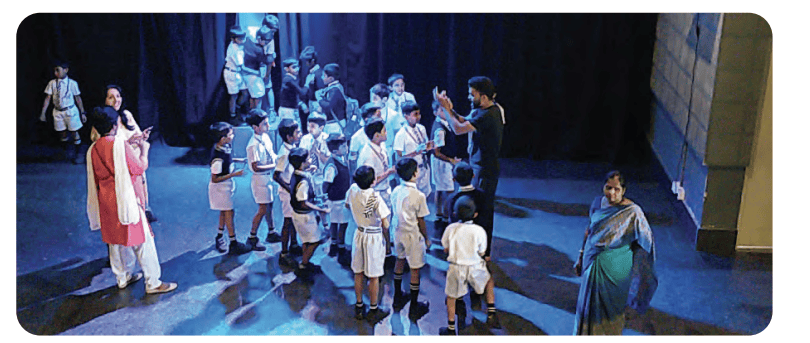
A group of students on stage during a rehearsal session with their teacher/director
Fig. 5.7. Rehearsals and feedback

Styles of Direction


  1. Realistic: In realistic direction, the stage looks and feels like real life. The director tries to make everything believable—the characters speak naturally, the set looks like a real place, and the emotions feel genuine. This is the style where the audience can relate to situations or characters and say, ‘Yes, I’ve seen someone like that!’
  2. Abstract or symbolic: In an abstract or symbolic direction, the story is told through ideas, images, and emotions rather than realistic action. A piece of cloth might represent a mountain, or a colour of light might show anger or love. This style encourages the audience to think and imagine.
  3. Devised theatre: Devised direction means the play is not based on a fixed script but created together by the group during rehearsals. The director becomes a guide or facilitator, helping actors improvise and explore ideas. The final performance is shaped by everyone’s imagination and collaboration.
  4. Script-based direction: Here the play begins with a written text. The director studies the script, understands the writer’s intention, and plans how each scene will be staged. Blocking, movement, and tone are all designed to bring the written story alive on stage while respecting the playwright’s vision.
Collaborative Direction and Activity
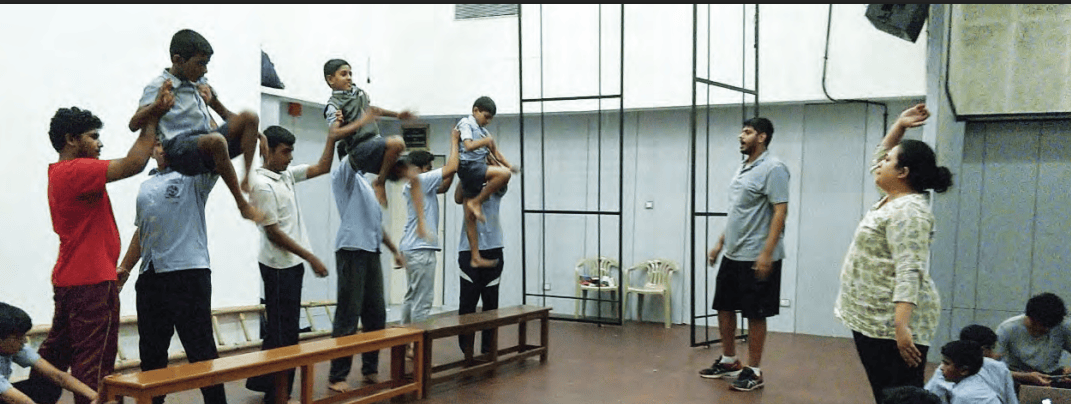
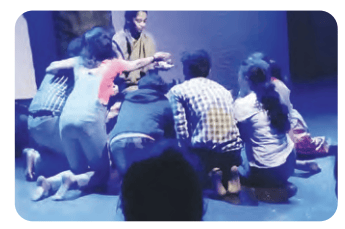
Students practicing physical theatre under teacher supervision
Fig. 5.8. Direction
Safety disclaimer: Such acts must be carried out only under the supervision of a teacher
  1. Collaborative direction: This combines all creative inputs from experts. There are some plays with two directors collaborating on a show, or a dance choreographer or a musician collaborating with a theatre director on a common concept.

Note: A director is the captain of the ship. This means that the director not only takes decisions for the team but is also responsible for the team. They do not just create and implement their ideas but are also answerable to the audience.

Activity 5.1

The director in you

Pick a scene of your choice from a play you have performed. Make groups of 5 – 10 (depending on the scenes). Each team will re-design the scene using the ideas below.

Focus on the following techniques:

  1. Emphasise more on movements or āngika.
  2. Focus more on the vāchika, or voice elements.
  3. Re-work the positions and movements based on the nine parts of the stage.
  4. Enact a scene without any emotions.
Bringing Characters Alive: Acting

Bringing Characters Alive: Acting


Once the director has visualised the story and shaped each scene, the next step is to bring that vision to life, and that’s where the actors step in. Actors play a crucial role in bringing characters to life and connecting with the audience. If direction is about seeing the bigger picture, acting is about feeling the heartbeat within the character. The director’s guidance gives structure, but it is the actor who fills it with life.

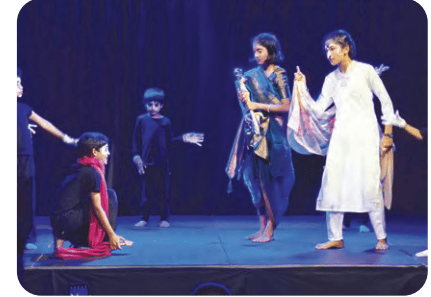
Children performing on a dark stage
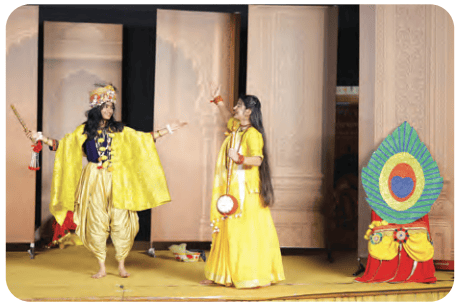
Children in colorful traditional costumes on stage

Fig. 5.10. Children bringing characters to life on stage

Schools of acting — approaches to the art of performing on stage

Schools of acting are different ways or systems of training that teach actors how to prepare, feel, and perform a role. Each school or method is based on a unique philosophy about what makes acting truthful and powerful. Some focus on inner emotion and imagination, while others emphasise voice, movement, or external expression. Let us look at some prominent schools of acting that actors and directors still use today.

INDIAN

Nātyashāstra: Chaturvidha Abhinaya

It refers to the four pillars of performance in Nātyashāstra (around fifth century BCE).

  • Āṅgika — of body. The use of the body to move and express with various bhedas (śhiro, dṛishṭi, etc.) and actions (hastas — gestures, postures). It explores how action can convey meaning.
  • Vāchika — the voice. It explores various voice modulations of different styles of characters (vṛittis).
  • Āhārya — the accessories. This is used by performers to enhance their show. For example, hand props, jewellery, etc.
  • Sāttvika — the inner experience. The overall rasānubhava of the art is the unique experience of each actor and audience.
Traditional and Global Schools of Acting

Gaura-lilā and Gūsta-lilā (Manipur)
It is a traditional theatre art form. It blends music, dance, acting, and rituals harmoniously. The audience also participates through chants and responses.

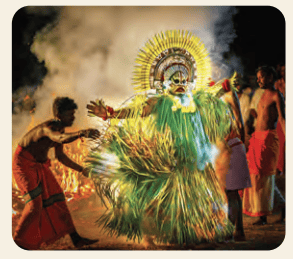
Bhūta-kola (Karnataka)
A divine folk tradition where local deities and ancestors are worshipped through dance, rituals, and Chende drums. It is central to the community’s collective memory and justice system.

Bhuta-kola performance in Karnataka
Fig. 5.11. Bhūta-kola
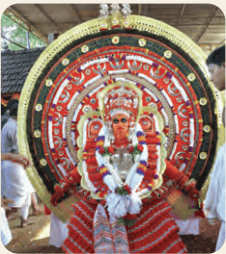
Teyyam performance in Kerala
Fig. 5.12. Teyyam

Rammāṇ (Uttarakhand)
It has been added to the UNESCO’s list of Intangible Cultural Heritage. It depicts historical stories through gestures, music, and masks. Roles are traditionally assigned to groups of people such as carpenters and drummers, who have been creating and practising the form for generations.

Teyyam (Kerala)
An ancient divine folk tradition with more than 400 variants, each with its own unique story and dance style. The most striking feature is its transformation into a divine state.

GLOBAL

In the twentieth century, stalwarts in theatre propagated the following theories.

The System and Method Acting
By Konstantin Stanislavsky and Lee Strasberg

  • Emotional truth: Deriving true emotions from people’s own experiences to give authenticity.
  • Magic ‘if’: Asking the question ‘what if’ to imagine the situation of the character as though the actor were actually in it.
  • Inner monologue: Maintaining the thought process as the character, even when not delivering a dialogue.
  • Commitment: Staying in character even when an actor is not on stage.
Actors performing method acting on stage
Fig. 5.13. Method acting
Global Acting Theories and Activity

Epic Theatre — Alienation Theory

By Bertolt Brecht

Actors maintain a distance between themselves and the character. They do not get emotionally involved. They do not want the audience to be emotionally carried away. This theory emphasises on making the audience think.

Poor Theatre

By Jerzy Grotowsky

This style of performance focuses on eliminating elaborate sets, properties, and costumes. The actor’s body becomes the most important medium of expression.

Stella Adler’s Technique

By Stella Adler

This technique emphasises using imagination rather than personal experiences to build a strong character. The actor then trains based on the character built.

Activity 5.2

The living painting

Instructions:

  1. Divide the class into small groups.
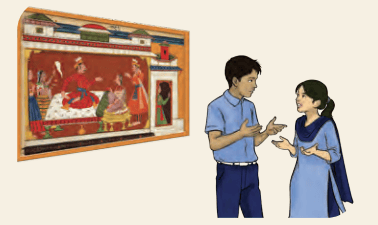
  2. Each group chooses a famous painting, sculpture, or traditional artwork.
  3. The task: Bring the artwork to life as a short 1-minute performance!

Steps for each group:

  1. Pick a painting, sculpture, or traditional artwork from the textbook.
  2. Imagine a possible situation for the picture. What might have happened before, and what might have happened after. Create a small story with that character or place as the core.
  3. Direction:
    • Discuss and plan the positions for each character based on their importance and the stage divisions you have learnt.
    • Plan the entry and exit of characters as per the story and stage divisions.
Illustration of students discussing a traditional Indian painting
Fig. 5.14. The living painting
Solo and Group Dynamics in Acting
  1. Acting:
    • The actors turn the still image into a living moment using expression, movement, and maybe even short lines of dialogue or sound.
    • Is the situation familiar to you in any way? Can you bring that to your performance?
    • Try enacting the entire scene only with āṅgika, without speech.
    • Try a vāchika version where the actors only speak in their position without any actions or gestures.
    • Add music, rhythm, or dance to enrich the scene.

Each group presents their ‘living painting’ to the class.

While the schools of acting introduce different ways of approaching character, emotion, and performance, they all meet at one common point—the actor’s relationship with the stage.

Solo and group dynamics in acting

Acting on stage involves both individual expression and collective harmony. Understanding how to perform alone and in a group is essential for an actor.

Solo acting (individual presence on stage)

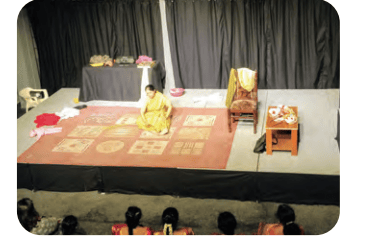
It focuses on the actor’s ability to hold the stage on their own. This includes monologues, soliloquies, narrations, or moments when a character is isolated even while others are present. In solo acting, the actor must rely on voice, body language, emotional truth, and imagination to communicate clearly with the audience.

Example: A character delivering a soliloquy about a secret fear, must keep the audience engaged using only personal energy and expression.

A solo actor performing on a stage set with traditional floor patterns
Fig. 5.15. Solo acting

Group acting (ensemble dynamics on stage)

It is about working together as an ensemble, where each actor supports the scene rather than trying to stand out. It requires listening, timing, awareness of space, and responding truthfully to others.

Example: In a market scene, one actor may be speaking, but others contribute through movement, reactions, and coordinated actions that make the scene feel alive and believable.

Balancing Solo and Group Work
A group of students performing together on stage
Fig. 5.16. Group acting

Balancing solo and group work

A strong actor knows when to lead and when to blend. This understanding helps young actors realise that theatre is both a personal craft and a shared experience, where individual effort and teamwork are equally important.

Activity 5.3

Solo to ensemble

Step 1: Solo presence

A single student walks onto the stage and performs a simple action silently (for example, waiting for a bus, tying a shoelace, searching for something lost). Other students observe posture, energy, clarity of action.

Discussion: What helped the students understand what the actor was doing without words?

Step 2: Group dynamic

In groups of 5–6, perform the same situation on stage (for example, everyone is waiting at a bus stop).

  • No one is the main character. Students must listen with their eyes and bodies, adjust spacing, rhythm, and reactions.

Discussion: Who leads unintentionally? How does one actor’s energy affect the whole group?

Step 3: Disruption and balance (5 minutes)

The teacher asks one actor to deliberately change the tempo or emotion (for example, becoming restless or slow). The group must organically adjust without speaking.

Discussion circle
  • Discuss the difference in impact between the āṅgika and vāchika versions.
  • How did acting solo feel different from acting in a group?
Students in a discussion circle
Exercises: From Vision to Performance

EXERCISES

Q1. What are the different styles of direction? If you were to direct a play, what would be your style and why?

Q2. What are the nine stage divisions? If you were to plan the following scene, where would the characters be positioned on stage, based on the nine stage divisions?

Scene: We are in Chhatrapati Shivaji Mahārāja’s court, and a famous poet of a neighbouring state is visiting him.

Give positions on stage for — Chhatrapati Shivaji Mahārāja, the famous poet, the in-house poets of Chhatrapati Shivaji Mahārāja, and the royal guards escorting the poet. You can make a drawing to indicate stage positions.

Q3. Which are the global schools of acting you have learnt about? Which one appeals to you the most and why?

Q4. Improvise and perform the following scene with:

  • just two people on stage;
  • atleast 5–6 on stage.

Scene: You are going to a shop to buy a notebook. You meet a friend from your childhood you haven’t spoken to, for many years.

Note down the differences you felt in the scene as an actor and as an audience.

Q5. Which are the various departments in theatre that come together for a performance? As a director, and in what order would you like to work with these departments, starting with the script?

Q6. Match the following.

Indian Name Description
i. Āṅgika a. Performance in Manipur
ii. Bhūta-kola b. Costume, jewellery, set, and props
iii. Gaura-lilā c. Body language
iv. Āhārya d. A divine folk tradition of Karnataka
page84.xhtml HTML Project Work: Theatre Workshop

PROJECT WORK

1. Planning and Conducting a Basic Workshop

Objective

To help Grade 9 students deepen their understanding of theatre by planning and conducting a three-hour theatre workshop for younger students (Grades 3–5), working in pairs. This not only develops a deeper understanding of the concepts learnt so far, but also builds leadership, communication, planning, empathy, and practical theatre skills.

Possible Workshop Themes

Each team of two to decide on a theme to plan their workshop session. This will help in creating focus and choosing the right activities.

  1. Storytelling through body and voice
  2. Emotions and expressions on stage
  3. Animals, nature and movement
  4. Creating characters from everyday life
  5. The magic of imagination in theatre
  6. Folk stories and simple drama
  7. Rhythm, sound, and movement games
  8. Teamwork and trust through theatre games

Tip: Themes to be playful, visual, and activity-based, rather than theory-heavy.

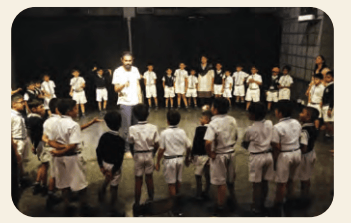
Students and instructor in a circle during a theatre workshop

Suggested 3-Hour Structure

Hour 1: Warm-up and comfort

  • Name games, icebreakers
  • Body and voice warm-ups
  • Simple movement or mirroring games

Hour 2: Core theatre activities

  • Main activities linked to the chosen theme
  • Small group improvisations
  • Story or scene creation using movement, sound, or imagination
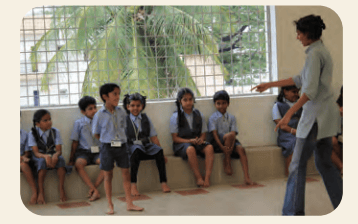
Young children participating in a workshop activity
Workshop Planning Steps

Hour 3: Creation and sharing

  • Help younger students prepare a short performance.
  • Encourage teamwork and confidence
  • Informal sharing/performance
  • Appreciation circle or reflection game

Planning Steps

Step 1: Divide roles

  • Partner A: Leads activities, explains games
  • Partner B: Manages group energy, helps children, ensures safety

(Partners can switch roles based on time or activity)

Step 2: Know your audience

  • Consider kids’ attention span, energy levels, and understanding level.
  • Use clear instructions, demonstrations, and repetition.
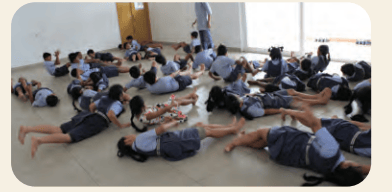
Students participating in a floor-based workshop activity

Step 3: Design activities

  • 6–8 short activities (10 –20 minutes each)
  • Include movement, imagination, and fun
  • Avoid long explanations.

Step 4: Prepare materials

  • Music (if needed)
  • Simple props (scarves, paper, rhythm objects)
  • Clear plan with time slots

Step 5: Rehearse as facilitators and plan backup activities

  • Practise explaining games.
  • Anticipate possible confusion or distractions.
  • Keep extra activities ready, in case your planned activity does not work well.

Step 6: Reflection after workshop

  • Hold a discussion circle with the children to get their thoughts.
  • After the workshop, have a mutual discussion — what worked well? What was challenging?
  • Reflect on what you have learnt as a theatre facilitator?

An in-class discussion that assimilates the experiences of all students will provide new insights into theatre and encourage practical learning.

Description of image