
09
Music Travels Around the World
Have you travelled to a town, city, or country different from where you live? Just as human beings travel and move from one place to another, music and culture also flow between different regions and countries. So, let’s pack our bags and set off on a journey!
Music and Migration
Migration is the movement of people from one place to another to settle in a new location. When populations such as people of a country or an ethnic group that originated from the same place settle in a new country, they form what is called a diaspora.
Over thousands of years, people moved in and out of the Indian subcontinent. And, with them, they carried not just physical possessions, but also their music. The music they carried served many purposes — it provided links to their home, helped them bond with fellow migrants, preserved their cultural practices, and also allowed them to express their feelings and hardships. Their music blended with local sounds, creating new, hybrid genres, and enriched the cultural landscape.
Chutney music
It emerged from the migration of Indians from Bihar and Uttar Pradesh to the Caribbean islands in the nineteenth and early twentieth centuries. Over time, Bhojpuri folk songs, bhajans, and instruments like the dholak blended with Caribbean styles such as soca and calypso. This fusion created a lively hybrid genre. Its lyrics mix Bhojpuri, Hindi, English, and Creole, reflecting everyday life and cultural identity. Instruments like the dholak, tassa, dhantal, and keyboards give Chutney its energetic, dance-driven sound.
Listening selections
- Phulowrie Bina Chutney Kaise Bani – Sundar Popo
- Cham Cham Baje – Drupatee Ramgoonai
Bhangra in the United Kingdom
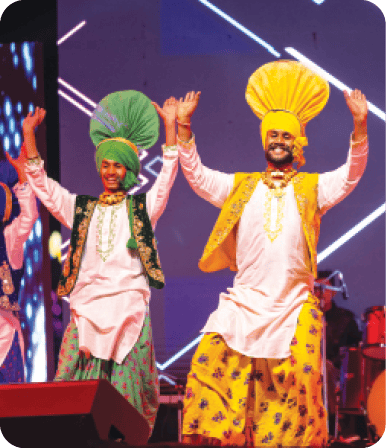
Fig. 9.1. Bhangra
A vibrant folk music and dance tradition from Punjab, Bhangra is rooted in energetic dhol rhythms and celebration. When Punjabi migrants settled in the UK between the 1950s and 1980s, they brought their music with them as a way to preserve their identity and community. Growing up between Punjabi homes and British cities, young musicians blended Bhangra with reggae, hip-hop, pop, and electronic sounds. This fusion led to the emergence of UK Bhangra, which is a blend of fast beats, heavy bass, Punjabi lyrics, and modern instruments.
Listening selections
- Tutak Tutak Tootiya – Malkit Singh
- Dowain Jaaniya – Heera group
Do you know?
Just as Indians have migrated to other countries, there have also been several examples of communities from other countries and continents migrating to India and bringing their music with them. Read and watch videos about the Siddi community and the Siddi Dhamāl music–dance form that combines African traditions with Gujarati folk traditions.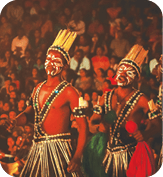
Fig. 9.2. Siddi
Dhamāl dance
Activity 9.1
Migration in your family
Has someone you know migrated to another town, city, or country?
- Speak to a person who has migrated, and ask them to share a song that reminds them of their home with you.
- If you had to write a song about your home and family to take with you to a different place, what would it be like? Write down a few lines of lyric in your journal.
Do you know?
The dancer icon seen in many messaging apps is inspired by flamenco, which is a tradition of song, dance, and guitar music from southern Spain, closely linked to the Andalusian Roma community. Its roots trace back to Roma migrations from Rajasthan to Spain between the ninth and fourteenth centuries, where their music blends with Jewish and Moorish cultures, creating this distinctive art form.
Families of Musical Instruments
We have studied the classification of instruments into four categories, namely string (tata), wind (suṣhira), percussion (avanaddha), and solid (ghana), according to the Nāṭyaśhāstra. What is most remarkable is that this classification applies to musical instruments found anywhere in the world. Musical instruments may also be classified in other ways such as based on the musical genre they belong to, which country or region they come from, or similar shared characteristics.
Do you know?
The rāvaṇa-hatthā is an ancient bowed string instrument. According to folklore, it was invented by Rāvaṇa in Lanka. It continues to be used as a folk instrument in Rajasthan. Can you find any other instruments that belong to this family of bowed string instruments?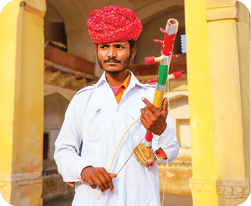
Fig. 9.3. Rāvaṇa-hatthā
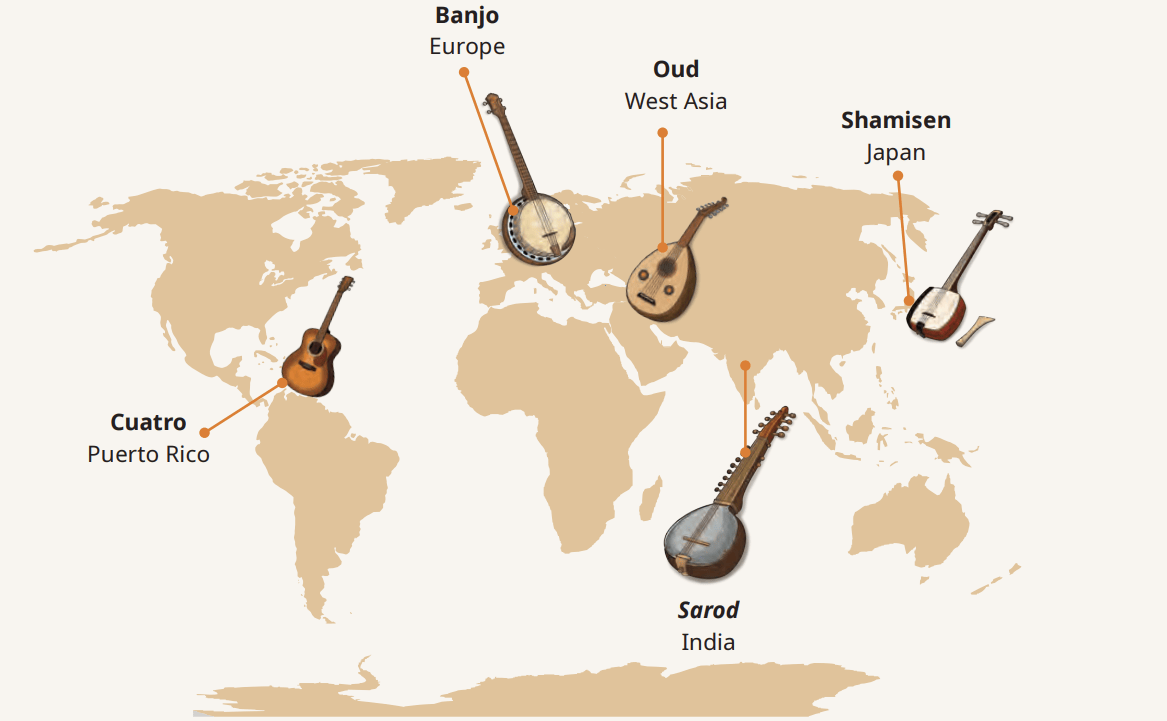
The lute family
It includes plucked string instruments found across Asia and Europe. All of these share a basic design—a wide resonating body and a narrow neck—but differ in materials and construction. The resonating top, or belly, may be made of wood, as in the West Asian oud, or skin, as in the banjo. Some instruments use highly specific materials — the Japanese shamisen traditionally uses cat skin (skin of dead animals), the Puerto Rican cuatro uses seasoned jagrumo wood, and the Indian sarod has a stretched goatskin top. In recent times, synthetic materials have also been adopted.
The flute family
The flute is among the most ancient types of musical instruments. Archaeologists have uncovered flutes dating back tens of thousands of years. At its very basic level, a flute is a hollow tube that produces sound when the player blows air into it or across a hole on its surface. Found in nearly every culture, flutes reveal how different societies shaped the same basic idea of astonishing variety into instruments. Here’s a brief comparison of some flutes from different countries.
Instrument Name: Ocarina
Region of Origin: Central America; modern form in Italy
Type of Flute: Vessel flute
Material: Clay/ ceramic
Key Features: Warm, pure tone; compact shape
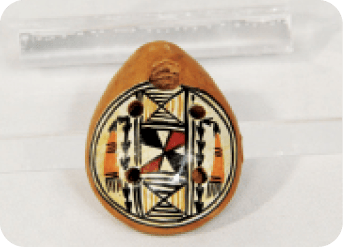
Fig. 9.5. Ocarina
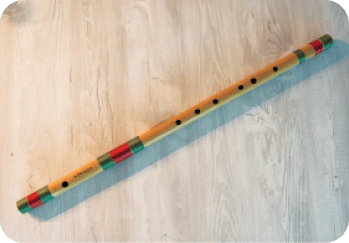
Instrument Name: Bansuri
Region of Origin: India
Type of Flute: Transverse flute
Material: Bamboo
Key Features: Smooth, airy sound; capable of expressive slides (meend)
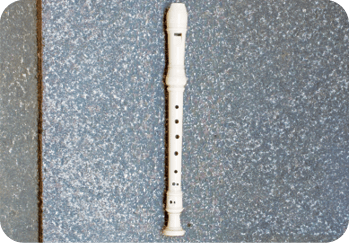
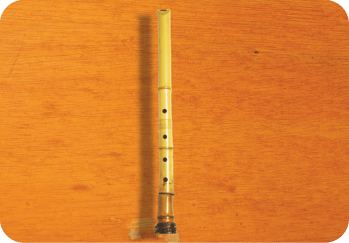
Fig. 9.8. Shakuhachi
Fig. 9.6. Recorder
Instrument Name: Recorder
Region of Origin: Europe
Type of Flute: Duct flute
Material: Wood or plastic
Key Features: Clear, bright tone; easy to learn
Instrument Name: Shakuhachi
Region of Origin: Japan
Type of Flute: End-blown flute
Material: Bamboo
Key Features: Breath-rich, meditative tone; flexible pitch bending
Fig. 9.7. Bansuri
Activity 9.2
Discovering families
Zithers are a family of stringed musical instruments.
- Can you find 4 – 5 instruments from around the world that belong to the zither family? Listen to their sound, and create a table that compares and contrasts them based on the characteristic of the sound, material used to make the instrument, technique
of playing, or any other. - Listen to the music played on two different stringed instruments. Observe their sound, and note down their similarities and differences, and how they can convey different emotions.
Making of the Veena
Look at the following images showing the process of making a veena. Reflect on how craftspersons make each instrument with great effort.
![[Alt text was not generated.]](/assets/ncert/2026/iemr109/OEBPS/Images/5.png)
![[Alt text was not generated.]](/assets/ncert/2026/iemr109/OEBPS/Images/3.png)
![[Alt text was not generated.]](/assets/ncert/2026/iemr109/OEBPS/Images/7.png)
![[Alt text was not generated.]](/assets/ncert/2026/iemr109/OEBPS/Images/6.png)
![[Alt text was not generated.]](/assets/ncert/2026/iemr109/OEBPS/Images/4.png)
The veena is one of the oldest string instruments of India. It is traditionally crafted from a single block of wood, most commonly jackwood. The instrument has two principal parts — a resonator called the kuḍam and a long hollow neck called the daṇḍi. At the end of the daṇḍi is a decorative carving of the yazhi, a mythical creature. The veena is central to Carnatic Music and is most commonly played in southern India.
![[Alt text was not generated.]](/assets/ncert/2026/iemr109/OEBPS/Images/8_%282%29.png)
![[Alt text was not generated.]](/assets/ncert/2026/iemr109/OEBPS/Images/9.png)
![[Alt text was not generated.]](/assets/ncert/2026/iemr109/OEBPS/Images/10.png)
Exercises
Q1. Name two instruments that belong to the flute family and identify where they are from.
Q2. Describe some features of Chutney music (50 words).
Q3. Give two examples of musical instruments and the materials used to make them.
Q4. Match the following:
|
i. Cuatro |
a. India |
|
ii. Sarod |
b. Japan |
|
iii. Shamisen |
c. West Asia |
|
iv. Oud |
d. Puerto Rico |
Q5. Besides the standard classification into tata, suṣhira, avanaddha, and ghana, what are some other ways in which we can classify musical instruments?
Q6. Describe some characteristic features of instruments belonging to the lute family, and share some examples.
Q7. What purpose does music serve when people migrate?
Q8. Do you think the mixing of musical genres as a result of migration is beneficial? Justify your answer.
Q9. Imagine you have migrated to another state in India, leaving your family behind. Write a few lines of a song describing your emotions.
Q10. Try to listen to these instruments:
i. Violin (which is bowed)
ii. Guitar (which is plucked)
Can you explain the difference in the sounds of the instruments?