Dance

आङ्गिको वाचिकस्तद्वदाहार्यः सात्त्विकस्तथा|
चतुर्धाभिनयो ह्येषः चतुर्द्वीपवतीं महीम्|
नाट्यशास्त्र, अध्याय 6, 38
Āṅgiko vāchikas tadvad āhāryaḥ sāttvikastathā |
Chaturdhābhinayo hyeṣaḥ chaturdvīpavatīṁ mahīm ||
Nātyaśāstra, Chapter 6, 38
Meaning: Abhinaya is four-fold — āṅgika (body gestures), vāchika (speech/vocals), āhārya (costumes and make-up), and sāttvika (mental states/emotions).
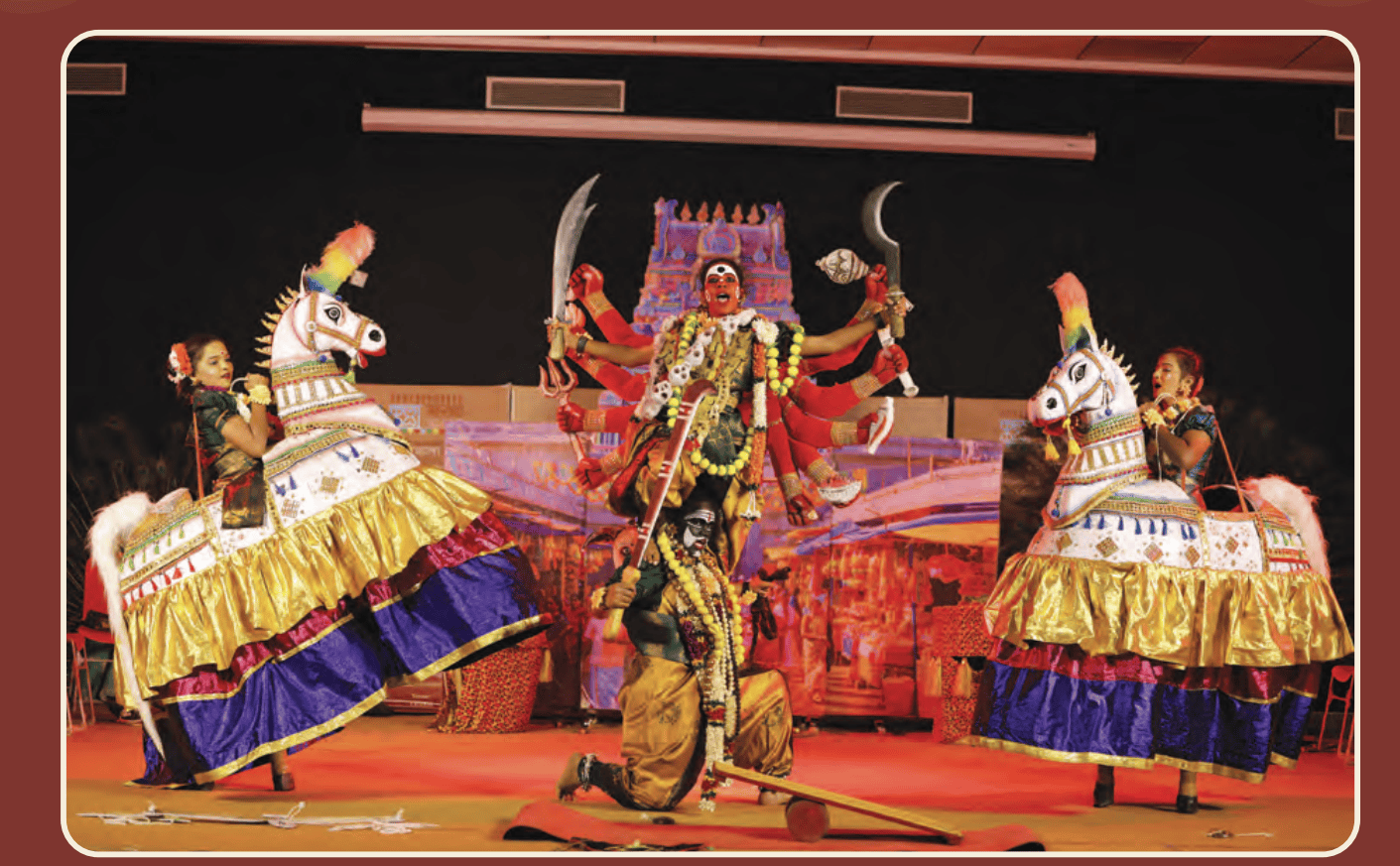 Traditional folk dance forms of Tamil Nadu potraying Poikāl Kudirai,
Oyilāttam, and Silambāttam
Traditional folk dance forms of Tamil Nadu potraying Poikāl Kudirai,
Oyilāttam, and Silambāttam
Note to the Teacher
The chapters in this section titled ‘Dance’ will help students to continue to explore their creativity by engaging in movement practices. Students will recall and revise concepts of posture, movement, and rhythm from previous grades. Introduction of new techniques and concepts such as abhinaya, choreography, and global dance forms have been given in this grade to enrich their knowledge of the discipline. You may modify the activities to suit your local context and the specific needs of your students.
In Grade 9 Dance, students will:
1. develop knowledge of posture, line, and disposition in dance and movement;
2. recall and revise all concepts of posture, movement, rhythm, rasa,
and bhāva;
3. study and apply the tools of expression (abhinaya) as a
communicative device;
4. be introduced to various dance forms of India, classical and other
traditional forms, and the cultural diversity of India;
5. apply the concepts of posture and abhinaya with various kinds of
dance forms experienced in class and outside;
6. be introduced to dances as cultural connections and performance
traditions of Southeast Asia;
7. be introduced to contemporary Indian dance and the use of dance
in popular culture, exploring creativity with movements;
8. collaborate and create solo and group choreographies, creatively
using patterns and space;
9. regularly journal and research notable Indian dance personalities;
10. learn the importance of teamwork and collaborative effort in
producing dance; and
11. learn that dance is for everyone, instilling values of equality and
sensitivity in students.
The dance classroom needs:
1. a spacious hall with ample space for children to move and dance;2. a space with ample ventilation and adequate lighting; and
3. a space or event to showcase their work.
Dance pedagogy would need to:
1. continue to help the children understand dancing with a relaxed
body, with importance given to breath and the holistic aspect of
dance and movement;
2. guide the children according to their ability to adopt the principles
provided;
3. encourage collaboration and help students to form groups and
work as teams;
4. encourage regular journalling of their ideas and experiences in the
Arts;
5. encourage inclusivity and gender sensitisation while learning;
encourage equal participation of all students irrespective of their
gender in all dances. Students with disabilities must be given equal
opportunities and access to participate in all art activities and
discussions; and
6. organise bagless days or field trips to help students gain exposure
to the dance and movement cultures and dance institutions in their
locality.
The Learning Outcomes mapped to Curricular Goals and Competencies
for each chapter are listed below.
| Learning Outcomes That Can Be Assessed | ||
|---|---|---|
| Chapter 10: Components of Dance | ||
| Curricular Goals | Competencies | Learning Outcomes |
| 2 | C–2.1 |
Describe the classifications of dance as well as four abhinayas and their application. Apply basic elements such as footwork, hand gestures, rhythm, tempo, and mood in dance sequences. |
| 3 | C–3.1 | Describe and demonstrate body alignment (sauṣṭhava) while performing dance movements. |
| 4 | C–4.2 | Identify the dance form and correlate nṛitta, nṛitya, abhinayas, rasa, and rhythm in the performances that they watch. |
| 4 | C–4.1 | Examine the four abhinayas through the work of important personalities across diverse art forms. |
| Chapter 11: Dance as Visual Storytelling | ||
|---|---|---|
| Curricular Goals | Competencies | Learning Outcomes |
| 3 | C–3.2 | Discuss and compare the different types of abhinaya and incorporate these into their creative practice. |
| 2 | C–2.2 | Perform movement sequences with different kinds of music and narration and compare the experiences. |
| Chapter 12: Cultural Connections Through Dance | ||
|---|---|---|
| Curricular Goals | Competencies | Learning Outcomes |
| 1 | C–1.2 | Interact with art professionals and find out more about what interests them in dance. |
| 4 | C–4.1 | Create a dance sequence inspired by elements from diverse Indian and global dance forms. |
| Chapter 13: Dance Choreography | ||
|---|---|---|
| Curricular Goals | Competencies | Learning Outcomes |
| 2 | C–2.2 | Contribute ideas and reflect on the collaborative process of dance choreographies. |
| 3 | C–3.1 | Creatively use space and directions in their solo and group choreographies. |
10 Components of Dance

Do you know that the Ganga is one of the most ancient rivers in India, yet its waters are always fresh and free-flowing. Similarly, in dance, the movement vocabulary and concepts that you have learnt so far are like an ancient river of knowledge that gets refreshed each time you practise and revise. The deeper you delve into this knowledge, the more you create innovatively. This is when dance (nritya) becomes 'Nitya Nūtana aur Purātana', meaning it is simultaneously old, yet can always bring newness. Now, let us rediscover nritya!
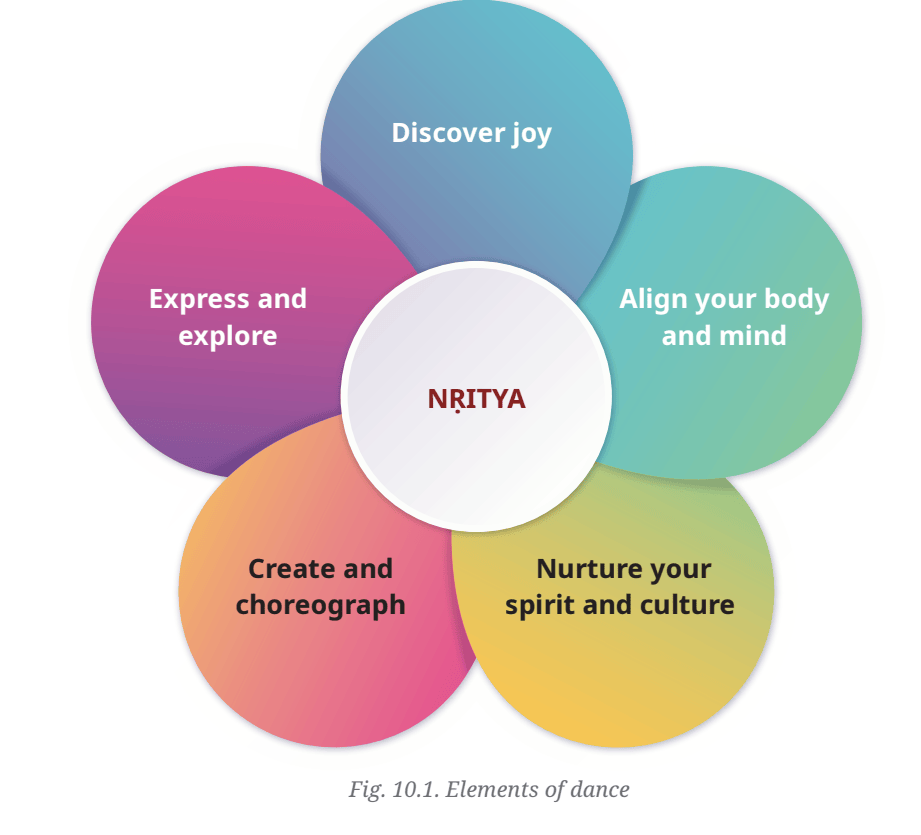
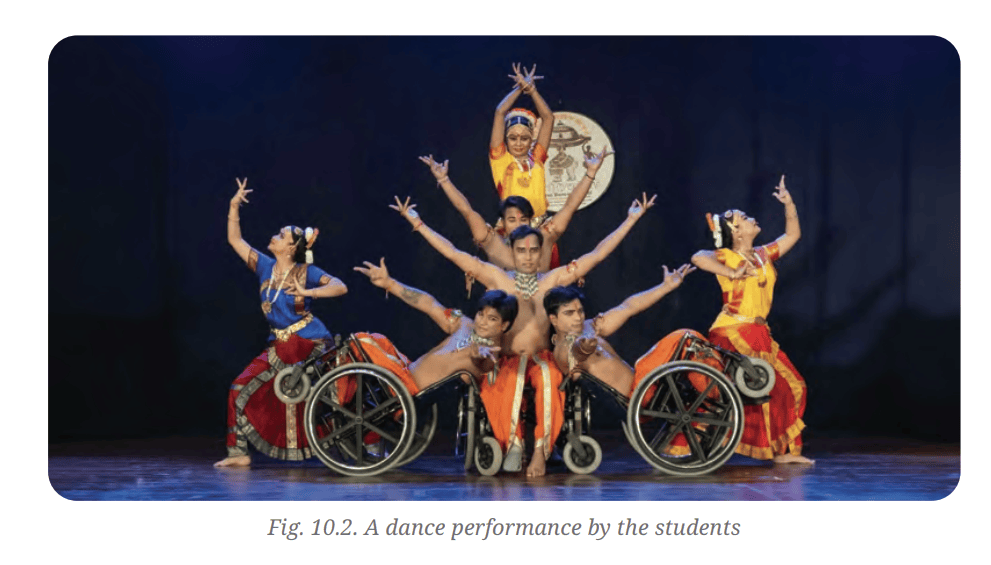
What Constitutes a Dance Movement?
For dancers, the body is a medium through which all movement comes alive. Since dance begins in the body, its alignment, balance, and graceful control shape the strength and clarity of every movement. Proper body posture forms the foundation of all technique and helps prevent injuries that arise from incorrect alignment. Just as in any physical activity, in dance too, warming up prepares the muscles and joints, ensuring that movements are free, fluid, and safe.
In Indian dances, this physical awareness is deepened through a conscious harmony between breath and body, allowing dancers to sense and direct the flow of energy within, similar to yoga. A well-aligned body allows the free flow of energy, enhancing endurance, stamina, and emotional expression. Before learning any dance movement, a dancer must first understand how to hold the body correctly.
Now, let us experience how awareness of body alignment transforms an ordinary movement into a stylised dance movement almost like a sculpture coming to life!
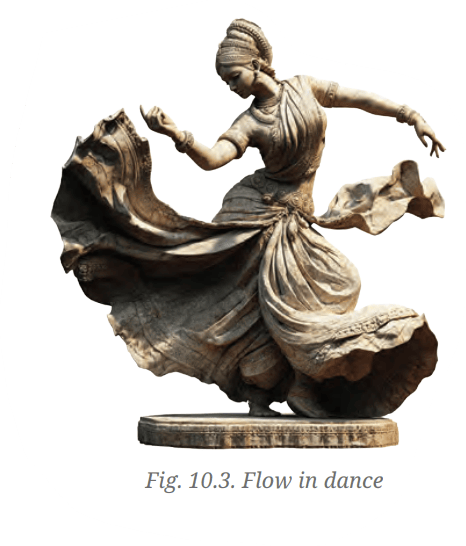
Activity 10.1
Explore geometry through your body
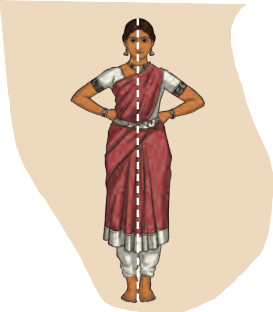 Fig. 10.4. Sauṣṭhava pose
◊
Sauṣṭhava pose: Hold your body with poise and alignment. Imagine the central meridian line passing vertically through your body. Try aligning your ears, shoulders, and waist in one line.
◊
Stand upright with your feet joined together. Distribute your body weight evenly on both feet. (Observe if you are leaning slightly forward or backward?)
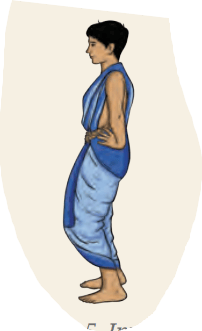 Fig. 10.6. Improper Sauṣṭhava pose
◊
Place your hands on your waist. The elbows, shoulders, and head are in a natural position (as shown in the Fig 10.4).
◊
Keep your torso upright and lifted. Stand balanced and alert, body erect yet relaxed, ready to move with control and grace. This poised stance of a dancer is called sauṣṭhava.
◊
Now try simple dancing actions whilst maintaining sauṣṭhava like walking, turning, jumping, and using your limbs.
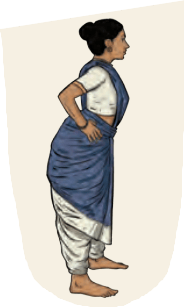 Fig. 10.5. Improper Sauṣṭhava pose
Activity 10.2
Visual composition in dance: explore shapes and emotions
◊
Create lines and shapes with different parts of your body — a
diagonal line with your arms, a quadrangle with your lower
body, or an arc with your torso, etc.
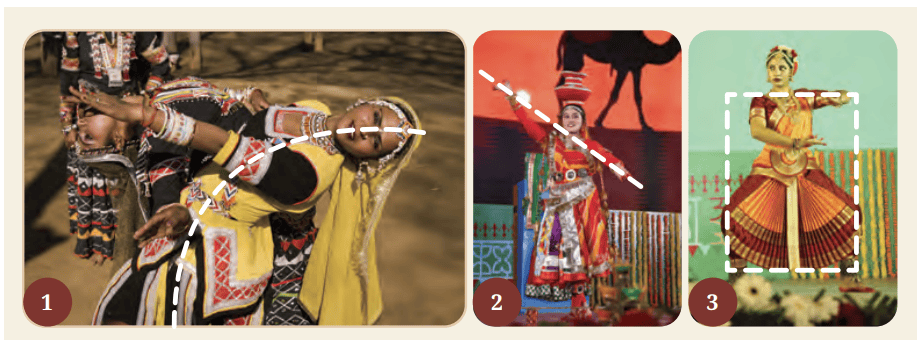 Fig. 10.7. (1) Curve; (2) Diagonal; (3) Quadrangle
◊
Try forming shapes with your entire body — stretching,
balancing, creating curves, and arcs through bends, etc.
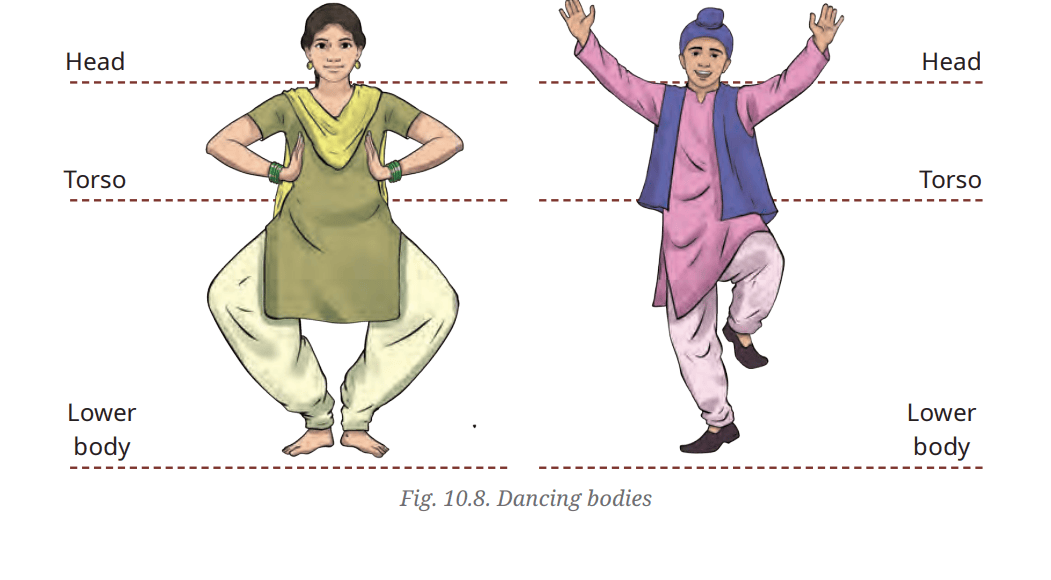
◊ These linear or curved forms, created through the coordination of your body parts, are called rekhā in dance.
◊ With bright, expressive eyes and a pleasant face, reflect your joy, or any emotion. This is your disposition or rūpa.
◊ These linear or curved forms, created through the coordination of your body parts, are called rekhā in dance.
◊ With bright, expressive eyes and a pleasant face, reflect your joy, or any emotion. This is your disposition or rūpa.
Developing alignment (sauṣhṭhava), clear lines (rekhā), and a good disposition (rūpa) help your movements feel more balanced, expressive, and confident, and each dancer discovers this in their own unique way.
Body in Motion: Revisiting the Basics of Dance
Revisiting body movements in dance
Revisit the concepts of body postures (sthāna), dynamic movements of the lower limbs (chārī and gati), and jumps and spins (utplavana and bhramarī) from your textbooks Bansuri and Kriti. Revisit the karaṇa you have learnt in your Grade 8 textbook Kriti.
Revisiting rhythm (tāla) and tempo (laya)
Have you noticed that our hearts beat in a repetitive pattern? Your
heartbeat is your own intrinsic and unique rhythm. When you run, your
heart beats faster, or when you sleep, it slows down. This is the natural
regulation of the tempo or speed (laya) of the heartbeat. Rhythm and
tempo go hand in hand in dance, and different dances have different
rhythmic patterns and tempos.
All Indian dances are based on rhythm and tempo. The basic rhythmic
patterns used in many Indian dance forms are in cycles of 3, 4, 5, 7, and
9 beats and can be permutations and combinations of these. The three
basic tempos are slow, medium, and fast. Have you noticed any regional
dance style in which the tempo progressively increases to reach a peak
at the end?
Let us explore
Now create a dance movement in your regional dance style using the concepts of tāla and laya.
Activity 10.3
Combine and connect to create a flow in dance
◈
Divide yourselves into groups of four.
◈
Choose any five shapes created in Activity 10.2 and connect each of these consciously to form a continuous, uninterrupted flow of movement.
◈
Decide on an intention or mood, such as joy, sorrow, excitement, etc.
◈
Based on this, decide how you will connect the shapes. Will they be slow, swift, sharp, or gentle? This is called the transition.
◈
Now, try moving from one shape to another with a suitable seamless transition. This is what makes a dance movement!
◈
Choose a rhythmic cycle from any beats (3, 4, 5, 7, 9), decide on a
tempo, and repeat the movement as stated in the previous step.
◈
Present your creation to the class.
Let us explore
Try creating a dance movement that flows like a river — ebbing,
flowing, and overflowing with ripples and whirlpools. Connect with
what you have learnt about rivers and oceans in Social Science.

Note to the teacher: Divide the class into groups of four. Play any instrumental music that matches the students’ chosen mood and tempo. Encourage them to notice how intention and rhythm influence the quality of their movement. The teacher can also encourage different groups to learn each other’s movements and combine them.
Revisiting Nṛitta and Nṛitya
According to the Abhinay larpanam, the text you have learnt about in the Chapter Introduction to the History of Art:
Nritta means non-narrative dance comprising pure dance movements.
Nritya is a dance which narrates or expresses a story/meaning.
In Indian dance, nritta is an expression of joy without conveying any meaning, and nritya is a blend of nritta along with expressive communication called abhinaya, thus making dance both beautiful and meaningful.
In some dances, these elements are fully merged with no visible demarcation.
Chaturvidha Abhinaya — The Four Forms of Expressive Communication
In Indian dance, the method of expressing and communicating the main
idea of a performance in a beautiful and meaningful way is an art in
itself, and is known as abhinaya. Different emotions are expressed
through the Chaturvidha Abhinaya, transferring the feeling to the
audience, creating the aesthetic enjoyment, or rasa.
There are four main ways of expressive communication, together known
as Chaturvidha Abhinaya: āṅgika, vāchika, āhārya, and sāttvika.
Āṅgika Abhinaya — using the body
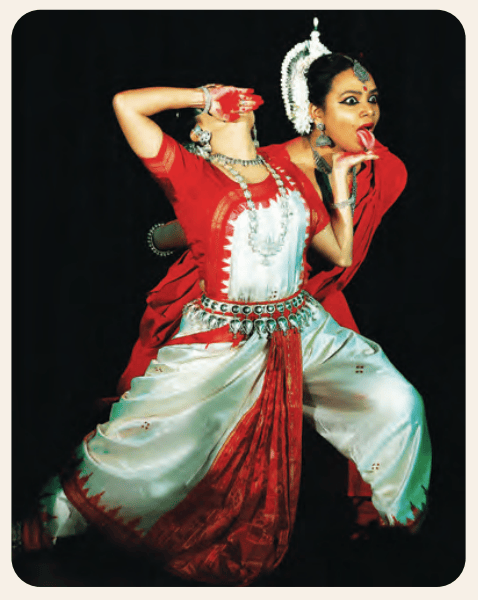
Fig. 10.10. Severed head of the Goddess Chhinnamastā depicted in Odissi by two dancers
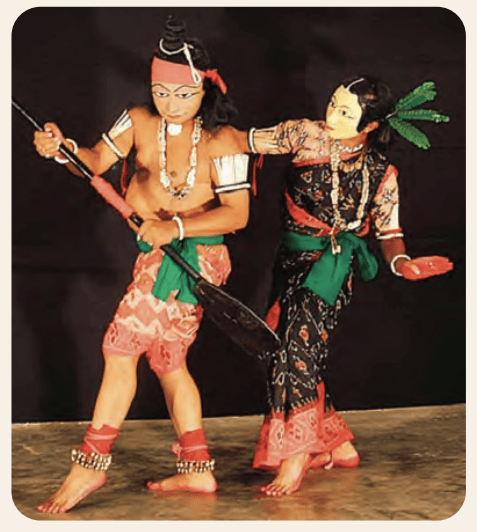
Fig. 10.11. The Boat Man (Nabik) in Seraikela Chhau, Jharkhand
Observe how the stance accentuates the act of rowing of the boat.
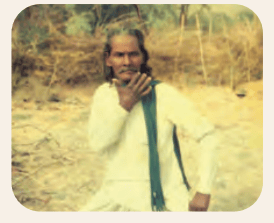
Fig. 10.12. Gambhir Singh Mura (1930–2002)
Gambhir Singh Mura (Padma Shri) was a prolific artist and teacher of the Purulia Chhau (a UNESCO recognised masked dance-drama from West Bengal), who worked extensively on organising indigenous and animal movements to develop the movement vocabulary of Chhau.
Let us explore
Try out the stance in Fig. 10.11 and see how you feel. What
expression do you think the dancer must have carried behind the
mask?
Do you know?
Mayurbhanj Chhau does not use mask and has stylised movements
of the body to express an idea or meaning, while Seraikella and
Purulia Chhau use impressive masks.
Vāchika Abhinaya — using verbal elements
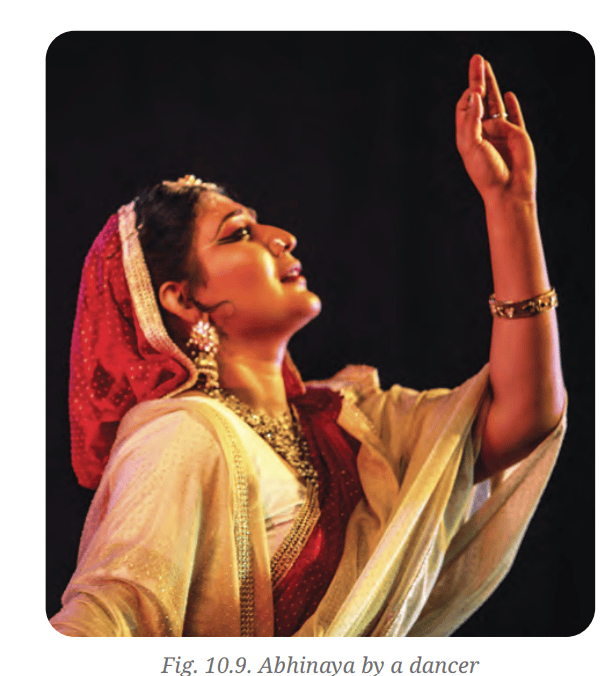
When the dancer uses vāchika (verbal elements) for expressive
communication, it is known as Vāchika Abhinaya. Verbal elements
include spoken or sung words, poetry, music, and rhythmic syllables
that support the dance.
The Mahārīs of Shree Jagannatha Temple (Odisha) and the temple
dancers of the Somnath Temple (Gujarat) and the Brihadeeswara Temple
(Tamil Nadu) traditionally sang as they danced, their voices resonating
within the garbha-gṛiha (inner sanctum) during ritual offerings.
During the annual Sāvan Jhūlā festival in Ayodhya, kathākārs narrate
stories from the Purāṇas through live singing and dancing, often
interspersed with humorous anecdotes to engage the audience and
convey spiritual messages.
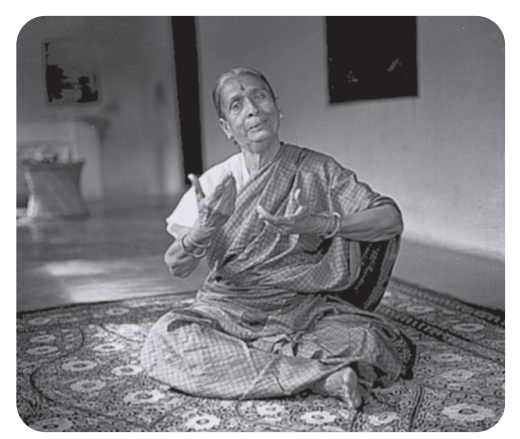
Fig. 10.13. Abhinaya by Mylapore Gouri Amma (1892–1971)
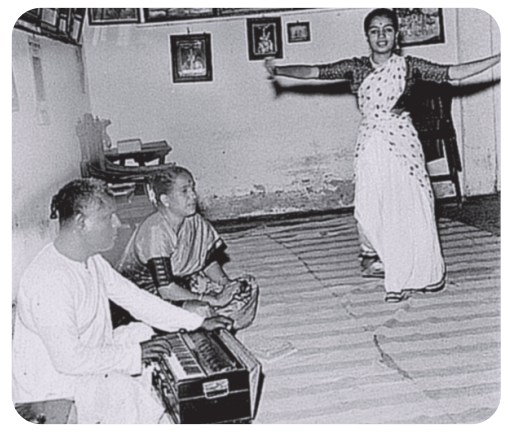
Fig. 10.14. Archival image of Sadir artists singing live while dancing
Āhārya Abhinaya — using appearance
Costumes, jewellery, make-up, and props help create the character and mood.
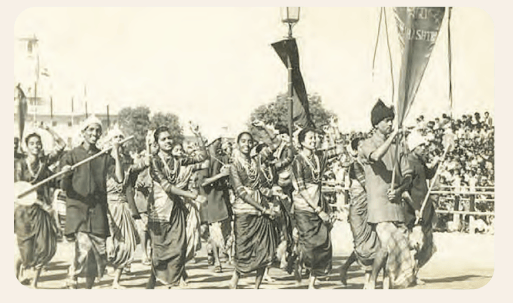
Fig. 10.15. Kolī was presented at the first
Republic Day Parade on 26 January 1950
The movements of the Kolī dance of the fisherfolk community of Maharashtra are a mimetic representation, portraying the rowing of boats, casting of nets, waves of the ocean, etc., using oars and fishing nets as props.
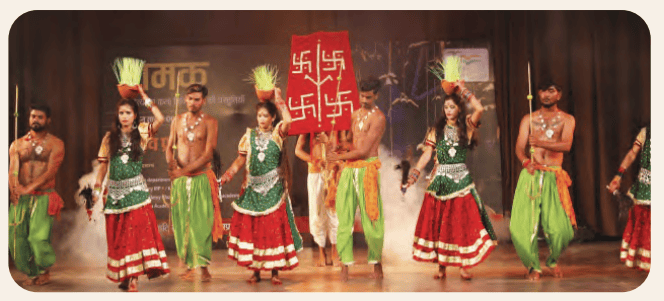
Fig. 10.11. The Boat Man (Nabik) in Seraikela Chhau, Jharkhand
In Pulikaḻi (the Tiger
Dance of Kerala), body
painting and a tiger
mask are coupled with
ferocious movements.
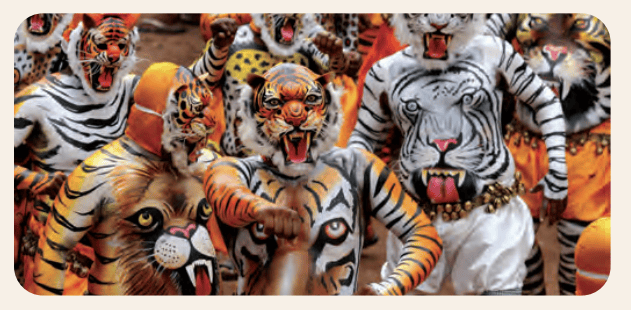
Fig. 10.12. Gambhir Singh Mura (1930–2002)
GPulikaḻi pioneer Chathunni Asan participated
in the famous Pulikaḻi performed during the
Onam festival (Thrissur, Kerala) for 60 years
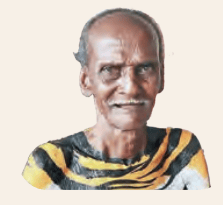
Fig. 10.18. Chathunni Asan
(1941–2019)
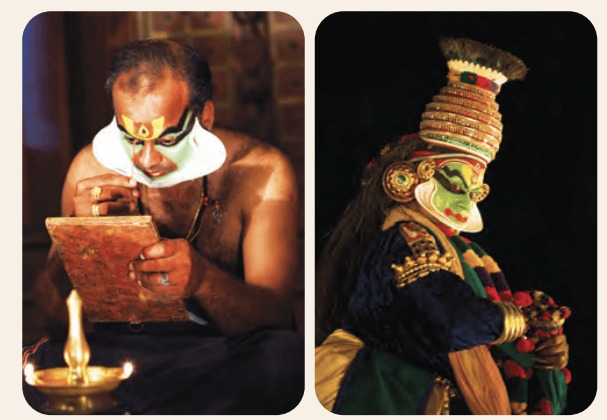
Fig. 10.19. Kathakali make-up
Kathakali artists’ makeup in progress. This
dance form has elaborate
make-up and costumes,
with different face
colours and headgear
for different male
characters. The white
make-up accessory is
made out of rice mixture.
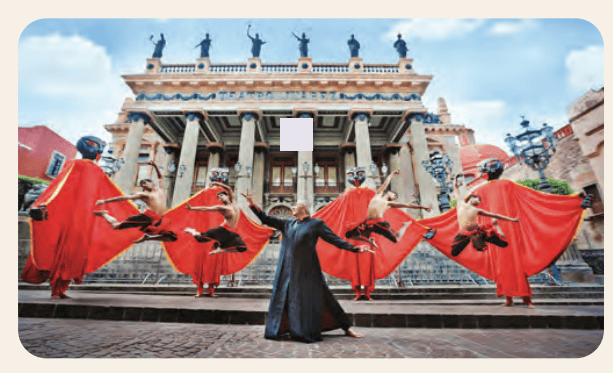
Creative use of masks and stilts as props by Astad Deboo (Padma Shri), who was a pioneer of contemporary dance in India.
Fig. 10.20. Astad Deboo (1947–2020)
Let us explore
Recreate a tiger dance with your own interpretation.
Sāttvika Abhinaya — using inner emotion
The term ‘sāttvika’ is derived from ‘sattva’, which indicates purity and harmony. In the context of abhinaya, Sāttvika is an immersive enactment in which the dancer generates and projects deep feelings and distilled emotions that are then felt by the audience. A dancer’s concentrated mind brings forth the inner feeling through focus and clarity, making the expression genuine, believable, and heartfelt. Dancers draw on observations and experiences from life. Dance maestros of India were known for conveying emotions (with bhāvas to recreate rasa) to the entire audience through their Sāttvika Abhinaya.
Let us recall
Revisit the concept of bhāva and rasa as studied in your Grade 8 textbook Kriti.
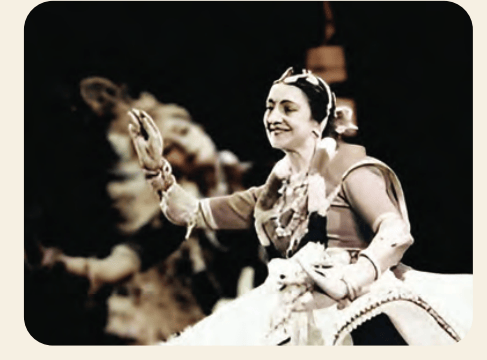
Fig. 10.21. Ranjana Jhaveri (1930–2017)
Rādhā in ‘bliss’, dancing with Kṛiṣhṇa, as depicted by Ranjana Jhaveri in Manipuri. She and her sisters became the first dancers from outside Manipur to learn Manipuri and disseminate it to the world audience. She was renowned for her beautiful, expressive quality.
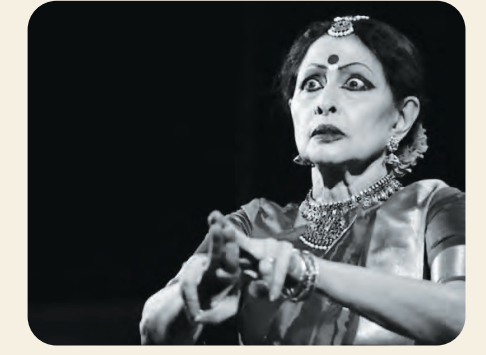
Fig. 10.22. Saroja Vaidyanathan (1937–2023)
‘Anger’ as depicted by the Bharatanatyam exponent Saroja Vaidyanathan (Padma Bhushan), who was known for her many innovative choreographies and prolific teaching.
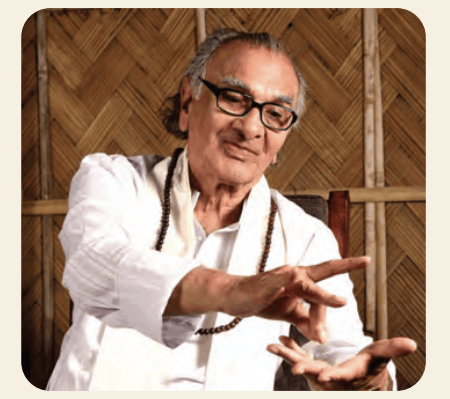
Fig. 10.23. Jatin Goswami (1933–Present)
Using the fingers to depict a bee buzzing around a flower. Observe how the eyes convey the expression of a bee concentrating upon extracting nectar from the flower.
Sattriya maestro Jatin Goswami (Padma Bhushan), who played a pivotal role in bringing Sattriya out of the Vaishnavite monasteries (sattrās) of Assam and onto the modern stage, both nationally and internationally.
Sattriya maestro Jatin Goswami (Padma Bhushan), who played a pivotal role in bringing Sattriya out of the Vaishnavite monasteries (sattrās) of Assam and onto the modern stage, both nationally and internationally.
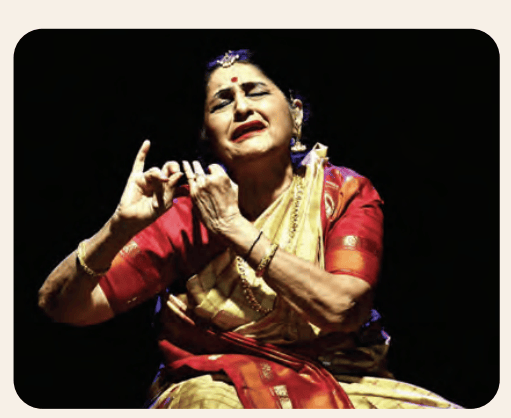
FFig. 10.24. Kanak Rele (1937–2023)
Kanak Rele portraying
‘pain’ and ‘fear’ in
Mohiniyattam. A Padma
Bhushan awardee, this
pioneer of Mohiniyattam
was not just a dancer,
academician, scholar, and
educator but also a lawyer.
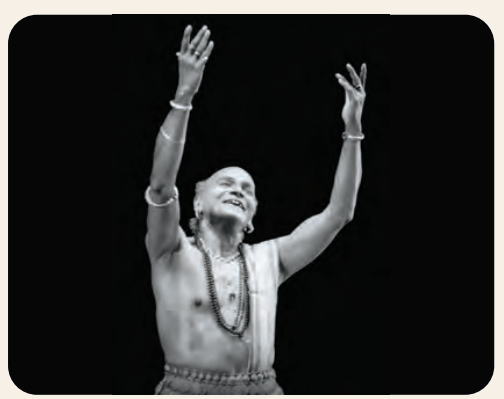
Fig. 10.25. Kelucharan Mohapatra
(1926–2004)
Odissi exponent Kelucharan
Mohapatra depicting ‘joy’. He
is credited with the revival
and popularisation of Odissi
and is the first individual to
receive the Padma Vibhushan
from Odisha
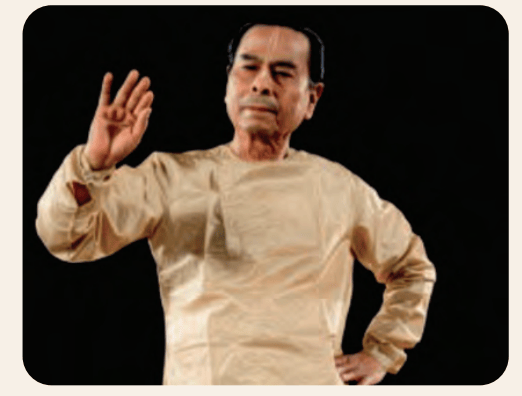
Fig. 10.26. Bipin Singh (1918–2000)
Bipin Singh’s expression of
serenity. He was a distinguished
Indian choreographer, teacher,
and scholar, celebrated for his
pivotal role in popularising
Manipuri across India
and internationally.
Activity 10.4
Experience dance: one of the best ways to learn is to observe!
Watch a live dance performance, or watch the
video screening of a dance performance in school.
It is time to begin your journey with journalling.

◈
Describe the dance form you watched or the music you heard.
◈
After watching the programme document in your journal.
◈
Describe whether you enjoyed the song, rhythm, and tempo.
◈
Mention the different āṅgika elements used (do not miss the hand gestures).
◈
Which part of the dance did you enjoy most? Did it bring to mind any particular emotion in you? Describe your feelings.
◈
Describe the costume, props, and stage decor (if any). Could you connect it to any particular region of the country? Explore these further.

Note to the teacher: Invite a dancer or troupe to perform at school.
Dance in Cinema
You must have seen many dances in the films you have watched in the past. Did you recognise any similarities between the various Indian dance forms you have been introduced to so far? From its earliest times, Indian cinema has incorporated dances based on various Indian dance traditions. Older Hindi movies like Jhanak Jhanak Payal Baje, Mughal-e-Azam, Pakeezah, and Amrapali, the Tamil movie Thillana Mohanambal, the Telugu movies Sankarabharanam and Swarnakamalam, the Marathi movie Sangte Aika, and the Odia movie Maa featured excellent portrayals of Indian dance traditions. Even globally, in 1957, the IndoSoviet co-production film titled Pardesi, also known by its Russian title Khozhdenie za tri
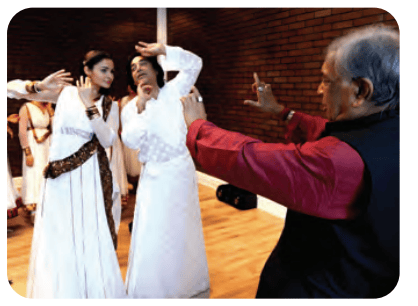
Fig. 10.27. Scenes from the movie Vishwaroopam
morya (Journey Beyond Three Seas), featured a dance representing a temple dancer resembling Bharatanatyam. More recently, the Manipuri film Sanabi and the Tamil film Sringaram have been appreciated as films potraying dances. Many other dances in films have been inspired by Indian traditions in recent times, like Bhangra in Jab We Met, Kathak in Devdas, Ghoomar in Padmavat, Garba in Hellaro, Bharatanatyam in Manichitrathazhu, the Gussādi dance of the Lambadi community in Bahubali: The Beginning and Lāvaṇī in Natarang.
Do you know?
The first dance film, Kalpana, was made by the legendary creative
dancer Uday Shankar way back in 1948. You may watch it online.
Discussion circle
Do you have any favourite dance forms from films with Indian dance
at its roots?
Kumari Kamala (Kamala Lakshman) was an Indian dancer and actress who began her career as a child artist and appeared in almost 100 Tamil, Hindi, Telugu, and Kannada films during her lifetime. She starred in the first Technicolour Tamil film Konjum Salangai (1962), with Bharatanatyam as a central theme. She was honoured with both the Sangeet Natak Akademi Award (1968) and Padma Bhushan (1970).
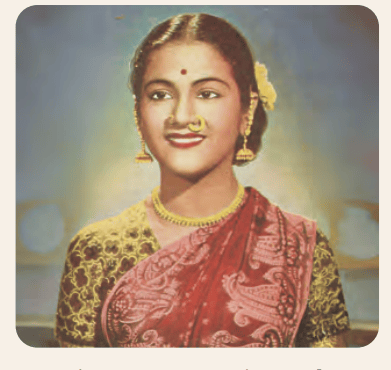
Fig. 10.28. Kumari Kamala
(1934–2025)
(1934–2025)
Activity 10.5
Your journal entry of cinematic dance
◈
Pick a dance sequence from a film and watch it with your classmates. It could be your favourite dance performance, a dance form belonging to your region or any of the above mentioned film dances.
◈
Discuss and correlate the performance to an Indian dance form.
Exercises
Q1. Which of these are not essential for proper body alignment?
i. Sauṣhṭhava
ii. Vāchika
iii. Rūpa
iv. Rekhā
Q3. Identify the abhinaya represented in the following pictures and fill in the blanks.
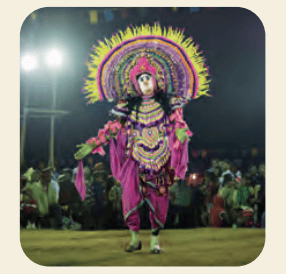
Fig. 10.29. Purulia Chhau costume
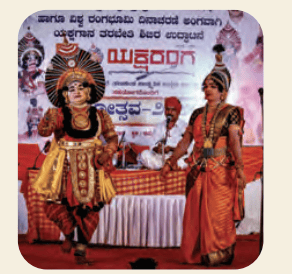
Fig. 10.30. Yakshagāna
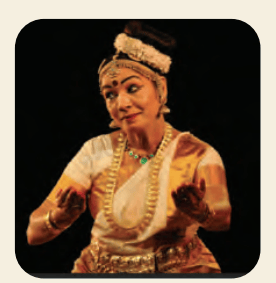
Fig. 10.31. Expression in Mohiniyattam
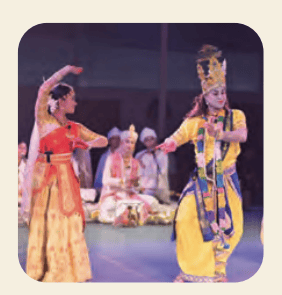
Fig. 10.32. Krishna
in Sattriya dance
Q4. Fill in the blanks with the name of a legend in the dance forms.
i. Kathak -
ii.. Sattriya -
iii Purulia Chhau -
v. Pulikaḻi -
v. Kathakali -
vii. Mohiniyattam -
vi. Odissi -
vii. Manipuri -
viii. Manipuri -
ix. Manipuri -
Q5. Journal: Present your observations based on the following:
i. The performance watched
ii. The cinema dance sequence
a. Explore your understanding of all the dance elements you have learnt in
this chapter in the above two dances.
b. Reflect on your choice of cinema dance sequence.
c. Analyse it based on all elements learnt in this chapter — body movements,
language, costume, emotional context, rhythm, and tempo.