12 Cultural Connections Through Dance

Culture connects people beyond boundaries. Our customs, social traditions, regional ideas, and beliefs together shape our culture. People from different cultures can connect and develop mutual respect through shared appreciation of diverse dance traditions. For example, dance forms like Dandiya and Bhangra have travelled beyond our borders with the Indian diaspora and are now being enjoyed across the world. They are no longer limited to a single community and have become part of the wider local culture wherever they are performed. Indian dance forms have also been adopted by international dancers promoting cross-cultural relations.
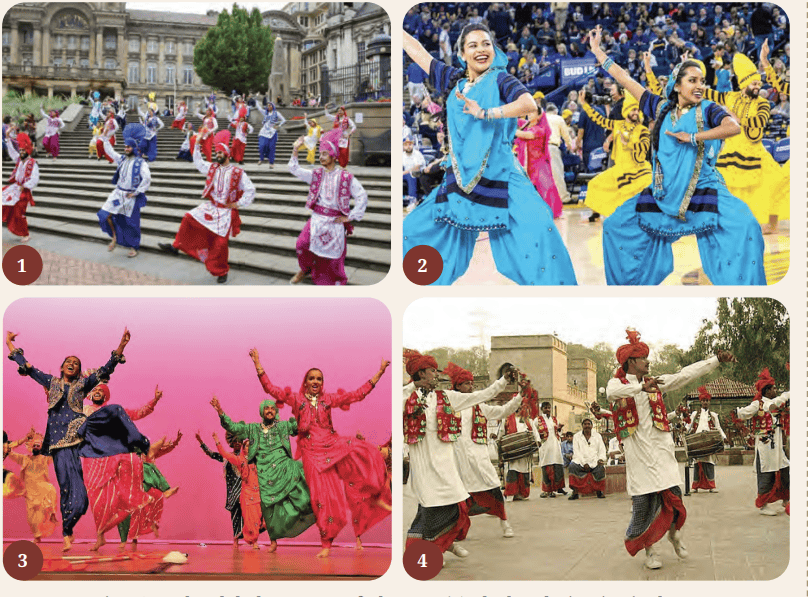 Fig. 12.1. The global presence of Bhangra (1) Flashmobs in Birmingham;
(2) Half-time performances at NBA games in the USA; (3) Stage competitions in
Singapore; and (4) Lohri celebrations in Punjab
Fig. 12.1. The global presence of Bhangra (1) Flashmobs in Birmingham;
(2) Half-time performances at NBA games in the USA; (3) Stage competitions in
Singapore; and (4) Lohri celebrations in Punjab
A Dance for Every Situation
Dance is a reflection of human experiences. From birth to death, you can find dances associated with every aspect of life in India. Many dances are performed to celebrate key moments in life — Badhāī of Madhya Pradesh and Sohar of Bihar are performed to celebrate birth, while Khoriyā of Haryana and Chholiyā Nṛitya of the Kumaon region of Uttarakhand are performed at weddings and in processions. NaṭaSaṅkīrtana of Manipur is an integral part of funeral rituals in the Vaishnavite communities of the region. Nāṭī of Himachal Pradesh is a colourful dance performed at weddings, among other celebrations. Jhūmar of Bihar is a celebratory dance that is performed year around.
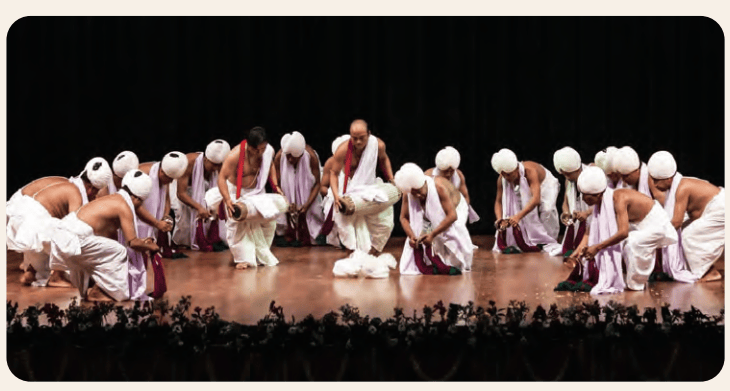
Fig. 12.2. Naṭa-Saṅkīrtana of Manipur
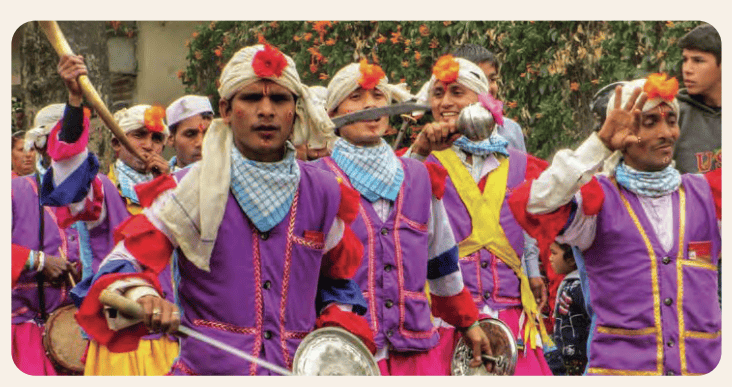 Fig. 12.3. Chholiyā Nṛitya of Kumaon, Uttarakhand
Bārḍo Chham from Arunachal Pradesh symbolises the journey between death and rebirth and is presented as the victory of good over evil. India also has numerous harvest festival dances, such as Bihu from Assam and Hojāgirī from Tripura. Taraṅgmel of Goa is a vibrant community dance in which performers carry colourful flags as props and move to various percussion instruments such as the dhol and tāśhā. Often, the dancers rhythmically, and in unison, cry out the words ‘ho ho’, which energises them and helps maintain coordination. The Ummattāṭ from Karnataka begins with an invocation to the river Kaveri and has its origins in harvest festivals.
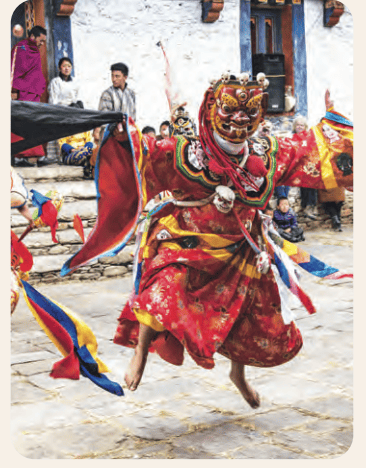
Fig. 12.4. Bārḍo Chham from Arunachal Pradesh
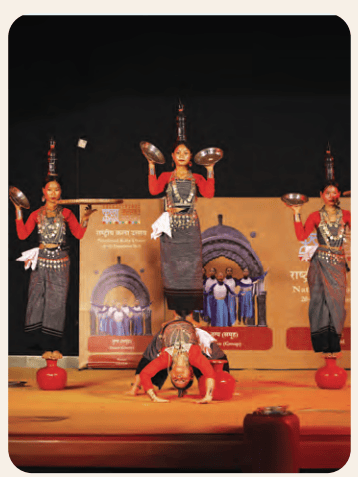
Fig. 12.5. Hojāgirī from Tripura
Safety disclaimer: Do not imitate these dance forms without teachers’ supervision.
Rani Machaiah was awarded the Padma Shri in March 2023 for her work in preserving and popularising the Ummattāṭ folk dance of the Koḍava community in Karnataka
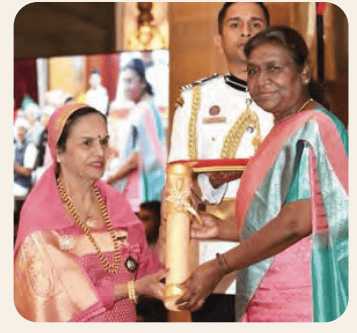
Fig. 12.6. Rani Machaiah receiving the Padma Shri from the honourable President of India Droupadi Murmu
Journalling your own dance culture
◈ Find information on the folk, tribal, popular, classical, and contemporary dances from:
• your State/ Union Territory of residence; and
• any State/ Union Territory that does not share a geographic boundary with your State/ Union Territory of residence.
◈ Organise the information and photographs you collect into your journal. Write about the different details of the dance practice, such as the instruments, songs, recurring syllables, and costumes associated with the dance, as well as the occasions for performance, venues, etc.
Become a part of your chosen dance culture
◈ Divide yourselves into groups of four or five. Discuss amongst each other and choose two dance forms, one from your region and one from a different region, based on the dances you have chosen.◈ Using videos and other available resources, learn dance movements from the two dance forms that you have researched in Activity 12.1.
◈ Discuss the signature movements and other aspects of the dance that are appealing to you within the group.
◈ As a group, introduce the dance forms to the rest of the class and present short performances of the two dance forms.
Cross-cultural collaboration in dance
Create and perform a short dance piece, combining elements from two dance forms selected by your group. You may continue with the selection made by your group in Activity 12.2 or choose two other dance forms. Be creative while remaining respectful to both the dance traditions you are fusing in this collaboration. What was your experience in fusing the two dances respectfully?

Note to the teacher: Encourage students to present their dance choreography at events such as a school assembly, annual function, etc.
Dance voices — be a dance podcaster/ interviewer
This activity has three stages: Pre-production, Production, Postproduction
◈ Compile a list of dance schools, institutions, organisations, and well-known dance artists in your region and neighbouring regions. Remember that a dance school or institution is not only a place to learn dance but also a cultural resource centre for the local community.
◈ Prepare a set of questions about the functioning of a dance organisation or the life/ career journey of a dance artist or a dance teacher.
◈ Encourage curiosity and open-ended inquiry. Every question helps uncover something new and adds to the learning process. Production: Focuses on conducting and recording the interview
Production: Focuses on conducting and recording the interview
◈ Visit the selected dance school/ institution/ organisation/ dance artist in a group along with a teacher.
◈ Assign roles: Some members act as podcast interviewers, while others handle lighting, recording, and technical support.

◈ Conduct the interview preferably in video format; if not possible, an audio recording may be used.
Post-production: Involves shaping the recorded material into a polished podcast and highlighting key moments from the experience

◈ If it’s possible, edit the recorded content to create the final dance podcast.
◈ You may also create short excerpt videos or highlight key moments and important learnings from the interaction, especially inspirational insights shared by the artist that can be applied to daily life.
◈ Present your key takeaways in class.
Note to the teacher: Divide students into groups based on the number of artists/ institutions accessible for an interview. If there are limitations related to meeting artists in person, students may conduct online or telephone interviews with the dance practitioners. In such cases, students can summarise the conversation, reflect on their experience, and present their findings in any convenient format instead of producing a full interview.
One Story, Many Renditions
Trade and travel from the eastern shores of Bharat since the first century BCE led to significant cultural, religious, and linguistic exchanges. It is believed that the region of Kaliṅga has records of Bāli-yātrā from the third century BCE, which is a festival marking the beginning of trade voyages that commenced after the monsoons, on Kārtika-Pūrṇimā. Even today, Bāli-jātrā is celebrated in Odisha with vibrant songs and dances, keeping alive the memory of those ancient maritime traditions.
From the seventh to the fourteenth century CE, a shared movement and performance vocabulary began to emerge across Southeast Asia.
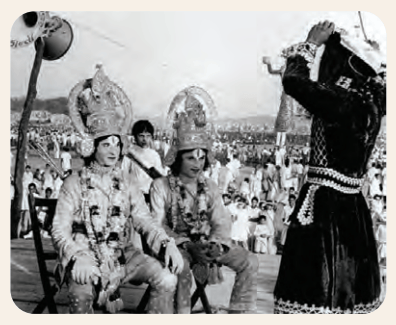
Fig. 12.7. Rāmalīlā, August 1949 Lord Rāma and Lakṣhmaṇa are receiving Vibhῑṣhana, the brother of Rāvaṇa
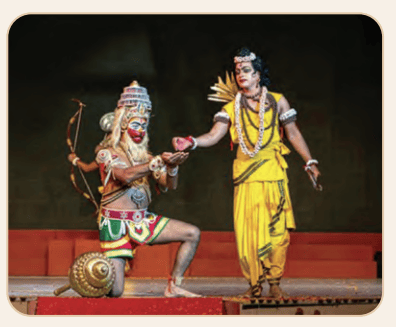
Fig. 12.8. Scene from Rāmalīlā
The popular dance-theatre tradition of Rāmalīlā, which has its roots in
the Kuśhῑlava traditions, developed in the form we see today during the
seventeenth century CE and is performed around the festival of Dussehra
(Vijaya-daśhmī).
The Rāmāyaṇa became a central theme and was interpreted, retold,
and danced in the performing arts of several regions, each adapting the
narrative to its own cultural style, dance language, and local aesthetics.
This is an example of how the same story connects different dance
traditions around the world.
| Chapter 10: Components of Dance | ||
|---|---|---|
| Region/ Country | Local name of the Rāmāyaṇa tradition | Form of presentation/ Dance style |
| Thailand | Ramakien | Performed through the classical masked dance-drama form—Khon |
| Java (Indonesia) | Sendratari Rāmāyaṇa | A large-scale dance-drama presented in open-air theatres |
| Bali (Indonesia) | Kecak | Performed with a rhythmic ensemble dance with vocal chanting (‘cak-cak’). |
| Myanmar | Yama Zatdaw | Performed as a dance-drama |
| Philippines | Singkil | A traditional dance narrating a segment resembling the Rāmāyaṇa |
| Laos | Phra Lak Phra Rām | A classical dance-drama adapting the Rāmāyaṇa narrative |
| Cambodia | Reamker | A Rāmāyaṇa version presented by the Royal Khmer Ballet through classical dance |
Note to the teacher: Play videos of different South Asian versions of the Rāmāyaṇa in class and ask students to observe characteristic elements such as signature movements, music, costumes, and make-up.
To deepen this cultural journey, let us take a brief look at how the
Rāmāyaṇa lives on beyond performance.
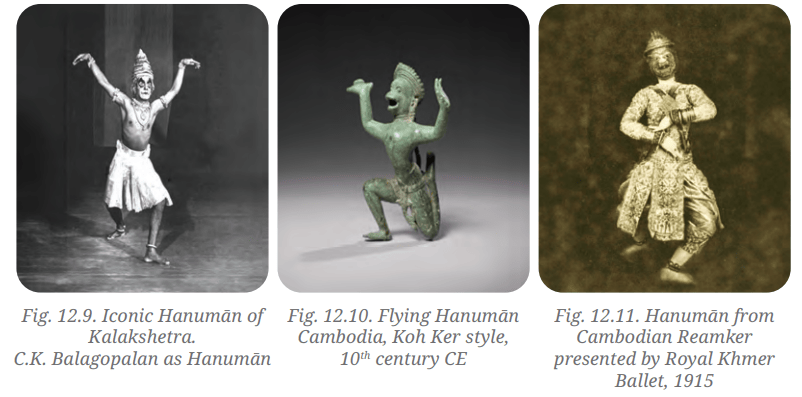
One of the most striking examples is the figure of Hanumān, whose form
appears in sculptures across Southeast Asian regions, each reflecting
local styles and artistic traditions.
A sculpture captures movement in stillness, and dance captures stillness even in movement!
A creative Rāmāyaṇa presentation
◈ In groups of three or four, select any episode from the Rāmāyaṇa and present it through a dance sequence in a style of the group’s choice.◈ Each group member may play a different role or character from the chosen episode.
◈ As you choreograph, explore whether elements from different Rāmāyaṇa presentations can be thoughtfully incorporated into your interpretation, such as characteristic gestures, group formations, musical patterns, costumes, or storytelling styles.
◈ The groups may choose any movement vocabulary or a combination of styles they are comfortable with to best present the episode.
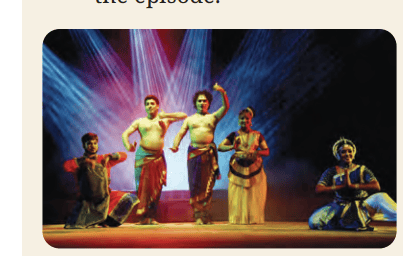
Fig. 12.12. Rāmāyaṇa in Indian dance
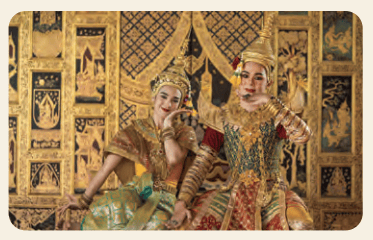
Fig. 12.13. Rāmāyaṇa in Khon dance from Thailand
EXERCISES
Q1. Name a dance form that has a global presence. Describe where it is
performed and by whom.
Q2. Match the following:
i. Dance in funeral rites a. Bihu
ii. Dance as a celebration
of good harvest b. Naṭa-Saṅkīrtana
iii. Martial art presented as
a dance c. Garba
iv. Dance for community
joy and togetherness d. Mayurbhanj Chhau
Q3. What is the importance of taking consent from the interviewee as a part of
the production process of any podcast/ interview.
Q4. Match the following:
i. Thailand a. Reamker
ii. Java (Indonesia) b. Phra Lak Phra Rām
iii. Bali (Indonesia) c. Ramakien
iv. Laos d. Sendratari
v. Cambodia e. Kecak
Notes
------------------------------------------------
------------------------