13 Dance Choreography
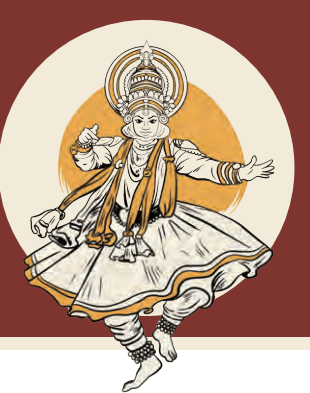

The first known thinker on the idea of choreography in India is Sage Bhārata, the author of the Nāṭyaśhāstra. More than 2000 years ago, he described a concept called ‘Piṇḍībandhas’, which are group formations characterised by clustering, weaving, linking, and moving in coordinated shapes.
Many of these ancient ideas appear in choreographies even today,
such as:
group formations and shapes;
◈
group formations and shapes;
◈
coordinated travelling patterns; and
◈
movement flow in unison or in opposition.

Choreography and Collaboration
In the context of Indian dance, one would use the term ‘nṛityasaṁrachanā’ (dance creation) to refer to dance choreography.
Creating a dance piece involves imagination, planning, teamwork, and
the thoughtful use of all the elements and techniques of dance and
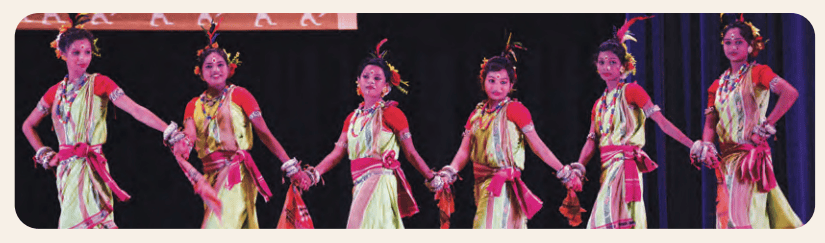 Fig. 13.1. Interlinked hands in a dance formation
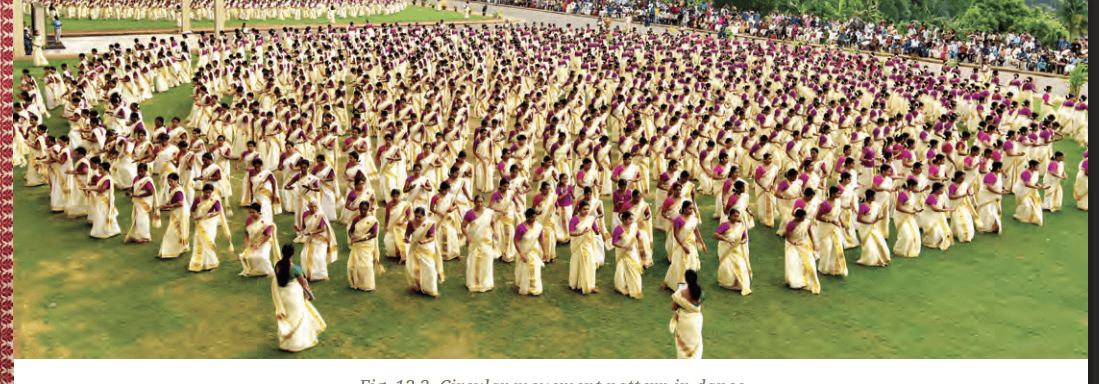 Fig. 13.2. Circular movement pattern in dance
movement you have learnt so far. A choreographer works collaboratively
with the dancers to shape ideas, experiment with movement, and refine
them before the final presentation. The soundscape can be instrumental,
lyrical, or even silent! The choreographer can choose to match the rhythm
or create cross-patterns with rhythm. The possibilities are endless…!
A choreography includes the following:






Now, let us explore the two aspects of choreography — movement patterns and use of space.
Movement patterns in choreography
There are infinite ways in which patterns can be created through
movement. The process of creating movement patterns can include:
◈
linking movements into sequences;
◈
designing shapes with the body;
◈
arranging dancers into formations; and
◈
creating symmetry or asymmetry.
Movement patterns in choreography carry layered meanings, especially
within folk traditions. Rooted in everyday life and collective experience,
these patterns emerge through simple steps, repetition, and group
formations. In Indian regional dances, such movement vocabulary
becomes a reflection of community life like shared work, social bonds,
and collective celebration expressed through bodies moving together
in rhythm.
Human formations, such as pyramids, are commonly seen in several
Indian dance forms.
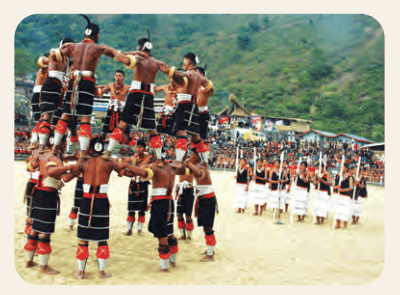
Fig. 13.3. Dance by the Naga Community, Hornbill festival
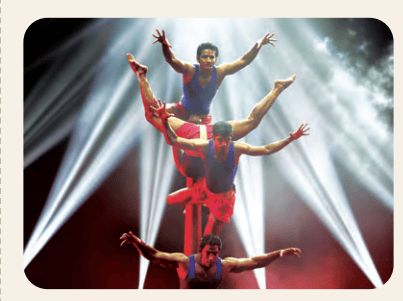
Fig. 13.4. Mallakhamba from Maharashtra
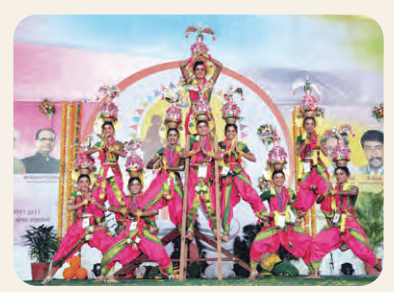
Fig. 13.5. Karagāṭṭam from Tamil Nadu
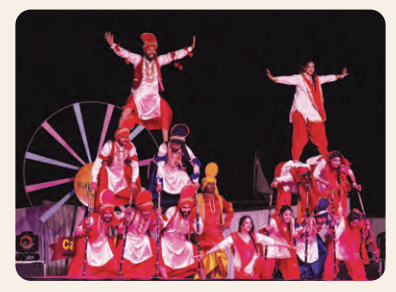
Fig. 13.6. Bhangra dance from Punjab
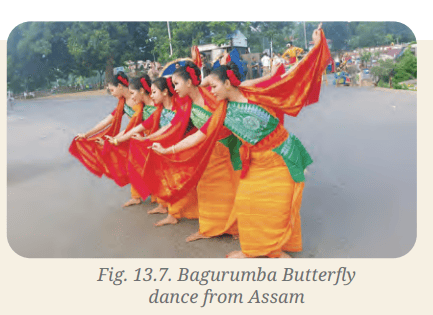
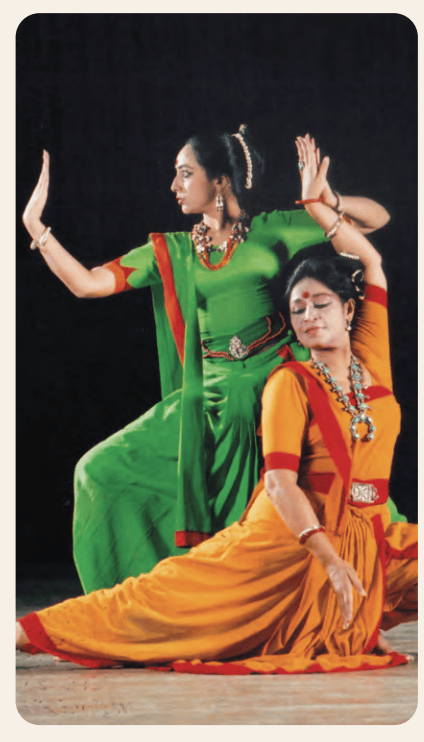
Fig. 13.8. Manjushree and Ranjabati Chaki Sarkar as Māyā and Prakṛiti in Modern Indian dance (Nava Nritya)
Nava Nritya of Manjushree
Chaki Sarkar
Manjushree Chaki Sarkar
was trained in Indian dance
forms in Kolkata in the 1950s.
She later spent several years
in the USA, where she was
exposed to Western modern
and contemporary dance.
On returning to India, she
felt the need to develop a
new contemporary dance
vocabulary rooted in Indian
aesthetics. Drawing on her
background in cultural
anthropology, she reimagined
her work as Nava Nritya,
creating a new dance
vocabulary based on Indian
aesthetics. She was assisted
in this work by her daughter
Ranjabati.
She received the Sangeet
Natak Akademi award in
1994.
Spatial usage in choreography
One of the key skills of a choreographer is to understand the dancing space. Mapping the dance floor to make various lines and shapes enables the choreographer to visualise the possibilities of movement patterns.
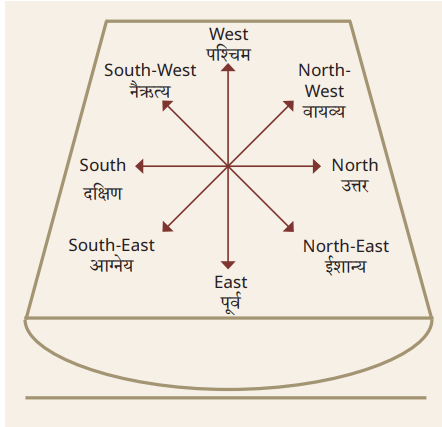
AUDIENCE
Fig. 13.9. Stage directions – Performers face Fig. 13.10. Present-day stage divisions East (stage directions are not compass-based)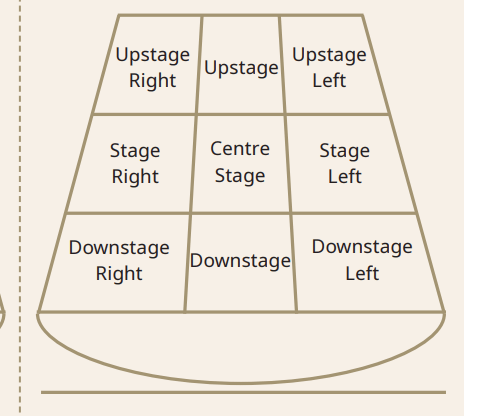
AUDIENCE
Fig. 13.10. Present-day stage divisionsPlan a choreography
Using the diagrams of a stage with markings as shown above, plot where different dancers can position themselves to create different formations. You can choose the number of dancers you would like in your choreography. This can also be done physically with dancers in your space.S
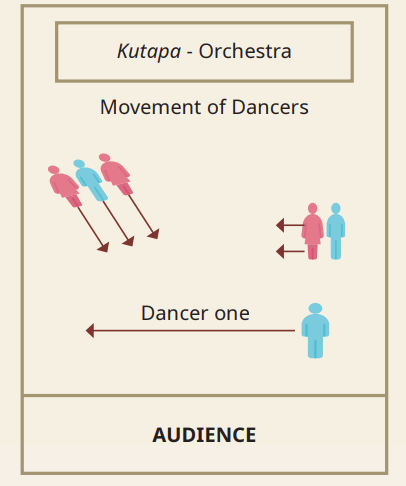
Fig. 13.11. Stage mapping
Creating your choreography
Divide yourself into four groups. Choose your lead choregrapher.
◈ First, each choreographer creates a solo movement portraying a concept of their choice (for example, contemporary theme, or depiction of nature like rain and thunderstorms, or celebration of festivals, etc.). They may choose any movement vocabulary they are comfortable with.
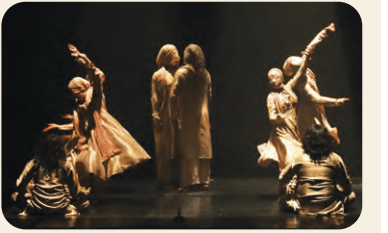
Fig. 13.12. Contemporary Kathak choreography
◈ Next, each lead choreographer must adapt their solo phrase into a group choreography, exploring formations, spacing, timing, and interaction.
◈ The choreography can include aspects of all four abhinayas, such as:
- expressive, stylised movements (use of hand gestures, animation, and mime);
- rhythmic syllables and spoken word;
- props; and
- emotional expression.
◈ Each solo choreographer presents their choreography, followed by the group performance of the same.
◈ Observe each group’s performance and explore how it can change and how expression changes with group interaction and usage of space in a:
- solo performance; and
- group performance

Note to the teacher: The number of lead choreographers,
grouping, presentation mode, and occasion, etc., may be
decided based on the teacher’s or group’s discretion. Encourage
students to perform their work in class or at a school event.
When we choreograph, we collaborate, and when we create, we connect!’
Reflectionsy
Reflect on and analyse the choreography created in Activity 13.2. Review your performance and ask for feedback from your peers and experts. Record it in your dance journal.◈ Self-Review: Were you able to communicate your concept clearly through your choreography? What worked well?
◈ Self-Review: Were you able to communicate your concept clearly through your choreography? What worked well?
◈ Self-Review: Were you able to communicate your concept clearly through your choreography? What worked well?
Well-being discussion circle
Prompts may include the following:◈ Now that you have completed your journey with dance and movement this year, discuss your experiences and observations of the various concepts you have learnt and practised.
◈ Reflect on your experiences of creating, sharing, and collaborating.
End the circle by identifying your silver lining! Find something positive you discovered about yourself, your group, and the creative process
स्वयं वितर्क्स कर्तव्यं हस्ताभिनयनं बुधैः ||
- नाट्यशास्त्र, 9.155
Ākrityā cheşhțayā chihnairjātyā vijñāya tat-punaḥ ||
Svayam vitarkya kartavyam hastābhinayanam budhaiḥ ||
- Nātyaśhāstra, 9.155
Sage Bharata, the author of the Nāṭyaśhāstra, tells us that once we understand the basics of the form, the movement, and the meaning, we must think creatively and shape it in our own way. The Nāṭyaśhāstra gives us guidance, but the dancer must bring imagination.
EXERCISES
Q1. Identify any visual patterns you see
around you in your daily life. Connect
them with signature movements
of any regional dance forms. Make
a table of the visual patterns and
connected dance forms.

Fig. 13.13. Milky Way Galaxy
Q2. Mention any three dance forms
where you see similar visual pattern
as in Fig.13.13.
Q3. Draw your choreography mapping
with directions of either:
i. stage settings with musicians,
sets, and props; or
ii. placement and movements of dancers.
Q4. Journal your reflections. Analyse your choreography in your
dance journal. Explain your chosen theme, the choreographic
patterns, and reason for choosing various dance elements
for the choreography.
Q5. You have learnt about rekhā, or creating beautiful lines. In which dance
forms could you identify the geometrical shapes?
Q6. ‘Where there is a body, there is dance. Dance begins not with perfection,
but with sensitivity to the mover.’ Discuss the concept of body inclusivity in
dance as per your understanding.
Q7. ‘A sculpture captures movement in stillness and dance captures stillness
even in movement.’ Discuss this statement with your understanding of
both Indian and Southeast Asian dances.
Practical
Q8. Put together a movement phrase or a dance sequence with all the elements
of dance that you have learnt. Think of your body alignment, breath, shapes,
footwork including jumps and spins, and arm movements with hand
gestures. Add appropriate rhythmic syllables, keeping in mind rhythm
and tempo.
Q9. Present a group dance with any form that you have explored in class, being
mindful about collaboration and coordination.
Q10. Create a thematic presentation. Be mindful of the various abhinayas that
you are using. Think about the choreography pattern you are going to use.