
Chapter 14
Exploring the Fundamentalsn of Visual Arts
Visual Arts
Note to the Teacher
The Visual Arts chapters lay emphasis on daily practice, guiding students in the application of fundamentals as they discover the elements and principles of art and design in every aspect of their everyday life and surroundings. They will also expand their knowledge of materials, mediums and techniques, and learn to create their own compositions in a systematic and iterative way. You may modify the activities to suit your local context and the specific needs of your students. To ensure the best learning experience for every student, here are some points that need to be kept in mind.
The Visual Arts classroom needs:
- adequate space for students to sit and work comfortably;
- sufficient lighting and ventilation;
- access to and proper storage of art materials, tools, basic stationery, and audio-visual facilities; and
- space for showcasing and exhibiting artwork periodically.
The Visual Arts pedagogy would need to:
- use storytelling and everyday examples when introducing concepts and processes;
- encourage students to freely express their original ideas, imagination, emotions, and curiosities in their artwork;
- encourage keen observations of everyday life and discourage copying images from other pictures and photographs;
- allow students to explore, investigate, experiment, collaborate, and have discussions (or engage in dialogue) in the classroom;
- include outdoor activities periodically, for example, drawing plants, animals, people, and objects from their surroundings in different seasons;
- organise field trips; visits to museums, heritage monuments, and melas to enable students to observe the life and culture around them;
- invite local artists and craftspeople to conduct interactive sessions and workshops that offer students hands-on experiences;
- emphasise routines of cleaning up after work (such as putting back materials they use and maintaining art materials with care); and
- encourage students to participate in deciding the selection of artwork for classroom display or exhibitions.
Visual Arts Assessment should be based on the following Competencies for the Secondary Stage
C 1.1 Evaluate own interest in Visual Art forms by considering its scope of practice and application (Fine Arts, crafts, applied art/ design, Art research and management)
C 1.2 Initiate discussions and take steps to find more information and resources to pursue their interest in the Visual Arts
C 2.1 Apply the elements and principles of Visual Arts into their artwork and incorporate these into their routine life
C 2.2 Analyse the development of visual expression across a series of works
C 3.1 Extend explorations and refine techniques in the Visual Arts through regular practice
C 3.2 Incorporate ideas and elements from various genres of Indian Visual Arts (traditional, popular, contemporary) into their artwork
C 4.1 Analyse commonalities and differences among diverse forms of Visual Arts, cultures, and aesthetic sensibilities in India and the rest of the world
C 4.2 Evaluate artwork based on creative expression, artistry, and social context
| Learning Outcomes That Can Be Assessed Across All Chapters | ||
|---|---|---|
| Curricular Goals | Compe-tencies | Learning Outcomes |
| 1 | C–1.1 | Journal their interests, observations, and experiences through visuals and notes |
| 2 | C–2.1 | Practise basic Visual Arts processes regularly (for example, the student spends 10–15 minutes every day to create a drawing from observation) |
| 3 | C–3.1 | Demonstrate familiarity with the use and maintenance of materials and tools used in Visual Arts |
| 1 | C–1.1, C–1.2 | Express their interests in various branches of Visual Arts and make inquiries about visual artists |
| Chapter 14: Exploring the Fundamentals of Visual Arts | ||
|---|---|---|
| Curricular Goals | Compe-tencies | Learning Outcomes |
| 1 | C–1.1 | Journal their interests, observations, and experiences through visuals and notes |
| 2 | C–2.1 | Practise basic Visual Arts processes regularly (for example, the student spends 10–15 minutes every day to create a drawing from observation) |
| Chapter 15: Mediums and Techniques in Visual Art | ||
|---|---|---|
| Curricular Goals | Compe-tencies | Learning Outcomes |
| 3 | C–3.1 | Demonstrate familiarity with the use and maintenance of materials and tools used in Visual Arts |
| 3 | C–3.1 | Practise colour exercises using a variety of materials and mediums |
| 3 | C–3.1 | Apply perspective techniques to show spatial depth in their artwork |
| 3 | C–3.2 | Create a three-dimensional artwork using a handcrafting technique from any part of India (for example, relief in clay, bamboo crafts |
| Chapter 16: Visual Composition | ||
|---|---|---|
| Curricular Goals | Compe-tencies | Learning Outcomes |
| 3 | C–3.1 | Create multiple iterations in the process of developing their ideas and making artworks |
| 2 | C–3.2 | Compare multiple iterations of one’s own artwork to explain how the arrangement of visual elements convey different meanings and emotions |
| Chapter 17: Branches of Visual Arts | ||
|---|---|---|
| Curricular Goals | Compe-tencies | Learning Outcomes |
| 1 | C–1.1, C–1.2 | Express their interests in various branches of Visual Arts and make inquiries about visual artists |
14 Exploring the Fundamentals of Visual Arts
Art is a reflection of society. It shows how people have experienced life at different stages through the ages, and how they have responded to their surroundings. The Visual Arts is a very powerful means of expression, especially when you cannot find words to express something.
Making visual artwork will help you discover your hidden strengths and unique qualities. You will be able to spend long periods of time imagining, reflecting, pondering, researching, and experimenting in creative ways.
Through the Visual Arts, you will explore unknown terrains. Since explorations need preparation, read the following section carefully and discuss every point in class so that you can help one another while facing challenges during your discoveries.
Essentials for a Visual Artist
Visualise a special bag having multiple compartments full of art materials. Begin by gathering these essentials in your bag.
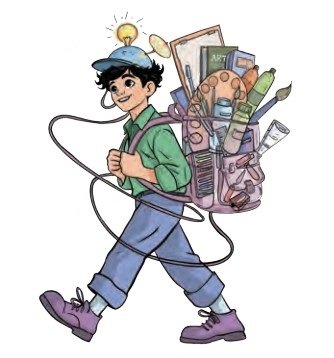
| S.No. | Stationery | Art Materials |
|---|---|---|
| 1. | Journal |
|
| 2. | Pencil | A pencil and sharperner |
| 3. | Glue | A small glue stick or bottle of gum/ glue |
| Desirable Traits of a Visual Artist | ||
|---|---|---|
| 1. | Curiosity | To observe and know the world |
| 2. | Wonder | At the beauty of life and your surroundings |
| 3. | Desire | To express yourself |
| 4. | Courage | To explore new ideas |
| 5. | Motivation | To experiment |
| 6. | Commitment | To practice |
| 7. | Perseverance | To resolve challenges |
| 8. | Satisfaction | With your efforts |
| 9. | Aspiration | To improve |
| 10. | Respect | For your journey and that of others |
| 11. | Gratitude | For what you have and the environment that has helped in your achievements |
Art Journal
A journal is a documentation or record of everyday experiences seen in different forms, such as handwritten diaries, sketchbooks, blogs, vlogs, photographs, reels, etc. Journals can contain text, drawings, pictures, moving images, sounds, and tactile materials.
Journalling is a healthy practice that helps us reflect on the way we think, emote, and relate to the world. For a visual artist or student, a journal is an important personal space for practice and growth.
You will use your journal through all activities. At the end of the term, you can compile your journals, sketches, drawings, and completed artwork to present them as your Visual Art portfolio.
Importance of a journal
- Captures a live moment or experience;
- Promotes keen observation;
- Records ideas and emotions in their nascent form, along with the date and time; and
- Helps in reflecting one’s own growth over longer periods of time.

Inspiring examples of visual journalling from history
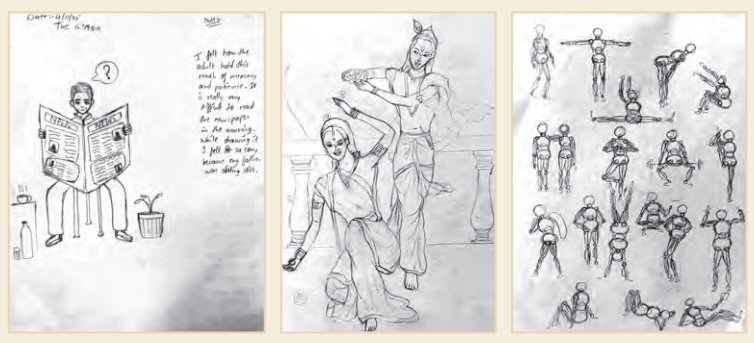
Visual artworks have been instrumental in helping historians and researchers understand events, people, and natural phenomena from the past. Although we may not know much about the languages of prehistoric people, their drawings and paintings on cave walls have provided many insights into their lives. Similarly, your journal would provide insights into how you think and feel.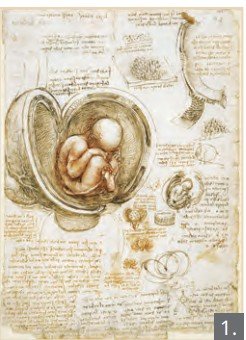
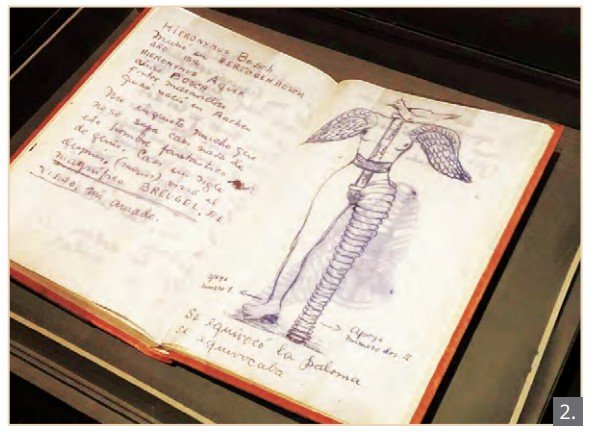
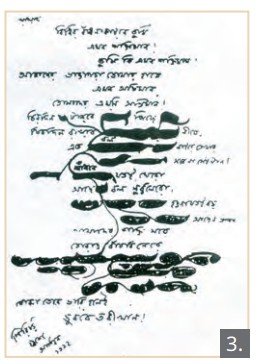
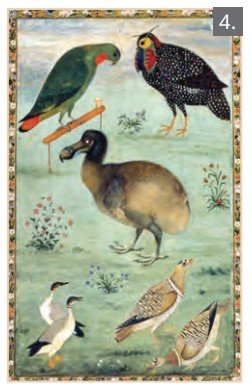
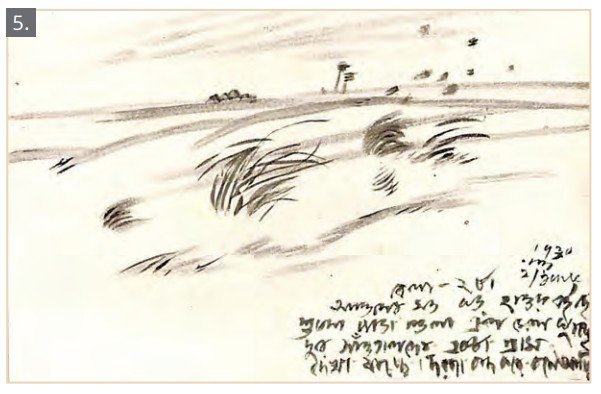
Just as scientists maintain log books and sportspersons record their performance timings, artists use journals to keep a record of their work and plan it. Find out more through this activity.
Activity 14.1
Explore artists’ journals in groups
Step 1: Make five groups.Step 2: Use books or digital resources to search for artists’ journals. You could also choose from the examples given in Fig. 14.1.
- Leonardo Da Vinci’s notebooks
- Frida Kahlo’s diary
- Rabindranath Tagore’s doodles
- Painting of birds and animals by Ustad Mansur
- Nandalal Bose’s illustration
Note to the teacher:
Prepare in advance by compiling pictures of artists’ journals from the internet or from books to provide students sufficient examples for this activity.Different Ways of Journalling
Drawing or sketching: It is used by artists, architects, and
designers to visualise their ideas; make small studies; and
work out solutions to problems.

Collage: It is used by artists who are interested in printed
matter or tactile surfaces. They collect pictures from
newspapers or magazines, textile scraps, samples of woven
fibres, etc., and paste these in their journal.

Photography: Smartphone cameras have made
photography accessible to many people. People
create digital photo journals based on different
themes that interest them.

Videography: Short videos lasting a few seconds to a minute
are also a form of journalling. This is also a common digital
medium these days.

Important reminders when journalling
- Focus on being authentic when you record your observations, thoughts, and experiences. Avoid attempting to impress others.
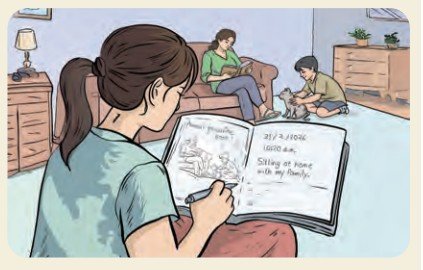
- Write the date, time, and place in each entry. For example, you could draw a quick sketch of an object or a person you have observed at home. Next to the drawing, write the date, place, and time like this: DD/MM/YYYY, 00:00 a.m./ p.m., sitting at home with my family.
- Include notes and thoughts with your drawings and pictures in the journal. For example, if you have pasted an interesting clothing pattern cut-out from a magazine, write about the elements that interest you and why.
- Set weekly goals and track your progress. You could decide to make one entry a day or spend more time on alternate days. At the end of each week, spend 10 minutes looking at your journal, check that you have written — the date, time, and other details — and assess your progress.
- Consolidate your journals at the end of each term. You may have made entries in more than one book.
Activity 14.2
Apply the elements of art
The elements of art are basic components that are used to create a visual artwork.- Dedicate a page in your journal for each of the seven elements of art.
- Create the element in many varieties using different materials.
- Create designs and patterns, and fill the entire page.
| Day | Element | Mediums and Techni-ques | Sugges-tions |
|---|---|---|---|
| 1. | Point | Pencils, pens, sketch pens, markers | Make dots of varying sizes. |
| 2. | Line | Pencils, pens, colour pencils, crayons, pastels, charcoal, chalk | Draw curvy, wavy, zigzag, dotted, dashed, and other types of lines in varying thickness. |
| 3. | Shape and Form | Pencils, pens, markers, crayons, paints | Doodle and create different shapes. Add light and shade to create a three-dimensional form. |
| 4. | Texture | Collage, frottage | Collect and paste textured materials. Create rubbings of textured surfaces and objects. |
| 5. | Colour | Crayons, colour pencils, water colours, poster colours | Play with blotches of colour in different mediums. |
| 6. | Value | Crayons, colour pencils, water colours, poster colours | Create colour tints, tones, and shades to show value. |
| 7. | Space | Any of the above mediums | Draw lines to demarcate the space on the page in interesting ways. Play with positive and negative space. |
Sketching
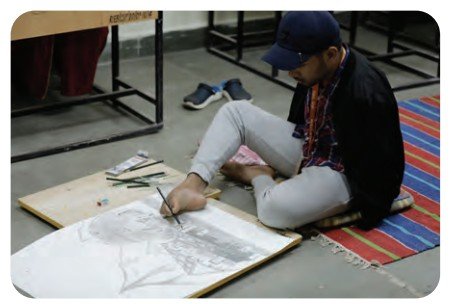
It is an exercise for spontaneous observation and drawing, which is used across many disciplines. It is similar to doing a warm-up and stretches practised by sportspersons. It is therefore very important to practise sketching regularly while observing your surroundings.
Avoid copying from other pictures.
Remember, the first steps are
always messy. When you start
sketching initially, it is natural to
experience dissatisfaction and
disappointment in your work. This is
when your dispositions help you to
pick up courage, commitment, and
perseverance. When you observe
more carefully and sketch repeatedly,
you will see your sketches improve
in a few weeks.
Sketching tips
- Sketches need not be perfect or contain too many details.
- Position yourself at a reasonable distance from the object or living being that you draw so that you can see the forms clearly.
- Always visualise the basic shapes before you draw.
- Draw the shapes lightly and quickly.
- Draw multiple times on the same image without using an eraser so that you can see your mistakes, corrections, and improvements.
- Observe the negative space and ensure that your sketch fits within your page.
- Capture the basic structure, placement, proportions, and postures along with the actions.
- Darken the lines and add details only when you are satisfied with the basic form and structure.
- Focus on the important parts while adding details.
Note to the teacher:
Refer to the activities in the textbooks Bansuri and Kriti that give details about drawing objects, people, and animals.Activity 14.3
Daily sketching schedule
The table below can help you schedule regular sketching with weekly targets. Aim to spend more than the minimum time mentioned here.Note: Sketch in your journal or on any paper which you can later paste into your journal. Write the date, time, and place.
| Minimum time per sketch | Themes | Sketches per day |
|---|---|---|
| 5 minutes | Objects in your school or home | 2 |
| 10 minutes | Plants/ landscapes in your school/ home | 2 |
| 10 minutes | Animals, insects, birds, and other life forms in your natural surroundings | 1 |
| 10 minutes | Different actions/ postures | 2 |
| 15 minutes | Buildings and architectural details | 1 |
| Weekly target | 8 sketches |
Activity 14.4
Apply the principles of visual design
1. Revise the principles of visual designThe principles of visual design are important concepts that help us improve the aesthetic qualities of artworks. These principles guide the structure, arrangement, and overall composition of visual elements.
The six principles you will examine are:- unity and harmony;
- balance;
- rhythm and movement;
- emphasis;
- proportion; and
- hierarchy (order of importance).
2. Observe and analyse the principles of design in printed material around you, including textbooks of other subjects.
3. Make three to four entries in your journal guided by these prompts:
- Look through old newspapers and magazines for interesting designs. You will find them in brand promotions, logos, advertisements, fashion photography, book cover designs, food wrappers, etc.
- You can also collect textile scraps and discarded food wrappers.
- Cut out designs that interest you and analyse the principles of design.
- Mention the principles that you observe in the design.
- You can also cut out examples that you think are not well-designed and analyse their problems.
Note to the teacher:
Refer to the textbook Kriti Grade 8 Chapter 15 to revise the Elements of Art and Principles of Design, if students are not familiar with these concepts.Continue journalling
As you keep journalling, try to observe details in your surroundings that you might have previously missed. Use the ideas given below to extend your journalling practice.
Journal your experiences of other art forms- Study and draw the hand in different hastas practised in Dance.
- Study and draw facial expressions practised in Dance and Theatre.
- Study the postures and body positions of vocalists, instrumentalists, dancers, and actors.
- Study and draw musical instruments, jewellery, props, and objects used in various art forms.
- Find out which day of the week the newspapers in your region feature articles on art and culture. Gather pictures and articles about artists, performances, events, and places.
- Note down your observations and art experiences regularly.
- Make sketches to visualise and illustrate scientific models and mathematical concepts.
- Create interesting mind-maps and infographics to capture a sequence of thoughts and processes or to document a sequence of events.
EXERCISES
Q1. Which of these is not an element of art.- Form
- Balance
- Point
- Texture
- -------------------
- -------------------
- Identify any three elements of art.
- How is balance created?
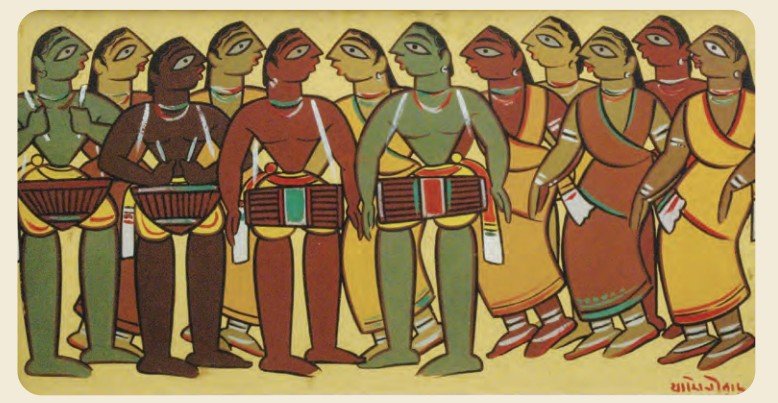
- Write about two or more aspects that attract you towards the artwork.
- What themes do you enjoy observing and sketching from your surroundings the most?
- Choose one page in the journal that you are most satisfied with. Give reasons for your choice in comparison with the other pages.
- What did you find difficult or challenging while sketching and journalling?