UNIT I
UNDERSTANDING ONESELF ADOLESCENCE
Unit I focusses on the stage of adolescence –
the stage of life to which you belong at present. This unit deals with understanding your own self in terms of your personal and social identity, your nutritional and health requirements, management of basic resources of time and space, fabrics around you, and your communication skills. The last chapter of the unit situates the adolescent in the context of the family and larger society, thereby linking it to the next unit that deals with the individual in relation to her/his family, school, community and society.
2
Understanding the Self A. What makes me ‘I’
Learning Objectives
After completing sections A,B and C the learner will be able to–
• discuss the importance of knowing oneself and the significance of developing a positive sense of self.
• list the factors that influence the development of selfhood and identity.
• analyse why the period of adolescence is critical for the development of self and identity.
• describe the characteristics of self during infancy, childhood and adolescence.
2A.1 Introduction
While we all have many things in common with our parents, siblings, other relatives and friends, each one of us is also a unique person, different from all others. This sense of being unique gives us our sense of self — the sense of ‘I’ which is different from ‘you’, ‘them’ and ‘others’. How do we develop this sense of self? What we think about ourselves and how we describe ourselves — does it change over the years? What are the elements of the self? Why should we study about the self? Does our self influence the way we interact with people? In this unit we will study about these and other interesting aspects of the self.
Related to the concept of the self are two other concepts — identity and personality. While psychologists distinguish between these three concepts in terms of their definitions, the concepts are intricately related and we often interchange these terms in common usage.
2A.2 What is Self?
The Webster’s Third New International Dictionary contains 500 entries that begin with “self”. The sense of self refers to the sense of who we are and what makes us different from everyone else. During adolescence – the period you are going through presently – we start thinking more than ever about who am I? What makes ‘me’ different from ‘others’? At this stage, more than at any other stage before this, we try to define our ‘self’. Some of you may have given this question a lot of thought, while some others may not be aware that they have been thinking of these aspects.
Activity 1
Complete the following sentences starting with – I am.
1. I am…………………………………………………………………………………….....
2. I am…………………………………………………………………………………….....
3. I am…………………………………………………………………………………….....
4. I am…………………………………………………………………………………….....
5. I am…………………………………………………………………………………….....
6. I am…………………………………………………………………………………….....
7. I am…………………………………………………………………………………….....
8. I am…………………………………………………………………………………….....
9. I am……………………………………………………………………………..………...
10. I am……………….……………………………………………………………………....
Re-examine the statements you wrote to describe yourself, some of these described the physical aspects of yourself, you described your bodily self; in some you referred to your feelings and emotions; in some you described yourself in terms of your mental abilities; in some others you may have described yourself in relation to others, in terms of the roles you perform and the relationships you are involved in every day such as son/daughter, wife/sister, student, i. e., you defined yourself in terms of your social relationships in the family and community. Some of you may have described yourself in terms of your potential or capabilities and some others in terms of your beliefs. In some you described yourself as a doer, as a person performing actions, as an agent, while in others you described yourself as a thinker. Thus, you can see that the self has several dimensions. Very broadly speaking we can think of these various dimensions of the self as the personal and the social. The personal self has those aspects which relate only to you while the social self refers to those aspects where you are involved with others, and includes aspects like sharing, cooperation, support and unity.
We can say that the term self refers to the totality of a person’s experiences, ideas, thoughts and feelings with regard to herself/himself. It is the characteristic way in which we define ourselves. The idea that we hold of ourselves is the notion of the self.
You must have heard and used the terms self-concept and self-esteem with reference to yourself and with others. What do you mean when you use them? Write your thoughts in the box below and discuss these after reading the definitions given after the box.
For your thoughts....
Self-concept and self-esteem are elements of identity. Self-concept is a description of oneself. It answers the question of ‘Who am I?’ Our self-concept includes our qualities, feelings and thoughts and what we are capable of doing.
An important aspect of the self-concept is self-esteem. Self-esteem refers to our judgment of ourselves according to the standards we have set for ourselves which are largely influenced by society. It is one’s evaluation of oneself.
2A.3 What is identity?
Refer to Activity 2 on this page. What did you conclude – ‘Yes’, you are the same person or ‘No’, you are not the same person, or was your answer both ‘Yes’ and ‘No’! Which is quite likely. Over the years your body has undergone many changes, you know many more people now as compared to earlier times, and you have developed a certain relationship with them. Your way of responding to and understanding events may have changed, you may have changed some of your beliefs and values, and your likes and dislikes may have also changed. So you are not really the same person as you were even a year ago! Yet, you have an unmistakable sense of having been the same person from as far back as you can remember. Most of us are able to maintain a sense of continuity and sameness throughout our lives despite the many changes and discontinuities that mark our life over the decades. In other words, we all have a sense of identity, a sense of who we are which we carry throughout our lives. Just as in the case of self, we can talk of personal identity and social identity. Personal identity refers to those attributes of a person that make her different from others. Social identity refers to those aspects of the person that link her to a group – professional, social or cultural. Thus, when you think of yourself as an Indian you have linked yourself with a group of people living in a country. When you describe yourself as a Gujarati or a Mizo, you are saying that you share some characteristics with the people living in that state, and that these characteristics seem to you to be different from people living in other states of India. Thus, being a Gujarati is one dimension of your social identity in the same way as being a Hindu, Muslim, Sikh or a Christian or being a teacher, farmer or lawyer.
Activity 2
Are you the same person that you were five years ago? Reflect on this for some time, and write your views and the reasons for these views in the space below.
The self is thus multi-dimensional in nature. It also undergoes change as a person grows and develops from an infant to an adolescent. The next chapter describes the characteristics of self during infancy, childhood and adolescence.
Key Terms
Self, Self-concept, Self-esteem, Identity
- Review Questions
1. Explain what you understand by the term ‘self’. Discuss its various dimensions giving examples.
2. Why is it important to understand the self?
2
B. Development and Characteristics of the Self
The self is not something that you are born with, but which you create and develop as you grow. In this section we will read about the development and characteristics of the self in infancy, early childhood, middle childhood and adolescence.
2B.1 Self during infancy
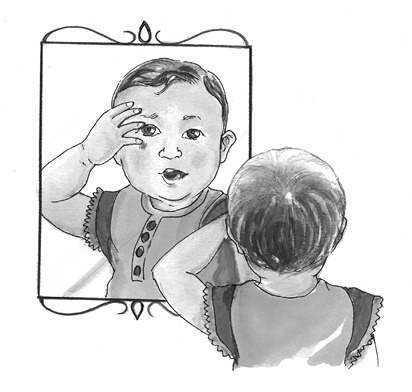
At birth we are not aware of our unique existence. Does that surprise you? This means that the infant does not realise that she/he is separate and distinct from the world outside – she/he has no self-awareness or self-understanding or self-recognition. By each of these terms we mean the mental representation (a mental picture) of the self. The infant brings her/his hand in front of her/his face and looks at it but does not ‘realise’ that the hand belongs to her/him and that she/he is separate from other people and things she/he sees around her. The sense of self emerges gradually during infancy and self-image recognition happens around 18 months of age. One interesting experiment which has been carried out with infants in the age range 14-24 months is described below. You can try it out too.
Activity 1
Put a dot of red lipstick/colour on the cheek of the infant and then place the infant in front of the mirror. If the infant has an awareness of the self, she/he will touch her own cheek after looking at the red spot on the face in the mirror. If the infant does not have self-awareness, she/he will touch the reflection in the mirror, or just play with the reflection in the mirror as if it is another infant.
2B.2 Self during early childhood
Since children are able to talk quite fluently by the time they are 3 years old, we need not rely only on self-recognition to know young children’s self-understanding. We can use verbal means by involving them in conversations about themselves. Researchers have found that the following are the five main characteristics of young children’s understanding of themselves.
1. They use physical descriptions of their self or material possessions to differentiate themselves from others – they may use descriptive words like ‘tall’, or ‘big’ or refer to the clothes they wear or the toys or objects they have. Their self-descriptions are in absolute terms – this means they do not see themselves in comparison with others. To give an example, instead of saying, “I am taller than Kiran”, the child will say, “I am tall.”
2. They describe themselves in terms of things they can do. For example, in terms of their play activities – “I can ride a cycle”; “I can make a house”; “I can count”. Thus, their self understanding contains active descriptions of themselves.
3. Their self descriptions are in concrete terms – i.e., they define themselves in terms of things they can do or what is visible to them – “I have a television.”
4. They often overestimate themselves. Thus, a child may say, “I am never scared” or “I know all the poems”, but may not remember them completely.
5. Young children are also unable to recognise that they can possess different attributes – that they can be ‘good’ and ‘bad’, ‘mean’ and ‘nice’ at different points in time.
The following is a brief interaction between an adult and Radha, a girl aged 3 years 8 months, which reveals the child’s perception of herself. The interaction is presented in the form of questions asked and the answers given by the child.
2B.3 Self during middle childhood
During this period, children’s self-evaluations become more complex. There are five key changes that characterise this increasing complexity:
1. The child shifts towards describing herself in terms of her internal characteristics. The child is more likely to name her/his psychological characteristics (such as preferences or personality traits) in her self-definition and less likely to name physical characteristics. Thus, the child may say, “I am good at making friends”, “I can work hard and finish my homework on time.”
2. The child’s descriptions include social descriptions and identity – they may define themselves in terms of groups they belong to, “I am in the music choir in school”.
3. Children begin to make social comparisons and differentiate themselves from others in comparative rather than absolute terms. Thus, they begin to think about what they can do in comparison with others, for example, “I can run faster than Kiran.”
4. They begin to distinguish between their real self and ideal self. Thus they can differentiate between their actual competencies and those that they want to have or those which they think are most important.
5. The self-descriptions become more realistic as compared to those of the pre-school child. This may be because of the ability to see things and situations from the point of view of others.
2B.4 Self during adolescence
Self understanding becomes increas-ingly complex during adolescence. Adolescence is also seen as a critical time for identity development. What are the characteristics of this more complex self understanding? Let us discuss the first two aspects and then we shall discuss the features of the adolescent’s self.
Activity 2
Make friends with a 5-year-old, a 9-year-old, and a 13-year-old. Ask them to describe themselves and note what they say. Do you find that their self-descriptions correspond with what you have read in this section?
Why is adolescence a critical time for identity development?
According to a well-known psychologist Erik H. Erikson, at each stage of our development, from infancy to old age, we have to accomplish certain tasks which enable us to move on to the next stage of development. For example, a task during late infancy and early childhood (between 2-4 years of age) is to achieve bowel and bladder control. Without this, participation in most social and community activities would become impossible for the child. The task during the period of adolescence, according to Erikson is to develop a sense of identity, a satisfactory self-definition.
The reason why the stage of adolescence is critical for identity development is because there is an enhanced focus on the development of the self. It is believed that the adolescent faces an identity crisis. This is because of three reasons—
1. This is the time when the person, more than at any other point of her/his life before this, is preoccupied with trying to know oneself. This means that the person is intensely concerned with understanding herself/himself.
2. Towards the end of adolescence the individual creates a relatively lasting sense of selfhood and identity and can say – “This is who I am”.
3. This is also the time when the individual’s identity is influenced by rapid biological changes and changing social demands.
Let us understand this in more detail
The adolescent is now expected to behave in an adult-like manner and begin to take on responsibilities related to family, work or marriage. This social transformation from dependent child to independent person occurs differently in different cultures. Western cultures generally emphasise independence in terms of ‘separation’ from parents (both physical and psychological). On the other hand, non-western cultures, such as the Indian, focus on interdependence within the family. In all cultures, however, adolescence is reported to be accompanied by dilemmas and disagreements. For instance, it is common to see that an adolescent may rebel against being treated “like a child” but at the same time may herself/himself seek comfort as a child would. The parents too may often tell the adolescent to “behave like a grown up”, but their other actions may indicate to the adolescent that they do not think that she/he is quite grown up. This may be somewhat different for girls and boys depending on the expectations of the family, in a particular culture. Thus, the adolescent herself experiences conflicting feelings and also receives conflicting messages and social expectations from the people around her/him. You may have experienced this for yourself. For example, the family members may expect you to behave in an adult-like manner in social situations as far as talking or dressing is concerned, but may still think you are too young to discuss the family budget.
Since individuals are different they may respond differently to situations. The conflicting expectations from familial and societal sources, one’s own changing needs and conflicting emotions may interfere with integrating the newly emerging selves during adolescence. Thus, the adolescents may experience what is known as role confusion or identity confusion. They may show behaviours like the inability to concentrate on the work at hand, difficulty in starting or finishing work on time, and a general difficulty in coping with schedules. It is important to stress that the difficulties that the adolescent experiences in the process of developing an identity are a normal part of development – there is nothing inappropriate with the contradictory feelings and emotions the adolescent experiences during this period. The feeling of identity crisis or role confusion arises when the adolescent feels that there is a significant gap in terms of what she/he is expected to do and how she/he is expected to behave as compared to earlier times. However, for many adolescents, especially those who are involved in family occupations, this sense of break may not be distinct and may not cause much emotional upheaval. For example, if a child in a village is assisting the family in agriculture, her/his role does not change much from when she/he was 12 to when she/he is 16, except may be in terms of being given more responsibility.
The following are the characteristics of an adolescent’s sense of self.
1. Self-descriptions during the period of adolescence are abstract. Adolescents are likely to lay less emphasis on describing themselves in physical terms as “tall”, or “big”; they emphasise the abstract or inner aspects of their personality. Thus, they may describe themselves as quiet, sensitive, cool headed, brave, emotional or truthful.
2. The self during adolescence carries several contradictions. Thus, adolescents may describe themselves as “I am calm but get easily disturbed” or “I am quiet and also talkative.”
3. The adolescent experiences a fluctuating sense of self. As adolescents experience diverse situations and respond to different experiences, their understanding about their own self fluctuates over situations and over time.
4. The self of the adolescent contains ‘the ideal self’ and ‘the real self’. The ideal self becomes more prominent now. Each one of us has an idea of what and how one would ideally like to be. This could be called the ideal self, towards which we would like to develop. For example, a girl may want to be tall but is actually quite short.
5. Adolescents, more than children, are self-conscious and preoccupied with themselves. This gives them a feeling of always “being on stage” – a feeling that they are always being noticed. This is the reason why most adolescents are over-concerned about their physical appearance.
We now know about the different characteristics of self during certain life stages. But how do we develop a sense of self in the first place? What influences the development of a person’s identity? The next chapter focusses on this aspect.
Activity 3
Do you feel that you are experiencing any of the feelings and thoughts we have described above? Do you feel you are able to handle these feelings or do you experience confusion? Have you discussed these aspects with your friends or family members? Talk to your friend about it.
Key Terms
Infancy, Early childhood, Middle childhood, Adolescence, Identity development, Real vs. Ideal self
- Review Questions
1. Describe, giving examples, the characteristics of the self during—
– infancy
– early childhood
– middle childhood
– adolescence2. “Adolescence is a time when all adolescents experience identity crisis”. Do you agree with this statement? Give reasons for your answer.
2
C. Influences on Identity How do we Develop a Sense of Self?
You have read that we are not born with a sense of selfhood or identity. How does it develop then? How does it evolve and change over time? The self develops as a result of what you learn about yourself through the experiences you have and through what others tell you about yourself. Each person lives in a web of relationships – these relationships are in the family, school, workplace and community. The sense of self develops as a result of interaction with the people around you and through your actions. Thus multiple people shape the development of your self and the construction of the self is a continuous dynamic process. The word ‘construction’ implies that the self is not something that you are born with but which you create and develop as you grow.
Activity 1
Recall any significant experience you have had. Did it influence the way you think about yourself? Note your observations in the space below. ...............................................................................................................................................................................................................................................................................
Let us trace how the sense of self develops from the early years. From the earliest days, parents address the children by a particular name or names in a variety of situations. The children begin to associate the name with themselves. Along with this they also point to the child in the mirror and in photographs with that name. They use the pronouns ‘you’ and ‘your’ and when they are able to speak, the use of the pronouns ‘me’ and ‘mine’ appears. The child understands that ‘you’ and ‘your’ refer to another person. Parents play various ‘body games’ pointing and labeling various parts of the child’s body and ask the child to point out body parts in turn. All this helps the child to gradually learn to see herself/himself as distinct and separate from others.
Second, as the child grows during infancy she begins to realise that her actions have an effect on the environment. For example, when she touches a toy it moves. All such experiences help her/him have a sense of being separate from other people and objects around her. If you recall the earlier discussion, this is also the time (around 18 months) when the child is able to identify that the spot of red is on her/his face and she/he does not treat the reflection in the mirror as another child.
Third, as the child grows older and can talk, the parents encourage the child to provide self–statements and ask her/him to give reasons. They ask the child, “Why did you do this?” or “How do you feel?” These questions help the child understand what she or he is experiencing or the reasons for certain actions; in this way they help the child in defining the self.
Fourth, during the course of the day the child has several encounters with people and objects around her/him which help to develop an idea about abilities. People also give the child a feedback about her or his behaviour and abilities. To a 6-year-old who helps in cleaning up the food area after the meal, the father may say, “That was a good thing to do. You are a good boy.” All this feeds into the child’s beliefs about herself/himself. The child thus constructs and re-constructs selfhood and sense of identity through the verbal-social interactions she/he has with caregivers and others.
Developing a sense of self and identity
The reasons why each one of us has a unique identity is because
• each one of us (except identical twins) has a unique combination of genes.
• each one of us has different experiences.
• even if we have similar experiences, we respond to these in different ways.
In this section we will study the influences on the formation of identity. These can be classified as—
• Biological and physical changes
• Socio-cultural contexts including family and peer relationships
• Emotional changes
• Cognitive changes
2C.1 Biological and physical changes
The period of adolescence is marked by certain universal physical and biological changes in the body which take place in particular sequences. These changes lead to the attainment of sexual maturity. The time when sexual maturity is reached is called puberty. Menarche (first menstruation) is usually considered the point of sexual maturity for girls. There is no corresponding definite event marking puberty for boys, although a criterion sometimes used is the production of spermatozoa. Puberty occurs at different average ages in different cultures. A criterion of puberty that has been found useful for both boys and girls is that of maximum yearly increase in height. The age of most rapid growth comes just before menarche for girls and before certain adult characteristics in boys. This period during which physical and biological changes occur, leading to puberty is called pubescence. For most girls this period ranges from 11 years to 13 years, and for boys it is 13 years to 15 years. Following is the list of changes in girls and boys showing normal sequence for development during pubescence.
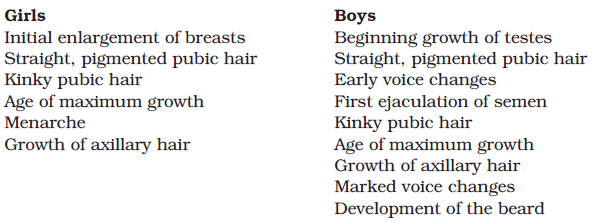
While the physical changes that take place in the body with the onset of puberty are universal, the psychological and social impact of these changes on the person vary from culture to culture and within a culture from person to person. We will discuss these aspects under the next two headings – socio-cultural contexts and emotional changes.
2C.2 Socio-cultural contexts
It has been stated that physical changes in the body and the changing social expectations are the two main aspects that influence the process of identity formation during the period of adolescence. But to what extent these physical and social changes impact the process of identity formation varies with cultural, social and familial contexts. In this section, let us first see how cultural and social contexts influence adolescent development and then we will read about the influence of the family.
Different sections of the society may respond differently to the physical changes during adolescence. In traditional Indian society, the onset of puberty places many restrictions on the girls while the boys retain their freedom of movement. Certain avenues of entertainment or work are not seen as appropriate for girls. The elements of the self and the identity of a girl from a traditional community would be very different from that of a girl living in urban areas.
Let us now compare our culture with Western cultures. In most Western cultures (such as the U.S. and U.K.) adolescents are expected to be fairly independent – in many cases they are expected to move away from the family to set up their own home. In the Indian context, a large majority of adolescents continue to be fairly dependent on parents as they are expected to be, and the family continues to exercise control over them. While many adolescents in India, especially in rural and tribal settings, begin to contribute towards the family income, and in this sense begin to assume adult roles, yet they do not break away from the family. Instead their efforts at earning are often aimed at the welfare of family members. The development of the self of an adolescent in these two cultural settings would be quite different. Even within India, the experiences of adolescents would be quite different in different communities. In traditional communities and regions where technology is not yet advanced and where occupational opportunity and choices for alternative lifestyles are limited, children are trained in the traditional family occupations, such as weaving, up to the time they reach adolescence. Such adolescents are, therefore, ready to assume adult
roles – this means they are seen as persons with responsibilities of beginning work, getting married and bearing children, like adults. Thus, in these communities the identity of the adolescent would be drawn more from familial sources. The adolescent may not enter into much conflict with elders since they are largely doing what adults expect of them. As a result, there are likely to be fewer confusions and doubts while developing a sense of self. On the other hand, in communities and families where a variety of occupational choices are open for the adolescent, where technology makes available many experiences and options to the individual, the adolescent may need to enter into an extended period of training to prepare herself/himself for the chosen occupation. During this period the adolescent still remains dependent on the parents. While the period of adolescence is thus extended, that of adulthood is delayed. Also, the increase in choices and exposure to alternate lifestyles may bring the adolescent in conflict with parents and other authority figures in society.
There is another reason why the development of identity is likely to vary in traditional cultures and cultures of the West. In traditional Indian communities, open reflection on oneself and the idea of talking about oneself is not a common activity among adolescents. In fact, such an attitude is often neither encouraged nor tolerated. Many Indians define themselves primarily in one or the other roles that they play – son/ daughter, mother/father, sister/brother. To put it differently, they often speak of themselves in terms of the family and the community – as “we” – rather than as “I”. For example, while talking about her views on marriage, an adolescent girl would say, “In our family marriages are arranged by parents”, rather than saying, “I would prefer my parents to arrange my marriage”. Thus we can see how important the socio-cultural context is in the construction of a sense of self. Of course the impact of these cultural influences will vary from family to family and person to person.
Having discussed how the culture and society impact adolescent identity development, let us read how the family can impact the development of the sense of identity. During adolescence identity formation is enhanced by family relationships where adolescents are encouraged to have their own point of view and where there is a secure relationship between family members which provides the adolescent with a secure base from which to explore her widening social world. It has also been found that firm and affectionate parenting fosters healthy development of identity. ‘Affectionate’ parenting means that the parents are warm, loving and supportive of the child’s effort and accomplishment. They often praise the child, show enthusiasm in her/his activities, respond sensitively to her/his feelings, and understand the child’s personality and points of view. However, such parents are also firm in disciplining. Such parenting style fosters independence and self-reliance in children.
Adolescence is the period in which the growing individual develops a strong need for support and acceptance from the peers. At times, parental and peer values can be in conflict with each other and the adolescent may tend to lean more towards friends. This can cause disharmony in parent-child relationships. Conforming to peer pressure can be both positive and negative. The negative effects become evident when adolescents indulge in harmful behaviours such as smoking or consuming, drugs or alcohol or bullying. However, often peers and parents serve complementary functions and fulfil different needs of the adolescents. It has been seen that a family atmosphere that promotes both individuality and connectedness is important for the identity development of the adolescent. By ‘Individuality’ implies greater opportunity and the ability to have one’s own point of view. ‘Connectedness’ suggests greater sensitivity to and respect for others’ views and openness to others’ views.
2C.3 Emotional changes
The adolescent experiences many emotional changes in the process of growing up. Many of these changes are a consequence of the biological and physical changes that the adolescent is undergoing. It is true that adolescents are preoccupied with their physical body. They imagine that others are noticing each and every aspect of their body and behaviour. A young person with pimples on the face may feel that everyone is first and foremost noticing that. However, there are individual differences in the way adolescents react to the bodily changes. A boy who does not have adequate growth of facial hair as compared to all the other boys of his age may feel peculiar about it. However, this same lack of facial hair may not disturb another boy. A sense of pride or comfort with the way one is developing physically will contribute positively to the adolescents’ sense of self. On the other hand, if the adolescent is dissatisfied with one’s appearance beyond a point, it can prevent from concentrating on other aspects of her/his personality, work or studies. This can cause a dip in performance at school and a lowering of self-image or self-esteem. A negative self-image can cause a person to feel insecure and also generate negative feelings about the body. An adolescent with a physical disability may not experience herself/himself as any less than others, whereas a well-built adolescent boy may feel conscious and inadequate because he feels that his body is not “good enough”.
The adolescent also experiences mood swings – for example, desiring the company of family members and friends at one time and wanting to be alone at other times. There may also be sharp bursts of anger. A lot of this happens as the adolescent is trying to make sense of and understand the variety of changes she/he is experiencing at different levels.
2C.4 Cognitive Changes
You will read in detail about the changes in thinking (cognition) that takes place from infancy to adolescence in Unit III titled ‘Childhood’. At this point we are briefly describing the cognitive changes that have an impact on the development of the sense of identity.
The child develops from a person who has no sense of a separate identity to one who describes the self during early childhood years. While the self-descriptions during middle childhood are also concrete, the difference is that these descriptions are now in comparative terms. By the time the child is 11, the self descriptions are fairly realistic enabling the child to differentiate between the ‘real’ and the ‘ideal’ self.
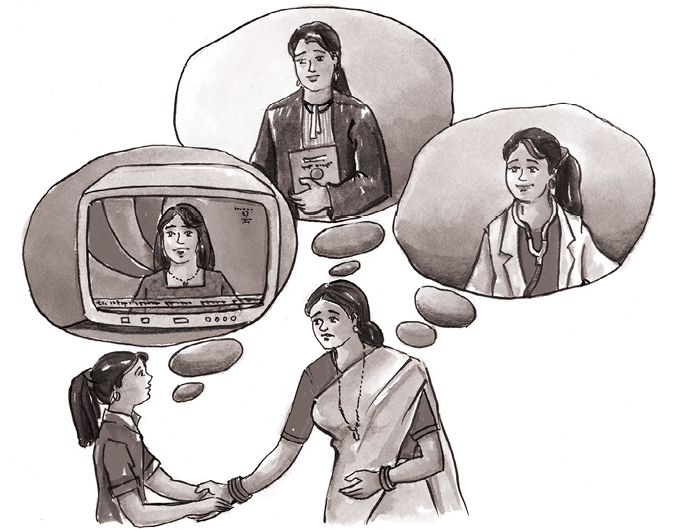
During adolescence, the leap that takes place is that adolescents can think in abstract terms, i.e., they can think beyond what is present and what they see and experience. Further, as thought becomes flexible, they can think of hypothetical situations — in other words, they can imagine the various possibilities and their outcomes without necessarily having to go through them or act out the steps of any outcome. The implication for identity formation is that adolescents can imaginatively link up their present with a future they imagine for themselves. For example, the adolescent can think of the possible careers that she/he can take up as an adult which are suited to her/his situation and temperament, and plan the current direction of her/his studies accordingly.
Thus, adolescence is a crucial stage for the development of identity. In fact, adolescence is a significant period of development involving many changes and opportunities. If the adolescent is healthy, she/he is able to deal with the changes in the best possible manner and realise one’s full potential. Appropriate food and nutrition are the key elements of good health. The next chapter discusses food, nutrition, health and fitness concerns during adolescence.
Key Terms
Puberty, Pubescence, Menarche, Personality, Peer pressure
- Review Questions
1. Discuss the concepts of puberty and pubescence. Explain the major physical and biological changes in girls and boys during puberty.
2. What is the role of family in shaping the personality of the adolescent?
3. To what extent does culture shape the adolescent identity? Explain with examples.
4. List the major emotional and cognitive changes during adolescence.
- Practical 1
Development and Characteristics of the Self
Theme Study of one’s physical self
Tasks 1. Recording of height, weight, hip size, round waist, round chest/bust
2. Recording of age of menarche (girls) and growth of beard and change in voice (boys)
3. Recording oت
Purpose of practical: You have read about physical growth and development during the age of adolescence. This practical will help you to understand your physical self better and also help you to know the average rate of growth and development of adolescents in your region as you compare your data with those of others. The measurements stated in Task 1 above are also important for you to know for the purpose of garment sizing–
Conduct of practical: Take your own measurements as stated in Task 1 above. Alternatively you can take each other's measurements in the class. The following measurements can be taken as described–
• Around Hip: Use a measuring tape around the widest portion of the hips with two fingers between the tape and the body.
• Around Bust/Chest: Hold the tape and measure across the fullest part of the bust/chest. Hold tape firmly but not tight.
• Around Waist: Hold the tape around waist and let it settle into the smallest portion of the body (that is the waistline). Take the measurement with one finger between tape and body
• Around neck: Lay a still measure tightly around the neck and gently tap it down until the lower edge settles at the base of the neck where the measurement is taken.
• Across back: It is measurement taken between the lateral ends of scapulae (shoulder blades). Take one more measurement 10-12 cms below the waist measurement over the fullest part of back.
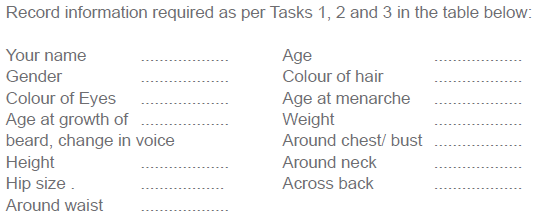
Now form yourself into groups of 10 students each and pool all your individual data together.
1. Note what the range is for each of the above measurements of the body in your group. For example, weight in your group ranges from ……kgs to …..kgs.
2. Note the range for age of menarche and the range during which growth of beard and change in voice takes place.
3. Correlate the size of ready-made garments you purchase with your measurement.
- Practical 2
Influences on Identity
Theme Task : Theme Emotions experienced by self
1. Making a record of your emotions experienced during a day
2. Reflecting on the reasons for experiencing the emotions
3. Identifying ways of handling them
Purpose of the practical: We all experience a variety of emotions each day and these influence the way we respond to situations. Being more aware of our emotions and the reasons for feeling the way we do, can help us to manage them better and respond appropriately to situations. This practical has been designed with this objective in mind.
Conduct of practical: Identify a particular day and bring to your awareness the emotions you experience since morning during that day. Keep a notepad and pen with you and record the emotion, the context situation and the reason for the emotion as soon as you become aware of it. You can use the following table for recording.
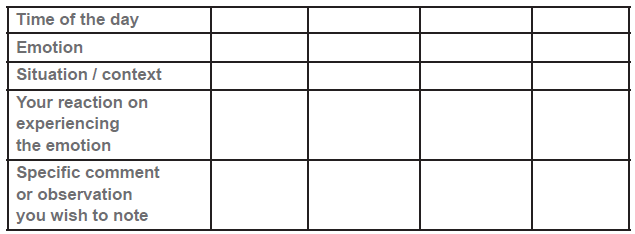
Make groups of 4-5 students per group and in your group compare your notes with those of others. Discuss the following:
1. Whether similar emotions were experienced by other group members?
2. The common features in the various situations that lead to the group members experiencing these emotions.
3. Whether each person handled the emotions appropriately?
4. Could there have been alternate ways of handling the emotions?
3
Food, Nutrition, Health and Fitness
Learning Objectives
After completing this chapter the learner will be able to —
• define the terms – food, nutrition, nutrients, health, fitness and the role of food and nutrition in maintaining health.
• understand the term, balanced diet and apply the concept in planning and consuming diets.
• understand the basis for defining the Recommended Dietary Allowances (RDAs) and the difference between Dietary Requirement and RDA.
• understand the basis for classifications of foods into appropriate groups.
• analyse the factors which influence adolescent food habits.
• identify the causes, symptoms and nutritional interventions related to eating disorders.
3.1 Introduction
The onset of adolescence brings with it many profound changes. The growth rate speeds up dramatically. This growth spurt occurs due to the activity of hormones that affect every organ of the body and this makes healthy eating very important. The nutrient needs rise throughout childhood, peak in adolescence and then level off or even diminish as the teenager becomes an adult. The saying ‘‘You are what you eat” seems to be proven true. We eat different kinds of food such as dal, chapatti, bread, rice, vegetables, milk, lassi, etc. All these different kinds of food provide us with nutrients to keep us healthy and active. It is important to know what food to eat in order to stay healthy. The science of food and nutrients and their action on our health is called Nutrition.
Nutrition and health, in fact, are two sides of the same coin. They are, therefore, inseparable. Health depends to a large extent on nutrition, and nutrition depends on the food intake. So food, is the most important single factor for health and fitness.
Let us define and describe food, nutrition, health and fitness
• Food can be defined as anything solid or liquid which when swallowed, digested and assimilated in the body provides it with essential substances called nutrients and keeps it well. It is the basic necessity of life. Food supplies energy, enables growth and repair of tissues and organs. It also protects the body from disease and regulates body functions.
• Nutrition is defined as the science of foods, nutrients and other substances they contain; and of their actions within the body including ingestion, digestion, absorption, metabolism and excretion. While this summarises the physiological dimensions, nutrition has social, psychological and economic dimensions too.
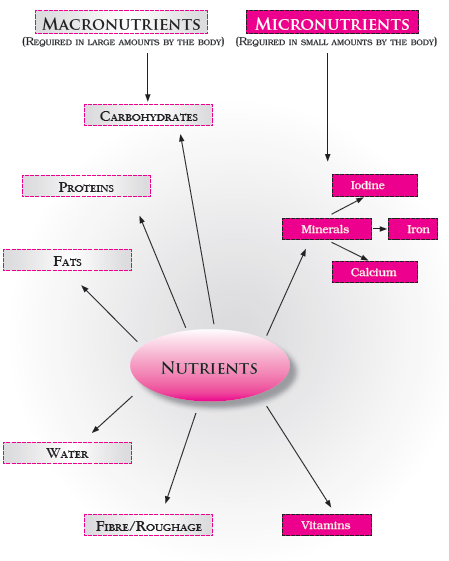
• Nutrients are the constituents in food that must be supplied to the body in suitable amounts. These include carbohydrates, proteins, fats, minerals, vitamins, water and fibre. We need a wide range of nutrients to keep ourselves healthy. Most foods contain more than one nutrient such as milk has proteins, fats, etc. Nutrients can be classified as macronutrients and micronutrients on the basis of the required quantity to be consumed by us everyday. The figure on the next page shows us the distinction between macronutrients and micronutrients.
3.2 Balanced diet
A balanced diet is one which includes a variety of foods in adequate amounts and correct proportions to meet the day’s requirements of all essential nutrients such as proteins, carbohydrates, fats, vitamins, minerals, water, and fibre. Such a diet helps to promote and preserve good health and also provides a safety margin or reserve of nutrients to withstand short durations of deprivation when they are not supplied by the diet.
The safety margin takes care of the days we fast, or the short-term deficiency of certain nutrients in the daily diet. If the balanced diet meets the Recommended Dietary Allowances (RDAs) for an individual, then the safety margin is already included since RDAs are formulated keeping extra allowances in mind.
Recommended Dietary Allowances = Requirements + Margin of safety
A balanced diet takes care of the following aspects.
1. Includes a variety of food items
2. Meets the RDA for all nutrients
3. Includes nutrients in correct proportions
4. Provides a safety margin for nutrients
5. Promotes and preserves good health
6. Maintains acceptable body weight for height
3.3 Health and fitness
According to World Health Organisation (WHO) ‘‘Health is the state of complete physical, emotional, and social well-being, not merely the absence of diseases or infirmity.’’ This definition has remained unchanged since 1948.
All of us want to maintain positive health, i.e., a perfect blend of physical, social and mental. Taking adequate amounts of essential nutrients in our diet is necessary to maintain positive health.
Physical health is probably the most easily understood aspect. Mental health can be defined as a state of emotional and psychological well-being in which an individual is able to use her or his cognitive and emotional capabilities, function in society, and meet the ordinary demands of everyday life. In other words, the absence of a recognised mental disorder is not necessarily an indicator of mental health. One way to assess mental health is to see how effectively and successfully a person functions. Feeling capable and competent, being able to handle normal levels of stress, maintaining satisfying relationships, and leading an independent life; and being able to “bounce back” or recover from difficult situations are all signs of good mental health.
Physical fitness is good bodily health; it is the result of regular exercise, proper diet and nutrition, and proper rest for physical recovery. The term physical fitness is used in two ways: general fitness (a state of health and well-being) and specific fitness (a task-oriented definition based on the ability to perform specific aspects of sports or occupations). Physical fitness is the capacity of the heart, blood vessels, lungs, and muscles to function at optimal efficiency. Earlier, fitness was defined as the capacity to carry out the day’s activities without undue fatigue. Automation, increased leisure time, and changes in lifestyles following the Industrial Revolution meant that this criterion was no longer sufficient. In the present context, optimum efficiency is the key.
Physical fitness is now defined as the body’s ability to function efficiently and effectively in work and leisure activities, to be healthy, to resist diseases and to meet emergency situations. Fitness can also be divided into five categories: aerobic fitness, muscular strength, muscular endurance, flexibility, and body composition. Being fit prepares one to meet mental and emotional challenges. One feels strong and energetic if one is fit. Fitness provides one with the ability to meet routine physical demands with enough reserve energy to rise to a sudden challenge, such as running to catch a bus.
Thus, health is a state of complete mental, physical and social well-being whereas fitness is the ability to meet the demands of a physical task. A well-nourished and fit person is better able to learn and has more energy, stamina, and self-esteem. A healthy eating pattern along with regular exercise will certainly help to remain fit. Teenagers between the ages of 12 and 18 who have unhealthy eating behaviours and are undernourished develop eating disorders.
3.4 Using Basic Food Groups for Planning Balanced Diets
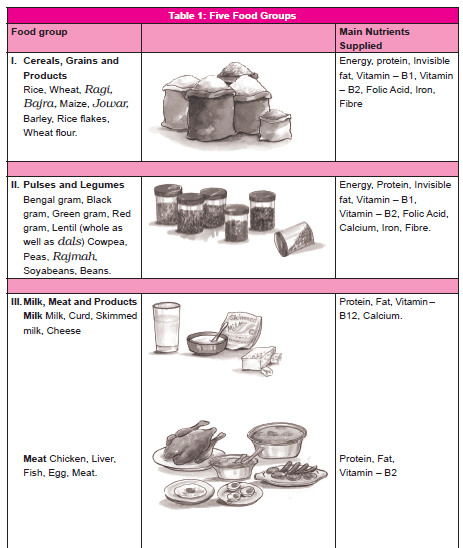
One of the simplest ways to plan a balanced diet is to divide foods into groups and then make sure that each group is included in the meals. A food group consists of different foods which have common characteristics. These common features may be the source of food, the physiological function performed, or the nutrients present.
Foods can be grouped on the basis of the predominant nutrients present in them. This classification varies from one country to another depending on many factors. The five food group classification is used in India as a guide to meal planning. Many factors have been considered while compiling these groups such as availability of food, cost, meal pattern, and deficiency diseases prevalent. Not all foods in each group are equal in their nutrient content. That is why a variety of foods from each group should be included in the diet.
A classification based on nutrients present will ensure that all nutrients are made available to the body and offer greater variety within the group.
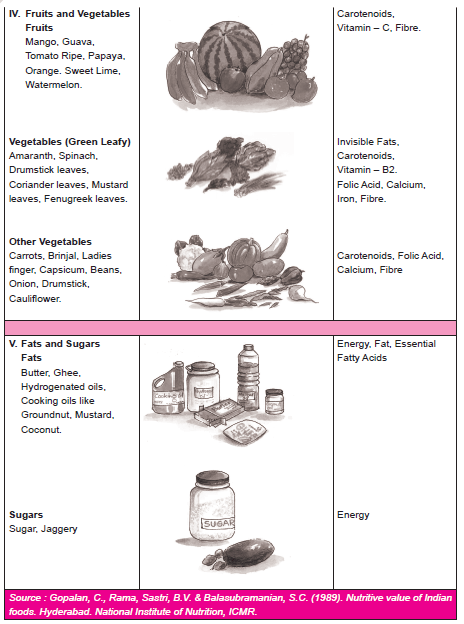
There are five basic food groups suggested by the Indian Council of Medical Research (ICMR). These include:
• Cereals, grains and products
• Pulses and legumes
• Milk and meat products
• Fruits and vegetables
• Fats and sugars
Activity 1
List 10 foods that you commonly eat. Identify the food group to which each food belongs. Then list the macronutrients and micronutrients present in the foods listed. Identify the foods which are the richest sources of energy.
The five food groups are summarised in the table below:
Remember
One gram of
• carbohydrate releases 4 Kcal. of energy
• protein releases 4 Kcal. of energy
• fat releases 9 Kcal. of energy
Guidelines for using the basic food groups
The five food group system can be used both for planning and assessing balanced diets. It is a simple daily food guide which can be used for nutrition education as well. Guidelines could be adopted depending on the food groups.
• Include at least one or a minimum number of servings from each food group in each meal.
• Make choices within each group as foods within each group are similar but not identical in nutritive value.
• If the meal is vegetarian, use suitable combinations to improve the overall protein quality of the diet. For example, serving cereal-pulse combinations or including small quantities of milk or curds in the meal.
• Include uncooked vegetables and fruits in the meals.
• Include at least one serving of milk to ensure a supply of calcium and other nutrients as milk contains all nutrients except iron, vitamin C, and fibre.
• Cereals should not supply more than 75 per cent of total Kcal/Calories.
In planning balanced diets, food should be chosen from each group in sufficient quantity. Cereals and pulses should be taken adequately, fruits and vegetables liberally, animal foods moderately and oils and sugars sparingly.
Now let us look at the concept of the food guide pyramid.
Food Guide Pyramid
The following figure (Figure 2) illustrates the food guide pyramid for Indians.
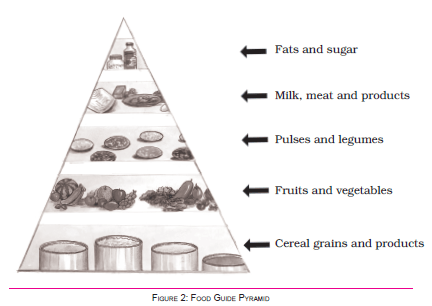
The food guide pyramid is a graphic depiction of the daily food guide. The illustration was designed to depict variety, moderation, and also proportions. The size of each section represents the number of daily servings recommended. The broad base at the bottom conveys the message that grains should be abundant and form the foundation of a healthy diet. Fruits and vegetables appear at the next level, showing that they have a less prominent, but still important place in the diet. Meats and milks appear in a smaller band near the top. A few servings of each can contribute valuable nutrients such as proteins, vitamins and minerals, without too much fat and cholesterol. Fats, oils and sweets occupy the tiny apex, indicating that they should be used sparingly.
Alcoholic beverages do not appear in the pyramid, but they too, if consumed, should be limited. Items such as spices, coffee, tea and diet soft drinks provide few, if any, nutrients, but can add flavour and pleasure to meals when used judiciously.
The daily food guide plan and food guide pyramid emphasise grains, vegetables, and fruits. These are all plant foods. Some 75 per cent of a day’s servings should come from these three groups. This strategy helps all people obtain complex carbohydrates, fibre, vitamins, and minerals with little fat. It also makes diet planning for vegetarians easier.
3.5 Vegetarian Food Guide
Vegetarian diets rely mainly on plant foods: grain, vegetables, legumes, fruits, seeds, and nuts. Some vegetarian diets include eggs, milk products, or both. People who do not eat meats or milk products can still use the daily food guide to create an adequate diet. The food groups are similar and the number of servings remains the same. Vegetarians can select alternatives to meat such as legumes, seeds, nuts, tofu and for those who eat them, eggs. Legumes, and at least one cup of dark leafy greens, help to supply the iron that meats usually provide. Vegetarians who do not drink cow’s milk can use soy ‘milk’ – a product made from soyabeans that provides similar nutrients if it has been fortified with calcium, vitamin D, and Vitamin B12 (i.e., these nutrients are added).
The food guide pyramid emphasises foods from the five food groups shown in the three lower sections of the pyramid. Each of these food groups provides some, but not all of the nutrients you need. Foods in one group cannot replace those in another. No one food group is more important than another – for good health you need all of them.
The pyramid is an outline of what to eat each day. It is not a right prescription, but a general guide that lets you choose a healthful diet that is right for you. The pyramid calls for eating a variety of foods to get the nutrients you need, and at the same time, the right amount of Calories to maintain a healthy weight.
3.6 Dietary Patterns in Adolescence
Healthy eating is vital for the teenager’s health and well-being. The nutritional needs of adolescents vary tremendously, but generally increase due to rapid growth and changes in body composition that occur during puberty. Adequate nutrition is vital for ensuring overall emotional and physical health. Good eating habits help prevent chronic illness in the future, including obesity, heart disease, cancer and diabetes.
Studies of nutrient intakes have shown that adolescents are likely to obtain less vitamin A, thiamine, iron, and calcium than recommended. They also ingest (consume) more fat, sugar, protein, and sodium than is currently thought to be optimal.
While concern is often expressed over the habit of eating between meals, it has been shown that teenagers obtain substantial nourishment from foods eaten outside of the traditional meals. The choice of foods they make is of greater importance than the time or place of eating. Emphasis should be placed on fresh vegetables and fruits as well as whole-grain products to complement the foods high in energy value and protein that they commonly choose.
What are the commonly adopted eating habits of adolescents and why are they important to recognise? Understanding diet patterns will help us to be better prepared to evaluate the nutritional adequacy of diets and ensure that they are meeting the minimum requirements to maintain health and well-being. Among the more common eating idiosyncracies include skipping meals, consuming fast foods in a routine way, avoiding fruits and vegetables, snacking frequently and dieting. By addressing each of these issues individually you can ensure that you are meeting the minimum nutritional requirements.
Irregular meals and skipping meals: The numbers of meals teenagers miss and eat away from home increases from early adolescence to late adolescence, reflecting the growing need for independence and time away from home. The evening meal appears to be the most regularly eaten meal of the day. Girls are found to skip the evening meal, as well as breakfast and lunch, more often than boys. In some homes with limited resources, the adolescents may not even receive adequate number of meals or amounts, leading to nutrient deficiency.
Breakfast is frequently neglected and is omitted more often by teenagers and young adults under 25 years of age than by any other age groups in the population. A likely explanation as to why girls are more apt to miss breakfast than are boys is the pursuit of thinness and frequent attempts at dieting. Many teenage girls believe that they can control their weight by omitting breakfast or lunch. In fact, this approach is likely to accomplish just the opposite. By mid-morning or lunchtime they may be so hungry that they overcompensate for the “saved kilocalories.” As a matter of fact, skipping breakfast can slow your metabolism contributing to weight gain and poor performance.
Snacking: Snacking is probably a survival technique for teens. Snacking does not have to be a bad habit. It can help maintain energy levels, particularly in active and growing adolescents. Many adolescents fail to eat three regular meals per day because of the ‘skipping meal’ factor. Thus snacking can actually be beneficial to ensure adequate intake of essential nutrients. However, surviving only on snacks is harmful to health.
Fast foods: Adolescents, particularly in urban areas, are more apt to eat fast food because it is convenient and typically a social affair, and they may believe it is the fashion of the day. Fast food is often packed with fat and “empty Calories”. We should make smart food choices even when visiting fast food restaurants. Table 2 provides important information about fast foods.
Dieting: Obesity is becoming a crucial problem among adolescents. Intervention is needed to maintain ideal body weight among the entire population. If this is not maintained, 80 per cent of them will stay
overweight as adults. This can put them at risk for many medical problems, including diabetes, high blood pressure, high cholesterol and sleep apnea (a sleep disorder).
The following factors appear to be the major nutritional limitations of fast-food meals.
Calcium, riboflavin, vitamin A: These essential nutrients are low unless milk or a milkshake is ordered.
Folic acid, fibre: There are few fast food sources of these key factors.
Fat: The percentage of energy from fat is high in many meal combinations.
Sodium: The sodium content of fast food meals is high, which is not desirable.
Energy: Common meal combinations contain excessive energy when compared with the amounts of other nutrients provided.
Although fast foods can contribute nutrients to the diet, they cannot completely meet the nutritional needs of teenagers. Both adolescents and health professionals should be aware that fast foods are acceptable nutritionally when they are consumed judiciously and as a part of a well-balanced diet. But when they become the mainstay of the diet there is cause for concern. A nutrient imbalance may not appear to be a problem until a number of years have gone by, unless some specific problem such as a chronic disease exists. However, evidence is accumulating to show that food intake patterns of teenagers affect their health in later life.
However, adolescents with normal weight often diet because of the perception that “thin is in”. Girls are bombarded with messages from the media about thinness, images of what is considered a beautiful body, and ways to achieve a lower body-weight. The images, in the context of a society that places a high value on physical beauty, sends mixed messages to teenagers and may result in unhealthy, unnecessary attempts to lose weight.
Dieting unsupervised by experts can lead to dangerous outcomes including eating disorders in teens. Some symptoms of dieting include: skipping meals, ‘binge’ eating, fasting or use of laxatives or diet pills. Consequences of such dieting include its possible association with cycles of weight loss and regain that increase the likelihood of developing
eating disorders and obesity, lowered self-esteem and other psychological problems. This can lead to increased cardiovascular risk (heart problems) and possible mortality.
One approach to overcome the problems related to dieting is to attempt to eliminate the term ‘diet’ and replace it with ‘healthy eating’. If you regularly incorporate healthy lifestyle and dietary practices into your life, you are less likely to diet on a consistent basis. Recognising good eating habits is the first step towards encouraging healthy diets. It is best to adopt a healthy lifestyle that incorporates sound eating habits and regular exercise.
3.7 Modifying diet related behaviour
As you have read in the chapter on ‘Self’, adolescence is a time when an individual begins to question authority and tries to establish her/his status. Eating behaviour is one of the mediums through which individuality may be expressed by adolescents. Thus, rejection of routine home food (which may be healthy) and eating outside (not so healthy), sometimes in order to conform to peer preferences, is not uncommon in adolescence.
It is easier for us to change lifestyle and diet patterns if we are convinced that we want to do so. What are the ways in which adolescents can modify their own behaviour? The next section tells us more about how to adopt healthy dietary practices.
Limiting television viewing: Television viewing should be limited to about one or two hours each day (this includes playing video games or using the computer). Watching television does not use up many Calories and it encourages eating erratically, since it is common to eat while watching TV. Overeating and under-eating is common among those who do it.
Healthy eating habits: Eat three balanced meals of average size each day, plus two nutritious snacks. One must try not to skip meals.
Snacks: Snacks should include low Calorie foods, such as raw fruits or vegetables. Avoid using high Calorie or high fat foods for snacks, especially potato chips, biscuits and fried foods. Of course, favourite snacks can be consumed once in a while, but this should not be made a habit.
Drinking water: Drinking four to six glasses of water each day. Water has no Calories and it will create a feeling of fullness. Avoid drinking soft drinks and fruit juices too frequently, as they are high in energy (150-170 Calories per serving).
Diet journal: It helps to keep a weekly journal of food and beverage intake and also of the amount of time that is spent in watching television, playing video games and exercising. Recording body weight each week is a good practice.
Exercise: This is essential for healthy life. Participating in extra-curricular activities such as sports helps to keep activity levels high.
Some tips to increase physical activities include:
• Walk or ride a bicycle for short distances.
• Use stairs instead of elevators in a building.
• Do regular exercise for 20-30 minutes, 3-4 times each week. This can include walking, jogging, swimming or bike riding. Playing games and sports, such as skipping rope, hockey, basketball, volleyball, or football, and doing yoga are also advisable at all ages.
Substance use and abuse: Substance use and abuse in adolescence is a public health problem of major significance and concern. The substances most widely abused by adolescents are tobacco, alcohol, and marijuana and other addictive drugs. The abuse of drugs and alcohol has a harmful effect on the nutrition and health status of adolescents. Nutrition intervention, support, and counselling would play a major role in the physical and psychosocial rehabilitation process.
Much of what we have discussed may be more relevant for adolescents in urban and semi-urban areas. Rural environments would be different. Rural girls and boys are often engaged in agricultural tasks. They may also be helping their parents in enterprises such as poultry-keeping, cattle-rearing and bee-keeping. Boys may be helping in farming. Girls also help in looking after their younger siblings as well as cooking and cleaning while their parents earn livelihood. Then there are the tasks of collecting fodder for the cattle, firewood and water. In tribal areas many people are dependent on forest products like berries, flowers, leaves, roots. They spend time gathering and processing these products.
Girls and boys doing these tasks will have high activity levels and therefore, their energy needs will be higher. Protein needs are also higher due to the high growth rate at adolescence. The chances of adolescents being malnourished are, therefore, very high in rural areas among the poorer communities. Girls in particular are known to be anaemic (low iron in blood) and require iron rich foods to be healthy. Adolescents from rich families in rural areas would face many of the same problems as those in urban areas in the higher income groups. They would tend to be sedentary and enjoy rich food having plenty of fat and carbohydrate.
|
Adolescence and Anaemia |
|
Anemia afflicts an estimated two billion people worldwide, mostly due to iron deficiency. It primarily affects women and girls. The National Family Health Survey-3 The prevalence of anemia is disproportionately high in developing countries like India, due to poverty, inadequate diet, certain diseases, repetitive pregnancy and lactation, and poor access to health services. Adolescence is an opportune time for interventions to address anaemia. In addition to growth needs, girls need to improve iron status before pregnancy. Both boys and girls have access to information about anaemia through schools, recreational activities and via the mass media. This can be used effectively to transmit messages about iron-rich foods and iron supplements where necessary. |
3.8 Factors influencing eating behaviour
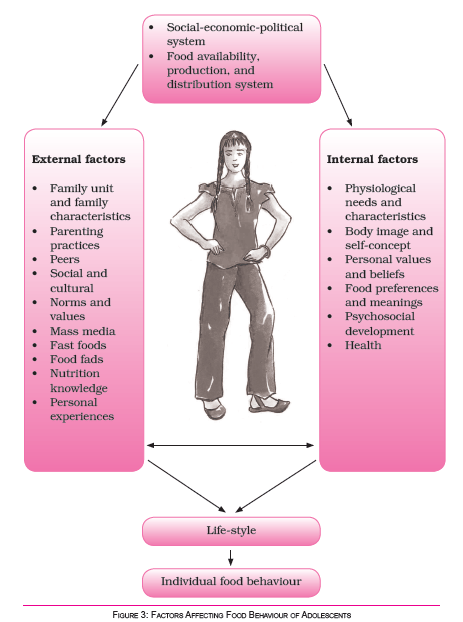
By the time a person reaches adolescence the influences on eating habits are numerous and the formation of those habits is extremely complex, as shown in Figure 3. The growing independence of adolescents, increased participation in social life, and a generally busy schedule of activities have a definite impact on what they eat. They are beginning to buy and prepare more food for themselves and they often eat rapidly and away from home.
In order to encourage adolescents to form reasonably healthy eating habits parents should give their children the opportunity to choose from a range of nourishing foods as they are growing up. By the time they are teenagers they will need some freedom to use the kitchen; this is true for boys as well as for girls.
While the basic foundation for eating habits is found in the family, many influences on eating behaviour originate outside the home. The influence of peers can be a useful source of support, as well as a source of stress for the adolescent. Peer influence and support can be helpful for overweight teenagers, although the same peers can also target such adolescents for teasing.
Teenagers are very vulnerable to advertising messages. Television food commercials and eating habits portrayed in programme content have influenced people for more than a decade. The majority of advertisements are for products with a high concentration of sweetness and fat. Hence, adolescents have to be discerning while consuming such food products.
The ease of obtaining food that is ready to eat also influences the eating habits of teenagers. Through home delivery/vending machines, at movies, melas and sporting events, at fast-food outlets and convenience groceries, food is available at numerous times throughout the day. Hence, adolescents may eat more often as well as more of not-so-healthy food stuffs. Watching this tendency is advisable.
3.9 Eating disorders at adolescence
Adolescence is associated with rapid physical growth and body-image development eating disorders are of special concern at this time. These changes intensify associated self-esteem problems. Anorexia nervosa, for example, is a disorder so tied to body image distortion that it is most commonly seen in adolescence, the period when a person is struggling with self-identity and most vulnerable to body image problems. Progress in adopting a normal adult body image will be interrupted for the teenager with an eating disorder.
To understand anorexia nervosa let us take the example of Sonam. She aspires to have a perfect body. She has been ignoring the advice of her parents and teachers and almost stopped eating. She has become obsessed with having a very thin body. Although her current weight is normal, she feels pressured to be “ideally” thin like some actresses in movies or models in magazines. She has a low self-esteem and remains depressed, and this has resulted in her withdrawing from her family and friends. She is unaware that she is undernourished and insists that she is fat. She is a clear case of the eating disorder called anorexia nervosa. She is unaware that drastic loss of weight can even lead to death.
Bulimia is another type of eating disorder. Bulimia often begins in late adolescence or early adulthood after a series of various unsuccessful weight reduction diets. Those with bulimia indulge in bingeing (overeating) and inducing purging by vomiting or using laxatives. Although more common in females, about five to ten per cent of all eating disorders occur in males too.
Anorexia and bulimia can have serious consequences such as convulsions, renal failure, irregular heartbeats and dental erosion. In adolescent girls, anorexia can delay the onset of menstruation, permanently minimise stature and result in osteoporosis (weakening of bones).
Perhaps a person’s best defense against these disorders is to learn to appreciate one’s uniqueness. Respecting and valuing oneself will certainly be life saving. Important dietary interventions include ensuring balanced diets, enhancing dietary fibre intake and using nutrient/food supplements to make up losses.
To sum up, physical, social and emotional changes experienced during adolescence can profoundly impact the adolescent’s nutritional status and eating patterns. Although young people are rarely motivated to learn about nutrition for the sake of longevity, learning how to apply sound dietary principles to reach our health goals can help build the foundation to a healthier life, now and in the future.
Health is a key resource of young people; it influences the availability and use of other resources that are important in everyday life. What are the other resources that an individual has? The following chapter on Management of Resources addresses this question and also discusses how best one can utilise and manage key resources such as time, energy and money.
Key terms and their meaning
Activity level
Level of activity of a person, i.e., sedentary or light, moderate, and heavy. This is closely related to one’s occupation.
Balanced diet
A diet which includes a variety of foods in adequate amounts and correct proportions to supply all essential nutrients which promote and preserve good health.
Food group
A number of foods sharing common characteristics which are grouped together. Characteristic for grouping may be function, nutrient, or source.
Lactation
The period when the mother nurses her infant.
Physiological state
State when nutrient needs increase because of normal physiological events such as pregnancy and lactation.
Recommended Dietary Allowances
Allowances of nutrients which cover the needs of practically all healthy individuals. These are not requirements for any individual but guidelines which tell us the amount of nutrients to be consumed daily.
- Review Questions
l Differentiate between the terms RDA and requirement.
2 Explain how the use of food groups simplifies planning of balanced meals.
3 List 10 foods which belong to the protective food group, stating reasons for your choice.
4 Discuss the factors that influence eating behaviour at adolescence.
5 Explain the two eating disorders that may arise at adolescence. What would be the best way to prevent their occurrence?
- Practical 3
Food, Nutrition, Health and Fitness
1. List 10 sign of good health. Evaluate yourself using the following format.
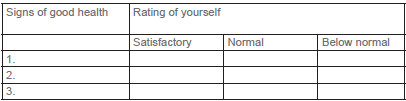
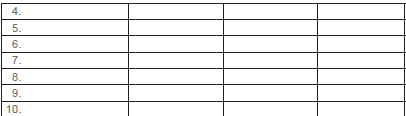
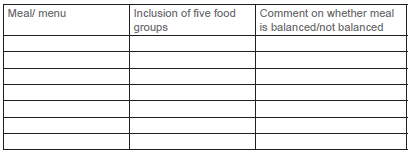
2. Record your diet for a day. Evaluate each meal in terms of inclusion of the five food groups. Do you think the diet is balanced? Use the following format to write your response.
3. Interview members of your family such as your grandmother, mother or aunt to collect information about—
(a) food taboos giving reasons why the taboos are followed.
(b) food practices during fasting and festivity from the region of India to which you belong.
(c) preparations during fasting.
Tabulate the information as follows.
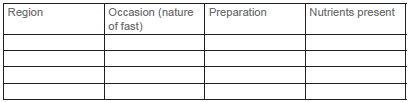
Give two inferences on the basis of the information tabulated.
4
Management of Resources
Learning Objectives
After completing this chapter the learner will be able to
• discuss the concept of a resource.
• identify various resources.
• classify resources into human and non-human.
• describe the characteristics of resources.
• explain the need for managing resources.
• analyse the management process.
4.1 Introduction
Everyday we carry out various activities. Think of any activity you do and you will find that to complete that activity you need one or more of the following.
• Time
• Energy
• Money for purchasing required material
• Knowledge
• Interest/Motivation
• Skills/Strengths/Aptitude
• Material goods like paper, pen, pencil, colours, etc.
• Water, air
• School building
All these – time, energy, money, knowledge, interest, skills, materials – are resources. Resources are anything which we make use of while carrying out any activity. They help us in accomplishing our goals. You may need more of a certain resource for a particular activity as compared to other resources. In the previous chapter, you have learnt about your own strengths. These are your resources.
Anything which is not used by us is not a resource. For example, a bicycle which has not been used for long and is just lying at your place may not be a resource for you. However, it may be a resource to someone else.
If you re-look at the list of resources above, you will find that resources can be classified as–
• Human resources
• Non Resources-human resources or material goods
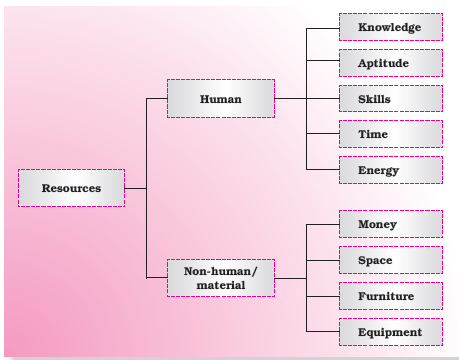
Resources
Resources can be classified in different ways.
• Human/non-human resources
• Individual/shared resources
• Natural/community resources
We will read about each of these classifications.
Human and Non-human Resources
Human Resources
Human resources are central to carrying out any activity. These resources can be developed through training and self-development. For example, knowledge regarding any field/task can be acquired, skill may developed which will help you to develop aptitude. Let us read about human resources in detail.
(a) Knowledge – It is a resource one uses throughout one’s life and is a pre-requisite for carrying out any activity successfully. A cook must have knowledge of how to operate cooking gas or chullah before she/he starts preparing food. A teacher who does not have thorough knowledge of her/his subject, cannot become an effective teacher. One needs to be open to acquiring knowledge throughout one’s life.
(b) Motivation/Interest: There is a common saying, ‘Where there is a will there is a way’. This indicates that to accomplish any task, the worker must be motivated and interested in doing it. For example, if a student is not interested in learning a task, even when other resources are available, she/he still may give excuses and not finish the task. We may pursue dance, painting, reading fiction, art and craft and other hobbies as per our motivation.
(c) Skills/Strength/Aptitude: All individuals may not be skilled in performing all activities. Each one of us has an aptitude in certain areas. We can therefore carry out activities in these areas better as compared to others. For example, pickles and chutney prepared by different individuals will taste different depending upon their skill. However, we can acquire skills we do not have through learning and training.
(d) Time: It is a resource available to everyone equally. There are 24 hours in a day and every one spends it in her/his own way. Time once lost cannot be regained. Hence, it is the most valuable resource. Managing time in a specific period and attaining the goal is very important. We need to continuously plan and be able to utilise the available time to finish the desired task.
Time can be thought of in terms of three dimensions — work time, non-work time, rest and leisure time. We need to learn and balance time across these three dimensions in order to be able to accomplish one’s goals. When one learns to balance all the three dimensions, it helps the individual to be physically fit, emotionally strong and intellectually alert. You should be aware of the peak periods when you are best able to work and use this precious resource effectively to accomplish your goals.
(e) Energy: For sustaining individual growth and physical output, energy is essential. Energy levels vary from person to person, according to their physical fitness, mental condition, personality, age, family background and their standard of living. To conserve energy and to use it most effectively, one must carefully think and plan through the activity so that one can complete the task efficiently.
Non-human Resources
(a) Money: We all require this resource but it is not equally distributed among us – some have less of this resource as compared to others. We need to remember that money is a limited resource and must be spent judiciously to fulfil our requirements.
(b) Material Resources: Space, furniture, clothes, stationery, food items, etc., are some of the material resources. We require these resources to carry out activities.
Individual and Shared Resources
(a) Individual Resources: These are resources which are available to an individual for personal use only. These can be human or non-human resources. Your own skills, knowledge, time, your school bag, your clothes are some of the examples of individual resources.
(b) Shared resources: These are resources which are available to many members of the community/society. Shared resources can be natural or community based.
Natural and Community Resources
(a) Natural Resources: Resources available in nature, like water, mountains, air, etc. are natural resources. These are available to all of us. In order to protect our environment, each one of us has the responsibility of judiciously using these resources.
(b) Community Resources: These resources are available to an individual as a member of community/society. These are generally provided by government. These may be human or non-human. Consultancy provided by government hospitals, doctors, roads, parks and post offices are some examples of community resources. Every individual must strive to optimally use these resources and feel responsible in maintaining them.
Characteristics of Resources
Though we can categorise resources in various ways, they also have certain similarities. The following are some characteristics of resources.
(i) Utility : ‘Utility’ means the importance or usefulness of a resource in helping one to achieve a goal. Whether or not a resource has utility depends on the goal and the situation. For example, cow dung is considered waste. However, it can be used as a fuel and can also be used to prepare humus (manure). Proper use of important resources available to a family or community leads to greater satisfaction.
Activity 1
Think of your own self and make a list of the human resources you have. Use the following guidelines to reflect on this.
• Knowledge – which areas are you knowledgeable about
• Motivation / interest – what activities do you enjoy doing most
• Skills/strengths/aptitude – what are you particularly good at doing
• Time – which periods of the day are you most active
• Energy – Do you largely feel energetic or tired?
(ii) Accessibility : First, certain resources are more easily available as compared to others. Second, resources may be more easily available to some people as compared to others. Third, the availability of resources changes over time. Thus, we can say that accessibility of resources varies from person to person and from time to time. For example, every family has money as a resource. While some have sufficient money to meet their needs, others have limited budgets. The amount of available money is also different during the beginning of a month as compared to towards the end of the month.
(iii) Interchangeability : Almost all the resources have substitutes. If one resource is not available, it can be substituted by another. For example, if your school bus does not arrive on time to pick you up, you can go to school in your car, tractor, bullock cart or scooter. Thus, the same function can be performed by a number of resources.
(iv) Manageable : Resources can be managed. Since resources are limited, they should be managed properly and effectively for their optimum utilisation. Resources should be used in such a way that we attain maximum output with minimum input of resources. For example, we should avoid using two-three buckets of water to wash clothes if we can wash them using one bucket.
Managing Resources
It is important to note that none of the resources are unlimited. All resources are finite. We need to utilise resources effectively to achieve our goals faster and efficiently. Resources, therefore, should not be misused and wasted. Thus, to achieve our goals, effective management of resources is extremely essential.
Managing resources is about getting the most from the resources which are available to us. For example, everybody has 24 hours in a day. While some plan their schedule everyday and utilise every hour to achieve their goals, others waste their time and are not able to do anything productive the entire day.
Management of resources involves implementing resource management procedures which include planning, organising, implementing, controlling and evaluation. We will read about these in detail in the following section.
The Management Process
As stated above, the management process involves five aspects – planning, organising, implementing, controlling and evaluation.
(a) Planning: It is the first step in any management process. It helps us to visualise the path to reach our goals. In other words, to plan is to produce a scheme for action to achieve specified goals by using the available resources.
Planning involves selecting the course of action. To plan effectively to achieve a goal, you must ask the following four basic questions. The answers to these questions will help you to develop a plan.
1. What is our present situation? This involves assessing the present situation, analysing what one has at present and what one would like to have in future.
2. Where do we want to reach? This involves setting specific goals or targets which we desire to achieve keeping in mind the present and future needs.
3. Gap. This is the difference between our present situation and the desired situation. We need to cover this gap in order to achieve our goal.
4. How can we reach our desired goals? Answering this question will help you to decide how to cover this gap. This involves making a plan to achieve goals.
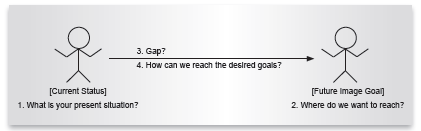
• Steps in planning : The basic steps in planning are–
1. Identifying the problem
2. Identifying different alternatives
3. Choosing between alternatives
4. Acting to carry out the plan/Putting the plan into action
5. Accepting the consequences
For example, there is only one month left for your annual examination and you have not completed your revision (present situation); your aim is to score good marks (goal). To achieve this goal you need to study five subjects in the specified time period (gap). You would think of a way of achieving this goal (prepare a plan of action), which will include the number of hours you will devote to each subject, prioritising subjects, curtailing other activities and so on.
Activity 2
List the resources you would need in order to secure good marks and study well. Compare your list with others.
_____________________________________________________________________
_____________________________________________________________________
_____________________________________________________________________
_____________________________________________________________________
_____________________________________________________________________
(b) Organising: It is collecting and arranging appropriate resources in order to implement plans in an effective and efficient manner. If we take the above example, you would organise and arrange all the resources which you may require to study and secure good marks.
Some resources could include books, notes, space to study, light, stationery, energy and time.
(c) Implementing: This stage involves carrying out the prepared plan. In the above example, you would put the plan into action by starting to study from the available resources (e.g., books, stationary, notes, etc.).
(d) Controlling: It refers to the task of ensuring that your activities are producing the desired results. In other words, the plan you have put into action is getting the desired results. Controlling helps monitor the outcome of activities and makes sure that the plans are being implemented correctly. It is important as it provides feedback and helps to check errors. Feedback helps you to revise your plan of action so you can achieve your goal. Therefore, while you are putting your study plan into action, yet you are unable to complete your allotted chapter because you watch television, this gives you the feedback that you need to minimise your distractions. You will not watch T.V, play or chat with friends during the study hours, as it can affect the outcome of your formulated plan (i.e., study as per the decided number of study hours).
(e) Evaluation: In the final stage, the outcomes that you have arrived at after putting your plan into action are evaluated. The end result of the task is compared with the desired result. All the limitations and the strengths of the task are noted so that they can be used in future to achieve one’s goals effectively. With reference to the example of studying, evaluation is what you do when you get back the checked answer sheets of the examination. You evaluate your marked answer sheets as per the preparation you had done for the examination and the results you had wanted to achieve. If the scores for any subject fall short of your expectations, you try to identify the reasons for the same. At the same time, you also try to find out your strengths which helped you to secure good marks in other subjects. Then you use these strengths to overcome your limitations to secure better marks in your next examination.
In addition to the different resources discussed in this chapter, there are some other non-human resources that form an integral part of our daily living. One such resource is fabrics. The following chapter tells us about the various fabrics that we come into contact with and their properties.
Key Terms
Resources, Human Resources, Non-human resources, Planning, Organising, Implementing, Controlling, Evaluation
Activity 3
You wish to arrange a farewell party for Class XII students. Identify your resources and state the aspects you will keep in mind at each stage of the management process in organising the party.
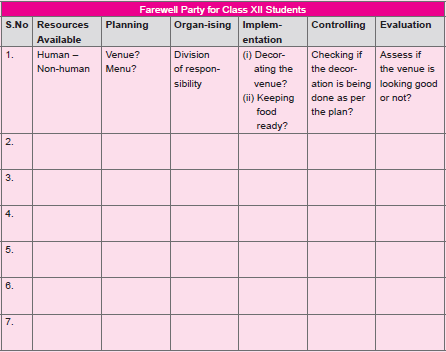
- Review Questions
1. Define a resource.
2. Classify resources in three different ways giving the definition of each resource and two examples of each.
3. Why should resources be managed?
4. Explain the steps in the management process, using one example to clarify each step.
- Practical 4
Management of Resources – Time, Money, Energy and Space
(A) Record your day’s activity from 6.00 a.m. onwards
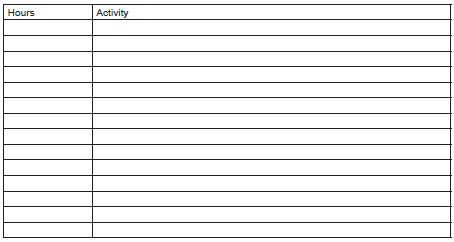
(B) Only one week is left for the annual examination. Prepare a time plan indicating the number of study hours for each day. An example is given for Monday.
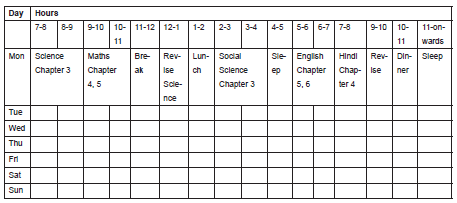
5
Fabrics Around Us
Learning Objectives
After completing this chapter the learner will be able to —
• discuss the diversity in fabrics.
• name and classify the fabrics commonly seen around.
• explain the concept of yarn and fabric making.
• describe the properties of each group of fabrics.
• make informed selection of textile products for specific end use.
5.1 Introduction
Fabrics are all around us. They are an important part in our lives. Fabrics give comfort and warmth, bring colour and decorative style, and add texture. Just think of a day’s activity and recall how fabrics touch you. When you wake up from your bed, the bedsheets and pillow covers are fabrics. As you get ready for school the towel you use after bath is a soft and absorbent fabric, and the school dress you wear is again a fabric of a special type. The school bag in which you carry your books and other items is also a fabric, but again different in texture. It may be slightly stiff and coarse but strong enough to bear the load. If you observe your home you will find fabrics in almost all places, from curtains to kitchen dusters, floor mops and durries. Fabrics are of different kinds, weights and thickness and their choice is related to their end use.
If you take a typical fabric in hand, and unravel it, you may be able to pull out the thread like structures from it. These may be interlaced with each other at right angles or interlooped as in your woollen cardigan or T shirts, or knotted as in nets and laces. These are called yarns. If you try to untwist the yarn you will see very tiny and fine hair like structures. These are called fibres. Thus fibres are the basic building blocks of fabrics. All these materials — fibres, yarns and fabrics are called textile products or simply textiles. After the fabric is ready it may be subjected to further processing which may improve its appearance (cleaning, whitening, colouring) or make it more lustrous or improve its touch and feel qualities or improve its service ability. This is called finishing. A large variety of fabrics are available in the market these days and each one behaves differently when in use. The behaviour of the fabric in use and in care and maintenance depends on various factors such as type of fibre, yarn, fabric and finishing.
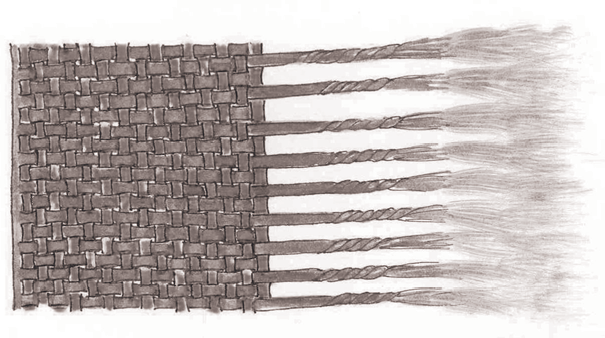
Activity 1
Collect different kinds of fabric samples from home, a tailor’s shop, a cloth shop or friends. Name each fabric.
5.2 Fibre properties
The properties of fibre contribute to the properties of the final fabric. For a fibre to be really important and useful, it must be available in large quantities and be economical. The most essential property is its spinnability, i.e., a characteristic which is essential for ease of conversion into yarn and later into fabric. It is the sum total of properties such as length, strength, flexibility and surface structure of the fibre. From the point of view of consumer satisfaction, properties such as colour, luster, weight, moisture and dye absorption and elasticity are desired. Factors that affect care and maintenance of the fabric such as abrasion resistance, effect of chemicals, soaps and detergents, effect of heat, and resistance to biological organism are also important to the user.
5.3 Classification of textile fibres
Textile fibres can be classified on the basis of their origin (natural or man-made or manufactured), general chemical type (cellulosic, protein or synthetic), generic types (animal hair or animal secretion) and common trade name (polyester, as terene or dacron). Further, fibres can be staple, i.e., short length like cotton, or filament, i.e., long length like silk, polyester, etc.
Natural Fibres
Natural Fibres are those which are available to us in nature. There are four types of natural fibres.
(a) Cellulosic fibres—
1. Seed hair-cotton, kapok
2. Bast fibres-flax(linen), hemp, jute
3. Leaf fibres-pineapple, agave(sisal)
4. Nut husk fibres-coir(coconut)
(b) Protein fibres
1. Animal hair–wool, specially hair (goat, camel), fur
2. Animal secretion–silk
(c) Mineral fibre: Asbestos
(d) Natural rubber
Manufactured Fibres (also called man-made fibres)
Most of you must have seen a cotton flower with fibres sticking to the seeds, or sheep with long overgrown hair. You can also imagine how these may be used for yarn and fabric production. However, you may find it difficult to understand how the manufactured or synthetic fibres came to exist.
The first manufactured fibre–Rayon–was commercially produced in AD 1895, while most others are products of the 20th century.
|
The concept of creating fibres perhaps originated from human desire to produce a fibre like silk. Possibly, the thought process could have been like this: the silk worm, which basically feeds on mulberry leaves, digests them and spews a liquid through its spinnerettes (two holes), which on solidifying becomes the silk filament (cocoon). Thus if a cellulose substance is digested it should be possible to produce something like silk. Therefore for a long time the rayons were referred to as Artificial Silk or simply Art Silk. |
The earliest manufactured fibres were made by modifying a non-fibrous material into a fibrous form. These were mainly from cellulosic substances like cotton waste or wood pulp. The second group of fibres were synthesised completely from use of chemicals. Whatever may be the raw material the basic steps for converting it into a fibrous form are the same.
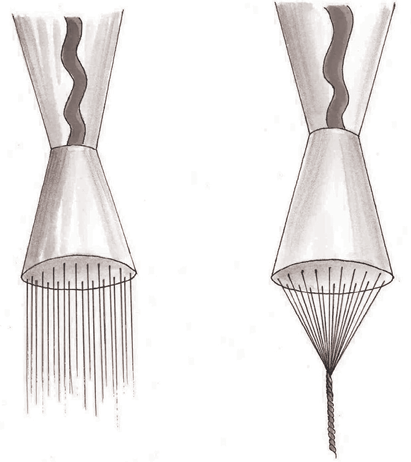
• The solid raw materials are converted into a liquid form of a specific viscosity. This may be due to a chemical action, dissolution, heat application or a combination action. This is called the spinning solution.
• This solution is passed through a spinnerette – a small thimble shaped nozzle with a series of very small holes, into an atmosphere which hardens it or coagulates it into fine filaments.
• As the filaments harden they are collected and stretched
for further fineness and orientation or subjected to further processing like texurisation to improve its stretch and/or bulk characteristics.
Types of Manufactured Fibres
(a) Regenerated cellulosic fibres: Rayon–cuprammonium, viscose, high-wet-modulus
(b) Modified cellulosic: Acetate–secondary acetate, triacetate
(c) Protein fibres: Azlon
(d) Non-cellulosic(synthetic) fibres
(i) nylon
(ii) polyester – terelene, terrene
(iii) acrylic – Orlon, cashmilon
(iv) modacrylic
(v) spandex
(vi) rubber
(e) Mineral fibres
(i) Glass – fibreglass
(ii) Metallic – lurex
5.4 Yarns
The textiles in the form of fibres cannot always be used for consumer products except in products like surgical cotton, stuffing for pillows, quilts, mattresses and cushions. To convert fibres into fabric form as we see around us, they have to be converted into a continuous strand. Although there are some fabrics like felts or non-wovens which are made directly from fibres, in most cases the fibres are processed to an intermediate stage called yarn.
Yarn can be defined as a continuous strand of textile fibres, filaments or material in a form suitable for knitting, weaving or otherwise intertwining to form a textile fabric.
Yarn Processing
Yarn processing from natural staple fibres is called spinning, although spinning is the last stage in the processing.
|
Earlier young unmarried girls were commonly involved in spinning the finest yarn because of their nimble fingers. The term ‘spinster’ for unmarried women originated in that context. |
Yarn processing, i.e., conversion of fibre into a yarn involves a number of stages.
Let us take them one by one.
(i) Cleaning: Natural fibres generally contain extraneous impurities depending upon their source, like seeds or leafy matter in cotton, twigs and suint in wool. These are removed, fibres sorted out and converted into laps (rolled sheets of loose fibres).
(ii) Making into a sliver: Laps are unrolled and subjected to straightening processes which are carding and combing. The process is similar to combing and brushing your hair. Carding disentangles the fibres and lays them straight and parallel to one another. For finer fabrics the laps are subjected to combing after carding. This process removes finer impurities and short fibres as well. The lap then passes through a funnel shaped device which helps to convert it into a sliver. Sliver is a rope like mass of loose fibres, 2-4 cms in diameter.
(iii) Attenuating, drawing out and twisting: Now that the fibres have been converted into a continuous strand, it needs to be made to the size required. This is called attenuation. Several slivers are combined for uniformity. The slivers are gradually drawn out so that they become longer and finer. If a blended yarn is required (e.g., cotswol-cotton and wool) slivers from different fibres are combined at this stage. The resultant sliver is still of the same size as the original sliver.
The sliver after drawing is taken to the roving machine where it is further attenuated till it becomes of its original diameter. It is given a slight twist to keep the fibres together. The next stage is spinning. Here the strand is given the final shape as the yarn. It is stretched to the required fineness and the desired amount of twist given to it and wound on cones.

Figure 3: Cotton spinning
All manufactured fibres are first made as filaments. The yarn can be composed of a single filament or a multifilament yarn when a number of individual filaments are taken together and twisted as one. It is also possible to cut the filament into staple length fibres. These are then subjected to spinning process as for natural fibres and are called spun yarns. Staple length fibres are also required when a mixed fabric/blend like ‘terecot’ (terene and cotton) or ‘terewool’ (terene and wool) or ‘polycot’ (rayon and cotton) is required.
Yarn Terminology
(a) Yarn number: You may have seen certain numbers 20, 30, 40, etc., on the labels of thread reels. If you observe carefully and compare the fineness of the thread you will realise that thread reel with a higher number is finer. There is a fixed relationship between the weight of the fibre and the length of yarn drawn from it. This is designated as yarn number which becomes the indication of the fineness of the yarn.
(b) Yarn twist: As fibres are transformed into yarn, twist is added to hold the fibres together and is indicated as t.p.i. (twist per inch). Loosely twisted yarns are softer and more lustrous, whereas tightly twisted yarns may show as ridges such as in denim material of jeans.
(c) Yarn and thread: Yarn and thread are basically similar. Yarn is the term usually used in the manufacturing of a fabric, whereas, thread indicates a product used to join pieces of fabrics together.
5.5 Fabric production
There are many types of fabric available in the market. Variation in different fabrics is due to the basic fibre content (cotton, wool, e.g.) or as you have just learnt, the type of yarn. When you look at the fabrics you may be able to distinguish between different structures as well.
We will now discuss how these fabrics are produced. Most of the fabrics you see are made from yarns. However, a small group of fabrics can be made directly from fibres.
Activity 2
Try and note the difference between the structure of the material of your shirt or dress, pant/jeans, towel, socks, shoe laces, floor covering felts (namdas) and carpets.
There are two main types of fabrics that are made directly from fibres–felts and non-wovens or bonded fibre fabrics. These fabrics are formed by laying the fibre (after carding and combing) in the form of a matt and then adhesion is caused between them. The matt can be made not only of required thickness but also of any shape.
As already mentioned, the majority of fabric constructions require the intermediate yarn stage. The main methods of fabric construction are weaving and knitting and to a small extent braiding and knotting.
Weaving
Weaving is the oldest form of textile art, which was originally used for making mats and baskets. A woven fabric consists of two sets of yarns which are interlaced at right angles to each other, to form a compact construction. It is done on machines called looms. One set of yarns is fitted on the loom, which determines the length and width of the fabric to be woven. These are called warp yarns. The loom helps to maintain these yarns at a fixed tension and even space. The second yarn, which is the filling yarn,
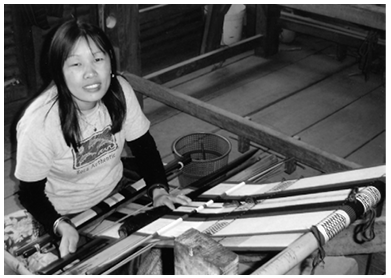
is then interlaced to form the fabric. The simplest interlacing is when the filling yarn moves over and under one warp yarn alternately in one row and reverses the process in the second row. By passing the filling yarn over and under different number of warp yarns, in a specified sequence, different designs can be created. Attachments like the dobby or jacquard to the loom can help to create figurative designs as well. These designs become clearer when different coloured yarns are used for warp and filling. Certain designs make use of an extra yarn which may run parallel to warp or filling yarns. This can be held up as loops during weaving, which may be left uncut or cut afterwards. This makes the texture like one sees in towels (uncut) or velvets and corduroy (cut).
The direction of the yarns in a woven fabric is referred to as grain. Warp yarns run along the length wise grain or selvedge. Filling yarns run along the width wise grain or weft. Thus the length and width in a woven fabric is called the selvedge and weft. When you buy a fabric, you see it has two cut sides and two bound sides. The bound sides are the selvedges. The fabric is strongest along the selvedge.
Knitting
Knitting is the interlooping of atleast one set of yarns. It may be done by hand using a set of two needles for flat fabrics or a set of four needles for circular fabrics. Knitting may be done on machines. The process consists of making a series of loops along the knitting needle or machine bed. Each successive row is formed by interlooping with the first row of loops. The movement of the yarn is along the width of the material and therefore it is called filling or weft knitting. This method of knitting is used to produce articles which can be shaped while being constructed.
At the industrial level, the knitting machines used are like the looms for weaving. They have a set of yarns (like warp yarns) fitted on the machine. The interlooping occurs with adjacent yarns. This is known as warp knitting. This can produce continuous lengths of material, which unlike the weft knitted fabric can be cut and stitched.
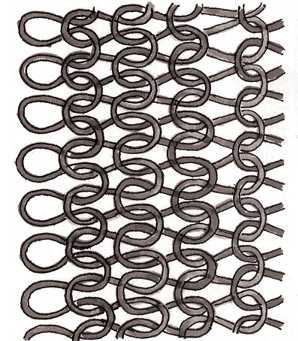
Figure 4: Weft knitting Figure
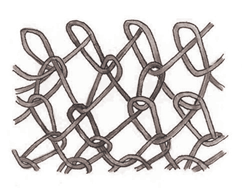
Knitted fabrics can be made more rapidly. Because of the system of loops they have more elasticity and thus are suitable for fitted articles like vests, underwear, socks, etc. They are porous and permit free circulation of air, are comfortable and allow freedom of movement and are therefore ideally suited for sportswear.
Braiding
Braided fabrics have a diagonal surface effect and are made by plaiting three or more yarns that originate from a single location and lie parallel before interlacing occurs. Braids appear in items as shoelaces, ropes, insulation for wires and trimmings.
Nets
Nets are open mesh fabrics with large geometric interstices between the yarns. These are made by inter-knotting of yarns by hands or machines.
Laces
Lace is an openwork fabric consisting of a network of yarns formed into intricate designs. It is a product of a combination of procedures including yarn twisting, interloping and knotting.
5.6 Textile Finishing
If you see the fabric as it comes out from the loom you will not be able to recognise it as the material you see in the market. All of the fabrics that are available in the market have received one or more finishing treatments, and except for whites, colour has been added to them in some form or the other.
Activity 3
Collect five labels of fabrics. Match the information with what you have just read.
A finish is any treatment on the fabric which can change its appearance, its textures or its behaviour for specific use. Finishes that are considered absolutely necessary are known as ‘routine’. The finishes may be durable (do not get removed on washing or drycleaning) like dyeing, or renewable (need to be applied repeatedly as they get removed on washing) like starching or blueing. A few important finishes depending upon their functions are:
• Change appearance : Cleaning (scouring, bleaching), straightening and smoothening (calendering and tentering)
• Change textures: Starching or sizing, special calendering
• Change behaviour : Wash and wear, permanent press, water repellent or water proof, mothproof, flame retardant or fire proof, antishrink (sanforisation).
(a) Finishing with colour: Colour is often the most important factor in selection of fabric, whether it is to be used for apparel or in the house. Substances that can add colour to the fabric in a manner that it does not easily wash out are known as dyes. The method of dying depends on the chemical natures of the fibre and the dye, and the type of effect desired. Colour application can be done
• at fibre stage – for yarns of different colours or designed felts.
• at yarn stage – for woven checks, stripes or other woven patterns.
• at fabric stage – the most common method for solid colour dye, as also for designed dying like batik and tie and dye and printing.
(b) Printing: It is a more advanced or specialised form of dyeing. It involves the localised application of colour which is restricted within the given limits of design. Printing uses special tools which cause the transfer of colour only to the specified areas. Thus, it allows the application of a number of different colours on the fabric. Printing can be done by hand tools like blocks, stencils or screens and at industrial level like roller printing or automatic screen printing.
5.7 Some important fibres
Cotton
Cotton is the most widely used fibre for apparel and home textiles. India is the first country where cotton was grown and used, and it continues to be one of the largest cotton growing areas. Cotton fibres are obtained from the seed pod of the cotton plant. Each seed has a large number of hair attached to it. When the seeds ripen the pod bursts open. The seeds are separated from the fibres by a process called ginning and sent as large bundles (bales) for spinning.
Properties
• Cotton is a natural cellulosic, staple fibre. It is the shortest fibre with length varying from 1 cm to 5 cms, therefore the yarn or the fabric made is dull in appearance and slightly rough to touch. It is heavier in weight than most of the other fibres.
• Cotton has good moisture absorbency and it also dries easily. Thus it is comfortable for summer use.
• It is available in fabrics of all types of weights, fineness, structures and finishes. Muslin, cambric, poplin, long cloth (latha), casement, denim, sheeting material and furnishing material are some of the cotton fabrics available in the market.
Linen
Linen is a bast fibre, obtained from the stems of the flax plant. The term bast means the fleshy part inside the bark. To obtain the fibres the stems are steeped in water for a long time to rot away the soft parts, in a process called retting. After retting the woody parts are separated and the linen fibres are collected and sent for spinning.
Properties
• Linen is also a cellulosic fibre, therefore, many of its properties are similar to that of cotton.
• The fibre is longer and finer than cotton, so the yarn produced is stronger and more lustrous.
• Like cotton, linen also absorbs moisture readily and, therefore, is comfortable. However, it does not absorb dyes very readily and therefore colours produced are not so bright.
Flax plant is cultivated in very few areas worldwide. Also it requires longer processing time, therefore, linen is used less than cotton.
Jute and Hemp are also bast fibres like Linen. They are coarser fibres and do not have good flexibility, and are therefore used for making ropes, gunny bags and other such products.
Wool
Wool is obtained from sheep hair. It can also be obtained from other animals like goats, rabbits and camels. These fibres are called speciality hair fibres. Different breed of sheep provide different types of hair. Some breeds are raised only for good quality of fibres they produce. Removal of hair from the animal is called shearing. It may be done once or twice a year depending on the climatic conditions. While shearing, effort is made to keep the hair in one piece which is called fleece. This makes the sorting of fibres easy because hair from different parts of the body vary in length and fineness. After sorting, the fibres are scoured to get rid of dirt, grease and dried perspiration. This is followed by carbonisation which removes entangled vegetable matter like leaves and twigs. Thereafter, the fibres are sent for spinning.
Properties
• Wool is a natural protein fibre. The fibres vary in length from 4 cms to 40 cms and may be coarse or fine depending on the breed of the sheep and the part of the animal body. It is characterised by a natural crimp or a built-in waviness responsible for elasticity and elongation properties.
• Compared to other fibres wool has low strength but has good resilience, and elastic recovery.
• Wool has surface scales which are water repellant in nature. However, it can absorb large amount of water but does not feel wet on the surface. This ability is responsible for its comfort in humid and cold atmospheres.
Wool is also used as blends with cotton, rayon and polyester, which improves its care and maintenance properties.
Silk
Silk is a natural filament fibre produced by the secretion of silk worms. If silk is produced in controlled conditions (cultivated or mulberry silk), it is smooth, and longer fibres are produced which results in a smoother, finer and lustrous fabric. If silk is produced in wild or natural conditions, the resulting silk is coarser, stronger and short in length, which results in a thicker, coarser but stronger fabric (e.g., tussar silk). For production of good quality silk, silk worm cultivation is carefully controlled. It is called sericulture. Being a filament fibre silk does not require the spinning process but has to be reeled carefully from the cocoon. The yarns are made by twisting a number of filaments together. If the filaments break or when the insects break the cocoon, the broken filaments are processed through spinning like cotton, and this is called spun silk.
It is believed that silk was discovered accidentally when the cocoon of an insect fell in the cup of tea of a Chinese princess. She took it out and discovered that she could pull out a long continuous filament from the cocoon. The Chinese kept the art of producing silk a secret for over 2000 years—until about 500 A.D.
Properties
• Silk is a natural protein fibre and the natural colour of silk is off white to cream. Wild silk is brownish in colour. Silk filaments are very long, fine, smooth and have a relatively high lustre or sheen. It contains a natural gum which gives silk a crisp texture.
• Silk is one of the stronger fibres used in making fabrics. It has good elastic recovery and moderate elongation.
Rayon
This is a manufactured cellulosic fibre. Cellulosic because it is made from wood pulp and manufactured because this wood pulp is treated with chemicals and regenerated into fibres.
Properties
• As rayon is a manufactured fibre the size and shape can be controlled. It has uniform diameter and is clear and lustrous.
• Rayon being a cellulosic fibre has most properties like cotton. But it has a lower strength and durability.
The main advantage of rayon and manufactured cellulosic fibres is that they can be reprocessed out of waste material and have an appearance like silk.
Nylon
Nylon was the first true synthetic fibre (totally manufactured from chemicals) to be manufactured. It was first introduced as bristles for tooth brushes. In 1940, the first fabrics from Nylon were socks and stocking which were very successful. Thereafter, it was used for all kinds of fabrics. It also provided the impetus for other synthetic fibres which followed.
Properties
• Nylon filaments are usually smooth and shiny, with uniform diameter.
• Nylon has very good strength and abrasion resistance. Its resistance to abrasion makes it appropriate to be used in brushes, carpets, etc.
• Nylon is a highly elastic fibre. Very fine and transparent fibres are used for ‘one-size’ garments like stockings.
• Nylon is a popular fabric used in apparel, socks, undergarments, swimsuits, gloves, nets, sarees, etc. It is a leading fibre in the manufacture of hosiery and lingerie. For outerwear it may be blended with other fibres.
Polyester
Polyester is another manufactured synthetic fibre. It is also referred to as Terylene or Terene.
Properties
• Polyester fibre has uniform diameter, smooth surface and rod like appearance. It can be made in any strength, length and diameter as per the requirements of the end use. The fibre is partially transparent and lustrous.
• The moisture regain of polyester is very low, i.e., it does not absorb water easily. Thus, it is not very comfortable to wear in hot dry summer months.
• The most advantageous property of polyster is its wrinkle resistance. It is one of the most commonly used fibre for blending with rayon, cotton and wool and, to some extent, spun silk.
Acrylic
This is another synthetic fibre. It resembles wool so much that even an expert may not be able to find the difference between the two. It is commonly called as Cashmilon. It is cheaper than wool.
Properties
Like all manufactured fibres the length, diameter and fineness of the fibre are controlled by the manufacturer. The fibre can be made in varied degrees of crimp and luster.
• Acrylic is not very strong and its strength is similar to cotton. The fibres have high elongation with good elastic recovery.
Acrylic is used as a substitute for wool and is used in children’s wear, apparels, blankets and knitted goods.
Elastomeric fibres
Apart from the fibres mentioned so far, there are a few less known ones. These are elastic, rubbers like substances and can be produced in various forms. In its natural form they include rubber and the synthetic equivalent is spandex or Lycra. These are usually used as blends with any of the above fibres with low elasticity.
Having studied about fabrics in this chapter, you will be introduced to the world of apparel, i.e., clothes, made from fabrics later under the section ‘Childhood’.
Knowing about fabrics is important for the adolescent as it would enable one to make wise selection of clothes – an interest that is commonly shared by all adolescents. Apart from clothes, another interest that binds adolescents from different contexts is media and communication. Let us learn more about these two interrelated aspects in the next chapter on Media and Communication Technology.
Key Terms
Fabrics, Yarns, Fibres, Textiles, Textile finishing, Weaving, Knitting, Cotton, Linen, Wool, Silk, Rayon, Nylon, Polyster, Acrylic.
- Review Questions
1. Name five articles of everyday use that are made from different types of fabrics.
2. How are textile fibres classified? Briefly discuss their characteristics.
3. What is a yarn? Explain different methods of yarn processing?
4. List the processes in fabric production.
5. Mention any three properties of each of the following fibres.
• Cotton
• Linen
• Wool
• Silk
• Rayon
• Nylon
• Acrylic - Practical 5
Fabrics Around Us
Theme Task : Fabrics around us
1. Make a record of fabrics and apparels used in a day
2. Analyse the suitability of the fabrics to the product
Conduct of the practical: Identify a particular day and note the fabrics and apparel that you use and experience throughout the day. You can use the following table for recording in various categories – (for self and ‘in surroundings’ like the examples given in the table).

Form groups of 4-5 students and pool your observations; and also discuss the fabrics used for apparel worn by them in school and at home.
- Practical 6
Fabrics Around Us
Theme : Thermal property and inflammability of fabrics
Task : Burning test on various fabrics and analysis of its type
Purpose of the Activity: Inflammability of fabrics will help to test the behaviour of fabrics in flame and while approaching flame. This will help consumer in taking special care when in use. This is also a way of identifying fibre content of fabrics which are in five composition.
Heat affects different fibres in different ways. Some fibres scorch and flame, others melt and/or flame or shrink. Some fibres are self extinguishing, others are completely non-combustible.
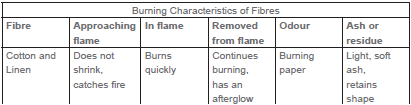
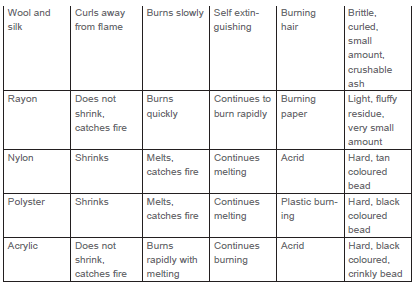
Conduct of the practical
1. Take a narrow strip of the fabric ( ½ cm X 5 cm)
2. Hold the strip with a forceps or tongs and do the burning test by bringing it near a burning candle, or low flame of spirit lamp.
Precaution
Perform this experiment on a very low flame of a candle or spirit lamp under the supervision of a teacher.
3. Repeat the process by taking 4-5 samples of different fabrics and record the observations.
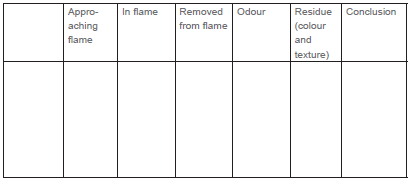
6
Media and Communication Technology
Learning Objectives
After completing this chapter the learner will be able to —
• define the concept of communication.
• discuss the significance of communication in everyday life.
• enlist the different types of communication.
• describe the process of communication.
• explain the classification and functions of media.
• analyse the various communication technologies.
An important field of study that has an impact on adolescents is that of media and communication. In this chapter we will discuss how these two aspects of our everyday ecology have become an integral part of our lives, usually adding to the quality of our lives. We will begin with the concept of communication first.
6.1 Communication and communication technology
Communication is very basic and vital for human survival and has existed since the inception of life on earth. In modern times, with fast developing technologies, new communication methods and gadgets are introduced in the market almost every week. Some of these have become more popular due to their cost effectiveness and utility, and have sustained over time.
Observe the following pictures and interpret the situation, feelings and thoughts of the different persons.

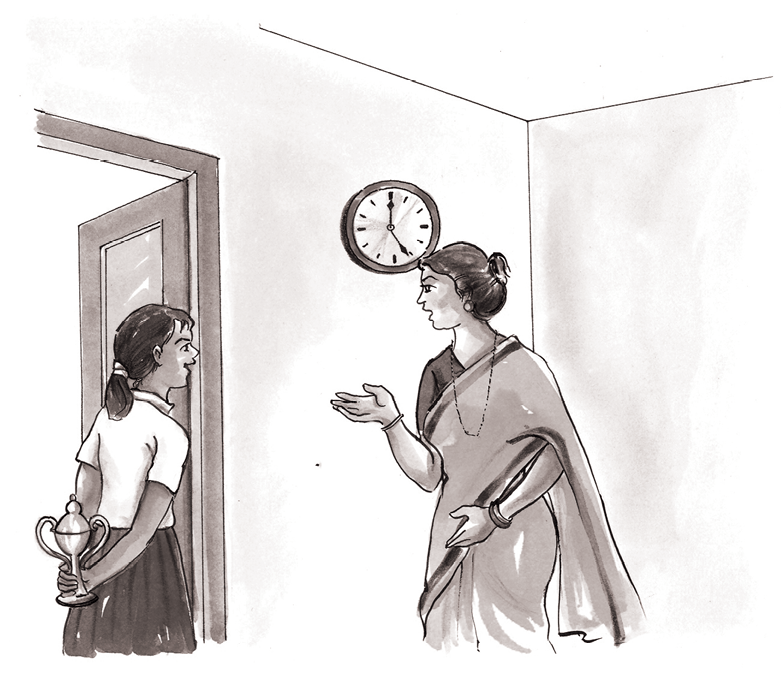
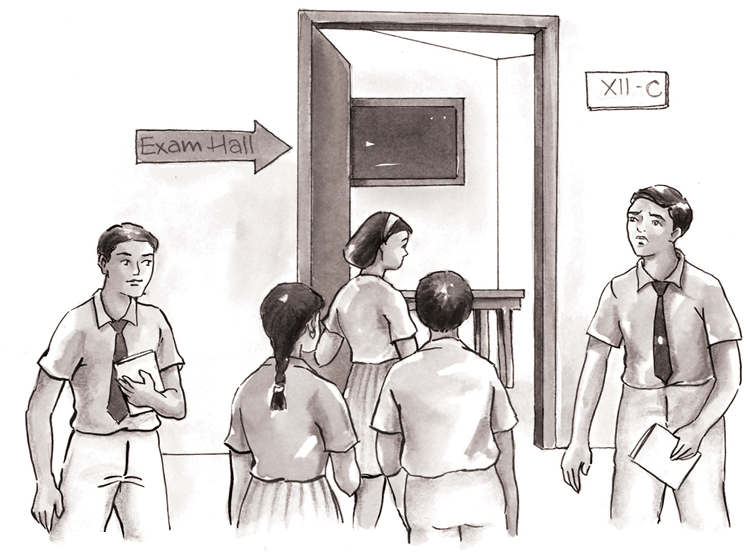
What is communication?
Communication is the process of thinking, observing, understanding, analysing, sharing, and transmitting or transferring feelings to others through a variety of mediums in diverse settings. It also refers to seeing or watching, listening or hearing, and exchanging ideas, thoughts, experiences, facts, knowledge, impressions, moments, emotions, and the like with self or with others.
As the name suggests, the word communication stems from the Latin word communis meaning common. It is therefore, not only sharing of ideas, thoughts or imparting knowledge and information, but it also involves understanding the exact meaning of the content in a way that is common to both, the communicator and the receiver. Thus, effective communication is a conscious effort in creating a shared understanding about the intended meaning of the message among people involved in the communication. The process of communication is continuous and permeates all areas of social life, including home, school, community and beyond.
Classification of communication
Communication can be classified on the basis of the following depending on the levels, types, forms and modes.
A. Classification based on the type of interaction
(i) One-way communication: In such situations the receiver receives information but is either never able to reciprocate to the sender or cannot respond immediately.
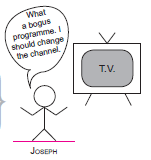
Therefore, communication remains one–way. Speeches, lectures, sermons, listening to music on the radio or a music system, watching any entertainment programmes on television, using internet to search information on a website, etc. are examples of one-way communication.
(ii) Two-way communication: This is comm-unication that takes place between two or more persons where all the parties communicating with each other share or exchange ideas, thoughts, information, etc. either silently or verbally.
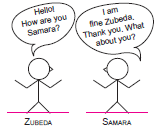
Some of the examples could be talking on mobile phone, discussing about future plans with one’s mother, using internet for chatting, etc.
When a baby cries to communicate her/his hunger, she/he is fed by the mother in response. The cry of the baby is the message that communicates the hunger of the child and is vital for the survival of the baby. Thus, in this case the communication is two-way.
B. Classification based on the levels of communication

(i) Intra-personal communication: This refers to communicating with oneself. This is a form of mental process involving observing, analysing, and drawing conclusions meaningful to the individual’s present, past and future behaviour and life. It is an on-going process that transpires inside an individual. For instance, mental rehearsal before appearing in an interview or oral exam.
(ii) Inter-personal communication: It refers to sharing of thoughts and ideas with one or more people in a face-to-face situation.
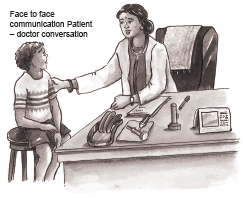
It can take place in a formal or an informal situation. Varied means of communication like body movements, facial expressions, gestures, postures, written text and verbal modes such as words and sounds can be used for this type of communication. Examples are talking to your friend about difficulties faced while studying or conducting an experiment or participating in a panel discussion followed by question-answer session.
Inter-personal communication is the most effective and ideal type of communication for two reasons. First, there is always proximity and direct contact between the communicatee and the communicator, and therefore it is easy to persuade, motivate and convince the communicatee for acceptance of the introduced idea or thought. Second, instantaneous and strong feedback with direct response of communicatee on the introduced idea is possible.
(iii) Group Communication: This form of communication is direct and personal, such as inter-personal communication, but with the involvement of more than two persons in the communication process. Group communication helps to facilitate a participatory approach and collective decision-making, gives an opportunity for self-expression, and increases the individual’s impact in a gathering, thereby augmenting one’s status in the group. It also helps in recreation and relaxation, socialising and motivating. A range of audio-visual aids may be used to enhance group communication.
(iv) Mass Communication: As a result of considerable advancement in technology, making thoughts, ideas and innovations reach the larger section of society has become possible. Mass communication can be defined as the process of multiplying messages with the help of any mechanical device and disseminating the same to the masses. The means and media of mass communication are radio, TV, satellite communication, newspapers, and magazines. The audiences of mass communication are very large in size, heterogeneous and anonymous, spread over a large area and separated from the communicator in terms of time and space. For these reasons it is not possible to take a correct, complete, direct and immediate feedback; rather there is slow, cumulative, expensive, and delayed feedback.
(v) Intra-organisational Communication: Organisational communication takes place in highly structured settings. Just like human beings, when people work together in an organisation, organisations also establish and maintain relationships. They use various levels of communication within their environment and amongst their departments or sections. Every organisation has different levels or hierarchy of ranks working together for achieving common goals. The information flow in such organisations is expected to be two-way at the same level and one-way across levels.
(vi) Inter-organisational Communication: This refers to the communication system developed by one organisation to communicate with other organisations with the aim of working in cooperation and coordination with each other. For example, for assistance in developmental activities of the country, both technical and financial support is provided by international agencies, whereas, administrative support is given by the Central government and State governments.
|
It is important to note that in both inter-organisational and inter-organisational set-ups, communication does not take place among the departments or organisations; rather it is always human beings working in these organisations who communicate with each other. Therefore, understanding of the human factor is very important. |
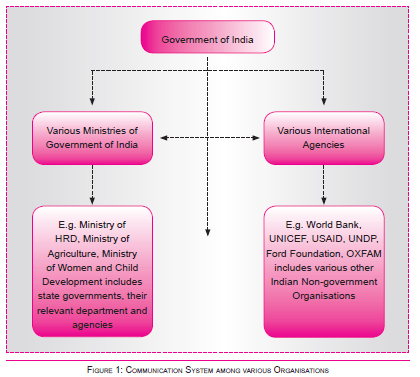
C. Classification based on the means or modes of communication
(i) Verbal communication: Auditory means or verbal modes like speaking, singing and sometimes even the tone of voice, etc. are of significance in verbal communication.
Research shows that on an average, an individual spends about 70 per cent of her/his active time in communicating verbally, i.e., listening, speaking and reading aloud.
(ii) Non-Verbal Communication: Non-verbal means of communication are gestures, facial expressions, disposition, posture, eye contact, touch, para-language, writing, clothing, hair styles, and even architecture, symbols and sign language such as smoke signals used by some tribal people.
D. Classification based on the involvement of number of human senses
Have you ever tried to know why learning about our rich traditional heritage by simply watching folk or classical dance performance live or on television makes it easy to understand and more interesting than reading about them in a book?
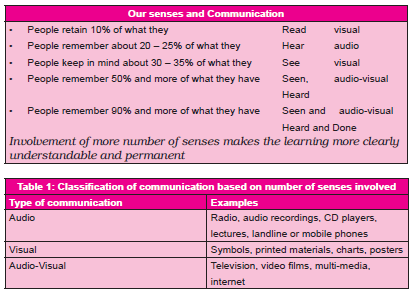
Activity 1
List the various means or modes, types and levels of communication involved in the following experience. Pen down your observations—Did you have the opportunity to live or visit a rural area or a village or a small town in the country? What was your experience? Did you observe symbols of advanced technology and communication like mobile phones, fax machines and other equipments, electricity poles and other similar things? How was the experience of meeting and interacting with people–young, women and older persons? Discuss this in your class.
How does communication take place?
The process of communication
Communication is the process of transferring information or content from a sender to a receiver with the use of a medium. It involves flexibility to exchange information using several methods in which the information is correctly, clearly and completely understood by both sender and receiver. It also takes the feedback of the audience on the message sent for further planning in the same way as carrying out market surveys before launching a product in the market.
Let us see the sequence in which the communication events occur. One way to describe it is as follows: Who says, what, to whom, when, in what manner, under what circumstances and with what effect. The basic elements of any communication process in general are arranged in a definite order to complete the cycle. Six elements have to be handled skillfully for effective and successful communication and can be easily understood by “The SMCRE Model” of communication.
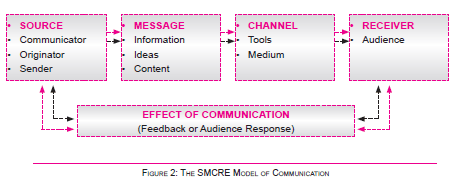
Activity 2
Identify the possible sources of information in villages/rural areas.
The SMCRE model (Figure 2) shows the complete process of communication and the elements involved in it.
1. Source: It is the person who initiates the process of communication. She/he is the key factor responsible for the effectiveness of the whole communication process. She/he gives the message to a specific group of audience in such a manner that it not only results in correct interpretation of the message but also yields the desired response. She/he could be your teacher, parents, friend or classmate, extension worker, leader, administrator, writer, a farmer or a tribal person from a remote area of the country possessing indigenous knowledge.
2. Message: It is the content or information a communicator wishes to receive, accept or act upon. It could be any technical, scientific or simply generalised information or ideas, specific or general to any field of knowledge or day-to-day life of an individual, group or even a larger section. A good message should be simple yet appealing and clear. It should also be very specific, authentic, timely, appropriate and applicable for the channels selected and the nature and type of the receiver group.
Activity 3
Collect one news story or a campaign or a social message from any two media such as radio, print or TV.
3. Channel: The medium of communication through which the information flows from a sender to one or more receivers is a channel. Face-to-face, word-of-mouth is the simplest and one of the most effective means of communication. It has been the most widely used medium of communication in the
world. But with the passage of time and social change in society the emphasis has shifted to advanced mass media and multi media technologies.
Activity 4
Find out any one traditional method which tribal and/or rural people in the country use to make important announcements in their areas.
There can be two types of channels:
(i) Inter - personal communication channels such as individuals and groups.
(ii) Mass media communication channels, e.g., satellite, wire-less and sound waves.
Activity 5
As a receiver of information write down the type and quality of information you tend to get from your school.
4. Receiver: It is the intended audience of the message or the target of the communication function. It could be an individual or group, men or women, rural or urban, old or young. The more homogeneous the receiver group, the greater are the chances of successful communication.
5. Effect of communication (feedback): A communication process is incomplete unless the response to the message is received. It is the initiating step as well as the terminating element in any communication process. Termination occurs when the response to the message is the same as expected. In such a situation, since the objective is achieved, the cycle is complete. However, if the response of the intended audience does not yield the desired results, rethinking and recasting of message occurs and the entire communication process is repeated. Here are a few examples: (a) When a teacher has taught a lesson, at the end she/he asks the students questions to find out if the lesson has been understood. The activity of asking questions and finding out what themes and parts were understood and which topics need to be explained again is a feedback. (b) Letters from readers in newspapers and magazines are a form of feedback to the editor and writers. (c) The ratings Television Rating Points (TRPs) of a television programme are another form of feedback from viewers.
6.2 What is Media?
If you listen to the radio or watch television, perhaps you are aware that what you hear or see influences you in one way or the other. That is media influence. Let us see how the media influences us.
Identify the most common element in the following: Advertisements and programmes we see on television, films on TV or theatre, the news we read in the newspapers, the speech of a politician, instructions imparted by the teacher in the classroom, or a complaint that is registered when an appliance is not functioning well, or shopping through internet sitting at home.
You will find that the common element in all these is that some or the other medium has been used to pass on or share varied messages or information across diverse fields. For instance, when we talk to
someone or hear someone talking, it is the air that acts as a medium through which the sound waves travel since no sound can be transmitted in a vacuum.
Therefore, if communication is a process, media is the means that uses various methods of communication for disseminating and sharing, ideas, thoughts, feelings, innovations experiences, etc. Mass media essentially uses modern technology for communication but the presence of technology does not always denote that mass communication is taking place. Mass media is always meant for heterogeneous, anonymous and large audience groups.
Does media mean only radio, and TV? No, all types of satellite transmission, computer and wireless technology are also included in it. Media has gone through a lot of change and development. Now numerous modern technologies are available as media for communication purpose.
Media classification and functions
Media can be classified into two broad categories, traditional and modern media.
Traditional media: Till very recently most rural extension work was completely dependent on traditional media such as fairs and radio. The situation is no different even today. Inter-personal communication media largely remains the most used and effective medium of communication in rural and remote areas. Examples of other traditional folk media are puppetry, folk dances, folk theatre, oral literature, fairs and festivals, rituals and symbols, print media such as charts, posters, newspapers, magazines, and other local publications from ancient times. Various traditional folk media are being used as indigenous channels of communication. Some very popular examples are – traditional folk theatre or drama like Jatra (Bengal), Ramleela and Nautanki ( Uttar Pradesh), Bidesia (Bihar), Tamasha (Maharashtra), Yakshagana, Dashavatar (Karnataka) or Bhavai (Gujarat). Likewise various oral literature-cum-musical forms basically include folk or tribal songs and dances such as Baul and Bhatiali (Bengal), Sna and Dadaria (Madhya Pradesh), Duha and Garba (Gujarat), Chakri (Kashmir), Bhangra and Gidda (Punjab), Kajri, Chaiti (U.P.) and Allha (U.P. and Bihar), Powda and Lavni (Maharashtra), Bihu (Assam) and Mand, Panihari, and songs sung by Charans and Bhaatt (Rajasthan). There are various drum festivals with very rhythmic drum beats followed by dance and songs of the North-eastern and other tribal communities of the country. Different types of puppetry forms have also been common media for communicating messages along with providing entertainment. Among the most common are the string puppets or ‘Sutradharika’ mainly used in Rajasthan and Gujarat, and Chhaya Putli (shadow puppets) which are more common in the southern parts of the country. Besides, there are numerous festivals, fairs, social rituals and ceremonies, yatras, etc. for conveying messages, expressions, feelings and traditions of the diverse communities across the country.
With changing times it became apparent that traditional communication media were neither sufficient nor well-equipped to meet the diverse information needs of the modern audiences. Hence, new media technologies have been popularised.
Modern media: With the advent of modern technology the range of communication media has expanded tremendously. New communication technologies, such as the mobile phone, are emerging with exciting features that have improved the quality and capacity of broadcast. The handy size of equipments has made them convenient for use in rural as well as remote areas. It has also increased the reach of modern communication technology. The availability of and access to computers, particularly the internet facility, has ushered a completely new era of communication media. Radio, satellite television, modern print media, films projected though various type of projectors, audio cassette and compact disk technology, cable and wireless technology, mobile phone, video film and video conferencing are some examples of modern media.
Activity 6
Collect information on different folk media used in your state in both urban and rural areas. If there are tribal areas in your state, collect the folk media relevant there.
Functions of media: The previous chapters have made you aware that as an adolescent you are likely to be influenced by media. It has the following functions.
1. Information: It includes both, providing information and information exchange. These days information is power. Communication is facilitated through various media such as radio, television, magazines, newspapers.
2. Persuasion/Motivation: We are not always convinced about whatever idea or thought we come across. Suitable communication media can be used to persuade an audience to accept an idea. This needs a deeper understanding of audience psychology and their socio-cultural background.
3. Entertainment: Both, traditional and modern communication media provide a wide variety of entertainment options starting from folk media and oral tradition to Direct to Home (DTH) telecast. Even for educational purposes media is used in an entertaining form to make learning easy and interesting.
4. Interpretation: Use of communication media, particularly pictographic presentations, and facts and figures make many difficult and complicated concepts easy to understand. For example, it is easy to locate and understand a geographical area with the help of a cartographic map or model of a globe than merely reading about it in a textbook.
5. Transmission of values: Media is expected to foster development of a healthy society by the transmission of wholesome values. For example, use of puppetry and cartoon films for teaching values through the story format that are attractive options.
6. Education or training: New learning experiences with the help of appropriate communication media in local language, and focussing on local problems always enrich the teaching–learning experience. These include interactive instruction video and audio cassettes, and discs of basic printed teaching-learning material on various concepts.
7. Coordination: Due to the introduction of modern interactive communication technologies, distance and physical proximity has become less important. Pace, scope and accuracy of communication has expanded to such an extent that it has now become very easy to sit in one place and coordinate large projects spread over a vast geographical area.
8. Behavioural change: All extension education activities related to varied fields, be it health, literacy, environmental issues, empowerment programmes and adoption of innovations depend largely on the art and technique of effective communication. Media remains the main vehicle for the transmission of useful messages, acceptance of which leads to direct and indirect behavioural change in the target people.
9. Development: Media is a catalyst (medium) in national development. Communication mediates between specialists and lay persons. Thus, communication occupies a pivotal position in the process of development. Media has accelerated the pace of development and made the world smaller by bringing people closer through communication.
Both communication and media employ modern technology for reaching out to people. We will read about this in the next section.
6.3 What is communication technology?
The global scenario is passing through a communication revolution and communication technologies are changing very fast. What is new today may be obsolete tomorrow. People want to know everything in a very short span of time. There is information overflow and it is easily available and accessible to all through a wide variety of traditional and modern mediums. It is here that communication technology is playing a key role.
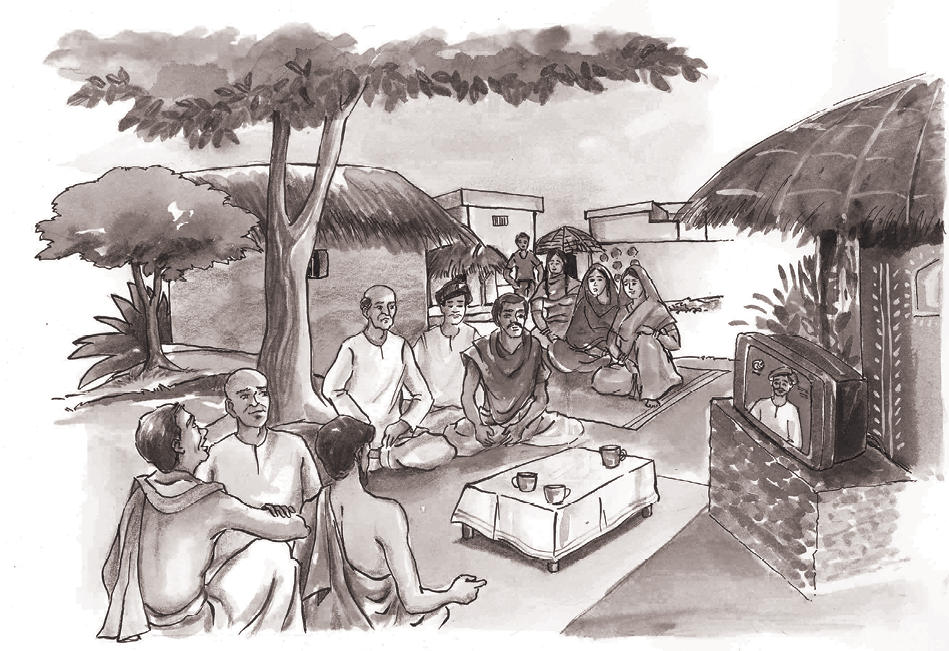
“We all know that distance is dead. What used to be far is near, what is local is global”
– Sam Pitroda Chairman of World Tel
We have been using different mediums and communication technologies for communicating in different times (in the past and at present), in different settings, for example rural/urban/tribal.
Let us have a look around us. You may have observed that many new technologies related to electronic media have revolutionised communication media?
|
Do you know that Pij village in Gujarat acquired the first TV transmitter in India, which provided programmes in local language along with common programmes from Delhi via satellite. |
Communication technology refers to various technologies developed and used to handle information and aid communication. This includes modern technologies that are used to transmit data, which could either be analogue (electronic signals) or digital. There are hardware, organisational structures, as well as social values which individuals access to collect, process, and exchange information.
Classification of communication technologies
A wide range of communication technologies are available. These fall into two broad groups.
(i) Cable (land) based technologies: These are comparatively cheap and less complicated. Landline telephone or a personal computer without internet are examples of such technology.
(ii) Wireless technologies: These generally require less infrastructure, but can be more expensive to use than cable-based technologies. Some examples are radio, microwave and satellite wireless telephony, or use of ‘bluetooth’ technology in mobile phones and computers.
Activity 7
Participate in a group discussion in your class on “Communication Technology – a curse or a boon?”
Two significant communication technologies that acted as media and changed the whole communication scenario are the radio and the television.
Radio: Radio commands a universal audience by geographical spread, income, education, age, sex and religion. Through on-the-spot broadcast or simulated broadcast it can overcome the barriers of time and space. With the use of small size transistors it was made possible to receive communication in the remotest parts of the country.
Television: TV was introduced in India in 1959 primarily to impact education and promote rural development. TV programmes are planned and produced using various techniques of visual magnification, sound amplification, super-imposition, split screen processes, fading, zooming, etc. These techniques make it more effective and strengthen the impact on the viewer.
Modern Communication Technologies
The list of modern communication technologies is long and every other day we hear of innovation in the existing technology. Following are some of the major types of modern communication technologies used primarily for extension purposes.
What is Bluetooth Technology?
Bluetooth Technology is a low-cost, short–range radio frequency (RF) link between mobile PCs, mobile phones and other portable devices capable of transmitting voice and data at the rate of 1 Mbps, which is from three to eight times the average speed of parallel and serial ports, respectively. It can transmit through solid, non-metal objects. It allows wireless control of and communication between a cell phone and a hands free head set or a car kit.
1. Micro Computers: Computers are classified as mainframes (large and costly), mini computers (less powerful) and micro-computers (based on microchip technology). This classification is based on their power, speed of executing a set of instructions and the amount of memory available to store data as well as degree of inter connectivity that the computer offers.
The functions of micro-computer, particularly for extension work, include processing, keeping record of all kinds of information, performing accounting function, acting as repository of various cases , experiences to be used for research and field purpose in a very small space and publishing information material at reasonable cost. Computers can also communicate with each other if linked together and provide sourcing of information from across the globe.
2. Video text: Video text or view-data is an electronic text service transmitted from central computer to home TV–set via telephone network or cable system. It is interactive in the sense that the viewer has the option to access the desired data.
3. Electronic mail (E-mail): It is the system which passes information electronically from sender to receiver. E-mail system is like surface mail in which a message is typed on the computer and sent to another computer via the mobile phone. It is a simple way of communicating between two or more persons through the provision of a mail box. The message is stored in the computer which acts as a post office, unless the receiver asks for it. The mail can be viewed using a modem connected to the telephone.
Satellite Communication
In the last 30 years satellite communication has reached almost all the countries across the world and has brought about revolution not only in the field of communication but in multifarious aspects of human life.
What is it?
Satellite communication is a method of communication carried out with the help of satellite technology for various purposes. The satellite is placed in space and information is obtained or transmitted across the globe with the help of optical sensors mounted on an airborne and space-borne platforms.
Unique feature of Satellite Technology
- It has the ability to establish quick and reliable communication between any two points.
- It enables transmission of information from one location to many points over a vast coverage area simultaneously.
- It gathers information from many locations in a central place.
Advantages and applications of Satellite Technology
- Remote sensing, i.e. serving an object from a distance. Data is collected rapidly and repeatedly. The sensor data produces imageries which are further used in wide range of applications. For instance, images helps in getting the right status about the availability of natural resources thereby helps in using natural resources efficiently or the climate forecaste is helpful in agriculture and
- Advancement in the application of space technology and Indian space development programme.
- High quality telecommunication system available all over the world and improved global competitiveness.
- Development benefits made available even in remote, isolated areas.
- Availability of quality and speedy communication has discouraged travelling and facilitated speedy decision-making thereby enhanced conservation of energy and other resources.
SITE: A REVOLUTIONARY SOCIO-TECHNOLOGICAL EXPERIMENT
- Satellite Instructional Television Experiment (SITE) was conducted in 1976 using USA’s Application Technology Satellite (ATS 6) and was one of the world’s largest experiments of its kind.
- SITE provided valuable experience in the field of development, testing and management of a satellite-based instructional television system, particularly in rural areas.
- Site demonstrated the potential of satellite technology in the rapid development of effective mass communications in developing countries like India.
Overall SITE proved that the dissemination of communication infrastructure in remote areas is not only feasible, but it can concretely contribute to the promotion of national development. In all terms SITE was a very successful experiment in achieving both social and technical objectives. It paved the way for further applications of satellite technology particularly for the use of television for communication in India with rural orientation.
4. Interactive video: Interactive video refers to a video system which is a combination of computer and video. It uses multi–media approach, i.e., text, still photographs, video, audio, slides, overheads, etc. The messages stored in different forms are received by the users as per their choice. The users’ response to the system determines the path to be followed.
5. Teleconferencing: Teleconferencing is interactive group communication. It refers to a system meant for creating dialogue between geographically dispersed participants and physically distant people. Advances in telecommunication have made it possible to hold meetings without travelling to long distances.
Activity 8
Write any two messages that you remember from the hoardings displayed on road sides. Also write your interpretation of the messages:
• Message: _______________________________________________________ Interpretation: ____________________________________________________________________________________________________________________
• Message: _______________________________________________________ Interpretation: ____________________________________________________________________________________________________________________
Communication Technology thus greatly facilitates communication; more and more people across the world are using these technologies. Yet the human touch cannot be ignored. In our everyday lives we need to engage in face to face communication with different people. Every individual hence, needs to develop certain basic skills for effective communication. The next chapter on Effective Communication Skills, will help us understand this.
Key Terms
Communication, Group communication, Mass communication, Verbal and non-verbal communication, Media, Communication technology, Bluetooth technology, Satellite communication.
- Review Questions
1. What do you understand by the term communication? What are the various modes of verbal and non–verbal communication?
2. Explain the process of communication with the help of an example.
3. “The more the number of senses involved in the communication process, the more effective and sustainable is the communication”. Write your comments with justification.
4. How does media affect our day-to-day life? Enumerate the different types of media.
5. How is the term communication technologies defined? Discuss two important communication technologies that have brought a revolution in the communication arena, giving justification for your answer.
7
Effective Communication Skills
Learning Objectives
After completing this chapter the learner will be able to —
• explain the meaning of communication skills.
• discuss the importance of communication.
• describe various communication skills.
• develop one's own communication skills further.
Every individual needs to be well equipped with the tools to communicate effectively, whether it is on the personal front or at work. According to experts, being a good communicator is half the battle won towards a successful personal and professional life. After all, if one speaks and listens well, then there is little or no scope for misunderstanding. Thus, the primary reasons for misunderstanding are the inability to express well, or listen effectively.
In the communication process we receive or send information using various skills, and effectiveness of the communication process depends on use of appropriate communication skills. Initiation of the communication process does not ensure that the intended receiver has received the message with common mutual understanding of the content as delivered by the sender. This is because distortions might occur at different sequential steps of the communication process. To minimise gaps in communication, one’s communication skills need to be sharpened so that the communication process is more effective.
7.1 Meaning of communication skills
• Communication skills are the abilities to use language (receptive) and express (expressive) information. Thus, communication skills are the abilities that help us send and receive information effectively. These can be natural or acquired.
• Communication skills refer to the range of behaviours that serve to convey information to another individual. This process requires one or more of the skills of thinking, speaking, listening, reading, writing, visualising and body language. This set of skills enables us to express and receive information under different situations in different ways.
• Psychologically speaking, the set of behaviours that serve to transmit and share common information to create a mutual understanding of the content being shared are termed as communication skills.
Communication skills are thus the ability that enables a person to share information consistently and effectively with a variety of audiences to create mutual understanding of the content being shared. These include the art or technique of persuasion through the use of spoken and written words, code and content sequence, treatment to content and body language used, visualisation and thinking towards configuring the contents according to the audience and the situation.
Communication skills are needed both for sending and receiving information. The one who sends the message needs to have the skills to think, visualise and design the intended message considering the type of audience, their needs and interests. The five Ws and one H need to be taken care of by the sender: What? Where? Why? When? Whom? and How? Similarly, the one who receives the message needs to receive the message without assumptions, placing biases aside and actively listening, viewing or reading the contents, often in-between the lines. It is said that nature has provided us with two ears and one mouth just so that we listen more and talk less. But do we follow that? The receiver needs to use one ear for words and the other ear to feel what is being said. This will help the receiver to have better understanding of the message.
|
Do you know that 70 per cent of all communication is misunderstood, misinterpreted, rejected, distorted and not heard? Effective communication skills will enable us to minimise these limitations. |
7.2 Types of Communication Skills
The way in which one communicates is as important or even more important, than what one is saying. Body language is equally or may even be more important than words. How effectively we are able to send or receive information depends on how effectively we use one or more than one of these communication skills—
• Thinking
• Reading
• Writing
• Listening
• Speaking
• Non-verbal communication
Thinking
This is an intra-personal communication skill. It implies individual reflection, contemplation and meditation. Thinking enables a person to select and organise one’s thoughts, opinions, judgments and feelings. In a way, it is abstract as one cannot see the thinking process until it is expressed through words or feelings or writings. This is the fundamental step in communication. Your actions and expressions depend on what and how you think.
How can you develop the skill of thinking?
• Concentrate on what you are thinking during.
• Do not be distracted during your thought process.
• Strengthen thinking by developing skills in creativity, problem-solving, teamwork, criticality and flexibility.
• Be positive, always.
Reading
This is the ability to acquire meaning from print or written matter. Recreation, gaining information and knowledge are some of the motivating factors for reading. In order to read proficiently one requires knowledge of language, reading fluency, vocabulary and reading comprehension, cognition and decoding. Typically one gains familiarity with language and its sounds by the age of 6 years. By 7 years of age, one is in the initial reading stage or decoding stage. Decoding skills continue to improve, and children develop speed in addition to accuracy in word recognition by the age of 8 years. One learns to read fluently around the age of 9 and develops liking for reading. By the ages 14 to 19 the reader begins to be able to analyse what one reads, understand different points of view, and react critically to what she/he reads.
How can you develop the skill of reading?
• Develop a liking for this skill, for example, by beginning with topics that interest you.
• Follow a kind of rhythm from left to right first and then from row to row while reading.
• Physical conditions such as adequate light from the left side, appropriate size of letters, and peaceful and quiet atmosphere are desirable.
Activity 1
List the following to know your reading habits—
• Note down how many pages of a textbook, magazine or novel do you read on an average every week.
• Compare with five of your friends the type of literature you and your friends read.
Writing
There are times when writing is the best way to communicate, and often the only way to get one’s message across. In writing, one needs to be aware of the fact that once something is in the written form, it cannot be taken back. Communicating in this way is more concrete than verbal communication, with less room for error and even lesser room for mistakes. This presents written communicators with new challenges, including spelling, grammar, punctuation, writing style and wording. Today’s technology (e.g., computers) provides reliable tools which make formal writing such as memos, letters or proposals much easier. There are spell-checks and grammar-checks. As students these skills are useful in writing essays, assignments, formal letters, and descriptive answers in exams.
Some guidelines for writing well—
• Avoid the use of slang words (e.g., ‘kids’ for children).
• Try not to use abbreviations (e.g., ‘apt.’ for apartment).
• Try not to use symbols unless it is writing for science, maths or technical subjects, or widely known and use symbols (e.g., ‘&’ for ‘and’).
• Use clichés with caution (e.g., ………… is middle class).
• Spell the names of people, companies and words correctly.
• Numbers should be expressed as words when the number is less than 10 or is used to start a sentence (example: Ten years ago, my sister and I...) The number 10, or anything greater than 10, should be expressed as a figure (example: My brother has 13 matchbox cars).
• Appropriate punctuation should be used.
• Keep your sentences short.
Activity 2
Collect samples of the following —
• Scientific writing (e.g, journal or textbook)
• Nursery school stories
• Magazine story
• Editorial in a newspaper
Study the difference in styles used in writing each of the above.
Listening
In the communication process we either send or receive information. Effective listening is the key to receiving information. Everyday we all listen to a variety of messages from morning to evening. But we remember certain things more easily and forget other things. Listening is a combination of skills pertaining to hearing, the attitude towards the person sharing the message and the content of the message, along with our psychological connection with the sender and the message. Listening requires more than hearing words. It requires a desire to understand, an attitude of respect and acceptance of the message and speaker, and a willing tendency to judge and evaluate others’ perception about the message. Listening requires a high level of concentration and energy. Listening skill can be natural or acquired. It can be acquired by using some basic principles.
|
Students spend 20 per cent of all school related hours in listening. If television watching and one-half of conversations are included, students spend approximately 50 per cent of their waking hours just listening. For those hours spent in the classroom, the amount of listening time can be almost 100 per cent. |
How can you develop the skill of listening?
• Pay attention to the speaker with alertness and relaxation.
• Stop talking while listening.
• Listening requires setting aside the listener’s thoughts and perception of the message with a feel of empathy. The listener needs to have the desire and willingness to try and see things from another’s perspective.
• Listen to the words and feelings to understand the message and try to read between the lines.
• Be aware of the non-verbal messages such as the motive, expressions and attitude of the speaker.
“To listen is to move. To listen is to be moved by the talker – physically and psychologically . . . The non-moving, unblinking person can reliably be said to be a non-listener . . . When other visible moving has ceased and the eye blink rate has fallen to less than once in six seconds, listening, for practical purposes, has stopped.”
– Franklin Ernst, Jr.
Speaking
Speaking is one of the most basic communication skills. Speech refers to the processes of production, comprehension and use of sounds in a spoken language. In our day-to-day life we speak with family members, friends, and others for business and work to inform, share feelings and for many other reasons.
Speaking before a group and public speaking are the two types of important speaking skills. Public speaking is the process of talking to a group of people in a structured, deliberate manner with the intention to inform, influence, persuade, motivate, or entertain the listeners.
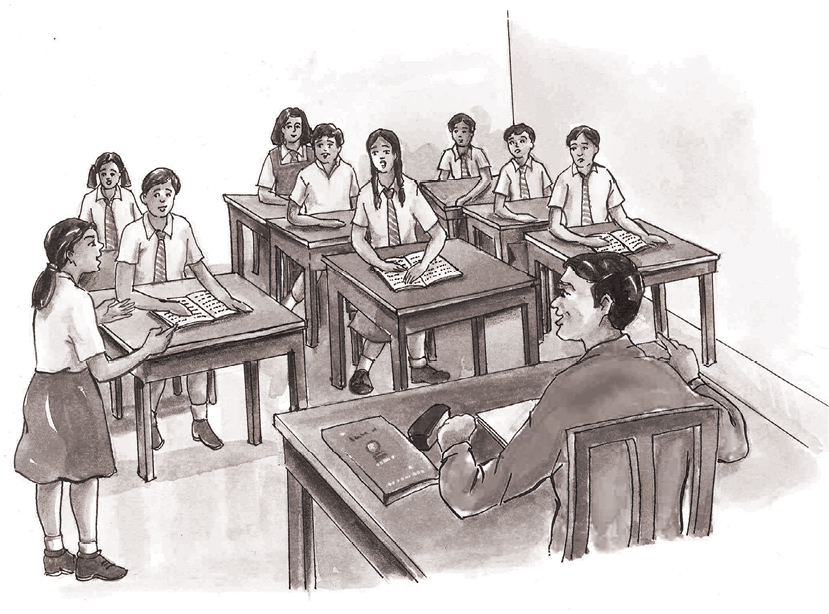
Most great speakers have a natural ability to display the skills and effectiveness that can help to engage and move an audience for a special purpose. Language and oratory are among the two most important aspects of public speaking and interpersonal communication. There are four obvious and simple actions to ensure that your verbal messages are understood and remembered. These are to —
• understand the purpose of the presentation.
• keep the message clear and concise.
• be prepared, rehearse well before speaking.
• be clear when delivering the message.
How can you make your talk or presentation effective?
Before you start working on your talk or presentation, it is vital that you understand—
Who are you speaking to? What are their interests, pre-suppositions and values? What do they share in common with others? How are they unique?
What do you wish to communicate? Adequate knowledge of the subject matter is crucial to your success. One way of answering this question is to ask about the ‘success criteria’. How do you know if and when you have successfully communicated what you have in mind?
How can you best convey your message? Choose your words and your nonverbal cues with your audience in mind. Plan a beginning, middle and end. If time and place allow, consider and prepare audio-visual aids.
When? Timing is important here. Develop a sense of timing, so that your contributions are seen and heard as relevant to the issue or matter at hand. There is a time to speak and a time to be silent. Remember ‘It is better to be silent than to sing a bad tune.’
Where? What is the physical context of the communication you have in mind? You may have time to visit the room, for example, and rearrange the furniture. Check for availability and visibility if you are using audio or visual aids.
Why? In order to convert hearers into listeners, you need to know why they should listen to you and tell them if necessary. What disposes them to listen? That implies that you know why you are seeking to communicate – the value or worth or interest of what you are going to say.
Activity 3
Recall the best speaker that you have heard. Write down why she/he was good.
Non-verbal communication
Non-verbal skills, sometimes also known as visual skills, convey the unsaid. They become a part of the communication process along with the written and typed modes of communication.
Non-verbal clues include–
• Body language (e.g., arms crossed, standing, sitting, relaxed, tense gestures, facial expressions, eye contact, posture).
• Emotion of the sender and receiver (e.g., shouting, speaking provocatively, enthusiasm).
• Other connections between the people (e.g., friends, enemies, professional similarities or differences, personal similarities or differences, age similarities or differences, philosophical similarities or differences, attitudes, expectations).
Eye contact: Eye contact, an important channel of interpersonal communication, helps regulate the flow of communication. It signals interest in others. Furthermore, eye contact with audiences increases the speaker’s credibility. A speaker who makes eye contact opens the flow of communication and conveys interest, concern, warmth and credibility.
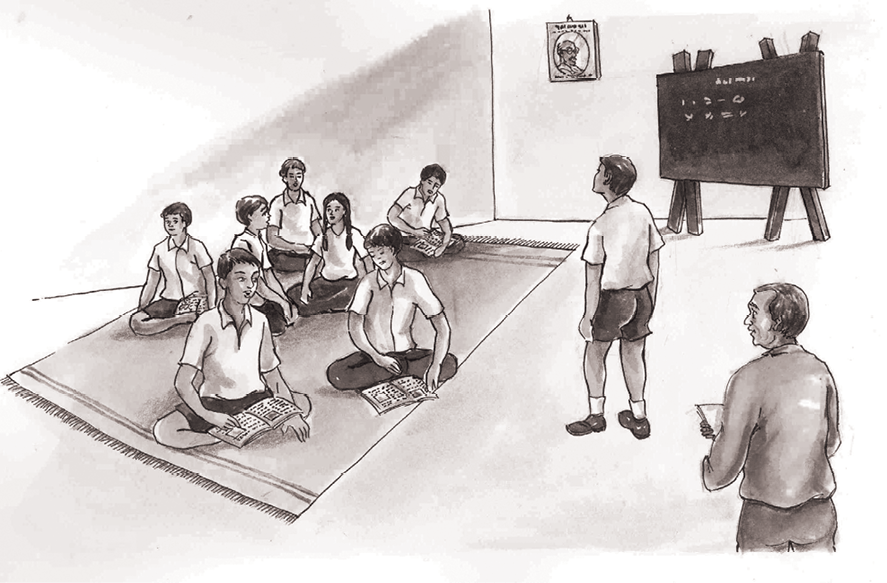
Inappropriate eye contact with the audience
Facial expressions: Smiling is a powerful cue that transmits —
• Happiness
• Friendliness
• Warmth
• Liking
• Affiliation
Thus, if you smile frequently you will be perceived as more likable, friendly, warm and approachable. Smiling is often contagious and the listener will react favourably and learn more.
Gestures: If you fail to gesture while speaking, you may be perceived as boring, stiff and unanimated. A lively and animated teaching style captures attention, makes the material more interesting, facilitates learning and provides a bit of entertainment. Head nod, a form of gesture, communicates positive reinforcement and indicate that you are listening.
Posture and body orientation: You communicate numerous messages by the way you walk, talk, stand and sit. Standing erect, but not rigid, and leaning slightly forward communicates that you are approachable, receptive and friendly. Furthermore, interpersonal closeness results when you and your audience face each other. Speaking with your back turned or looking at the floor or ceiling should be avoided; it communicates disinterest.
Proximity: Cultural norms dictate a comfortable distance for interaction with others. You should look for signals of discomfort caused by invading others’ space. Some of these are—
• Rocking
• Leg swinging
• Tapping
• Gaze aversion
Typically, in large college classes or in a large meeting room or a presentation room space invasion is not a problem. In fact, there is usually too much distance. To counteract this, move around the room to increase interaction with your listeners. Increasing proximity enables you to make better eye contact and makes it possible for the listeners to speak or to communicate.
Paralinguistic: This facet of nonverbal communication includes six vocal elements – tone, pitch, rhythm, timbre, loudness and inflection.
For maximum effectiveness in your speech, learn to vary these six elements of your voice. One of the common criticisms of instructors or communicators is that they speak in a monotone. Listeners perceive these instructors or communicators as boring and dull. In a formal setting students report that they learn less and lose interest more quickly when listening to teachers who have not learned to modulate their voices.
Activity 4
Find out the definitions of tone, pitch, rhythm, timbre, loudness and inflection. Practise with variations of each of these elements.
Activity 5
To improve your verbal and nonverbal skills, record a segment of your speaking or presentation on a video/audio tape. Then ask a colleague or friend to suggest refinements.
Humour: Humour is often overlooked as a tool to create a more pleasant and relaxed atmosphere. It is too often not encouraged in a classroom setting. Laughter releases stress and tension for both the communicator and the listener. One should develop the ability to laugh at oneself and encourage the listeners to do the same. It fosters a friendly environment that facilitates better communication.
Let us recapitulate
– Every individual needs to be well equipped with the tools to communicate effectively, whether it is on the personal front or at work.
– Communication skills are the abilities that help us send and receive information effectively. They can be natural or acquired.
– Communication skills refer to a range of behaviours that serve to convey information to others. The process requires one or more of the skills of thinking, speaking, listening, reading, writing, visualising and body language.
The Chapter X on Living and Working in a Global Society, which is the last in this unit, highlights the different interrelated contexts of family, community and global society with which an individual interacts in the course of development.
Key Terms
Communication skills, Thinking, Reading, Writing, Listening, Speaking, Non-verbal skills
- Review Questions
1. Discuss the importance of communication skills.
2. Enumerate and describe each communication skill.
3. “Non-verbal skills are not as important as verbal communication skills”. Comment.
4. Write an effective dialogue between two strangers who have met on a train.
5. According to you, which three communication skills are most important? and Why?
- Practical 7
Effective Communication Skills
Theme: Understanding Communication Styles and Skills
Task : Analysis of own communication styles and skills
Purpose of the practical: Students will be able to analyse their own skills, i.e., personal strengths and limitations and practice to overcome these.
Conduct of the practical–
• You have understood in the chapter that our communication skills have two equally important components, i.e., verbal and non-verbal. Therefore, while analysing communication skills one must observe both the components.
• Observe each of your classmates when they speak to study their body language, proximity, and paralinguistic procedure.
Step 1: Ask students to think of one topic on which they can speak after putting their thoughts together for five minutes.
Step 2: Ask students to start presenting in the order they would like, either alphabetically by their names or they may volunteer their turns.
Step 3: Now analyse each speaker’s style on the following checklist using one for each person.
Step 4: After a group of students have presented, total the score and match it with the impression you made of the speaker.
Step 5: Make conclusions about each of the speakers and identify the characteristics for which each one needs to practise in order to improve one’s communication skills.
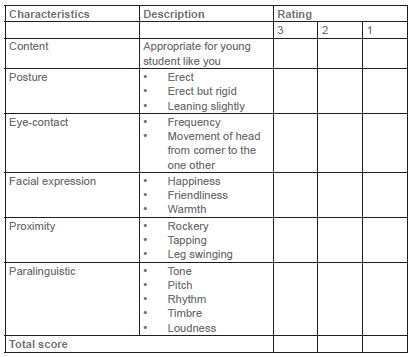
8
Living and Working in a Global Society
Learning Objectives
After completing this chapter the learner will be able to–
• understand the relationship among the individual, the family, community and global society.
In the previous chapters you have learnt a lot about yourself. Understanding oneself is the first step towards understanding others. Every individual lives and grows in a social context. Hence, to understand the development and behaviour of an individual it is necessary to understand the immediate context such as one’s family and the larger socio-cultural milieu.
As the individual grows and develops, she/he forms a growing network of relationships with others. The family is the primary and most immediate environment for the individual. During childhood, one’s activities, roles and interpersonal relations are generally shaped in consonance with the family context. As the child grows, her/his interactions with other settings such as the school, peers and neighbourhood enhances.
All these systems operate within the larger culture and context which include belief systems, norms, resources, opportunities and constraints. All aspects of daily living such as food, nutrition, clothing, resources, communication approaches and strategies, and interactions and relationships are affected by the larger systems in one’s own society and increasingly by other societies as well. Any change, positive development or conflict, even in the distant environment, extends to the other settings and influences the individual too. This is particularly applicable in the present era of globalisation wherein the boundaries between countries are less rigid and the world is becoming more and more interconnected in different ways – geographically, economically, culturally, and politically. The term “globalisation” refers to increased inter-connectedness and exchange between people across the world in the form of goods, services, money, and information. Although globalisation is not a new development, its pace has increased with the advent of new technologies, especially in the area of telecommunications.
Each society is increasingly influenced by events and developments occurring in other societies of the world. For example, the US sub-prime crisis of 2008 impacted economies across the world and the ripple effect was seen on the financial status of markets, families and individuals in India. Many people lost money invested in shares and stocks or even their jobs; hence they had to adjust their living standards markedly. Fashion trends are another example. Increasingly we find ourselves adopting international fashion trends in our dressing styles. Similarity the style of dress is prominent in urban youth across the world, and between rural and urban youth in India. Our everyday lives are thus influenced not only by what we experience in our families, schools and neighbourhoods, but also by events occurring at the global level.
What is important to note here is that we are not passive entities that simply absorb any influence that comes our way. Every individual is an active being who interprets the external influence or input according to her/his own unique personality and cultural sensibilities. An example from fashion is the adaptation of the Western style of wearing jeans with T-shirt to wearing jeans with kurta. Furthermore, each individual in turn also influences the environmental contexts or persons with whom she/he comes into contact. For example, it is not uncommon to find adolescents or even younger children influence their parents on matters such as the brand and colour of a new vehicle or the place they want to visit during the holidays. Thus the influence is two-way. Even in your own family, you would find that not only are you being influenced by your parents, but in some areas they too are being influenced by you.
Activity 1
Think and note down two to five examples from your family where you may have influenced your parents’ or other members decisions.
Contexts and individuals are dynamic. Across the life course, an individual passes through different stages of development and situations. At the same time, the settings also undergo change. In the present times, the pace of change is so rapid that what we know as “generation gap” may occur not only between two generations, i.e., between parents and children or grandparents and grandchildren, but it may also be evident between older and younger siblings. What was an accepted practice or way of thinking three years ago may have now changed. Those of you who have older or younger siblings may be able to think of instances when you and your sibling argued about something because both of you felt that what you were saying was the right way to do something. Do you recall saying, “When I was of your age…………..” to younger siblings or children?
Thus, individuals are embedded in their context and both shape each other. This is a reiteration of what you read in the ‘Introduction’ Chapter, i.e., individuals have a close relationship with their environment. The quality of one’s life is influenced by the different ecological contexts including the family, the neighbourhood, the community and the society, both local as well as global. In Unit II we will move from understanding oneself to understanding the contexts of family, school, community and society.
Key Terms
Globalisation, Bi-directional ways, Culture, Adaptation, Context
- Review Questions
1. Describe ‘globalisation’. Identify some of your everyday practices and interests that may have been influenced by global trends or events.
2. Discuss the ways in which you think you have influenced your parents.
3. Think about your own family and identify two instances when you felt there was a generation gap between you and your parents.