UNIT II
Importance of family
Understanding Family,Community and Society
The chapters in Unit I were all addressed to you for the understanding of self and of the factors that influence your decision making. Let us now move on to understanding the family, the community and the society that you are a part of. In the first section – Chapter 9 the focus will be on relationships and interactions with ‘significant others’, i.e., those important to you in these contexts. The second section –
Chapter 10 will discuss concerns and needs, such as those of health, work, resources, education and textile tradition in the adolescent’s diverse social contexts.
9
Relationships and Interactions with ‘Significant Others’
A. Family
Learning Objectives
After completing this section the learner will be able to—
• understand the meaning and definition of family.
• explain the importance of the family and its functions.
• describe the functions of family for overall development of the individual.
• gain knowledge of the family life cycle.
• analyse dynamics within the family.
• understand the importance of effective communication in the family.
IMPORTANCE OF FAMILY
The pictures show you scenes of children in their homes. Notice that there are adults taking care of children, including some older people. In some pictures there is only a mother or father and children. They are all related to each other by blood or through marriage or adoption. One thing common to all situations regardless of the socio-economic or cultural variation is that there are at least two or more than two generations of persons staying together, i.e., mother and children, grandparents and children, parents and adult unmarried children, related to each other by blood or marriage. An exception is that of two adults, a husband and wife, who are of the same generation, and yet they form the beginning of a family.
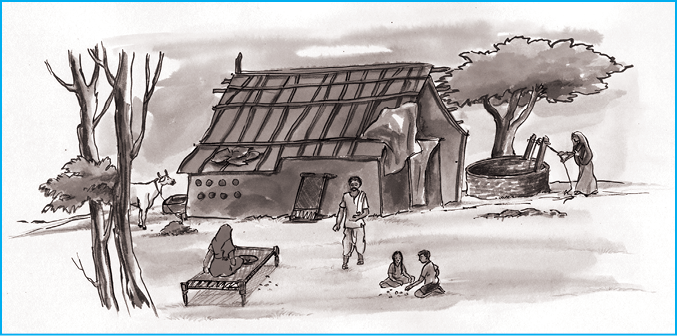


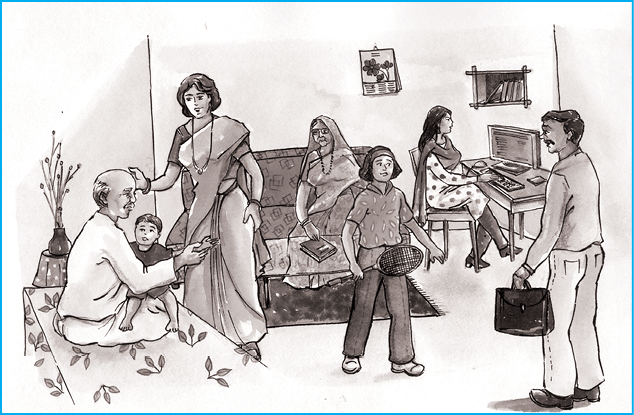
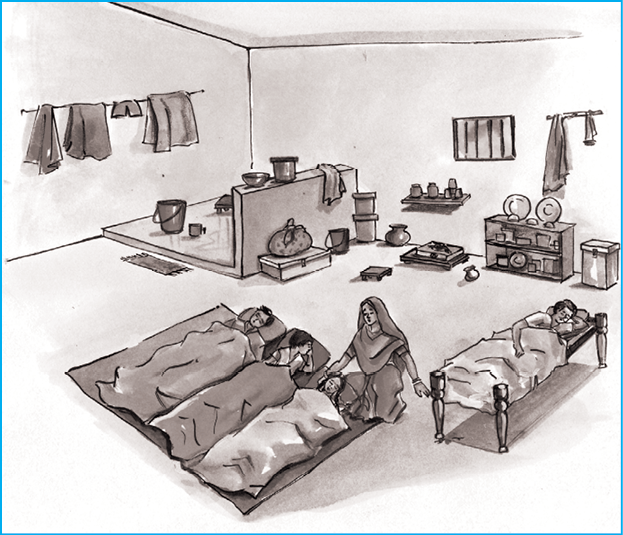
9A.1 Introduction
You and all of your classmates live with your families. Families are basic units of society. Families are needed to meet the needs of individuals, both children and adults. The family also helps to continue the culture of any society. It provides care and nurturance to all the children, thus contributing to their wholesome development. In the earlier chapters you have studied how adequate nutrition and other experiences contribute to the physical well-being of the child. Similarly, for a baby to grow into a caring and productive member of the society, she must have positive socio-emotional experiences, relationships and a feeling of belongingness. Through parenting, families attempt to provide all these experiences to children. You could recall incidents in your family when you were down with fever. How did your parents take care of you? Or the times when you were not feeling cheerful and happy, and the other members of your family may have tried to make you feel better. There are numerous such examples in everyone’s life where parents, or siblings or other members may have given a comforting hand or encouragement. Thus families not only nurture, they also provide stability and support in times of need. Every child has a right to be reared in a family.
Not all children are so fortunate to have families with both parents staying together, under one roof. In your neighbourhood, you may know that there are some children who have lost a parent due to death. In such cases, the other parent, usually fulfil the tasks of father as well as mother, may be helped by an aunt or grandmother. We are also aware that many times mothers and fathers have problems living together and decide to separate. In such circumstances children may be cared for by a single parent.
As far as possible, children should not be removed from their families. You may now think about those children who, due to unfortunate circumstances, such as flood or earthquake, may become destitute. How can they seek experiences of living in a family? In such instances adoption or care in an institution are the available options. It is the responsibility of the state to care for these children.
You may be familiar with the sight of young children or adolescents who appear to be homeless. Some of them have left home or children’s institutions on their own in search of livelihood. Some others may have been abandoned by families or may have got lost. Such children are referred to as ‘street children’. They usually do live in their families of origin, but the other children they live with on the street become like family to them. Sometimes, these children return to their families.
We could hence define the term family as “a group of persons united by – the ties of marriage, blood or adoption constituting a single household, interacting with each other in their respective social roles of husband and wife, mother and father, son and daughter, brother and sister or any other, creating a common culture”.
When you fill up your examination forms, you had to write the name of the head of the family. Whose name did you write? Reflect on your own name; your first name is a name given by your parents but the second name for many, that is surname, is common for all family members. This is mostly the father’s family name. Among tribes in the North-East and South, the second name is that of the mother. The families that use father’s name for identification are called Patrilineal and the ones that use the mother’s name are known as Matrilineal. Being patriarchal or matriarchal decides the authority, i.e., father’s or mother’s, and more importantly the rules of inheritance are also governed by this.
Patrilocal and matrilocal residence refers to the living arrangement where patrilocal families are those that reside in the father’s native home and matrilocal ones are those where the residence is in the mother’s native home.
On the basis of who all live together, the family could be identified as nuclear or extended. If you are living with your parents, brothers and sisters, then it is called a nuclear family. Some of you must be having grand parents and/or uncles and aunts living with you, which is called an extended family. A joint family is one where several generations of members live together; specifically a couple with married children (usually sons) and unmarried children and their offspring live together as a joint household. These can be of a very large size, and are often also joined by the same occupation. In families where there are adults other than parents, usually work and responsibilities are shared, especially the care of children. In nuclear families, the parents are largely on their own for the care for their children. In some families you will see that though the grandparents or other family members do not stay with the family, they keep coming regularly to stay. Sometimes if both the parents are going out to work, they may leave the children at a relative’s place. Therefore, even when children are living in a nuclear family, they have the experience of interacting with others. There are advantages and disadvantages of having large families, but the well-being of members depends mostly on the individuals concerned.
9A.2 Functions of the family
Whatever the structure or number of members or location of the family, this institution is committed towards providing some essential functions for its members, especially children. These are:
1. Providing nurturance: All families provide legitimate platforms for couples to live and reproduce, and continue the lineage. Recalling your own experiences as children, you would know that all families make efforts to provide nurturance to their children by looking after their needs. The provision for emotional needs through affection and care are equally important in nurturing a sense of belongingness. As we grow older our need of being wanted and loved does not diminish. These needs for affiliation and affection are present at every age, although the expression and manifestations can be different. A young adolescent boy may not appear as if he needs to be nurtured due to sudden physical change in his body and the need for autonomy, but he does not stop needing the loving support of a caring family. A grandmother may also be eagerly awaiting the arrival of her grandchildren to share her time and do things with them. Thus the family attempts to provide love, care and support to its members at all ages, and through various experiences and situations.
2. Socialisation: This is the process of teaching the young generation about social processes through everyday interactions. We can see that the family is in a unique position to act as a link between continuity and change through the process of socialisation. The ‘We’ feeling within the family is helpful in transmitting attitudes and sentiments. How often have you heard your mother or father saying “No, you can’t do this because it is not done in our family” or “In our family children have to study very hard”. The values that families pass on to the young ones are often filtered and adapted from the general social scenario of the community, the region and the nation. Although there are many common practices, each family adopts these in its own unique way.
Activity 1
Make a list of do’s and don’ts in your family for boys and girls. Discuss these in class and make comparisons with children from other families. This should help you to understand that although there are similarities, each family provides a unique experience to its members.
3. Conferring a status and role to individuals: Do you realise that here in school, you have the status of a student regardless of your gender; but in your home setting, you have a different status which can vary from family to family. An adolescent boy may be playing the roles of a son, a brother and a brother-in-law. Each role carries certain responsibilities and features that are socially defined. These arrangements bring stability and predictability in an individual’s life because of which it becomes easier to perform day-to-day responsibilities.
Activity 2
Convene a debate in the class on the topic, “Traditions are a hindrance to modern living”.
Conclude in the class by noting the positive and negative dimensions of traditions.
4. Economic function: Parents all over the world are busy earning a livelihood to generate income to provide for the family. Families provide for their children and also for other adults, older persons, and developmentally challenged children/adults, who may be temporarily non-productive. Your own experiences in and around your family and community can substantiate this point.
The family is a primary unit of society. Maintaining relations with the community and the society are also within its purview. Thus the family also needs to spend resources for maintaining relations with relatives, friends, the community and the country. For instance, we contribute to different groups like panchayats and welfare associations, give gifts at marriages and birthdays, and we participate by giving our time to social events. These are all examples of active participation of families in the larger society.
Activity 3
Interact with your parents and make a note of a recent expenditure that was special, like a gift for a relative or friend. Note the amount and choice of gifts, and any comments your parents may have.Interact with your parents and make a note of a recent expenditure that was special, like a gift for a relative or friend. Note the amount and choice of gifts, and any comments your parents may have.
5. Fulfilling the need for psychological support: Everyday, family members travel out of the home to various places, for example, children go to school and parents go to their workplaces. Yet at the end of the day there is often a feeling of comfort of returning to the familiar space of the family. Along with the basic needs of food, clothes and shelter, a person needs intimate human response, acceptance and love. This feeling of security is known to be quite important for the development of a healthy all-round individual. The absence of a positive atmosphere at home can be a likely cause of stress and disturbance at any age. Thus, maintaining harmonious relationships and supportive roles for all of its members remains one of the significant responsibilities of the family. Within a family, members are likely to have caring and reciprocal relationships. We learn to give and take affection from each other. This formulates the basis for later development. Most societies rely almost entirely upon the family for affectionate responses.
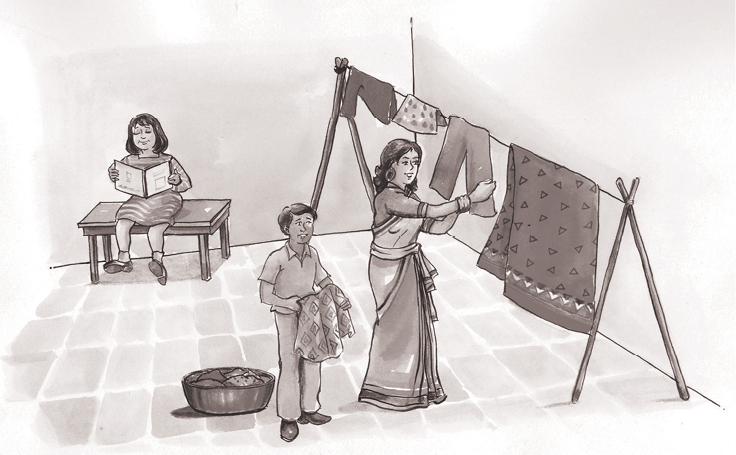
It is important to reiterate here that there is a small minority of street children who lack social and psychological support from their biological family. They may seek such support from their peers or adults in similar situations. Many children who are abandoned or orphaned may find themselves in children’s homes run by the state or various NGOs. All of them have a right to care and education.
6. Other functions: The family also fulfils other functions which are recreational, religious and social and are important for the continuity of society.
Families usually visit others (family or friends) for social functions like birthdays, puja ceremonies or other such activities.
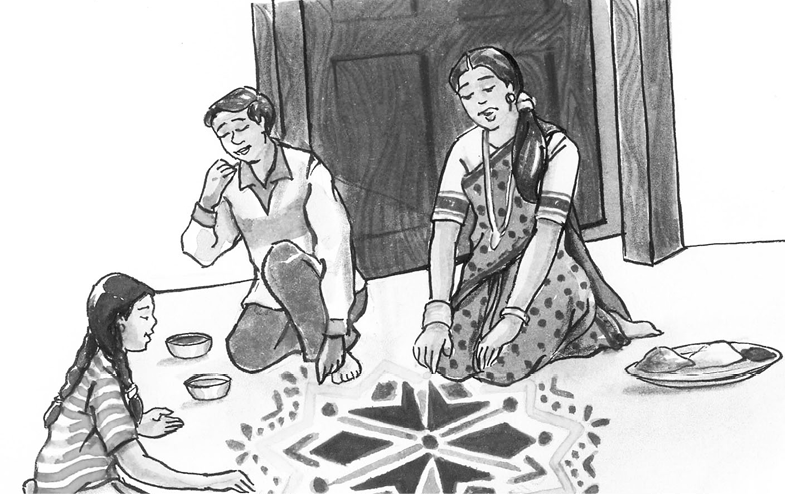
Another important task that the families have been doing is in socialising its young ones for community duties. Family is the ‘school’ of civic values. Can you recall your first lessons regarding ownership of property or things when, by mistake, you may have brought home another child’s pencil or eraser, and you were asked to return it? Similarly if you look back at your childhood experiences you will be able to recollect incidents which are evidence of families providing opportunities for learning to share, love, cooperate, tolerate, sacrifice and obey. These qualities enable one to grow into a healthy citizen.
9A.3 Family Life Cycle
Saguna had gone to the wedding of her elder sister. She came back home and asked her mother. “Could Sudhadi and jijaji be called a family? Or are they a couple?” Her mother took some time to reflect and then said that “Look Saguna, Sudha and her husband are a couple; yet they are at the beginning stage of the family”. Now does that make you wonder about the stages in family life? Look around and you will find that there are families at different stages. If we continue the example of Sudha and her husband they may soon have children who will grow from infancy to adulthood and then they are likely to establish their own families. When they are old, Sudha and her husband will probably be left as husband and wife in the household. The cycle that started with their being a couple brings them back to being a couple again. Thus, you will see that the entire family life is cyclic in nature. That is why it is called the “Family Life Cycle”. In the box you will find the different stages of the family life cycle. Each stage has challenges and tasks to be performed which are beneficial for the development of its members, at that phase of family life.
|
The family life cycle adopts a longitudinal view of family life. It is based on the recognition of successive phases and patterns as they happen over the years. |
|
Stages in the family life cycle of a nuclear family The family life cycle generally consists of seven stages. These include– 1. Married couple (without children) 2. Child bearing family 3. Family with preschool-age children 4. Family with school-age children and adolescents 5. Family launching young adults into higher education/work 6. Middle-aged parents with grown up/married children
7. Ageing couple—retirement to death of both spouses |
9A.4 Family Developmental Tasks
Shri and Shrimati Kumar live in Ravi’s neighbourhood. They are taking care of their newborn baby and their older daughter goes to school. The Patels who stay upstairs have school going children and they are always worried about the marks the children are getting in school. In Ravi’s family the maid who comes to help is anxious because her daughter wants to pursue her studies further, but she does not have the money. In all these stories you will notice that the parents are performing different tasks for the family. The variety in the tasks that the parents perform depends on the age group of their children. Therefore, we can say that family developmental tasks are those responsibilities that are specifically related to the needs of the family members.
Activity 4
Pick out the family developmental tasks related to the stage which your family is in and observe the tasks that your parents have been doing. Report in the class noting the variations in the performance of tasks due to family structure, number of children and adults present.
9A.5 Family dynamics
Family members perform their roles while interacting with one another. Each family has its own patterns of interaction. These are called family dynamics. They are influenced by factors such as the structure of the family — the number of children and adults, and how they are related – the personalities of family members, cultural background, values, and personal or family experiences.
Understanding and relating with parents is one of the most important activities in the family. Parents have a very powerful influence over children’s personality and future life. When parents and adolescents share an easy communication based on positive understanding together they could build a happy, successful family life. To accomplish this understanding all members need to value and respect each other.
Activity 5
How well do I know my mother/father?
• What is your mother’s full name?
• What is her birth place?
• What is your father’s full name?
• Who gave you your last name?
• Where did your mother spend most of her childhood?
• Where did your father spend most of his childhood?
• What is your mother's level of education?
• What is your father's level of education?
• What makes your mother happy?
• What makes your father happy?
• What does your mother want you to become?
• What does your father want you to become?
Note for the teacher–
By the end of this session the students will be able to assess their own understanding and knowledge of their parents as individuals. Moreover this is likely to sensitise them to their parents’ needs, perceptions and aspirations.
9A.6 Handling Situations
Parents’ advice to young people is sometimes seen as interference by children. However, it is important for children to realise that parenting is a difficult and challenging task that requires life-long commitment. Similarly, parents and other adults also need to realise that children have a need to make their own place in the family and society. It is important for each member to appreciate the responsibilities of others without conflict and tension. Career choices, dresses young people wear, choice of friends, sharing household responsibilities and television watching are some areas of family disagreements and conflicts. Each family has different ways of handling such conflicts. In single parent families where either parent is absent for one reason or the other, the responsibility of the remaining parent becomes more crucial. As a young person one needs to show extra sensitivity and understanding to a mother/father who is trying to do the job of both the parents. Understanding the other person’s perspective is an effective way of conflict management.
Activity 6
Perspective taking
1. Choose a conflict situation, e.g., career choice.
2. Teacher could point out that there are four perspectives to it — (1) Adolescent’s (2) Mother’s (3) Father’s (4) the fourth perspective could be that of the teacher/ school counsellor.
3. All four perspectives could be role-played by the students in class.
4. After 10 minutes of role play the parts should be exchanged, i.e., the student who played Father shall now play the part of an Adolescent and the one who became the counsel or could be the Mother.
5. The activity could be concluded by discussing how the experience may have helped them in having better insights into the other persons’ perspectives.
9A.7 Support and Strength to Members
You have learnt in the earlier unit on development of self that one of the developmental tasks of a person of your age is learning to act as adults among adults. Middle-aged parents may develop problems such as poor health, a set-back in career, transfer of either parent to a distant place, death in family, added responsibility of an older relative, financial crisis, etc. The understanding and contribution of young people and children during difficult circumstances cannot be underestimated. The presence and company of children have the potential to help families through even the most difficult crisis.
Let us now see what helps family members understand one another’s needs and emotions. It has been found that communication has an important role in this.
9A.8 Communication in the Family
You must have often heard that human beings are social animals. But, did you know that 70 per cent of our active time, that is waking hours, are spent communicating in some form or the other? Perhaps your day begins with someone in the family or an alarm clock waking you up to get ready for school, and then go to school with friends, all this while talking to someone or the other. From morning assembly, to interacting with school teachers, class mates and the principal, the entire learning experience involves formal and informal communication. The ability to communicate effectively in a variety of settings is essential for leading a happy and productive life.
Similarly, while we are at home, we communicate differently with elders, our siblings—younger or older, grandparents, neighbours and helpers at home. Thus family communication is the way verbal and non-verbal information is exchanged between family members. These interactions develop over time among a group of related individuals who share common living space.
Communication within the family is extremely important because it enables members to express their needs, wants, and concerns to one another and offer social and emotional support. It is a unifying element since speaking and listening behaviours are intertwined. Communication involves the ability to pay attention to what others are thinking and feeling. In other words, an important part of communication is not just talking, but listening to what others have to say. It is through communication that family members are able to resolve the unavoidable problems that arise in all families. Open and honest communication creates an atmosphere that allows family members to express their differences as well as love and admiration for one another.
Four styles of communication have been identified which are as follows—
(i) Clear and direct communication: Clear and direct communication is the healthiest form of communication and occurs when the message is stated plainly and directly to the appropriate family member. An example of this style of communication is when a father, disappointed about his son failing to complete his chore, states, “Son, I’m disappointed that you forgot to take your grandmother to the doctor today”.
(ii) Clear and indirect communication: In this second style of communication, the message is clear, but it is not directed to the person for whom it is intended. Using the previous example, the father might say, “It’s disappointing when people forget to complete their chores.” In this message the son may or may not know that his father is referring to him.
(iii) Masked and direct communication: Masked and direct communication occurs when the content of the message is unclear, but directed to the appropriate family member. The father in our example may say something like, “Son, people just don’t pay attention as they used to.”
(iv) Masked and indirect communication: Masked and indirect communication occurs when both the message and intended recipient are unclear. In unhealthy family relationships, communication tends to be very masked and indirect. An example of this type of communication might be the father stating, “The youth of today are very lazy and irresponsible.”
It is important to note here that the communication styles are also mediated by culture. For instance, direct and open communication may be more acceptable in a western society (e.g., U.S.); however in the hierarchical structure of Indian families, indirect communication may be preferred as direct communication with older persons may be considered disrespectful.
9A.9 Keys to Building Effective Family Communication
With increased professional commitments for urban families and anxiety and competition experienced by young people in rural areas, it is important that our communication behaviour equips us to face these daily challenges rather than feel. There are many approaches that families can adopt to become more effective communicators, and in turn, to improve the quality of their relationships. Following are some suggestions for building effective family communication.
• Communicate frequently: One of the most difficult challenges facing urban families today is finding time to spend together. With our busy schedules, it is difficult to find sufficient time to spend with one another in meaningful conversation. It is extremely important for members in families to make time to try and communicate regularly to and directly. Sometimes, eating meals together is a good idea, without the TV turned on. It can be a good idea to switch off the TV and eat dinner together; or sit together on a Sunday afternoon to talk about important issues that effect the family. Similarly, spending time with elders in the family will strengthen family bonds, and talking with them will help young persons relax and make the elders feel that they are important, thus inducing a feeling of mutual love and respect.
• Communicate clearly: It has been found that families that appear happy, usually communicate their thoughts and feelings in a clear manner. This is especially important while attempting to resolve problems that arise between family members (e.g., between spouses, parents and children). Indirect and vague communication will not only fail to resolve problems, but it will also contribute to a lack of intimacy and emotional bonding between family members.
• Be an active listener: An essential aspect of effective communication is listening to what others are saying. Being an active listener involves trying one’s best to understand the point of view of the other person. It is important to pay close attention to the verbal and non-verbal messages and cues. As an active listener, one must acknowledge and respect the other person’s perspective. Another aspect of active listening is seeking clarification. This can be done by simply asking, “What did you mean when you said?” or “Did I understand you correctly?” Active listening involves acknowledging and respecting the other person’s point of view.
Family will always remain a significant context for an individual. With development; however, the child’s universe of interaction widens. After the family, for most children school is another vital context which offers the opportunity to interact with other people who are likely to have a significant influence on their lives. The school also provides the opportunity to build multiple, significant non-family relationships. The next chapter on ‘School: Peers and Educators’ discusses this aspect.
Key Terms
Family, Patrilineal, Matrilineal, Nuclear family, Extended family, Family life cycle, Family developmental tasks, Communication in family
- Review Questions
1. Define the term family. Discuss the different variations in family types.
2. Discuss any three functions of the family with examples.
3. Write short notes on—
(a) Family life cycle
(b) Family developmental task
(c) Family dynamics
(d) Conflict situations in the family
4. What is the significance of communication in the family? Using your own family as an example, describe the communication patterns. Suggest how communication between family members can be improved.
-
Practical 8
Family
Theme Areas of agreements and disagreements with family members, friends and teachers.
Tasks 1. Listing the areas of agreements and disagreements
2. Identifying ways of resolving disagreements
Purpose of practical: Adolescence is a time when you are forming a sense of your identity. Often, but not always, this process may bring you in conflict with your family members and significant others as your views on particular aspects may be different from theirs. This can cause stress in relationships. This practical will help you to identify sources of disagreements and will also encourage you to reflect on how you can minimise and resolve these differences.
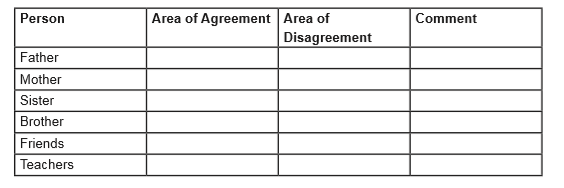
Conduct of practical: Form yourself into groups of 4-6 students. For the first 10 minutes, reflect individually upon your interactions with your family members, friends and teachers in the past few months. Use the following format to record the areas of agreements and disagreements.
|
|
 |
Now share your data with the other members of the group and discuss the following—
1 (a) Whether there are areas where most of you have disagreements with a particular family member, friends, teachers.
(b) Why do you think this happens?
(c) What are you doing presently to resolve the disagreements?
(d) What can be done to resolve/minimise the differences?
2. (a) Whether there are areas where only you seem to be having differences while the rest of the group members do not have disagreements in that area?
(b) What could be the reason for this?
(c) Can you do something to resolve the disagreements?
3. (a) Which are the areas where most of you are in agreement with the family members, friends and teachers.
(b) Can you use these areas of agreement to build a stronger relationship with the persons around you and thus reduce the areas of disagreements?
9
B. School Peers and Educators
Learning Objectives
After completing this section the learner will be able to—
• discuss the role of school in developing new relationships.
• understand how relationships with peers transform as the child grows.
• know the importance of developing friendships.
• analyse the influence of education and teachers on students’ development and achievement.
9B.1 School
In your view is school just a place to study or something more? What is the first thing that comes to your mind when you hear/read/think of the word ‘school’? Studies and examinations, most of you would say! Hard work and some degree of fear, you may want to add! But school is also a place where you meet friends and some of these friendships lead to lasting, even
life-long relationships. You also meet adults in the role of teachers and many of them shape your attitude towards learning, towards new subjects, and in fact towards life! Most of you would have a special feeling about one or more teachers who have taught you during your school life – teachers whom you admire and look upto. Thus school, apart from serving an academic function in our lives, is also a network of social relationships that influence our values, behaviour and thinking, both directly through the process of teaching-learning, and indirectly, as we interact with peers and educators in the school. In other words, it is one of the agents of socialisation. In this chapter we will focus on the role of school as a place for developing relationships and interactions with ‘significant others’ in our life.
9B.2 Peer Relationships
Infants as young as six months show an interest in other infants. When placed together they may attempt to touch each other, smile and look at each other. But at this time they treat the other just as an object – they do not respond to or see them as persons in the ways that we understand. Between one and three years of age, the child begins to realise that other children are persons and begin to have social interactions with them. In the early years, a friend is someone who lives close to you; in other words one who is available for play. These friendships usually have nothing to do with liking the person or her/his qualities. At this age, most children do not show a preference for any one playmate. They play together occasionally, using the same toy or interacting with each other, but most of the time they play on their own.
In the preschool years the child starts relating to others in a more sustained manner. But early friendships are superficial. They are quickly formed and quickly broken – the child may be friends with another child who has a toy that she wants; however, the friendship may not carry over to the next day, unlike the friendships of an older child. Thus during the preschool age, a friend is someone with whom the child ‘does things’ such as playing with toys. During the later part of preschool years, interactions between children become more sustained. Older preschoolers play with each other, cooperate and take turns during play. They may also prefer some peers over others. By the beginning of middle childhood years, the child begins to realise that friends are those with whom one shares common interests and feelings and not just those who have things one likes. The child begins to realise that trusting each other, responding to each other’s needs and presence of desirable qualities such as kindness and considerateness in friends are critical features of friendship. They understand that friends help each other. During the middle childhood years the child’s circle of friends usually increases – the child spends more time with friends and their influence also becomes more powerful. By adolescence friendships become deeper and friends share each others’ innermost thoughts and feelings.
You have read in the chapter on ‘self’ that by the time the child becomes an adolescent, friends may become even more important than the parents. Most adolescents usually have a small group of close friends – called ‘clique’ – and a larger number of friends who are at some distance – called ‘crowd’. The crowd is a loosely organised group of peers who tend to be together because of shared interests and activities. However, members of the crowd are not close to each other as members of cliques are. Thus young people watching a stage show form a crowd and a group of adolescents planning an outing together are part of a clique.
9B.3 The Importance of Friendships
Friendships at every age are important because they help the child feel accepted by people who are like her. This gives the child a sense of emotional security which is important for the development of social and emotional relationships in adult life. Children who are rejected by peers are likely to show aggressive behaviour and are also likely to interrupt group activities through deviant behaviour. They tend to remain alone or; may join deviant subcultures whose values and activities may be markedly different from those of the mainstream culture. This can cause a lot of harm to the child.
During adolescence there is a tremendous pressure on the adolescent to conform to the values held by the peer group and behave in ways considered appropriate by them. These values and behaviours may be contradictory to parental values, and this coupled with decline in conformity to parents’ values and demands by the adolescents, can lead to tremendous conflict with the parents. However, it is important to understand that experiencing such a peer pressure to conform is a normal feature of growing up. In fact, being able to express feelings and experiences with friends which the adolescent would not be able to share at home helps the adolescents feel ‘normal’ and not alone, as they realise that their friends have similar concerns and experiences. Also, by the end of adolescence, peer pressure tends to decline and the growing adult is able to look at issues from multiple perspectives. However, it is also true that under pressure to conform many adolescents can get involved in anti-social activities which are dangerous to the self and the society. These include experimenting with drugs and sex without adequate protection and information. Adolescents and their parents need to understand each others’ points of view and concerns. This can happen when there is free-flowing communication between parents and adolescents – something which both parties have to work towards.
It is also important to remember that in many cultures peer values may be quite similar to values held by adults in the society, in which case adolescents would not experience as much conflict with parents. In such a situation, peers would serve to reinforce the values held by the society.
Activity 1
You have read about many aspects of friendship in various stages of a child’s development. Reflect upon your own experiences and think of friends who have influenced you in different ways.
Activity 2
As adolescents, are there aspects in which you agree with your friends but disagree with parents? Discuss these in the class.
9B.4 Influence of the Teachers
Teachers are a major influence in the school. Like parents, they set limits, make demands, communicate values and foster development. Teachers are powerful role models and often impact a child’s development. Children are most likely to imitate the behaviour of teachers they like and value, and they also tend to enjoy subjects taught by teachers whom they admire.
Teachers’ expectations of students often, but not always, have a major influence on student performance and behaviour. It has been found that teachers’ expectations influence student achievement, motivation, self-esteem, expectancy for success and actual achievement. This has both positive and negative aspects. The positive aspect is that, by and large, teachers may behave more positively towards students from whom they have high expectations. They smile at them more frequently, praise them more often, supervise their work more closely, and press them harder to find answers. And when they perform poorly, the teachers are likely to encourage them to work harder. Thus they communicate to these students that they are expected to succeed. The negative aspect is that the teachers are not likely to press or motivate the students from whom they have lower expectations. The teachers’ expectations become a self-fulfilling prophecy, with the children becoming, achieving and behaving as the teacher expect them to become. Studies have shown that if a student has average ability, but the teacher is informed that the child has tremendous potential, the teacher modifies her/his ways of relating to the child so that the child actually improves upon past performance.
The implication of the above discussion is that teachers need to be conscious of the harmful effects of low expectations. There is need to avoid pre-judgment of children’s abilities. Also, even if the child is not performing adequately at any given time, there is every chance that the child can do better in the future, given adequate support and encouragement. Teachers need to have reasonably optimal demand of achievement from all students and not merely from a few. Children’s achievement needs to be judged against their own past performance and not compared only with the class average.
The teacher-taught relationship is the essence of the teaching-learning process. Philosophers and educators in India and the world have visualised the teaching-learning process as one where knowledge is co-constructed between the teacher and the learner. The Guru in the ancient learning tradition of India had a vibrant role – his role as revealed in the Upanishads was to make the pupil completely independent and himself completely superfluous. However, this independence was believed to be achieved after years of hard work, learning, dedication and devotion. They encouraged questioning, probing and sustained enquiry by the students so that the students’ own creativity came to the fore. In the contemporary Indian context, the role of the school and educators is mediated by factors such as the pressure of ensuring that students get high marks in their examinations. There are teachers who merely dictate lessons to their students, allowing no questioning. When students do not experience the school and the learning process as one of psychological safety, it is doubtful that the education system would succeed in helping them form healthy relationships with their teachers. However, there are teachers who play a very constructive role in the education of their students, and act as their mentors and guides for future.
School is thus a significant context influencing the adolescent’s development. In the next chapter we shall learn about Community and Society, the larger contexts in which the micro-contexts of family and school are situated.
Key terms and their meaning
Clique: a group of a few close friends
Crowd: a larger number of peers who are at some social distance from each other
Peer pressure: pressure on the adolescent to conform to the values held by the peer group and behave in ways considered appropriate by them.
Co-construction: when the teacher and the student both contribute to the development of understanding and knowledge, it is a perspective that holds that knowledge is not a static body of information that is passed on from the all knowing teacher to the ‘empty’ student; rather both the student and the teacher recreate knowledge during the teaching-learning process as they bring their own experiences and understanding to the teaching-learning situation and try to
re-discover and re-interpret the knowledge as stated in the books or as being stated by the teacher
Psychological safety: an atmosphere where the person does not experience threat to her/his self-esteem; where the person experiences a sense of self-worth and a positive regards of her /his abilities. In such an atmosphere the person is able to participate freely with a sense of security about the negative reactions of others.
Here is a brain teaser for you. Check your skill in solving the puzzle
In Column 1 are some words you have read in the chapter above. Unjumble the words and match them with the meaning after locating it in Column 2.
|
Column 1 |
Column 2 |
|
1. dowcr …………. |
• larger number of friends who are at some distance |
|
2. quelci …………… |
• a group of small number of close friends |
|
3. repe repsruse ……… |
• need to conform to the values and behaviours |
|
4. fles-uliflflgin oprhpcey ….…. |
• children becoming, achieving and behaving as the teacher expected them to become |
|
5. urug ……….. |
• encourages questioning, probing and sustained enquiry by the students |
-
Review Questions
1. Explain how the school is a place for forming relationships and interacting with significant others?
2. Explain how the nature of friendship changes from infancy to adolescence?
3. Why are friendships important?
4. What is meant by the term ‘peer pressure’? How can this be a source of stress for the adolescent?
5. Discuss how teachers and their behaviour can influence students’ achievement and motivation?
9
c. Community and Society
Learning Objectives
After completing this section the learner will be able to—
• discuss the concepts of community and society.
• describe the significance of society in the lives of individuals and families, and its relationship to culture.
• explain the role of media as a social influence.
• elaborate on the responsibility of individuals towards community living.
9C.1 Introduction
In the preceding chapters, you have learnt about the importance of the family, school and friends in the lives of individual people. Human beings are a social species; we live in close connection with other people in our lives. After birth, the human infant is the most dependent of all newborns across all mammals, and remains so for the longest period in comparison. This period of dependence allows for close interactions between the caregiver and infant and facilitates important developments in early life that lay the foundations for the future. Sociability is a critical attribute in human life. We like to be among other people, we build our idea about ourselves from listening to others and seeing their reactions to us, we learn about our society and culture by engaging with people around us; and we develop a sense of right and wrong by looking around us. These are some of the examples of the ways in which groups can influence individual development. This does not imply that the reverse cannot be true. As sentient living beings (beings that have sensory organs) we are deeply affected by what we experience. This is one of the primary reasons why we are deeply affected by our experiences; our dealings with other people are one of the main influences on our lives.
9C.2 Community
The idea of a community is of a group that shares common values, beliefs, spaces, interests and a common heritage. The size of the group does not matter; a community can be a small group of people who share common activity, or even a group of people who may temporarily gather for common purposes like a chat community on the internet, or a group of children getting together to play regular sports in a field. The term ‘community’ is also used to refer to people who live within a common area and share a common environment. Due to these shared features, community members are of importance to each other, whether they are aware of it or not. The terms society or ethnic group also imply the same shared reality as ‘community’. In common usage, these terms can be used interchangeably.
From ancient times, individuals have lived in clusters where work, food, shelter, children’s care and many other activities are shared with other people. Although the family has sustained as the longest standing group over centuries, people outside the family also provide very important input in people’s lives. Even people whom you never meet may play a critical role in your life. In some sense, people living in a country, and indeed, people of the world can also be considered as a community. For instance, if we wish to speak about the consequences of global warming, we can discuss the consequences of collective action on the people of the world as a community. Citizens of a country share a government, a constitution, and an economy. Thus community is an abstract idea of a collection of people, and is not limited to any one shared characteristic. In Sociology, the terms community and society have slightly different meanings. Society implies a larger, more abstract concept of human grouping, whereas, a community is defined as a grouping with a more cohesive unit. Family and kinship are considered examples of communities, with a great deal of shared knowledge and experience, beliefs and values.
Different types of communities
Let us consider examples of communities around us, that is, people with whom we share certain experiences. The simplest starting point after the family is the neighbourhood. A neighbourhood is an important social unit since these are the people among whom we live, with whom we share our daily activities. Of course this does not imply that all members of a neighbourhood are exactly the same. Far from it! However, there is a sharing of life circumstances that makes us similar in some ways. For instance, most neighbours use services of the locality that are provided, like marketplace, health care, schooling and play areas for children. This brings people together, and often results in conversations, friendships and even cooperation. During festival time, for example, people belonging to different religious groups may bring food specially prepared for families to share their celebrations with others. Neighbours are also very important in times of crises. In emergencies, sometimes neighbours are the first people towards whom we can turn, even before family and friends. People usually help each other in such moments, although there are differences in the extent of support that different people are willing to offer. It is true that we will be more willing to assist someone living near us, whom we know, than we are to help a stranger on the street, about whom we may know nothing. At this point, it is important to discuss the organisation of community living and social institutions that are different in different ecological settings like a village and a city.
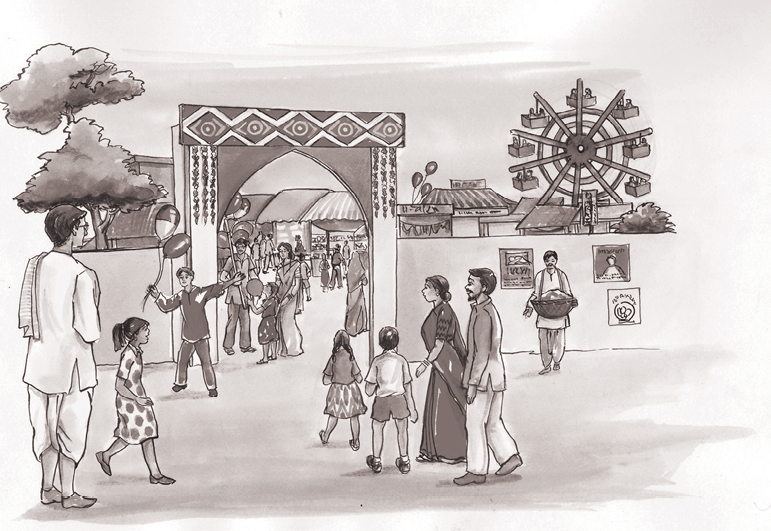
There are differences between cities, towns and villages in the way the homes, the services and the society are organised. We do find that homes in a neighbourhood of a big city can become quite distant and many people do not often talk to or know each other very well, although there are many exceptions to this. In villages and towns, in contrast, there is a greater sense of belonging and closeness among neighbours. People usually know all the families living in their locality in a village, and if the village is small, then they would even know all the families that reside within. People would recognise each other by name, at least of the head of the family, and any stranger would be spotted instantly. This does not mean the city people are not friendly; sometimes the pressures of dual incomes and city life can leave little time for interactions such as these. Further, the increasing mobility in urban spaces, where everyone does not own the house they live in, can also result in lower interaction. In villages, on the other hand, it seems that everyone knows everyone else. Families are identified by their members, and not by address. Life in townships is somewhere in between these extremes, where some of the character of village life sustains, since people do know each other reasonably well; and yet there is some mobility, higher employment outside the home, and other factors common with city life. That is why social scientists tend to differentiate between rural, urban and tribal societies, since these are organised somewhat differently from each other. Another important feature to note is that social institutions, like schools, community centres, health clinics, local political bodies, are also differently organised in rural and urban areas. There is a greater sense of anonymity in urban spaces, which remains an important characteristic in the social interactions, social control and changing social reality.
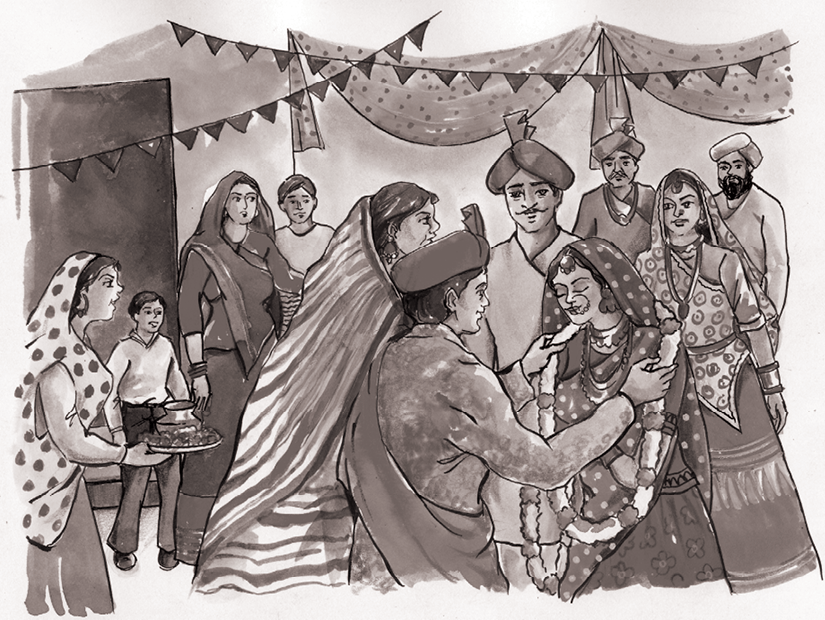
Apart from the neighbourhood, village, town or city, we also have other kinds of communities. For example, people who speak a common language or belong to the same native place (in a large city, for example) get together for specific occasions. For instance, we can see that during the period around September/October, Durga Puja is an important event for the Bengali speaking community. We find several pandals put up for the days of the prayer where people come and celebrate, eat and worship together. Children have fun and games in these areas, young people dance for worship and older members sit and watch and pray to the goddess for her blessings.
Activity 1
List the names of a few communities that you can think of including your own. List the common characteristics of these communities. Discuss this with your peers as well as the teacher to get ideas about the communities of which you are members. Sometimes you may not realise that these are your characteristics too.
In the state of Maharashtra, as another example, the celebration of Ganesh Puja is performed with a lot of pomp and show during Ganesh Chaturthi. People get together, collect funds and organise special activities regularly over a period of several days and then finally culminate the celebrations with the immersion of the Ganesha idols in sea/river water. Thus we can see that religious membership, ethnic group and common language are some of the ways in which larger society can be organised into smaller, more identifiable groupings.
Note that one person can potentially be a member of many communities. For example, a child from a Parsi family is also attending a school, and automatically becomes a member of the school community. She may also be learning dance under the guidance of a teacher, so she is also a member of that dance group. This girl may be a part of a group of people who have got together to prevent cruelty to animals on the street. This makes her a member of that animal lovers group also. Thus, at any given time, we are all members of several groups and communities and sometimes we may not even be aware of these memberships. However, these memberships are important for us in the formation of our identity and our sense of belongingness to a group.
Functions of communities
As discussed already, communities play an essential role in a person’s life. However, it is also true that communities cannot exist without people. Thus there is a dynamic, co-constructive relationship between the individual person and her/his community. Although the community provides a person with identity, support, social control (what to do and what not to do), goals and activities, individuals comprising a community do the actual work in order to make things happen. Without the participation of the individual members of a community, there can be no social organisation. For instance, when a family gets together to fulfil the function of teaching new members the rules of any given community, it is transacted through the participation of individual family members. The mother is commonly expected to fulfil the responsibility of bearing and rearing young children, the father often provides support to the mother for fulfilling these responsibilities by providing for the family in terms of protection and income. These responsibilities can be shared between fathers and mothers, and with other members of the family, or even others like friends and neighbours. For instance, when the mother goes out of the home for employment, the care of her children may be shared with the father or/and grandparents. Sometimes even neighbours can help to keep the child until the parents return home. Often older members of a family who share the home can be the caregivers of young children and therefore participate actively in the care of the child. Let us now attempt to enumerate some of the functions of a community, any community, whether it is a family, a kin group, a residential community or a country. A community attempts to do some of the following things for its members—
• Provide a sense of identity to a person.
• Provide opportunity for survival, learning, livelihood, entertainment, security and care. This is especially true during periods of vulnerability (when a person is at risk), for example, illness during old age.
• Prepare younger generations for social participation.
• Ensure the survival of the group.
• Participate in the transformation of a person into a functional member of community and society.
Activity 2
For each of the above functions, discuss with a classmate examples from your own life. Share them in the class as a whole.
9C.3 Society and Culture
As discussed in the previous section, the concept of society is more flexible in comparison with community. Society can be seen perhaps as people in general, without the notion of sharing specific features, the way we define a community. However, the two terms can also be used interchangeably in ordinary language. The term culture refers primarily to the way of living of a people. Culture consists of all those elements of a person or a group’s environment, both tangible (material things) as well as intangible (beliefs, values, practices) that are created by people for their own use. This term (culture) is also used in different ways in ordinary language. Sometimes, culture is used to imply ‘high society’ when we refer to a person as very ‘cultured’ for example. This is not the way the term is used in our subject. We use culture to simply mean the beliefs of people and their ways of living. It includes the food we eat, the clothes we wear, the language we use and the celebrations that we participate in, among other things. Culture also consists of ideas of people. Thus we can say that culture is a dynamic and complex construction of a variety of things that are part of our present, our past, as well as our future. Like a community, a cultural group is seen as a group that has shared ideas about things, usually living in close proximity to each other. Also culture should not be confused with country, especially in a country as large as ours where there are countless ethnic groups, several ecological settings and thousands of languages. Our country can be called a multi-cultural society. Officially our country has 22 scheduled languages as per the Eighth Schedule to the Constitution of India when four new languages were added. These are: Bodo, Maithili, Santhali and Dogri. For each scheduled language, there are many other dialects that are spoken in the concerned states. These official languages can be counted very easily on a 10 rupee note (see Activity 3). You will find only 18 languages on it since this note was printed prior to the addition of the last four. In your counting, do not forget that Hindi and English appear in larger fonts on the note.
Activity 3
Take a 10 rupee note and look very carefully at all the images and words printed on it. You will see the term Ten Rupees written in both Hindi and English. Note that there are many other languages listed, all of which say the same thing: Ten Rupees. Try to identify all the languages listed here. Hint: These are arranged in alphabetic order.
9C.4 Media and Society
Media is an important factor in modern society. Along with the legislature, judiciary and executive, it is the fourth pillar of modern society. Whereas, the other three are concerned with social organisation, social control and functioning, media is the means whereby communication takes place at an organised, group level. The different media that we have, keep us abreast with the events, personalities, and advances in society, local, national and international. Some of the different media that we encounter in our daily lives in modern society include television, newspaper, radio and internet. Each of these sources provides us with a window to the world. If it were not for the media, then we would know only what we discover for ourselves or what people tell us. Media provides us with information from the past and the present, from near and far away. It also exercises an influence on the social trends. For example, television advertisements have been found to have an important influence on the consumption patterns of its viewers. That is why businesses use television for advertising their products. Advertising is now a powerful and vibrant career today.
Media also provides us with information about events related to education and careers. For example, information about examination dates, careers and scholarships are all advertised in national dailies. This way we can access possible places to apply for further education or occupation. However, it is important to note that the influence that media information has upon an individual depends on several factors like the person’s age, sex, education, ethnic background and of course, temperament. Whenever a new technology is introduced (take for instance mobile phones) it is usually seen that younger generations are more impacted by the invention if it is available to them.

Apart from TV and newspaper, we are also connected with the world through the internet. Today, we find cyber cafes even in small towns and villages. The information available on the internet is much more varied and detailed than any other media source. Like every powerful medium, there is as much potential harm the internet sources can do; and like any other media source, the most important factor that determines its positive impact on society is the judicious use of the internet. For instance, when we access information on the internet, we can also access sites that have material that may be potentially damaging to the minds of young people. Internet is also a powerful source of sharing information by criminals who work towards harming other people and therefore society in general. It is very important for parents and other concerned adults to be aware of the media accessed by their children. Without being overly strict, parents, teachers and others can guide children towards the optimal use of media sources, and can thus gather important information, receive entertainment and also network with other people.
Activity 4
From a recent newspaper/ magazine, identify one article in each of the following areas and bring to the class:
1. Article related to sports
2. Article related to entertainment
3. Matrimonial advertisements
4. Advertisement for a product
Discuss the articles collected in the class. You may classify them in different ways.
Thus we can say that no medium is harmful in and of itself; it is the way in which it is used and the purpose for which it is used that makes it good or bad. In the following box, there are a few simple guidelines to parents or caregivers for facilitating responsible television viewing among children.
|
In order to facilitate responsible TV viewing the following points are helpful for caregivers. • Always be aware of what programmes your children are watching; preferably watch WITH them rather than using the TV as a substitute for you. • TV viewing is a habit, so set the trend early. • If you expect the child to be watching limited hours, remember your own pattern of watching TV is the biggest guide for the child. • Recommend to the child the programmes that are fun and informative for children. • It is often useful to place a TV in a central place so that everyone can watch. • Do not use the TV as a punishment (switching off) or reward (can see all the time); this adds unnecessary complication to the dynamics around viewing for long hours. • During exams, children want movement and entertainment; let the child watch some TV, BUT ensure that the child gets adequate outdoor activity. This is good for the memory and emotional stability during exams. • Explain to the child that the violence and bloodshed (even if it is the news) is hurtful for the people experiencing it, even if you cannot feel the pain. • Limit TV viewing to a few programmes a day rather than leaving it on all the time. • Avoid viewing late into the night with young children, since many of the programmes are unsuitable for children. • Have a variety of activities like indoor games, board games, stories and book reading along with TV. |
Another important social influence on individuals is films. India is the largest producer of films and it is no surprise that some of the most influential role models are film stars. The fan following of Amitabh Bachchan must include millions of people. These fans look up to him as a role model and try to follow his actions, his appearance and sometimes even his lifestyle. People want to become like him. Actors are therefore charismatic and have a lot of influence on the society. Their conduct is always under scrutiny and our newspapers and TV channels follow their every move very closely. We also listen carefully to news items about them and discuss their lives with our family and friends. Apart from actors, films both reflect and affect social reality. For example, over the years, the image of women in movies has changed, and we are now accepting a greater variety of stories in film. Meanwhile we also see that a number of films are banned by the censor board or a religious community. If films were inconsequential, no one would ban them. The truth is that the multicultural fabric of Indian society provides rich material for film scripts, as well as multiple challenges to movie makers. Films also bring home to us the cultures of different countries. Through foreign films, we learn about new places and people and may know some of their ways of living, whether it is in Europe or America or Australia.
In this manner, different media provide us with windows to the world, through which we are entertained, informed, emotionally moved and socially networked with people around and all over the world. It is thus a critical dimension of social reality and cultural dynamics.
Activity 5
Name the latest film you have seen or heard about, recall the story of the film and focus on any one character/role that you liked and one that you did not like. List the reasons for each of your choices.
9C.5 The Individual Child, Community and the Society
Individual children enter into the world, in the company of several members, that comprise a family. In previous chapters, you have been able to grasp the importance of the family in the lives of individuals. The family is the primary unit of social life that forms the intersection between the larger social reality, the community life and the individual. It is family members who decide (consciously or unconsciously) what values and practices of larger society they will adopt and which they will oppose. In this manner, every family of a community or a culture will not have identical values. Human beings are diverse on account of personal experiences, social historical factors and individual temperament, that makes each individual unique.
In same instances, like due to natural or man-made disasters, personal constraints or social difficulties can sometimes lead to the absence of a caring group for the child to grow up in. Sometimes, a family may also be too poor to care for the child adequately. In situations like these, it is important to remember that the State or Central Government is responsible for providing adequate care for the child. The Fundamental Rights in our Constitution state the basic provisions for individual needs. Due to the economic situation in our country, the lack of resources, inadequate distribution and sometimes also lack of outreach, the care of children and families in difficult circumstances by the Government remains unfulfilled. This is a distressing fact of the Indian society; despite the many success stories that we have in the field of technological and educational development, we have not been able to ensure that all children receive adequate food, and that every child has access to schooling and health care. In India, we have a long way to go before the community becomes organised and is involved more effectively in the care of people in difficult circumstances. Undoubtedly, the NGO sector has provided an alternative movement for developing programmes and advocacy for such situations, but we need a more concerted will of the Government machinery along with improved work ethics and better funding to take responsibility for health care, education, entertainment and overall well-being of children and people in difficulty.
All of us have to be aware that if a community provides us with security, and if we have rights in any community, we also have individual and group responsibilities. Giving back to society and communities from where we have taken is a very important duty of every individual member. Remember that communities cannot survive without individual will and participation. Therefore, you must resolve to be an active member of your family, community, society, country and the world, in order that you can play your role in the betterment of the future for the generations to come. That is the strength of the relationship between any individual and the group; that there is an exchange of mutual dependence, of rights and responsibilities which we all have to fulfil.
In the next four chapters we shall learn about some crucial concerns that are relevant to all individuals in society. These are – health and nutrition, work and work place, resource availability, learning and education and textile heritage of our country.
Key Terms
Community, Society, Culture, Social control, Television, Internet, Rights and responsibilities
- Review Questions
1. Briefly discuss the meaning of a community. What are some of the functions of a community?
2. What do you understand by the term society? How is it different from community or similar to it?
3. What is culture? Discuss using examples.
4. How do TV and internet impact society?
5. Discuss the ways in which an individual can contribute to the society.
- Practical 9
Community and Society
Theme Observing and recording group dynamics in different situations
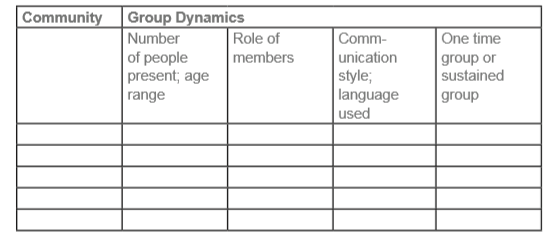
Tasks Observing group dynamics at home, eateries, playfield, school, recreation areas
Purpose of practical: Each of the above constitutes distinct communities. People in a community have certain ways of responding and interacting with each other, depending on the purpose for which the community is organised, the degree of closeness of the community members and the duration for which they are together.
Conduct of practical: Spend one hour each at each of the following locations and observe the group dynamics that takes place while you are present:
Home, eateries, playfield, school, recreation areas
You are not required to interact with the people present – just observe; however if someone initiates interaction with you, respond in a natural manner. Some of the aspects you can note in each of the above communities are the following–
• Number of people present at the location
• Whether all the people were together as a cohesive group or were there many smaller groups of people
• The age range of people in the group
• What was the role of different members? Were some members of the group more active as compared to others? For example, was someone the leader in the group and others were following him?
• What was the communication style among the group members: formal–informal; democratic-hierarchical?
• What was the language used for communication among the group members-mother tongue, English? Was the language used formal or informal?
• The duration for which the group members were together: Will the group form again on another day with the same members or was it a one-time coming together of people?
Record the observations using the following format :
|
|
||||
In the class, form groups of 4-5 students and present your findings to each other. Discuss amongst yourself whether the group dynamics were similar or different in different communities. Each group should then make its presentation to the entire class.
10
Concerns and Needs in Diverse Contexts
A. Nutrition, Health and Hygiene
Learning Objectives
After completing this section the learner will be able to—
• discuss the importance of health and its dimensions.
• understand the interrelationship of nutrition and health.
• identify the consequences of undernutrition and overnutrition.
• select appropriate and healthy food choices.
• identify the interrelationship between nutrition and disease.
• explain the importance of hygiene and sanitation for preventing food- borne diseases.
10A.1 Introduction
Every person wants to live a good quality life and have a sense of well-being. As far back as 1948, the Universal Declaration of Human Rights stated: “Everyone has the right to a standard of living adequate for the health and well-being of oneself and one’s family including food”. Yet, many of the environmental conditions and our own lifestyles affect our health, sometimes having harmful effects. At the outset let us define “health”. The world’s premier organisation concerned with health, the World Health Organisation (WHO) defines health as “a state of complete mental, physical and social well-being and not merely the absence of disease”. Disease means impairment of body health, alteration/disruption/derangement in function of some part or organ of the body, interrupting normal functions and deviating from a state of complete well-being. Health is a fundamental human right. All persons, irrespective of age, gender, caste, creed/religion, place of stay (urban, rural, tribal) and nationality, throughout their lives, should have the opportunity to achieve and maintain the highest attainable state of health.
It is the aim of every health professional (persons who deal with various aspects of health) to promote good health; in other words, to promote maintenance of well-being or wellness, quality of life.
10A.2 Health and Its Dimensions
You must have noticed that the definition of health includes various dimensions–social, mental and physical. Let us briefly deal with all three dimensions before we discuss physical health in greater detail.
Social health: It refers to health of individuals and of a society. When we are concerned with society, it refers to a society in which there is equal opportunity and access for all citizens to the goods and services essential for good health. When we refer to individuals, we refer to each person’s well-being – how well the individual gets along with other people and with social institutions. This includes our social skills and the ability to function as a member of the society. When we are faced with problems and stress, social support helps us to cope with them and solve the problems facing us. Social support measures contribute to positive adjustment in children and adults, and encourages personal growth. Emphasis on social health is gaining importance as scientific studies have shown that persons who are socially well adjusted, tend to live longer and recover faster from disease. A few social determinants of health are:
– Employment status
– Safety in workplaces
– Access to health services
– Cultural/religious beliefs, taboos and value systems
– Socio-economic and environmental conditions
Mental health: This refers to emotional and psychological well-being. An individual who experiences a sense of well-being can utilise his/her cognitive and emotional capabilities, function well in society and meet the ordinary demands of daily life. The box below lists the indicators of mental health.
|
A person who has positive mental health– • feels that he/she is capable and competent. • can handle normal levels of stress he/she faces in daily life. • has satisfying relationships. • can lead an independent life. • if faced with any mental or emotional stress or events, he/she can cope with them and recover from them. • does not fear things. • does not feel defeated or depressed for unusually long periods of time when small difficulties/problems are encountered. |
Physical health: This aspect of health encompasses physical fitness and functioning of the body. A physically healthy person is able to undertake normal activities, does not feel unusually fatigued and has adequate resistance to infection and disease.
10A.3 Health Care
Every individual is responsible for his/her own health, but it is also a major public concern. Thus the government assumes considerable responsibility and provides health services at various levels to the citizens of the country. This is because good health is the foundation for good quality of life and standard of living for the individual and the family, and is the key for ensuring social, economic and human development of a community and a nation.
Health Care consists of all the various services provided to individuals or communities by agents of health services or professions for the purpose of promoting, maintaining, monitoring or restoring health. Thus health care includes preventive, promotive and therapeutic care. Health Care services are delivered at three levels – primary care, secondary care and tertiary care levels.
Primary Health Care: The first level of contact between individuals with the health care system is known as Primary Health Care.
Secondary Health Care: When patients from primary health care are referred to specialised hospital also like district hospitals, it is called as Secondary Health Care.
Tertiary Health Care: When patients are referred from primary and secondary health system for specialised intensive care, advanced diagnostic support serious and medical care, then it is called as Tertiary Health Care.
10A.4 Indicators of Health
Health is multidimensional, with each dimension being influenced by several factors. Therefore, several indicators are employed to assess health. These include indicators of mortality, morbidity (illness/disease), disability rates, nutritional status, health care delivery, utilisation, environment, health policy, quality of life, etc.
10A.5 Nutrition and Health
Nutrition and health are intimately interlinked. In the global campaign of ‘Health for All’, promotion of nutrition is one of the primary elements. Nutrition is concerned with maintenance of body organs and tissues in structure and function. It is also concerned with growth and development of the body. Good nutrition enables the person to enjoy good health, resist infection, have adequate energy levels and perform daily tasks without feeling fatigued. In case of children and adolescents, nutrition is vital for their growth, mental development and achieving their potential. For adults, adequate nutrition is crucial to lead a socially and economically productive and healthy life. In turn, the health status of an individual determines the nutrient requirements of a person and food intake. During illness, nutrient requirements increase, and breakdown of nutrients are higher. Therefore, illness and disease adversely affect nutritional status. Hence, nutrition is a ‘fundamental pillar’ of human life, health and development.
10A.6 Nutrients
There are more than 50 nutrients in food. Nutrients are broadly classified into macronutrients (required in relatively larger amounts) and micronutrients (required in small quantities) based on the amounts required by the human body. Macronutrients are generally fat, protein, carbohydrate and fibre. Micronutrients include the minerals such as iron, zinc, selenium and the various fat-soluble and water-soluble vitamins, each of which performs important functions. Some of them function as co-factors and co-enzymes in the various metabolic reactions that occur in the body. Nutrients can also influence gene expression and transcription. Different organs and systems play a critical role in the digestion, absorption, metabolism, storage and excretion of nutrients and their end products of metabolism. In essence, each and every cell in all parts of the body requires nutrients. Nutrient requirements in the normal healthy state vary according to age, sex and the physiological state, i.e., during periods of growth such as infancy, childhood, adolescence, and pregnancy and lactation in women. Level of physical activity also determines requirements for energy and nutrients involved in energy metabolism, e.g., vitamins like thiamine and riboflavin.
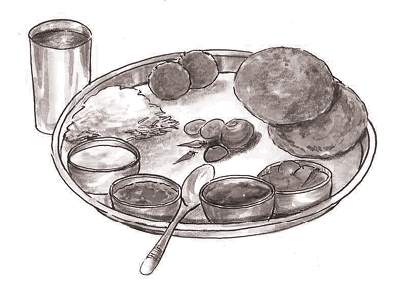
Balanced meal
Knowledge about nutrients, their metabolism and sources as well as functions are vital. One should consume a balanced diet which includes foods that will provide all the necessary nutrients in required amounts.
The science of nutrition is concerned with access to, availability and utilisation of food and nutrients for life, growth, development and well-being. Nutritionists (professionals who work in this field) are concerned with myriad aspects. These range from biological and metabolic aspects to what happens in disease states and how the body is nourished (clinical nutrition). Nutrition as a discipline studies the nutritional needs of populations and their nutritional problems, including health problems caused by lack of nutrients (public health nutrition) and prevention of diseases such as heart disease, diabetes, cancer, hypertension.
We all know that when one is ill, one may not feel like eating. What and how much is eaten by a person not only depends on taste but availability of food (food security) which in turn is influenced by purchasing power (economic factors), environment (water and irrigation), and policies at the national and international levels. Culture, religion, social status, beliefs and taboos also influence our food choices, food intake, and nutritional status.
How do good health and nutrition help? Look around you. You will notice that people in good health are generally in a happier frame of mind and are more productive than others. Healthy parents are able to take adequate care of their children, and healthy children are generally happy and do well in school. Thus, when one is healthy, one is more constructive for oneself and can take active part in activities at the community level. It is therefore obvious that one cannot achieve good health and be productive, sociable and a contributory member of society if one is starving and undernourished.
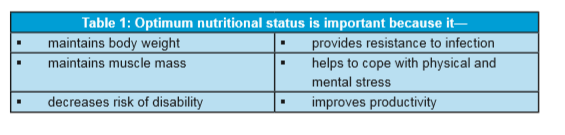
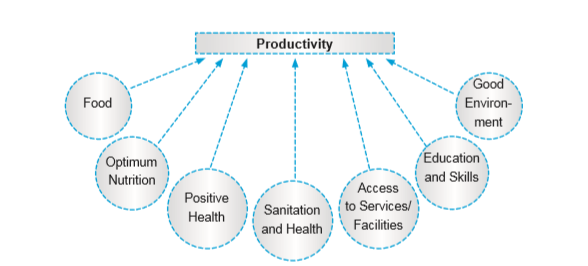
Figure 1: Health and Nutritional inputs required for Productivity
Figure 2 summarises the benefits of good nutritional status for children’s education.
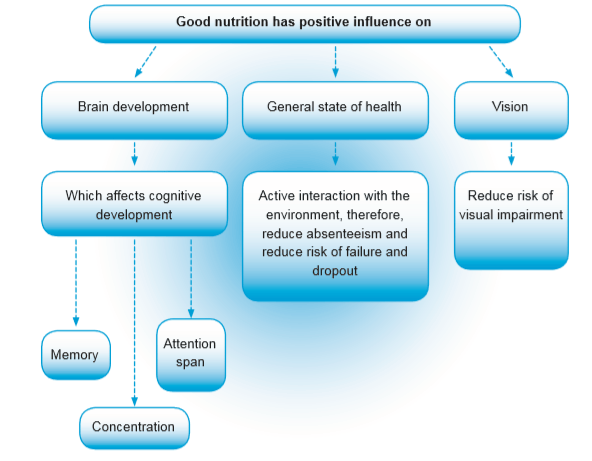
Figure 2: Benefits of Good Nutritional Status for Children’s Education
What is malnutrition? Malnutrition is a deviation from the normal state of nutrition. When the intake of nutrients is less than the amount that is required by the body, or in excess of the requirements, malnutrition results. Malnutrition can take the form of overnutrition or undernutrition. Excess intake of nutrients results in overnutrition; inadequate intake results in undernutrition. Wrong food choices and combinations can be a very significant cause of malnutrition in adolescents.
10A.7 Factors Affecting Nutritional Well-being
The World Health Organisation has listed four main factors (as shown in the diagram) that are important for nutritional well-being.
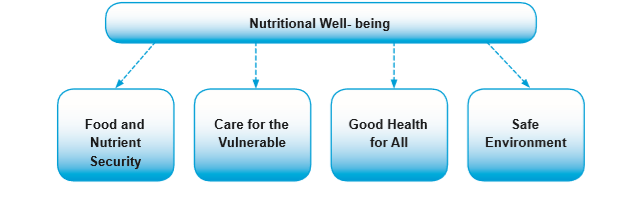
Food and nutrient security means that each and every person (regardless of age) has access to and can obtain adequate food and nutrients throughout the year, as per his/her requirements to enable him/her to lead a healthy life.
Care for those who are vulnerable means that each individual needs loving care and attention reflected by caring behaviour. In the case of babies it means whether the baby receives the correct type and amount of food as well as care and attention. In case of expectant mothers, it refers to whether they get all the care and support they need from the family, the community and in case of working mothers, from employers. Similarly, persons who are ill and suffer from any disease require care and support in various ways including food, nourishment, medication, etc.
Health for all includes prevention of disease and curing disease when it occurs. Special attention needs to be paid to infectious diseases since they can deplete the body of nutrients and lead to poor health and poor nutritional status. Every citizen should get a minimum amount of health care. Health is a basic human right. Some of the diseases that take their toll in India, especially among young children are diarrhoea, respiratory infections, measles, malaria, tuberculosis among others.
Safe environment focusses on all aspects of environment including physical, biological and chemical substances which may influence health. This includes safe, potable drinking water, hygienic food, and prevention of environmental pollution and degradation.
10A.8 Nutritional Problems and Their Consequences
In India, there exist several nutritional problems in the population. Undernutrition is a major problem which is reflected in the high numbers of pregnant women who are undernourished and have small babies with low birth weight as well as young children (below 3 years of age) who are underweight and stunted. One-third of the babies born in India are low birth weight, i.e., less than 2500 gms. Similarly, considerable percentage of women too are underweight. There are other nutrition-related deficiencies such as iron deficiency anaemia, vitamin A deficiency and consequent blindness and iodine deficiency. Undernutrition has several negative effects on the individual.
Undernutrition not only reduces body weight but has devastating effects on children’s cognitive development, immunity and can also result in disability, e.g., blindness due to vitamin A deficiency. Iodine deficiency is a threat to health and development, specially for young children and pregnant women since it results in goitre, still birth, and miscarriage in women, and deaf-mutism, mental retardation and cretinism in children.
Iron deficiency also has negative impact on health and well-being. In infants and young children, its deficiency impairs psychomotor and cognitive development, and thus adversely affects scholastic performance. It also decreases physical activity. Iron deficiency during pregnancy affects the growth of the foetus and increases risk of morbidity and mortality for the mother.
Conversely, overnutrition is also not good. Intake in excess of requirements leads to several health problems. In case of some nutrients if may lead to toxicity, and the person may become overweight and even obese. Obesity in turn increases the risk of several diseases such as diabetes, heart disease and hypertension. In India, we face problems at both ends of the spectrum, i.e., undernutrition (nutritional deficiencies) and overnutrition (diet-related chronic, non-communicable diseases). This has been termed “double burden of malnutrition”. In our country, the third National and Family Health Survey shows that 28.9 per cent men and
22.2 per cent women from urban areas are overweight or obese, the percentage being much lower among rural men (8.6 per cent) and women (7.3 per cent).
Nutrition and infection: Providing enough food to fulfil nutritional requirements is not adequate. The influence of environment is also important. Nutritional status does not depend only on sufficient supply of food and nutrients but also on the person’s health status, to a great extent. Nutrition and infection are intimately interlinked. Poor nutritional status decreases resistance and immunity, and thus increases risk of infection. On the other hand, during infection, the body loses considerable amount of its nutrient reserves (through vomiting and diarrhoea), while the nutrient requirements are actually increased. If nutrient intake is insufficient compared to the requirement due to loss of appetite or inability to eat (if there is nausea and/or vomiting), infections will affect the nutritional status adversely. Thus the risk of another infection increases, and all persons, especially children, the elderly and those undernourished are at the risk of contracting more infections/diseases.
In developing countries, food-borne illnesses such as diarrhoea and dysentery are major problems since they can lead to dehydration and death. Many of the infectious and communicable diseases are due to poor environmental sanitation, poor household, personal and food hygiene. The key therefore is to look into how these diseases can be prevented.
10A.9 Hygiene and Sanitation
Prevention and control of disease has to address both intrinsic and extrinsic factors which are linked with various diseases. The box below lists these factors.
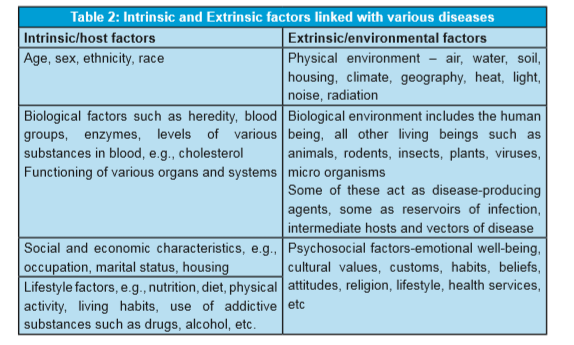
Among these factors sanitation and hygiene, nutrition and immunisation are key inputs. When we speak of hygiene we are concerned with essentially two aspects: personal and environmental. Health depends to a great extent on the social environment as well as on lifestyle and behaviour, including food intake. It is also closely related to hygiene. Poor hygiene leads to several infections and infestations such as worm infestations.
Environmental hygiene comprises external matter, both organic and inorganic, at the domestic hygiene (home) and community levels. This includes physical factors such as water, air, housing, radiation, etc., as well as biological factors such as plants, bacteria, viruses, insects, rodents and animals.
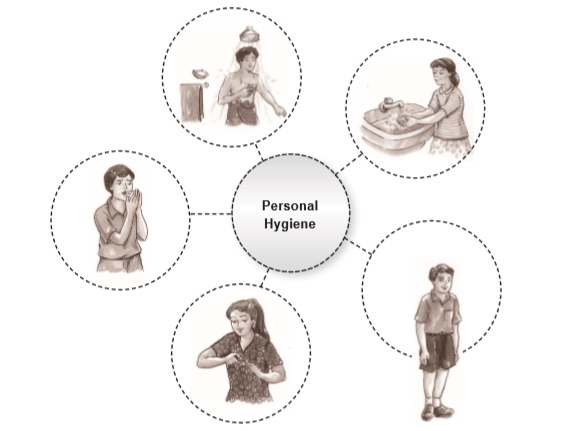
Figure 3: Personal Aspects of Hygiene
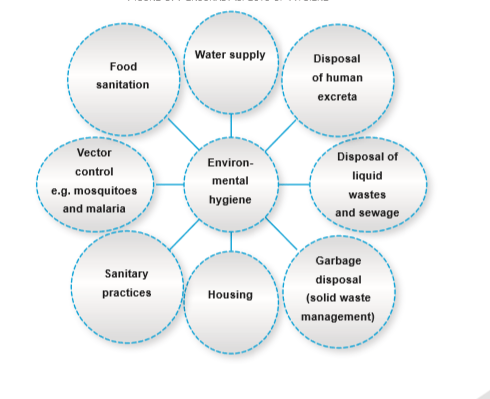
Figure 4: Environmental Aspects of Hygiene
Environmental health needs attention so as to create and maintain ecological conditions that will promote health and prevent disease. Among these, safe drinking water and sanitation, especially feaces disposal, are of great importance. Similarly air and water pollution are of concern. Water quality is important as contaminated water is the cause for many diseases such as diarrhoea, worm infestations, skin and eye infections, guinea worm, etc.
Food Hygiene: Food-borne illnesses occur when we consume food that contains disease-causing (pathogenic) micro-organisms. Several factors are needed for a food-borne illness to occur.
• Either the organism or the toxin must be present in the food eaten.
• The number of pathogenic micro-organisms must be in sufficient numbers.
• The contaminated food must have been consumed in sufficient quantity.
The illnesses that are caused include diarrhoea, dysentery, amoebiasis, infective hepatitis, typhoid, listeriosis, botulism, cholera, gastroenteritis. Most of these are traced back to poor personal and food handling practices as outlined below.
- Use of food items that are spoiled/infected/unsafe, include water, spices, seasonings, mixes.
- Improper storage leading to multiplication of disease causing micro-organisms.
- Not practising insect and vermin control.
- Use of contaminated equipment, utensils and plates, spoons, glasses
- Inadequate cooking.
- Storage of foods at temperatures favourable to growth of microorganisms ( 4 to 600C).
- Improper cooling.
- Improper/inadequate heating/reheating of cooked foods/left overs.
- Cross contamination.
- Leaving food uncovered.
- Use of contaminated substances for garnishing.
- Poor hygiene and sanitation of persons handling food, such as unclean clothes, not washing of hands, dirt and grime under the nails.
Effective practices related to nutrition, health and hygiene are essential to be productive in the work that one does, within home or outside the home. The next chapter discusses the relationship between work, worker and workplace.
Key Terms
Health care, Nutrients, Malnutrition, Hygiene and sanitation, Food hygiene.
- Exercises
1. Look up the following websites and discuss them in the class
• UNICEF’s report on State of the World’s Children
http://www.unicef.org/sowc08/
• Human Development Index
http://hdr.undp.org/en/statistics/
• WHO’s World Health Report
http://www.who.int/whr/en/
2. Identify at least 5-6 key indicators that you think are important for health and see how India ranks among the various countries in the world.
Or
Alternative for rural students: Interview two mothers of young children in your village. Ask each mother how many episodes of diarrhoea have occurred in the case of her child in the last one year. Give your comments on the reasons given by the mothers.
3. There are so many dimensions of health. List the various occupations or professions which are involved in providing services for health and nutrition – including prevention of health problems, promotion of good health and therapeutic services.
- Review Questions
1. “Nutrition affects productivity, income and quality of life”. Write your opinion about this statement.
2. How is nutrition linked to mental and visual disability and quality of life?
3. Divide the class into groups. Each group should visit a food service establishment, e.g., canteen/cafeteria, restaurant, street food vendor. Identify the bad hygiene practices related to (a) food hygiene (b) personal hygiene.
4. Have a class discussion on how hygiene can be improved and food can be rendered safer.
Or
Divide yourselves into three groups. One group will study the ‘Food’ aspect, the second will study ‘People’ and the third will assess ‘Unit, facilities and equipment’. After listing the various aspects/parts/activities that increase risk of illness, the groups can be asked to give a presentation followed by a discussion on remedial measures.
Note for Teachers
Teachers may guide students to organise an exhibition on Health, Nutrition and Hygiene for the school children, parents and members of community.
Note for students
In the vicinity of (a) your school (b) your home, observe and rate as very good, good, fair, poor and very poor at least three factors that are related to environmental hygiene.
-
Practical 10
A. Nutrition, Health and Hygiene
Compare the energy, protein, calcium and iron content of 150 g. edible portion of foods using the food composition tables provided—
(a) Cereals
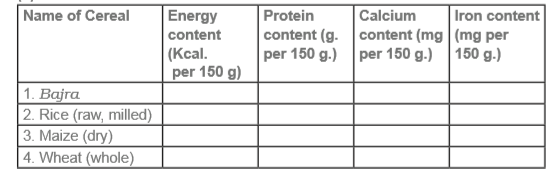
(b) Pulses
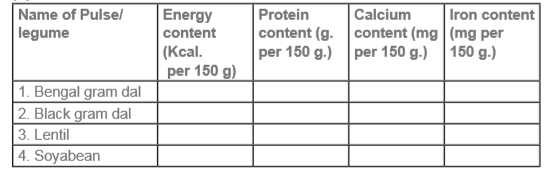
(c) Vegetables
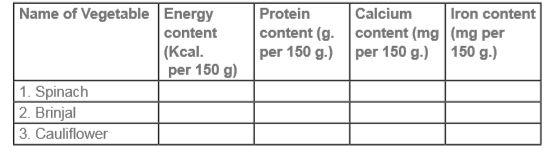
(d) Fruits
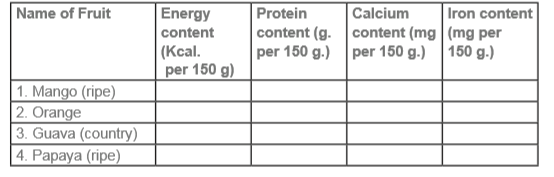
B. Identify the rich sources of carbohydrate, protein, fat, vitamin A, iron and calcium in your family’s diet. Can you suggest improvements? Use the following formats to record your answer.
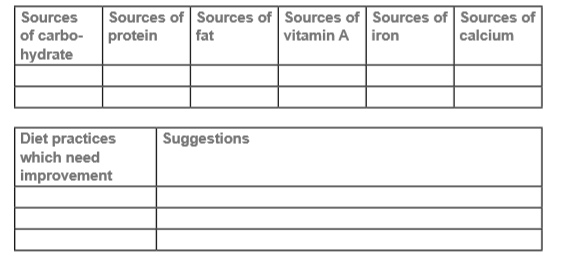
Note for Teachers
Teachers can encourage students to calculate the nutritive value of foods in their own region (which may not be listed in the table provided). A useful reference published by Indian Council of Medical Research (ICMR) is as follows.
FOOD COMPOSITION TABLES
(Nutritive Value per 100 g edible portion)
Cereals
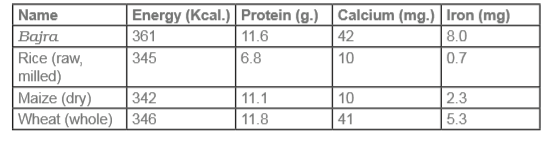
Pulses
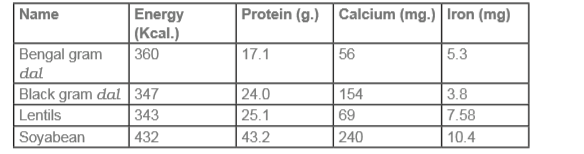
Vegetables
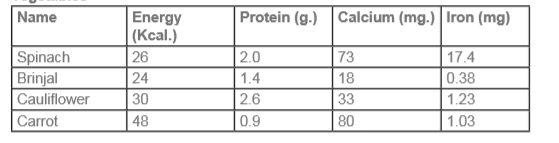
Fruits
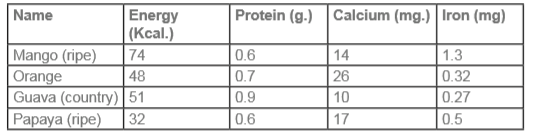
(Source : Nutritive Value of Indian Foods (1985), by C. Gopalan, B.V. Rama Sastri and S.C. Balasubramanian, Revised and Updated (1989), by B.S. Narasinga Rao, Y.G. Deosthale and K.C.Pant (Reprinted 2007))
10
B. Work, Worker and Workplace
Learning Objectives
After completing this section the learner will be able to—
• identify the components of work.
• define work, worker and workplace.
• describe the importance of workplace design for better work efficiency.
• explain the interdependence among work, worker and workplace.
10B.1 Introduction
All of us work for long hours daily – while children study and attend to other essential tasks, parents earn livelihood and manage the home. Although we perform a lot of activities everyday, have you ever thought of the number of ways in which you can perform one activity? Why is it that you perform well in certain activities and not so well in others?
Nisha, a skilled labourer, is unable to perform well because of her inconsistency in work. Her place of work has a very poor work environment. The place is uncomfortable and the work-stations are also poorly designed. As a result, she has lost interest in her work. She can deliver better results and optimally utilise her resources (skills and knowledge) if the work environment improves. There can also be factors other than work environment that may affect work performance. Let us try to understand these.
For optimal performance, it is important to understand work in relation to the environment in which it is performed — the workplace and those who perform it — workers. This understanding helps to reduce the energy used and time spent on the task, thereby increasing work efficiency. At the same time, it will also prevent fatigue and other health problems. It is therefore necessary to create a healthy work environment for the worker instead of forcing the worker to perform the task in an uncomfortable workplace.
For example, your mother works in the kitchen and has to bend again and again to pick up utensils which may be kept at a distance from the kitchen counter. In this case, she would be using more energy and spending more time to take out the utensils and will also experience fatigue and backache. On the other hand, if the utensils are kept near the counter and at a suitable height she will be able to work more comfortably, thereby, increasing her work efficiency!
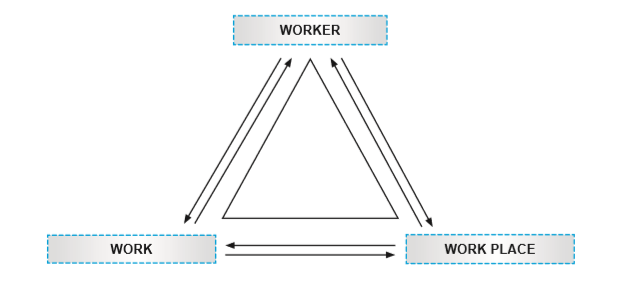
Figure 1: Relationship between work, worker and workplace
The diagram above clearly shows the interdependence between work, worker and workplace. To understand this relationship well, the following three components should be studied in detail.
10B.2 Work
To create a better match between worker, workplace and the equipments or tools used, understanding work is of prime importance. Work is defined as the activity directed towards making or doing something. Work is to exert oneself physically and/or mentally in order to do or complete a task. It forms the basis for accomplishing our goals. It is something that is done or performed, especially a duty, task or an activity. For a student, work primarily means studying to gain knowledge.
Work comprises many smaller jobs, tasks or sub-tasks. Such tasks become instrumental in achieving desired goals. But before deciding the tasks and sub-tasks one should be clear about goals or else work will suffer.
Work performed will be of good quality if the
(a) Worker understands the goal well.
(b) Worker sets certain standards for herself/himself for personal satisfaction.
(c) Work is organised as per the goal.
However, there are certain forces like ‘time’ and ‘attention requirement’ which affect completion of certain tasks. To avoid this, work simplification is necessary. It is the management of both time and energy. Work simplification may be defined as accomplishing more work in the given amount of time and energy.
Therefore, it is essential to make the activity simple, perhaps, more interesting. If one likes the activity one gets involved in it and finishes it faster and more efficiently. (You will study about this in detail in the next chapter.)
10B.3 Worker
A worker is a person who performs a particular task or activity to achieve productive outcomes. A student doing her/his school work, and a homemaker cleaning the house, are examples of a worker. The following aspects are involved in any work done by an individual.
Physical
It is related to the body of the worker. It includes human energy, physical activity, and growth.
– Energy : We all need energy to live and to work. Where does this energy come from? Energy is supplied by the food we eat. The dietary energy needs depend on the factors that include age, sex, body type, type of work and duration of work.
– Physical activity : The amount of energy needed by the individual to do any work depends on type of activity, intensity of work and duration of time, age and sex of the individual. The more the number of muscles used and the longer the duration of work, the greater is the energy demand or energy requirement.
The following table shows the energy required to perform different common activities that most of us perform on a daily basis.
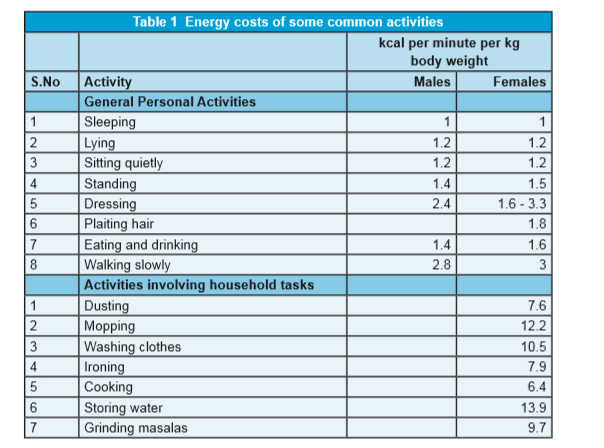
Source: Varghese, M.A., Atreya, N., Bhatnagar.A, & Chatterjee, L. (1989):Ergonomics in the home, DRS Report, Mumbai, S.N.D.T Women’s University.
– Growth : Energy is also required for growth. Hence when growth at a particular stage of life is faster, energy requirements are greater. For this reason infants, children and adolescents have higher energy needs.
Cognitive
Cognitive or mental aspect includes the psychological features of the worker. These are attitudes, skills, knowledge, etc. To reach our goals we require ability and aptitude. Also we need to gain knowledge on the subject, develop skills by undergoing formal training and repeated practice, and have the willingness to improve performance — attitude. Significance of a positive mind-set can be seen in the following case.
Shobha, a young talented girl with a fertile imagination and drawing skills, aspired to be an artist. She had enrolled herself in a course where she improved her skills and acquired the knowledge she needed to achieve her goal. With her efforts, hard work and available resources she achieved her goal to be a successful teacher of art.
Affective
It includes likes, dislikes and preferences a worker has towards work. It concerns the worker’s personal feelings about the activity and contributes towards achieving goals. Dissatisfaction leads to a feeling of fatigue, whereas satisfaction contributes to work efficiency.
Temporal
This is concerned with time management. Sometimes the number of activities that one has to perform in a specified time period is large. This requires good management of time, which you will study in the next chapter.
Thus, an understanding of these components of the worker is an indicator that every worker is different and has different physical, cognitive, affective and temporal compositions. Perhaps tools, equipments and work spaces should be designed according to different body types. For example, tools such as scissors must be designed in order to suit both left-handed and right-handed workers. Equipments should also be designed such, that they fit the safety needs of all workers.
Activity 1
Make a list of activities under the following headings—
• Physical activities that require extra energy expenditure.
• Activities which require mental work and skills.
• Activities you like and dislike.
• Activities that require time management.
10B.4 Workplace
This is the place where a worker performs a job. Some examples of workplace are school, office, study room, kitchen, etc. A well designed workplace is important to prevent health problems related to poor working conditions, as well as for ensuring work performance and productivity. Every work station should be designed with both the worker and the task in mind so that the work can be performed comfortably, smoothly and efficiently with minimum energy expenditure.
A work place includes the following components–
Physical and Chemical Environment
Workplaces typically contain a number of physical and chemical environmental factors. We cannot completely avoid being exposed to these factors, but we must ensure that we are not exposed to them to such an extent that our health is adversely affected.
The environmental factors which are of concern while selecting or designing a workplace are—
- Noise : Exposure to high levels of noise affects our concentration while performing a task. The source of noise can be indoor (like TV volume, whistle of a pressure cooker, running of a tap, machines, etc) or outdoor (like road traffic, loud speakers, processions, etc).
- Illumination : Illumination is the amount of light that falls on the work surface. A workplace should be well-illuminated depending on the task to be performed, age of the worker, duration of activity, placement of light fixture, colour scheme of the work area, etc.
- Climate : The four important factors which influence climate are air temperature, radiation temperature of hot and cold surfaces, air velocity and relative humidity. These factors also influence the energy cost for the individual at work. The indoor climate can be controlled by artificial means like fans, exhaust fans, room heaters, coolers and air-conditioners.
- Radiation : As you may have studied in Physics or Chemistry, when a substance sends out rays or waves that are electromagnetic in nature, it is called radiation. . Radiation has some benefits and some harmful effects, depending on the type (alpha, beta, gamma, X-rays, UV rays), intensity and duration of exposure.
- Microbiological pollution : We are constantly exposed to micro- organisms in the environment because they are present in air, water, food, as well as in our bodies. When individuals do not maintain good standards of hygiene and cleanliness, it promotes micro-organisms. If they are harmful, they can cause disease. For example, a person preparing food should wash her/his hands before starting work or else the food will be contaminated with the micro-organisms on her/his hands.
- Chemical substances : At any given point of time, we are surrounded by chemical substances present in the environment in the form of liquids, gases, vapours, dust or solids. Some of these may cause discomfort and some may be hazardous to health.
Work Surface
Apart from the physical and chemical environment of a workplace, work surface design also affects a worker’s comfort and health. This concept is concerned with the height, width and depth of the work station. Appropriate storage design and equipment design are also important factors which affect work surface design.
While designing the work place the following points should be kept in mind—
• What tasks are done?
• How the tasks are done?
• How many tasks are done?
• In what order are the tasks done?
Workplace design is concerned with the workstation, the equipments and the body positions of the worker. Good workplace design reduces stationary positions, repetitive movements and awkward body positions, thereby improving the work quality.
Following points should be kept in mind while designing a good workplace—
• Equipments or tools should be kept in places and at positions where the worker can easily reach them. For example, in a kitchen, used utensils and washed utensils should be kept on either side of the washing area. Utensil detergents and cleaners should also be within easy reach of the worker.
• For work that needs detailing, the workbench should be at a lower position than for heavy work.
• Hand tools and other equipments used should be comfortable to handle and should not cause injury.
• While performing a task the worker should not stay in difficult positions, such as reaching or bending for long periods of time.
For most of the tasks that are performed, a worker may not have the option to choose her/his workplace. However, she/he can design it as per her/his needs and requirements.
Activity 2
Design your study area as per your requirements, keeping in view the three components–work, worker and workplace.
A well designed workplace of a student should include a well lit study area, preferably with a table. Room temperature should be comfortable and there should be minimum noise in the room. If using a chair, the height of the chair should neither be too high nor too low, but according to the height of the study table. Books and stationery cupboards shelves should also be placed nearby and easily accessible to the student.
The interface between work, worker and workplace can thus be strengthened by judicious use of resources such as time and space. Let us learn more about these two important resources in the next chapter on Resource Availability and Management.
Key Terms
Work, Worker, Workplace, Work environment, Energy cost.
- Review Questions
1. What is work? List the components of work.
2. What components of a worker facilitate efficiency of work?
3. Discuss the environmental factors that can inhibit a student’s work-related activities.
4. How will you explain the interdependence between work, worker and workplace?
10
c. Resource Availability and Management
Learning Objectives
After completing this section the learner will be able to—
• describe time and space as important resources.
• analyse the need for managing time and space.
• discuss ways of managing time and space.
• discuss tools in time management.
• explain the principles of planning space.
As you have learnt in the previous chapter, resources are possessions, material or funds which can be used to achieve goals. You have also learnt that money, time, space and energy are some examples of resources. These resources are assets for an individual. They are rarely in abundant supply and are also not equally available to everyone. Therefore, to achieve our goals appropriate management of all the resources that are available to us is important. If these resources are wasted or not utilised properly we may be hindered in reaching our goals.
Timely and efficient management of resources enhances their optimism utilisation. In this chapter, you will learn about time and space management. Money as a resource and its management will be dealt with in Unit IV.
10C.1 Time Management
Time is limited and irreversible. Time is measured in years, months, days, hours, minutes and seconds. We are provided with 24 hours of time each day to use it as we like. The key is how we use that time. If not managed properly, time keeps slipping away inspite of our effort to control it. No matter how important and valuable an individual may be, one cannot stop time, nor slow it down, or speed it up. Once passed, time can never be regained.
In today’s fast changing lifestyle, our demands and responsibilities at home, at school and at work have increased. This has made the need for managing time very important. To be successful it is essential to develop time management skills. People who use these techniques become high achievers in all walks of life, from agriculture to business to sports to public service in all other professions and personal life. Time management allows one to have adequate rest and recreation along with work.
The principle of time management is to concentrate on results, not on being busy. People often spend their days getting anxious about the unfinished task, but achieve very little, as they do not concentrate on what matters the most– time. For example, some students may spend their time worrying about examinations rather than actually studying for them.
All time management begins with planning. A time plan is necessary. A time plan can be defined as an advance schedule of activities to be performed in a given time period.
How good is your time management?
Before understanding the steps in time and activity planning, it is essential to determine how effective your own time management is. How often are you able to complete the task planned? Are you able to efficiently complete your weekly, daily or hourly work? For most of us, it seems that there is just never enough time in the day to complete all our activities.
Activity 1
The activity given below will help you identify your own time management skills.
Instructions: Score the questions given below and determine how well these statements describe you. The following are the ratings for your answers:
Not at all = 1
Rarely = 2
Sometimes = 3
Often = 4
Very often = 5
Examples: If for the first question the answer of your choice is ‘often’, then write a score of ‘4’ in the respective box, and if your answer is ‘rarely’ you may write your score as ‘2’ and so on.
After answering all the questions add your scores across all the questions to get the final total.
|
Question |
Not at all |
Rarely |
Sometimes |
Often |
Very often |
|
1. Are you able to complete your highest priority tasks during the day? |
|||||
|
2. Are you able to place all your tasks according to their priority? |
|||||
|
3. Are you able to perform your tasks in the given time period? |
|||||
|
4. Do you keep separate time for planning and scheduling? |
|||||
|
5. Do you keep track of the time spent on the jobs done by you? |
|||||
|
6. How often are you able to work without distractions and interruptions? |
|||||
|
7. Do you do goal setting to help you decide the various tasks you would work on? |
|||||
|
8. Do you keep extra time margin in your schedule to deal with ‘the unexpected’? |
|||||
|
9. Do you prioritise the importance of any new assignment given? |
|||||
|
10. Are you able to complete your task without being pressured by deadlines and commitments? |
|||||
|
11. Are you able to work effectively on important tasks because of distractions? |
|||||
|
12. Are you able to complete your work at the work place instead of taking it home? |
|||||
|
13. Do you prepare a “To do” list or an action programme before carrying out the tasks? |
|||||
|
14. Do you consult persons with experience before setting priorities for a given task? |
|||||
|
15. Do you consider whether the task would be worth the time put in, before you start your task? |
Total =
Score Interpretation
Score Comment
46-75 You are managing your time very effectively! However, check the section below to make it even better.
31-45 You are good at some aspects, but there is scope for improvement elsewhere. Focus on the key issues in the section below and you will most likely find that work becomes less stressful.
15-30 The good news is that you have a great opportunity to improve your effectiveness at work for long term success! However, to realise this you have to improve your time management skills.
Steps in time and activity plan
(a) Start your work as quickly as possible. Do not waste time in avoiding or delaying the task. When a student reaches home, she/he should relax for a while, have a meal and then start with the school work without postponing it for the end of the day.
(b) Get into a routine every day. Choose a time to accomplish certain tasks, such as completing school work, doing household chores; and then stick to the routine activities. The student should make an everyday routine to complete work in time, without any delay.
(c) Prioritise your tasks. Before picking up any new task make sure it does not impact the already existing activities. Do not undertake too many activities at a particular time. If the time available is less and work is more then keep the optional tasks for a later time and complete compulsory activities first. For example, if the student has a class test, she/he should first study for the test, then do homework and later get involved in other activities.
(d) Do not commit yourself to unimportant and low priority tasks. Learn to say ‘No’. If you have less time and more tasks in hand, you should be able to say ‘No’ to the tasks which are not very important. For example, the student can avoid watching television, if she/he has to complete a task for the next day.
(e) Divide the big tasks into a series of small manageable activities. The day’s school work (big task) can be divided into smaller tasks by dividing the work as per different subjects.
(f) Do not waste energy and time on tasks which do not need much attention.
(g) Deal with a task one at a time till it is completed or decide when to deal with it. Do not put it aside before completion.
(h) Arrange ‘start’ and ‘stop’ times to schedule activities. Appropriate time should be allotted to each subject without spending too much time on each subject.
(i) Make a schedule of your activities and tasks. This will help to effectively manage time allocated to each task. A proper time schedule should be prepared for the entire day, which must always include leisure time.
Activity 2
An example of a time and activity plan of a student studying in Class XII, who lives in a small town and lives near the school, is given below. In the next column write your own time and activity plan.
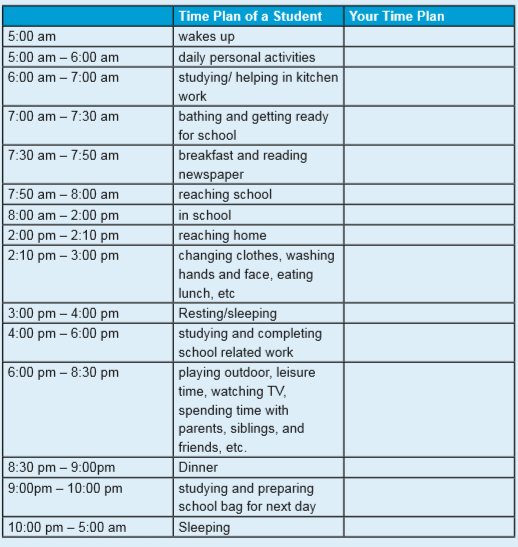
Activity 3

Tips for effective time management
1. Create a simple “To Do” list
It helps you to identify the activities, reasons for doing them and a timeline for completing them.
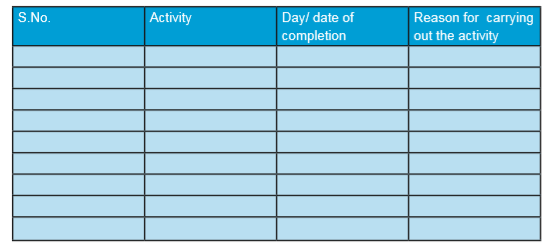
2. Daily/ weekly planner
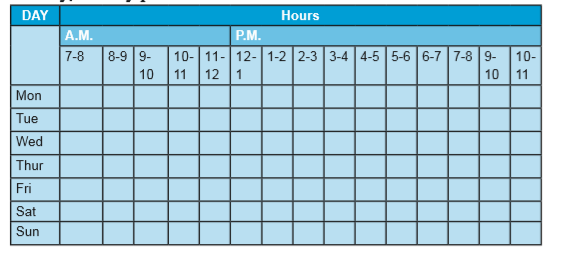
3. Long term planner
Use a monthly chart so that you can plan ahead. Long-term planners will also serve as a reminder to constructively plan time for oneself.
Tools in time management
Following are the tools which help in managing time effectively—
(i) Peak load period: It is the maximum load of work during a specified period of time. For example, early morning time or dinner time.
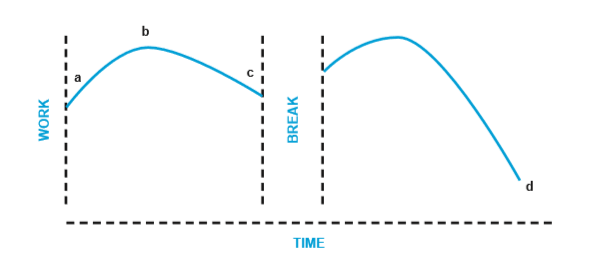
(ii) Work Curve: A device to trace the work against time.
Here, a to b is warming up period, c is plateau of maximum ability to do work and d is maximum fall due to fatigue.
(iii) Rest periods/break periods are defined as unproductive interruptions of working time. The frequency and duration of rest period is very important. It should neither be too long nor too short.
Activity 4
Identify your daily peak load and rest periods.
(iv) Work simplification can be defined as the conscious seeking of the simplest, easiest and quickest method of doing work. It implies proper blending and management of two important resources, namely time and human energy. It aims at accomplishing more work with a given amount of time and energy, or at reducing the amount of either or both to accomplish a given amount of work. In order to bring change in work procedure as well as to simplify it, three levels of changes are important. These include the following—
-
Change in hand and body motions: It involves changes in hand and body motion only, keeping the same work tools and product. Many tasks can be completed with less effort by—
(i) Eliminating and combining certain process as, for example
• Allowing dishes to dry on utensil racks eliminates the need to dry them by wiping.
• Making a list of all the items required from the market and buying them together rather than getting each item separately.
(ii) By improving the sequence and rhythm of work, for example
• Doing like tasks together – while cleaning the house, all the processes of dusting, sweeping and mopping should be done in continuation in all rooms together, rather than cleaning each room separately. This also helps in maintaining rhythm.
(iii) By developing skills at work – knowing and mastering a job well help to eliminate extra motions thereby saving both time and energy.
(iv) By improving body posture – i.e., maintaining a correct and good body posture (see Figure 2 below), using muscles effectively, keeping the body parts in alignment and finally carrying the maximum weight on the bony framework, thus releasing the muscles of all strains. For example, use of long handle on the broom instead of bending and sweeping in order to maintain a stable posture (see Figure 3).
Good Standing Posture – a good standing position is one in which the head, neck, chest and abdomen are balanced one upon the other, so that the weight is carried mainly by the bony framework and minimum effort and strain is placed upon the muscles and ligaments.
Similarly, Good Sitting Posture for work is a well-balanced and poised position. The weight is carried by the bony support of the skeleton thus releasing the muscles and nerves of all strain. The poise is such that as much adjustment is done as is necessary to carry out the work.
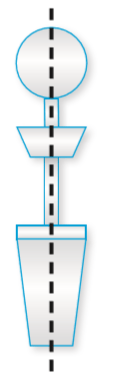
Figure 2: Figure showing alignment of body parts in line with gravity
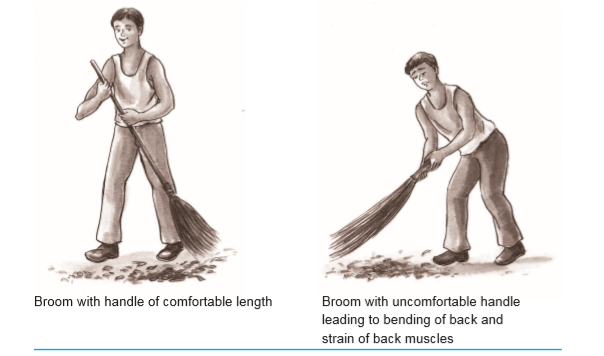
Figure 3
- Change in work, storage space and equipment used: This requires organising storage spaces, rearranging kitchen equipment, planning work surfaces with proper height and width according to the user, using labour-saving devices like pressure cookers, washing machines, microwave oven, etc., which help in saving time as well as hand motions.
-
Change in the end product: These changes result from the use of –
– Different raw materials – for example, using readymade ground spices instead of whole spices, using organic seeds to grow produce, etc.
– Making different products from same raw materials – for example, making kulfi instead of ice-cream, lauki paranthas instead of kofta curry, etc.
– Changes in both the raw material and finished product – for example, using ball pen instead of ink pen, etc.
10C.2 Space management
Space is utilised by people to carry out various activities at home, outside the home and at workplace. You must have observed that a well-designed room gives a sense of spaciousness, while a room with similar dimensions, if not managed well, results in the room looking apparently cramped or cluttered. Space management involves planning of space, organising it as per the plan, implementing the plan in terms of its utilisation, and evaluating it in terms of achieving functionality and aesthetic appeal. A well-managed space not only offers comfort while working but also appears attractive.
Space and the home
Sitting, sleeping, studying, cooking, bathing, washing, entertainment, etc. are the major activities to be carried out in the home. To conduct each of these activities and the actions that may follow them, usually specific areas are identified in the home. Wherever there is space available, specified rooms are built to carry out such activities. Most urban middle Socio-economic Status (SES) homes are likely to have sitting room/area, bed room/rooms, kitchen, store room, bathroom and toilet, verandah/courtyard (optional).
Besides the above, some homes may additionally have other rooms like dining room, study room, entertainment room, dressing room, guest room, children’s room, garage (for scooter, car), stairs, passages, puja room, garden, terrace, etc. Let us learn, how to plan spaces?
Activity 5
Make a list of different rooms/areas in your house and the activities carried out in each of these. For example–
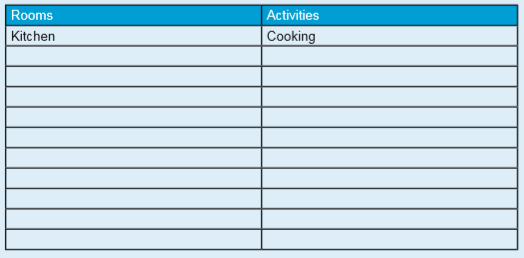
Principles of space planning
Space must be planned for its optimal utilisation. Following are the principles to be kept in mind while assigning/designing work areas in the house–
(i) Aspect: ‘Aspect’ indicates the arrangement of doors and windows in the external walls of a building which allows the occupants to enjoy the nature in the form of sunshine, breeze, scenery, etc.
(ii) Prospect: ‘Prospect’ in its proper sense, is the impression or impact that a house is likely to make on a person who looks at it from outside. Therefore, it includes the attainment of pleasing appearance using natural beauty, positioning of doors and windows, and covering up of undesirable views.
(iii) Privacy: Privacy is one of the most important principles in space planning. Privacy requires consideration in two ways:
- Internal privacy : Privacy of one room from another is referred to as internal privacy. It is attained by careful planning in the house with respect to grouping, positioning of doors, provision of small corridor or lobby, etc. Internal privacy can be also be achieved by setting up screens and curtains. In some homes with large families separate sitting area is provided for women, ensuring their privacy.
-
External privacy : This means privacy of all parts of a house from the neighbouring buildings or houses, public streets and by-ways. It can be a shade secured by carefully planning the entrance and covering it with a tree or creepers.
External privacy – A house secured by fence and shrubs
Activity 6
Talk to members of your family from different age groups and ask them what they understand by privacy.
(iv) Grouping: It implies the outlook of rooms with respect to their relative position with each other. For example, in a building, the dining area must be close to the kitchen and the kitchen must be away from the toilet.
House plan
(v) Roominess: It is the spacious effect a room gives to those who live in it. The available space should be fully utilised. For example, one can have built-in wall cupboard, shelves and storage area so that the floor of the room is left free for various activities. In addition, the size and shape of the room, the furniture arrangement as well as the colour scheme used have a bearing on its roominess. Well proportionate rectangular room looks spacious compared to a square room of similar dimensions. Light colours make a room look more spacious than dark ones.
(vi) Furniture requirements: The rooms must be planned with due thought to the furniture to be placed there. Every room in a building should serve its purpose well. Care must be taken to place only required pieces of furniture. Furniture must be arranged in such a way so that one gets free circulation spaces.
Unfurnished rooms, which are later furnished, meeting all the furniture requirements
(vii) Sanitation: Sanitation consists of providing ample light, ventilation, facilities for cleaning and sanitary conveniences in the following manner:
(a) Light: Light has two-fold significance, firstly it illuminates, and secondly, it helps maintain hygiene. Light in a building may be provided by natural or artificial sources. Windows, bulbs, tube-lights are some sources of light.
(b) Ventilation: It is the supply of the outside air into the building. Good ventilation is an important factor which affects comfort in the building or room. This is generally achieved by placing the windows, doors and ventilators such that they may allow as much breeze as possible. Windows, if placed opposite to each other, provide good ventilation. Lack of fresh air in the building may lead to headaches, sleepiness, inability to focus attention, etc. Ventilation may be natural or mechanical (using exhaust fan).
(c) Cleanliness and sanitary conveniences: General cleaning and up- keep of the building is the responsibility of the occupants, but even then some provision to facilitate cleaning and prevention of dust are necessary in planning. Sanitary conveniences include the provision of bathrooms, water closets and lavatories in a building. Lavatories and bathrooms in rural houses are constructed as a separate unit, usually in the backyard or the frontyard, away from the other rooms, thus maintaining hygiene.
(viii) Circulation: Air circulation from room to room should be possible. Good circulation includes an independent entry to each living space through a common space. It also ensures privacy to members.
(ix) Practical Considerations: While planning spaces, one may consider practical points such as strength and stability of the structure, convenience and comfort for the family, simplicity, beauty and provision for expansion in future. One should not economise by creating a weak structure.
(x) Elegance: ‘Elegance’ is the effect produced by the general layout of the plan. Without compromising on economy, the space plan should be aesthetically appealing.
The above mentioned principles when considered, aid in space planning and management.
In this chapter we learnt about two very important resources—time and space, and the efficient ways to use them. In the next chapter we shall learn about yet another significant resource – knowledge, and the ways in which it can be acquired. The processes of learning, education and extension are basic for knowledge acquisition.
Key Terms
Time management, Space management, Time plan, Activity plan, Work simplification.
- Review Questions
1. Describe time and space resources.
2. Why is time management necessary?
3. Discuss the steps in a time and activity plan.
4. What are the tools in time management?
5. Define space management. Discuss the principles of planning space inside the home.
10
D. Learning, Education and Extension
Learning Objectives
After completing this section the learner will be able to—
• discuss the meaning and types of learning.
• describe the role of education in the context of family, school, community and society.
• explain the significance of extension education and methods.
• examine some of the extension programmes in India.
10D.1 Learning
Introduction: By now, so much learning must have taken place in your life that you do not need to be told what it means. You would agree that learning plays a very vital role in our lives. It is the key to our knowledge, understanding and behaviour. We start learning from the moment we are born. In fact, research has shown that the foetus learns even in the mother’s womb! In other words, learning begins with life. Thus, learning can be described as–
• the acquisition of new behaviour or the strengthening or weakening of old behaviour as a result of experience.
The process of learning involves three main components–
• Learner, whose behaviour gets modified
• Training required for behaviour modification
• Resources, human and material.
Learning can be of five types
(i) Verbal learning: Acquisition of verbal behaviour such as learning of languages is the result of verbal learning. Normally, we use communication devices such as signs, pictures, symbols, words, figures, sounds and voices as instruments for this type of learning. It also includes learning of semantics or procedural knowledge from written or spoken prose. For example, learning by reading lessons in a textbook.
(ii) Rote learning or memorisation: This is also a form of verbal learning. However, this form gives less importance to understanding the deeper meaning and inferences of the subject being learned; instead it focusses on memorising the material. The major practice involved in rote learning techniques is learning by repetition. Rote learning is used in diverse areas, from mathematics to music to religion. For example: learning poems and multiplication tables or the Surahs/Shlokas (religious sayings) are examples of rote learning.
(iii) Motor learning: In this type of learning we learn to use all types of muscles leading to physical dexterity and ultimately development of skill. Some examples are learning to swim, drive, sew, knit, type, play musical instruments, cycle, draw, paint, dance, etc. Acquisition and mastering of various skills through this type of learning provides confidence and satisfaction to the learner.
(iv) Concept learning: In concept learning an image is acquired in our mind as a result of perception, previous experience, training and/or certain cognitive processes. A mental image denotes a generalised idea about something. For example, when we have developed a concept of an animal called dog, every time the word ‘dog’ is uttered a mental image with all the characteristics of a dog comes to our mind. Concept learning is useful in recognising, naming and identifying things and ideas. Gradually this enables learners to grasp theoretical concepts such as justice, truth and heterogeneity.
(v) Problem-solving: As the name indicates problem-solving denotes higher order learning. It requires cognitive abilities like thinking, reasoning, discrimination, generalisation, imagination, ability to observe, to infer, and draw conclusions. People of all ages are engaged in problem-solving – an infant solves her/his problem of being hungry by crying for milk, while a student solves her/his problem of finishing an assignment by working on it in earnest. Thus in the process of problem-solving one learns a lot.
To sum up
Types of Learning
• Verbal Learning: e.g. learning a new language.
• Rote Learning: e.g. learning of poems, multiplication tables, religious hymns.
• Motor Learning: e.g. driving, typing, sewing, cycling, swimming.
• Concept Learning: e.g. national flag, liberty, emotion.
• Problem-solving: e.g. maths sums, puzzles, crossing a busy road.
10D.2 Education
Have a look at the picture on this page and respond to the following statements. In your daily experience does education mean:

(a) Reading a lot of bulky books and memorising them?
Yes No Sometimes
(b) Something that is taught in the formal system using a pre-defined curriculum?
Yes No Sometimes
(c) Acquiring new concepts?
Yes No Sometimes
(d) Realising one’s potential?
Yes No Sometimes
In this section we will see how education contributes to our understanding of human ecology, i.e. the family, the school, community and society.
The central aim of education is the building of the powers of the human mind and spirit… it is the evoking of knowledge and will, and of the power to use knowledge, character and culture.
– Sri Aurobindo, a 20th Century Indian Philosopher
Education facilitates our understanding of the world through our physical, emotional, cognitive and transcendental experiences. It also helps in unfolding the potential that human beings have. Education can occur in various settings, both formal and informal. Formal education implies teaching through focussed instruction whereas informal education refers to learning that is accomplished with relatively little input, in every day, unstructured settings. It is critical to understand that teaching can only be meaningful when learning has happened; and that learning is a process that a student undergoes rather than something that is ‘done to’ a learner.
As a student of Class XI you may wonder how the processes in education mentioned above are linked to your education so far. In school, you are a student in formal education, although a lot of your learning and education take place outside school as well. The figure that follows provides a graphic representation of the different components of institution-based education.
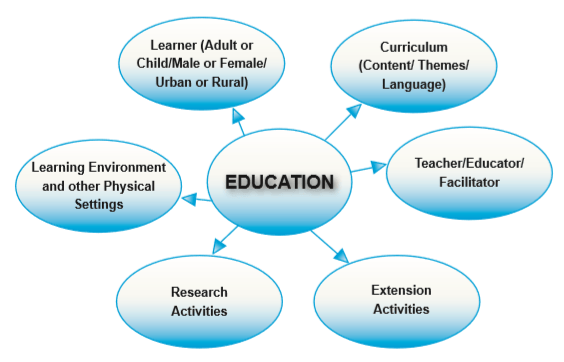
Figure 1: Components of Education
Education and the family
You have read in the chapter on ‘Family’ in Unit II A that the family begins to perform the function of ‘socialisation’ from well before the child goes to school, and also while she/he attends different educational institutions. Socialisation includes ‘educating’ the child about the family’s ways of living, its values, beliefs and attitudes. Thus the child not only learns to speak the language of the family, but also learns, for example, how to behave when visitors arrive, and what she/he must not do to displease the parents and others.
Now, the question is how does education contribute to our understanding of the family, its concerns and needs? From Figure 1 you can see that all formal education has content, referred to as curriculum. Throughout different stages of education, from primary to tertiary, there are many lessons and subjects that inform us about the family. Starting from writing your first essay and drawing a picture of the family in a primary class, you began to form the broad concept of a family. Then many aspects of the Social Studies curriculum also provided information about diversity in families in the world. Subjects like Sociology, and now Human Ecology and Family Sciences enrich your knowledge further in this area. Thus, we get to know that there are urban, rural and tribal families with varied needs and experiences.
Activity 1
Recall the first time you may have written an essay on ‘My Family’. If you were to write on this topic today which five points will you highlight in it?
1. ______________________________________________________________
______________________________________________________________
2. ______________________________________________________________
______________________________________________________________
3. ______________________________________________________________
______________________________________________________________
4. ______________________________________________________________
______________________________________________________________
5. ______________________________________________________________
______________________________________________________________
Education and the school
Most of you associate education first of all with school. You have read about the significance of school in forming relationships in a chapter in Unit II A.
In the present times the school is an important institution in providing formal education to children from Classes I to Classes XII. In many parts of the country, the preschool group is also attached to the formal school. In many systems after Class X, the students join a college to complete Classes XI and XII. We have used the term ‘formal’ education many times. It is also possible for a student to be in ‘non-formal’ education. What is the difference between formal and non-formal education? In what contexts are the two systems relevant?
(a) Formal education: Formal education is systematic teaching-learning activity, undertaken by institutions which may be run by the government or by recognised non-government agencies. Thus schools, colleges, universities, technical and professional institutions provide formal education. All formal institutions of education share certain characteristics. These are–
- Formal education is chronologically graded starting from primary schooling, reaching to higher secondary, and then tertiary education at the university level. It implies that before moving to a higher grade it is mandatory to formally pass the previous grade or level.
- The curriculum is pre-determined, although there is flexibility in how the teacher transacts it in the classroom.
- The learners have shared goals for seeking that particular kind or level of education.
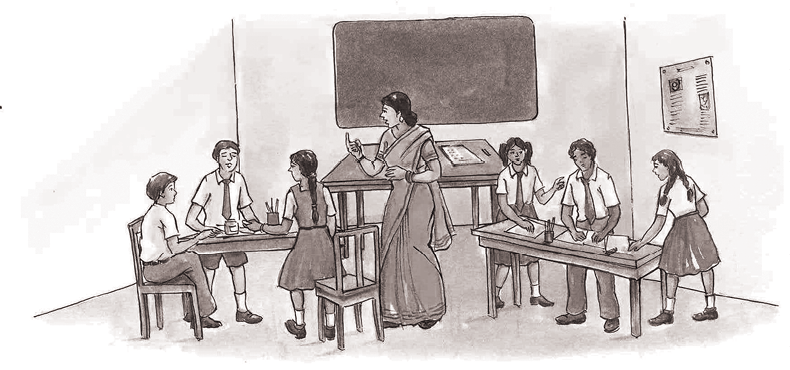
- All learners are examined during the session and at the end of completion of the curriculum. After successful completion, they are awarded a certificate/diploma/degree.
(b) Non-formal education: In India there are many children who are unable to go to school due to various reasons. These are listed in the chapter on ‘Care and Education’ of Unit-III. Then there are adults who could not attend school or complete their education when they were younger. The system of non-formal education provides opportunity to these learners to receive education.
Thus non-formal education is a systematic educational activity that is carried out outside the formal framework. There are non-formal centres for street and working children, and adult education programmes for older persons. While the goal of education here too is to gain knowledge and develop skills, some of the characteristics are different from formal education. These are given below:
- Since the learners are heterogeneous in age, previous educational experience and goals, the system is not rigidly graded.
- The instruction is learner-centred and learners’ perspective is given importance.
- Teachers act as facilitators and the curriculum they impart is need-based.
- Local initiatives and self-help groups are encouraged to develop such programmes for meeting the needs in their community.
- The learners may receive certificates, however, diplomas and degrees are not awarded.
-
Activity 2
Other than your school, name one formal government school and one private school in your city.
1. ____________________________________________________________
____________________________________________________________
2. ____________________________________________________________
____________________________________________________________
Find out if there is any centre of non-formal education in your city, town or village. Write down its name.
__________________________________________________________________
Education, community and society
All education that children, youth and adults experience must finally help in the development of the community around us and the society as a whole. Knowledge gain, personal development as well as skill acquisition through processes in education empower individuals to contribute to nation building, and at a global level to human development.
If you can look up Figure 1 on Components of Education, you will note that ‘extension activities’ are an integral part of education. The next section deals with Extension Education and its relevance to the development of communities.
10D.3 Extension
Three important processes in education besides learning are–
• Creating new knowledge through research
• Disseminating knowledge through teaching
• Putting knowledge into practice, and applying it through extension.
Thus there is a close link between education and extension. Today, extension is a tool for national development through research, training approach, communication and technology, NGO movement and government interventions.
Extension and extension education
Extension means to extend knowledge from known to unknown. It is a two-way process of sharing knowledge and experiences for mobilising individuals and groups for personal and community development. For example, Gram Sevaks and Gram Sevikas working in the community take the problems of the people to the extension officers or other educational institutions; after these are discussed at the block level the solutions are carried back to the community.
Extension education is a full-fledged discipline, with its own philosophy, objectives, principles, methods and techniques which must be understood by every extension worker and others connected with community development. When learning and knowledge are put into practice, and extended to the community, it is referred to as extension education.
Some of the examples are:
1. Sevagram in Maharashtra by Mahatma Gandhi in 1920 to provide basic education and achieve self sufficiency Website for more information: http://wardha.nic.in/htmldocs/sevagram.asp
2. Shantiniketan in Bengal by Rabindranath Tagore in 1921 to assist villagers in solving their pressing problems. A full-fledged university called the Visva Bharati University came up here later.
Website for more information: http://www.wb.nic.in/westbg/shanti.html
Principles of extension education
(i) Principle of interest and need: Extension work must be based on the needs and interests of people. As these differ from individual to individual, from village to village, from block to block, and from one state to another, there cannot be one programme for all people.
(ii) Principle of cultural difference: Extension work takes into account the cultural background of the people with whom the work is being done. This means that the extension worker has to know the knowledge level, and skills of the people, methods and tools used by them, their customs, traditions, beliefs, values, etc. before starting any extension programme.
(iii) Principle of participation: Extension helps people help themselves. Good extension work is directed towards assisting rural and urban families to work out their own problems rather than giving them ready-made solutions.
(iv) Principle of adaptability: An extension programme should be flexible, so that whenever required, necessary changes can be made to meet the varying conditions on the ground.
(v) The grassroot principle of organisation: Extension work should be sponsored by the local community. The aim of organising the local groups is to demonstrate the value of new practices or programmes so that more and more people would participate to adopt them.
(vi) The leadership principle: More extension work is based on the utilisation of local leadership. People have more faith in local leaders and hence their identification and training is essential so that new ideas are accepted in the community with least resistance.
(vii) The whole-family principle: Extension work will have a better chance of success if it is carried out with the whole family, i.e., all men, and women, children and the youth members of the family.
(viii) Principle of co-operation: Extension is a co-operative venture. It is a joint democratic enterprise in which people co-operate with their village, block and state officials to pursue a common cause.
(ix) Principle of satisfaction: The end-product of the effort of extension teaching is the satisfaction that comes to the participants in the form of solving a problem, meeting a need, acquiring a new skill or bringing about some other change in behaviour.
(x) The evaluation principle: Extension is based on methods of science, and it needs constant evaluation. Effectiveness of the work done is measured in terms of the changes brought about in the knowledge, skills, attitudes and adoption behaviour of the people, and not merely in terms of achievement of physical targets. For example, when Gram Sevikas inform women about immunisation of children against Polio, then afterwards they must try to evaluate whether or not the incidence of polio has gone down.
Extension teaching methods
Extension work is carried out using several methods. These are:
(i) Farm and home visits: These constitute the direct or face-to-face contact by an extension worker with the individual or/and the members of the family to exchange information and to get acquainted with their problems.
(ii) Result demonstration: Result demonstration is an educational test to prove the advantages of recommended practices and to demonstrate their applicability to the local condition. This method can be used to show the superiority of certain practices, such as the use of fertilisers, insecticides and pesticides and high yielding varieties of seeds in farming.
(iii) Method demonstration: It is used to show the technique of doing things or carrying out new practices, e.g. preparing a nursery-bed, treating seed with insecticides and fungicides, line-sowing, taking a soil sample, grafting fruit trees, etc.
(iv) Group discussions: All the farmers cannot be contacted by extension workers individually because of their large number. It is convenient and feasible to contact them in groups. This method is commonly known as group discussion.
(v) Exhibitions: An exhibition is a systematic display of information, actual specimens, models, posters, photographs, and charts, etc. in a logical sequence. It is organised for arousing the interest of the visitors in the items displayed. Exhibitions are used for a wide range of topics, such as planning a model village or demonstrating improved irrigation practices.
(vi) General meetings: These are usually held for passing on certain information to the people for future action. For example to prepare the community for celebration of Van mahotsav, a national festival.
(vii) Campaigns: Campaigns are used to focus the attention of the people on a particular problem, e.g. rat control, village sanitation and plant protection, the production of rabi crops and family planning. These build up community confidence and involve the people emotionally in a programme.
(viii) Tours and field-visits: Conducted tours for farmers are used to convince them and to provide them with an opportunity of seeing the results of new practices, demonstration skills, new implements, etc. and to help them gain an idea regarding the suitability and application of these in their own area.
(ix) Use of Audio-Visual Aids such as:
- Printed matter (literature). Includes newspapers, magazines, bulletins, leaflets, folders, pamphlets and wall news-sheets for communicating information to a large number of literate people.
- Radio is a mass medium of communication and can reach a large number of people at any given time involving the least expense.
- Television is one of the most powerful medium of communication. It combines both audio and visual impact and is very suitable for the dissemination of all kinds of information.
- Motion-pictures (movies) are an effective tool for arousing interest among the people, because they involve seeing, hearing, and action, and sometimes to near life experiences.
Some of the Rural Employment Generation and Other Schemes
There are many schemes planned by the government for improving the quality of life of people in both rural and urban areas. Some of these are described below.
1. Swarnajayanti Gram Swarojgar Yojana (SGSY): This programme was launched in April, 1999. It is a holistic programme covering all aspects of self-employment such as organisation of the poor into self-help groups, training, credit, technology, infrastructure and marketing.
The objective of SGSY is to provide sustainable income to the rural poor. The programme aims at establishing a large number of micro-enterprises in rural areas, based on the potential of the poor. It is envisaged that every family assisted under SGSY will be brought above the poverty-line.
2. Jawahar Gram Samridhi Yojna (JGSY) is the restructured, streamlined and comprehensive version of the erstwhile Jawahar Rozgar Yojana. Designed to improve the quality of life of the poor, JGSY was launched on 1 April 1999. Its primary objective is the creation of demand driven community village infrastructure including durable assets (e.g. training centre) at the village level. These assets are created to enable the rural poor to increase opportunities for sustained employment. The secondary objective is the generation of supplementary employment for the unemployed poor in rural areas.
3. MP Local Area Development Programme: MPLADP was launched in December 1993 as a central sector scheme to enable members of Lok Sabha and Rajya Sabha to execute the schemes of their choice that are developmental and based on locally felt needs within the guidelines for this purpose.
Expand the following acronyms
1. SGSY ______________________________________________________
2. JGSY ______________________________________________________
3. MPLADP ______________________________________________________
Locate one more extension programme in your area and write its name below.
___________________________________________________________________
Look up the following website for more information
http://www.krishiworld.com/html/agri_extension_edu1.html
Group assignment: (make groups of 6-10, each group to select a separate field of study and target group)
1. Select an appropriate topic from the field of farming or agriculture or technology or health and hygiene for one of the following groups–
• Adolescent girls from an urban slum
• Adolescent girls from a rural area
• Urban youth in the age group of 20-30 years
• Rural youth in the age group of 20-30 years
• Parents of primary school in rural/urban area
• Your own classmates
• Marketing management trainees to be posted in villages
• Housewives
• Working women
2. Search appropriate subject matter for the same.
3. Choose an extension method to teach selected topic to the selected group.
4. Give reasons for your choice of topic, subject matter and extension method.
The works which can be carried out under this scheme are construction of buildings for schools, hostels, libraries and shelter for old/handicapped, construction of link/approach roads, culverts/bridges, public irrigation and public drainage facilities, etc.
One distinct advantage of being involved in extension activities at the grassroot level is that it offers the valuable opportunity to know the cultural heritage of our country. India has a rich and diverse cultural heritage. In the next chapter we shall learn about one aspect of this heritage – the Textile Heritage.
Key Terms
Learning, Education, Non-formal Education, Extension Education, Rural Employment Generating Schemes
- Review Questions
1. Explain the term—learning and its types.
2. Describe any three components of education.
3. Differentiate between formal and non-formal education.
4. What do you understand by extension education? Enumerate its principles.
5. Select and describe two most suitable extension methods for the following situations. (Teacher’s guidance may be required)
(a) To popularise education for the girl child.
Or
(b) Importance of men sharing house work.
10
E. Textile Traditions in India
Learning Objectives
After completing this section the learner will be able to—
• recognise the diversity of textile products produced in India since millennia.
• identify the areas associated with production of cotton, silk and wool fabrics.
• describe the concept of dyeing and its occurrence on textiles.
• explain the characteristic features of embroideries of different parts of the country.
• discuss the significance of prevailing traditions of textile production in the socio-cultural and economic setup of our lives.
10E.1 Introduction
In the earlier chapter ‘Fabrics Around Us’ you became aware of the diversity of the textile products and their usage. Have you ever wondered how these came to exist, and how in India they are considered an important heritage? If you ever visited a museum, you must have noticed a section where fabrics and apparel are displayed. You may have realised that not only there are fewer exhibits in this section, they are also not as old as other objects. This is because fabrics decay much more quickly than bone, stone or metal. However, archaeological records depicting clothed human figures on wall and sculptures indicate that humans knew the art of making cloth even 20,000 years ago. We also learn about them from references in ancient literature and paintings on walls in caves and buildings.
Textile materials have fascinated humans since ancient times and have been an essential part of civilisation. People of all ancient civilisations developed techniques/technologies for utilising the raw material available in their region. They also created their own distinctive designs and produced elaborately designed products.
10E.2 Historical Perspective in India
The manufacture of sophisticated textiles in India is as ancient as the Indian civilisation. Fabric has been used as a symbol while describing the creation of the universe in the Rig Veda and the Upanishads. The universe, in these texts, is described as ‘a fabric woven by the Gods’. The appearance of Day and Night, as they bring light and darkness over the earth, are compared to the movement of the shuttle in the loom by the weaver.
Weaving is one of the oldest arts and fine fabric products have been made from very early times. Cloth fragments, as well as terracotta spindles and bronze needles, that have been found at the excavation site at Mohenjo-Daro, are evidence that the traditions of cotton spinning, weaving, dyeing and embroidery in India are at least 5000 years old. India was first among the ancient civilisations to discover colour and perfect the technique of application on textile materials, especially on cotton. Dyed and printed cotton fabrics were exported to other nations and they were known for their colourfastness properties. Classical (Greek and Latin) literature has reference to them, e.g. “colour on Indian fabrics is as lasting as wisdom”.
Throughout the period of recorded history there are references extolling the excellence of Indian fabrics made from cotton, silk and wool. They were known for their fabric characteristics as also for designs produced on them through weaving, resist dyeing, printing and embroidery. They soon became coveted items of trade, helped in political linkages and influenced the establishment of such industries in other countries. From around 15th century onwards India was the greatest exporter of textiles ever known. The setting up of the various East India Companies by the European nations was associated with textile trade from India.
10E.3 The Three Main Fibres
Traditionally Indian fabric production is associated with three main natural fibres, which are cotton, silk and wool. Let us now discuss their significance.
Cotton
India is the home of cotton. Cotton cultivation and its use in weaving are known since prehistoric times. The spinning and weaving techniques developed here produced fabrics, which came to be known for their extreme fineness and decorations. Cotton travelled from India to all over the world. That it was a trade item is learnt from the material recovered from archeological digs in the ancient land of Babylon with Harappan seals. When the Romans and Greeks first saw cotton, they described it as wool that grew on trees.
The legends associated with cotton weaving are many. Dacca (now in Bangladesh) produced the finest fabric—the mulmul khas or the royal muslin. It was so fine that it was almost invisible and thus had poetic names; baft-hava (woven air), abe-rawan (flowing water), shabnam (evening dew). The Jamdani or the figured muslin traditionally woven in Bengal and parts of North India using cotton is one of the finest brocade products of Indian weaving.
|
In regular weaving, the filling yarn passes over and under the warp yarn in a specific sequence. But when brocade designs in silk, cotton, or gold/silver yarns are to be woven, these yarns are transfixed in between regular weaving. Depending upon the fibre content used for patterning there may be cotton brocades, silk brocades, or zari (metallic yarn) brocades. |
Besides the proficiency in making cotton fabrics, India’s crowning textile accomplishment was the creation of pattern in the cotton cloth with brilliant fast dyes. Until the 17th century, Indians alone had mastered the complicated chemistry of cotton dyeing, which was not mere application of pigments to the surface, but produced fast and lasting colours. Indian Chintz (printed and painted cotton cloth) had revolutionised European fashion and market. Indian craftpersons were ‘the master dyers to the world’.
Cotton is woven universally all over India. Super fine yarn is still spun and woven in many places, though the bulk production may be thick. The materials are made in a variety of designs and colours and find specific usages in different parts of the country.
Silk
Silk fabrics have been made in India since ancient times. We learnt in the earlier chapter that the origin of silk was in China. However, some silk must have been used in India as well. Silk weaving is mentioned as early as the 3rd century BC., and distinction is made between Indian and Chinese silk. The silk weaving centres developed in and around the capitals of kingdoms, holy cities or trade centres. As the weavers migrated, it helped in the development and creation of many new centres. Different regions in our country have specific silk weaving styles. Some of the important centres are–
Varanasi in Uttar Pradesh, which has an old tradition in weaving special styles. Its best-known product is the brocade or kinkhwab. Its splendour and elegance and the high cost of the fabric gave it its name—kinkhwab meaning something a person cannot even dream of or a fabric which is seldom seen in a dream or the golden (kin) dream (khwab).
West Bengal is traditionally famous for its silk weaving. By using a loom similar to that of Jamdani weavers, the weavers of West Bengal weave a silk brocaded sari called Baluchar Butedar. This style originated from a place called Baluchar in Murshidabad district. It is now successfully being produced in Varanasi. Here the plain-woven fabric is brocaded with untwisted silk thread. The most characteristic feature of these sarees is their pallav or the end piece. It has unique designs, depicting scenes from epics, royal court, domestic or travel scenes with riders and palanquins. Mango motif is most commonly used in borders and pallavs.
Gujarat developed its own style of kinkhwabs. Very fine textiles were produced in Bharuch and Cambay, which were popular in the courts of Indian rulers. The Ashavali sarees of Ahmedabad are known for their beautiful brocade borders and pallavs. They have rich gold or silver metallic background on which patterns are woven with coloured threads, giving the fabric an enamalled appearance. Human, animal and bird motifs are frequently incorporated into the pattern as they are an integral part of Gujarati folk tradition.
Kanchipuram in Tamil Nadu is a famous brocade weaving centre in South India from ancient times. The traditional sarees display bird and animal motifs with rich brocaded pallav. Dark colours like red, purple, orange, yellow, green and blue predominate in South Indian fabrics.
Paithan, located on banks of Godavari River near Aurangabad in Maharashtra, is one of the oldest cities in Deccan region. It is famous for a special silk saree with gold inlay weaving for borders and motifs. The tapestry weave used in Paithan is the oldest technique of decorative weaving. It is known for its closely woven golden fabric. In the shimmering gold background, various patterns (butas, the tree of life, stylised buds and floral borders) are worked in red, green, pink and purple glow like jewels.
|
Tapestry weave utilises the principle of discontinuous weft or filling yarns, thus allowing multicoloured yarns to be used. It results in the fabric appearing the same on its face and reverse side. |
Surat, Ahmedabad, Agra, Delhi, Burhanpur, Tiruchirapalli and Thanjavur are other traditionally renowned centres of zari brocade weaving.
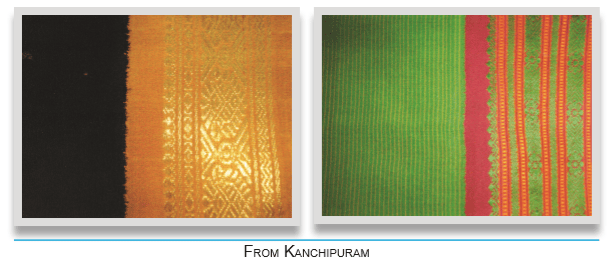
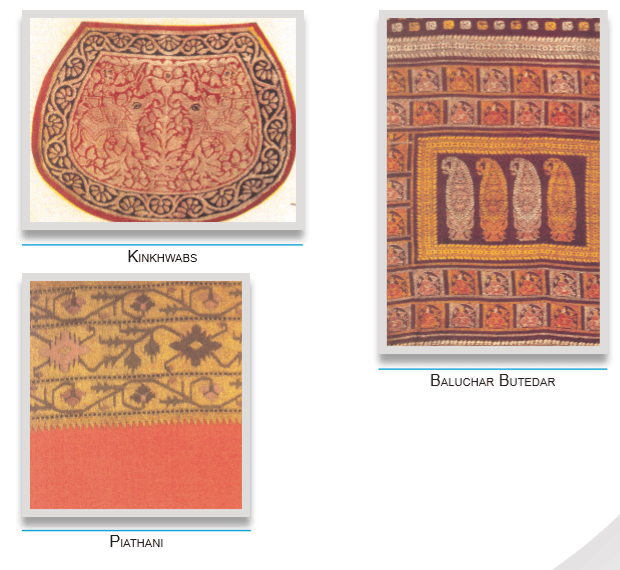
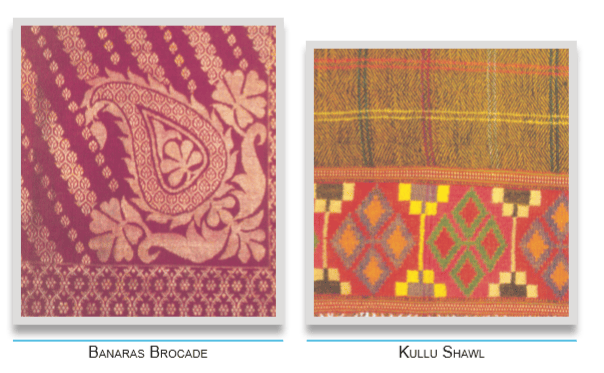
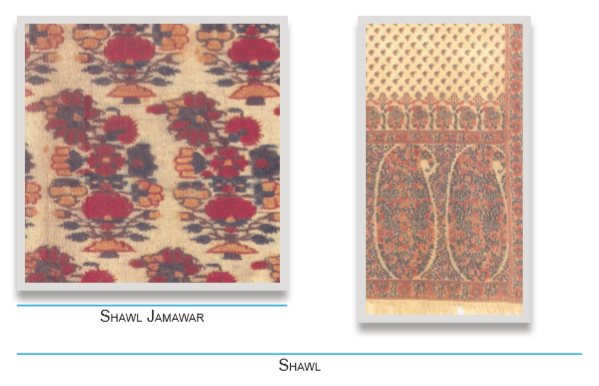
Wool
The development of wool is associated with the colder regions like hills of Ladhakh, Jammu and Kashmir, Himachal Pradesh, Uttar Pradesh, hills of West Bengal, some N.E. states, Punjab, Rajasthan and a few places of Central and West India. Specialty hair, i.e., the hair of animals other than sheep, (mountain goats, rabbits and camels) have also been used in India. The earliest references of wool make mention of very fine hair obtained from mountain goats and some deer like animals.
Kashmiri literature of 11th century confirms the weaving of multicoloured woolen fabrics during the period. From the 14th century, the Persian
influence led to the production of shawls. It utilised the most complex tapestry weave in a multitude of colours and intricate patterns. The best shawls were made from pashmina and shahtus, the hair of mountain goats. The Mughal emperors were responsible for promoting this art and shawls of Kashmir became world famous. Like the printed cotton these were a major export item from 18th century. Later embroidery was also introduced in shawls. The designs of the shawls copy the beauty of nature of Kashmir. The mango motif, also known as paisley, is seen in countless varieties and colour combinations.
|
Akbar is said to have introduced the style of Jamawar shawls. These were large shawls designed in a manner, which were also suitable for making garments (Jama, i.e. cloak and war meaning yardage). You may have noticed in paintings in museums or illustrations in books, the Mughal rulers usually have large shoulder wraps in intricate designs. |
The shawls of Himachal Pradesh are mostly woven in angular geometrical motifs grouped in straight horizontal lines, bands and stripes, one or two placed vertically as well. Kullu valley specifically is known for shawl weaving and several other woollen fabrics like pattu and dohru (wraps for men).
In the recent years shawl weaving in other places have also gained importance. Special mention can be made of Amritsar and Ludhiana in Punjab, Uttrakhand and Gujarat.
10E.4 Dyeing
We have already learnt that the history of dyeing in India is very old. Before the middle of 19th century the dyes were obtained only from natural sources. Most of the dyes used were from plants – roots, bark, leaves, flowers and seeds. Some insects and minerals also yielded colour. The analysis of the old samples confirms that Indians had a deep knowledge of chemistry of dyes and techniques of dye application to produce fabrics, renowned for their colourfastness properties.
Resist dyed fabrics
The oldest form of designing with colour is resist dyeing. Having perfected the art of dyeing, it must have been discovered that if certain parts of material were prevented from absorbing the dye, it would retain its original colour and thus appear designed. The resist material could be thread, pieces of fabric, or substances such as clay and wax that offer physical resistance. The most common method of resist is tying with thread. There are two methods of tie and dye fabrics produced in India; fabric tie and dye and yarn tie and dye. In both cases the part where design is required, is tied up by tightly winding a thread around it and dyeing. During the dyeing process, the tied areas retain the original colour of the ground. On drying, some tied up parts are opened and some more tied and dyed again. The process can be further repeated for more colours, always proceeding from light to dark colours.
Tie and dye has a ritualistic significance. Among the Hindus, the thread tied around the wrist before any religious ceremony is white, yellow and red tie-dyed. Tie and dyed fabrics are considered auspicious for marriage ceremonies; the dress of the bride and turbans of male members are generally of these fabrics.
(i) Fabric tie and dye: Bandhani, chunari, laheria are some of the names of materials in which the pattern is created by tie-dyeing the fabric after it is woven. A typical tie and dye design is bandhej where the patterns comprise innumerable dots; another is the laheria type where the pattern is in the form of diagonal stripes. Gujarat and Rajasthan are the homes of this type of fabrics.
(ii) Yarn tie and dye: This is a complicated process of producing designed fabrics. These are known as Ikat fabrics. Fabrics are produced by a technique in which the warp yarns or filling/weft yarns or both are tie-dyed before weaving. Thus, when the fabric is woven, a specific pattern appears depending on the dyed spaces of the yarns. If only one yarn, i.e., only warp or weft yarn is tie-dyed, it is called single Ikat; if both yarns are so treated, it can be combined Ikat (both are creating separate patterns) or double Ikat (a unified pattern is created).
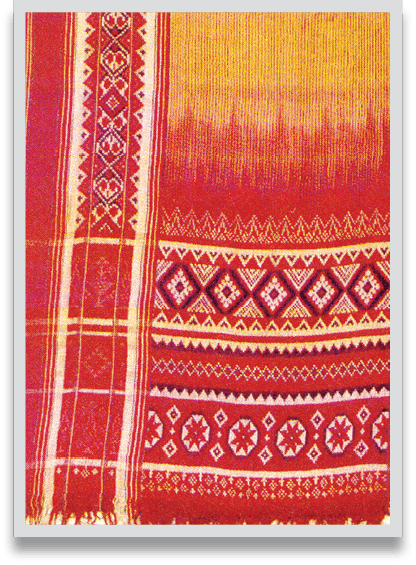
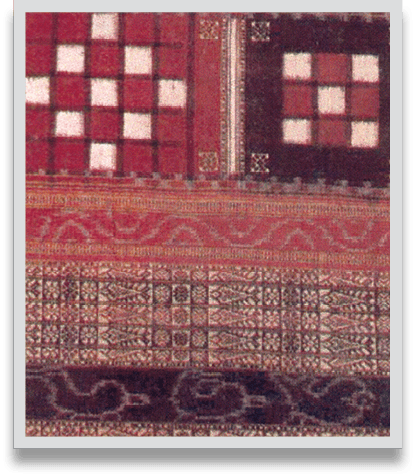


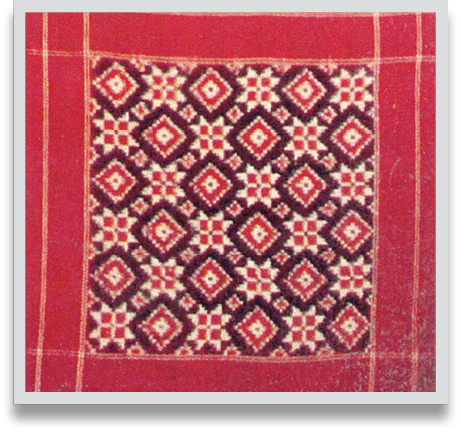
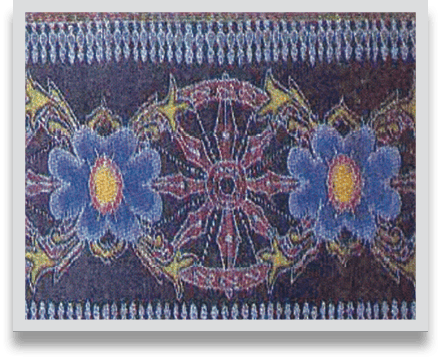

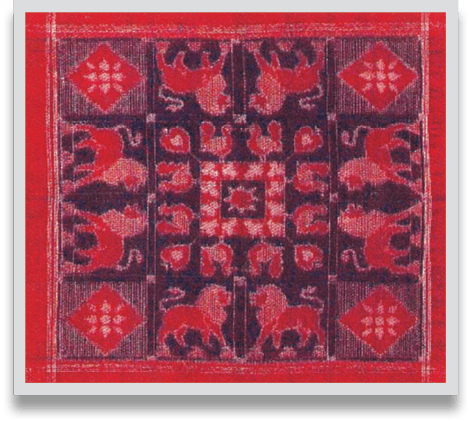
|
The Ikat artisan is not only proficient in the art of dyeing; she/he also has the technical knowledge of weaving. The process consists of calculating the amount of warp and filling yarns required for the article to be made. The tying of the yarn and weaving it after dyeing require great expertise so that warp and filling yarns match to produce the design. |
Gujarat has the richest tradition of Ikat weaving. Patola is the most colourful double Ikat sari made in silk. Its manufacture is concentrated in Patan, in Mehsana district. Apart from geometrical design patterns inspired from local architecture, other designs are flowers, birds, animals and dancing dolls. The colours most commonly used are red, yellow, green, black and white. They tend to flow into one another without the harshness of outline.
Orissa is another region where Ikat saris and fabrics of cotton and silk are produced. The process here is known as Bandha, which may be single or combined ikat. Compared to Patola, the designs here have a softer and curvilinear quality. They are also characterised by the addition of extra weft yarn woven in small figurative designs.
Pochampalli and Chirala in Andhra Pradesh have the tradition of production of cotton ikat fabrics called Telia Rumals. These were designed 75–90 cms. square pieces of fabric usually woven as a pair. The coarser ones were used as lungis, shoulder cloth or loincloth by the fishermen community and the finer ones as dupattas or veils.
10E.5 Embroidery
Embroidery is the art of surface ornamentation of fabric with threads of silk, cotton, gold or silver using needle or needle like tools. Embroidery, an ancient art form, referred to as painting with a needle, was practised in many parts of the world. In India too it has been practised from very early times and there is evidence to indicate that embroidery was prevalent all over the country–
• at all socio-economic levels – from the nomadic cattlemen to members of royal households.
• on all kinds of fabrics – from the most coarse cotton and camel wool to finest of silks and pashminas.
• with all materials and threads – cotton, wool, silk or zari along with cowrie shells, bits of mirror and glass, beads, gems and coins.
• used in making varied articles – personal clothing, household use, home decoration, offerings for religious places and decorative items for their animals and cattle.
Embroidery is generally regarded as a homely handicraft, an occupation that women undertake during their leisure hours, mainly to ornament or decorate articles of apparel or household use. Nevertheless, certain embroideries became items of trade within country and also in different parts of the world. Let us now have a glimpse into some of the styles, which are being commercially produced today.
Phulkari
Phulkari is the art of embroidery of Punjab. It is the term used for both the embroidery and the chaddar or shawl made with this type of embroidery. Phulkari means ‘flower work’ or a bed of flowers. The other term bagh (literally a garden) has also the same connotation. Phulkari was mainly a domestic craft, executed by the girls and ladies of the household and sometimes by women servants under their directions. The embroidery is done on coarse cotton (khaddar) material with untwisted silk floss called pat. In the heavily embroidered baghs, the embroidery covers the fabric so completely that the base colour of the fabric can only be seen on the reverse side. Traditionally, this embroidery was associated with wedding ceremonies and baghs were made by the maternal grandmother for her grand-daughter or by the paternal grandmother for her grand daughter-in-law.
Kasuti
Kasuti is the term used for the embroidery of Karnataka. Kasuti word is derived from the Persian word kashida, which means embroidery. Like phulkari, it is also a domestic craft mainly done by women. This is the most subtle form of embroidery, where the embroidery threads follow the pattern of the weave of the fabric. It is done on silk material with fine strands of silk threads. Even the colours used tend to blend with the background material. The main designs seem to be inspired from the temple architecture of the area.
Kantha
Kantha embroidery of Bengal is done on a base prepared by 3-4 layers of old cotton sarees or dhotis. The embroidery is like quilting – small running stitches going through all the layers of the base material. The article thus produced are also known as Kantha. This embroidery may have had its origin in darning to strengthen the worn-out areas, but now the stitches fill up the shapes that are drawn on it. It generally has a white base with embroidery in multi-coloured threads, which were originally pulled out from borders of old sarees. The articles made vary from small comb case and wallet to shawls of various sizes. There are also kanthas with ritualistic importance made for presentation to religious places or for use on special occasions.
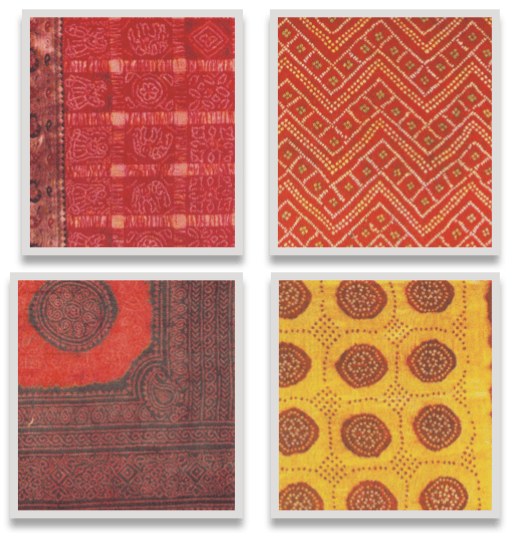

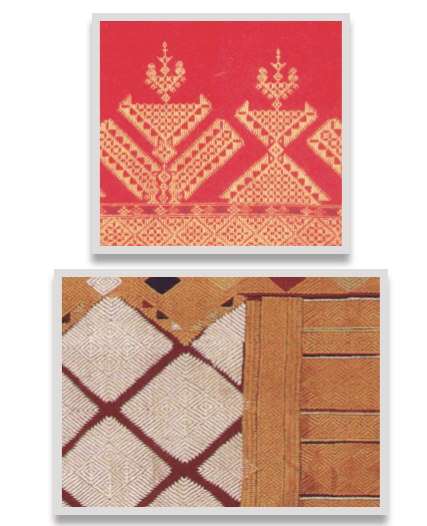

Kashida
Kashida is the general term used for embroidery in Kashmir. The two most important embroideries are suzani and zalakdozi. Kashmir being the land of wool, the embroidery is done on woollen fabrics – from the finest of shawls to medium thickness cloaks like ‘pherans’, to thick namdas used as floor coverings.
On shawls and fine woollens, perhaps the embroidery had its origin in repairing the defects that occurred during weaving. Later the multi-coloured weaving patterns were copied, to which were added the styles of Chinese embroideries like satin stitch and long and short stitch. The suzni embroidery includes all the stitches that lie flat on the surface and also show uniformity on both sides of the material. This embroidery is done with silk threads, in a multitude of colours, and shades to make the designs look natural.
|
The twill tapestry technique that was used for weaving often required small corrections and alterations. This was done like embroidery repeating the pattern of the weave, thus was called darning. The embroiderers in Kashmir are still referred to as rafugars, i.e., darners. |
Zalakdozi is the chain stitch embroidery done with ‘ari’ – a hook like the cobblers use. Originally it was done mainly on namdas, but now it is done on all kinds of materials, including shawls. Unlike the other embroideries discussed so far, Kashmir embroidery is a commercial activity, done by men folk and thus caters to the demand of the buyers.
Chikankari
Chikankari of Uttar Pradesh is the embroidery, which was commercialised at a very early stage. Although ladies do the main work, the master craft persons and organisers of the trade are mainly men. Lucknow is considered the main centre for the work. Originally it was done on white material with white thread. The main effects produced are shadow work by embroidering on the wrong side of the material, net like surface by tightening the yarns of the fabric with embroidering, and raised patterns on the face of the fabric by knotting stitch resembling rice or millet grains. The past few years have also seen the inclusion of zari threads, small beads and shiny discs (sitara) incorporated in the designs. Since it is a commercial activity, the designs and styles keep changing with fashion.
Gujarat has a very rich tradition in embroidery
It has basically been a land of nomadic tribes who have thus been responsible for amalgamation of designs and techniques of various cultures. Here embroidery is used for all aspects of life; decoration of the doorways with torans or pachipattis and walls with chaklas or chandrawas, ganesh sthapnas (all these are important in a nomadic lifestyle), garments for men, women and children in styles specific to various tribes, coverings for cattle, horses, elephants. Many of the embroideries are known by the names of the tribes – Mahajan, Rabari, Mochibharat, Kanbibharat, and Sindhi. Most of the colours used are bright and loud.
Appliqué work in Gujarat has its own style. It is a patchwork, in which the pieces of fabric with different designs are cut in different sizes and shapes and sewn on a plain background. This is used mainly on household items.
Bead work of Saurashtra and Kutch is also an important art. It is not an embroidery, but interlacing of different coloured beads through a network of threads to create coverlets for utensils, hangings, purses, etc.
The close proximity of the states of Gujarat and Rajasthan, and because Rajasthan also has a tribal population has resulted in embroidery in a similar style. The colours and the motifs used vary between the tribes and the occasions for which they are produced.
Chamba rumals
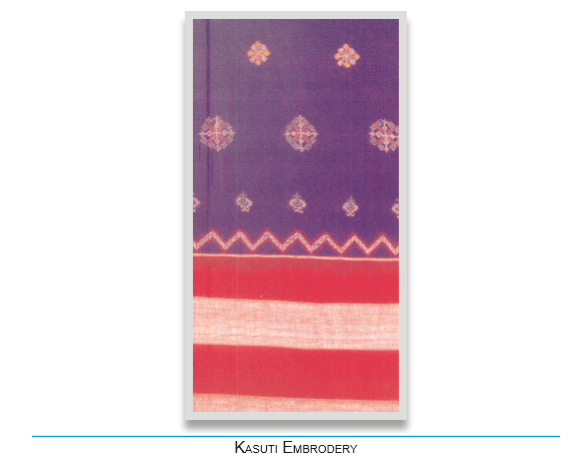
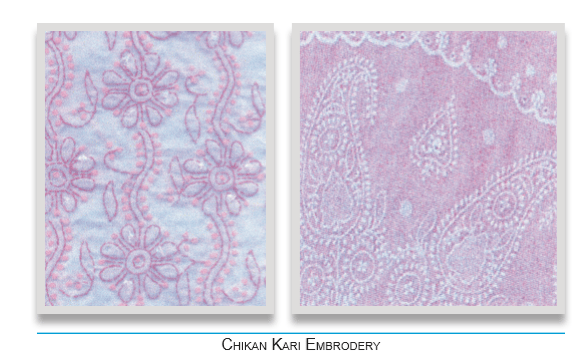
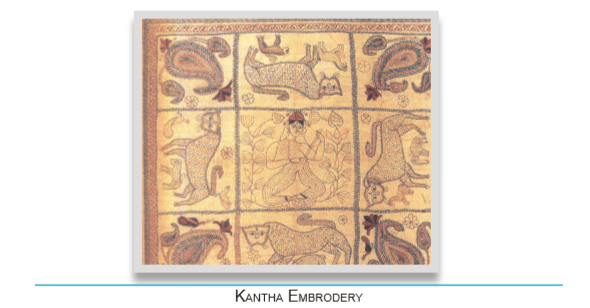
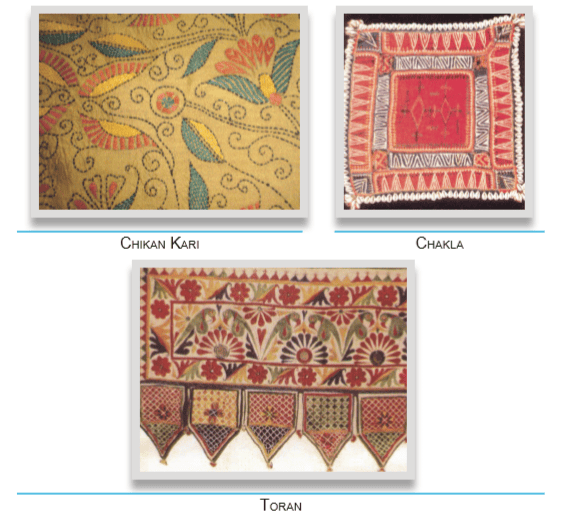
Chamba rumals, from the erstwhile hill state of Chamba in Himachal Pradesh were made mainly for covering trays of gifts, when being presented to dignitaries or special guests. They depicted mythological scenes similar to Pahadi Paintings, by using running stitch in outline and darn-stitch in filling. At their best, the scenes appeared the same on either side of the textile.
10E.6 Conclusion
India has beautiful textiles which have been recognised the world over for their beauty and craftsmanship. Repeated and persistent invasions, migrations, political upheavals and many other ups and downs led to a synthesis that enriched the textile craft of India. The richness and diversity of contemporary form of art practised in India owes much to the coexistence of numerous cultural strains on its soil.
Specific geographical regions in India have age-long traditions associated with fabric production. This is in terms of different fibre groups – cotton, silk and wool and different manufacturing processes – spinning, weaving, dyeing and printing and surface ornamentation. With changing times, the production centres have evolved their own grammar in terms of colour, design and ornamentation and their usage for specific products. A large number of such centres continue to be important in the social and economic life not only for the production of items associated with religious and social rites, also in their effort to make a statement which fits into contemporary usage. Thus they are making an effort to go in for product diversification and alternate usage of traditional textiles. Gradually the emphasis is also shifting from customised products to mass production.
Almost all the traditions of Indian textiles have survived. New design development has only enriched these age-old traditions. Numerous government and non-government organisations, along with many academic institutions, have joined hands to preserve, revive and contemporarise the textile traditions.
Key Terms
Brocade, Mulmul, Jamdani, Kinkhwab, Shawl, Tapestry, Tie and Dye, Ikat, Patola, Embroidery, Phulkari, Kashida, Chikankari.
- Review Questions
1. From which historical sources of information can one learn about the antiquity of Indian textile art?
2. What are the two aspects of cotton production which made the Indian fabrics world famous?
3. Name some of the areas associated with silk brocade weaving. What are the special characteristics of each?
4. Why were the Indians called ‘master dyers’ to the world?
5. What do you associate with the following terms: phulkari, kasuti, kashida, kantha and Chikankari.
- Practical 11
Textile Traditions in India
Theme Documentation of traditional textile art/craft of neighbouring area
Task Make a folder or catalogue giving information and pictures of traditional textile art and craft of any one selected area.
Purpose of the practical: Indian craft and its millions of prastising craft people are a huge and important resource of traditional knowledge and indigenous technologies. It will help the students to understand and appreciate the craft traditions of India. They will be able to collect relevant information and develop their creative skills in expressing textile traditions. Also it is a means of linking rural and urban youth.
Conduct of the practical: Visit a nearby exhibition or craft mela or museum to collect information on selected textile craft in terms of origin/history, fabrics, techniques, colour, design and products of the selected craft. Present it in the form of a folder or a catalogue.
Craft could be associated with any one more of fabric production processes – spinning, weaving, dyeing, printing or embroidery.