UNIT IV
Adulthood
With the advent of adulthood, the adolescent passes through the portals of what may be termed as the “real world”. One enters the world of higher education, work, and marriage, and gets involved in establishing one’s own family. Hence responsibilities of the individual increase manifold. In this unit you will learn about the major factors that play a role in determining the quality of adult life, these being health and wellness, financial planning and management, maintenance of fabrics and apparel that one uses personally as well as in the home, and appreciation of different perspectives in communication. The unit concludes with a chapter on individual responsibilities and rights, not only for one’s own self, but also in relation to the family and larger society.
15 Health and Wellness
Learning Objectives
After completing this chapter the learner will be able to–
- discuss the importance of health and fitness.
- explain the health concerns and challenges of adults.
- describe the concept of wellness.
- describe the steps to promote and maintain good health and wellness in adults.
15.1 Health Scenario in India
A cursory glance at the health profile of Indians shows that there is scope for substantial improvement. The 2008 report of the World Health Organisation reveals to us the following data:
|
Total population: 1,151,751,000 Life expectancy at birth: 62 years for males, 64 years for females Healthy life expectancy at birth: 53 years for males, 54 years for females Probability of dying under five (per 1000 live births): 76 Probability of dying between 15 and 60 years (per 1000 population): 276 for males/203 for females |
Source: World Health Statistics 2008
|
Indicators of health status of the Indian population Ophthalmology: Annual incidence of cataract, the cause of 80 per cent of blindness, is 3.8 million cases. Cancer: The total number of cancer cases in India was estimated at 924,790 in 2001. This is projected to increase to 1,229,968 by 2011 and to 1,557,800 by 2021. Cardiovascular diseases: The mortality rate due to cardiac arrest and related causes was estimated at 2.4 million in 1990. With increasing urbanisation the problem is on the rise. Malaria: Projected to increase from 2.03 million cases in 2001 to 2.62 million cases in 2021. Hypertension, diabetes and renal diseases: These stress and lifestyle related disorders are on the rise. The diabetic population in India is projected to increase from 40 million of 2001 to 47 million people in 2010. Hypertension is lower in rural areas but on an increase in urban cities. |
Source: The Investment Information and Credit Rating Agency (ICRA) – Report on Indian Healthcare and Technology Information Forecasting and Assessment Council (TIFAC), Department of Science and Technology (DST), Government of India
These startling facts on health status in India and the projection that “by 2025, it is likely that one in every five Indians will be diabetic”, highlights the need for every Indian to become aware about health and fitness as important dimensions of their lives. Besides diabetes, the increasing prevalence of heart disease, osteoporosis, infectious/communicable diseases such as hepatitis, tuberculosis, AIDS, etc. have become public health problems and need immediate attention at all stages of life.
It is now recognised that there is a shift in the causes of death (mortality) from infectious and communicable diseases in the past, to non-communicable diseases such as diabetes, heart disease or cancer. Experts estimate that the number of persons having non-communicable diseases will increase in the future and there is an urgent need to address this problem, nationwide and worldwide.
It is important to note that many of these diseases were earlier seen in older persons. However, it is of concern today that many of these diseases are now found to occur in youth and younger adults. Another point of concern is that these diseases are not restricted to upper income families alone. Persons from low income families, especially in urban areas, are prone to these problems. It is stated by health experts that most of these health problems are due to unhealthy diets and lack of physical activity.
Therefore, the world’s apex body dealing with health, the World Health Organisation (WHO), has made recommendations to develop a global strategy on diet, physical activity and health. Simultaneously, the Government of India is equally concerned about the increasing health problems and related issues. As such when diseases increase, there will be tremendous pressure in terms of: (i) providing health care to such persons, (ii) the economic cost to the person and her/his family as well as to the nation, since the government also has to provide health care and treatment facilities for these problems, (iii) adverse impact on the quality of life of such persons, and (iv) promoting and maintaining their health as well as their capacity to function ‘normally’.
15.2 Healthy Persons
Healthy persons are those who are physically fit and active, cheerful in their outlook, have adequate immunity against infections and are not easily fatigued. Research has indicated the benefits of healthy diets, physical activity, individual action and population-based public health interventions. Unhealthy diets generally include consumption of energy dense foods (high in sugar and fat). They are also high in salt. Such foods when eaten in higher amounts than what the body requires and coupled with reduced activity levels across all age groups, especially adolescents and adults, increase risk of non-communicable disease. Diet and physical activity both influence health independently as well as together. Physical activity is a fundamental means of improving physical and mental health. There is a tremendous need to increase awareness and promote better lifestyles to prevent people from having health problems. The risk of developing diseases such as diabetes, heart disease and hypertension in youth and adults is higher among individuals who are overweight or obese. Health professionals commonly use anthropometric indicators (body measurements) to assess nutritional status and risk.
A simple indicator is the Body Mass Index (BMI) that is commonly used to classify underweight, overweight and obesity in adults. This index basically tells us whether a person’s weight is appropriate for her/his height (i.e., ‘weight-for-height’). It is defined as the weight in kilograms divided by the square of the height in metres (kg/m2). For example, an adult who weighs 70kg and whose height is 1.75m will have a BMI of 22.9.
|
BMI = 70 (kg) / 1.752 (m2) = 22.9 |
WHO has recommended use of ‘cut-off points’ for determining whether individuals are underweight, overweight, obese or normal as shown in the Table 1. Thus, if a person’s BMI is below 18.5 he/she is classified as underweight. Similarly, cut-off points have been given for three categories ‘normal weight’, ‘overweight’ and ‘obese’ and subcategories within each. For each of these, there is a minimum value and maximum value (a range of values). The health risks are higher as BMI increases because there are numerous related changes occurring in the body which are detrimental. These include increased body fat (adipose tissue), decreased glucose tolerance, changes in blood cholesterol etc.
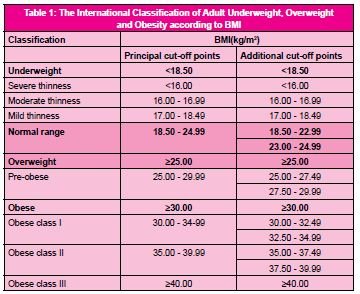
Source: Adapted from WHO, 1995, WHO, 2000 and WHO 2004.
BMI values are age-independent and the same for both sexes but to some extent may differ in different populations due to genetic, ethnic and racial factors. Among the various ethnic populations, research evidence indicates that Asians have higher risk at the same BMI compared to others. Hence the WHO has found it necessary to further subdivide the categories (as shown in the third column of Table 1).
Note to Teachers: It is recommended that teachers familiarise themselves with this concept in order to explain it better to the students. Please refer to the notes for teachers at the end of the chapter.
In order to maintain good health and maintain desirable body weight, the following recommendations have been made by health experts for populations and individuals to achieve energy balance and a healthy weight.
Do’s and Don’ts for health promoting diets
Do’s
– Increase consumption of fruits and vegetables.
– Increase intake of legumes, whole grains and nuts.
– Match energy intake to energy expenditure.
– Use iodised salt.
– Drink plenty of water.
Don’ts
– Consume too much fat/oil ( butter on bread, ghee on parathas), or fried foods e.g pakodas, puris, nuts, samosas etc
– Consume too much saturated (fats that are solid at room temperature ) and trans fats (vanaspati).
– Consume too much salt (sodium) from all sources especially processed foods such as wafers, ketchups, sauces, biscuits, pickles, papads etc.
– Sprinkle salt on cooked food or salad
– Indulge in sweets, chocolates, soft drinks etc
15.3 Fitness
Health is promoted not only by appropriate, well balanced diets but also by physical activity and fitness. There was a brief discussion about fitness in Chapter III in Unit I of Part I on Understanding Oneself: Adolescence. Here, the focus will be fitness at adulthood. As the human body advances in age, certain changes take place resulting in various changes including decline in capacities and body functions.
Exercise and some physical activity are of utmost importance for maintenance of physical fitness and to sustain a healthy life as well as to establish a certain quality of life. Regular exercise burns up extra calories consumed and reduces the likelihood of the surplus calories being converted into fat. Regular exercise makes a person fit. Persons who exercise regularly experience a sense of well-being and sleep better. Exercise also makes the heart and lungs work more efficiently, improving circulation and respiration. Exercise carried out for about 20 minutes at least three times a week is beneficial. Older people should undertake exercise regularly so as to prevent and control several of the diseases like obesity, hypertension, diabetes etc. In fact youth and young adults should begin to take precautionary health regimen to stave off these diseases at a later stage.
Benefits of exercise in adulthood
(i) Exercise and illness: Exercise reduces the risk of acute and chronic illness through improving body composition, affecting metabolism and cardio-respiratory fitness. It decreases disability by improving endurance, muscle mass, muscle strength, agility and flexibility. It helps to prevent and treat common, often difficult–to–treat problems seen among older adults such as depression, insomnia, anorexia, constipation, and cognitive impairment.
Exercising regularly yields specific benefits such as:
- Helps to postpone disability by as much as 15 years. Even inactive persons, once they begin to do small amounts of exercise derive considerable health benefits.
- Lower body exercises help to establish/retrain balance in older adults.
- Helps persons who are overweight/obese to lose weight.
- Helps in maintaining desirable body weight.
- Helps to control blood sugar levels and blood pressure.
- It helps to maintain bone mineral density and thus reduces the risk of fractures and disability especially among the elderly.
- Helps to enhance muscle strength in both upper and lower limbs (training for a couple of months can help to increase strength of our lower limbs)
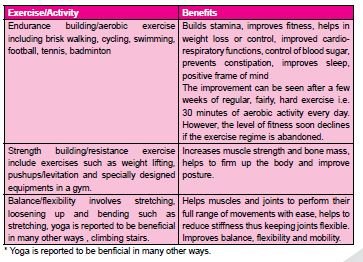
Exercises can be grouped into three broad categories:
- Endurance building /Aerobic exercise
- Strength building /Resistance exercise
- Promoting balance /Flexibility excercise
The benefits of these exercises are summarised in the box below.
|
There are 1,440 minutes in every day. Schedule 30 of them for physical activity! Make exercising part of the daily routine to ensure wellness in adulthood. |
(ii) Exercise, mental health and well-being: In addition to the benefits for physical health, there is growing awareness and scientific evidence of its benefits for wellness and mental health. Scientists at Duke University, USA, studied persons suffering from depression for 4 months and found that 60% of the persons who exercised for 30 minutes three times a week, overcame their depression without any medication. Another research study showed that short workouts of 8 minutes could help lower sadness, tension and anger along with improving resistance to disease in healthy people. Many people have found that exercising helps to boost confidence as well as reduce anxiety and stress, all of which contribute to psychological health and well-being. Thus, exercise can be viewed as a wellness activity that prevents physical and mental health problems.
Experts caution that viewing exercise as a punishment can hamper its benefits. On the other hand, exercise should be enjoyed. The physical pain and soreness that one feels in the first few days gradually disappear. In India, yoga and meditation have been traditionally used to achieve mental health and well being. Yogic asanas help the body become more flexible. Researchers have shown that yoga also has benefits for conditions such as diabetes and high blood pressure.
During and after exercise, the brain releases substances called endorphins. These are the body’s natural painkillers and also increase feelings of happiness and well-being. Today’s lifestyles, especially in urban areas and metropolitan cities, are fast paced and more stressful. Hence it is crucial to ensure that every individual takes care of her/his physical and mental health.
|
In 2002, the World Health Organisation deemed ‘Physical Activity’ the theme of World Health Day. Since then, April 6th is celebrated as the World Day for Physical Activity. This is an example of a global initiative aimed at promoting health through physical activity across populations. |
15.4 What is Wellness?
Wellness is a state of optimal well-being. It means achieving balance and harmony in all aspects of our lives. Wellness is achieved through the integration of physical, social, emotional, intellectual, spiritual and environmental health. It is a proactive, preventive approach designed to achieve optimum levels of functioning. The concept of ‘wellness’ is a unique perspective that lays emphasis on facilitating health and well-being. It focuses on human strengths as resources for health, rather than dwelling on problems, needs or weaknesses. Promoting wellness is an approach to prevent ill health or dependency on doctors and medicines.
How does the wellness approach help?
Wellness improves ‘Quality of Life’ by reducing risk of disease, disability, discomfort and distress throughout the life cycle. It is of paramount importance to promote positive human strengths which in turn can help foster growth and development, harmony and well-being.
The wellness approach requires first and foremost that a person should take responsibility for the quality of one’s own life. It begins with a conscious decision to have a healthy lifestyle that will lead to high levels of well-being and life satisfaction.
|
Wellness is a choice…. a decision made to achieve optimal health. Wellness is a way of life…. a lifestyle that helps a person to reach one’s goals and realise one’s potential Wellness is a process…. a sequence of decisions and behaviours that lead to health, well-being and happiness. Wellness is holistic …. an approach to integrate the body, mind, and spirit with the appreciation that all our beliefs, thoughts, feelings and actions greatly influence us in everyway. Wellness is wholehearted acceptance of self situations and circumstances….with all of one’s weaknesses, strengths and challeges |
The holistic approach to well-being is described in the diagram that portrays the dimensions/focal areas for a healthy lifestyle.
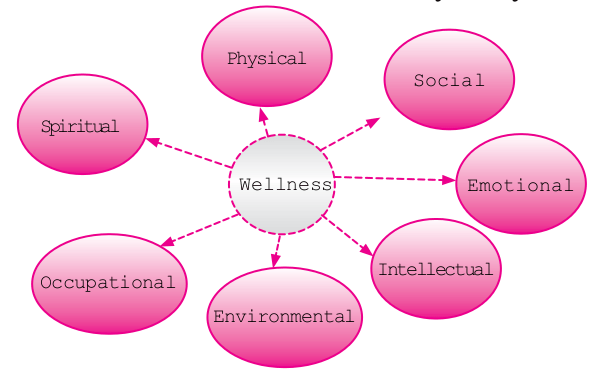
Figure 1: Dimensions of a healthy life style
Wellness has become an important area of research in order to understand it and provide guidelines for practice and promotion. Evidence from numerous studies indicates that persons rated ‘high’ on the wellness and well-being profile have in common the following qualities:
- High self-esteem, a positive outlook and a sense of purpose
- A strong sense of personal responsibility and commitment
- A good sense of humor
- A concern for others
- A respect for the environment
- A physically fit and an integrated healthy lifestyle
- Absence of addictive behaviours
- A capacity to cope with life’s challenges
- An ability to continue to learn
- A capacity to love and an ability to nurture
- An ability for effective communication
Dimensions of Wellness
A ‘wellness lifestyle’ is associated with good physical health, emotional stability, healthy relationships with family, friends and peers as well as productivity and satisfaction in one’s work and workplace.
Social aspect: This emphasises the interdependence with others, making friends and having meaningful, happy, satisfying and stable relationships with others. Social wellness promotes the idea that it is helpful to contribute to the common welfare of our community than to think only of ourselves. The basic tenet is that it is better to live in harmony with others and our environment than to live in conflict with them.
Physical aspect: This refers to deliberate choices for a life style that includes adequate physical activity, well balanced diets and good fitness regimen that will help to achieve and maintain optimum body health and well being. Making healthy lifestyle choices that affect health and quality of life for the present and future is crucial.
Intellectual aspect: This encompasses the extent to which one engages in creative, stimulating mental activities. An active mind is crucial for overall wellness. Being open to new ideas, thinking critically, being creative and curious, and being motivated to master new skills are the keys to intellectual wellness. An ‘intellectually well’ person uses the resources available to expand his/her knowledge to improve skills along with sharing with others. Benefits include improved job performance, better problem solving, more knowledge and a better chance at being successful in life.
Occupational aspect: This is concerned with the satisfaction gained from one’s work and how much one feels enriched by the work. The satisfaction gained is related to a person’s attitudes about work, the sense of direction and goals, and a feeling of achievement. Achieving personal satisfaction and enrichment in one’s life through work is required for adults to have a sense of comfort and satisfaction in life. Wellness at the workplace is being increasingly focused upon by employers to ensure better employee health, well-being and productivity.
Emotional aspect: This is closely related to the degree of awareness and acceptance that one has of one’s feelings. It includes the extent to which one feels positive and enthusiastic about one’s self and life, the capacity to appropriately handle and express one’s emotions (both positive and negative), how one copes with stress as well as being able to realistically assess one’s limitations. Emotional well-being allows an individual to recognise, understand, experience and express a full range of emotions. In adulthood particularly; living with chronic illness such as heart disease or cancer has mental health implications.
Stress can affect the individual in several ways—contribute to irritability, heart burn, headaches, heart disease and perhaps cancer. Stress cannot be completely avoided. However, one can learn to cope with stress (see Figure 2 in this chapter). Health promotion activities can positively impact overall health and well-being.
Spiritual aspect: This addresses one’s continuous involvement in seeking meaning and purpose of life and living, in general in human existence itself. Spirituality generally relates to better mental health, greater well-being and higher quality of life. Physical health and medical outcomes may also be affected. Spirituality can help persons to cope with problems even related to physical health.
Environmental aspect: This deals with the interaction and interdependence between humans and the environment. Awareness of the critical role the environment plays in our individual wellbeing and that all human activity affects the environment is required. Environmental degradation and destruction by human beings is jeopardising the availability of natural resources leading to several major problems that will compromise the quality of human life.
Financial aspect: This focuses on informed decision-making and learning how to manage financial resources wisely, save, invest, and plan for the future. In a monetised society (a society that functions largely on monetary transactions), adequate financial resources are required to achieve health and well-being. Every person has to work hard and be productive to have sufficient finances, not only at the micro-level i.e., individual and family, but also at the macro-level i.e., community, region, state and national levels.
15.5 Stress and Coping with Stress
Stress is unavoidable in daily life and has both positive and negative connotations in the personal and professional roles. Some stress can motivate and energise one to perform better and be more efficient. When stress has a positive effect, it is termed ‘eustress’, when stress adversely affects performance, physical and mental health, it is known as ‘distress’. At the simplistic level, any one can assess oneself through the activity given below.
Activity 2
Ask yourself the following questions:
- Do I often feel irritated/ anxious/ depressed?
- Do I feel tired most of the time without sufficient reason?
- Do I worry too much and hence get tense and not be able to sleep?
- Do I often feel very ‘fed up’ and over burdened?
If the answer to one or more questions is ‘yes’, it is likely that the person is stressed. Prolonged stress (chronic stress) can damage the body and lead to diseases such as high blood pressure, obesity, heart attack, decreased immunity among others.
Every human being, young or old, male or female, wealthy or poor, in good or poor health will benefit by learning to cope with stress in order to enhance well-being and improve their quality of life. There are various stress management techniques which are indicated in Figure 2. The decision to use one or more techniques is a matter of individual choice.
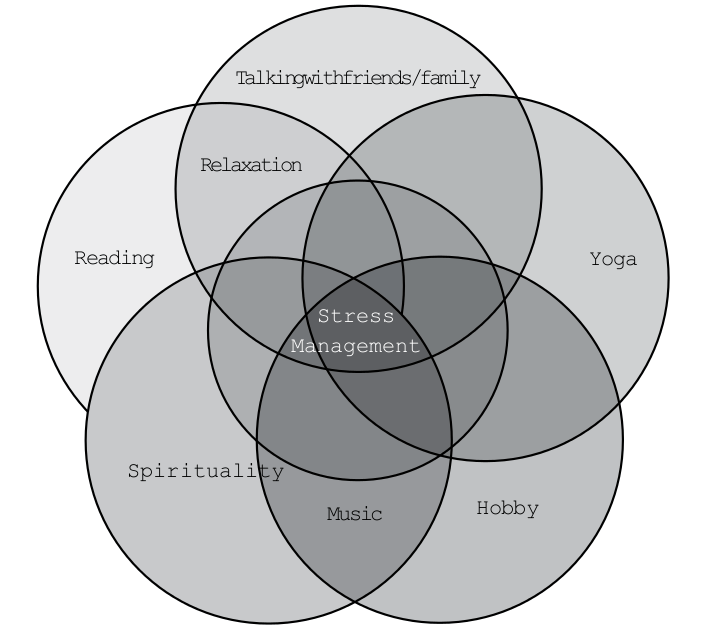
Figure 2: Simple techniques to cope with stress
Research shows that persons who take care of themselves and manage their lifestyles are healthier, more productive, have fewer absences from work, and make fewer demands for medical services. It is not medical care alone, rather consistent self care which promotes better health and an improved quality of life.
|
Note for teachers about BMI classification |
|
In the recent years, there has been a growing debate on whether there are possible needs for developing different BMI cut-off points for different ethnic groups due to the increasing evidence that the associations between BMI, percentage of body fat, and body fat distribution differ across populations and therefore, the health risks increase below the cut-off point of 25 kg/m2 that defines overweight in the current WHO classification. There had been two previous attempts to interpret the BMI cut-offs in Asian and Pacific populations, which contributed to the growing debates. Therefore, to shed light on these debates, WHO convened the Expert Consultation on BMI in Asian populations (Singapore, 8-11 July, 2002). The WHO Expert Consultation concluded that the proportion of Asian people with a high risk of type 2 diabetes and cardiovascular disease is substantial at BMI’s lower than the existing WHO cut-off point for overweight (= 25 kg/m2). However, the cut-off point for observed risk varies from 22 kg/m2 to 25 kg/m2 in different Asian populations and for high risk, it varies from 26 kg/m2 to 31 kg/m2. The Consultation, therefore, recommended that the current WHO BMI cut-off points (Table 1) should be retained as the international classification. But the cut-off points of 23, 27.5, 32.5 and 37.5 kg/m2 are to be added as points for public health action. It was, therefore, recommended that countries should use all categories (i.e. 18.5, 23, 25, 27.5, 30, 32.5 kg/m2 , and in many populations, 35, 37.5, and 40 kg/m2) for reporting purposes, with a view to facilitating international comparisons. This chapter has provided you a fair idea about the importance of good health in adulthood, and the way of maintaining a sense of well-being. You would agree that having adequate financial resources would be an important component of wellness for an adult. However, simply possessing money is not enough. How one manages it and plans its use is equally significant for the optimal benefit of this resource. These issues will be addressed in the next chapter – Financial Management and Planning. |
Key terms and their meaning
Wellness: Associated with good physical health, emotional stability, healthy relationships with family, friends and peers as well as productivity and satisfaction in one’s work and workplace.
Cut-off Point: Values which indicate the range of normal levels for weight or blood cholesterol or blood glucose and so on. Anything below the minimal value or above the maximum value becomes abnormal. In other words such values “cut off” the abnormal from the normal values.
Glucose Tolerance: Ability of the body to respond to high intake of glucose (and consequently high levels of blood glucose) by secreting adequate levels of insulin. Insulin helps glucose to enter the body cells and thus reduces glucose levels in the blood. People who are predisposed to diabetes or suffering from diabetes have poor glucose tolerance.
1. Mark the following statements as True or False.
1. You need to be physically active only when you need to lose weight. True/False
2. Physical fitness requires membership in a gym, special equipment and clothes. True/False
3. Without 60 minutes of exercise everyday physical fitness cannot be achieved. True/False
4. Endorphins are chemical substances that make a person depressed. True/False
2. Exercises
(a) Assess BMI for self and two adults, one young adult and one older adult.
(b) Group Discussion: Organise a group discussion on “Older adults do not need to exercise”.
(c) Debate: Organise a debate in the class between groups for and against the statement: “When one is physically fit, it is not necessary to bother about one’s diet”.
(d) Personal diary: Differentiate between eustress and distress. Keep a record for one week of your eustress and distress states.
3. Group projects
1. Design attractive posters to publicise the importance of wellness and fitness.
2. Collect recipes for snacks that are healthy and nutritious. Make a recipe booklet and share it in the community.
4. Projects for school
1. Organise a walking rally to promote benefits of exercise.
2. The teachers in the school may organise an exhibition of students’ posters to publicise the importance of wellness and fitness for parents and community members.
3. School may organise Health and Wellness week to celebrate the World Health Day.
16 Financial Management and Planning
Learning Objectives
After completing this chapter the learner will be able to —
- understand the meaning and concept of financial management.
- know the different types of income.
- explain the steps in making family budgets.
- describe meaning of savings and investments.
- discuss the principles of sound investments.
16.1 Introduction
(i) Financial management in the context of a family simply means management of finances. Finances are all types of income available to a family which include salary, wages, rent, interest, dividends, bonus, retirement benefits and all other forms of monetary receipts. Planning, controlling and evaluating the use of all these types of incomes is called financial management. Its purpose is to give the family greatest satisfaction from the resources at hand.
The quality of living that can be exchanged for financial resources is dependent not only on how much income is available, but more importantly on the regularity and stability of income. Therefore, it is important to learn the skill of managing money as a resource. This chapter will deal with the types of family income, management of income and the steps in making family budgets.
(ii) Financial planning is a component of financial management. The term budget is often used for the planning stage in financial management. When families make budgets, they see to it that the family income is used in a manner that fulfills all the present needs of the family members and also takes care of the long term goals of the family. Thus families are able to achieve their objectives by optimising the use of their resources. In addition, financial planning minimises wastage of money on non-essentials, thus making families save a part of their income for future use. This is, however, possible when the family monitors its financial plans and evaluates the plans from time to time. Commitment of family members towards the success of the financial plan is very important for it to show any results.
Management is using what you have (resources) to achieve what you want (goals and objectives). Family resources are the resources that are available to the individual or the family at a particular time, which help them reach their family goals. Family resources include human resources such as knowledge, skills, health, time and energy; material resources such as housing, money and investments; and community resources such as the library, parks, community centres, hospitals etc. In order to ensure maximum utilisation of resources it is important to manage them well.
A family is a consumption unit while being a social unit, and its purpose is to manage the finances of the family for the well-being of its members. Money is one of the important family resources. A family cannot lead a comfortable life without sufficient money. Managing money effectively to meet present needs and future goals is a learned skill. So let us understand what we mean by family income.
16.2 Family Income
Family income means the sum total of the income of all types and from all sources of all the family members in a given time period. It can be annual, monthly, weekly or daily income. However, for official purposes, it is considered as the annual income in a financial year which is generally from 1st April to 31st March of the next year.
Income may be in the form of
- Wages
- Salary
- Profits from business
- Commissions
- Rent from properties
- Interest on cash loans
- Dividends
- Pensions
- Gifts
- Royalties
- Tips and donations
- Bonus
- Subsidies, Charities etc.
Activity 1
Participate in a group discussion in your class on “Communication Technology – a curse or a boon?”
Types of family income
There are three types of family income.
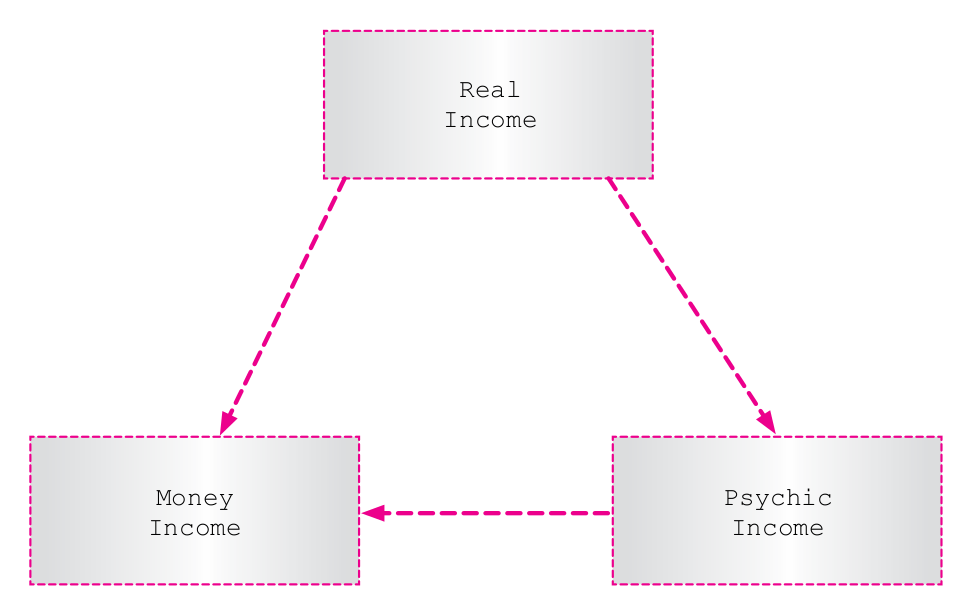
Before we go into the details of different types of family income, let us understand what is money and its functions.
Money is what money does. Two most important functions of money are:
- Serving as a medium of exchange, and
- Measurement of value
Thus money is “anything which is generally acceptable in exchange of commodities and in terms of which the value of other commodities is determined”.
Importance of money
- Money serves as a medium of exchange, thus doing away with the problems of spending time for exchange to materialise.
- Money serves as a standard of value, i.e., a common denominator in terms of which the value of all other commodities is expressed.
- It works as a standard of deferred payments facilitating savings and investments, which are the basis for capital formation, and hence for better standard of living.
- Storage in terms of money is durable for long time periods, facilitating accumulation for investment in production and improved standard of living for the family.
Activity 2
Identify all the sources of money income available to your family in a month.
(a) Money Income is the purc-hasing power in rupees and paisa that goes into the family treasury in a given period of time. It comes to the family in the form of wages, salary, bonus, commission, rent, dividends, interest, retirement income, royalties and any other allowances to any member of the family. Money income is converted into goods and services required for daily living, and often a part is diverted into savings for delayed use or for investment purposes.
The frequency and pattern of flow of money income varies from family to family. For example in rural areas agriculture is the main occupation. The income of a farmer is not regular but she/he earns money when she/he sells the crop which may be twice in a year–the rabi and the kharif crops. In contrast, a person having a job will have regular income every month.
(b) Real Income is defined by economists as a flow of commodities and services available for satisfaction of human wants and needs over a given period of time.
This definition has three important points, namely:
- Real income is a flow of goods and services, it is not stagnant.
- It consists of goods and services which might or might not be available with money, e.g., produce from your own land, services of a household.
- There is a time period involved – it may be a month or a year.
Real income is of two types- direct income and indirect income
1. Direct Income – consists of those goods and services available to the family members without the use of money. For example, services rendered by family members, like cooking, laundering, stitching, maintaining kitchen garden, etc. A house which is fully paid for and community facilities like parks, roads, libraries also come under direct income.
2. Indirect Income – those material goods and services which are available to the family only after some means of exchange (ordinarily money) has been obtained, e.g. use of money to buy good quality vegetables because it involves one’s skill and ability to select.
(c) Psychic Income is the satisfaction that results from the ownership and utilisation of goods and services. It can also be defined as the satisfaction derived from real income. It is difficult to quantify psychic income in terms of rupees. It is a form of hidden income. It is intangible and subjective and the most important in terms of quality of living.
16.3 Income Management
Activity 3
Identify the different sources of direct income of your family.
Income management may be defined as planning, controlling and evaluating the use of all types of income. Its purpose is to simply get the greatest satisfaction from the resources at hand.
No two families, even though they have identical incomes, will have identical needs and desires. Thus every family must devise their own plan of expenditure keeping in mind their goals, needs and desires. For efficient income management it is essential that families recognise and analyse all resources available to them.
16.4 Budget
Budget is the most common planning device for the use of money. A budget is a plan for future expenditure. It represents the first step in the managerial process as applied to money. Its success depends upon
- its being realistic and flexible.
- suitability to the group for which it is prepared.
- quality of the control and evaluation steps which follow.
A family budget gives in detail the income and the expenditure of a family for a month or a year. It mentions all the sources of income during the period and also all the items of expenditure under different headings, such as food, clothing, housing, entertainment, travel, education, health and medicine and savings.
Steps in making a budget
There are mainly five steps in making a budget. They are as follows:
(i) List the commodities and services needed by the family members throughout the proposed budget plan. Group the related goods and services together. The following grouping may be helpful:
- Food and related costs
- Housing
- Household operations – fuel, utilities
- Education
- Transportation
- Clothing
- Income tax
- Medical
- Personal allowances
- Miscellaneous – recreation, house furnishings
- Provision for future – saving, retirement
(ii) Estimate the cost of the desired items totaling each classification and the budget as a whole. General market trends must be considered while making these estimates. For example, if prices are showing an upward trend, sufficient margin should be allowed to cover such increases.
(iii) Estimate total expected income. It is helpful to list income under two headings – assured and possible income. The budget should ensure that necessities are taken care from the assured income and the ‘nice but not necessary’ items can be obtained from possible income.
(iv) Bring expected income and expenditure into balance. Sometimes expenses are more than income. There are two ways to bring them into balance. One can either increase the income (for example by, taking up an extra job/work) or cut expenditures (less frequent outings or less expenditure on festivals).
(v) Check plans to see that they have a reasonable chance of success. The plans are checked in light of the following factors:
- The needs of the family have been met.
- The budget allows for emergencies. A joint fund may be kept aside for emergency period.
- Solvency is assured. Solvency is the ability to pay bills or debts as they fall due.
- The national and world-wide conditions have been considered (e.g., global economic recession).
- The long term goals of the family are recognised.
Advantages of planning family budgets
- Planning enables a family to take an overview of the use of their income.
- Amounts allocated to various categories can be studied in relation to total income.
- The budget helps families use their income to first attain those goals which they consider most important. Spending without a plan frequently results in wastage of income.
- Family members are less likely to be swayed, as they can make rational decisions which are reflective of long term goals of the family.
16.5 Control in Money Management
After planning, controlling is the next step in money management. Control in financial management is usually of two types: checking to see how well the plan is progressing and adjusting wherever necessary.
Checking is important as it tells how one’s plans are progressing and where adjustments are needed. There can be two kinds of checks:
(i) Mental and mechanical checks: Mental checks are usually established by breaking the allocations into units which can be related to actual expenditures. For example, Rs. 1000 may appear to be a large amount to a student, but when one realises that one must purchase a pair of shoes, a new dress for a festival and a few books all at one time, it is obvious that one must take extreme care in the selection and the price in light of the total money available. Thus, in mental checking one visualises clearly the items a specific amount must cover.
A mechanical check is one in which you set aside a certain amount of money in cash to be used for a particular item. For example, many homemakers have a food purse in which monthly allocation for food is kept. All food expenses are carried out from the money in this envelope. Quick disappearance of the money shows how rapidly the money is being spent.
(ii) Records and accounts: Records and accounts show the distribution of money after expenditures have been made. Such records can be quite casual, such as keeping everyday written account or receipted bills, or they can consist of formal and detailed accounts. For a family the purpose of records is to show the distribution of money which has been spent and to compare the amounts spent with the amounts allocated to a particular group of items.
Advantages of record keeping for a family
- Monthly expenditure can be compared with the spending plan and show us where adjustments must be made to avoid excessive expenditure.
- Helps in identifying those categories or sub-categories where expenditure is too high or too low. This in turn enables us to make better future budgets.
- Some record keeping methods need bills and receipts to be maintained. Thus a proof of payment is at hand in case of a poor product or service if one wants to lodge a complaint.
Activity 4
Identify the ways in which your family keeps accounts of its expenses.
Single sheet method is a simple and flexible method of record keeping. The record of expenses are kept on a single sheet (see Figure 1).
Adjusting the plan is very important to keep it on track. Adjustments may be needed if the original planning was poor because of factors beyond the family’s control like emergencies, family going on an unplanned shopping spree or inadequate checking mechanisms which do not tell the family that there is a considerable gap between the plan and its execution.
Evaluation is the final step in money management. The satisfaction derived from expenditures is one of the most important means for determining the success of a budget. Evaluation is done in light of specific goals such as obtaining fair value of money spent, being able to pay bills when they fall due, providing for future and improving economic status of the family.
|
Records of expenditures may be kept on a single, double or multiple sheets. This method is simple and flexible. Also the sheet can be tacked on the back of a door or cabinet with a pencil hanging nearby, which makes it convenient. Although the double and multiple sheet methods can be more adequate than single sheet, yet if the single sheet is well worked out it may include essential data. Consider the following example
|
Figure 1: Single sheet method
After having learnt about the family income and its management by planning, controlling and evaluating we have a good idea about what we need to do to make optimal use of our resources. The next step would then be to learn about savings and investment of money so that we can make good use of it in future.
16.6 Savings
Savings means keeping aside a part of your money or other resource for use in future or for further production. Savings are important for a family to take care of their future needs. Savings are also important for any economy to survive and grow as savings lead to capital formation and accumulation. This happens when savings are put to productive use by starting a business or depositing money in banks and financial institutions which mobilise public savings and use them for productive use.
Savings of a family depend on the ability to save and willingness to save. Ability to save depends on per capita income. Higher income families have a higher potential to save compared to low income families who have little to save after taking care of their basic needs. Willingness to save depends upon the long term goals of the family and how willing they may be to sacrifice some luxuries in the present to take care of the future.
Saving money is not easy. It takes discipline, planning, co–operation and hard work on the part of family members. But saving money is very important for family security and happiness. Saving for saving’s sake is futile. Savings have meaning only when the purpose is well-planned and understood by all family members and the money wisely invested for future use.
16.7 Investment
Investment implies using the money for further production. If savings are put under the folds of a saree or kept hidden in a pitcher, it is not going to result in investment. Savings have to be put to productive use in the economic sense to result in investment. Investments may be in two types of assets – physical assets and financial assets. Savings, if put into bank accounts, post offices, or financial credit societies institution, in shares and securities, insurance policies etc. lead to formation of financial assets. They provide financial security to the family and are productive in economic terms. Savings in physical assets means using your savings to buy land, property, house, gold, household durables etc. This kind of investment is not productive in the economic sense of the term and does not result in capital formation. However, it usually has long term positive returns.
Activity 5
Identify the various avenues of savings and investments that your family is making use of.
Principles underlying sound investments
Families spend a lifetime accumulating savings. These savings must be invested wisely to give the family good returns and ensure that the money is safe and available to them when they need it.
Let us now discuss the principles underlying sound investments.
(i) Safety of the principal amount: The principal itself has to be safe if it is to earn interest or dividends. This principal is the most important factor for sound investing. Safety can be ensured by
- Owning securities in both government and private sectors like National Savings Certificate (NSCs), Public Provident Fund(PPF), Kisan Vikas Patra (KVPs), fixed deposits in banks
- Investing in companies in different geographical zones
- Owning shares and bonds in different companies
- Studying the market reputation of the issues of the securities
- Varying the kind of securities purchased – agricultural land, real estate, stocks, bonds, fixed deposits etc.
- Understanding prevailing phase of business cycle
(ii) Reasonable rate of return: In general, the higher the rate of return on an investment, the greater the risk i.e., safety of principal and rate of return are inversely related. To some people, particularly those depending upon investments as their major source of income, regularity of income is more important than a higher but fluctuating return. This is determined by the selection of securities. Therefore, before investing money one should compare the rate of interest and the associated risk under various schemes and options.
(iii) Liquidity: It is the ability to convert the securities into cash without sacrificing value. The more liquid an investment is, the higher is its price, or in other words, the lower the return to the investor. Hence income and liquidity must be balanced.
(iv) Recognition of effect of world conditions: Changes in business trends will affect both the amount of protection needed, the ease of providing it and the methods chosen to provide it. Considering the long time business trends, a family must recognise the effect of their savings on the entire economy. Their willingness or unwillingness to invest in business enterprises at various stages in the cycle may well have an effect in reducing the extremeness of the cycle.
(v) Easy accessibility and convenience: While choosing an investment option for family funds, one must consider the knowledge required for its success. A family may choose an investment which might result in loss simply because they did not foresee the problems involved in the management of security or property acquired.
(vi) Investing in needed commodities: The date on which an investment is to mature is important for a family that plans to have funds available for a known future need. Therefore, while investing money, families should purchase securities of lengths and durations so that they mature close to the time of the envisaged need or needs, e.g., for the child’s higher education.
(vii) Tax efficiency: Investments should be made in those instruments which lead to tax saving. A number of provisions in the Income Tax Act can be used to save taxes. Investment in insurance policies, Employees Provident Fund, PPF etc. have built-in tax rebates with a specific ceiling limit.
(viii) After investment service: While selecting an investment instrument, customer care or customer service must be a critical decision-making factor. Good customer care includes easy encashability of securities, good communication network, timely dispatch of interest or dividend warrants, timely disbursal of the due amount after completion of investment period, keeping the customer posted about changes in the policies, interest rate etc. A customer-friendly company provides the needed support and protection to the investor as and when required.
(ix) Time period: The “lock in” period is a critical aspect to be considered before deciding on an investment. The longer the period of investment the higher is the rate of return. For example in most fixed schemes the rate of interest is higher for long-term deposits compared to short-term deposits. Thus the investor must choose between a higher return with a longer waiting period or a comparatively lower return for a short lock-in-period, based on the needs and requirements of his/her family.
(x) Capacity: One should not invest beyond one’s capacity so that the investments can be free of undue hardships. It is important to balance present needs with future needs and security.
16.9 Savings and Investment Avenues
Following is the list of saving and investment options which are available to an Indian consumer:
- Post Office
- Banks
- Unit Trust of India
- National Savings Scheme
- National Savings Certificates
- Shares and Debentures
- Bonds
- Mutual Funds
- Provident Fund
- Public Provident Fund
- Chit Fund
- Life Insurance and Medical Insurance
- Pension Schemes
- Gold, House, Land
Activity 6
Visit a bank in your neighbourhood and enquire about the various facilities, investment and savings options available to the customers.
16.10 Credit
Inspite of the fact that families save and invest money income they have to sometimes use credit to meet their needs or obligations. That is, families make use of credit to avail of goods and services whose initial cost is too high to bear at once. The word credit comes from the Latin word ‘CREDO’ meaning ‘I believe’. Credit means getting money, goods or services in the present and paying for them in the future. In reality, it is a process of postponed payment, a privilege for which we have to sometimes pay a very high rate. At any given time the use of credit increases purchasing power and thus makes possible the provision of more goods or services than the cash on hand would allow. Families should understand the nature and operation of credit since repayment of the amount borrowed, together with interest for its use, must eventually be made.
Need for credit
Families use credit to meet needs or obligations. The need may be real or imaginary. If the initial cost of a commodity seems too large to save before the purchase is made, families borrow money to possess the commodity immediately; for example, land. The cost of the good is spread over a long period of time and the family can have the advantage of using the good during the payment period. Another reason for borrowing is to meet family emergencies like sickness of a family member. Families also borrow to meet obligations like marriage of children or performing rituals during death of a member. A self-supporting and self-sufficient family can always use credit in emergencies and do so with a feeling of confidence.
A lender will make a loan only when she/he believes that the borrower will repay the money she/he borrows. The lender may a bank or any other financial institution. Their decision to give credit to individuals and families is governed by 4C’s, which are mentioned below.
4 Cs of credit
Character means willingness and determination to repay a loan as agreed, even though it is at greater cost and inconvenience than the borrower anticipated.
Capacity means the ability to meet an obligation when it is due. Ordinarily capacity depends upon income. It is important to understand that the capacity of family to repay a loan depends not so much upon total income as upon the available margin over and above necessary expenses. The capacity of a family to repay a loan is determined by the difference between what the family receives and what it spends.
Capital means net worth. A family’s capital is determined by the difference between what it owns and what it owes. The existence of this capital provides a margin of safety for the lender, since if the family’s income proves to be inadequate to repay the loan, it can draw upon its invested capital.
Collateral consists of specific units of capital which are pledged as security for a given loan. Usually these units are placed in the possession of the lender with the understanding that if the borrower fails to pay the loan as agreed, the lender is to reimburse himself in so far as he can from the sale of the pledged collateral.
Commercial banks, cooperative banks and agricultural banks, credit unions etc. are the main source of taking credit. One can also take credit from self-help groups of which one is a member. The members of this self-help group contribute some money every month and make a corpus amount. From this credit is given to the needy member based on her/his requirement and repaying capacity. These groups have members known to each other and hence no collateral is needed and the interest rate is nominal.
Before using credit the family should consider not only satisfaction gained by possession of the good or service but also future adjustments in family budget imposed by repayment of the loan. Managing credit includes determining when to use credit and when its use has become excessive. Credit is a useful resource when handled with an understanding of its potential and its cost.
If used indiscriminately credit can be disastrous for a family. Avoiding use of credit and taking credit at the lowest possible cost should be the first target for most families.
Let us conclude this chapter with an understanding that money and other financial resources can be multiplied and optimally used if certain measures, mentioned in the chapter, are adopted. As adult members of family, most people have to take care of many things. One such area in daily living is care of clothes and fabrics in the home. If fact, one can learn about the care of one’s clothes from a young age. Let us read about this in the next chapter.
Key Terms
Financial Management, Financial Planning, Money Income, Real Income, Psychic Income, Family Budget, Savings, Investments, Credit
1. Indicate if the following statements are ‘True’ or ‘False’.
(i) Budget is the first step in money management.
(True/False) ________
(ii) Money serves as a medium of exchange of commodities.
(True/False) _________
(iii) Profits from business and gifts are a form of income.
(True/False) _________
(iv) One should first estimate the cost and then list the commodities and services needed while making the budget.
(True/False) _________
(v) Savings in physical assets are productive in economic terms.
(True/False) _________
(vi) The trend in business cycle is an important consideration under the principal of safety. (True/False) _________
(vii) The time period may be ignored while considering and deciding on an investment. (True/False) _________
(viii) The 4 C’s of credit are character, capacity, capital and collateral
(True/False) _________
(ix) Nature of enterprise is not an important safety consideration.
(True/False) _________
(i) What do you understand by ‘management of finances’?
(ii) Discuss the different types of income.
(iii) Discuss the steps in making a budget.
(iv) What are the controls that can be exercised in money management?
(v) Discuss the principles underlying sound investments.
Practical 16
Financial Management and Planning
Plan a budget for any festival celebrated in your school. One example under each heading is given.
No. of students: 30
No. of teachers: 5
|
S.No. |
Item |
Cost (Rs.) |
||
|
1. |
Venue arrangement |
|||
|
Decoration |
||||
|
a) |
Flowers |
100.00 |
||
|
b) |
||||
|
c) |
||||
|
d) |
||||
|
e) |
||||
|
Sub total |
||||
|
2. |
Food |
|||
|
a) |
Sweets (Prasad) |
200.00 |
||
|
b) |
||||
|
c) |
||||
|
d) |
||||
|
Sub total |
||||
|
3. |
Stationery |
|||
|
a) |
Coloured paper |
200.00 |
||
|
b) |
||||
|
c) |
||||
|
d) |
||||
|
Sub total |
||||
|
4. |
Miscellaneous |
|||
|
a) |
Transportation |
|||
|
b) |
Costumes |
|||
|
c) |
Gifts |
|||
|
d) |
||||
|
e) |
||||
|
f) |
||||
|
Sub total |
||||
|
Grand total |
||||
Note: Strike out that which is not applicable.
17 Care and Maintenance of Fabrics
Learning Objectives
After completing this chapter the learner will be able to —
- understand the aspects of care and maintenance of different fabrics.
- know the procedure of removing different stains.
- identify the process of laundry.
- describe the role of water, soaps and detergents in laundering.
- describe use and care of the fabric in relation to their properties.
17.1 Introduction
You learnt in some of the previous chapters about the significance of fabrics around us. They protect and enhance humans and their surroundings. Care and maintenance of fabric products e.g., clothing, furnishing, or any other use within the household, is very important. Final selection and purchase of any product or material is largely based on its appearance in terms of colour and texture, its quality and its functionality. It therefore becomes very important that these characteristics are retained for the expected life of the material. Care and maintenance may thus include:
- keeping the material free of physical damage;
- retaining its appearance:
– Removal of stains and dirt without damaging its colour
– Retaining or refurbishing its brightness and textural characteristics such as softness, stiffness or crispness
– Keeping it free of wrinkles or retaining creases or removing wrinkles and adding creases where required
17.2 Mending
Mending is the general term we use when we try to keep the material free of damage occurring in normal use or due to accident. It includes the following.
– Repairing cuts, tears, holes
– Replacing buttons/fasteners, ribbons, laces or fancy attachments
– Restitching seams and hems if they open up
These are best taken care of as and when they occur. It is absolutely essential that they be attended to before laundering as the strain of washing may lead to greater loss to the fabric.
17.3 Laundry
Every day care of the fabrics generally consists of washing to keep it clean and ironing to get a smooth wrinkle free appearance. Many materials often require special treatments to get rid of accidental stains, overcoming the grayness or yellowness that occurs due to repeated washings and adding stiffness or crispness. Laundering includes — stain removal, preparation of fabrics for washing, removing dirt from clothes by washing, finishing for its appearance (blueing and starching) and finally pressing or ironing for a neat appearance so that they can be stored ready for use.
Stain Removal
A stain is an unwanted mark or colouration on a fabric caused by contact and absorption of foreign matter, which cannot be removed by normal washing process and requires special treatment.
In order to use the right procedure for removing the stain, it is important to identify the stain first. Identification may be done on the basis of colour, smell and feel. The stains can be classified as:
(i) Vegetable stains: tea, coffee, fruits, and vegetables. These stains are acidic by nature and can be removed by alkaline medium.
(ii) Animal stains: blood, milk, meat, eggs etc. These are protein in nature and removed by detergents in cold water only.
(iii) Oil stains: oils, ghee, butter etc. These are removed by the use of grease solvents and absorbents.
(iv) Mineral stains: ink, rust, coal tar, medicine etc. These stains should be washed first in acidic medium and then in alkaline medium
(v) Dye bleeding: colour from other fabrics. These stains can be removed either by dilute alpalies or acids depending on the fabric type.
|
Removal of Stains – General Considerations
|
(i) Techniques of stain removal
(a) Scraping: built up surface stains can be scraped lightly using a blunt knife.
(b) Dipping: The stained material is dipped into the reagent and scrubbed.
(c) Sponging: The stained area is placed on a flat surface. The reagent is applied with a sponge on the stained area and absorbed by the blotting paper laid underneath.
(d) Drop Method: The stained cloth is stretched over a bowl. The reagent is put on it with a dropper.
(ii) Stain removers/reagents for stain removal: The various reagents used for stain removal should be used in liquid form and in concentrations recommended for their use. These reagents can be grouped as follows:
(a) Grease solvents: Turpentine, kerosene, white petrol, methylated spirit, acetone, carbon tetra chloride
(b) Grease absorbents: Bran, Fuller’s earth, talcum powder, starch, French chalk
(c) Emulsifiers: Soaps, detergents
(d) Acidic reagents: Acetic acid (vinegar), oxalic acid, lemon, tomato, sour milk, curds
(e) Alkaline reagents: Ammonia, borax, baking soda
(f) Bleaching agents:
- Oxidising bleaches: Sunlight, sodium hypochlorite (javelle water), sodium perborate, hydrogen peroxide
- Reducing bleaches: Sodium hydrosulphite, sodium bisulphate, sodium thiosulphate
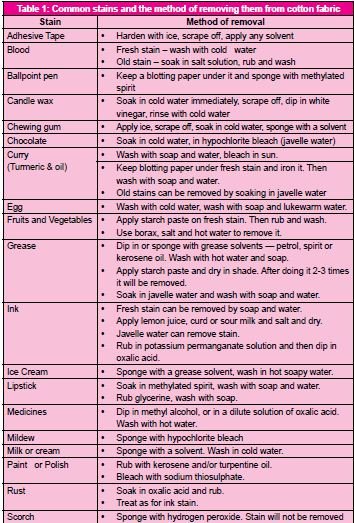
Note:
(a) These are the methods of removing stains from white cotton fabrics. Suitable precautions should be taken when applying on other fibres or on coloured materials.
(b) Stain removal is the preparatory step in laundry. It must be followed by washing or dry-cleaning and all traces of chemicals used should be removed.
Removal of dirt – the cleaning process
Dirt is the term applied to grease, grime and dust jammed between the fabric structure. There are two types of dirt. One, which is held loosely onto the fabric and can be removed easily and the other, which is held tightly by means of sweat and grease. The loose dirt can be simply brushed or shaken off or will be removed by steeping in water. The tightly held grease can be loosened in steeping process, but requires reagents that will act upon the grease to loosen the dirt. There are three main methods of removing grease – by the use of solvents, absorbents or emulsifiers. When cleaning is done by solvents or absorbents it is called dry cleaning. Normal cleaning – washing is done in water with the help of soaps and detergents, which emulsify the grease (break it in to very small particles). This is then rinsed with water.
(i) Water is the most valuable agent used for laundry work. There is a certain adhesion between fabrics and water. During steeping water penetrates into the fabric and cause wetting. Pedesis or the movement of water particles helps to remove the non-greasy dirt from the fabric. Washing in water alone, with agitation provided by hand or machine, will remove some loose dirt and particulate soils. Increase in temperature of the water increases its pedesis and its penetrating power. It is further beneficial when the dirt is greasy. However, water alone cannot remove the dirt that is not soluble in water. It also does not have the ability to keep the dirt suspended resulting in the removed dirt getting redeposited on fabric. Redeposition of dirt is the major cause of fabric graying over repeated launderings.
(ii) Soaps and detergents are the most important cleansing agents used in laundry work. Soap result from a reaction between natural oils or fats and alkali. If alkali is used in excess it is released when soap is used on the fabric. Synthetic detergents are synthesised from chemicals. Both soaps and detergents are sold in powder, flake, bar and liquid forms. The type of soap or detergent to be used depends on the fibre content, colour and the type of dirt on the fabric.
Both soaps and detergents share a critical chemical property – they are surface–active agents or surfactants. In other words, they reduce the surface tension of water. By reducing this effect water soaks more easily in clothes and removes stains and dirt faster. Surfactants and other ingredients in laundry detergents also work to keep the removed soils suspended in the wash water so they do not redeposit on to the clean fabrics. This prevents graying of fabrics.
There are some differences in soaps and detergents. Soaps possess a number of qualities that make them preferable to detergents. As mentioned earlier, they are natural products and less harmful to the skin and environment. Soaps are biodegradable and do not create pollution in our rivers and streams. On the other hand, soap is not effective in hard water, which results in wastage. Another shortcoming of soap is that it is less powerful than synthetic detergent and tends to lose its cleaning power over time. An added benefit of detergent is that they can be specifically engineered for each cleaning task and for use in different types of washing machines.
(iii) Methods of washing: Once the soap or detergent has emulsified the grease holding the dirt, it has to be held in suspension till it is rinsed out. Some parts of the fabric may have dirt, which is closely adhering to the fabric. The methods employed for washing assist in these two tasks – disassociating the dirt adhering to the fabric and holding it in suspension. The method selected depends on the fibre content, the type of yarn and fabric construction and the size and weight of the article being washed.
The methods of washing are classified as follows:
- Friction washing
- Kneading and squeezing
- Suction
- Washing by machines
Let us now discuss these methods in detail.
(a) Friction: This is the most commonly used method. This method of cleaning is suitable for strong fabrics like cottons. Friction may be caused by rubbing one part of the garment against another part of the garment with hands. Alternately using a brush over the dirty parts kept on the palm of the hand or on a scrubbing board if the article is big are also examples of friction washing. Friction is not applied on delicate fabrics like silk and wool and on surfaces like pile, looped or embroidery.
(b) Kneading and squeezing: As the name suggests, this method involves gently rubbing with hands of the article in soap solution. Since the pressure applied in this is very low, it does not harm the texture, colour or weave of the fabric. Thus the method can be easily used to clean delicate fabrics like wool, silk, rayon and coloured fabrics. This method would not be effective for heavily soiled articles.
(c) Suction washing: This method is used for articles like towels where brush cannot be used and when it is too big or heavy to be handled by kneading and squeezing technique. The article is placed in soap solution in a tub and the suction washer is pressed down and lifted repeatedly. The vacuum created by pressing loosens dirt particles.
(d) Machine washing: Washing machine is a labour saving device especially useful for large institutions, like hotels and hospitals. These days a variety of washing machines are available in the market by different companies. The principle behind each is the same. This is to create agitation in the clothes to loosen the dirt. For washing in these machines, pressure is provided by the movement of either the tub in the machine or a central rod attached to the machine. The washing time varies with type of fabric and amount of soiling. Washing machines can be manual, semi-automatic and fully automatic.
Finishing
After washing it is very important to rinse the article in clean water till it is absolutely free of soap or detergent. Very often in the last rinse some other reagents are added which can help to restore the freshness or brightness of the fabric. Other reagents may add to the body of the fabric and improve its stiffness or crispness.
(i) Blues and Optical Brighteners: You must have observed that with repeated use and washings white cotton articles tend to loose their whiteness and become yellow in colour. In case of synthetic or manufactured fabrics and their blends the discolouration is more towards gray.
The use of blues is recommended to counteract yellowness and to restore the whiteness. They cannot remedy the grayness. Blue is available in the market as ultramarine blue (in the form of a fine powdered pigment) and as liquid chemical dye. Right amount of blueing should be used in the last rinse. The powder blue is pasted with a little amount of water and then added to more water. This solution is used immediately, as on standing this powder tends to settle at the bottom and would give patchy results. Liquid blues are easier to use and give more even results. Care should be taken to see that blue is applied to the fabric in a thoroughly wet (but not dripping) condition, which is free of folds of wringing. Move the article in the blue solution for a short duration, remove the excess moisture and place it for drying.
Optical Brightening Agents or Fluorescent brightening agents are compounds with low grade or weak dyes that possess the property of fluorescence. These compounds can absorb light at a shorter wavelength and re-emit them at a longer wavelength. Treating a fabric with an optical fluorescent brightener can give it an intense bright whiteness, which can counteract both yellowness and grayness. They can also be used on coloured printed fabrics. Optical brighteners are sometimes referred to as whiteners. However, they cannot destroy a colour and therefore should not be confused with bleaching.
(ii) Starches and stiffening agents: Repeated launderings cause loss to body of the fabric, which also looses its gloss and shine. Starching or use of stiffening agents is the most common technique to make the fabric firm, smooth and shiny. This finish not only enhances appearance and texture, but also prevents direct contact of dirt with the fabric. Starching also makes the subsequent washing easier as dirt clings to starch rather than to the fabric.
Stiffening agents are derived from nature, either plants or animals. The most common stiffening agents are starch, gum acacia, borax and gelatin.
(a) Starch is obtained from wheat (maida), rice, arrow-root, tapioca etc. They are available powder form in the market and have to be cooked before use. Consistency of starch depends on the thickness of the fabric to be starched. As a stiffening agent it is used only for cotton and linen. Thick cottons need light starching while thin fabrics need heavy starching. Commercially prepared starches available in the market are easy to use and do not necessarily require hot water for preparation.
(b) Gum Acacia or Gum Arabic is the natural gum obtained from the Acacia plant (babool tree) which is available in granulated lumps. The stiffening solution is prepared by soaking it overnight to dissolve it and then sieving it to get a lump free solution. This gives only light stiffening, which is more in the nature of crispness. It is used for silks, very fine cottons, rayons and silk and cotton blends.
(c) Gelatin is easy to make and use but is expensive compared to other homemade starches.
(d) Borax is not really a starch but the addition of a small quantity in the starch solution helps to improve its stiffening action. When the fabric is ironed after starching, borax melts and forms a thin film on the surface of the fabric. This is water repellent in nature and thus maintains the crispness even in humid climates.
Application of stiffening agent depends on the fibre content and the specific use of the article. For personal clothing it is often the user’s choice as well. Care has to be taken when applying the starch solution that the correct consistency of the starch is taken and the fabric is in a thoroughly wet (but not dripping) condition. The fabric is kneaded well in the solution, excess squeesed out and dried. When starching dark coloured cottons a small amount of blue or tea concoction can be added to the starch solution so that it does not show up as white patches.
(e) Drying: After the clothes have been washed, blued and starched, they have to be dried, before they can be ironed or stored. The best way of drying is to hang the fabrics outside in the sun with the wrong side facing out. Sun not only dries the clothes faster but also acts as an antiseptic, and also as a bleaching agent for white fabrics. Delicate fabrics like silk and woolens cannot be hung for too long in the sun, as strong sunlight damages these fabrics. Synthetic fibres lose their strength when exposed to sunlight. These fabrics also tend to turn yellow, which is irreversible. So, it is best to dry these fabrics indoors.
Ironing
After you have washed your articles, you would notice that these articles have wrinkles and undesired creases on them. Ironing helps to get rid of these and creates creases where desired. Good ironing requires three things high temperature, moisture, and pressure.
An iron can provide high temperature. It can be a charcoal iron or an electric iron. The charcoal iron though cheap has certain disadvantages. The coal that is used to produce heat may stain the article being ironed and most important is that the temperature cannot be controlled in this type of iron. Different fibre groups have different thermal properties. Due to this they need to be ironed at their specific temperatures This can be achieved by using an electric iron, where the temperature can be controlled. Thus, if electricity is not a problem, then an automatic electric iron is the best option.
The second requirement for ironing is moisture. Moisture would be automatically provided if you start ironing your clothes when they are damp after washing. If your articles are completely dry, then you can sprinkle some water on them and roll them in towel, so that moisture penetrates evenly throughout the article. Water can also be sprayed with a normal spraying bottle.
The third requirement for good ironing is pressure. This is provided manually by the movement of the iron over the article to be ironed. Iron is generally moved on the clothes along the length. The articles, which may stretch or loose their shape by the movement of iron, for example, laces should be pressed and not ironed. Pressing involves keeping the hot iron at one place on the cloth, then lifting it and then keeping it at another place on the cloth. Pressing can also be used for setting of any folds like creases, hems, pockets, plackets and pleats.
The table that one uses for ironing should be rightly padded, and yet firm. The top should have an even surface and should be of such size and height that it is comfortable for the worker. These days padded ironing boards are available in market. If these are not available, then on any leveled surface 3-4 layers of some thick fabric can be spread and used as a surface for ironing.
After ironing the articles are either given specific folds or are placed on hangers depending upon the storage space available. It is important that they are available in the finished state when required for use.
Dry-cleaning
Dry-cleaning can be defined as the cleaning of fabrics in a non-aqueous liquid medium. The important difference between dry and wet solvents is that while water is absorbed by the fibres, which causes shrinkage, wrinkle formation and colour bleeding; the dry solvents do not cause fibre swelling. Hence dry-cleaning is a safe method for cleaning delicate textiles. For dry-cleaning, the most common solvents used are perchloro-ethylene, a petroleum solvent, or a fluorocarbon solvent.
Dry-cleaning is generally done in industrial establishments and not at the domestic level. The items are brought to the cleaner’s and identified with a tag that includes special instructions. Items are first inspected and treated at a spot board. Because a solvent is used, stains that are water-soluble and other hard-to-remove spots must be treated on the spot board. Customers who identify the stains for the dry cleaner make the cleaning task easier and ultimately improve their satisfaction with the cleaned product.
Additional treatment that many dry cleaners are equipped to do include replacing buttons, doing minor repairs to items, replacing sizing, water repellency and other finishes like permanent creases, moth proofing and cleaning fur and leather. Some dry cleaners also clean and sanitise feather pillows, blankets, quilts and carpets, and clean and press draperies.
17.4 Storage of Textile Products
The weather is not the same all the year round in our country; hence we have clothing to match all temperatures. The need for specific fabrics for specific weather conditions necessitates the storage of those not needed at the particular time. Whatever be the clothes, they need to be clean and dry before they are packed and stored away. Woolens should be brushed well and dry cleaned before they are stored, all stains should be removed and all tears mended. Pockets are to be turned inside out, trousers and sleeves turned up; they must be examined and freed from dust, grit, soot etc. All clothing should be shaken, brushed, washed, ironed and folded. Pack loosely in cupboards or trunks. Too compact and tight packing may result in permanent creases sets at the folds of the fabrics. The shelves, boxes or closets chosen for storing should be clean, dry and insect free, away from dust and dirt. It is important that the packing should be in an atmosphere of very low humidity. Different fabrics require different care while storage, as each is susceptible to different micro organisms.
17.5 Factors Affecting Fabric Care
The selection, use, and care of fabrics depend on many factors. Fibre content, yarn structure, fabric construction, colour application and finishing are the important factors considered for the product.
Each type of fabric has its own individual characteristics and hence needs specific care.
Fibres of which fabrics are made influence their care requirements, as shown in Table 2.
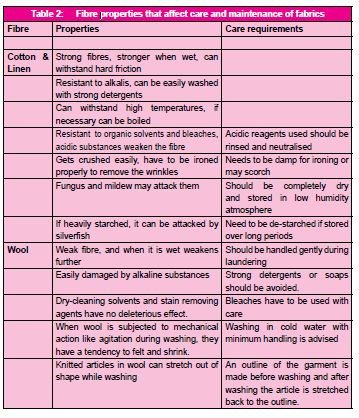
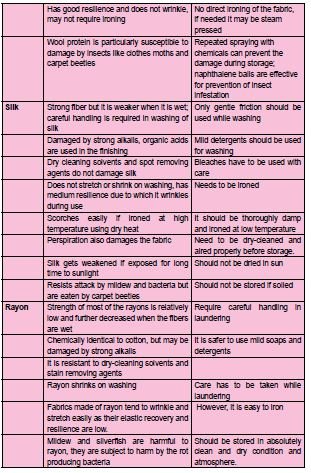
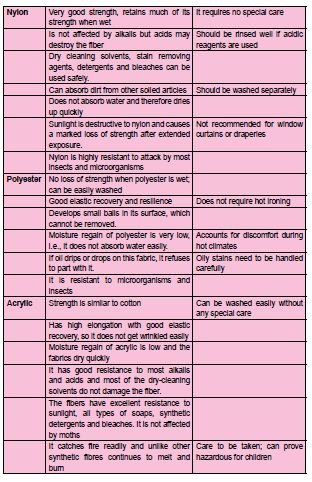
Yarn structure
Yarn structure (twist or type of yarn) may affect maintenance. For example yarns with high twist would shrink or novelty and complex yarns may catch or snag or get abraded. Blended yarns would mean that both fibre contents would have to be taken care of. You cannot use very hot water when polyester is blended with cotton since it would shrink, however it would not wrinkle much and therefore easier to iron.
Fabric construction
Fabric construction is closely related to maintenance. Simple closely woven fabrics are easy to maintain. Fancy weaves — satin, pile, or those with long floats may snag during washing. Knitted fabrics stretch out of shape and may thus require re-blocking. Sheer fabrics, laces and nets as also felts and non-wovens have to be handled carefully.
Colour and finishes
Colour is an important aspect of care. Dyed and printed fabrics may lose colour during cleaning and may stain other materials. The colour of the fabric may be tested before use and proper care needs to be taken in its use.
Many of the finishing treatments alter the behaviour of the fabrics, which may improve or cause problems. Some of the finishes may require renewal after every wash.
Thus, we can conclude that fibre content, yarn structure, fabric construction, colour application and finishing are the important factors considered for all fabric products. They combine to determine the appearance, comfort, durability and maintenance requirements. The importance of appearance, comfort, durability and maintenance are relative. It becomes our responsibility to evaluate the qualities of a fabric in terms of its ultimate end-use and then make the decisions concerning its use and care.
17.6 Care Label
The care label is a permanent label or tag containing regular care information and instructions that are attached or affixed in such a manner that it will not separate from the product and will remain legible during the useful life of the garment.
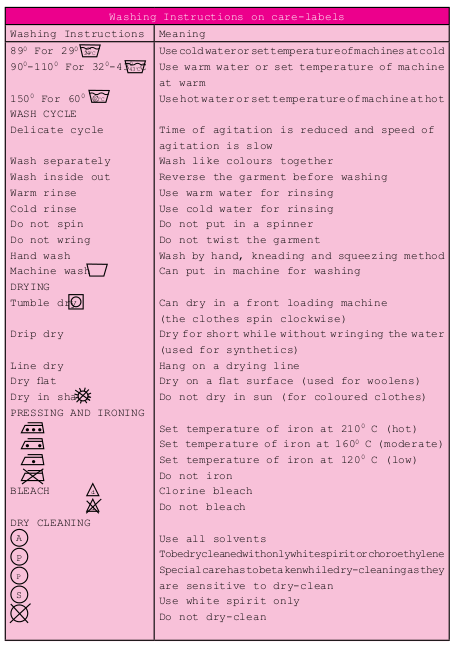
In one of the last chapters that follow this, we once again refer to the significance of communication – just as you read about this on the care labels. The next chapter tells us of the various reasons why communications are received differently by different people.
Key Terms
Mending, Laundry, Stain Removal, Water, Soaps and Detergents, Dry-cleaning, Friction, Suction, Kneading and squeesing, Blues and Starches, Care label
Review Questions
1. What are the different aspects of care and maintenance of fabrics?
2. Define the term ‘stain’. What are the different types of stains and what techniques can be used for removing them?
3. Write the steps in removing unknown stains from fabrics.
4. What is dirt? How do water, soaps and detergents combine to remove dirt from fabrics?
5. How does finishing after washing improve the brightness and textural characteristics of fabrics?
6. What is dry-cleaning? What are the types of fabrics where dry-cleaning is recommended?
Practical 17
Care and Maintenance of Fabrics
Theme: Colour fastness of fabrics
Task: Analysis of colour fastness to washing
Conduct of the practical: This type of knowledge will help the consumer make a wise choice for the care to be taken while washing coloured fabrics.
Conduct of the practical
- Take four samples each of coloured fabric and white cotton fabric measuring 2” x 4”.
- Join coloured samples with white samples to produce (4” X 4”) four samples (ABCD)
- Keep (A) as control sample and treat the samples B C D with already prepared 0.5% soap solution in warm water (40o C), rub gently.
- After five minutes rinse and dry.
- Repeat the process for samples C and D. Wash, rinse and dry.
- Repeat the process with sample D and record the observation.
Observations
|
Sample |
Change in colour of test samples |
Staining of white cloth attached |
|
A |
Control Sample |
- |
|
B |
||
|
C |
||
|
D |
Make a group of 4-5 students and compare the observations of other fabrics also.
Practical 18
Care and Maintenance of Fabrics
Theme: Study of labels on fabrics and apparel
Task: Analyse the information given on the fabric and apparel labels
Purpose of the practical: The appearance, care, and servicability of garments and other products made of fabrics is a concern for consumers. This information is provided to consumers through labels or hand-tags. The fabric or yardage material has information stamped on one end or on selvage at regular intervals. These labels aid the consumer in identifying their products’ properties and in caring for them in an appropriate manner so as to retain their claimed characteristics for a reasonable period of time.
Conduct of the practical: Collect five samples each of labels of readymade garment and ‘stampings’ on yardage.
- Analyse garment labels with respect to clarity, fibre content, size and care instructions regarding washing, ironing, storage etc.
- Analyse stampings with respect to fibre content, yarn and fabric description, and finishes applied.
18 Perspectives in Communication
Learning Objectives
After completing this chapter the learner will be able to —
- know the meaning of and processes within communication.
- analyse the influence of age, education, gender, cultural background and exposure on communication.
18.1 Introduction
You have learnt about the important aspects of communication in the earlier chapters. Communication is a vital process for all in this information age. How does communication occur? It is a process in which a sender and a receiver are involved. A sender sends a message with some intention. Likewise, the message is received by a receiver according to her/his ability or perspective. The communication process is complete only when the intentions of the sender match with the aptitude of the receiver. If the views of the sender and the receiver match, a common meaning is derived. The perspectives of the sender and the receiver will determine effective acceptance of the message.
There are many factors that determine perspectives about communication. These are: age, education, gender, cultural background and exposure to communication. Let us study how each of these factors influence communication.
Age
Age has influence on communication. As one grows, fundamental changes take place: one is ideational (related to ideas), and the second is structural and material. Ideational changes refer to the changes in ideas. For example, the ideas about career and life are different for an 18-year-old teenager who is thinking of a career, a 40-year-old executive who is settled in her career and a 55-year-old who is reaching the end of his career. Structural changes refer to physiological and age-related changes in cognitive functioning. Many faculties are affected with age. Vision is the first faculty to be affected. The other faculties start deteriorating, some slowly and others rapidly. Consequently, how and what one communicates is influenced by age, and messages need to be adjusted and altered accordingly. Let us take an example of older persons. As one grows older, one may begin to experience difficulty in listening. For example, in noisy environments (such as a restaurant where loud music is playing) they often find it difficult to determine who is talking and what is exactly being said. Younger people may not have any such difficulty. Further, the selection of words and style of communication also differ according to age.
Material changes refer to changes in use of material for communication. For example, a teenager prefers a mobile phone to listen to music, or will download it from the internet, whereas, an adult will be comfortable using a record player or a CD player. In rural areas, an older adult will be comfortable listening to the radio. The ease with which the younger generation uses equipments for communication is not matched by older age groups. Thus, communication of older and younger people is bound to be affected by age, and so is communication between them.
Activity 1
Think about some words or phrases you commonly use at home that your parents disapprove of. What is their objection?
Education
Education broadens the horizon of knowledge. It develops the individual’s ability to think and apply knowledge, gives access to information and prepares people for careers. All these benefits enhance one’s capacity and scope to communicate. An educated sender is likely to articulate and express her/his thoughts more effectively; if the receiver is equally educated it leads to good communication. For example, when a teacher explains a concept to another teacher, it is at a higher level of cognition than the concept being explained to students. This is so partly due to the differences in educational levels of students and their teachers. Similarly, when concepts like global warming, deforestation, effect of pesticides on crops, consequence of heat on nutrients etc. are to be explained to farmers, health professionals, home-makers or officers, the vocabulary, information, the strategy and mode of communication need to be selected to suit their levels.
Culture
Culture is a complex whole that includes knowledge, beliefs, arts, morals, laws, customs, language and other habits of human beings as members of society. When we discuss the relationship between communication and culture, it includes the total spectrum of communication such as language, non-verbal communication, customs, perceived values, and concepts of time and space.
Culture varies widely within a country and throughout the world. Variations in culture account for differences in ways of living and expectations from members. We often find that it may not be easy to communicate with persons who are from cultures that are different from our own. Through greater understanding of cultural differences and sensitivity to unknown differences, many problems that arise due to cross-cultural communication can be resolved. Culture is important in business as well. There may be cultural differences in schedule of meetings, holidays, concern for punctuality, rules of etiquette and language usage to conduct business.
People from the same culture will have shared experiences including language, customs, value system, food habits, and so on. Therefore, their communication is facilitated. For example, in India we may not be very used to saying “thank you” in our everyday interactions with family and friends. However, the intonations in the voice or the facial expression would convey that one is thankful. In Western cultures however, not saying “thank you” would be considered ill-mannered. Another common example is the way of addressing people. In India the hierarchical structure defines how one addresses persons who are positioned at a certain level in the hierarchy vis-a-vis oneself. The terms “aap” and “tum” are used accordingly. In many Western cultures, however, irrespective of the age or position of the person, it is quite acceptable to address people older than oneself by their first name. Interestingly the English language does not have any words that distinguish between “aap” and “tum”.
Activity 2
Select any five words in your local language, and request two college students and two older persons to write down their meanings. Study the similarities and differences in their understanding.
Yet another example is of the concept of time. In India if people are invited for dinner to someone’s place and asked to come at 8.00 p.m., they generally interpret it as any time after 8 p.m. Even the person who is extending the invitation is more likely to say, “Come around 8 p.m.”. However, in many other cultures, like the Japanese, one is supposed to abide by the actual time given. In fact, not keeping to the time is considered rude, and in the workplace it may actually lead to a negative comment on one’s assessment report.
Gender
The differences between men and women range from biological to social ones. The extent of biological basis in gender differences is still a heavily debated issue in developmental psychology. Whether the tendencies are biological or learned, there is no denying that differences between men and women exist. Gender and culture intersect in ways that make the distinction between the two almost impossible. Although there are some universal gender stereotypes, culture intervenes to bring about differences in how these are manifested. Thus, it is relatively impossible to understand gender differences in communication without considering cultural context and social history. In certain cultures, men and women are socialised to communicate in different ways. For instance, women are encouraged to be more concerned with social consensus, sharing and caring; whereas, men are urged to focus on information, competitiveness and finding solutions.
Exposure to new knowledge
Exposure to new software and new technology provides practical insights into long-term social and economic implications of information communication technologies. These include automation in offices, in production, telecommunications, and electronic networks that connect organisations. As you may know, the advancement of communication technology has created new fields such as information management. With exposure to modern technologies, the way one looks at work patterns, shares information and ideas, and networks has changed. For example, with access to the internet, school students are able to do project work with relative ease and their approach to assignments has changed. People in offices communicate through e-mail. Today it has become easier to share one’s views on different issues with people anywhere in the world; reading, posting and exchanging information on the internet is one such mode. For example, a teacher wanted to write an article on “Teacher’s Day” which falls on 5th September. She did not want to write a routine article. She surfed on the internet and found that Teachers’ Day was celebrated in many countries in different ways. With access to the internet she was able to write an interesting and informative article. Children (under 10 years) of today who have access to TV channels such as National Geographic and Animal Planet get a lot of information on animals, their habitat, habits, and life patterns. Sensitising people to problems related to wastage of water, environment degradation, hygiene etc. can be done effectively through exposure to media. Thus, as you would have noted perspectives in communication will continue to change and new ideas and knowledge will be added.
We have now reached the end of the textbook on Human Ecology and Family Sciences. The last chapter that follows expects you to reflect on the responsibilities and rights of individuals such that these not only lead to their own well-being, but also that of their family and society.
Activity 2
Given below are a few situations. Study them and identify the factors that led to a different understanding for the sender and the receiver.
1. In a film appreciation class, the teacher had selected a Hindi film “Hari Bhari” by Shyam Benegal as an example of good cinema. The students did not feel the same way. They felt that “Dilwale Dulhaniya Le Jayenge’’ was an excellent movie. Why so?
2. A family was deciding where to go for an outing on a week-end. For the teenage children a nearby hill station was the perfect place for the outing, whereas, the grandparents preferred to go to a historical monument or visit temples.
Why was the week-end outing perceived differently by the children and the grandparents?
3. Nanda, a student of Class X was engrossed in the class, listening to the teacher Shri Pathak. Suddenly she said, “Sir, your screw is loose”.
The whole class burst out laughing.
Shri Pathak said, “I do not approve of what you just said. Do you not have manners”?
Naturally, the teacher was angry. Nanda was serious, she did not realise why she received such reactions from her classmates and the teacher. She was summoned by the teacher and asked to explain.
Nanda: Sir, the screw of your spectacle had become loose, so I thought I’ll tell you otherwise the eye glass will fall down.
Shri Pathak: Oh! I did not realise this. It’s okay, thanks for telling me.
The class was amused by her reply and in a way relieved that no mischief was intended. The teacher quickly checked his spectacles and set the screw tight.
Question: In the above example there was a difference in the perspectives of Nanda and Shri Pathak which caused a misunderstanding. What were their perspectives?
Key Terms
Perspective, Communication, Rapport talk, Report talk, Culture
Review Questions
1. Describe the role of culture in determining perspectives in communication.
2. How do age, gender and education influence the communication process?
- Website for reference
http://www.aging.utoronto.ca/node/95
19 Individual Responsibilities and Rights
Learning Objectives
After completing this chapter the learner will be able to —
- discuss the interface between responsibilities and rights.
- analyse one’s own responsibilities towards self, family, community and the larger society.
19.1 Introduction
You must have read about rights and responsibilities of individuals in different contexts. Let us begin with a brief recapitulation.
All individuals have the right to life, liberty, security, equality and dignity. These rights are enshrined to every man, woman, youth and child irrespective of their caste, race, colour, sex, religion, nation or place of origin or habitat, rural-urban differences or socio-economic backgrounds. The rights are enforced, either by individual or collective force or through mutual negotiations and help in the form of written or unwritten social contracts.
Rights and freedom do not exist in a vacuum or by mere belief. All freely exercised rights and freedom are contingent on people recognising these rights and supporting their implementation. Mutual and reciprocal respect and recognition among human beings is crucial and remains the basic principle for the protection of all types of rights. Rights and responsibilities are corollary to each other.
‘‘I learned from my illiterate but wise mother that all rights to be deserved and preserved come from duty well done” — Mahatma Gandhi.
Every right gives rise to a corresponding duty.
In the present times, we are becoming increasingly conscious about our rights, which is a positive development. Many non-government organisations (NGOs) are involved in efforts to educate people about their rights and ways to assert them. However, as we become aware of our rights, at the same time we also need to become sensitive and concerned about our responsibilities.
Activity 1
Conduct a brainstorming session on the following thought
“It has always been a mystery to me how men can feel themselves honoured by the humiliation of their fellow beings.” – Mahatma Gandhi
Individual rights for adults should and are always accompanied by responsibilities. If one values one’s own needs, interests, safety, feelings, wants, or the whole self and expects every part of her/his life worth caring for and protecting, She/he is expected to do the same for others. Where rights in general, and human rights in particular, are the resultant of certain essential basic human needs, responsibilities are sincere and committed efforts by an individual made for ensuring the protection of human rights of both, self and others. By fulfilling one’s responsibilities properly one can ensure protection of one’s own rights as a human being. These are the two sides of the same coin. For example, an adolescent has the responsibility to educate herself/himself and attend to the health of mind and body such that one’s own quality of life is enhanced along with that of the family; thereby the adolescent is fulfilling responsibilities towards one’s own self and also her/his family.
Although it is of utmost importance to assert one’s rights, it is equally significant to ensure that in the process of doing so, one is not violating another’s rights. For example, it is the right of every individual to celebrate a wedding or a festival with music. Yet, if the loud music from the “band-baja” late into the night is disturbing many people who live nearby, then it is violating their right to a noise-free environment during this time. Do you agree with this? Can you think of examples in which your own rights may be in conflict with another’s rights? How can such situations be reconciled?
An important aspect of responsibility is also to question and intervene when one observes violation of another’s right. For example, if you observe that a young girl walking down the street is being harassed by some boys and she is trying to protest, what would you do?
Study Figure 1 below and discuss the responsibilities that you have in this stage of your life.
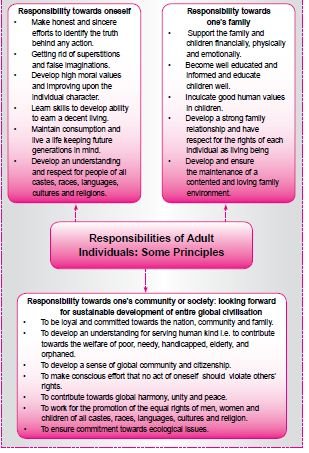
Figure 1: Responsibilities of an adult
19.2 Do Responsibilities and Rights Differ from Individual to Individual?
There is an extensive list of rights and their corresponding responsibilities in different combinations and permutations. Rights and responsibilities could be between nation states and international agencies, government and its citizens, employer and employee, teacher and student, parents and child, men and women, doctor and patient, consumer and producer or service provider, husband and wife and many more. In any relationship each has different sets of responsibilities. The same is true for rights. In a family, rights and responsibilities are played out in tandem. However, they are mediated by the cultural norms and beliefs, kinship, hierarchical relationships and gender roles of each individual. For example, the rights and responsibilities of an older brother will often be fundamentally different from that of a younger sister. Sometimes, it may also happen that cultural norms and beliefs could come into conflict with individual rights. For example, in Indian families there is the strong belief that children must seek parents’ approval in selection of their marriage partner. But what if the parents disapprove of the partner that the adult daughter or son has selected? What should the girl or boy do in such a case? What about the right of an individual to select a partner of one’s own choice?
Activity 2
Select any two individuals or groups who need to interact or work with each other on a regular basis, and outline their corresponding rights and responsibilities.
19.3 How to protect rights and promote the sense of responsibility?
We pass through different stages and situations in our life and accordingly our rights and responsibilities change. Newborns and infants obviously have no responsibilities but enjoy all rights of a human being. Responsibilities begin as the individual grows. However, it is necessary to give responsibilities to children from a very young age so that they learn its importance along with an assertion of their rights; with time, it would make them conscious about fulfilling their responsibilities as members of the family, community and society.
As we read in the chapter ‘‘Living and Working in a Global Society, in Part I of the book an individual’s quality of life is influenced by the different ecological contexts including one’s family, the neighbourhood or community and the society in which one grows and lives as well as other societies in the global world. With advancement in communication technology, we are able to see and hear about the difficulties that people in different parts of our own country as well as other countries may experience. For example, in 2008 we saw how the floods in Bihar washed away entire villages leaving many people homeless and destitute. During such natural calamities often there are requests for help in the form of money or clothes or food. Sometimes schools NGOs or even newspapers (e.g., Times of India) and news channels (e.g., NDTV) organise drives for help. What is our response to such initiatives? Do we have a responsibility to contribute in any way that we may be able to?
Activity 3
Read the following situation and discuss —
“Pushpa is 15 years old. Her father is a labourer and her mother works as a domestic help in several houses. Both of them are out of the house for most part of the day. In the evening Pushpa goes to a house nearby for two hours to do some cleaning and ironing work. She wants to study but is unable to go to school since she is the eldest daughter in the family; hence during the day she needs to stay at home to look after her younger brother and sister”.
The teacher should guide the discussion on the following questions.
Questions
- Is helping the parents to earn a living for the family called child labour?
- Is there any violation of Pushpa’s rights? Which rights are being violated?
- What about the responsibilities of Pushpa’s parents?
- What about Pushpa’s responsibilities towards her family?
Key Terms
Rights, Responsibilities, Duties
Review Questions
1. List any five responsibilities that you have as a member of your (a) family, (b) neighbourhood or community, and (c) society.
2. Explain the relationship between rights and responsibilities.
THE JOURNEY OF HUMAN RIGHTS
It covers thousands of years and draws upon religious, cultural, philosophical and legal developments throughout recorded history. Several ancient documents and later religions and philosophies included a variety of concepts that may be considered to be human rights. Much of modern human rights law and the basis of most modern interpretations of human rights can be traced back to relatively recent history.
Some of the notable documents and declarations among all are:
- Cyrus Cylinder of 539 BC, a declaration of intentions by the Persian emperor Cyrus the Great after his conquest of the Neo-Babylonian Empire.
- The Edicts of Ashoka issued by Ashoka the Great of India between 272-231 BC.
- • the Constitution of Medina of 622 AD, drafted by Muhammad to mark a formal agreement between all of the significant tribes and families of Yathrib (later known as Medina), including Muslims, Jews and Pagans.
- The English Magna Carta of 1215 is particularly significant in the history of English law, and is hence significant in international law and constitutional law today.
- The British Bill of Rights (or “An Act Declaring the Rights and Liberties of the Subject and Settling the Succession of the Crown”) of 1689 made illegal a range of oppressive governmental actions in the United Kingdom.
- Two major revolutions occurred during the 18th century, in the United States (1776) and in France (1789), leading to the adoption of the United States Declaration of Independence and the French Declaration of the Rights of Man and of the Citizen respectively.
- The Virginia Declaration of Rights of 1776 set up a number of fundamental rights and freedoms.
- Declaration of the Rights of Man and of the Citizen approved by the National Assembly of France, 26 August 1789.
- The establishment of the International Committee of the Red Cross, the 1864 Lieber Code and the first of the Geneva Conventions in 1864 laid the foundations of International Humanitarian Law to be further developed following the two World Wars.
- The League of Nations was established in 1919 at the negotiations over the Treaty of Versailles following the end of World War I. The League’s goals included disarmament, preventing war through collective security, settling disputes between countries through negotiation, diplomacy and improving global welfare. Enshrined in its Charter was a mandate to promote many of the rights that were later included in the Universal Declaration of Human Rights?
- At the 1945 Yalta Conference, the Allied Powers agreed to create a new body to supplant the League’s role. United Nations Organisations Charter in 1945 after the World War-II.
- Universal Declaration of Human Rights document (UDHR) 1948 and International Bill of Human Rights including International Covenant of Civil and Political Rights (ICCPR) and International Covenant of Social, Economic and Cultural rights (ICSECR).
Practical 19
Study of Adulthood
Theme: Study of one female and one male adult in the age range 35- 60 years with respect to
(i) health and illness
(ii) physical activity and time management
(iii) diet behaviour
(iv) coping with challenges
(v) media availability and preferences
Tasks:
1. Identify a female and a male adult in the age range 35-60 years
2. Collect information with respect to the above aspects by asking them specific questions
3. Analyse similarities and differences in responses and assess whether there are differences in responses due to age or gender.
Conduct of the practical: After identifying the two persons (they could be persons in your family or neighbourhood), ask them the following questions.
A. Questions related to health and illness
1. Have you had any health problem (s) or illness (es) in the past few years?
2. What treatment did you use? Did you seek medical help or did you use home remedies?
3. How did you manage the illness – by your self or with the support of family members or neighbours?
4. What do you do to keep yourself healthy?
5. Do you have health insurance?
B. Questions related to physical activity and management
1. Briefly describe your routine for the day (from the answer you get to this question, try to find how physically active the person is during the day)
2. What strategies do you use for accomplishing all the tasks that have to be done? Do you schedule specific activities for specific periods of
the day? Do you combine activities of a similar nature and do them together (the answer will give you insights about how the person manages time)
C. Questions related to diet behaviour
1. What are the foods that you prefer to eat?
2. Are there any foods which you dislike?
3. In your family are there any foods avoided because of religious or social reasons?
4. What are the major influences on your food behaviour?
D. Questions related to coping with challenges
Each one of us faces one or the other challenging situation in our lives:
1. Can you state some challenging situation that you have had to face?
2. What emotions did you experience as you were passing through the situation?
3. How did you cope with this situation – were you alone in the situation or there were members of the family to help you cope?
4. Do you think that you could have responded differently than the way you did?
E. Questions related to media availability and preferences
1. Which media is available to you for reading/viewing – newspapers, radio, television, films?
2. Which media do you prefer and why?
3. What programmes or items do you like to watch/read in your preferred media?
4. When do you read/watch your preferred media?
Record your finding with respect to each of the above aspects using the following type of tables.
A. Health and illness
|
S.No. |
Health problem/illness |
Treatment used |
Self-management of illness/ support of family or others |
Measures to maintain health |
Health Insurance |
|
Adult woman |
|||||
|
Adult man |
B. Physical activity and time management
Physical activity and time management: Adult woman
|
Time (in hrs) |
Activity |
Physical activity and time management: Adult man
|
Time (in hrs) |
Activity |
Comment on the time management strategies used, based on the principles you have studied.
Adult woman
_____________________________________________________
_____________________________________________________
_____________________________________________________
_____________________________________________________
_____________________________________________________
_____________________________________________________
Adult man
_____________________________________________________
_____________________________________________________
_____________________________________________________
_____________________________________________________
_____________________________________________________
_____________________________________________________
C. Diet behaviour
|
S. No. |
Foods preferred |
Foods Disliked |
Foods avoided due to religious or social reasons |
Factors influencing food behaviour |
|
Adult woman |
||||
|
Adult man |
D. Coping with challenges
Describe in the following space the challenging situation faced by the two adults and their ways of coping
Adult woman
___________________________________________________
___________________________________________________
___________________________________________________
___________________________________________________
___________________________________________________
___________________________________________________
Adult man
___________________________________________________
___________________________________________________
___________________________________________________
___________________________________________________
___________________________________________________
__________________________________________________
E. Media availability and preferences
|
S.No |
Media availability |
Media preference |
Programmes/items/columns preferred |
Time for watching /reading media |
|
Adult woman |
||||
|
Adult man |
CROSSWORD PUZZLE
Dear Student,
You have learnt several new terms and concepts in the preceding chapters. Now we shall play a game. This game will be fun as well as entertaining. You are required to read the clues presented on the next page and attempt to fill in the answers in the crossword puzzle given below. One has been done for you.
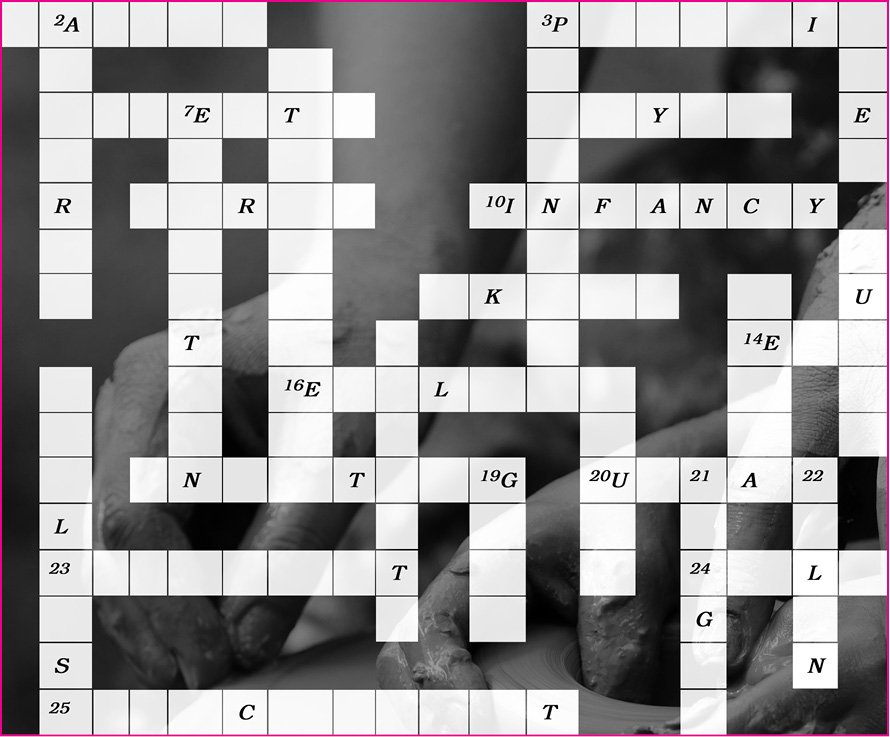
CLUES
ACROSS
1. A group consisting of parents and their children and/or other members
3. An essential nutrient consisting of amino acids
6. The period or age when a person first becomes capable of sexual reproduction
8. A regenerated semi-synthetic fibre
9. Of or pertaining to village life
10. The period of very early childhood
12. The ability or talent to do something based on practice or knowledge
14. A nourishing, protein rich food
16. A branch of study dealing with the relationship between persons and the environment
18. The act of forming a fabric by looping a yarn
20. Of or pertaining to city life
23. A substance providing nourishment
24. Viscous liquids made of vegetable or animal fat
25. A person’s idea about himself or herself
DOWN
2. Clothing, especially outerwear
3. The process of bringing up children in a family
4. A requirement or necessity of a person
5. Sharing a special, emotional bond with another person
7. The act or process of imparting knowledge
11. A sweat foodstuff that provides quick energy
13. A means of communication, like TV, radio
15. The state of being in good health
17. A period between childhood and adulthood
19. The act of giving goods to another person as a token of affection, regard or ceremony
21. A kind of alternative fuel
22. A common synthetic fibre
Answers
Across
1. Family, 3. Protein, 6. Puberty, 8. Rayon, 9. Rural, 10. Infancy, 12. Skill, 14. Egg, 16. Ecology, 18. Knitting, 20. Urban, 23. Nutrient, 24. Oils, 25. Self-concept
Down
2. Apparel, 3. Parenting, 4. Need, 5. Attachment, 7. Education, 11. Sugar, 13. Media, 15. Wellness, 17. Youth, 19. Gift, 21. Biogas, 22. Nylon
References for Further Reading
Chattopadhyay, K. 1985. Handicrafts of India. Indian Council for Cultural Relations.
New Delhi.
Chisti, R. K., and Jain, R. 2000. Handcrafted Indian textiles. Roli Books. New Delhi.
Damhorst, M L., Miller, K. A., and Michelman, S. O. 2001. The Meanings of Dress. Fairchild Pub. New York.
D’Souza, N. 1998. Fabric Care. New Age International Pvt. Ltd. New Delhi.
Ghosh, G.K. and Ghosh, Shukla 1983. Indian Textiles. Rinehart and Winston. New York.
Gupta, C. B. 2004. Management Concepts and Practices (5th ed.). Sultan Chand & Sons. New Delhi.
Harnold, K. H. 2001. Essentials of Management. Tata McGraw Hill. New Delhi.
Joseph, M. L. 1986. Introductory Textile Science. Rinehart and Winston. New York.
Joshi, S.A. 1992. Nutrition and Dietetics. Tata McGraw Hill. New Delhi.
Kumar, K. J. 2008. Mass Communication in India. Jaico Publishing House Mumbai.
Mahan, K. L., and Escott, S.S. 2008. Krause’s Food and Nutrition Therapy (12th ed.). Elsevier Science. Boston.
Mangal, S.K. 2004. Advanced Educational Psychology. Prentice Hall. New Delhi.
Mishra, G., and Dalal, A. K. (Eds.). 2001. New Directions in Indian Psychology: Vol. 1. Social Psychology. Sage. New Delhi.
Mudambi, S.R., and Rajagopal, M.V. 2001. Fundamentals of Foods and Nutrition. New Age International Pvt. Ltd. New Delhi.
Pandey, I. M. 2007. Financial Management. (9th ed.). Vikas Publishing House.
New Delhi
Pankajam, G. 2001. Extension Third Dimension of Education. Gyan Publishing House
New Delhi.
Rao Raja, S.T. 2000. Planning of Residential Buildings. Standard Distributors.
New Delhi.
Saraswathi, T. S. 1999. Culture, Socialisation and Human Development. Sage.
New Delhi
Sawhney, H. K., and Mital, M. 2007. Family Finance and Consumer Studies. Elite Publishing House. New Delhi.
Sharma, D. 2003. Childhood, Family and Socio-cultural Change in India: Reinterpreting the inner world. OUP. New Delhi.
Sharma, N. 2009.Understanding Adolescence. National Book Trust. New Delhi.
Srivastava, A. K. 1998. Child Development: An Indian Perspective. NCERT. New Delhi.
Sturm, M. M., and Grieser, E. H. 1962. Guide to Modern Clothing. Mc Graw Hill.
New York.
Vidyasagar, P.V. 1998. Handbook of Textiles. Mittal Pub. New Delhi.
Wadhwa, A., and Sharma, S. 2003. Nutrition in the Community. Elite Pub. New Delhi.
Yadava, J.S., and Mathur, P. 1998. Issues in Mass Communication, the Basic Concepts. Vol. 1. Kanishka Pub. New Delhi.
NOTES