3 अनुवाद की प्रक्रिया
The Process of Translation


3. अनुवाद की प्रक्रिया
I. संक्षिप्त परिचय
II. विश्लेषण
III. भाषांतरण
IV. पुनर्रचना
3. The Process of Translation
I. An Introduction
II. Analysis
III. Transference
IV. Restructuring
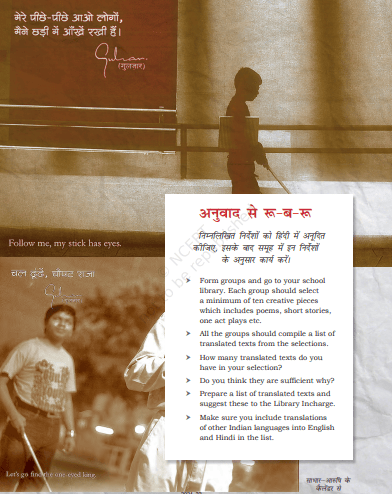
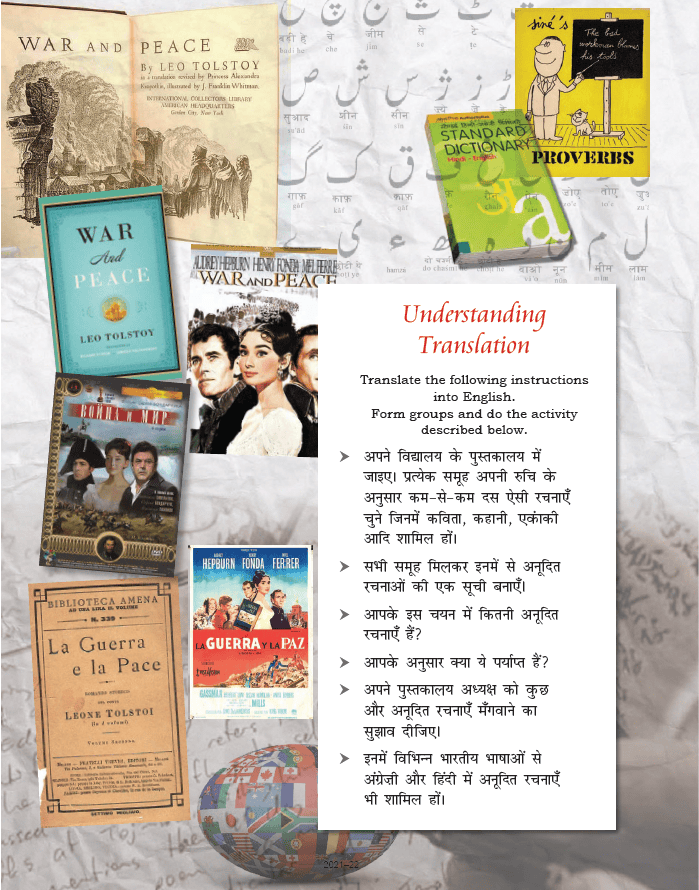
अनुवाद से रू-ब-रू
- Form groups and go to your school library. Each group should select a minimum of ten creative pieces which includes poems, short stories, one act plays etc.
- All the groups should compile a list of translated texts from the selections.
- How many translated texts do you have in your selection?
- Do you think they are sufficient why?
- Prepare a list of translated texts and suggest these to the Library Incharge.
- Make sure you include translations of other Indian languages into English and Hindi in the list.
संक्षिप्त परिचय
यह बहु-प्रचलित अंग्रेजी नर्सरी राइम का अनुवाद है। अनुवाद करते समय बहुत-से ऐसे परिवर्तन किए. गए हैं जो सृजनात्मक अनुवाद करते समय ज़रूरी होते हैं-उदाहरण के लिए राजा प्रभावशाली होता है, कुछ भी करा सकने में समर्थ। मूल पाठ राजा के नौकरों की मजबूरी संकेतित करता है-'कुड नॉट पुट हंपटी-डंपटी टूगेदर अगेन|। अनुवाद में राजा की मंशा पर संदेह व्यक्त किया गया है- 'हंपटी-डंपटी कभी न जोड़ें' सुनकर ऐसा लगता है कि चाहते तो जोड़ लेते लेकिन चाहते ही नहीं। दूसरा अनुवाद और भी रचनात्मक है, और उसके अंतर्पाठीय प्रयाण काफ़ी महत्वपूर्ण जान पड़ते हैं। मूल राइम है-
“लिटिल मिस मफ़ेट
सेट ऑन अ टफ़ेट
ईटिंग हर कर्ड्स ऐण्ड ह्वे
देयर केम अ बिग स्पाइडर
एण्ड सैट डाउन बिसाइड हर
इट फ्राइटेण्ड मिस मफ़ेट अबे ॥
अनुवाद इसे ऐसे पढ़ता है-
मुफ़्ती माई, दलाई-मलाई,
घास में बैठके खाई,
जब बड़ा-सा मकड़ा
उसकी साड़ी को पकड़ा
भागी मुफ़्ती माई
सबसे पहले तो यहाँ “मिस मफ़ेट' की मेम साहिबी झाड़ी गई है और उसे एक छोटी लड़की के बदले “माई” बना दिया गया है-एक अम्मा जो प्रेमचंद की “बूढ़ी काकी', उदयप्रकाश के “छत्तीस तोले का करधन' की बुढ़िया और निराला के 'भिक्षुक' की तरह दाने-दाने को मोहताज़ है। घर में खाना नहीं मिलता तो कहीं से बटोरकर लाती है। और घर के बाहर, कहीं घास पर बैठकर खाती है। निराला के भिक्षुकों की स्पर्द्धा जूठे पत्तलों के पास मँडराते कुत्तों से बनती है-
चाट रहे हैं जूठे पत्तल
कहीं सड़क पर खड़े हुए
और झपट लेने को उनसे
कुत्ते भी है अड़े हुए।
यहाँ कुत्ते नहीं है पर मकड़ा है। यह बड़ा-सा मकड़ा अंग्रेज भी हो सकता है। इस तरह के सैकड़ों प्रतिकार अनुवाद के माध्यम से घटित हुए होंगे। अनुवाद करते समय इस तरह के तमाम बदलाव परिवेश, भाषा और समय के अनुसार भी होते हैं। जैसे भारतेंदु हरिश्चंद्र ने 'मर्चेट ऑफ़ वेनिस' का जब अनुवाद करना शुरू किया था तो “वेनिस के व्यापारी' के नाम से शुरू किया। भाषा नीति बदली तो बाद में उसका एक हिस्सा “वेनिस के सौदागर' नाम से प्रकाशित हुआ। इस तरह के अनुवाद सृजनात्मक प्रक्रिया द्वारा ही संभव है, पर एक भाषा से दूसरी भाषा में आवाजाही करने के लिए कुछ ज़रूरी बातों पर ध्यान देना होगा।
2 . विश्लेषण
अनुवाद का अर्थ है-किसी भी मसौदे को एक भाषा से दूसरी भाषा में इस तरह बदलना कि मूल मसौदे का आशय अनूदित मसौदे में आ जाए। सामान्य गद्य- खबरों, लेखों, विज्ञापनों का अनुवाद इसी प्रकार किया जाता है। इसका अर्थ यह हुआ कि अनुवाद की पहली शर्त हे-किन्हीं भी दो भाषाओं में महारत होना। एक वह, जिससे अनुवाद किया जाना हे, दूसरी वह जिसमें अनुवाद किया जाना हे। किंतु सृजनात्मक साहित्य अर्थात् कविता, नाटक, कहानी के अनुवाद के लिए महज़ दो भाषाओं में महारत को ही पर्याप्त नहीं माना जा सकता। कहानी और नाटक में संवाद होते हैं और संवादों का रूप हरेक भाषा में, बोलचाल के लहतसज़े के हिसाब से अलग तरह का होता हे। उनमें मुहावरे होते हैं, व्यंग्य का, गुस्से का, प्रसन्नता का, विस्मय का भाव होता है। मात्र शब्दकोश की सहायता से या
अर्जित सामान्य भाषा-ज्ञान के सहारे संवादों का एक से दूसरी भाषा में अनुवाद नहीं किया जा सकता। अगर किया जाएगा, तो उनमें एक तरह का सपाटपन होगा। वह स्वाभाविक रंग उनमें नहीं होगा, जो किसी भाषा में बोलचाल की रवानी का होता है। इसके साथ-साथ कहानी में वृत्तात या नेरेशन की भी अपनी अलग विशिष्टता होती हे-हर भाषा की, यहाँ तक कि हरेक कथाकार की अपनी एक खास शैली होती हे-कहानी कहने की। इस दृष्टि से कहानी या नाटक के अनुवाद का काम सामान्य अनुवाद की तुलना में अलग तरह का और विशिष्ट हो जाता है। सिर्फ़ भाषा-ज्ञान के सहारे उसे ठीक-ठीक अंजाम नहीं दिया जा सकता। वहाँ एक भाषा के सृजनात्मक स्वभाव को दूसरी भाषा के सृजनात्मक स्वभाव में इस तरह ढालना होता है कि अनुवाद जैसा न लगे। मूल भाषा या स्रोत भाषा से लक्ष्य भाषा में अनुवाद करते हुए लक्ष्य भाषा की स्वाभाविक रंगत लाना यहाँ अनुवादक की कसौटी होगी। नाटक के अनुवाद में तो सामान्य अनुवाद-प्रक्रिया से काम चला लिया जाएगा, क्योंकि वहाँ निर्देशक और अभिनेता अभिनय की ज़रूरत के अनुसार संवादों को बदल लेते हैं, किंतु कहानी को तो सीधे छपकर पाठक से ही मुखातिब होना है। यही कारण है कि कहानी का अनुवाद करते हुए अनुवादक को दोहरी भूमिकाएँ निभानी होती हैं-मूल या स्रोत भाषा की रचना में पैठकर उसकी अंतरात्मा से एकाकार होना और फिर लक्ष्य भाषा में रूपांतरित करते हुए उसे उस भाषा की कहानी का मौलिक चोला पहनाना। इस काम को सफ़लतापूर्वक तभी अंजाम दिया जा सकता है, जब अनुवादक स्वयं अपनी भाषा का कहानीकार हो या कम-से-कम कहानियों का सहदय पाठक तो हो ही कि उसे कहानी-लेखन की मूलभूत स्थापनाओं का बुनियादी ज्ञान हो। वह भाषा की बारीकियाँ जानता हो।
अनुवाद को लेकर दो दृष्टियाँ
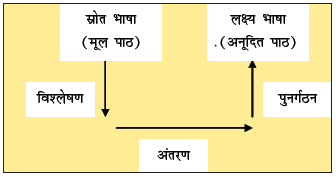
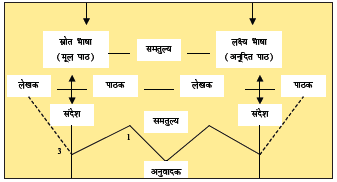
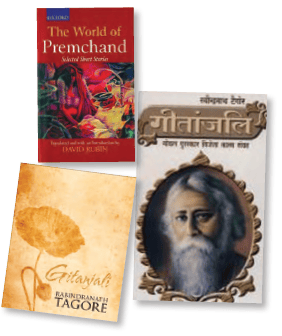
अनुवाद को लेकर दो दृष्टियाँ दिखाई पड़ती हैं-एक पाठपरक और दूसरी प्रक्रियापरक। पाठपरक दृष्टि में हम अनूदित रचना को एक बनी बनाई रचना की तरह देखते हैं और उसमें कोई परिवर्तन करना ठीक नहीं माना जाता। इसमें ध्यान इस बात पर होता है कि अनूदित पाठ मूल रचना के कितना नज़दीक है? वह कहाँ तक मूल रचना के संदेश को संप्रेषित करने में समर्थ है? और अपनी संरचनात्मक बनावट में भी मूल रचना के शिल्पविधान के कितना निकट है? यह दृष्टि कई मायनों में अनुवाद की अधूरी प्रक्रिया को लेकर चलती है। अनुवाद की प्रक्रिया में अनुवादक को तमाम ऐसे परिवर्तन करने पड़ते हैं, जिसे यह दृष्टि स्वीकार नहीं करती। दूसरी दृष्टि हे-प्रक्रियापरक दृष्टि। यह दृष्टि अनुवाद की सर्जनात्मकता को केंद्र में रखती हे। अनुवाद करते समय अनुवाद की समस्याओं को ध्यान में रखते हुए यह दृष्टि मूल रचना को समझते हुए दूसरी भाषा में पुनर्रचना की बात करती है। यहाँ यह सवाल मायने रखता है कि कोई अनुवाद मूल रचना से भिन्न है तो क्यों? अनुवाद की यह प्रक्रिया कैसे घटित होती है? इसका एक चित्र अगले पृष्ठ पर दिया जा रहा है। भाषा वैज्ञानिकों के अनुसार अनुवाद प्रक्रिया के तीन सोपान हैं- () विश्लेषण, (2) अंतरण और (3) पुनर्गटन। एक कुशल और अनुभवी अनुवादक इन तीन विभिन्न सोपानों को एक छलाँग में पार कर लेता है। पर अनुवाद के प्रशिक्षार्थी को इन तीन सोपानों से क्रमश: गुज़रना पड़ता हे। नाइडा ने अनुवाद के सोपानों को आरेखण द्वारा इस प्रकार व्यक्त किया है- दो भाषाओं के संप्रेषण - व्यापार के संदर्भ में अनुवादक को तीन प्रकार की विशिष्ट भूमिकाओं का निर्वाह करना पड़ता है- () मूल पाठ के पाठक की भूमिका, (2) (मूल पाठ के) संदेश को (अनूदित पाठ में) भाषांतरित करने वाले द्विभाषिक की भूमिका, और (3) अनूदित पाठ के रचयिता की भूमिका। आरेखण देखिए-- ऊपर अनुवाद की दो दृष्टियों की बात हुई है। आज विश्व स्तर पर साहित्य के अनुवाद की भी दो धाराएँ या दो स्कूल पहचाने जाते हैं। एक स्कूल की मान्यता है कि साहित्य का अनुवाद करते समय रचना को एक भाषा-संस्कृति से दूसरी भाषा-संस्कृति में प्रत्यागेपित | लेखक करें। यह एक बहुत सृजनात्मक प्रक्रिया छ्ज है, जिसमें अनुवादक को एक माली की तरह अपने दायित्व का निर्वाह करना होता है। एक माली जब पौधे को एक जगह से उखाड़कर दूसरी जगह प्रत्यारोपित करता है तो उसकी कुछेक गैर ज़रूरी पत्तियाँ, शाखें और मुख्य जड़ के आस-पास फ़ैले रेशों के जाल को, जो प्रत्यारोपित पौधे के समुचित विकास में बाधा खड़ी करते हैं, कुशलतापूर्वक छाँट देता है। ठीक इसी तरह एक साहित्य का अनुवादक भी किसी रचना को एक भाषा-संस्कृति से दूसरी भाषा-संस्कृति में प्रत्यारोपित करते हुए स्रोत भाषा के मसौदे में इतनी छूट ले सकता है कि मूल रचना की आत्मा सुरक्षित रहे। इस प्रसंग में गुरुदेव रवीन्द्रनाथ टैगोर का नाम विशेष रूप से याद आता है। उनकी जिस काव्यकृति *गीतांजलि' पर उन्हें नोबेल पुरस्कार मिला, उसके गीतों का मूल बांग्ला भाषा से अंग्रेज़ी में अनुवाद स्वयं गुरुदेव ने किया था। उन्हें भी वहाँ इसी पद्धति का अनुगमन करना पड़ा, क्योंकि बांग्ला कविता और अंग्रेज़ी कविता के स्वभाव में बहुत अंतर है।
भाषातरण
अब हम कविता के अनुवाद के माध्यम से अनुवाद की प्रक्रिया पर बात करेंगे। कविता के अनुवाद को लेकर अनुवाद-विशेषज्ञों के बीच बहुत-सी बहसें दुनिया-भर में हुई हैं ओर जिस बात पर सर्वसम्मति बनी है, वह यह है कि कविता का अनुवाद सिर्फ़ कविता की बारीकियों को जानने वाले व्यक्ति को ही करना चाहिए। जो व्यक्ति कविता का प्रेमी नहीं है वह समझ ही नहीं सकता कि किसी कविता के शिल्प और उसकी काव्य-भाषा के साथ कविता-सुलभ संजीदगी से पेश न आने पर उसका मूल आशय या आत्मा नष्ट हो सकती है। जापान के एक महान मध्यकालीन कवि हैं- बाशो (जन्म-644), जिन्होंने जापानी कविता में “हाइकृ ' छंद का पुनर्सस्कार किया। हाइकू तीन चरणों और ॥7 वर्णों का एक छंद हे, जिसका लघु रूप दुनिया-भर की कविता में अब तक अनूठा माना जाता है। इसके पहले और तीसरे चरण में पाँच-पाँच और मध्यवर्ती दूसरे चरण में सात वर्ण होते हैं और प्रकृति इस छंद का प्रधान आलम्बन है।
जापानी कविता में अब बाशो और हाइकू को एक दूसरे के पर्याय के रूप में याद किया जाता है। बाशो के जिस एक हाइकू का दुनिया की लगभग सभी विकसित भाषाओं में काव्यानुवाद हुआ वह इस प्रकार है-
फ़ुरूडका या ताल पुराना
कावाजु तोबी-कोगु कूदा दादुर
मित्रु नो ओवा गुड़प्
(मूल जापानी पाठ ) (हाइकू का हिंदी में
काव्यानुवाद )
एक पुराना तालाब उसमें मेढ़क कूदा मेढ़क के कूदने की पानी से निकली आवाज़।
(हिंदी में शाब्दिक अनुवाद )
ब्रेकिंग दि साइलेंस
आफ एन ऐशिएंट पॉण्ड,
ए फ्रॉग जंपूड इनटु वाटर
ए डीप रिज़ोनेन्स।
(एक पुराने तालाब की चुप्पी को तोड़ते हुए, एक मेढ़क जल में कूदा। एक गहरी अनुज या हलचल।)
( व्याख्यात्मक काव्यानुवाद)
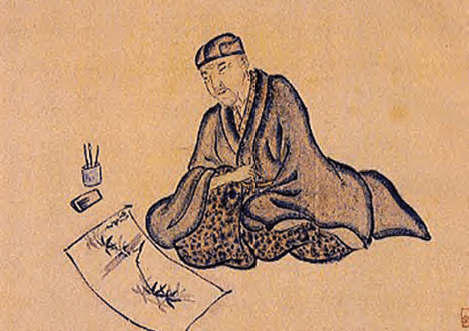
ऊपर बाशो के इस हाइकू के कई अनुवाद दिए गए हैं, पर यथार्थ रूपक नोबुयुकी के इस व्याख्यात्मक अनुवाद से ही खुलता है। कविता का मूल आशय जड़ता या जमाव को विखंडित करती गति से है। रूपक के अनुसार, एक पुराना जमा हुआ तालाब हे, जिसमें कोई हलचल नहीं है। एक मेढ़क उसमें कूदता है और उसके कूदने से तालाब के जल में एक गहरी हलचल होती है। जब इस रूपक और मूल कविता के उद्घाटित अर्थ के आलोक में हम उपर्युक्त हिंदी काव्यानुवाद पढ़ते हैं, तो साफ़ होता है कि कविता का मूल आशय यहाँ ठीक तरह से रूपांतरित नहीं हो पाया। बल्कि कहीं-न-कहीं विपरीत अर्थ ही निकलता है, क्योंकि “गुड़ुप' ध्वनि का जो चित्र संवेदना में उभरता हे वह गतिशील न होकर गतिहीन और जीवनहीन है। किसी भी जीवित पदार्थ के जल में कूदने या गिरने से गुडुप की नहीं बल्कि 'छप्' या छपाक्' की ध्वनि उभरती है और जल में आवर्तन होता है। गुडुप् की ध्वनि तब होती है, जब कोई कंकड़ या छोटा ढेला पानी में डाला जाए। वैसी स्थिति में जल में गहरा आवर्तन नहीं होता। एक कवि-अनुवादक का चातुर्य इसमें भी हे कि वह “गुडुप्! 'छपाक्' ध्वनियों के विवाद में न पड़ कर भी मूल कविता के निहितार्थ की रक्षा करे। रवीन्द्रनाथ टैगोर ने उक्त हाइकू का अनुवाद करते हुए यही किया। उन्होंने मूल हाइकू के तीसरे चरण का बाँग्ला में अनुवाद किया “जेलेर ध्वनि” “यानी जल की ध्वनि" यानी मेढ़क के कूदने से जल में ध्वनि हुई, जल ध्वनित हुआ । वह ध्वनि कैसी है-क्या हे, यह प्रत्येक व्यक्ति अपनी-अपनी तरह से परिभाषित-व्याख्यायित करने के लिए स्वतंत्र है। कविता-अनुवादक की मूल सफ़लता इस बात में हे कि उसने लक्षित कविता के मूलार्थ की काव्यानुवाद में भरपूर रक्षा की। इसी आशय से बाशों के इसी हाइकू का एक काव्यानुवाद यहाँ प्रस्तावित है। इसमें मूल कविता के आशय को सुरक्षित रखने के साथ-साथ हाइकू के छंद-विधान का भी ध्यान रखा गया है-
ताल पुराना
थिरक उठा,
जब कूदा दादुर
4 पुनर्रचना
मूल रचना में जोड़-घटाव
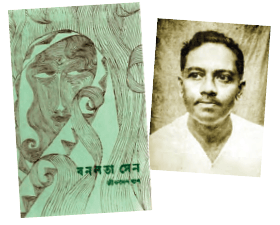
किसी छंदबद्ध कविता का अनुवाद करते हुए प्राय: कवि-अनुवादक को कुछ जोड़ना और कुछ घटाना पड़ता है। बिना कुछ जोड़े-घटाए, किसी छंदबद्ध कविता का छंदबद्ध कविता में अनुवाद बहुत टेढ़ा काम है। इसमें प्राय: अनुवादक डगमगा जाते हैं। इस दृष्टि से प्रख्यात बाँग्ला कवि जीवनानंद दास की बहुचर्चित कविता * बनलतासेन' उल्लेखनीय है। बनलतासेन एक स्त्रीवाची नाम है। उसके आलम्ब से कविता का ऊपरी रूपाकार कवि ने एक प्रेम कविता जैसा रखा है, किंतु उसकी अंतर्वस्तु में यह कविता प्रेम से बहुत आगे बढ़कर परंपरा, इतिहास और आधुनिकता से टकराती हुई आगे बढ़ती है। मूल कविता छंद में हे और हिंदी के कई वरिष्ठ व समकालीन कवियों ने इसका अनुवाद करने का प्रयास किया है। उनमें 'तारसप्तक' के कवि स्व. भारतभूषण अग्रवाल द्वारा किया गया काव्यानुवाद महत्वपूर्ण है। काव्यानुवाद उद्धृत करने से पहले मूल कविता की एक आँशिक झलक दे देना उचित होगा। जीवनानंद दास की मूल कविता का पहला छंद यह है-
हज़ार वेछर धरे आमि पथ हाँटितेछि प्रथिवीर पथे,
सिंहल समुद्र थेके निशीथेर अंधकारे मलय सागरे;
अनेक पूरोछि आमि; बिम्बिसार अशोकेर धूसद
जगते,
शेखाने छिलाम आमि; आरो दूर अधकारे विदर्भ
नगरे;
आमि क्लात प्राण एक, चारिदिके जीवनेर समुद्र
सफेन,
आमारे दु-दण्ड शांति दियेछिलो नाटोरेर बनलतासेना
इसका शाब्दिक गद्य अनुवाद पहले देख लें-
हज़ार वर्षों से में पृथ्वी पथ पर चलता आ रहा हूँ।
सिहल समुद्र से लेकर, रात्रि के अंधकार में, मलय
सागर तक/ अनेक लोग मुझे घूरते रहे; बिम्बसार
अशोक के धुधले अस्पष्ट जगत में/ में था, और
भी दूर अंधकारग्रस्त विदर्भ नगर में भी गया;/
मैं एक थका हुआ प्राणी, चारों ओर फेनयुक्त
गरजता जीवन सागर /(तब) मुझे नाटोर की
वनलता सेन ने दो पल का सुकून दिया था।
इसी क्रम में कविता आगे बढ़ती है और प्रत्येक पदबंध के अंत में टेक की भाँति “नाटोरेर बनलता सेन! आवृत्ति होती है। इसका हिंदी में काव्यानुवाद करते हुए भारत जी ने एक ओर जहाँ मूल कविता की छंदोबद्धता को सुरक्षित रखा, वहीं मोटे तौर पर ही सही, कविता की विषयवस्तु को अक्षुण्ण रखने का भी भरपूर प्रयास किया है। देखें उनके काव्यानुवाद का पाठ-
“पृथ्वी-पथ पर चलते-चलते बीत चुके हैं वर्ष
हजार
निशि के तम में मलय सिंधु तक घूमा सिंहल से
लेकर बिम्बिसार,
विजयी अशोक का देखा है धूमिल
संसार
उससे भी पहले तिमिरावृत वह विदर्भ का राजनगर,
क्लांत प्राण मैं, गज चतुर्दिक जीवन-सिन्धु हिलोर
की
शांति दे गई थी दो पल बनलता सेन नाटोर
की। .. . ”
यहाँ मूल पाठ से किंचित् छूटें ली गई हें, मूल संवेदना भी संभवत: पूरी-पूरी काव्यानुवाद में नहीं सिमट पाई है। वस्तुतः इसे ही एक भाषा से दूसरी भाषा में कविता के अनुवाद की सीमा या विवशता मानना होगा। किसी भी कलारूप को यथावत् रूपांतरित नहीं किया जा सकता। पेंटिंग में भी मूल कलाकृति और उसकी प्रतिकृति या प्रिंट में इतना अंतर तो दिखाई देता ही है। अंग्रेज़ी से हिंदी में अनुवाद करते समय दोनों भाषाओं की संरचनागत प्रकृति में अंतर के कारण बहुत बदलाव करने पड़ते हें।
मूल रचना को बार-बार पढ़ना
कविता के अनुवाद की बुनियादी शर्त यह है कि जिस कविता का अनुवाद करना हो, उसे पूरी तरह हृदयंगम किया जाए। इसके लिए मूल कविता को कई-कई बार पढ़ना पड़ता है, उसके शीर्षक का, कविता के रूपक अथवा कथ्य के साथ, क्या तार्किक आधार है, कवि-अनुवादक को अपने मानस में स्पष्ट करना होता है। कई बार हम मूल कविता को एक दो बार पढ़ कर ही भ्रम पाल लेते हैं कि हमने उसे पूरी तरह समझ लिया और अति उत्साह में उसका अनुवाद करने लग जाते हैं। वैसी स्थिति में बड़ी चूक हो सकती हे और अनुवाद में मूल कविता का अनर्थ हो सकता हे।
रचना के मूल उपागम की समझ बनाना
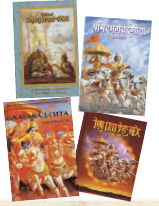
किसी भी रचना का अनुवाद करने से पहले उसे ध्यानपूर्वक पढ़ना और उसके मूल उपागम को समझना बहुत ज़रूरी होता है। कविता का मूल आशय समझने के बाद ही आप तय कर पायेंगे कि मूल पाठ और अनुवाद में कितना अंतर आ सकता है और लक्ष्य भाषा की प्रकृति के अनुरूप कितना फेरबदल उसमें करना पड़ सकता हे।
स्पेनिश भाषा में एक महाकवि हुए हैं-सेसर वाय्येखो। पेरू की उनकी नागरिकता थी। अंग्रेज़ी माध्यम से उनकी एक कविता का अनुवाद करते हुए अंतिम पदबंध में एक पहाड़ जैसी समस्या सामने आ खड़ी हुई, जिसे सुलझाने में मुझे कई वर्ष लग गए। और इसमें न डिक्शनरियाँ मेरी मदद कर पाई, न मूल स्पेनिश कविता का टेक्स्ट, न ही स्पेनिश थराषा-विशेषज्ञ। उस समस्या को हिंदी की अपनी काव्य-परपरा के अर्जित ज्ञान-भंडार की सहायता से ही-मुझे सुलझाना पड़ा। सेसर वाय्येखो की मूल स्पेनिश कविता के “दि एगर दैट ब्रेक्स मेन इनढु चिल्ड्रेन” (“गुस्सा, जो आदमी को तोड़कर बच्चों में बदल देता है?) शीर्षक वाले अग्रेज़ी पाठ का आंतिम पदबंध इस प्रकार है।
The anger that breaks soul into bodies, body into dissimilar organs and organ into thought eights the anger of the poor has a central fire against two craters.
अनुवाद करते हुए शेष सब कुछ तो ठीक-ठीक निभता गया, लेकिन 'थॉट एट्स” पर आकर गाड़ी अटक गई। सारे विकल्प आज़मा लेने के बाद भी कई साल तक अटकी रही ओर “थॉट एट्स” की गाँठ खुल नहीं पाई। और एक दिन अचानक सूरदास की पंक्ति “आठ पहर बंसीवट भटक्यों, साँझ पहर घर आयो” गुनगुनाते हुए यक्ूबयक् खुल गई। इस “आठ पहर” ने खोली 'थॉट एट्स” की गाँठ। और तब जो हिंदी में अनूदित पाठ तैयार हुआ, वह यह है- “... गुस्सा, जो रूह को तोड़ कर ढाँचों में बदल देता है ढाँचे को असमान अवयवों में और अवयवों को आठों पहर की चिताओं में, गरीब का वह गुस्सा ज्वालामुखी के दो मुहानों के मुकाबले एक केंद्रीय आग जितना विनाशकारी होता है।”
- एक कवि-अनुवादक का अनुभव
गद्य का अनुवाद
When I was very young, I was suitably impressed to learn that, appearances not Withstanding, the whale is not a fish. Nowadays these questions of classification move me less; and it does not worry me unduly when I am assured that history is not a science. This terminological question is an eccentricity of English language. In every other European language, the equivalent word to ‘science’ includes history without hesitation. But in the English-speaking world this question has a long past behind it, and the issues raised by it are a convenient introduction to the problems of method in history. At the end of the Eighteenth century, when science had contributed so triumphantly both to man’s knowledge of the world and to man’s knowledge of his own physical attributes, it began to be asked whether science could not also further man’s knowledge of society. The conception of the social sciences, and of history among them, gradully developed throughout the Nineteenth century; and the method by which science studied the world of nature was applied to the study of human affairs.
— History, Science, and Morality - E.H. Carr
हिंदी अनुवाद दिए जा रहे हैं
(1 ) जब मैं छोटा था तो मैं इस जानकारी से खासा प्रभावित हुआ था कि देखने में मछली जैसी लगने वाली हल दरअसल मछली नहीं होती। इस प्रकार के वर्गीकरण के प्रश्न अब मुझे कम प्रभावित करते हैं और जब मुझे यह विश्वास दिलाया जाता है कि इतिहास विज्ञान नहीं होता तो मैं ज़्यादा परेशान नहीं होता। अंग्रेज़ी में पारिभाषिक प्रश्नों से उलझने की एक सनक हे। दूसरी हरेक भाषा में इतिहास को बिना हिचक “विज्ञान! के अंतर्गत स्वीकार कर लिया गया है। मगर अंग्रेज़ी भाषी दुनिया में इस प्रश्न की एक लंबी परंपरा बन गई है और जिन मुद्दों को इसने जन्म दिया है उनमें 'इतिहास पद्धति की समस्या' का प्रश्न आसानी से जुड़ गया है। अठारहवीं शताब्दी के अंत में, जब विज्ञान की उपलब्धियों ने विश्व के बारे में और खुद आदमी की भौतिक विशेषताओं के बारे में उसके ज्ञान को बढ़ाने में एक बड़ी भूमिका अदा की थी, यह प्रश्न उठने लगा कि क्या विज्ञान समाज के बारे में आदमी का ज्ञान नहीं बढ़ा सकता? पूरी उन्नीसवीं शताब्दी में धीरे-धीरे सामाजिक विज्ञानों और उनमें इतिहास को शामिल करने की धारणा विकसित हुई। तभी से मानवीय व्यवहार का अध्ययन करने के लिए वह पद्धति अपनाई जाने लगी जिसे विज्ञान प्राकृतिक दुनिया का अध्ययन करने के लिए करता है। (2) जब मैं बहुत छोटा था, यह जान कर उचित ही प्रभावित हुआ था, कि एक जैसी दिखाई देने के बावजूद हेल मछली की श्रेणी में नहीं आती। वर्गीकरण के इस तरह के प्रश्न अब मुझे कम ही विचलित करते हैं, और वह बात बहुत चिंतित नहीं करती, जबकि मुझे भलीभांति पता है कि इतिहास कोई विज्ञान नहीं है। पारिभाषिकता का प्रश्न अंग्रेज़ी भाषा का एक वहम है। यूरोप की अन्य सभी भाषाओं में “विज्ञान! के समानार्थी जो शब्द हैं, निस्संकोच रूप से इतिहास उनमें समाहित है। कितु अंग्रेजी भाषी दुनिया में यह प्रश्न लंबी अवधि से छाया हुआ है, और इसके द्वारा उठाए गए मुददों से इतिहास की पद्धतिगत समस्याओं को सहज ही समझा जा सकता है। अठारहवीं सदी के अंत में, जब विज्ञान ने मानक के विश्व-ज्ञान-भंडार और उसकी अपनी शरीर-रचना संबंधी ज्ञान-राशि में बहुत ही उत्साहकर्धक योगदान किया, तो यह प्रश्न उभरना शुरू हुआ कि क्या विज्ञान, समाज संबंधी मानव-ज्ञान के विकास में भी योगदान नहीं कर सकेगा? उन्नीसवी सदी के दौरान समाज विज्ञानों, उन्हीं के अंतर्गत इतिहास की अवधारणा धीरे-धीरे विकसित होती रही है, और जिस पद्धति के विज्ञान ने प्राकृतिक जगत का अध्ययन किया, उसे ही मानवीय व्यवहार के अध्ययन कर लागू किया गया। ...”
- इतिहास क्या है?! ई. एच. कार इतिहास, विज्ञान और नैतिकता अध्याय का पूर्वांश
दोनों अनुवादों में रेखोकित अंशों पर ध्यान दें।
- Suitably impressed के लिए पहले अंश में “खासा प्रभावित” तो दूसरे अंश में “उचित ही प्रभावित' लिखा गया है। ये दोनों ही अनुवाद अर्थ को स्पष्ट करने में पूरी तरह समर्थ है।
- इसी तरह Move me less के लिए “मुझे कम प्रभावित” (पहले अंश में) तथा “मुझे कम ही विचलित' (दूसरे अंश में) का प्रयोग किया गया है। यहाँ पर दूसरा अनुवाद ज़्यादा ठीक लगता हे क्योंकि लेखक के बड़े होने के साथ-साथ उसकी जानकारी बढ़ी है और अब उसे इतिहास और विज्ञान का फ़र्क पता है। इसीलिए पहले विचार से विचलन का प्रश्न ही नहीं उठता।
- eccentricity के लिए 'सनक' और “वहम' शब्द का प्रयोग किया गया है। ये दोनों शब्द अंग्रेज़ी भाषा के संदर्भ में लिखे गए हैं किसी भाषा विशेष पर टिप्पणी करते हुए वहम शब्द का प्रयोग तो किया जा सकता है पर सनक शब्द का लिखा जाना उतना ठीक नहीं होगा। सृजनात्मक लेखन की तरह अनुवाद करते समय भी हमें ऐसे सख्त टिप्पणी वाले शब्दों या भाषा से बचना चाहिए जो किसी को ठेस पहुँचाते हैं।
इसीलिए एक भाषा से किसी अन्य भाषा में अनुवाद का प्रश्न काफ़ी जटिल है। इसका कोई एक पाठ नहीं हो सकता, क्योंकि अभिव्यक्ति के रूप एक से नहीं हैं। कविता का अनुवाद करते समय जो अनुवाद-पद्धति आदर्श हो सकती है, कहानी या नाटक का अनुवाद करते समय वही पद्धति आदर्श नहीं भी हो सकती है। सृजनात्मक पाठों का अनुवाद करते हुए जहाँ हमें व्यंजनात्मक पद्धति के निकट जाना होता है, वहीं वैचारिक और विश्लेषणपरक पाठ के लिए तथ्यात्मक पद्धति अपनानी पड़ती हे। ई.एच.कार की सैद्धांतिक पुस्तक “व्हाट इज़ हिस्ट्री' के संलग्न अंश का अनुवाद करते हुए इसी तथ्यात्मक पद्धति को आधार बताया गया है। ऐसा इसलिए किया गया क्योंकि इस पुस्तक में “इतिहास' की अवधारणा पर सैद्धांतिक व विश्लेषणात्मक शैली से विचार किया गया हे, जिसमें प्रत्येक शब्द का, वाक्यों अनुच्छेदों के क्रम का विशिष्ट किस्म का तार्किक महत्त्व हे। पाठ के साथ छेड़छाड़ करने में अर्थ का अनर्थ भी हो सकता है। ऐसे पाठों का अनुवाद करते हुए एक ओर जहाँ अनुवादक के समक्ष शब्द, मुहावरे व अभिव्यक्तिगत बहुत विकल्प नहीं होते, वहीं उसके सम्मुख वह लक्ष्मण रेखा भी रहती है कि संबंधित विषय की बुनियादी जानकारी उसे हो और यह भी कि अनूदित पाठ में उसे एक ऐसी भाषा विकसित करनी है, जो मूल लेखक के आशय को आसान शैली में यथातथ्य रख दे। संलग्न अंश का अनुवाद करते हुए इन्हीं सतर्कताओं से गुज़रना पड़ेगा।
अनुवाद में भाषा, मुहावरे और सामाजिक संदर्भों की जानकारी
Now the feet of the dancers grow heavy
अब नर्तकियों के पैर भारी हो उठे हैं।
-नाइट ऑफ साइने, एल.एस. सेंगोर ( प. आफ्रीकी )
हिंदी अनुवाद
इस अनुवाद में दो गलतियाँ हुई हैं। एक डांसर को मात्र स्त्री समझने की। लोकनृत्यों में पुरुष और स्त्रियाँ साथ-साथ नृत्य करते हैें। दूसरी-हिंदी मुहावरे की जानकारी का न होना। यह मुहावरा उन स्त्रियों पर प्रयुक्त होता है जो गर्भवती होती हैं। यदि पहली गलती यानि डांसर्स को नर्तकियों के बजाय नर्तक भी माना गया होता तो फिर दूसरी गलती यानि गलत मुहावरा भी न आता। यहाँ पर अंग्रेज़ी भाषा का अज्ञान, अफ्रीकी लोक संस्कृति का अज्ञान और हिंदी मुहावरों का अज्ञान एक साथ दिखाई पड़ रहे हैं। एक और उदाहरण देखें- Let the rail-splitters awake. पाब्लो नेरुदा (चिली) रेल-भंजकों को जगने दो (हिंदी अनुवाद) यह कविता मूल रूप से चिली के उन विद्रोही लकड्हारों के संदर्भ में लिखी गई थी, जो बड़ी-बड़ी कंपनियों से जुड़े थे और शोषण एवं दमन के शिकार थे। अंग्रेज़ी में रेल शब्द के कई अर्थ हैं, जिनमें से एक छड़, डंडा या लड्ढठा भी है। यहाँ आशय लकड़ी के बड़े-बड़े लट्टों को आरे से चीरने वाले श्रमिक बढ़इयों से है। हिंदी अनुवाद में उसे रेल हड़तालों के दौरान रेल की पटरियाँ उखाड़ने वाले आंदोलनकारियों से जोड़ दिया गया है। भाषिक स्तर पर कविता को “शब्दों का खेल! भी कहते हैं और हर भाषा के शब्दों का अपना भिन्न स्वभाव होता है, भिन्न अर्थ होता हे। बाँग्ला भाषा में प्रेम की उत्कटता के लिए “'भीषण' विशेषण प्रयोग किया जाता है, जबकि हिंदी में 'भीषक' शब्द का स्वभाव सर्वथा भिन्न है। प्रेम की उत्कटता के संदर्भ में तो उसका प्रयोग नहीं ही होता। इसी तरह बाँग्ला में एक शब्द है 'भालोबाशा' भालोबाशा को साथ-साथ लिखने पर उसका अर्थ होता है “प्रेम', और जब “भालो' अलग व “बाशा' अलग लिखे हों तो अर्थ होगा- “अच्छा घर'। इस तरह कविता के अनुवाद में एक ओर जहाँ मूल कविता के सामाजिक, सांस्कृतिक, आर्थिक, भौगोलिक व भावात्मक पूर्वापर संदर्भो को समझना ज़रूरी होता है, वहीं स्रोत भाषा व लक्ष्य भाषा के विविध स्तरों का पूरा व पक्का ज्ञान भी काव्यानुवाद की एक प्रमुख शर्त हे।
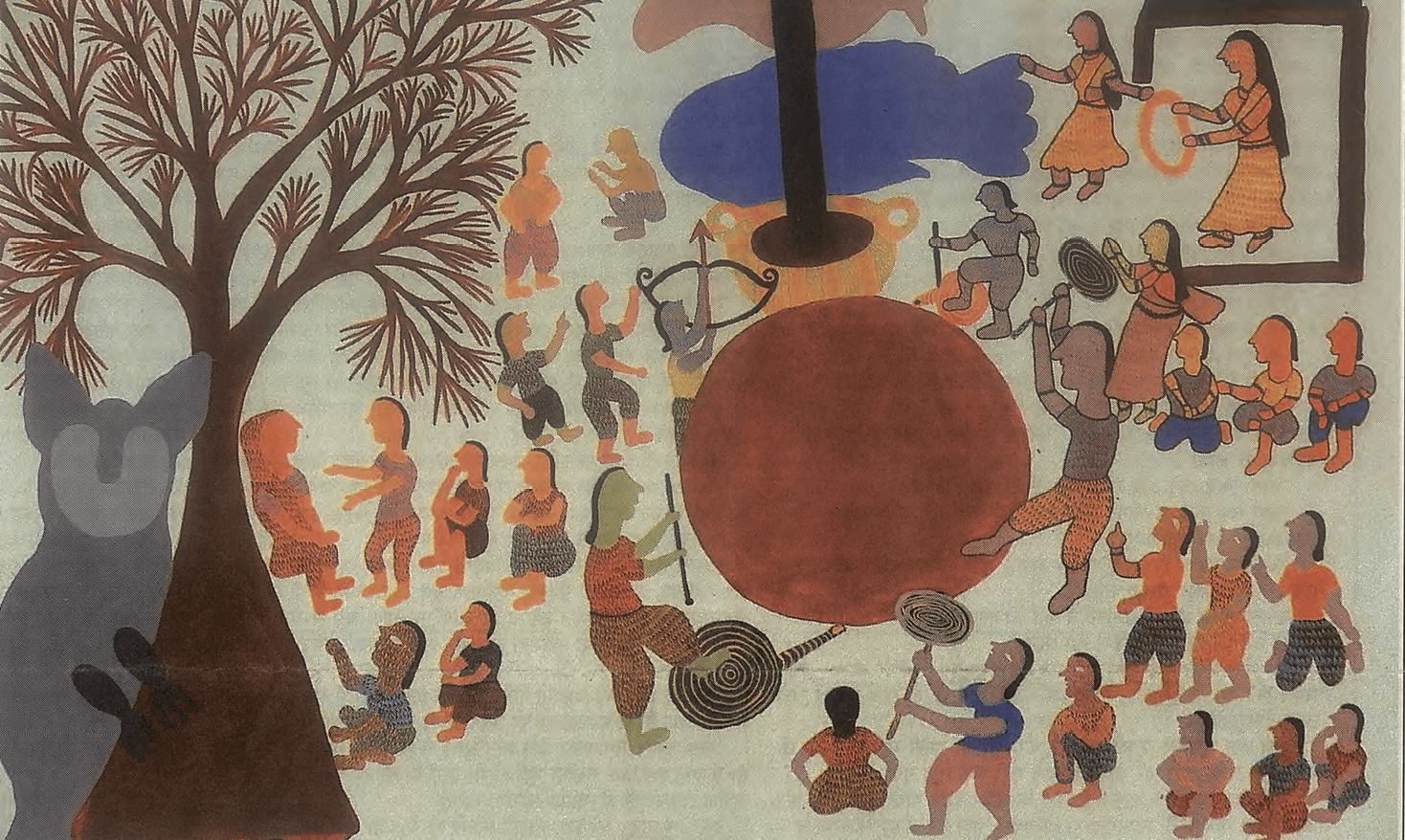
अनुवाद में रूपातरण का एक नमूना-(द्रौपदी स्वयंवर मध्यप्रदेश की गरॉंड शैली का चित्र (जनसत्ता से साभार)
अनुवाद के पूर्व तैयारियाँ
पहले ही उल्लेख हो चुका है कि अनुवाद-कर्म में दो भाषाएँ निहित होती हैं-एक मूल या स्रोत भाषा और दूसरी लक्ष्य भाषा, और यह भी कि अनुवादक का इन दोनों पर पूरा अधिकार होना चाहिए। नहीं है, तो उसे अर्जित करना होगा। किंतु काव्यानुवाद में संलग्न अनुवादकों की ज़रूरतें इतने भर से नहीं पूरी हो जातीं। दोनों भाषाओं पर पूरा अधिकार अर्जित करने के साथ-साथ उन्हें अपनी स्मृति में लक्ष्य भाषा के समानार्थी और विलोमार्थी शब्दों का एक व्यापक शब्द-भंडार विकसित और सुरक्षित करना होता है, क्योंकि मूल या स्रोत भाषा की कविता में एक ही भावाभिव्यक्ति की अनेक अर्थ-छवियाँ हो सकती हैं, बल्कि कहें कि होती हैं। उन सबको अनूदित पाठ में तब तक नहीं उतारा जा सकता, जब तक कवि-अनुवादक की स्मृति में एक वृहत्
शब्द-भंडार सुरक्षित न हो। उसी में से उसे विविध अर्थ-छवियों के अनुरूप स्वविवेक से शब्दों का चुनाव करना होता है। इसके साथ ही लक्ष्य भाषा की लम्बी साहित्य परंपरा को भी अनुवादक को हृदयंगम करना होता है। बड़े कवियों और गद्यकारों ने परंपरा में सुरक्षित जो भाषा विकसित की, जो विशिष्ट मुहावरे सृजित किए, अनूदित रचना की सौंदर्यवृद्धि में उनसे सहायता मिलती है। कभी- कभी मूल या स्रोत भाषा के पाठ की कूट अभिव्यक्तियों को खोलने में भी परंपरा से अर्जित वह ज्ञान-भंडार हमारी बड़ी सहायता करता है। अनुवाद करते समय ऐसी तमाम बारीकियों पर हमें ध्यान देना पड़ता है। सृजनात्मक लेखन का अनुवाद हो या तथ्यात्मक गद्याशों के अनुवाद दोनों ही स्थितियों में संदर्भ के अनुसार उचित शब्दों का प्रयोग, भाषायी संदर्भो के प्रति सचेतता तथा अनुवाद किए जाने वाले अंश को संपूर्णता में समझ कर अनुवाद करना ही ठीक होगा। इसी अर्थ में अनुवाद शुरू से अंत तक सृजनात्मक प्रक्रिया हे।
कार्यशाला में विद्यार्थी के द्वारा किए गए अनुवाद के नमूने
Me―An Exchange Student?
Could I, too, be an exchange student? The idea sounds frightening yet tempting at the same time. It would be unrealistic if you were not afraid at all, but the most important thing is that you want to go for it and that your expectations lie within reasonable limits.
मैं-एक बदला हुआ विद्यार्थी
क्या मैं भी एक बदला हुआ विद्यार्थी हो सकता हूँ। यह सुनने में बहुत ही अटपटा लगता है फिर भी लुभावना है। यह बहुत ही गलत होगा अगर हम कहें कि हम बिलकुल नहीं डरते, परंतु सबसे महत्वपूर्ण चीज़ यह है कि हम सब ऐसा बनना चाहते हैं और हमारी उम्मीदें हमेशा एक सही सीमा के तहत ही रह जाती हैं।
मैं-सांस्कृतिक आदान-प्रदान की छात्रा
मैं भी एक सांस्कृतिक आदान-प्रदान की छात्रा बन सकती हूँ? यह विचार डरावना है परंतु साथ-ही-साथ लुभावना भी है। यह सच नहीं होगा अगर आपको बिलकुल डर ना लगे। परंतु सबसे ज़रूरी है कि आप यह करना चाहते हैं और आपकी अपेक्षाएँ सीमित हैं।
मैं भी एक एक्सचेंज छात्र'
क्या मैं भी एक “एक्सचेंज छात्र' (एक्सचेंज छात्र -विदेश में किसी मेज़बान परिवार के साथ रह कर पढ़ाई करता है, जिसकी अवधि ज़्यादातर एक वर्ष होती है।) हो सकता हूँ? यह खयाल भयभीत करने वाला लेकिन लुभावना भी है। ये असत्य नहीं होगा अगर बिलकुल भी डर न लगे। परंतु सबसे आवश्यक चीज़ यह है कि आप जाना चाहते हैं और आपकी उम्मीद सीमा के भीतर हे।
मैं-मिलान केंद्र की विद्यार्थी
क्या मैं भी मिलान केंद्र की विद्यार्थी बन सकती हूँ। विचार कुछ जोखिम भरा-सा तो है पर बहुत लुभावना भी है। यह बात सोच के एकदम परे होगी, अगर इस विचार से आप ज़रा भी भयभीत नहीं हुए। जो भी हो महत्वपूर्ण बात तो यह है कि आप भी इसके लिए इच्छुक होगें और आपकी अपेक्षाएँ उचित सीमाओं के भीतर ही होंगी।
मैं-एक पलायन विद्यार्थी
क्या मैं भी एक पलायन विद्यार्थी हो सकती हूँ। इस तरह का विचार कभी-कभी डरावना सा लगता है व उसी समय यह विचार लुभावना भी लगता है। यह वास्तविकता न भी हो फिर भी डर-सा लगता है लेकिन फिर यह विचार महत्वपूर्ण हो जाता है कि तुम अपनी सीमाओं से परे तथा आशाओं की सीमा में रहते हो।
अग्रेज़ी के उपर्युक्त अंश को एक कार्यशाला में कई विद्यार्थियों ने अपने-अपने ढंग से अनूदित किया। इसे पढ़िए और कक्षा में चर्चा कीजिए कि इसमें शब्द चयन, वाक्य सरेचना, भाषागत परिवर्तन का कहाँ तक ध्यान रखा गया है। सभी अनुवादों का विश्लेषण करते हुए अपनी राय भी लिखिए।
I. An Introduction
Translation essentially implies transference of material from one language into another and literary translation is quite close to creative writing. Translation as a creative activity encompasses the process and the product. However, there is always a first text involved in translation and hence the process of translation produces a written or spoken text in a different language while retaining the original meaning. The original text is called the Source Text (ST). The translated text is called the Target Text (TT). Similarly, we have the Source Language (SL) and the Target Language (TL). For a translator, knowledge of two or more languages is essential. This involves not only a working knowledge of two different languages but also the knowledge of two linguistic systems as also their literature and culture. You must have come across the word ‘translating the idea’. When you convert an idea or a theory into practice, it is translating the idea. In science, social science and maths you translate the idea everyday. How close is that meaning to what we are discussing here? Discuss in the class.
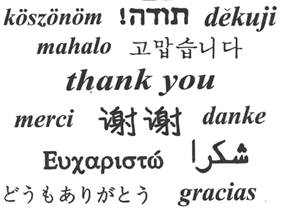
Translation in a Multilingual Nation
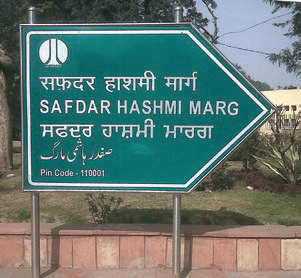
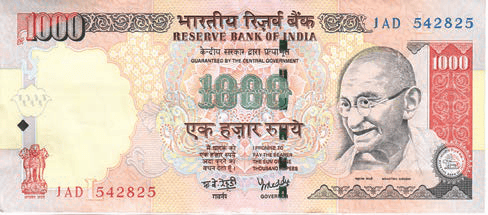
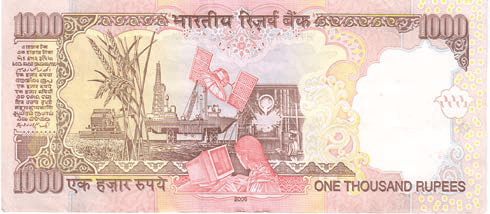
Translation is almost a natural activity in a multilingual country like ours. We just switch from one language to another without taking recourse to translation. The reality is that usually we are not equally competent in all languages. Hence, there are times we struggle to find words in one language and are forced to think of them in another and then to translate them into the language of immediate communication. Thus, any multilingual situation calls for translation. Look at the rupee note given here and see the number of languages and scripts that are represented on it. All the languages on the currency note convey the same information.
Basic Types of Translations
Intra-lingual translation is not just a possibility but a necessity in many languages with a long history, where the language has changed considerably. Let us take the example of William Shakespeare’s plays. They were originally written in old English and have now been re-written in contemporary English. Given below is a passage from Shakespeare’s Hamlet. It is followed by an intra-lingual translation into contemporary English by Jonnie Patricia Mobley. Read the two passages carefully. So excellent a king, that was to this Hyperion to a satyr, so loving to my mother That he might not beteem the winds of heaven Visit her face too roughly. (Act I, scene II) So excellent a king! He was to this king As the sun god is to a goatish beast; so loving to my mother, He would allow the winds of heaven To blow too roughly on her face.
What changes has the translator made? Are the changes only in terms of words? Discuss in groups.
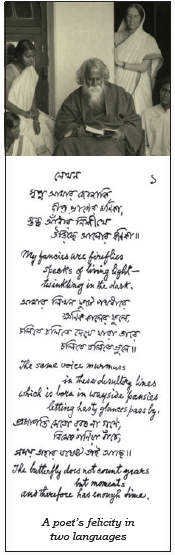
The other kind of translation is the translation of a text from one language into another. This inter-lingual translation is not only common but necessary if the people of the world have to understand each other. Given below is an example of inter-lingual translation of an extract from a story (A Death in Delhi written by Kamleshwar translated by Gordan C. Roadarmel). चारों तरफ़ कोहरा छाया हुआ है। सुबह के नौ बज चुके हैं, लेकिन पूरी दिल्ली धुन्ध में लिपटी हुई है। सड़कें नम हैं। पेड़ भींगे हुए हैं। कुछ भी साफ़ नहीं दिखायी देता। ज़िंदगी कीं हलचल का पता आवाज़ों से लग रहा है। ये आवाज़ें कानों में बस गई हैं, घर से हर हिस्से से आवाजें आ रहीं हैं। A shroud of fog covers everything. It is past nine in the morning, but all of Delhi is enmeshed in the haze. The streets are damp. The trees are wet. Nothing is clearly visible. The bustle of life reveals itself in sounds, sounds which fill the ears. Sounds are coming from every part of the house..
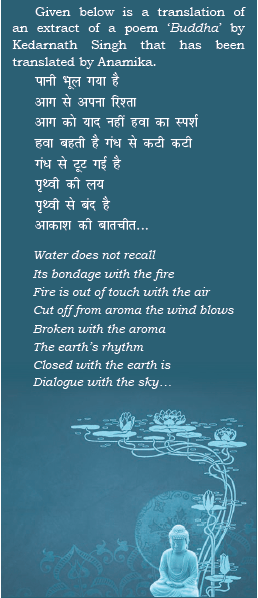
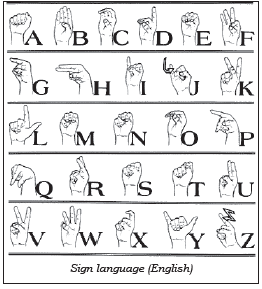
Have you ever used sign language to communicate with someone who cannot hear or perhaps understand your language? Or, have you learnt and performed in any dance form, or watched one? Or, have you seen a movie version of a play or a novel, or of an epic, or of a comic book? Have you ever drawn graphs or diagrams to illustrate facts and figures? You may not immediately think of any of these activities as translation but they all are. The first two are different ways of communicating your thoughts in one language through your body and accepted sign systems. The third example, of cinematic rendering, too is a translation into a different communication system, as is the case of graphs or diagrams. All this is known as inter-semiotic translation. The three basic types of translations: intra-lingual, inter-lingual, and intersemiotic— help us understand each other. Translation should fulfil the same functions as the original texts but in a different language. So, if an advertisement in English tries to persuade consumers to buy a particular brand of toothpaste, so should its translation in Hindi. The aim of translation of scientific text is to give exact information. In the case of a literary text, its translation should read like a literary text in the target language or people will think that the original must have been very poorly written. While you may have illustrations in all these, and sometimes the illustrations have to be changed as well in keeping the target culture, it is the language that we are concerned with at the moment. The debate in translation is how closely one must translate the original text. The extreme positions are those of literal translation, and creative or free translation. In the first, you translate every word in the original and in the second you rewrite the original text in a different language without bothering to translate every word, so long as you can carry the sense across. In its most extreme form, this is called transcription—you translate the literary text to read like it were written originally in the target language. Whether you believe in a word for word translation or a sense for sense translation, you have to deal with language; you have to know both languages well, and you have to understand the meaning of the original text. This means that a translator has to have a good vocabulary to begin with—in two languages!
The Process of Translation
There are two approaches to translation, which are known as the product approach and the process approach. Earlier translations were done keeping the product, i.e., finished translation in mind. The focus was how far the textual material in source language has been replaced by the target language equivalents. Whereas, the process approach urges the translators to understand the nuances, the culture, the language and the grammar of the source language and then produce their work, i.e., the translated text.
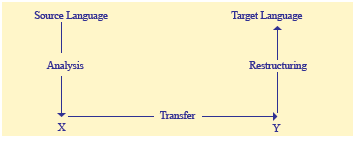
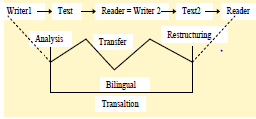
The process of translation involves three steps: analysis, transference and restructuring. Therefore, the translator has to go through this process i.e., of a good reader. It is imperative to read the original text carefully. As a bilingual person, one has to find the words and expressions that are most suitable. Then, as a writer, one restructures the text into the target language. So, it can be said that the translator first decodes and analyses the original text to understand the message as a reader and then restructures it as a creative writer. The process of translation thus involves understanding a text completely, in all its parts. This is also called deverbalisation or decoding. Once you have understood the text completely you rewrite it in the target language. This is called recoding. The process can also be seen as one of analysis (of the SL text), transfer (of meaning), and restructuring (in the TL). This is the diagram of the process as given by a famous Translation Theorist Eugene Nida:
II. Analysis
The process of analysis involves reading the text thoroughly i.e., comprehending the text and drawing inferences. It also requires understanding the language, grammar, referential commutative meaning and also the socio-cultural nuances. In effect, you analyse the original to see underlying meanings that are generated in the words used, thinking those meanings through to another language, and expressing those meanings paying due regard to the rules of the other language. Thus, you attempt to generate a text that is equivalent to the original in that it has similar effect on its audience as the original had on its. So there should be a correspondence in meaning between the translation and the original. To be able to do this, the translator must have competence in both the languages. A translator must have a good command of grammar as well as a large vocabulary, and must also be good at interpretation—should understand what is implied. He or she must also understand the socio-cultural nuances of the text.
III. Transference
Two things must be kept in mind in order to understand the process of message transference; that there is no one-to-one relationship between the grammatical and lexical units of the two languages (SL and TL). Each language has its own grammatical and lexical structure. Secondly, transference requires bilingual competence, i.e., ability to understand and articulate the same message in the two languages (SL and TL). The translator must also know why a text is being translated. Texts which are informative and/or persuasive and are meant to be so even in translation. These need to be translated to read as if they were written originally in the Target Language. However, other texts (including literary texts) can be translated in different ways. You can try to retain the style of the original even if it sounds or reads strange in the TL. You can choose to foreignise or domesticate the SL text, i.e., translate it in such a manner that a reader immediately knows that it is a translation, or make it read so much like other texts in the TL that the reader does not realise it is a translation. This is a choice that the translator has to make. You have to know the function of the SL text, the intended function of the TL text and then proceed with your translation. Some concepts or words are un-translatable. One has to cope with untranslatability in different ways—by paraphrasing or explaining the concept, by adapting,by creating a new expression (called a calque), by word for word translation (“dining leaf” for the Tamil “sappattu ilai”), by borrowing (“Baaraat”), or by compensation (using elements from the TL to overcome the loss of meaning— e.g., the bridegroom’s party arrived in a Baaraat, a procession to the wedding).
IV. Restructuring
The creation of the text in the target language involves restructuring. Since word to word translation is not possible. Therefore, one must focus on the meaning. At the same time keep in view the cultural nuances and grammar of both the languages. It also involves the personalities of two writers—the writer of the original text and the writer of the translated text. The creation of a text is always done for the reader. The translator must render the original text in such a way that it should be as close to the original as possible and is communicable to its reader. And, it should read like a contemporary piece of writing. The following diagram from Nida clearly depicts the three functions that the translator has to perform in the process of translation.
Understanding Translation
Here is a passage from Premchand’s story ‘Idgah’ originally written in Hindi. Its translation by Nandini Nopany and P. Lal into English is also given below.
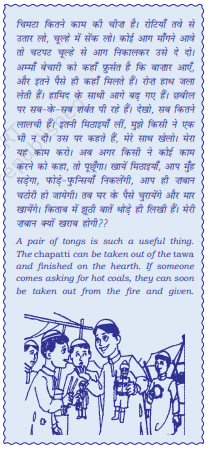

Now translate the same passage and see if there are changes in your version.
Analysis of the passage
Translating Poetry
To translate a poem you need to know how to read poetry. You have to read the poem aloud, learning to breathe right, to pause at the right points, to get the rhythm, to get the sound pattern of the poem. You have to understand how the poem is constructed—the beats, the grammatical structure, the tenses, the use of adjectives, the use of imagery and symbols, and the way meaning is conveyed through in direction and suggestion. The challenge of translating poetry is immense but it can be done and done wonderfully. We read Pablo Neruda in translation and the genius of the poet is not lost. He originally wrote in Spanish. Read an excerpt from the poem Keeping Quiet translated by Alastair Reid.
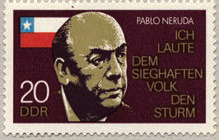
In the poem, Neruda talks about the necessity of quiet introspection and creating a feeling of mutual understanding among human beings.
Now we will count to twelve
and we will all keep still.
For once on the face of the Earth
let’s not speak in any language,
let’s not stop for one second.
and not move our arms so much...
Here is a poem एक पुष्प की अभिलाषा (A Flower’s Wishes) by Makhanlal Chaturvedi, the poem was written in Bilaspur prison, and glorifies the spirit of sacrifice and martyrdom for the sake of the motherland.
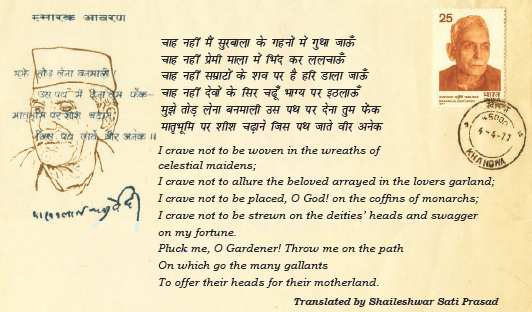
Analysis of the Poem
Chah Nahin is used to express a strong desire or feeling, therefore, the translator has used the word ‘Crave’. Similarly, in the context of the poem ‘Surbala’ refers to ‘celestial maidens’, which are considered epitome of beauty and their using the flowers for beatification enhances the importance of flowers. You may also note that the translator has used the subject ‘I’ in the beginning of the sentence and has still maintained the rhythm of the original where the poet has used the words—‘chah nahin’. Before you start translating the poem, read about the poet, his/her sociocultural background, try to figure out what must the poet be thinking when he/ she wrote this poem. Is there any imagery or language that is repeated? Does it symbolise something or some aspect of life. It will help you understand the nuances of the poems. Remember that the translation of a poem will read differently from the original because sound systems and grammar will differ. You will also have a different prosody. Your perfect word-toword equivalence is not possible. While translating the poem stay as close to meaning as possible. A direct translation of the poem will fail. If you doubt getting the meaning of a word/phrase, try to give an equivalent. Remember, you are giving your readers the poem to enjoy. Your work does not end here. After translating the poem, take some time to rethink and then come back and see where you can fill the gaps to improve. Translating a poem is not less creative than writing a poem because you have to feel the emotion, understand the idea and share the culture.
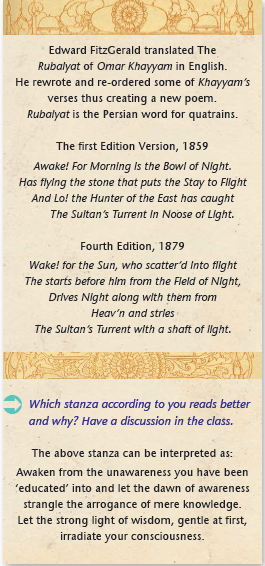
Translating Dialogues
This takes us to the specific problem of translating the spoken word. As you know, we may all speak the same language but we speak it differently—not only our accents but also our vocabulary and sometimes even our grammar differ from each other’s because of the region we come from. We may also speak different dialects of the same language. In a play, as in a short story, or even a poem, it is usually important to maintain different speech patterns for different characters. How does one achieve this in translation? First of all, we must ensure that the spoken text from one language does seem to be a spoken text in the other. When we translate dialogues, they must appear to be so in the TL text. Chandradhar Sharma Guleri’s story ‘उसने कहा था’ (She had said) has powerful dialogues that make the story come alive. The following dialogues have been translated. Read and see whether the translated dialogues have been able to translate the nuances of the language.
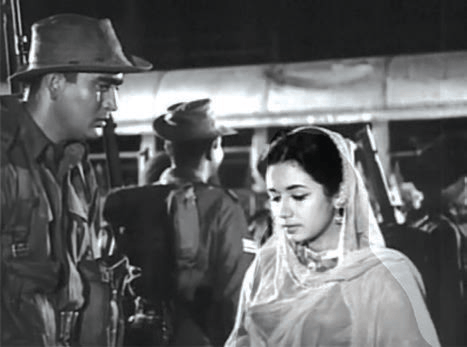
by Moni Bhattacharjee
“मुझे पहचाना?”
“नहां। ”
“तेरी कुड़माई हो गई... धत्...कल हो गई...
देखते नहीं रेशमी ब्॒टों वाला सालु...
अप्रतमर में... ”
भावों की टकराहट से मूर्छहा खुली! करवट
बदलाौ। पस्ली का घाव बह निकला।
“बजीरा, पानी पिला।" उसने कहा था।...
“Do you recognise me?”
“No.”
“Are you engaged–Hush–yesterdaycan’t
you see my shalu with the
silk embroidery—At Amritsar---”
He appeared to regain consciousness
and he turned on his side. The
wound on the ribcage started
bleeding once again.
“Wazeera, give me some water.”
—‘She had said’---
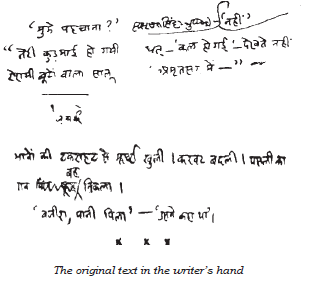
Analysis of the Dialogue
The writer has used the words Mujhe Pahchana? Which makes a complete sense, but to translate this into English, the translator has to use the pronoun ‘you’ to convey the complete meaning, i.e., ‘Do you recognise me?’ The word Kurmai is a punjabi word which means ‘engagement’. The use of such words bring home the fact that the story and the characters are from the Punjab. To translate plays, then, one should have a good ear; one should know how different kinds of people speak—in an area, in a community, in different formal or informal situations. You have to see how you can convey speech patterns—usages, rhythms, and accents—that characterise different people in one language and text into speech patterns in another language. This is crucial in drama, and perhaps not so crucial in prose fiction, where you can add information and say that the character speaks in an accent or language typical to a particular area. You need to get the tone and the register right when you translate a dialogue.To translate from an academic text, you need to know the terms in both languages; competence in language alone won’t suffice in these translations. An example from the Class X, Science Textbook (NCERT) is given below.
‘To translate, one must have a style of his
own, for otherwise the translation will have
no rhythm or nuance, which come from
the process of artistically thinking through
and molding the sentences; they cannot be
reconstituted by piecemeal imitation.
The Problem of translation is to retreat to a
simpler tenor of one’s own style and creatively
adjust this to one’s author.’
— Paul Goodman
Words, words, words
By now you have understood that though words are the smallest units of language that can stand by themselves, so, one has to be careful about articles in English. You have to be careful about your grammar in order to understand the significance of “a”/ “an” and “the”, as also their absence. We have a particular problem in translation into our Indian languages because we don’t have any such grammatical units; so we have to know how to convey any important information that the articles or their absence may convey. Let us look at some examples. What is the difference between “a man”, “the man”, and “man”? If you think that “a man” means “one man”, then how do you translate a sentence like “He likes a man to stand for his principles”? How would you translate the admiring statement, “He is a man!” What difference between do you see “He is going to jail”, and “He is going to the jail”? As you can see, if you don’t pay attention to the article, you may end up translating wrongly, saying that a man has been sentenced to serve a prison term when he may only have gone there to meet a client! (In case you haven’t worked it out yet, the one going to jail has been sentenced to imprisonment.) You may still think that translation basically involves substituting words in one language with words in another that have the same meaning—so “North” becomes “Uttar” and “Eye” becomes “Aankh”. While this is true, one must remember that not all words have equivalents in other languages, and also that words gain different meanings in different contexts. For example, “North” in “Brigadier North issued the orders to advance” is a name of a person. When you try to translate “He had an eye for detail”, you may be forced to use some word other than “Aankh”, or take the word in the phrase commentators use— “Tendulkar has got his eye in now and is hitting the ball at will”. “Eye” is actually a good word to explore in its different uses—look up a good dictionary to see its different meanings; what does it mean when you are all eyes, or see eye to eye? What is the English equivalent of chacha or mama. In English we have the word ‘Uncle’. Try translating the sentence, mere chacha mere mama se baat kar rahe the. Obviously the kinship terms in Hindi reflect shades and hierarchies of relationship that English does not recognise. It is also obvious that while we need to know the meanings of words in one language and their equivalents in the other, we also need to be careful about multiple meanings and how words take on different meanings in different contexts.
Make a list of all kinship terms in Hindi and in any other Indian language that you know. How many of them have equivalents in English? How would you translate them into English if they occurred in a text? What about names of food items? How about other culture specific terms like “kumkum” or “sindur”, “dhoti” or “kurta”? To think this through, think of what we do in Hindi to translate “shirt” or “skirt” or “trousers”.
Understanding the Context
Words convey more than just simple meanings. They may also contain more information than a single word should! Let us take the word “Aayi” as a single word sentence in reply to a shouted out name like “Harpreet”. When you read this as a part of a script, even if you are not sure of the gender of the person called when you read the name, you are certain that it is a woman who has been called out to when you read the reply because the word “coming” is gendered in Hindi as all verbs are. How can you replicate this in languages where this is not the grammatical rule? To put it simply, in this particular case, you cannot, at least not in the dialogue. So there will be still some suspense about the gender after the answer “coming” in the English translation, unless you add “she answered” after or before Harpreet’s “Coming”. You will have the same problem in reverse when you translate into Hindi – what if an English (or Bangla or Tamil) poet is addressing lines to his child and using the second person singular “you” throughout and you are not clear if the child is a boy or a girl? Therefore understanding the context is crucial.
Write down five English nouns that you use in Hindi. What is their gender in Hindi?
Words can also have prefixes which change their meaning – like “rebuild”, or “unclean”, or “inconceivable” (which is actually more complex since it has a suffix as well and can be represented as in + conceive + able). The last word should bring us to suffixes, and words that can be formed like “hopeful” and “hopeless”. Suffixes have grammatical functions and may express plurality (adding “s” for instance), gender, or negation (like in “unclean”). Thus with these words, you may sometimes have single word equivalents but usually you will end up using more than one word to convey their meanings. We have already realised that words may have more than one meaning. Your translation can go wrong if you get the wrong meaning.
Usually there is no excuse for getting a straightforward meaning wrong. If you get the denotative meaning of a word wrong you fail as a translator. This is why translators need to consult technical dictionaries and also read up on the subject fields they are translating texts in. But words have other functions than just to name things. To name just two other functions; they show emotions and politeness; and they show attitudes. Let us take synonyms. Synonyms ought to be interchangeable but we always know one word is more apt than the other to express what we want in a given context. Think of how you address your mother or father when you want to show extreme affection (when you perhaps want something from them!). As per the context you would use the word. Similarly, we move from casual language to the most formal of speeches in our daily life. We use slang, we use baby talk, we use sports vocabulary, we use scientific or other subject-specific terminology, and may even say some set prayers handed down over centuries. So you have to understand the weight of words, to which register they belong, when you translate from one language into another.
 Take a look at the following words—comfortable, comfy, homely, cosy, snug—and describe the differences between them.
Find all the synonyms for the word “Black” when used as an adjective in a thesaurus. Select one of the meanings of “black” (e.g., “dirty”) and try to find equivalents in Hindi for all the synonyms listed there.
You will have realised by now that words can be slippery and that word for word translation still involves understanding the sentence, and the context. So if someone asks you a meaning of a word, you may end up giving the person a wrong meaning, something that is not meant in the particular context. Translation calls for such caution twice over, in both languages. “She is my sister and she is my aunt.” Earlier in the chapter it has been discussed how to deal with names of objects for which we don’t have equivalents in other languages. This was followed by a question where you were asked to list five English nouns you use in Hindi.
This is one of the ways in which languages and translators cope with words that have no equivalents – adopt the word in their own languages. Such words are called Loan Words since they are seen to be taken on loan from the other language. We say “cycle” and “scooter”, “switch” and “tractor”, and “atom bomb” and “fertiliser” in most languages without finding equivalents. There are other words too that enter our languages because either the field is new to us or because we just haven’t felt the need to have words to articulate the concept. One word that has entered all our languages in the recent past is “tsunami”. Computer related vocabulary is another such example. We also need to deal with acronyms and abbreviations. An acronym is formed by taking the first letters of each word in a compound word or phrase, whereas, an abbreviation is the shortened form of a word. UN is the acronym for United Nations.
What will you do if you come across the UN in your original text? What is it and how is it referred to in Hindi? With an abbreviation you need to know the original word in order to translate it correctly – for example, take the abbreviation “Mr.”, which is the shortened form of “Mister”. If you are a science student you know that every element has a symbol which refers to it – for example, Iron is “Fe”. In Hindi, many of the English acronyms are used in the same manner, for example MLA. Perhaps the most difficult words to translate are puns, which are words that are used for humorous effect, which is dependant on two words sounding alike or being spelt in the same way, or any such ambiguity. Read the following sentences and underline the word that leads to different readings:
■ I wondered why the cricket ball was getting bigger. Then it hit me.
■ The magician got so mad he pulled his hare out.
■ When I saw the first strands of gray hair, I thought I would dye!

Beyond Words: Phrasal Verbs, Idioms, and Proverbs
■ He always runs his children down.
■ I finally ran his phone number down.
■ My mother looks run down nowadays.
■ I felt so bad when the dog was run over by the bus
Find the meanings for the other phrasal verbs listed that are made with “run” and make sentences with them.
Idiomatic expressions and proverbs can also create unexpected difficulties for the translator.An idiom is a phrase where the words together have a different meaning from the dictionary definitions of individual words. When you tell someone, “A penny for your thoughts”, you are really asking them to tell you what they are thinking about. When you say “a bit much”, you are showing your annoyance. When something is “a steal” it is being sold really cheap, less than it is usually worth. When someone say, he is “all ears”, it means that he is interested in listening to something. If someone asks you to “get a grip” they mean that you should control your emotions. Think of “nau do gyarah hona” in Hindi. Think of how to say it in Engish—you can’t say that someone became nine to eleven! You cannot hope to give a word to word translation and be right. I hope you “get the picture” by now, that is you understand the situation fully. You need to know the idiom before you can use it for translation. Proverbs, on the other hand, are old sayings that usually give advice—e.g., “A stitch in time saves nine.” These are usually clearer in meaning and more easily understood but again one has to be careful when translating them. Proverbs come from specific cultures and histories. They may seem strange when translated but they may also work in the sense that we get an insight into another culture and we also learn a different way of looking at the world.
Sentences and Texts
You already know that the grammatical structure of sentences in English is different from that of Hindi. English is a SVO language (that is sentences are constructed in the following pattern— Subject Verb Object) whereas Hindi is a SOV language. Aap apna khana khate hain in Hindi but in English it becomes ‘you eat your food’. So you have to be careful when you are translating from one language into another since you have to respect the grammar of your Target Language so that you don’t end up with inelegant translations. You have to be careful about question forms, about tenses, about agreement and this is true in each of the languages. Even sentences occur in contexts and the same sentence may mean different things in different situations. Some utterances may be made ironically and therefore you should not understand them literally. Irony may be carried into another language easily so long as the context is clear. By now you know that you have to be careful about your choice of translation units, i.e., the blocks of passages that you can translate at one time without making any mistakes about meaning.
You need to be able to convey the ideas that are present in the source text in a consistent (and acceptable for the specific translation) style and register, producing a text that is written cohesively and coherently. For this you need to be aware of all reference markers within a text. You have to use these markers for they give you links between sentences. “Whereas” and “however” in the beginning of a sentence can be used when there is going to be a contrasting idea presented, “moreover” is used where additional information is going to be given. But remember that you have to use all tools with intelligence and caution. In this computer age, many of these resources are available online. Computers have been used to assist translation (this is called CAT or Computer Assisted/ Aided Translation).
Computers can help in two ways—the first by remembering how you translated sentences (or parts of sentences) previously and reminding you of your previous translations when such sentences crop up again. Another way is by doing translation based on grammatical rules and vocabulary lists that are fed into the computer. Remember, translation is the transfer of meaning. Words are not only the names of things or of ideas. Words also convey emotions, they combine with one another, change their forms, and they follow rules of grammar that vary from language to language. The rules of grammar govern use of words but extra-linguistic factors such as culture, background etc., also render meaning to the text. We need to keep all this in view while translating from one language to another.
Tools for Translation
Remember that while tools do not make the man, a worker without his tools can do very little work. A translator needs the following:
- Good monolingual dictionaries (as you would need in both Hindi and English)
- Access to encyclopedias
- Thesaurus in both languages
- Grammar books in both languages
- Guides to usage
- A good bilingual dictionary
While Translating Locate and Analyse
■ What cannot be translated
■ Now recreate the piece
■ Make sure that the meaning is clear
■ Read the text as a whole
■ Take out the difficult/new words
■ Write their English
■ Look for appropriate synonyms
■ Understand the context of the passage
■ Sometimes one sentence is broken into two to convey the meaning.
Points to Ponder
■ It is necessary to have adequate knowledge of both the Source Language and the Target Language.
■ One must understand the grammar and linguistic characteristics of both the languages.
■ A good translator has to have a good understanding of the subject or area that is to be translated.
■ As a translator it is necessary to understand the culture and nuances that go along with the languages.
■ A word-to-word translation may not convey the entire meaning, therefore, understanding the text in totality is crucial for translation.
■ Before translating the text, some research trying to understand the topic and the author certainly helps.
■ Keep the tools of translation handy for reference.
Samples of translation of the same text done in a workshop.
Sample 1 of the translation of a section of the text from the story ‘Samvadiya’ by Fanishwar Nath Renu.
A reluctant Hargobind entered the
village. People around recognised
him at once— “O the messenger from
Jalalgarh? Don’t know what message
he has brought”
“Ram Ram Bhai! You’ve brought good
message, haven’t you?”
“Ram Ram Bhaiyaji! I have only good
message by the Grace of God”.
“Hope you had good rains in your
village?”…
Bahuria’s brother could hardly
recognise Hargobind. He had to
introduce himself. The concerned
brother immediately asked,” How’s
my elder sister?” “All are fine, by the
Grace of God,” Hargobind replied.
Sample 2 of the translation of the same passage.
Unwillingly, Hargovind entered the
village. The moment people saw him
they recognised him as the messenger
from Jalalgad. God knows what kind
of message he has brought?
“Hello, Hope everything is fine?”
“O! Yes, all is well by God’s grace”
“How is the weather there?....”
Brother of Bahuria could not recognise
Hargovind. Hargovind introduced himself.
The brother asked about the welfare
of his sister. “By God’s grace she is
OK”, he said.
संवाद / Exercises
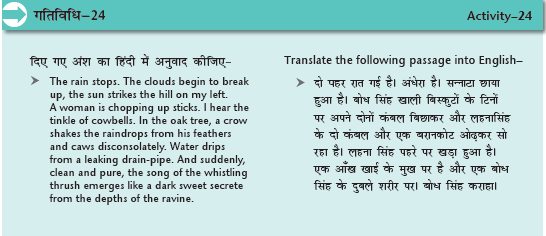
1 दिए गए अंश का हिंदी में अनुवाद कीजिए और लिखिए |
History and legend will grow around this day. It marks a milestorne in the march of our democracy. It is a significant date for the people of India who are trying to rebuild and transform themsleves. Through a long night of waiting, a night full of fateful portents and silent prayers for the dawn of freedom, of haunting spectres of hunger and death, our sentinels kept watch, the lights were burning bright till at last the dawn is breaking and we greet it with the utmost enthusiam. When we are passing from a state of serfdom, a state of slavery and subjection to one of freedom and liberation, it is an occasion for rejoicing. That it is being effected in such an orderly and dignified way, is a matter for gratification.
(क ) अनुवाद करते समय आपको कहाँ -कहाँ और क्या - क्या कठिनाइयां आई ?
(ख ) आपने उन्हें कैसे सुलझाया ? लिखिए |
Translate the following passage into English.
मनुष्य का भविष्य
विकसित देश वे हैं जहाँ आधुनिक तकनीक का पूर्ण उपयोग हो रहा है। ऐसे देश नाना प्रकार की सामग्री का उत्पादन करते हैं और उस सामग्री की ख़प्त के लिए बाजार छूँदते रहते हैं। अत्याधिक उत्पादन-क्षमता के कारण हो ये देश विकसित और अमौर हैं। विकासोन्मुख या गरीब देश उनके समान ही उत्पादन करने की आकांक्षा रखते हैं और इसीलिए उन सभी आधुनिक तरीकों कौ जानकारी प्राप्त करते हैं। उत्पादन-क्षमता बढ़ाने का स्वप्न देखते हैं। इसका परिणाम यह हुआ कि सारे संसार में उन वायुमंडल-प्रदूषण यंत्रों की भीड़ बढ़ने लगी है जो विकास के लिए परम आवश्यक माने जाते हैं। इन विकास-वाहक उपकरणों ने अनेक प्रकार कौ समस्याएँ उत्पन्त कर दी हैं। वायुमंडल विषाक्त गैसों से ऐसा भरता जा रहा है कि मनुष्य का सारा पर्यावरण दूषित हो उठा है, जिससे वनस्पतियों तक के अस्तित्व संकटापनत हो गए हैं।
(a) What did you find difficult to translate? Highlight those sections.
(b) How did you translate the difficult sections?
2- “The most necessary person is the person you are with at a particular moment, for no one knows what will happen in the future and whether we will meet anyone else. The most important business is to do that person good, because we were sent into this world for that purpose alone.”
(a) How many different kinds of words can be used in English for the underlined words?
(b) Out of these which word can best be used in the above passage?
(c) Why did you find that particular word the best choice? Explain.
(क) दिए गए अंश में से रेखांकित शब्दों के लिए हिंदी में कितने शब्द हो सकते हैं? लिखिए।
(ख) उपर्युक्त संदर्भ के अनुसार कौन-सी पंक्ति में कौन-सा शब्द उपयुक्त है? चुनिए।
(ग) आपको यही शब्द सबसे उपयुक्त क्यों लगता है? सोचिए और लिखिए।
कल शाम खूब पानी बरसा। ऐसे बर॒सा कि बुधिया के घर का छप्पर भी टूटकर बह गया। अगर बरसात से पहले मालिक ने पैसे दे दिए होते तो छप्पर की मरम्मत हो गई होती। मन ही मन बुधिया तिलमिलाया पर कुछ न बोला। बादल के साथ-साथ आँसू भी बरसे, पर उसका गुस्सा न बरसा।
3. दी गई बातचीत का हिंदी में अनुवाद कीजिए।
“No,” Valli said, “I’m going back on this same bus.”
She took another thirty paise from her pocket and handed the coins to the conductor.
“Why? Is something the matter?”
“No,” nothing’s the matter. I just felt like having a bus ride, that’s all.”
“Don’t you want to have a look at the sights, now that you’re here?”
“All by myself? Oh, I’d be much too afraid.”
Greatly amused by the girl’s way of speaking, the counductor said,
“But you weren’t afraid to come in the bus.”
“Nothing to be afraid of about that,” she answered.
“Well, then, why not go to that stall over there and have something to drink?
Nothing to be afraid of about that either.”
“Oh, no, I couldn’t do that.”
“Well, then, let me bring you a cold drink.”
Translate the following dialogues into English.
पिस्ते-बादाम
“दादी माँ, यह देखो”, श्याम दौड़ता-दौड़ता अपनी दादी माँ के पास आया और बोला।
“क्या है?" दादी माँ काम में लगी थी, उसने उसकी ओर देखे बिना ही झल्लाकर पूछा।
“देखो ना, मैं क्या खा रहा हूँ”, श्याम ने मुट्ठी खोलते हुए कहा।
“क्या खा रहा है, रे?” दादी माँ ने फिर पूछा।
“देखो ना, मेरे दोस्त सुनील की माँ ने दिए हैं”, श्याम ने उत्तर दिया।
“अरे, यह तो पिस्ते-बादाम हैं।” दादी माँ ने हैरत से कहा-“उसके यहाँ ये कहाँ से आए?”
श्याम बोला-“सुनील का बड़ा भाई दुबई से आया है ना! वह ले आया है। बहुत-सा सामान
लाया है। सुनील कह रहा था, हम यह सामान बेचेंगे और खूब पैसा कमाएँगे।”
4... तापमान के बिंदु देख कर -
(क) मौसम की इस जानकारी को रचनात्मक ढंग से लिखिए।
(ख) इस जानकारी का अनुवाद भी कौजिए समूह में बैठकर |
See the weather report and —
(a) Form a group and translate the weather report in English.
(b) Attempt a creative piece (on the basis of the weather report).
5. नीचे दिए गए वाक्यों में अर्थ की दृष्टि से कोई अंतर दिखाई पड़ रहा है? क्या कुछ ऐसे वाक्य भी हैं जिनके एक से अधिक अर्थ हो सकते हैं। c,d और e में 'he ' का प्रयोग दो बार हुआ है। क्या यह एक ही व्यक्ति के लिए हुआ है या अलग-अलग? इनका अनुवाद हिंदी में कर के देखिए।
(a) He sang and danced.
(b) He sang and then danced.
(c) He sang and he danced.
(d) He sang and then he danced.
(e) He said that he sang and he danced.
How do the following sentences differ from each other in meaning?
Do some of the sentences have more than one possible meaning.
Do the two uses of “वह ” in lines क , ख , ग and घ refer to the same person each time? Translate them into English.
(क) वह आया और निकल गया
(ख) वह आया हो नहीं
(ग) वह आने वाला है
(घ) वह आकर जायेगी
(हू) वह भी आयेगी
नौचे दिए गए वाक्यों का हिन्दी में अनुवाद करें और उनके अर्थ की भिन्नता को बताएँ।
(a) She bears a good moral character.
(b) She could not bear the loss.
(c) She bears the victory marks on her body.
(d) She bear is brown in colour.
(e) She bore the brunt of her wrath.
Translate the following sentences into English so as to bring out the differences in meaning.
(क) मैं पानी पीना चाहतों हूँ।
(ख) आज बहुत पानी बरसा।
(ग) शिमला का पानी अच्छा हैं।
(घ) इस अंगूठी का पानी उतर गया है।
(डः) यह पेड़ तीन पानी का है।