Chapter 4
Vitamin-M
Reflect and Respond
I From your experience with an elderly person at home or in your neighbourhood, complete the following graphic organiser.
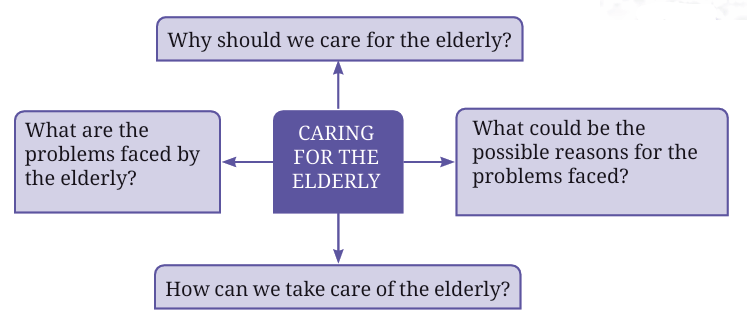
Now, discuss the points written in the organiser with your classmates and teacher.
II Fill in the table given below. You may check your answers with the help of a dictionary.
|
Word |
Not heard this word before |
Have heard this word but don’t know what it means |
I know this word. It has something to do with… |
Write the meaning of this word |
|
|
1. frail |
|
|
|
|
|
|
2. shuddered |
|
|
|
|
|
|
3. poky |
|
|
|
|
|
|
4. forbid |
|
|
|
|
|
|
5. pottering |
|
|
|
|
|
|
6. winced |
|
|
|
|
|
III Think of a tradition, story, or recipe passed down by grandparents or an elderly relative in your family. What does it mean to you? How does it connect you to your growing-up years? Share with your classmates and teacher.
Reading for Meaning
I
“I wish,” said Ravi’s mother, hurriedly putting some green, red and orange tablets on a saucer, “that somebody would invent a memory — Vitamin-M, they could call it, and we could give it to old people to help them improve their memories.”
“Shh … Grandpa’ll hear you,” said Ravi, pointing to the frail old figure sitting in the rocking chair, holding the newspaper inches from his nose to read it.
“Don’t worry, I doubt whether Grandpa can hear me. He doesn’t hear too well, or see too well, or even remember too well these days. I’m glad that your holidays have started from today. Now you can look after him. Last month was…” she stopped and shuddered at the memory.
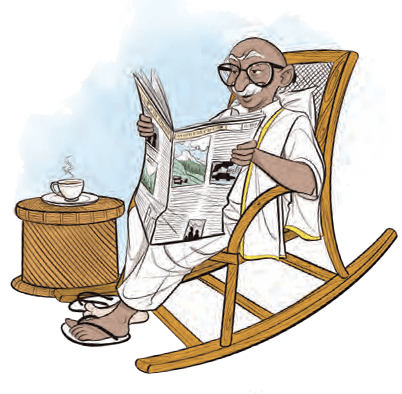
It was only last month that Ravi’s Grandpa had come to live with them because he was getting too old to live on his own. It had been a difficult month with Grandpa having to be admitted to the hospital because he absent-mindedly took a double dose of his medicines, and then gave them several anxious moments when he got lost on one occasion he went for a walk and forgot the way back home.
Grandpa had got very upset when his daughter, Ravi’s mother, insisted that he shouldn’t go out alone again. “I’ll have you know, Vidya, my dear,” he had told his daughter with a trace of the firmness that had been a natural part of his job as a lawyer, “that I’ve been looking after myself for the better part of my seventy-five years. After your mother died ten years ago, I took over her duties as well and have been cooking, shopping and keeping house too. First you force me to come and live with you in this poky little flat, in this horrible, crowded city and then you think you have the right to forbid me to go out on my own!”
Grandpa hated the noise and bustle of city life and when they were on their own, he often spoke, longingly, of his small brick house in town. “Such a wonderful place…! With that big mango tree in the garden! It is so quiet that at dusk you can even hear a leaf fall!” But then Grandpa had slipped and fallen in the garden late one evening while he was pottering around and lain outside all night because there was no one at home to help him up. That was a month ago and it made Ravi’s mother lock up the tiny brick house and bring Grandpa to live with them.
“Whatever happens, Ravi, you’re not to let Grandpa go out on his own. It’s too dangerous,” she instructed, adding details of medicines to be given to Grandpa after lunch. Turning to her father she said, “I’m off to work, Papa, Ravi will be here to look after you. His holidays have begun from today.”
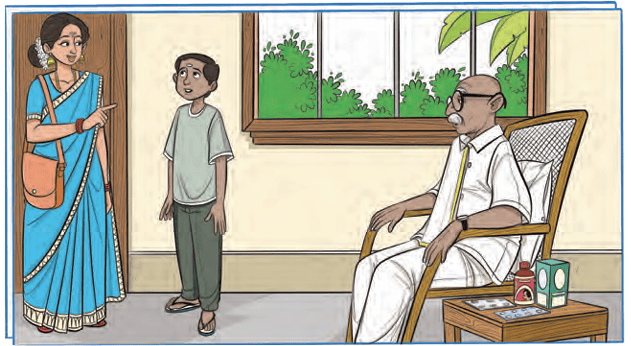
Ravi winced at the over-loud tone his mother used when speaking to Grandpa, as though she were speaking to a child who couldn’t hear or understand too well. Grandpa continued to rock gently and gave no sign that he had heard her at all.
“Don’t worry, Mamma,” Ravi promised, looking at his mother’s anxious face. He felt sorry for her. “You go to work. Grandpa’ll be fine at home with me.”
“Shall we play chess or watch the cricket match on TV, Grandpa?” Ravi asked after his mother left. Grandpa played a great game of chess, very cool and cunning, and Ravi found that his own game had improved greatly ever since Grandpa had come to live with them. “That’s the opening move Karpov made when he played against the computer,” he would tell Ravi as he moved a piece, or, “You’re making the same mistake that Bobby Fischer made in his historic match against Spassky.”
“How can he remember all those thousands of chess games and still forget the names of people he meets often!” Ravi wondered.
“You set out the chessboard,” said Grandpa, putting his paper down, “I’ll just walk across to the corner shop to see if the Tamil newspaper has arrived.”
“Papa usually buys you the Tamil paper on his way home! But if you want it immediately, I’ll go now and buy it for you,” Ravi offered.
“I hope you’re not going to be as tiresome as your mother, Ravi. Treating me like a baby! Has she told you not to let me go out on my own? Told you to keep me a prisoner here, has she?” Grandpa looked suspicious at this thought.
Ravi felt guilty for a moment, then quickly recovered to say loyally, “Of course not, Grandpa. Mamma would never treat you like a baby … or a prisoner.”
“Good,” said Grandpa craftily, “then you’ll have no objection to my going out.”
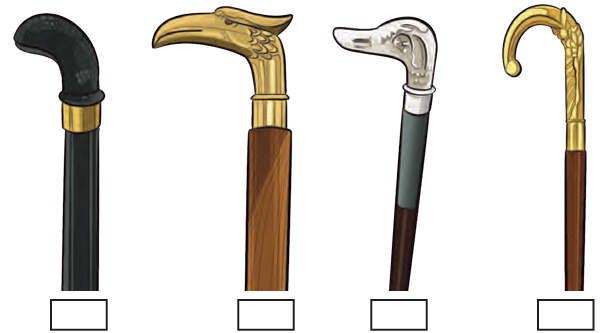
He picked up his beautiful shiny-black mahogany walking stick with a brass handle carved in the shape of an eagle’s head, put on his bright-yellow cap and declared, “I’ll be back home before you can set up the board, Ravi.”
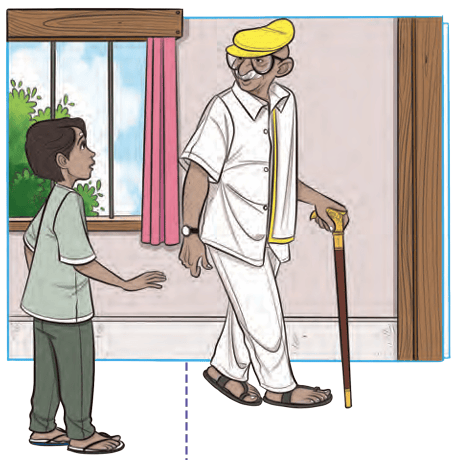
Off he went, twirling his walking stick jauntily, leaving Ravi in a dilemma. His grandfather would feel hurt if he insisted on accompanying him and his mother would be furious if she knew Ravi had let him go out on his own.
He heard the elevator door shut as Grandpa went down. Ravi decided he would follow Grandpa secretly, at a safe distance, to make sure he came to no harm.
Check Your Understanding
I Why did Grandpa dislike living in the city with his daughter?
II Why did Vidya not want her father to go out alone?
III Was Ravi in favour of his mother treating Grandpa like a child? How can you say so?
IV Would Ravi be able to keep up his promise to his mother?
II
Ravi ran out of the building just in time to see Grandpa’s yellow cap disappearing round the corner. Grandpa’s first stop was the children’s park where he bought himself a paper-cone of peanuts and settled on a bench, watching the children play. Ravi, feeling very foolish, had to crouch behind a bush trimmed in the shape of an elephant to avoid being seen. He felt even more foolish when a small child came up to him and asked, “Are you playing hide and seek? I can show you a better place to hide.”
“Shhh, shhh,” was all Ravi could say before he felt a shadow fall over him and a loud voice boomed, “How dare you shoo my child? Who are you?” It was the little boy’s mother.
“Shhh, shhh,” Ravi repeated to the lady.
“I’ll shh you, you rude boy!” said the lady, picking up her umbrella threateningly. The ultimate humiliation was when Ravi had to crawl out of the park on all fours, ducking behind the benches, creeping behind the bushes, thanking his lucky stars that Grandpa hadn’t heard the noise and spotted him.
Grandpa’s next stop was the tea stall, and this time Ravi took position behind a big banyan tree to watch him, feeling most embarrassed when the vendors sitting under the tree gave him quizzical looks.
“This area is booked by us,” said one lady who was selling plastic combs, in the same tone she might use were she asked to address a gathering without being given a loudspeaker, “There’s no room for any new vendors.”
“Shhh, Don’t talk so loudly. Do I look as though I’m selling anything?” Ravi asked her.
“Who’s talking loudly?” said the old lady, raising her voice just enough for Ravi to hear her, as though she was talking to him from across the city.
“Who are you accusing of talking loudly? … and that too from behind the tree. Who are you hiding from?” another vendor selling ribbons and clips asked. She too was one of those lucky ones who would never ever require a megaphone.
“Are you talking about one of us?” asked another vendor. A group of them surrounded Ravi.
“Oh, all right!” Ravi conceded defeat and moved to duck behind a shiny silver car, peering through the windows to keep an eye on his grandfather. Grandpa took his time sipping a sugary cup of tea (he was forbidden sugar at home), then ate two bananas (another banned item), then tucked into an ice cream bought from the cart. (Mother would faint if she saw this!)
Ravi himself felt hot, bothered and close to fainting by the time Grandpa finished his snack. His heart thudded anxiously when he saw Grandpa zigzagging through the traffic as he crossed the road. He shut his eyes in panic when he heard the screech of brakes and opened them just in time to see Grandpa entering the barber shop.
Now Grandpa was as bald as a table tennis ball, so Ravi decided that a closer look was in order. He crossed the road, first looking dramatically left and then right and then hurriedly ducked into the shop next to the barber shop … only to be evicted a moment later amidst a volley of feminine shrieks because it happened to be a Ladies’ Hairdressing Salon.
“Just as well I was thrown out,” thought Ravi because he spotted Grandpa making his way briskly towards the bus stop, and, oh no, boarding the first bus that stopped there.
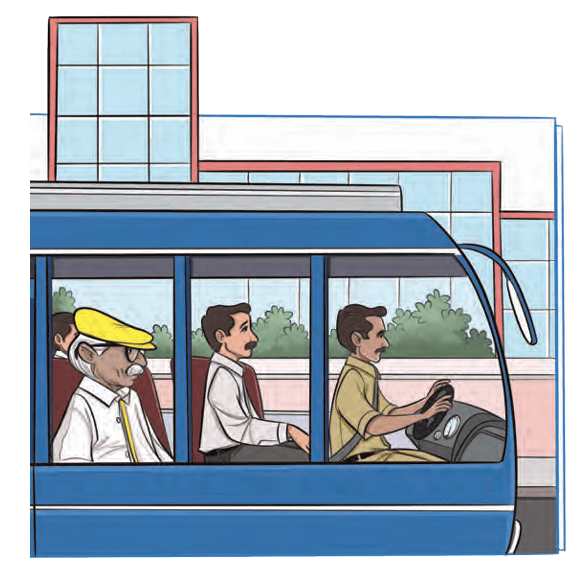
Sprinting for the bus and jumping on to it seconds before it started would have deterred a lesser detective, but not Ravi, who was panting as he struggled for a place in the bus. He could see Grandpa’s yellow cap somewhere in the front. It was warm inside the bus so Grandpa took off his cap to reveal … a full head of grey hair! Ravi was startled. Surely Grandpa couldn’t have bought a wig at the barber shop, he thought, pushing his way to the front of the bus to confront the cap-wearer. It was a total stranger! He was wearing a white pyjama and shirt, which was Grandpa’s standard attire, and a yellow cap exactly like Grandpa’s. But wait, the cap had a coffee-strain on its rim just like Grandpa’s!
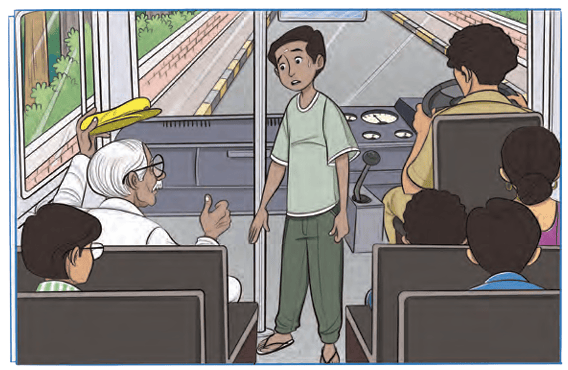
“Grandpa’s cap!” Ravi couldn’t help exclaiming. The stranger grinned pleasantly and told Ravi that a kind old gentleman in the barber shop had insisted that he take his cap because it was such a hot day. That was typical of Grandpa, always generous. But where was Grandpa?
Check Your Understanding
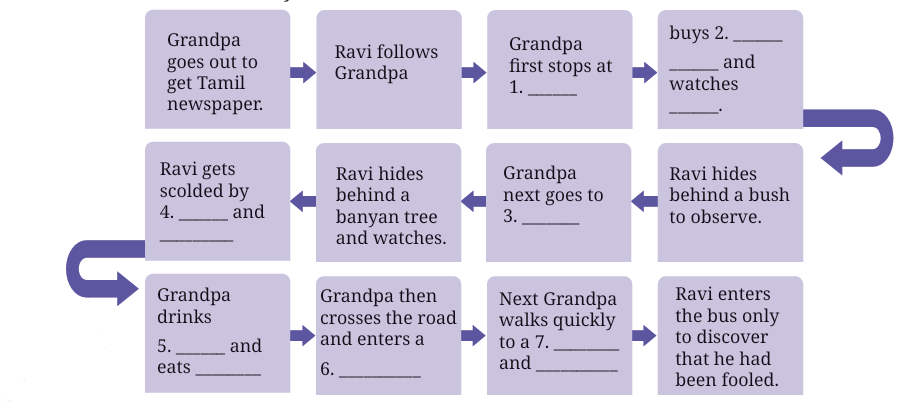
I Complete the flow chart by describing Grandpa’s day out.
II Was Grandpa lost as feared by Ravi’s mother?
III How would Ravi feel after seeing Grandpa?
IV Do you think Ravi’s mother will get to know about what had happened?
III
Ravi went back to the barber shop. Grandpa wasn’t there. He wasn’t at the park either. Ravi was frantic. After all, his mother had left him in charge of Grandpa. He tried calling first his mother and then his father from a telephone booth but both numbers were busy. Sick with worry, Ravi went home wondering whether Grandpa would be able to find his way back.
To his great delight and relief, the first thing he heard when he opened the front door was the gentle whirr of Grandpa snoring in his bedroom. He knelt down near the bed and put his cheek against the old man’s face. Grandpa’s wrinkled skin had more creases than lines on a map. Grandpa smelt of eucalyptus ointment and shaving cream. Ravi was suddenly overcome with affection for his grandfather and gave him a hug, but Grandpa only grunted in his sleep. He decided not to question Grandpa because then he would have to reveal that he had been following him.
“What did you both do today?” asked Ravi’s mother when she got back from office.
“I had a quiet morning, but I don’t know about Ravi. He just disappeared instead of staying at home to look after me like you told him to,” answered Grandpa coolly, while Ravi just looked confused and embarrassed.
Grandpa had another surprise for Ravi. A gift-wrapped parcel!
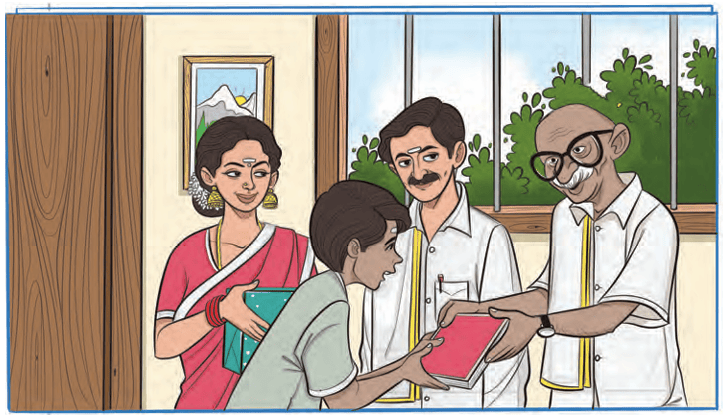
“But, Papa, Ravi’s birthday was three months ago. Have you forgotten?” exclaimed Ravi’s mother, impatiently.
“No. But you know I always give a gift to every child in the house on my birthday. Have you forgotten?” countered Grandpa, very seriously. Ravi’s mother flushed and darted a stricken look at the calendar on which she had, at the beginning of the year circled the date in red and written ‘Papa’s birthday’. There was a gift for her too, and for Ravi’s father as well, for Grandpa still considered them his ‘babies’.
Grandpa turned to Ravi’s father who had just walked into the room, “My daughter needs some Vitamin-M, I think—for her memory.” Ravi’s mother flushed a darker shade of red and Ravi’s father looked confused.
Ravi unwrapped his gift to find a thick, hardcover book, The Best Detective Stories. “Great stories, Ravi. You can pick up some really good tips on how to be a detective.
How to avoid getting fooled when one is trailing a suspect, for instance,” Grandpa said solemnly.
“I don’t think he wants to be a detective, do you, Ravi?” asked his father looking even more confused.
“I haven’t decided yet,” answered Ravi, because he was too busy trying to decide whether the twinkle in Grandpa’s eye was an innocent gleam or a mischievous one.
Asha Nehemiah
Check Your Understanding
I Describe how Ravi’s emotional reaction upon finding Grandpa safe at home reveals his feelings towards his grandfather.
II What might be the significance of Grandpa’s habit of giving gifts to everyone on his birthday rather than receiving them?
III Why do you think Grandpa gave Ravi a detective story book as a gift? What might this suggest about Grandpa’s awareness of Ravi’s actions earlier in the day?
Critical Reflection
I Read the extracts given below and answer the questions that follow.
1. Grandpa hated the noise and bustle of city life and when they were on their own, he often spoke longingly of his small brick house in town. “Such a wonderful place…! With that big mango tree in the garden! It is so quiet that at dusk you can even hear a leaf fall!” But then Grandpa had slipped and fallen in the garden late one evening while he was pottering around and lain outside all night because there was no one at home to help him up.
(i) Choose the emotion displayed by the Grandfather.
A. regretful
B. apologetic
C. nostalgic
D. wistful
(ii) Complete the following sentence with a reason. Grandpa hated the busy and noisy city life because ___________.
(iii) Why did Grandpa come to the city despite his dislike for city life?
(iv) Choose an expression similar in meaning to, ‘you can even hear a leaf fall’.
A. end of one’s life
B. arrival of autumn
C. sign of good luck
D. pin drop silence
(v) State one advantage and one disadvantage of the Grandfather living in the house in town.
2. “I had a quiet morning, but I don’t know about Ravi. He just disappeared instead of staying at home to look after me like you told him to,” answered Grandpa coolly, while Ravi just looked confused and embarrassed.
Grandpa had another surprise for Ravi. A gift-wrapped parcel!
“But, Papa, Ravi’s birthday was three months ago. Have you forgotten?” exclaimed Ravi’s mother, impatiently.

(i) Choose the option that displays the tone of the Grandfather’s response.
A. apologetic
B. hurtful
C. calm
D. puzzled
(ii) Why was Ravi confused and embarrassed?
(iii) Complete the sentence with a suitable reason.
Ravi’s mother was impatient because _________________.
(iv) State whether the following sentence is true or false.
Grandfather forgot that Ravi’s birthday was three months ago.
(v) Why did Grandpa say he didn’t know what kind of morning Ravi might have had?
II Answer the following questions.
1. Grandpa is portrayed as a person with failing memory in the beginning of the story. Give two evidences to disprove the statement.
2. Give two characteristic traits of each of the following characters.
(i) Grandfather
(ii) Ravi
(iii) Ravi’s mother
3. Why was Ravi worried about what Grandfather had at the tea stall?
4. Do you think it was easy for Ravi to follow his Grandfather? If yes, why? If no, why not?
5. ‘Ravi is a good detective’. Give one argument in favour of and against the given statement.
6. Was Grandfather aware that Ravi was following him? How do you know?
7. In your opinion, who needs Vitamin-M? And why?
8. Some people believe society shows bias based on age (being young or old). Give an example where you might have experienced or observed such discrimination, when opinions were disregarded because of age.
Vocabulary and Structures in Context
I Classify the words given in the box on the next page into movement words in Column 1 and sound words in Column 2. One example has been done for you.
|
Column 1 |
Column 2 |
|
pottering |
boomed |
|
|
|
|
|
|
|
|
|
|
|
|
|
|
|
|
|
|
|
|
Now, fill in the blanks with appropriate words from Column 1 or Column 2.
Detective Shankar, 1. _____________ the mysterious suspect through the dimly lit side lanes, away from the 2. _____________ of the city, quickened his pace 3. _____________. The suspect’s heavy footsteps 4. _______________ across the street, unaware of the pursuit. Shankar 5. _____________ his magnifying glass had to Kaveri 112 6. ______________ behind the market stalls, 7. ______________ through the lanes to avoid being seen. Shankar 8. ______________ when he hit himself against a pole. This alarmed the suspect and he 9. ______________ into the night leaving only the distant 10. ______________ of the sleeping city behind.

II Study the highlighted word in the given sentence from the text and fill in the boxes with synonymous words. You may refer to a dictionary.
Off he went, twirling his walking stick jauntily, leaving Ravi in a dilemma.

III Fill in the table given below. Check your answers with the help of a dictionary.
|
Word |
Meaning |
Part of Speech |
Synonym |
Antonym |
|
1. craftily |
|
|
|
|
|
2. dilemma |
|
|
|
|
|
3. furious |
|
|
|
|
|
4. boomed |
|
|
|
|
|
5. humiliation |
|
|
|
|
|
6. attire |
|
|
|
|
IV Match the emotions/expressions in Column 1 with their meanings in Column 2. One meaning is extra.
|
Column 1 Emotions/Expressions |
Column 2 Meanings |
|
1. embarrassed |
(i) affected severely by an unpleasant feeling |
|
2. countered |
(ii) to be confused |
|
3. flushed |
(iii) expression of emotion |
|
4. stricken |
(iv) reply to an argument |
|
5. gleam |
(v) felt uncomfortable |
|
(vi) became red in the face |
V Read the highlighted words in the following phrases from the story. Now, revisit the story and underline the prepositions.
1. I’ll just walk across to the corner shop…
2. … he felt a shadow fall over him…
3. …the vendors sitting under the tree…
4. Ravi took position behind a big banyan…
Now, fill in the blanks with appropriate prepositions.
I walked (i) _____________ (through, between, against) the village, crossed a bridge (ii) _____________ (over, under, beside) a brook, and found a quiet garden (iii) _____________ (among, near, across) a cottage. Sitting on a bench (iv) _____________ (on, at, in) the garden, I enjoyed the peaceful surroundings. Later, I strolled (v) _____________ (beside, through, along) a riverbank, exploring the forest and heading (vi) _________________ (into, towards, beyond) the unknown.
VI Read the following dialogues from the story.
1. “Shall we play chess or watch the cricket match on TV, Grandpa?” asked Ravi.
2. “Who are you?” said the little boy’s mother.
3. “What did you both do today?” asked Ravi’s mother.
4. “Have you forgotten?” countered Grandpa.
5. A small child came up to him and asked, “Are you playing hide and seek?”
Now, choose the correct answer.
A. The words in the quotes are (i) _____________ (exclamatory/interrogative) sentences.
B. Sentences 1, 4, and 5 are (ii) _____________ (Wh-/Yes, No type) interrogative sentences.
C. Sentences 2 and 3 are (iii) ______________ (Wh-/Yes, No type) interrogative sentences.
So, there are (iv) _____________ (two/three) types of interrogative sentences.
D. Let us have a quick glance at a few guidelines to remind you of the changes while transforming from direct form of speech to indirect. You can ask your teacher for more inputs.
|
Direct Speech |
Indirect Speech |
Direct Speech |
Indirect Speech |
|
Present |
Past |
here |
there |
|
Past |
Past Perfect |
today |
that day |
|
Present Progressive |
Past Progressive |
tomorrow |
the following day |
|
Past Progressive |
Past Perfect Progressive |
now |
then |
|
Pronouns |
|||
|
I |
he/she |
we |
they |
|
you |
he/she/they |
our |
their |
|
Direct to Indirect |
Steps to Remember |
|
Both Wh- type and Yes/No type |
Converting the interrogative sentence into declarative sentence. |
|
Yes/No type |
Use of ‘if’ or ‘whether’ next to the reporting verb |
|
Wh- type |
Use of the same ‘wh’ word next to the reporting verb |
VII Read the following conversation.
Arvind - Do you help in taking care of your grandparents at home?
Priya - Yes, I do. We take turns making sure they're alright. Do you have grandparents living with you?
Arvind - No. My parents and I visit my grandpa every weekend. How do you manage your grandparents’ medical needs?
Priya - We have a schedule for giving medications and visits to the doctor.
Now, complete the following sentences in reported speech.
Arvind asked Priya if she 1. _______________________ ________________________ for which Priya replied in the affirmative and said that they 2. _____________. Priya further asked Arvind 3. _________________________ ___________________. Arvind replied in the negative and said that 4. ____________________________ every weekend. He further enquired 5. ________________________________ _________________. Priya responded by saying that they 6. ___________________________________.
Listen and Respond
I You will listen to a podcast on meditation. As you listen, complete the sentences with not more than three exact words that you hear. (Transcript for teacher on page 266)
1. Meditation is a form of yoga that usually refreshes the mind and helps with ___________________.
2. Meditation leads to a better health condition both ________________.
3. Meditation also aids in lessening undesirable feelings and improving __________________.
4. It is advised that we meditate every day so that it becomes a _______________.
5. Meditating on a daily basis is beneficial in comfortably tackling ________________.
Speaking Activity
I Intonation refers to the pitch of the voice while speaking. In questions, intonation can indicate the sentiment or the expected response.
For example:
• What is your name?
(In Wh and How questions we use a falling intonation towards the end.)
• Are you feeling okay?
(In Yes or No questions we use a rising intonation towards the end.)
• This is your notebook, isn’t it?
(When we have an affirmative main clause and negative question tag, we use a rising intonation to show we are fairly sure of the answer.)
• You weren’t in the library yesterday, were you?
(When we have a negative main clause and affirmative question tag, we use a falling intonation to show we are unsure of the answer.)
• Shall we read this storybook or borrow another one?
(When we have a question with choices, we use rise-fall intonation.)
Now, revisit the story and select different questions. Work in pairs and practise speaking them aloud according to the examples shared.
II Make a presentation about a brief personal experience related to taking care of an older person. For example, mention a specific individual you cared for or an occasion when you provided assistance to that person.
You may use the following prompts to structure your narration.
• Background of your experience
1. The person I had the privilege of taking care of was...
2. I found myself in a caregiving role for...
3. I took on the responsibility of caring for...
• Reflect on what you learned about yourself during this caregiving experience.
1. Did you discover any new qualities or strengths in yourself?
2. How did this experience contribute to your personal growth?
• Caring for someone taught me valuable lessons about myself, including...
• In this role, I learned that I possess the ability to...
• One significant realisation about me during this experience was …
1. Discuss what you learned about the older person you were caring for.
2. What insights did you gain into their needs, preferences, or challenges?
3. How did your understanding of aging evolve through this experience?
• Understanding the needs and preferences of the older person, I learned that...
• Their challenges offered insights into the difficulties of aging, such as...
• Caring for them deepened my understanding of the ageing process, particularly...
Writing Task
I As you read in the story, we have a lot to learn from our elderly. Based on the lessons learned from them, write an article for your school magazine on the topic ‘Our Inspiring Elderly’.
Organise the article in the manner given below.
Follow the steps given below to write an article about your skills and passions.
• Write the title at the top and your name and grade below it.
• Paragraph 1: Give a brief introduction to the topic. Focus on the main idea, but do not give any details.
• Paragraph 2: Give details to support the main idea—how the elderly inspire. Include examples, facts, and quotations.
• Paragraph 3: Elaborate on how they overcame challenges and the inspiring impact on you.
• Paragraph 4: Conclude with a final comment on the topic and leave the reader with the most important ideas to think about.
Learning Beyond the Text
I Revisit the story and choose the image that correctly displays Grandpa’s walking stick.
II A picture is worth a thousand words!
Explore and revisit memories.
Collect a few memorable photographs of yourself and your family. Make a slide show. Mention the following:
• When and where was it clicked?
• Who are the people in the photograph?
• Why is it memorable for you?
III You must have read stories about taking care of the family members of all age groups in English and also in your own language. Now, read the story given below. Discuss with your classmates and teacher.
The Lost Child
It was the festival of spring. From the wintry shades of narrow lanes and alleys emerged a gaily clad humanity. Some walked, some rode on horses, others sat, being carried in bamboo and bullock carts. One little boy ran between his father’s legs, brimming over with life and laughter.
“Come, child, come,” called his parents, as he lagged behind, fascinated by the toys in the shops that lined the way.
He hurried towards his parents, his feet obedient to their call, his eyes still lingering on the receding toys. As he came to where they had stopped to wait for him, he could not suppress the desire of his heart, even though he well knew the old, cold stare of refusal in their eyes.
“I want that toy,” he pleaded.
His father looked at him red-eyed, in his familiar tyrant’s way. His mother, melted by the free spirit of the day was tender and, giving him her finger to hold, said, “Look, child, what is before you!” It was a flowering mustard-field, pale like melting gold as it swept across miles and miles of even land.
A group of dragon-flies were bustling about on their gaudy purple wings, intercepting the flight of a lone black bee or butterfly in search of sweetness from the flowers. The child followed them in the air with his gaze, till one of them would still its wings and rest, and he would try to catch it. But it would go fluttering, flapping, up into the air, when he had almost caught it in his hands. Then his mother gave a cautionary call: “Come, child, come, come on to the footpath.”
He ran towards his parents gaily and walked abreast of them for a while, being, however, soon left behind, attracted by the little insects and worms along the footpath that were teeming out from their hiding places to enjoy the sunshine.
“Come, child, come!” his parents called from the shade of a grove where they had seated themselves on the edge of a well. He ran towards them.
A shower of young flowers fell upon the child as he entered the grove, and, forgetting his parents, he began to gather the raining petals in his hands. But lo! he heard the cooing of doves and ran towards his parents, shouting, “The dove! The dove!” The raining petals dropped from his forgotten hands.
“Come, child, come!” they called to the child, who had now gone running in wild capers round the banyan tree, and gathering him up they took the narrow, winding footpath which led to the fair through the mustard fields.
As they neared the village the child could see many other footpaths full of throngs, converging to the whirlpool of the fair, and felt at once repelled and fascinated by the confusion of the world he was entering.
A sweetmeat seller hawked, “gulab-jamun, rasagulla, burfi, jalebi,” at the corner of the entrance and a crowd pressed round his counter at the foot of an architecture of many coloured sweets, decorated with leaves of silver and gold. The child stared open-eyed and his mouth watered for the burfi that was his favourite sweet. “I want that burfi,” he slowly murmured. But he half knew as he begged that his plea would not be heeded because his parents would say he was greedy. So without waiting for an answer he moved on.
A flower-seller hawked, “A garland of gulmohur, a garland of gulmohur!” The child seemed irresistibly drawn. He went towards the basket where the flowers lay heaped and half murmured, “I want that garland.” But he well knew his parents would refuse to buy him those flowers because they would say that they were cheap. So, without waiting for an answer, he moved on.
A man stood holding a pole with yellow, red, green and purple balloons flying from it. The child was simply carried away by the rainbow glory of their silken colours and he was filled with an overwhelming desire to possess them all. But he well knew his parents would never buy him the balloons because they would say he was too old to play with such toys. So he walked on farther.
A snake-charmer stood playing a flute to a snake which coiled itself in a basket, its head raised in a graceful bend like the neck of a swan, while the music stole into its invisible ears like the gentle rippling of an invisible waterfall. The child went towards the snake-charmer. But, knowing his parents had forbidden him to hear such coarse music as the snake-charmer played, he proceeded farther.
There was a roundabout in full swing. Men, women and children, carried away in a whirling motion, shrieked and cried with dizzy laughter. The child watched them intently and then he made a bold request: “I want to go on the roundabout, please, Father, Mother.”
There was no reply. He turned to look at his parents. They were not there, ahead of him. He turned to look on either side. They were not there. He looked behind. There was no sign of them.
A full, deep cry rose within his dry throat and with a sudden jerk of his body he ran from where he stood, crying in real fear, “Mother, Father.” Tears rolled down from his eyes, hot and fierce; his flushed face was convulsed with fear. Panic-stricken, he ran to one side first, then to the other, hither and thither in all directions, knowing not where to go. “Mother, Father,” he wailed. His yellow turban came untied and his clothes became muddy.
Having run to and fro in a rage of running for a while, he stood defeated, his cries suppressed into sobs. At little distances on the green grass he could see, through his filmy eyes, men and women talking. He tried to look intently among the patches of bright yellow clothes, but there was no sign of his father and mother among these people, who seemed to laugh and talk just for the sake of laughing and talking.
He ran quickly again, this time to a shrine to which people seemed to be crowding. Every little inch of space here was congested with men, but he ran through people’s legs, his little sob lingering: “Mother, Father!” Near the entrance to the temple, however, the crowd became very thick: men jostled each other, heavy men, with flashing, murderous eyes and hefty shoulders. The poor child struggled to thrust a way between their feet but, knocked to and fro by their brutal movements, he might have been trampled underfoot, had he not shrieked at the highest pitch of his voice, “Father, Mother!” A man in the surging crowd heard his cry and, stooping with great difficulty, lifted him up in his arms.
“How did you get here, child? Whose baby are you?” the man asked as he steered clear of the mass. The child wept more bitterly than ever now and only cried, “I want my mother, I want my father!”
The man tried to soothe him by taking him to the roundabout. “Will you have a ride on the horse?” he gently asked as he approached the ring. The child’s throat tore into a thousand shrill sobs and he only shouted, “I want my mother, I want my father!”
The man headed towards the place where the snake-charmer still played on the flute to the swaying cobra. “Listen to that nice music, child!” he pleaded. But the child shut his ears with his fingers and shouted his double-pitched strain: “I want my mother, I want my father!”
The man took him near the balloons, thinking the bright colours of the balloons would distract the child’s attention and quieten him. “Would you like a rainbow-coloured balloon?” he persuasively asked. The child turned his eyes from the flying balloons and just sobbed, “I want my mother, I want my father!”
The man, still trying to make the child happy, bore him to the gate where the flower-seller sat. “Look! Can you smell those nice flowers, child! Would you like a garland to put round your neck?”
The child turned his nose away from the basket and reiterated his sob, “I want my mother, I want my father!”
Thinking to humour his disconsolate charge by a gift of sweets, the man took him to the counter of the sweet shop. “What sweets would you like, child?” he asked. The child turned his face from the sweet shop and only sobbed, “I want my mother, I want my father!”
Mulk Raj Anand
I Cannot Remember My Mother
Reflect and Respond
I Work in pairs. Discuss the memories from your childhood that you remember. List them and share with your classmates and teacher.
II Discuss how children’s relationship with their mother can influence their emotions and memories.
III Match the words given in Column 1 with their meanings in Column 2.
|
Column 1 |
Column 2 |
|
1. hover |
(i) sing a tune with your lips closed |
|
2. hum |
(ii) a type of flower (coral jasmine) |
|
3. cradle |
(iii) look steadily for a long time |
|
4. shiuli |
(iv) rituals conducted in a temple |
|
5. morning service |
(v) linger or remain near a place |
|
6. gaze |
(vi) a small bed for a baby |
Reading for Appreciation
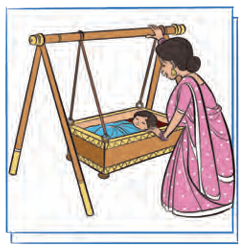
I cannot remember my mother only sometimes in the midst of my play a tune seems to hover over my playthings, the tune of some song that she used to hum while rocking my cradle.
I cannot remember my mother but when in the early autumn morning the smell of the shiuli flowers floats in the air the scent of the morning service in the temple comes to me as the scent of my mother. I cannot remember my mother.
only when from my bedroom window I send my eyes into the blue of the distant sky, I feel that the stillness of my mother’s gaze on my face has spread all over the sky.
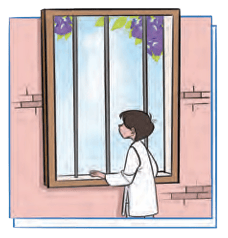
Rabindranath Tagore
Check Your Understanding
I Fill in the blanks with appropriate words.
Stanza 1
1. The poet remembers his mother while he ____________.
2. The poet remembers the ____________ but not the ____________.
Setting: ____________ (outdoor/indoor)
Stanza 2
1. The poet remembers his mother in the ____________ season.
2. The poet remembers his mother by the smell of ____________.
Setting: ____________ (outdoor/indoor)
Stanza 3
1. The poet feels that his mother ____________ at him from the ____________.
Setting: ____________ (outdoor/indoor)
II The senses of olfactory (smell), auditory (hearing), and visual (sight), are three of the five basic senses in humans. Give examples of references to senses from the poem. Complete the table given below.
|
Stanza |
Lines from the Poem |
Senses |
|
1. |
_____________________________ _____________________________ _____________________________ _____________________________ |
|
|
3. |
...the tune of some song that she used to hum while rocking my cradle |
|
|
3. |
_____________________________ _____________________________ _____________________________ |
olfactory |
III Read the poem silently once again and complete the following.
1. Two examples of alliteration from the poem are (i) __________ and (ii) ___________.
2. An example of onomatopoeia is ________________.
3. The poem uses imagery extensively. Explain.
4. Although the poem does not have a rhyme scheme, it is enjoyable because ______________.
5. What is the tone of the poet? Why do you say so?
6. What impact does the title of the poem have on the overall mood of the poem?
7. The poet uses ‘I cannot remember my mother’ as a refrain because __________________.
8. The poet uses symbolism to indicate the memory of his mother’s presence. Identify the symbols used in the poem.
Symbolism is a literary device in which a writer uses a tangible object, abstract idea, or phenomenon that represents something beyond the literal meaning. It helps the poet convey deeper meanings and to connect with readers on an emotional level.
Refrain is a poetic device defined as a line or a group of lines that is repeated at regular intervals in a poem.
Critical Reflection
I Read the extracts given below and answer the questions that follow.
1. I cannot remember my mother only sometimes in the midst of my play a tune seems to hover over my playthings,
(i) Complete the following sentence appropriately. The poet is reminded of his mother during his ________________.
(ii) What is the primary emotion conveyed by the line ‘a tune seems to hover over my playthings’?
A. It enhances the joy of play.
B. It disrupts the playtime atmosphere.
C. It activates memories of the mother.
D. It symbolises the carefree nature of childhood.
(iii) In the context of the poem, what role does the hovering tune play during the speaker’s playtime?
(iv) State whether the following sentence is true or false.
The poet experiences the tune lingering over playthings only occasionally during playtime.
(v) How could the poet feel his mother’s presence, even though she isn’t there?
2. I feel that the stillness of my mother’s gaze on my face has spread all over the sky.
(i) What does the poet suggest about the stillness of his mother's gaze spreading over the sky?
A. The mother’s gaze is physically present in the sky.
B. The sky is a symbolic extension of the mother’s presence.
C. The sky mirrors the mother’s emotions.
D. The stillness is fleeting and unrelated to the mother.
(ii) What emotion does the poet associate with the ‘stillness’ of his mother’s gaze?
A. a sense of grief
B. a sense of anticipation
C. a sense of nostalgia
D. a sense of serenity
(iii) State whether the following sentence is true or false.
The poet suggests that the mother’s gaze has a tangible and visual effect on the sky.
(iv) What is the purpose of likening the mother’s gaze to the sky?
(v) Complete the sentence appropriately.
The tone of the poet in the given extract is _____________ because _____________.
II Answer the following questions.
1. What is the emotional impact of the refrain, ‘I cannot remember my mother’?
2. Interpret the connection between the poet’s mother and the following:
(i) shiuli flowers (ii) humming tune
3. What role does nature play in the poet’s description of the memory of his mother?
4. What can be inferred about the poet’s perception of the mother–child relationship?
Vocabulary in Context
I Work in pairs to classify the sensory words given in the box below. One example has been done for you.
|
Visual |
Auditory |
Olfactory |
Tactile |
|
glowing |
hiss |
aroma |
sticky |
II Fill in the blanks with sensory words in the box for the following passage written by Sarojini Naidu. There are two extra words.
Come and share my exquisite March morning with me: this sumptuous blaze of gold and sapphire sky; these 1. _____________ lilies that adorn the sunshine; the voluptuous 2. _____________ of neem and champak and serisha that beat upon the languid air with their implacable 3. _____________; the thousand little gold and blue and silver breasted birds bursting with the 4. _____________ ecstasy of life in nesting time. And, do you know that the scarlet lilies are woven petal by petal from my heart’s blood, these little quivering birds are my soul made incarnate music, these heavy 5. _____________ are my emotions dissolved into aerial 6. _____________, this 7. _____________ blue and gold sky is the ‘very me’…
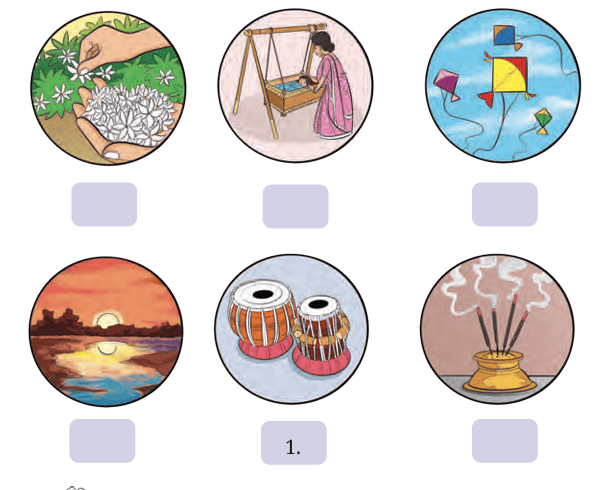
III Write numbers against each picture with the phrases that describe them with their sensorial associations. One example has been done for you.
1. beats of music echo in air
2. melody of soothing scent, dancing in the air
3. fragrant breeze of blooming buds
4. gentle lullaby, a soft melody
5. colourful sky, painting a lively sight
6. attractive canvas painting the horizon
Listen and Respond
I You will listen to four short extracts of people expressing their childhood memories. As you listen, match each statement 1–6 to each speaker (i)–(iv). There are two statements that you do not need. (Transcript for teacher on page 266)
|
Statement |
Speaker |
|
1. The precious memories by the seaside are not the same anymore. |
|
|
2. My grandfather’s encouragement influences me in moments of difficulty. |
|
|
3. The school days are a source of recollection to stay in touch. |
|
|
4. Childhood days are about freedom and ordinary pleasures in outdoor activities. |
|
|
5. Memories of school days are grandparents and my funny tales. |
|
|
6. Parents urge us to be adventurous and discover nature but with limitations. |
|
Speaking Activity
I Work in pairs. Think of an object, song, or a place that is memorable for you. Take turns to speak about it using the prompts given below.
• Introduce it briefly
• Describe it in detail including sensory details
• Narrate the specific memory associated with it
• Explain how it has impacted your life
• Summarise why this memory is meaningful to you even now
You may use the following phrases.
• During my childhood...
• Growing up, I fondly remember...
• Recalling those early years, I can’t forget...
• In my younger days, I used to...
• I have a clear memory of...
• A routine activity in my childhood involved...
• A cherished part of my childhood includes...
• As a child, I was fond of...
• One of my favourite childhood moments is...
• Thinking about my early years, I recall...
• A common occurrence during my youth was...
Writing Task
I Imagine you had been on a school trip to a scenic place which appealed to all your senses. Write a diary entry describing the place and why it was a memorable experience.
Contents of the diary entry:
• begin with day, date, and time
• use only first person (I, my)
• capture sensory details
• express emotions
• focus on significant moments and experiences
• conclude with reflection

Learning Beyond the Text
I You read about the shiuli flowers from the poem. Gather more information on unique flowers of India—where they are found, how they look, what smell they emit, and what the historical significance is, if any. [For example, Kurinji or Neelakurinji that blooms once in twelve years.] Add more flowers to this list.
Shiuli Flowers:
• known as Parijat, Parijata, and Harsingar
• revered and used for various ceremonial purposes
• release a sweet fragrance
• associated with numerous Indian legends
• bloom exclusively during the night
II You must have read poems and songs related to the theme of family, friends and their reminiscences, in English and also in your own language. Collect these poems and songs, and share with your classmates and teacher. Now, read and enjoy the poem given below.
I Remember, I Remember
I remember, I remember
The house where I was born,
The little window where the sun
Came peeping in at morn;
He never came a wink too soon
Nor brought too long a day;
But now, I often wish the night
Had borne my breath away.
I remember, I remember
The roses red and white,
The violets and the lily cups —
Those flowers made of light!
The lilacs where the robin built,
And where my brother set
The laburnum on his birthday, —
The tree is living yet!
Thomas Hood