
Chapter 5
The World of Limitless Possibilities
Paralympics
Reflect and Respond
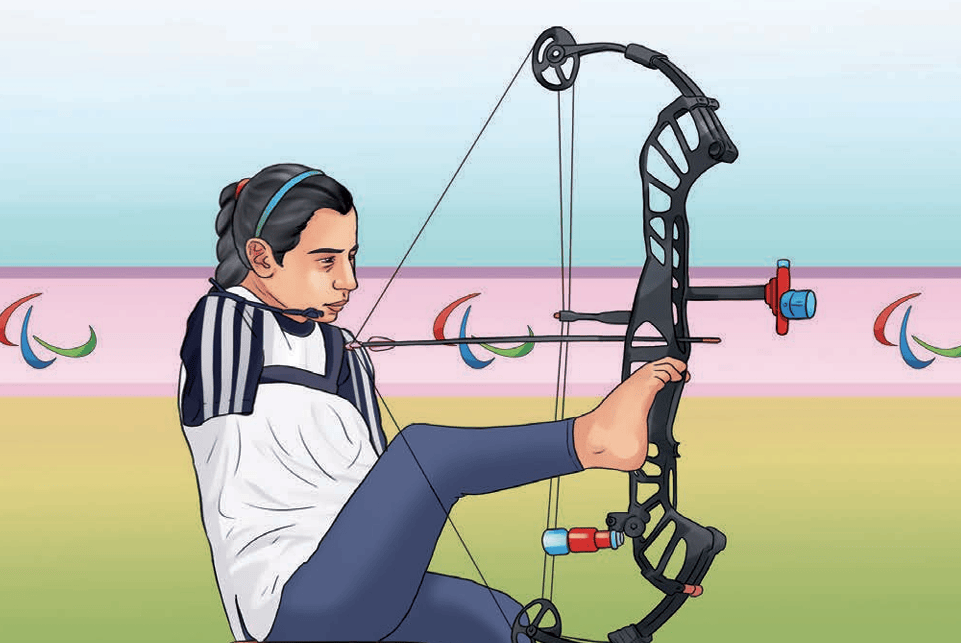
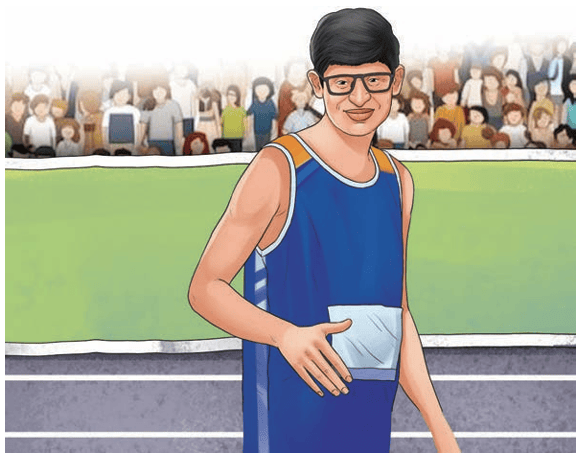
I This is a picture of Sheetal Devi, a para-archer who was honoured with the Arjuna Award in January 2024.
1. Look at the picture carefully and share your observations with your classmates and teacher.
2. Does this personality inspire you? Explain how.
3. Give a caption for this picture.
II Complete the table given below about Paralympics. Share your responses with your classmates and teacher.
|
What I know |
What I want to know |
|
|
|
|
|
|
|
|
Reading for Meaning
I
Ever wondered what happens when incredible athletes defy the odds and showcase their exceptional skills on a global stage? Well, enter the world of Paralympic Games, a thrilling celebration of resilience, and extraordinary talent of athletes with locomotor, sensory, or intellectual disabilities. Paralympics go beyond competition, to quell stereotypes and redefine possibilities.
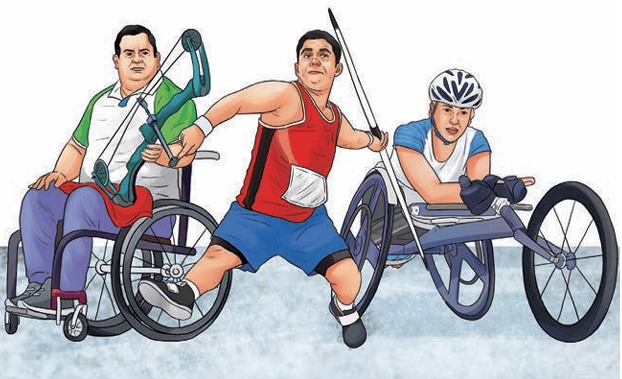
Bharat’s debut in the Paralympics dates back to 1968, and the first medal was clinched in swimming in 1972. Since then, many Indian Paralympians have brought incredible honour to our country. One such Paralympian, Dr. Deepa Malik, a Khel Ratna, Arjuna, and Padma Shri Awardee, has left an indelible mark on innumerable aspiring athletes.
Read the following interview.
Interviewer: Namaste, ma’am! It is my privilege to have this opportunity to meet a famous personality in the world of Paralympics, such as you.
Dr. Malik: Namaste! Believe me, I’m truly honoured.
Interviewer: You’ve been listed as one of the 10 most inspirational women para-athletes globally by the International Paralympic Committee. How did you brave the odds to be who you are today?
Dr. Malik: I was 29, an awful tragedy struck me when I was diagnosed with spine tumour. I underwent a surgery, but misfortune raised its ugly head again. The doctors declared that I would be bound to a wheelchair for the rest of my life, as I was paralysed waist down. I had two choices—squander my life in remorse or transform it to a world of limitless possibilities.
I love sports and had been a swimmer too, so I decided to switch to para-athletics. This is how my Paralympics journey began. My breakthrough moment came in the 2016 Rio Paralympic Games, when I secured the silver medal in the shot-put event. In hindsight, I feel it was a moment of personal victory and a step forward in changing perceptions.

Interviewer: You’re a trailblazer—the first ever Indian female para-athlete to win an Asian Games medal in athletics. You’re also India’s first ever female Paralympics medallist across any sport and the list of ‘firsts’ is never ending. You’ve been bestowed with several coveted awards too. What do these accomplishments mean to you?
Dr. Malik: I truly appreciate these accolades that have been showered on me. These achievements are a testimony to my belief that physical limitations don’t define one’s potential. Moreover, I’m a proponent of the school of thought, ‘ability beyond disability’.
Interviewer : That’s incredible. Could you share something about the challenges you faced in your journey and how you overcame them?
Dr. Malik : One of the significant challenges for me was societal perceptions. People often underestimated my abilities. Overcoming this required not only physical strength but also mental resilience. I embraced challenges as opportunities to prove my capabilities. The support of my family, coupled with my fortitude, allowed me to turn obstacles into stepping stones.
Interviewer: Your story is indeed a testament to the power of determination. How do you believe sports and Paralympics can contribute to challenging societal stereotypes? What has been the impact of Paralympics in your life?
Dr. Malik: Honestly, I feel sports, especially Paralympics, have the extraordinary ability to challenge stereotypes and change attitudes towards disability. When people witness the strength, skill, and competitive spirit of para-athletes, it breaks down preconceived notions. Paralympics has given me a new lease of life and helped me push boundaries. It has made me what I am today. It has made me realise that individuals with disabilities can be as capable, if not more than their able-bodied counterparts.
Interviewer: Beyond the medals, you’ve become vocal for inclusivity and accessibility. How do you see your role in advocating for disability rights and inclusivity?
Dr. Malik: Advocacy is integral to my mission. I strongly believe in working for the cause of strengthening the emotional health of persons with challenges and empowering women through outdoor sports and adventure activities. I also support persons from lower socio–economic strata and provide equipment to para sportspersons. I believe youth is the voice of tomorrow. So, we organise disability sports awareness and advocacy sessions at various schools and colleges. My goal is to contribute to create a society where everyone, regardless of ability, is treated with dignity and given a fair chance to succeed.
Interviewer: Lastly, what advice do you have for individuals facing challenges or setbacks, especially those with disabilities, who aspire to achieve their goals?
Dr. Malik: I would say, every setback is an opportunity to prove your strength. Surround yourself with a support system, believe in yourself, and let your journey inspire others. Remember, disability is not a limitation; it’s a unique strength waiting to be unleashed.
Interviewer: Thank you for sharing your insights. Your story is undoubtedly inspirational.
Dr. Malik: Thank you for having me! It’s been a pleasure.
Check Your Understanding
I Fill in the fact table given below based on the interview with Dr. Deepa Malik. Discuss your answers with your classmates and teacher.
|
Fact Table |
|
|
1. diagnosed with spinal tumour at the age of |
|
|
2. result of the surgery |
|
|
3. named as one of the 10 most effective para-athletes by |
|
|
4. first successful Paralympic event |
|
|
5. list of ‘firsts’ |
(i) (ii) |
|
6. awards won |
(i) (ii) (iii) |
|
7. two things supported by her |
(i) (ii) |
II Read the two sets of sentences given below.
Choose whether the given statements display: fact-opinion or cause-effect.
1
(i) In the 2016 Rio Paralympic Games, I secured the silver medal in the shot-put event.
(ii) I feel it was a moment of personal victory and a step forward in changing perceptions.
2
(i) I was diagnosed with a tumour in my spine.
(ii) I had a surgery and was told that I would be bound to a wheelchair for the rest of my life.
Knowing the difference between fact (evidence/factual information that can be proved to be true) and opinion (writer’s beliefs/perception) helps us understand the text better.
Understanding the relationship between cause (actions/ events) and effect (outcomes) is also helpful in deeper analysis of the text.
III Work in pairs to identify which of these pairs of sentences show:
1. cause-effect
2. fact-opinion
Write 1 or 2 in the boxes given.
(i) Dr. Deepa Malik was a member of the Working Group for the Formulation of Twelfth Five Year Plan (2012–17).
It is believed that she contributed greatly to create better sports policies for the persons with disabilities. ____
(ii) Paralympics showcases incredible talent and determination of para-athletes.
The global perception on disabilities shifts, inspiring para-athletes to pursue their dreams. ____
Critical Reflection
I Read the extracts given below and answer the questions that follow.
I had two choices—squander my life in remorse or transform it to a world of limitless possibilities.
I love sports and had been a swimmer too, so I decided to switch to para-athletics. This is how my Paralympics journey began. My breakthrough moment came in the 2016 Rio Paralympic Games, when I secured the silver medal in the shot-put event. In hindsight, I feel it was a moment of personal victory and a step forward in changing perceptions.
(i) Give a reason for the following statement.
The speaker’s decision to transform her life can be likened to the concept of a caterpillar transforming into a butterfly.
(ii) Why could the speaker switch to para-athletics quite comfortably?
(iii) Complete the sentence with an appropriate reason.
The speaker calls 2016 Rio Paralympic Games as a ‘breakthrough moment’ because ________.
(iv) Select the correct option to complete the sentence.
The phrase ‘in hindsight’ indicates the speaker is __________.
A. curious
B. reflective
C. determined
D. courageous
(v) The speaker uses the phrase ‘changing perceptions’. List one likely perception the speaker might have changed.
2. Honestly, I feel sports, especially Paralympics, have the extraordinary ability to challenge stereotypes and change attitudes towards disability. When people witness the strength, skill, and competitive spirit of para-athletes, it breaks down preconceived notions. Paralympics has given me a new lease of life and helped me push boundaries.
(i) Choose the option that lists the words to describe the tone of the speaker.
A. appreciative
B. moralistic
C. sentimental
D. optimistic
E. defensive
(a) A and D
(b) B, D, and E
(c) B and C
(d) A, C, and E
(ii) Complete the analogy given below with a word from the extract.
ability : potential :: preconceived notions: __________
(iii) State whether the following sentence is true or false.
Paralympics is a platform that not only showcases the remarkable abilities of para-athletes but also questions stereotypes.
(iv) What does ‘helped me push boundaries’ tell us about the speaker?
(v) Which phrase from the extract suggests that the speaker was able to transform her life?
II Answer the following questions.
1. Explain how Dr. Malik’s achievements challenge societal perceptions.
2. What can be the long-term impact of involving youth in schools and colleges in advocacy with respect to disability?
3. Rationalise the appropriateness of the title of this text with reference to Dr. Deepa Malik’s attitude and achievements.
4. “Every setback is an opportunity to prove your strength”. How might this be a life lesson for every individual, and not just sportspersons?
5. Examine how Dr. Deepa Malik’s recognition as one of the 10 most inspirational para-athletes globally contributes to the larger discourse on gender equality in sports.
6. How might Dr. Deepa Malik’s thought, ‘ability beyond disability’, serve as a guideline for success for all future para-athletes?
7. What have you learnt from this interview, and how can you implement these learnings in your life?
Vocabulary and Structures in Context
I Work in pairs. Match the given phrases in Column 1 with their meanings in Column 2. Use the phrases in sentences of your own.
|
Column 1 |
Column 2 |
|
|
1. defy the odds |
(i) a time of significant development or discovery |
|
|
2. a new lease of life |
(ii) overcome challenges and achieve goals |
|
|
3. in hindsight |
(iii) succeed in doing something when most people think it would result in failure |
|
|
4. breakthrough moment |
(iv) ability to understand something after it has happened |
|
|
5. turn obstacles into stepping stones |
(v) an occasion when you become more energetic and active than earlier |
|
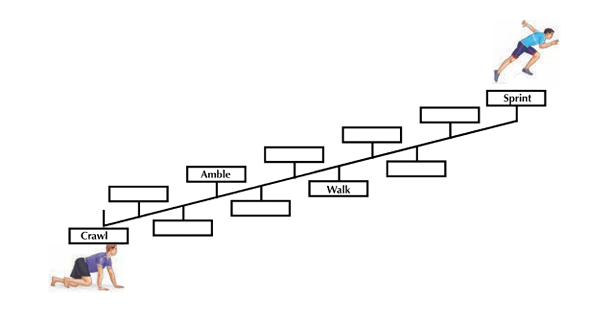
II A common word used in athletics is ‘sprinting’ which relates to movement. Read the words related to movement given in the box below.
Arrange them on the word cline in increasing order of pace from the slowest to the fastest. Some examples have been done for you.
III Match the highlighted verbs in Column 1 with their functions in Column 2. There are two extra functions that you do not need.
|
Column 1 |
Column 2 |
|
|
1. I could hear the audience clapping. |
(i) promise |
|
|
2. It couldn’t be helped. |
(ii) possibility |
|
|
3. I should give it my best shot. |
(iii) prediction |
|
|
4. I knew if I tried, I would win. |
(iv) obligation |
|
|
(v) past ability |
||
|
(vi) impossibility |
||
The verbs in bold are called modal auxiliaries. Each of these modal verbs can perform various functions based on the situation in which they are used.
IV Read the table which shows other functions of the modal auxiliaries.
|
Modal Verbs |
Functions |
|
1. could |
(i) possibility |
|
2. couldn’t |
(i) inability |
|
3. should |
(i) probability |
|
4. would |
(i) request |
Now, make sentences with the modal verbs given in the table above with each function of the modal verbs. Mention the function in brackets.
Read the following sentences.
• Interviewer: You’ve been listed as one of the 10 most inspirational women para-athletes globally by the International Paralympic Committee.
• Dr. Malik: I love sports and had been a swimmer too, so I decided to switch to para-athletics.
The sentences given above are in ______________________. (Direct Speech/Reported Speech)
The sentences given above are ___________ sentences. (declarative/interrogative/exclamatory/imperative)
Now, work in pairs. Observe the changes from Column 1 to Column 2. Note these changes in Column 3. One example has been done for you.
|
Column 1 Direct Speech |
Column 2 Reported Speech |
Column 3 Changes Noted |
|
Interviewer: You’ve been listed as one of the ten most inspirational women para-athletes globally by the International Paralympic Committee. |
The interviewer said that she had been listed as one of the 10 most inspirational women para-athletes globally by the International Paralympic Committee. |
1. ‘said’ added |
|
Dr. Malik: I love sports and had been a swimmer too, and so I decided to switch to para-athletics. |
Dr. Malik said that she loved sports and had been a swimmer too, and so she had decided to switch to para-athletics. |
1. |
|
Interviewer: Your story is indeed a testament to the power of determination. |
The interviewer said that her story was indeed a testament to the power of determination. |
1. |
|
Dr. Malik: I believe youth is the voice of tomorrow. |
Dr. Malik says that she believes youth is the voice of tomorrow. |
1. |
|
Steps to Remember |
|
Use reporting verbs said, told, or says. |
|
Remove quotation marks. |
|
Add linking word ‘that’ after the reporting verb. |
VI Read the conversation given below.
Siya - I watcheD a DocuMentary on the para equeStrIan event on televISIon laSt nIght.
Tarun - I DIDn’t know paralyMpIcS haS equeStrIan eventS.
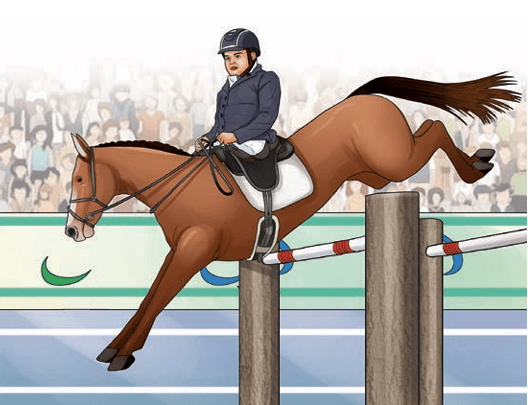
Siya - It does. It was so interesting to watch.
Tarun - That’s wonderful. So, para equestrians must be training for months for this.
Siya - They also have to find and develop their own style of communication with their horse.
Tarun - I will watch this documentary the next weekend.
Change the conversation given above to reported speech. Siya said that she 1. __________________________________________ ________. Tarun replied that he hadn’t known that Paralympics had equestrian events. Siya added that 2. ____________________ _________________________________. Tarun remarked that it was wonderful and that para equestrians must be training for months for that. Siya replied that 3. _________________________ ___________________________. Tarun said that 4. ________________ ____________________________________.
Listen and Respond
I You will listen to an announcement for special assembly in school. As you listen, fill in the blanks with one or two exact words. (Transcript for teacher on page 268)
1. The venue for the special assembly is the ______________.
2. A presentation on inclusion will be made by the ________________.
3. The dance performance will focus on the themes of ___________ and ____________.
4. A _______________ will be conducted by experts who support inclusion.
5. The celebration will end with a _______________ to encourage team work.
Speaking Activity
I Interview the Sports Captain and the Sports Coach of your school.
Note that the interview of the Sports Captain is informal, and that of the Sports Coach is formal.

Work in pairs. One of you can be the interviewer and the other the interviewee in the informal interview. Interchange your role for the formal one.
|
Informal |
Formal |
|
Hello! I’m so glad that you agreed to meet me for this interview. |
Good morning, it is my privilege to get this opportunity to have this interaction with you. |
|
Tell me about yourself and your love for sports. |
Could you tell me how your journey in sports began? |
|
Did you face any challenges? How did you deal with them? |
Could you share something about the challenges you faced and how you overcame them? |
|
What are some impressive achievements you’ve had? How do you feel about them? |
You’ve received many accolades. What do these accomplishments mean to you? |
|
What would you like to say to your peers or juniors who are interested in sports? |
What advice do you have for aspiring athletes? |
Writing Task
I Read the details about a notice in the table given below.
|
What is a notice? |
A notice is generally written to convey some information to students, or a specific group of people. |
|
A notice tells us about… |
An event, a celebration, a competition, important information, lost/found article |
|
Format of a notice |
Name of Organisation NOTICE Date Heading Details Signature Name Designation |
II The Sports Club of your school is organising an Inter-school Athletic Meet. As the Sports Captain, draft a notice in not more than 50 words asking interested students to register themselves for selection in different events. Add all necessary details. Do not forget to design your notice within a box.
Learning Beyond the Text
I Did you know? The origin of Paralympics can be traced back to the year 1948, when Sir Ludwig Guttmann, organised a sports competition for war veterans with spinal cord-related injuries in England. The Stoke Mandeville Games was the Olympic-style games for differently- abled athletes. It was organised for the first time in Rome in 1960 and since then the game has evolved. The Paralympics are split into Winter Games and Summer Games, which alternately occur every two years. Since the late twentieth century, the Paralympics have been held in the same city, which hosts the corresponding Olympic Games; the Paralympics follow shortly after the Olympics.
II Work in groups of four. Choose any one of the topics given below and make a presentation.
• Two lesser-known Paralympic sports (examples: para equestrian, para rowing, etc.)
• Two Paralympians from India
Steps to be followed:
1. Do research on the topic of your choice. Refer to magazines, newspapers, and the internet.
2. Prepare the presentation based on the following guidelines:
• One introductory slide (mentioning topic chosen)
• Two slides on origin and brief history of Paralympics
• Four to five slides about lesser-known Paralympic sports or Indian Paralympians
• One concluding slide
3. Choose appropriate slide design, colour schemes, and images.
4. Ensure there is a good balance between text and images.
5. Share your presentation in class.
6. Each member of the group to take turns to present.
Nine Gold Medals
Reflect and Respond
I Work in pairs. Discuss the difference between Olympics, Special Olympics, and Paralympics.
II Work in pairs to match the words ‘empathy’, ‘sympathy’, and ‘compassion’ to the sentences given in the table below.
|
I am so sorry for what is happening to you. It is sad, do you want something to eat? |
I can imagine how you feel. I understand that you are upset and why. |
I understand why you feel terribly low. I will spend some time with you, so that you don’t feel lonely. |
III Work in pairs. List the words you associate with ‘empathy’. Share your responses with your classmates and teacher.
Reading for Appreciation
1. The athletes had come from all over the country To run for the gold, for the silver, and bronze Many weeks and months of training All coming down to these games.
2. The spectators gathered around the old field To cheer on all the young women and men The final event of the day was approaching Excitement was high to begin.
3. The blocks were all lined up for those who would use them The hundred-yard dash and the race to be run These were nine resolved athletes in the back of the starting line Poised for the sound of the gun.
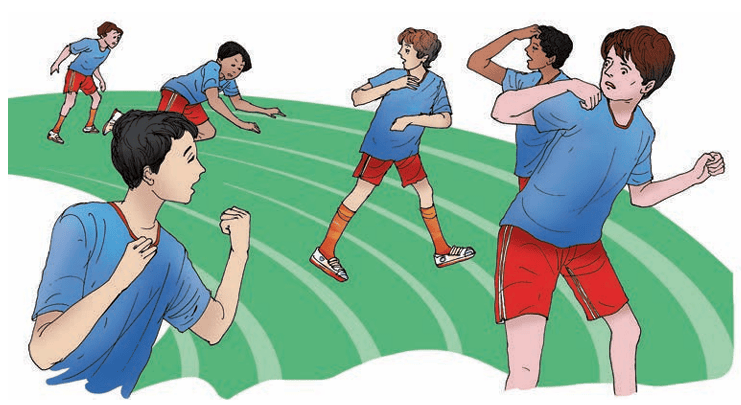
4. The signal was given, the pistol exploded And so did the runners all charging ahead But the smallest among them, he stumbled and staggered And fell to the asphalt instead.
5. He gave out a cry of frustration and anguish His dreams and his efforts dashed in the dirt But as sure as I’m standing here telling this story The same goes for what next occurred.
6. The eight other runners pulled up on their heels The ones who had trained for so long to compete One by one they all turned round and went back to help him And brought the young boy to his feet.
7. Then all the nine runners joined hands and continued The hundred-yard dash now reduced to a walk And a banner above that said (Special Olympics) Could not have been more on the mark.
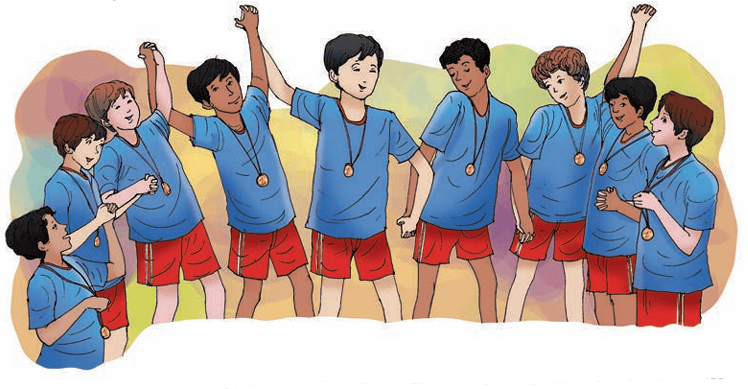
8. That’s how the race ended, with nine gold medals They came to the finish line holding hands still And a standing ovation and nine beaming faces Said more than these words ever will.
DAVID ROTH
Check Your Understanding
I Work in pairs. Match the words and phrases in Column 1 with their meanings in Column 2. You may read the poem again and infer the contextual meaning. Check your answers with the teacher.
|
Column 1 |
Column 2 |
|
1. dashed in the dirt |
(i) walk or move with difficulty |
|
2. stumbled |
(ii) destroyed |
|
3. staggered |
(iii) a hard black substance used to make roads and paths |
|
4. anguish |
(iv) step awkwardly, lose balance and almost fall |
|
5. asphalt |
(v) extreme pain or suffering |
II Identify the gist of each stanza. Write the number of the stanza in the boxes given.
1. Spectators cheered participants of different events and waited enthusiastically for the final event to start. ____
2. All runners dashed ahead as soon as they heard the gun shot; suddenly, one of the athletes tripped and fell on the ground.____
3. The race finished with nine athletes holding hands and winning the well-deserved gold medals; their smiles, and spectators standing up to applaud, conveyed everything. ____
4. Participants got ready at the starting line and nine determined athletes waited for the sound of the gun.____
5. Athletes from various parts of the country had gone through months of training; had big dreams of winning a medal.____
6. The eight athletes stopped to help the young fallen athlete stand up, forgetting that they were competing.____
7. Nine athletes held the banner and walked hand in hand; this gesture represented the ethos of Special Olympics. ____
8. The young athlete felt his dreams were shattered and cried in pain and disappointment, but something unique happened.____
III Let us appreciate the poem.
1. Two examples of alliteration from the poem are
(i) ______________ and (ii) _______________.
2. Give three examples of visual imagery from the poem.
(i) ______________
(ii) _______________
(iii) _______________
3. Give an example of auditory imagery from the poem. (i) _________________
4. How does the use of imagery make the poem more appealing?
5. How does the poet’s tone change from the beginning to the end of the poem?
6. What is the overall mood created by the poem?
7. What is the message being conveyed by the poem?
Critical Reflection
I Read the extracts given below and answer the questions that follow.
1. The eight other runners pulled up on their heels The ones who had trained for so long to compete One by one they all turned round and went back to help him And brought the young boy to his feet.
(i) Select the correct option to complete the sentence.
The phrase ‘pulled up on their heels’ means that the runners _______.
A. moved aside
B. stopped running
C. tried to run faster
D. jumped ahead
(ii) Mention one character trait common to all the eight other runners.
(iii) What is the tone of the poet in these lines?
(iv) How might the young athlete have felt on being helped by the others?
(v) Would you consider this incident as a turning point in the poem? If yes, why? If no, why not?
2. That’s how the race ended, with nine gold medals They came to the finish line holding hands still And a standing ovation and nine beaming faces Said more than these words ever will.
(i) How did the nine contestants feel when they reached the finishing line together?
(ii) Why do you think all the nine contestants were given gold medals?
(iii) Complete the sentence appropriately. The holding of hands signifies a feeling of _____________________.
(iv) Choose the correct option to complete the sentence.
The spectators giving a ‘standing ovation’ indicates that they were ___________.
A. amazed
B. speechless
C. distracted
D. thoughtful
(v) Explain the last line of the extract.
II Answer the following questions.
1. Describe how the setting established in the first two stanzas of the poem create a vivid atmosphere for the events that follow.
2. How do you think the youngest athlete might have felt when he fell?
3. Why were the athletes eager to begin the race?
4. What does the transformation of the hundred-yard dash to a walk symbolise?
5. How might the poem be different if the focus was solely on individual achievement rather than collective support?
6. How does the poet’s use of language and tone enhance the reader’s engagement with the poem?
7. What might be the poet’s purpose of writing this poem?
Vocabulary in Context
I The phrase ‘standing ovation’ is an example of an adjective–noun collocation. Identify two other similar examples from the poem.
Collocation is a pair or group of words that habitually appear together.
II Complete the table given below by writing four nouns in Column 2 that collocate with the adjectives in Column 1. One example has been done for you. You may take the help of a dictionary.
|
Column 1 |
Column 2 |
|
1. big |
disappointment, failure, surprise, decision |
|
2. heavy |
|
|
3. strong |
|
|
4. large |
|
|
5. great |
|
III Choose the correct adjectives from those given in the box for the underlined words given in the sentences below. Ensure you do not use the same adjective twice.
1. The littlest athlete was moving at a steady pace. _____________________
2. The eight athletes had a smiling attitude. _____________________
3.
When the athlete fell, he gave a huge cry of pain. _____________________4. The spectators saw a terrible difference in the athletes who had only come to compete. _____________________
5. The gaudy crowd cheered the runners enthusiastically. _____________________
Listen and Respond
I You will listen to a radio-talk about Patrick Gomes, a coach of special athletes. As you listen, write true or false for the statements given. (Transcript for teacher on page 268)
1. Patrick Gomes began his career in sports with track events.
2. Patrick Gomes has been coaching special athletes for 10 years.
3. Patrick Gomes does all the household work himself.
II You will listen to the radio-talk once again. As you listen, choose the correct option for each question.
1. When the speaker uses the phrase ‘push your boundaries’, he wants listeners to _________.
(i) challenge themselves
(ii) meet new people
(iii) be open-minded
2. Patrick Gomes is a ___________ at present.
(i) special athlete
(ii) coach of special athletes
(iii) value education teacher
3. Special Olympic Games held at Connecticut was a __________ for Patrick Gomes.
(i) motivational year
(ii) turning point
(iii) gradual change
4. As a special athlete, Patrick Gomes mostly participated in ___________.
(i) track events
(ii) jogging
(iii) football
5. Patrick Gomes believes that sports is essential because it encourages ___________ along with fitness.
(i) a positive outlook
(ii) a peaceful mind
(iii) an active life
Speaking Activity
I Work in pairs. Take turns to express your points of view regarding Special Olympics.
Use the key points given below to develop the conversation.
Key points:
• Importance of Special Olympics (promotes inclusion)
• Impact of Special Olympics on sportspersons with special abilities
• How to create awareness regarding Special Olympics
Use the sentence starters given in the table below when you speak.
|
Asking someone for a point of view |
Expressing a point of view |
|
What is your opinion on…? |
Personally, I believe that… |
|
How do you feel about…? |
I hold the opinion that… |
|
In your view, is…? |
It’s my belief that… |
|
What is your take on…? |
I have a strong feeling that… |
|
Do you think that…? |
From my perspective… |
Writing Task
I Work in pairs to write three creative slogans on Special Olympics.
One example of a slogan on Special Olympics has been given below.
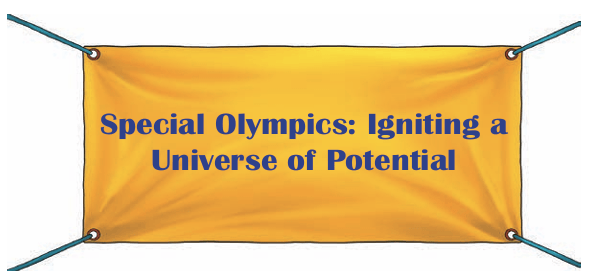
Special Olympics: Igniting a Universe of Potential
Present your slogans in a creative manner and share with your classmates and teacher.
Steps to write a slogan
• Write down the ideas.
• Brainstorm ideas and use them to create the slogan.
• Keep it brief and simple.
• It should not be more than eight to ten words.
• Make the slogan catchy.
Now, create a poster based on the inspiration you have drawn from the poem. Present your poster to the class and display it on the classroom board.
Steps to design a poster
• Include all vital information.
• Remember to place the slogan you created.
• Use top, bottom, and sides of the poster for other important information.
• Include some illustrations, a call for action, if needed..
• Colour and decorate your poster.
• Present your poster as a box item.
Learning Beyond the Text
I Read the information given below about some athletes who participated in Special Olympic Games 2023 held in Berlin, Germany.
RavIMathI ARUMUGAM - She is an athl ete who made India proud by clinching the gold medal in the 400 metre, Level C women’s race.
Aanchal goyal - She won the gold medal in the 400 metre, Level B women’s race.
Saket kunDu - Saket Kundu achieved a rare double in track and field by winning a silver medal in the Level B mini javelin event and a bronze in the Level B 400 metre men’s race.
Find out more about other Indian achievers of Special Olympics.
III Read the information given below in the infographic.
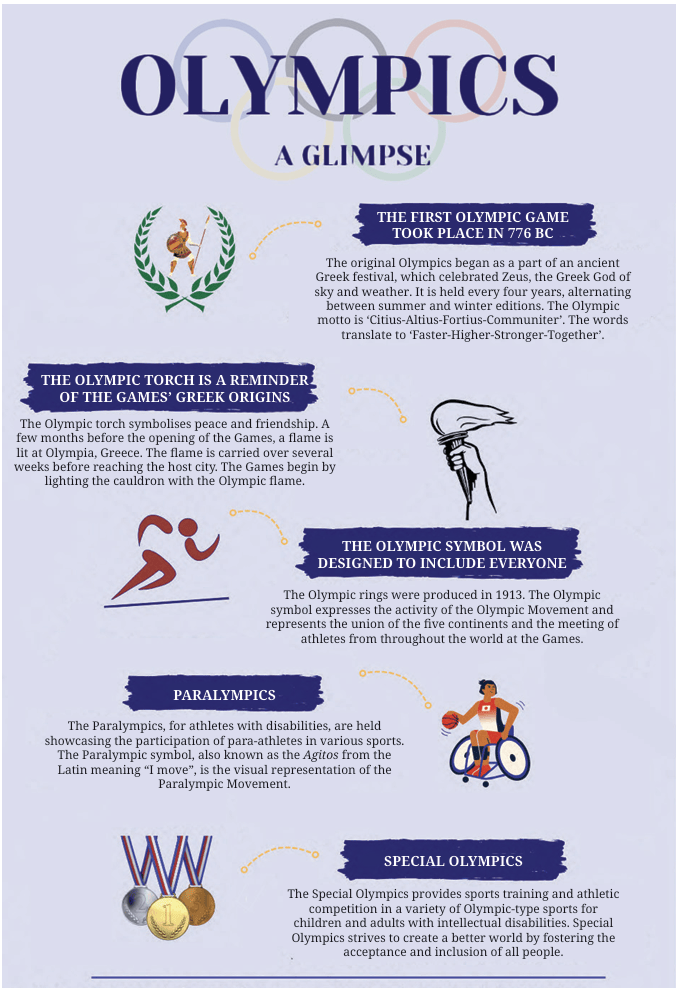
Now, create an infographic on any sport and present it in the class.