
Unit-II
Chapter-2
The World Population
Distribution, Density and Growth
The people of a country are its real wealth. It is they, who are the actual resources and make use of the country’s other resources and decide its policies. Ultimately a country is known by its people.
It is important to know how many women and men a country has, how many children are born each year, how many people die and how? Whether they live in cities or villages, can they read or write and what work do they do? These are what you will study about in this unit.
The world at the beginning of 21st century
recorded the presence of over 6 billion
population. We shall discuss the patterns of
their distribution and density here.
Why do people prefer to live in certain regions and not in others?
The population of the world is unevenly
distributed. The remark of George B. Cressey
about the population of Asia that “Asia has many
places where people are few and few place where
people are very many” is true about the pattern
of population distribution of the world also.
Patterns of Population distribution in the world
Patterns of population distribution and density help us to understand the demographic characteristics of any area. The term population distribution refers to the way people are spaced over the earth’s surface. Broadly, 90 per cent of the world population lives in about 10 per cent of its land area.
The 10 most populous countries of the
world contribute about 60 per cent of the world’s
population. Of these 10 countries, 6 are located
in Asia. Identify these six countries of Asia.
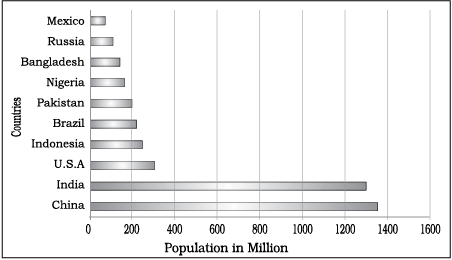
Fig. 2.1: Most Populous Countries
Density of Population
Each unit of land has limited capacity to
support people living on it. Hence, it is
necessary to understand the ratio between the
numbers of people to the size of land. This ratio
is the density of population. It is usually
measured in persons per sq km
Density of Population = Population / Area
For example, area of Region X is 100 sq
km and the population is 1,50,000 persons.
The density of population is calculated as:
Density = 150,000 / 100
= 1,500 person/sq km
What does this tell you about Region X?
Look at Table 2.1 and observe that Asia has
the highest density of population. Discuss
in the class about what could be the reason for
this.
Factors Influencing the Distribution of Population
I. Geographical Factors
(i) Availability of water: Water is the most
important factor for life. So, people prefer
to live in areas where fresh water is easily
available. Water is used for drinking,
bathing and cooking – and also for cattle,
crops, industries and navigation. It is
because of this that river valleys are among
the most densely populated areas of the
world.
(ii) Landforms: People prefer living on flat plains and gentle slopes. This is because such areas are favourable for the production of crops and to build roads and industries. The mountainous and hilly areas hinder the development of transport network and hence initially do not favour agricultural and industrial development. So, these areas tend to be less populated. The Ganga plains are among the most densely populated areas of the world while the mountains zones in the Himalayas are scarcely populated.
(iii) Climate: An extreme climate such as very hot or cold deserts are uncomfortable for human habitation. Areas with a comfortable climate, where there is not much seasonal variation attract more people. Areas with very heavy rainfall or extreme and harsh climates have low population. Mediterranean regions were inhabited from early periods in history due to their pleasant climate.
(iv) Soils: Fertile soils are important for agricultural and allied activities. Therefore, areas which have fertile loamy soils have more people living on them as these can support intensive agriculture. Can you name some areas in India which are thinly populated due to poor soils?
II. Economic Factors
(i) Minerals: Areas with mineral deposits attract industries. Mining and industrial activities generate employment. So, skilled and semi–skilled workers move to these areas and make them densely populated. Katanga Zambia copper belt in Africa is one such good example.
(ii) Urbanisation: Cities offer better
employment opportunities, educational
and medical facilities, better means of
transport and communication. Good civic
amenities and the attraction of city life draw
people to the cities. It leads to rural to
urban migration and cities grow in size.
Mega cities of the world continue to attract
large number of migrants every year.
Yet city life can be very taxing…. think
of some of the unpleasant aspects of city
life.
(iii) Industrialisation: Industrial belts provide
job opportunities and attract large
numbers of people. These include not just
factory workers but also transport
operators, shopkeepers, bank employees,
doctors, teachers and other service
providers. The Kobe-Osaka region of Japan is thickly populated because of the
presence of a number of industries.
III. Social and Cultural Factors
Some places attract more people because they
have religious or cultural significance. In the
same way – people tend to move away from
places where there is social and political
unrest. Many a times governments offer
incentives to people to live in sparsely
populated areas or move away from
overcrowded places. Can you think of some
examples from your region?
Population Growth
The population growth or population change
refers to the change in number of inhabitants of
a territory during a specific period of time. This
change may be positive as well as negative. It
can be expressed either in terms of absolute
numbers or in terms of percentage. Population
change in an area is an important indicator of
economic development, social upliftment and
historical and cultural background of the region.
Some Basic Concepts of Population Geography
Growth of Population : Change of population in particular area between two points of time is known as growth of population. For example, if we deduct the population of India 2001 (102.70 crore) from population of 2011 (121.02 crore) then we shall get the growth of population (18.15 crores) in actual numbers.
Growth Rate of Population : This is the change of population expressed in percentage.
Natural Growth of Population: : This is the population increased by difference between births and deaths in a particular region between two points of time.
Natural Growth = Births – Deaths
Actual Growth of Population : This is
Births – Deaths + In Migration – Out Migration
Positive Growth of Population: This happens when the birth rate is more than the death rate between two points of time or when people from other countries migrate permanently to a region.
Negative Growth of Population: If the population decreases between two points of time it is known as negative growth of population. It occurs when the birth rate falls below the death rate or people migrate to other countries.
Components of Population Change
There are three components of population change – births, deaths and migration.
The crude birth rate (CBR) is expressed as
number of live births in a year per thousand of
population. It is calculated as:
CBR = Bi / P * 1000
Here, CBR = Crude Birth Rate; Bi = live births during the year; P=Mid year population of the area.
Death rate plays an active role in
population change. Population growth occurs
not only by increasing births rate but also due
to decreasing death rate. Crude Death Rate
(CDR) is a simple method of measuring
mortality of any area. CDR is expressed in terms
of number of deaths in a particular year per
thousand of population in a particular region.
CDR is calculated as:
CDR = D / P * 1000
Here, CDR=Crude Death Rate; D= Number of deaths; P=Estimated mid-year population of that year.
By and large mortality rates are affected
by the region’s demographic structure, social
advancement and levels of its economic
development.
Migration
Apart from birth and death there is another way
by which the population size changes.
When people move from one place to another, the place they move from is called the Place of Origin and the place they move to is called the Place of Destination. The place of origin shows a decrease in population while the population increases in the place of destination. Migration may be interpreted as a spontaneous effort to achieve a better balance between population and resources.
Migration may be permanent, temporary or seasonal. It may take place from rural to rural areas, rural to urban areas, urban to urban areas and urban to rural areas.
Do you realise that the same person is both an immigrant and an emigrant?
Immigration: Migrants who move into a new place are called Immigrants.
Emigration: Migrants who move out of a place are called Emigrants.
Can you think of reasons why people migrate?
People migrate for a better economic and
social life. There are two sets of factors that
influence migration.
The Push factors make the place of origin
seem less attractive for reasons like
unemployment, poor living conditions,
political turmoil, unpleasant climate, natural
disasters, epidemics and socio-economic
backwardness.
The Pull factors make the place of
destination seem more attractive than the place
of origin for reasons like better job opportunities
and living conditions, peace and stability,
security of life and property and pleasant
climate.
DO YOU KNOW
Human population increased more than ten times in the past 500 hundred years.
In the twentieth century itself the population has increased four times.
Demographic Transition
Fig. 2.2 explains the three-staged model of Demographic Transition Theory:
The first stage has high fertility and high mortality because people reproduce more to compensate for the deaths due to epidemics and variable food supply. The population growth is slow and most of the people are engaged in agriculture where large families are an asset. Life expectancy is low, people are mostly illiterate and have low levels of technology. Two hundred years ago all the countries of the world were in this stage.
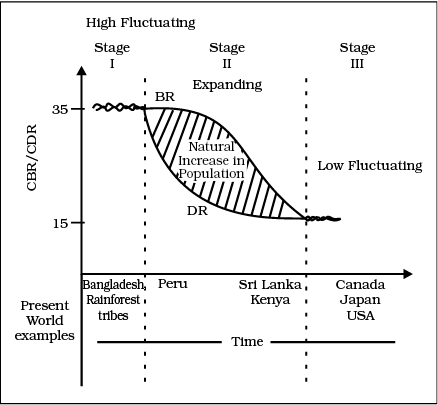
Fig. 2.2: Demographic Transition Theory
Fertility remains high in the beginning of second stage but it declines with time. This is accompanied by reduced mortality rate. Improvements in sanitation and health conditions lead to decline in mortality. Because of this gap the net addition to population is high.
In the last stage, both fertility and mortality decline considerably. The population is either stable or grows slowly. The population becomes urbanised, literate and has high technical know- how and deliberately controls the family size.
This shows that human beings are extremely flexible and are able to adjust their fertility.
In the present day, different countries are
at different stages of demographic transition..
POPULATION CONTROL MEASURES
Family planning is the spacing or preventing the birth of children. Access to family planning services is a significant factor in limiting population growth and improving women’s health. Propaganda, free availability of contraceptives and tax disincentives for large families are some of the measures which can help population control.
Thomas Malthus in his theory (1798)
stated that the number of people would
increase faster than the food supply. Any
further increase would result in a population
crash caused by famine, disease and war. The
preventive checks are better than the physical
checks. For the sustainability of our resources,
the world will have to control the rapid
population increase.

EXERCISES
1. Choose the right answer from the four alternatives given below.
Choose the right answer from the four alternatives given below.
(i) Which one of the following continents has the highest growth of population?
(a) Africa (c) Asia
(b) South America (d) North America
(ii) Which one of the following is not an area of sparse population?
(a) The Atacama (c) Equatorial region
(b) South-east Asia (d) Polar regions
(iii) Which one of the following is not a push factor ?
(a) Water shortage (c) Unemployment
(b) Medical/educational facilities (d) Epidemics
(iv) Which one of the following is not a fact ?
(a) Human population increased more than ten times during the past 500 years.
(b) Population growth is high in the first stage of demographic transition?
2. Answer the following questions in about 30 words.
(i) Name three geographical factors that influence the distribution of population.