
Chapter 8 Social Movements
A great many students and office-workers around the world go to work only for five or six days and rest on the weekends. Yet, very few people who relax on their day off realise that this holiday is the outcome of a long struggle by workers. That the work-day should not exceed eight hours, that men and women should be paid equally for doing the same work, that workers are entitled to social security and pension — these and many other rights were gained through social movements. Social movements have shaped the world we live in and continue to do so.
BOX 8.1
The Right to Vote
Universal adult franchise, or the right of every adult
to vote, is one of the foremost rights guaranteed
by the Indian Constitution. It means that we cannot be
governed by anyone other than the people we have ourselves
elected to represent us. This right is a radical departure from
the days of colonial rule when ordinary people were forced
to submit to the authority of colonial officers who represented
the interests of the British Crown. However, even in Britain,
not everyone was allowed to vote. Voting rights were limited
to property-owning men. Chartism was a social movement for
parliamentary representation in England. In 1839, more than
1.25 million people signed the People’s Charter asking for
universal male suffrage, voting by ballot, and the right to stand
for elections without owning property. In 1842, the movement
managed to collect 3.25 million signatures, a huge number for
a tiny country. Yet, it was only after World War I, in 1918 that
all men over 21, married women, women owning houses, and
women university graduates over the age of 30, got the right
to vote. When the suffragettes (women activists) took up the
cause of all adult women’s right to vote, they were bitterly
opposed and their movement violently crushed.
Compare your life with your grandmother. How is it different from yours? What are the rights you take for granted in your life and which she did not have? Discuss.
We often assume that the rights we enjoy just happened to exist. It is important to recall the struggles of the past, which made these rights possible. You have read about the 19th century social reform movements, of the struggles against caste and gender discrimination and of the nationalist movement in India that brought us independence from colonial rule in 1947. You are familiar also with the many nationalist movements around the world in Asia and Africa and Americas that put an end to colonial rule. The socialist movements world over, the civil rights movement in the United States in the 1950s and 1960s that fought for equal rights for Blacks, the anti apartheid struggle in South Africa have all changed the world in fundamental ways. Social movements not only change societies. They also inspire other social movements. You saw in chapter 3 how the Indian national movement shaped the making of the Indian Constitution. And how in turn the Indian Constitution played a major role in bringing about social change.
Activity 8.2
Try and think of any example that will show you how society is changed by social movements and also how a social movement can lead to other social movements.
8.1 Features of a social movement
A social movement requires sustained collective action over time. Such action
is often directed against the state and takes the form of demanding changes in
state policy or practice. Spontaneous, disorganised protest cannot be called a
social movement either. Collective action must be marked by some degree of
organisation. This organisation may include a leadership and a structure that
defines how members relate to each other, make decisions and carry them
out. Those participating in a social movement also have shared objectives and
ideologies. A social movement has a general orientation or way of approaching
to bring about (or to prevent) change. These defining features are not constant.
They may change over the course of a social movement’s life.
Social movements often arise with the aim of bringing about changes on
a public issue, such as ensuring the right of the tribal population to use the
forests or the right of displaced people to settlement and compensation. Think
of other issues that social movements have taken up in the past and present.
While social movements seek to bring in social change, counter movements
sometimes arise in defence of status quo. There are many instances of such
counter movements. When Raja Rammohun Roy campaigned against sati
and formed the Brahmo Samaj, defenders of sati formed Dharma Sabha and
petitioned the British not to legislate against sati. When reformers demanded
education for girls, many protested that this would be disastrous for society.
When reformers campaigned for widow remarriage, they were socially boycotted.
When the so called ‘lower caste’ children enrolled in schools, some so called
‘upper caste’ children were withdrawn from the schools by their families.
Peasant movements have often been brutally suppressed. More recently the
social movements of erstwhile excluded groups, like the Dalits, have often
invoked retaliatory action. Likewise proposals for extending reservation in
educational institutions have led to counter movements opposing them. Social
movements cannot change society easily. Since it goes against both entrenched
interests and values, there is bound to be opposition and resistance. But over
a period of time changes do take place.
ACTIVITY 8.3
Make a list of different social
movements that you have heard or read
of. What changes do they want to bring
about? What changes do they want to
prevent?
While protest is the most visible form of collective action, a social
movement also acts in other, equally important ways. Social movement activists hold meetings to mobilise people around
the issues that concern them. Such activities help
shared understanding, and also prepare for a feeling
of agreement or consensus about how to pursue the
collective agenda. Social movements also chart out
campaigns that include lobbying with the government,
media and other important makers of public opinion.
You will recall this discussion from Chapter 3. Social
movements also develop distinct modes of protest. This
could be candle and torch light processions, use of black cloth, street theatres,
songs, poetry. Gandhi adopted novel ways such as ahimsa, satyagraha and
his use of the charkha in the freedom movement. Recall the innovative modes
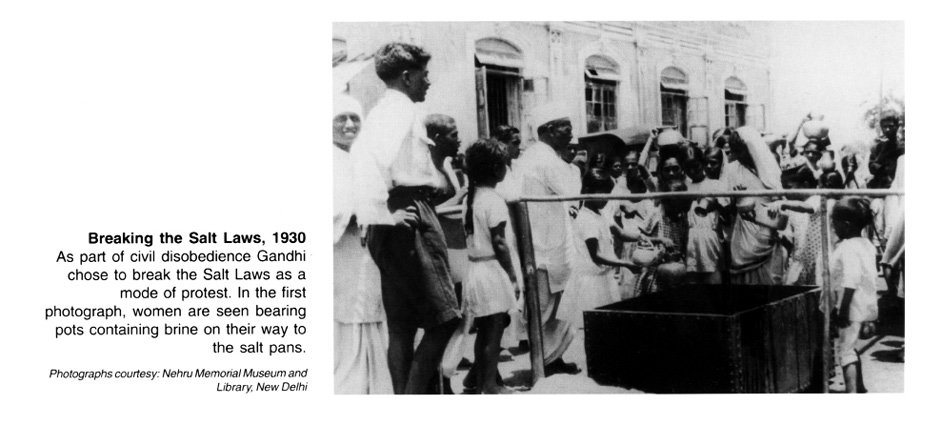
of protest such as picketing and defying of the colonial ban on producing salt.
BOX 8.2
The repertoire of satyagraha
The fusion of foreign power and capital was the focus of social protest during India’s nationalist struggle. Mahatma Gandhi wore khadi, hand-spun, hand-woven cloth, to support Indian cotton-growers, spinners and weavers whose livelihoods had been destroyed by the government policy of favouring mill-made cloth. The legendary Dandi Marchto make salt was a protest against British taxation policies that placed a huge burden on consumers of basic commodities in order to benefit the empire. Gandhi took items of everyday mass consumption like cloth and salt, and transformed them into symbols of resistance.
Distinguishing social change and social movements
It is important to distinguish between social change in general and social
movements. Social change is continuous and ongoing. The broad historical
processes of social change are the sum total of countless individual and
collective actions gathered across time and space. Social movements are
directed towards some specific goals. It involves long and continuous social
effort and action by people. To draw from our discussion in Chapter 2, we can
view sanskritisation and westernisation as social changes and see the 19th
century social reformers’ efforts to change the society as social movements.
8.2 Sociology and social movements
Why the study of social movements is important for sociology
From the very beginning, the discipline of sociology has been interested in social
movements. The French Revolution was the violent culmination of several
movements aimed at overthrowing the monarchy and establishing ‘liberty,
equality and fraternity’. In Britain, the industrial revolution was marked by
great social upheaval. Recall our discussion on the emergence of sociology in
the west in NCERT Class XI textbook Introducing Sociology. Poor labourers
and artisans who had left the countryside to find work in the cities protested
against the inhuman living conditions into which they were forced. Food riots in
England were often suppressed by the government. These protests were perceived by
elites as a major threat to the established order of society. Their anxiety about
maintaining social order was reflected in the work of sociologist Emile Durkheim.
Durkheim’s writings about the division of labour in society, forms of religious
life, and even suicide, mirror his concern about how social structures enable
social integration. Social movements were seen as forces that led to disorder.
Scholars influenced by the ideas of Karl Marx offered a different view of violent collective action. Historians like E. P. Thompson showed that the ‘crowd’ and the ‘mob’ were not made up of anarchic hooligans out to destroy society. Instead, they too had a ‘moral economy’. In other words, they have their own shared understanding of right and wrong that informed their actions. Their research showed that poor people in urban areas had good reasons for protesting. They often resorted to public protest because they had no other way of expressing their anger and resentment against deprivation.
8.3 Types of social movements
There are different kinds of social movements. They can be classified as: (i) redemptive or transformatory; (ii) reformist; and (iii) revolutionary. A redemptive social movement aims to bring about a change in the personal consciousness and actions of its individual members. For instance, people in the Ezhava community in Kerala were led by Narayana Guru to change their social practices. Reformist social movements strive to change the existing social and political arrangements through gradual, incremental steps. The 1960s movement for the reorganisation of Indian states on the basis of language and the recent Right to Information campaign are examples of reformist movements. Revolutionary social movements attempt to radically transform social relations, often by capturing state power. The Bolshevik revolution in Russia that deposed the Tsar to create a communist state and the Naxalite movement in India that seeks to remove oppressive landlords and state officials can be described as revolutionary movements
As you might discover when you try to classify a social movement in terms of this typology, most movements have a mix of redemptive, reformist and revolutionary elements. Or the orientation of a social movement may shift over time such that it starts off with, say, revolutionary objectives and becomes reformist. A movement may start from a phase of mass mobilisation and collective protest to become more institutionalised. Social scientists who study the life cycles of social movements call this a move towards ‘social movement organisations’.
How a social movement is perceived and classified is always a matter
of interpretation. It differs from one section to another. For instance, what
was a ‘mutiny’ or ‘rebellion’ for British colonial rulers in 1857 was ‘the first
war of Independence’ for Indian nationalists. A mutiny is an act of defiance
against supposedly legitimate authority, i.e., the British rule. A struggle for
independence is a challenge to the very legitimacy of British rule. This shows
how people attach different meanings to social movements.
Distinguishing the new social movement from the old social movements
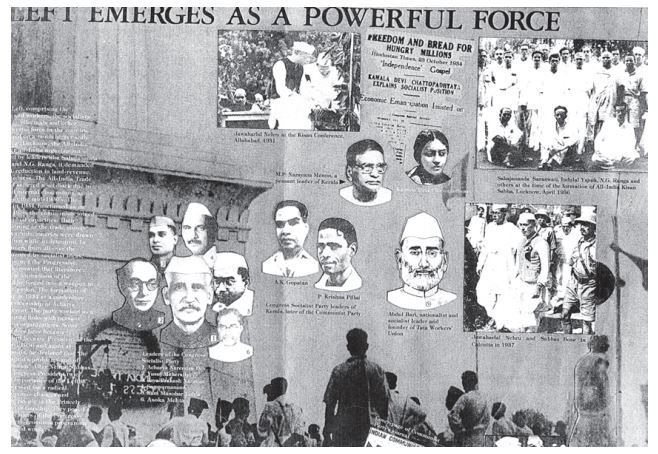
As you read about the various dimensions of social change in India, you would have been struck by the fact that globalisation has been re-shaping peoples’ lives in industry and agriculture, culture and media. Often firms are transnational. Often legal arrangements that are binding are international such as the regulations of the World Trade Organisation (WTO). Environmental and health risks, fears of nuclear warfare are global in nature. Not surprisingly therefore many of the new social movements are international in scope. What is significant, however, is that the old and new movements are working together in new alliances such as the World Social Forum that have been raising awareness about the hazards of globalisation.
8.4 Ecological Movements
For much of the modern period the greatest emphasis has been laid on
development. Over the decades there has been a great deal of concern about
the unchecked use of natural resources and a model of development that
creates new needs that further demands greater exploitation of the already
depleted natural resources. This model of development has also been critiqued
for assuming that all sections of people will be beneficiaries of development.
Thus big dams displace people from their homes and sources of livelihood.
Industries displace agriculturalists from their homes and livelihood. The impact
of industrial pollution is yet another story. Here we take just one example of
an ecological movement to examine the many issues that are interlinked in an
ecological movement.
ACTIVITY 8.4
Find out some instances of
environmental pollution from your
region. Discuss. You can also have a
poster exhibition of all your findings.
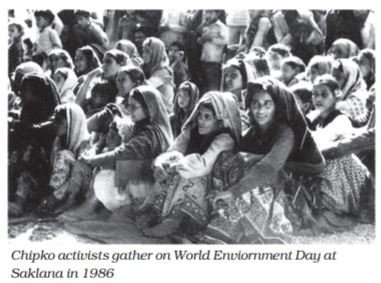
Chipko activists gather on World Enviornment Day at
Saklana in 1986
The Chipko Movement,
an example of the ecological
movement, in the Himalayan
foothills is a good example of
such intermingled interests
and ideologies. According to Ramachandra Guha in his book, Unquiet Woods,
villagers rallied together to save the oak and rhododendron forests near their
villages. When government forest contractors came to cut down the trees,
villagers, including large number of women, stepped forward to hug the trees to
prevent their being felled. At stake was the question of villagers’ subsistence. All
of them relied on the forest to get firewood, fodder and other daily necessities.
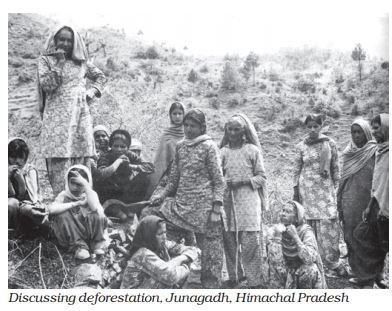
Discussing deforestation, Junagadh,
Himachal Pradesh
This conflict placed the livelihood needs of
poor villagers against the government’s desire
to generate revenues from selling timber. The
economy of subsistence was pitted against the
economy of profit. Along with this issue of social
inequality (villagers versus a government that
represented commercial, capitalist interests),
the Chipko Movement also raised the issue
of ecological sustainability. Cutting down
natural forests was a form of environmental
destruction that had resulted in devastating
floods and landslides in the region. For the
villagers, these ‘red’ and ‘green’ issues were
interlinked. While their survival depended on
the survival of the forest, they also valued the
forest for its own sake as a form of ecological wealth that benefits all. In addition,
the Chipko Movement also expressed the resentment of hill villagers against a
distant government headquartered in the plains that seemed indifferent and
hostile to their concerns. So, concerns about economy, ecology and political
representation underlay the Chipko Movement. Trees are necessary for the
conservation of environment. Similarly, clean water is necessary for a healthy
environment. In the light of this, the Government of India has recently, through
the ‘Intergrated Ganga Conservation Mission’ (Namami Gange) and Swachch
Bharat Abhiyan imitiated systematic efforts to create a balance, structure and
quality in India’s ecology.
Box 8.3
Chipko Movement
The unusually heavy monsoon of 1970 precipitated the most devastating flood in living memory. In the Alaknanda valley, water inundated 100 square kilometres of land, washed away 6 metal bridges and 10 kilometres of motor roads, 24 buses and several other vehicles; 366 houses collapsed and 500 acres of standing paddy crops were destroyed. The loss of human and bovine life was considerable.
…The 1970 floods mark a turning-point in the ecological history of the region. Villagers, who bore the brunt of the damage, were beginning to perceive the hitherto tenuous links between deforestation, landslides and floods. It was observed that some of the villages most affected by landslides lay directly below forests where felling operations had taken place….
…The villagers’ cause was taken up by the Dashauli Gram Swaraja Sangh (DGSS), a cooperative organisation based in Chamoli district.
…Despite these early protests, the government went ahead with the yearly auction of forests in November. One of the plots scheduled to be assigned was the Reni forest….
…The contractors’ men who were travelling to Reni from Joshimath stopped the bus shortly before Reni. Skirting the village, they made for the forest. A small girl who spied the workers with their implements rushed to Gaura Devi, the head of the village Mahila Mandal (Women’s Club). Gaura Devi quickly mobilised the other housewives and went to the forest. Pleading with the labourers not to start felling operations, the women initially met with abuse and threats. When the women refused to budge, the men were eventually forced to retire.
Box 8.4
8.5 Class Based Movements
Peasant Movements
Peasant movements or agrarian struggles have taken place from pre-colonial
days. The movements in the period between 1858 and 1914 tended to remain
localised, disjointed and confined to particular grievances. Well-known are
the Bengal revolt of 1859-62 against the indigo plantation system and the
‘Deccan riots’ of 1857 against moneylenders. Some of these issues continued
into the following period, and under the leadership of Mahatma Gandhi became
partially linked to the Independence movement. For instance, the Bardoli
Satyagraha (1928, Surat District) a ‘non-tax’ campaign as part of the nationwide
non-cooperation movement, a campaign of refusal to pay land revenue and the
Champaran Satyagraha (1917–18) directed against indigo plantations. In the
1920s, protest movements against the forest policies of the British government
and local rulers arose in certain regions. Recall our discussion on structural
changes in Chapter 1.
Between 1920 and 1940 peasant organisations arose. The first organisation to be founded was the Bihar Provincial Kisan Sabha (1929), and in 1936 the All India Kisan Sabha. The peasants organised by the Sabhas demanded freedom from economic exploitation for peasants, workers and all other exploited classes. At the time of Independence, we had the two most classical cases of peasant movements, namely the Tebhaga movement (1946–47) and the Telangana movement (1946–51). The first was a struggle of sharecroppers in Bengal in North Bihar for two thirds share of their produce instead of the customary half. It had the support of the Kisan Sabha and the Communist Party of India (CPI). The second was directed against the feudal conditions in the princely state of Hyderabad and was led by the CPI.
New farmer’s movements began in the 1970s in Punjab and Tamil Nadu. These movements were regionally oganised, were non-party, and involved farmers rather than peasants (farmers are said to be market-involved as both commodity producers and purchasers). The basic ideology of the movement was strongly anti-state and anti-urban. The focus of demand were ‘price and related issues’ (for example, price procurement, remunerative prices, prices for agricultural inputs, taxation, non-repayment of loans). Novel methods of agitation were used: blocking of roads and railways, refusing politicians’ and bureaucrats’ entry to villages, and so on. It has been argued that the farmers’ movements have broadened their agenda and ideology and include environment and women’s issues. Therefore, they can be seen as a part of the worldwide ‘new social movements’.
BOX 8.5
…the Siliguri subdivision peasants’ conference proved to be a great success. The peasants, quickened and strengthened by their earlier militant struggles, looked forward expectantly. Faces deadened and dulled with the grinding routine of labour on the jotedars’ fields in sun and rain glowed with hope and understanding. According to Kanu Sanyal’s later claims, from March 1967 to April 1967, all the villagers were organised. From 15,000 to 20,000 peasants were enrolled as wholetime activists. Peasants’ committees were formed in every village and they were transformed into armed guards. They soon occupied land in the name of peasants’ committees, burnt all land records ‘which had been used to cheat them of their dues’, cancelled all hypothecary debts, passed death sentences on oppressive landlords, formed armed bands by looting guns from landlords, armed themselves with conventional weapons like bows, arrows and spears, and set up parallel administration to look after the villages…
Source: Sumanata Banerjee “Naxalbari and the Left Movement” in ed. Ghanshyam Shah Social Movements and the State (Sage, Delhi 2002) pp.125-192
BOX 8.6
The guerrilla movement was heralded by the forcible cutting of crops from the land of a rich landlord at Garudabhadra, near Boddapadu in the plains area on 24 November 1968. More significant was the action in the hill tracts the next day, when in Pedagottili village of the Parvatipuram Agency area, about 250 Girijans from several villages armed with bows, arrows and spears... raided the house of a …landlord cum moneylender.. .and took possession of his hoarded paddy, rice, other food grains and property worth about Rs. 20,000. They also seized documents.
Workers’ Movements
Factory production began in India in the early part of the 1860s. You will recall
our discussion on the specific character of industrialisation in the colonial
period. The general pattern of trade set up by the colonial regime was one
under which raw materials were procured from India and goods manufactured
in the United Kingdom were marketed in the colony. These factories were, thus
established in the port towns of Calcutta (Kolkata) and Bombay (Mumbai). Later
factories were also set up in Madras (Chennai). Tea plantations in Assam were
established as early as in 1839.
In the early stages of colonialism, labour was very cheap as the colonial
government did not regulate either wages or working conditions. You will
remember the manner in which the colonial government ensured supply of
labour in the tea plantations (Chapter 1).
Though trade unions emerged later, workers did protest. Their actions then were, however, more spontaneous than sustained. Some of the nationalist leaders also drew in the workers into the anti colonial movement. The war led to the expansion of industries in the country but it also brought a great deal of misery to the poor. There were food shortage and sharp increase in prices. There were waves of strikes in the textile mills in Bombay. In September and October 1917 there were around 30 recorded strikes. Jute workers in Calcutta struck work. In Madras, the workers of Buchingham and Carnatic Mills (Binny’s) struck work for increased wages. Textile workers in Ahmedabad struck work for increase in wages by 50 per cent. (Bhowmick 2004)
The first trade union was established in April 1918 in Madras by B.P.
Wadia, a social worker and member of the Theosophical Society. During the
same year, Mahatma Gandhi founded the Textile Labour Association (TLA). In
1920, the All India Trade Union Congress (AITUC) was formed in Bombay. The AITUC was a broad-based organisation involving diverse ideologies. The main
ideological groups were the communists led by S.A. Dange and M.N. Roy, the
moderates led by M. Joshi and V.V. Giri and the nationalist movements which
involved people like Lala Lajpat Rai and Jawaharlal Nehru.
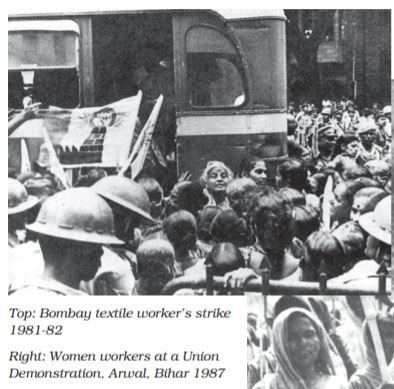
Top: Bombay textile worker’s
strike 1981–82
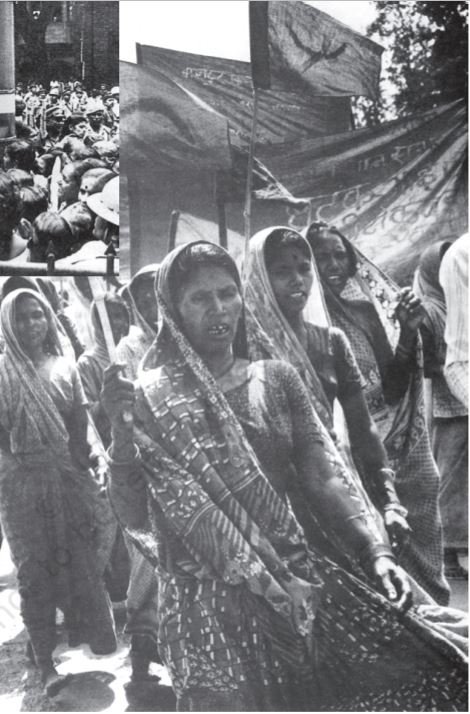
Right: Women workers at a Union
Demonstration, Arwal, Bihar 1987
During the last few years of British rule the communists gained considerable control over the AITUC. The Indian National Congress chose to form another union called the Indian National Trade Union Congress (INTUC) in May 1947. The split in the AITUC in 1947 paved the way for further splits on the line of political parties. Apart from the working class movement being divided on the lines of political parties at the national level, regional parties too started to form their own unions from the late 1960s.
In 1966–67, the economy suffered a major recession which led to a decrease
in production and consequently employment. There was a general unrest. In
1974 there was a major railway workers’ strike. The confrontation between the
state and trade unions became acute. The worker’s moment was very much
part of the wide struggle for civil liberties.
8.6 Caste Based Movements
The Dalit Movement
Social movements of Dalits show a particular character. The movements cannot be explained satisfactorily by reference to economic exploitations alone or political oppression, although these dimensions are important. This is a struggle for recognition as fellow human beings. It is a struggle for self-confidence and a space for self-determination. It is a struggle for abolishment of stigmatisation, that untouchability implied. It has been called a struggle to be touched.The word Dalit is commonly used in Marathi, Hindi, Gujarati and many
other Indian languages, meaning the poor and oppressed persons. It was first
used in the new context in Marathi by neo-Buddhist activists, the followers of
Babasaheb Ambedkar in the early 1970s. It
refers to those who have been broken, ground
down by those above them in a deliberate way.
There is, in the word itself, inherent denial of
pollution, karma and justified caste hierarchy.
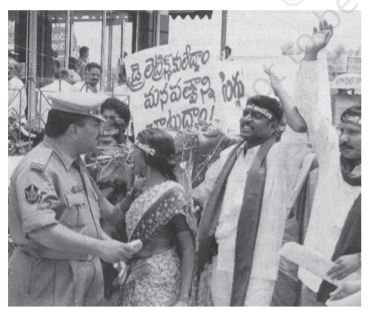
There has not been a single, unified Dalit movement in the country now or in the past. Different movements have highlighted different issues related to Dalits, around different ideologies. However, all of them assert a Dalit identity though the meaning may not be identical or precise for everyone. Notwithstanding differences in the nature of Dalit movements and the meaning of identity, there has been a common quest for equality, self-dignity and eradication of untouchability (Shah 2001:194). This can be seen in the Satnami Movement of the Chamars in the Chattisgarh plains in eastern MP, Adi Dharma Movement in Punjab, the Mahar Movement in Maharashtra, the socio-political mobilisation among the Jatavas of Agra and the Anti-Brahman Movement in south India.
In the contemporary period, the Dalit movement has unquestionably acquired a place in the public sphere that cannot be ignored. This has been accompanied by a growing body of Dalit literature.
Dalit writers are insistent on using their own imageries and expressions
rooted in their own experiences and perceptions. Many felt that the highflown social imageries of mainstream society would hide the truth rather than
reveal it. Dalit literature gives a call for social and cultural revolt. While some
emphasise the cultural struggle for dignity and identity, others also bring in
the structural features of society including the economic dimensions.
BOX 8.7
Sociologists, attempts to classify Dalit movements have led them to believe that they belong to all the types, namely reformative, redemptive, revolutionary.
…the anti-caste movement which began in the 19th century under the inspiration of Jotiba Phule and was carried out in the 1920s by the non-Brahmin movements in Maharashtra and Tamil Nadu and then developed under the leadership of Dr. Ambedkar had characteristics of all types. At its best it was revolutionary in terms of society and redemptive in terms of individuals. In partial context, the ‘post Ambedkar Dalit movement’ has had revolutionary practice. It has provided alternative ways of living, at some points limited and at some points radical and all-encompassing, ranging from changes in behaviour such as giving up eating beef to religious conversion. It has focussed on changes in the entire society, from radical revolutionary goal of abolishing caste oppression and economic exploitation to the limited goals of providing scope for members of Scheduled Caste to achieve social mobility.
But on the whole…this movement has been a reformist movement. It has mobilized along caste lines, but only made half hearted efforts to destroy caste; it has attempted and achieved some real though limited societal changes with gains especially for the educated sections among Dalits, but it has failed to transform society sufficiently to raise the general mass from what is still among the most excruciating poverty in the world.
Backward Class Castes Movements
The emergence of backward castes/classes as political entities has occurred
both in the colonial and post-colonial contexts. The colonial state often
distributed patronage on the basis of caste. It made sense, therefore, for people
to stay within their caste for social and political identity in institutional life. It
also influenced similarly placed caste groups to unite themselves and to form
what has been termed a ‘horizontal stretch’. Caste, thus, began to lose its ritual
content and become more and more secularised for political mobilisation (recall
the discussion on secularisation in Chapter 2).
The term ‘Backward Classes’ has
been in use in different parts of the
country since the late 19th Century.
It began to be used more widely in
Madras presidency since 1872, in the
princely state of Mysore since 1918,
and in Bombay presidency since
1925. From the 1920s, a number
of organisations united around
the issue of caste sprang up in
different parts of the country. These
included the United Provinces Hindu
Backward Classes League, All-India
Backward Classes Federation, All
India Backward Classes League. In
1954, 88 organisations were counted
working for the Backward Classes.
BOX 8.8
The following observations were made by G.B. Pant during a speech that moved the constitution of the Advisory Committee on fundamental rights, minorities, etc.: ‘We have to take particular care of the Depressed Classes, the Scheduled Castes and the Backward Classes… We must do all we can to bring them up to the general level…The strength of the chain is measured by the weakest link of it and so until every link is fully revitalised, we will not have a healthy body politic.’ In 2019, the Government of India introduced 10 per cent reservation in education and government jobs for economically weaker sections among upper castes. How is it different from the above quote? Discuss.
8.7 The Tribal Movements
Different tribal groups spread
across the country may share
common issues. But the
distinctions between them are
equally significant. Many of the
tribal movements have been
largely located in the so called
‘tribal belt’ in middle India, such
as the Santhals, Hos, Oraons,
Mundas in Chota Nagpur and
the Santhal Parganas. The region
constitutes the main part of what
has come to be called Jharkhand.
We will not be able to go into any
detailed account of the different movements. We take Jharkhand as an example
of a tribal movement with a history that goes back a hundred years. We also
briefly touch on the specificity of the tribal movements in the North East but
fail to deal comprehensively the many differences that exist between one tribal
movement and another within the region
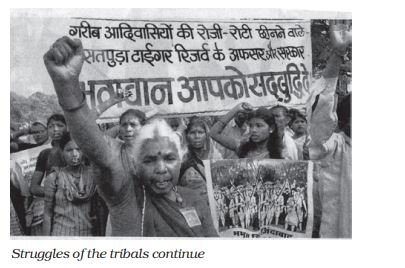
Struggles of the tribals continue
Jharkhand
Jharkhand is one of the newly formed states of India, carved out of south Bihar in the year 2000. Behind the formation of this state lies more than a century of resistance. The social movement for Jharkhand had a charismatic leader in Birsa Munda, an adivasi who led a major uprising against the British. After his death, Birsa became an important icon of the movement. Stories and songs about him can be found all over Jharkhand. The memory of Birsa’s struggle was also kept alive by writing. Christian missionaries working in south Bihar were responsible for spreading literacy in the area. Literate adivasis began to
research and write about their history and myths. They documented and disseminated information about tribal customs and cultural practices. This helped create a unified ethnic consciousness and a shared identity as Jharkhandis.
Literate adivasis were also in a position to get government jobs so that, over
time, a middle-class adivasi intellectual leadership emerged that formulated
the demand for a separate state and lobbied for it in India and abroad. Within
south Bihar, adivasis shared a common hatred of dikus – migrant traders and
moneylenders who had settled in the area and grabbed its wealth, impoverishing
the original residents. Most of the benefits from the mining and industrial
projects in this mineral-rich region had gone to dikus even as adivasi lands
had been alienated. Adivasi experiences of marginalisation and their sense of
injustice were mobilised to create a shared Jharkhandi identity and inspire
collective action that eventually led to the formation of a separate state.
The issues against which the leaders of the movement in Jharkand agitated were:
- acquisition of land for large irrigation projects and firing ranges;
- survey and settlement operations, which were held up, camps closed down,
etc
- collection of loans, rent and cooperative dues, which were resisted
- nationalisation of forest produce which they boycotted
The North East
The process of state formation initiated by the Indian government following
the attainment of independence generated disquieting trends in all the
major hill districts in the region. Conscious of their distinct identity and
traditional autonomy, the tribes were unsure of being incorporated within the
administrative machinery of Assam.
The rise of ethnicity in the region is thus a response to cope with the new situation which developed as a consequence of the tribe’s contact with a powerful alien system. Long isolated from the Indian mainstream the tribes were able to maintain their own worldview and social and cultural institutions with little external influence. …While the earlier phase showed a tendency towards secessionism, this trend has been replaced by a search for autonomy within the framework of the Indian Constitution. (Nongbri 2003: 115)
One of the key issues that bind tribal movements from different parts of the country is the alienation of tribals from forest lands. In this sense ecological issues are central to tribal movements. Just as cultural issues of identity and economic issues such as inequality are. This brings us back to the question about the blurring of old and new social movements in India.
8.8 The Women’s Movement
The 19th century social reform movements and early Women’s Organisations
You are already familiar with the 19th century
social reform movements that raised various issues
concerning women. Chapter 2 had dealt with it as
did the earlier book. The early 20th century saw the
growth of women’s organisations at the national
and the local level. The Women’s India Association
(WIA) (1917), All India Women’s Conference (AIWC)
(1926) and National Council for Women in India
(NCWI) (1925) are ready names of organisations
that we can mention. While many of them began
with a limited focus, their scope extended over
time. For instance, the AIWC began with the idea
that ‘women’s welfare’ and ‘politics’ were mutually
exclusive. Few years later in one of the Presidential
addresses it was stated, “…Can the Indian man
or woman be free if India be a slave? How can we
remain dumb about national freedom, the very
basis of all great reforms?” (Chaudhuri 1993: 149)
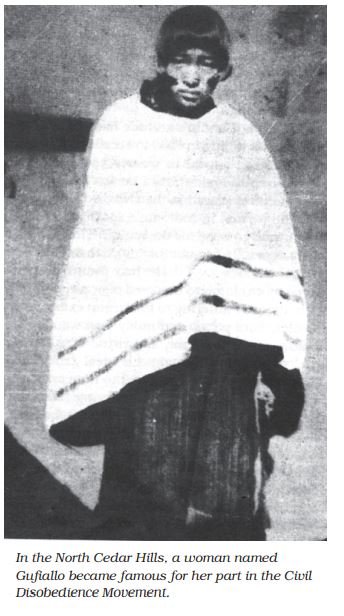
In the North Cedar Hills, a woman named
Gufiallo became famous for her part in the
Civil Disobedience Movement.
It can be argued that this period of activity
did not constitute a social movement. It can be
argued otherwise too. Let us recall some of the
features that characterise social movements. It did
have organisations, ideology, leadership, a shared
understanding and the aim of bringing about
changes on a public issue. What they succeeded
together was to create an atmosphere where the
women’s question could not be ignored.
Agrarian Struggles and Revolts
It is often assumed that only middle class educated women are involved in social
movements. Part of the struggle has been to remember the forgotten history of
women’s participation. Women participated along with men in struggles and
revolts originating in tribal and rural areas in the colonial period. The Tebhaga
movement in Bengal, the Telangana arms struggle from the erstwhile Nizam’s rule,
and the Warli tribal’s revolt against bondage in Maharashtra are some examples. Post–1947
An issue that is often raised is that if there was an active women’s movement before 1947, whatever happened afterwards. One explanation has been that many of the women activists who were also involved in the nationalist movement got involved in the nation building task. Others cite the trauma of Partition responsible for the lull.
In the mid–1970s, there was a renewal of the women’s movement in India.
Some call it the second phase of the Indian women’s movement. While many
of the concerns remained the same that there were changes both in terms of
organisational strategy, as well as, ideologies.
Apart from organisational changes, there were new issues that were focussed
upon. For instance, violence against women. Over the years, there have been
numerous campaigns that have been taken up. You may have noticed that
application for school forms have both father’s and mother’s names. This was
not always true. Likewise, important legal changes have taken place thanks
to the campaign by the women’s movement. Issues of land rights, employment
have been fought alongside rights against sexual harassment and dowry.
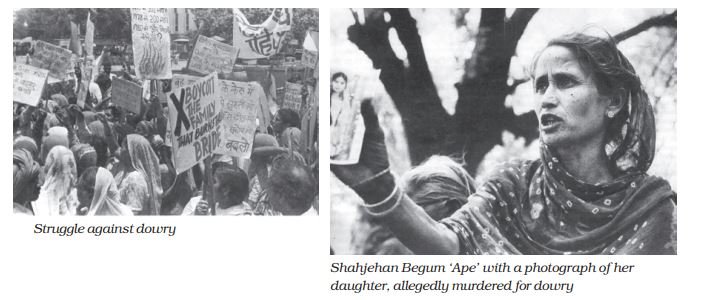
Struggle against dowry
Shahjehan Begum ‘Ape’ with a photograph of her
daughter, allegedly murdered for dowry
There has been a recognition too that while all women are in some way
disadvantaged vis-a-vis men, all women do not suffer the same level or kind of
discrimination. The concerns of the educated middle class woman is different
from the peasant woman, just as the concern of the Dalit woman is different
from the ‘upper caste’ woman. Let us take the example of violence.
There has also been greater recognition that both men and women are constrained by the dominant gender identities. For instance, men in patriarchal societies feel they must be strong and successful. It is not, manly, to express oneself emotionally. A gender-just society would allow both men and women to be free. This of course rests on the idea that for true freedom to grow and develop, injustices of all kind have to end. The idea of gender-just society is based upon two important factors — educated women with multiple roles and improved sex ratio. The programme of the Government of India, Beti Bachao, Beti Padhao Yojana is an important effort in the actualisation of a gender-just society.
Conclusion
As we reach the end of the book, it is perhaps relevant to go back to where
we began in our first sociology book in Class XI. We had begun by discussing
the dialectical relationship between the individual and the society. Social
movements perhaps best show this relationship. They arise because individuals
and social groups seek to change their conditions. Thereby, they change both
themselves and the society.
Questions
1. Imagine a society where there has been no social movement. Discuss. You can also describe how you imagine such a society to be.
2. Write short notes on:
- Women’s Movement
- Tribal Movements
3. In India it is difficult to make a clear distinction between the old and new social movements. Discuss.
4. Environmental movements often also contain economic and identity issues. Discuss.
5. Distinguish between peasent and New Farmer’s movements.
References
Banerjee, Sumanta. 2002. ‘Naxalbari and the Left Movement’ in ed. Ghanshyam Shah, Social Movements and the State 2002. pp. 125-192. Sage. New Delhi.
Bhowmick, Sharit K. 2004. ‘The Working Class Movement in India : Trade Unions and the State’ in Manoranjan Mohanti Class, Caste and Gender. Sage. New Delhi.
Chaudhuri, Maitrayee. 1993. The Indian Women’s Movement: Reform and Revival. Radiant. New Delhi.
___ 2014. Theory and Methods in Indian Sociology. In Yogendra Singh (Ed.), Indian Sociology: Emerging Concepts, Structure and Change. Oxford University Press,
New Delhi.
Fuchs, Martin and Antje, Linkenbach. 2003. ‘Social Movements’ in ed. Veena Das, The Oxford India Companion to Sociology and Social Anthropology. pp. 1524-1563. Oxford University Press. New Delhi.
Deshpande, Satish. 2003. Contemporary India: A Sociological View. Viking.
New Delhi.
Giddens, Anthony. 2001. Sociology (Fourth edition). Polity. Cambridge.
Guha, Ramchandra. 2002. “Chipko: Social History of an Environmental Movement” in Shah Ghansyam Social Movements and the State. Sage. New Delhi.
Nongbri, Tiplut. 2003. Development. Ethnicity and Gende: Select Essays on Tribes. Rawat. Jaipur/New Delhi.
Nongbri, Tilput. 2013. Kinship Terminology and Marriage Rules: The Khasis of North-East India. Sociological Bulletin, September 2013. New Delhi.
Oommen, T.K. 2004. Nation, Civil Society and Social Movements: Essays in Political Sociology. Sage. New Delhi.
Rege, Sharmila. 2004. ‘Dalit Women Talk Differently: A Critique of ‘Difference’ and Towards a Dalit Feminist Standpoint Position’ in Maitrayee Chaudhuri Ed. Feminism in India. pp.211-223. Women Unlimited/Kali. Delhi.
___2006. Writing caste/writing gender: narrating dalit women’s testimonies. Zubaan/Kali. Delhi.
Sen, Ilina. 2004. ‘Women’s Politics in India’ in ed. Maitrayee Chaudhuri Feminism in India. Women Unlimited/Kali. Delhi.
Shah, Ghansyam Ed. 2001. Dalit Identity and Politics. Sage. New Delhi.
___2002. Social Movements and the State. Sage. New Delhi.