x and y are the sides of two squares such that y = x – x2. Find the rate of change of the area of the second square with respect to the area of the first square.
Given: two squares of sides x and y, such that y = x-x2
To find: the rate of change of the area of the second square with respect to the area of the first square
Explanation: Let the area of the first and the second square be A1 and A2 respectively.
Then Area of the first square is
A1 = x2
Differentiating this with respect to time, we get


And the area of the second square is
A2 = y2…….(ii)
But given, y = x-x2
Substituting this given value in equation (ii), we get
A2 = (x-x2)2 …….(iii)
Now differentiating equation (iii) with respect to t, we get

Now applying the power rule of differentiation, we get

Now applying the sum rule of differentiation, we get
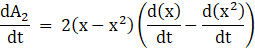
Applying the derivative, we get



We need to find the rate of change of area of the second square with respect to the area of the first square, i.e.,

Substituting values from equation (i) and (iv), we get

By cancelling the like terms we get


Hence the rate of change of the area of the second square with respect to the area of the first square is 2x2-3x+1